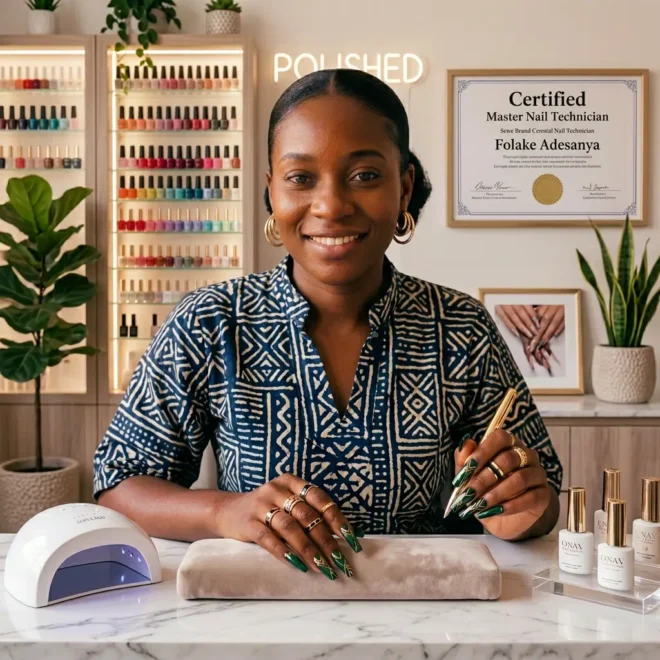


Green nails go wrong fast. On the wrong shape, they can turn muddy, toy-like, or oddly harsh; on green ballerina nails, the right shade can look crisp, expensive, and far more wearable than people expect.
That shape does a lot of heavy lifting. Ballerina nails have the taper of a coffin nail, but the end looks a touch cleaner and more balanced when the sidewalls stay slim and the tip is filed flat, not chunky. Dark greens look sharper there. Pale greens get more structure. Metallic greens stop looking like costume polish and start looking deliberate.
I’ve seen this play out under salon lamps more times than I can count: a bottle-green swatch that looked rich in the jar turns black once top coat hits, a mint that looked soft on the swatch wheel goes chalky on the full nail, an olive that seemed boring suddenly looks chic when it’s used as a 1-millimeter French tip instead of a full-color set. Green is picky. That is why it can be so good.
The best sets don’t try to do six things at once. They pick a lane—milky, glossy, velvet, marble, sheer—and let the ballerina shape frame it.
Why Green Ballerina Nails Work Better Than Most People Expect
Ballerina nails give green polish structure. That’s the short version.
Green has more personality than beige, soft pink, or cherry red, which means it needs a shape that can hold that weight. Almond can make some greens look a bit soft. Square can make deep greens feel blocky. Ballerina sits in the middle, with enough taper to slim the hand and enough flat edge to keep the color from drifting into fairy-costume territory.
Length matters too. The sweet spot for most green ballerina sets lands around 5 to 9 millimeters past the fingertip. Shorter than that, and some detailed designs get cramped. Longer than that, and heavy shades like hunter, moss, or blackened emerald can start to dominate your whole hand, especially if the tech leaves the sidewalls too wide.
A good nail tech knows where the shape can go wrong. If the shoulders are filed too broad, light greens look paddle-shaped. If the tip is too narrow, dark chrome greens can make the nail look pinched. And if the apex sits too low on a medium-long set, rich green shades show every little imbalance.
That is the part people miss. Green isn’t hard to wear because it’s green. It’s hard to wear when the shape, opacity, and finish are fighting each other.
The Shade, Finish, and Accent Choices That Keep Green From Looking Cheap
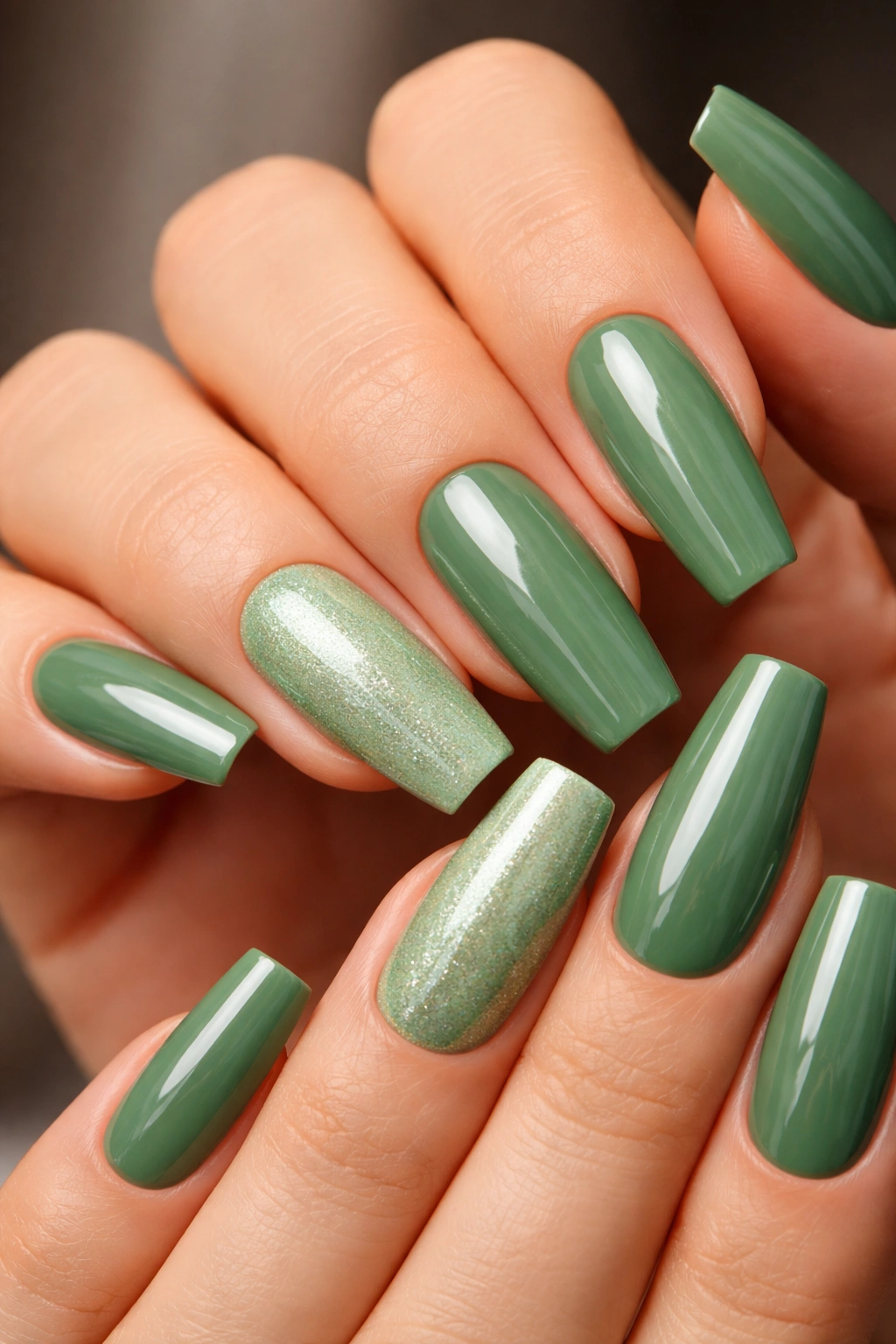
What separates a polished green manicure from one that feels off by day two? Usually, three things: undertone, opacity, and placement.
Match the green to the base tone in your skin
Warm olive and pistachio shades tend to flatter skin with golden or neutral warmth. Cooler celadon, mint, and blue-green shades tend to sit better on cooler or pink-toned skin. If you are neutral, you get the easiest ride—most muted greens will work if the finish is clean.
Pick one statement element
Chrome, cat-eye, marble, glitter flakes, florals, crystals, 3D gel, aura. Any one of those can look sharp. Two can work. Three is where green manicures start getting noisy on a ballerina shape.
Use opacity on purpose
- Opaque crème greens look strongest on a cleanly filed medium length.
- Jelly and sheer greens give a lighter feel and hide grow-out better.
- Matte greens look richer when the surface underneath is perfectly smooth.
- Chrome and velvet finishes need strong side symmetry, or every tiny filing flaw shows.
One more thing. Accent placement matters more than people think. If you want marble, tortoiseshell, crystals, or florals, keep them to 2 to 4 nails max unless the whole set shares the same light visual weight. Green already carries visual punch. It does not need extra noise to make its point.
1. Milky Sage Green Ballerina Nails
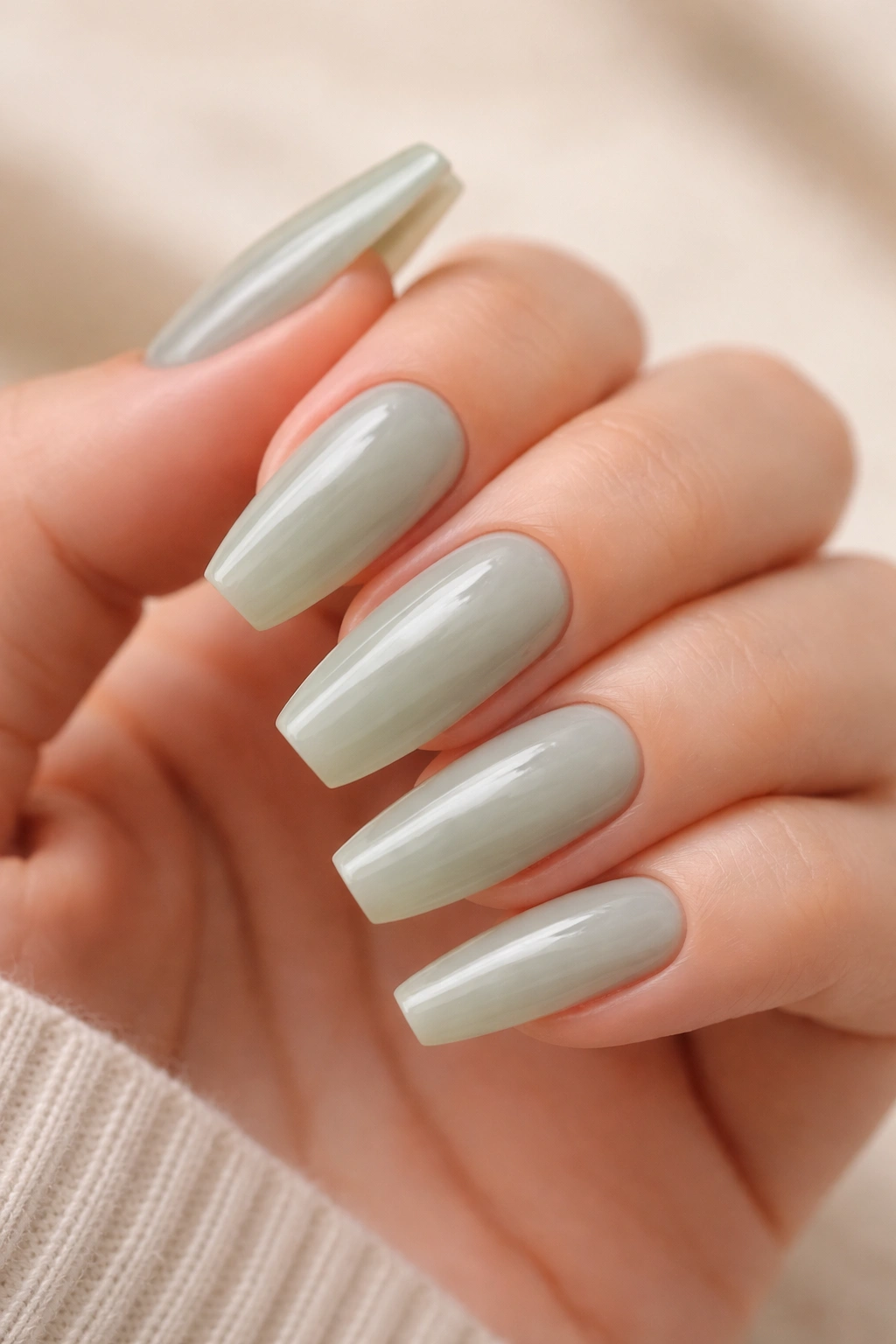
The easiest green set to wear is often the softest one. Milky sage has that creamy, muted cast that makes your nails look polished instead of loud, and on a ballerina shape it smooths out the sharpness of the file line in a good way.
What I like here is the balance. Sage can go gray if the formula is too cool, or baby-food green if the yellow is too strong. The sweet spot sits between those two—think soft eucalyptus with one drop of white mixed in. On a medium ballerina length, that reads clean and expensive.
Why this shade works so well
A milky finish diffuses the color, which means you see the shape first and the pigment second. That’s why this design works in places where neon chartreuse would feel like a lot. You still get green, but the mood is calmer.
A builder-gel base in a sheer pink or pale beige helps too. It keeps the nail bed alive under the color, so the manicure doesn’t flatten out.
Ask your tech for these details
- Two thin coats of semi-sheer sage instead of one heavy opaque coat
- A high-gloss top coat rather than matte
- A length that extends about 6 to 8 millimeters past the fingertip
- Sidewalls filed narrow, with a blunt tip that is flat—not flared
Best move: keep every nail the same shade and skip accent art. This set wins because it looks restrained.
2. Olive Micro-French Tips
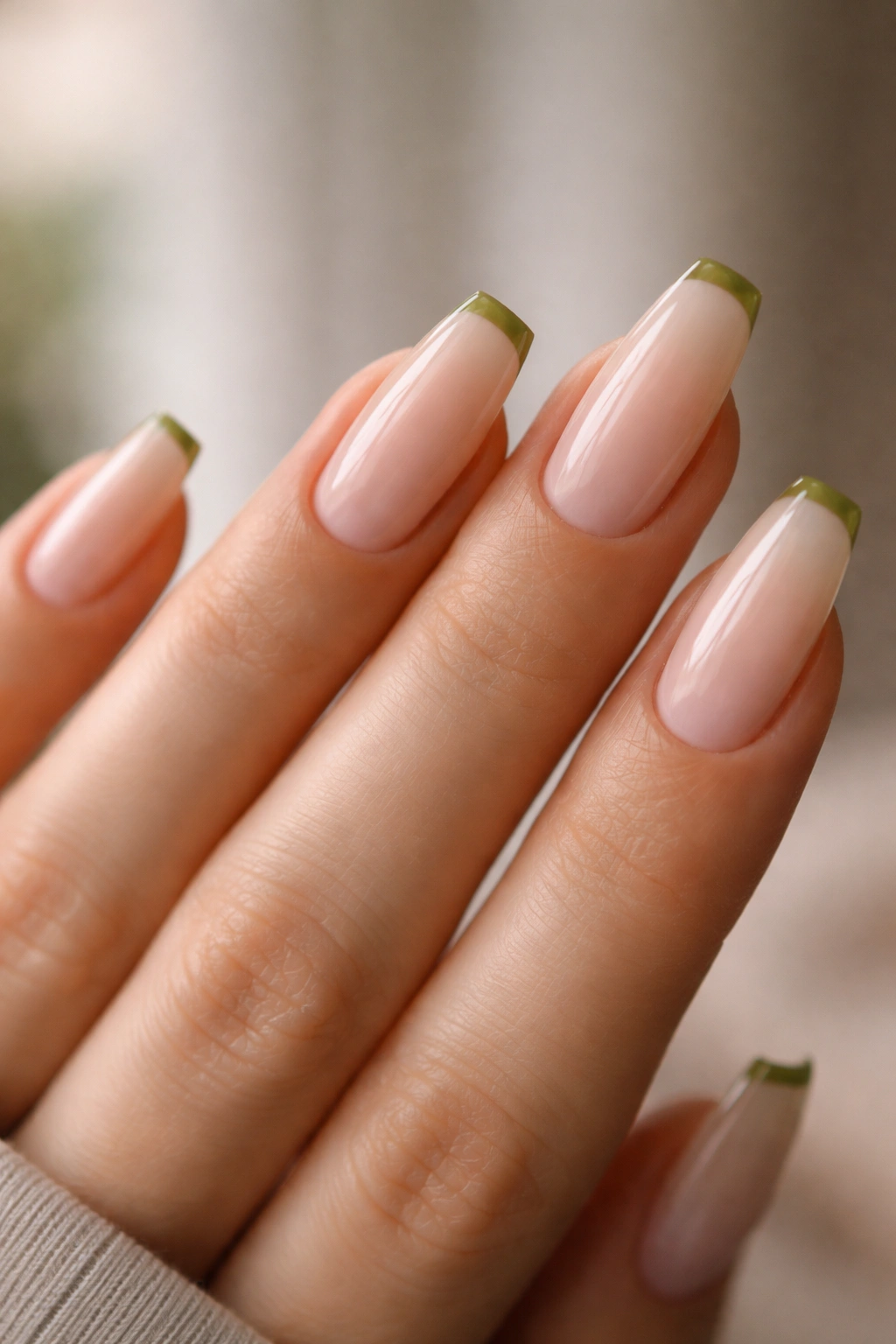
This is the green manicure I suggest to people who swear they do not like green nails.
A full olive set can skew heavy, especially on longer ballerina shapes. An olive micro-French changes the equation. You get that earthy, fashion-y tone right at the edge, while the rest of the nail stays clean with a nude, pink-beige, or soft apricot base.
The line should stay thin—about 1 millimeter, maybe 1.5 if the nails are longer. Once the tip gets thick, olive starts to take over the set and the whole point disappears. You want a sliver of green, not a block of it. On a ballerina shape, that flat edge gives the color a crisp stop, which looks much sharper than the same line on a round nail.
Warm olive works best here. Army green can look dull, and khaki can read flat under top coat. Ask for an olive with a touch of yellow-brown depth, not gray. It pairs especially well with gold rings and tan skin, though neutral skin tones wear it with ease too.
Grow-out is kind to this design. Because the color sits at the tip, the cuticle area stays fresh-looking for longer than a full-color set. If you like manicure ideas that feel polished but not fussy, this one earns its place fast.
3. Emerald Chrome Green Ballerina Nails
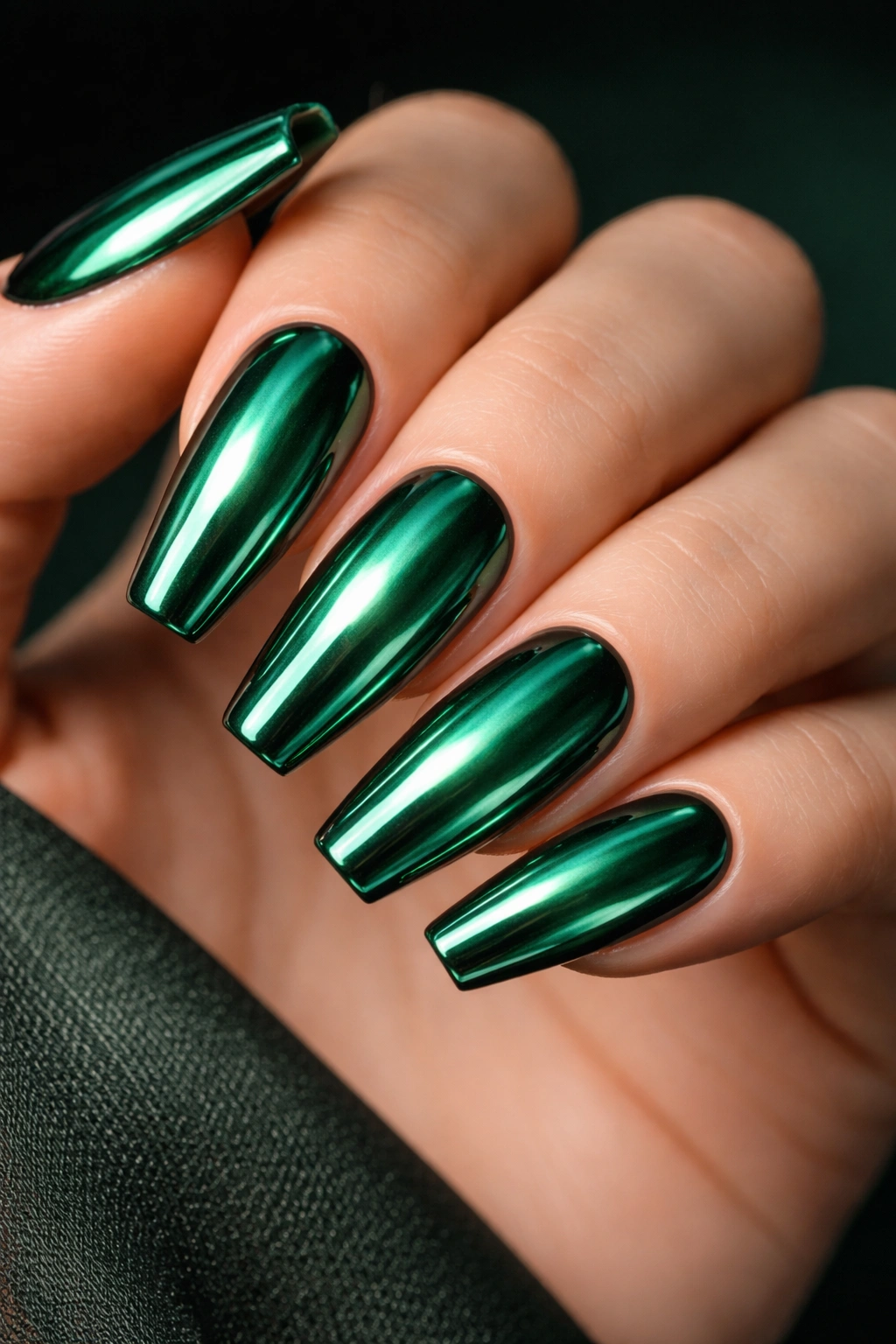
Why does emerald chrome work on ballerina nails when mirror finishes can look harsh on other shapes?
Because the shape gives the reflection somewhere to go. The tapered sidewalls narrow the beam of light, and the flat tip keeps the mirror effect from turning into a rounded blob. On a square nail, chrome can look bulky. On almond, it can look a little slippery. Ballerina nails give chrome a cleaner frame.
Emerald is the right depth for this finish. Bright green chrome can edge into sci-fi costume territory, while dark emerald keeps a jewel tone underneath the shine. I prefer a deep forest or blackened green base under the chrome powder, not black. Black can swallow the green and leave you with a gunmetal look instead.
How to ask for it so you get green, not silver-green
Ask for a green chrome over a dark emerald gel, sealed with a no-wipe top coat before the chrome goes on. If your tech uses a pale base, the color can come out icy and thin.
Keep the length controlled—medium or medium-long works best. And be picky about prep. Chrome shows every ridge, every bulky cuticle line, every uneven file mark.
If you want one flashy green manicure that still looks sleek, this is it. I would not add crystals, decals, or glitter here. The finish has already said enough.
4. Matcha Jelly Ballerina Nails
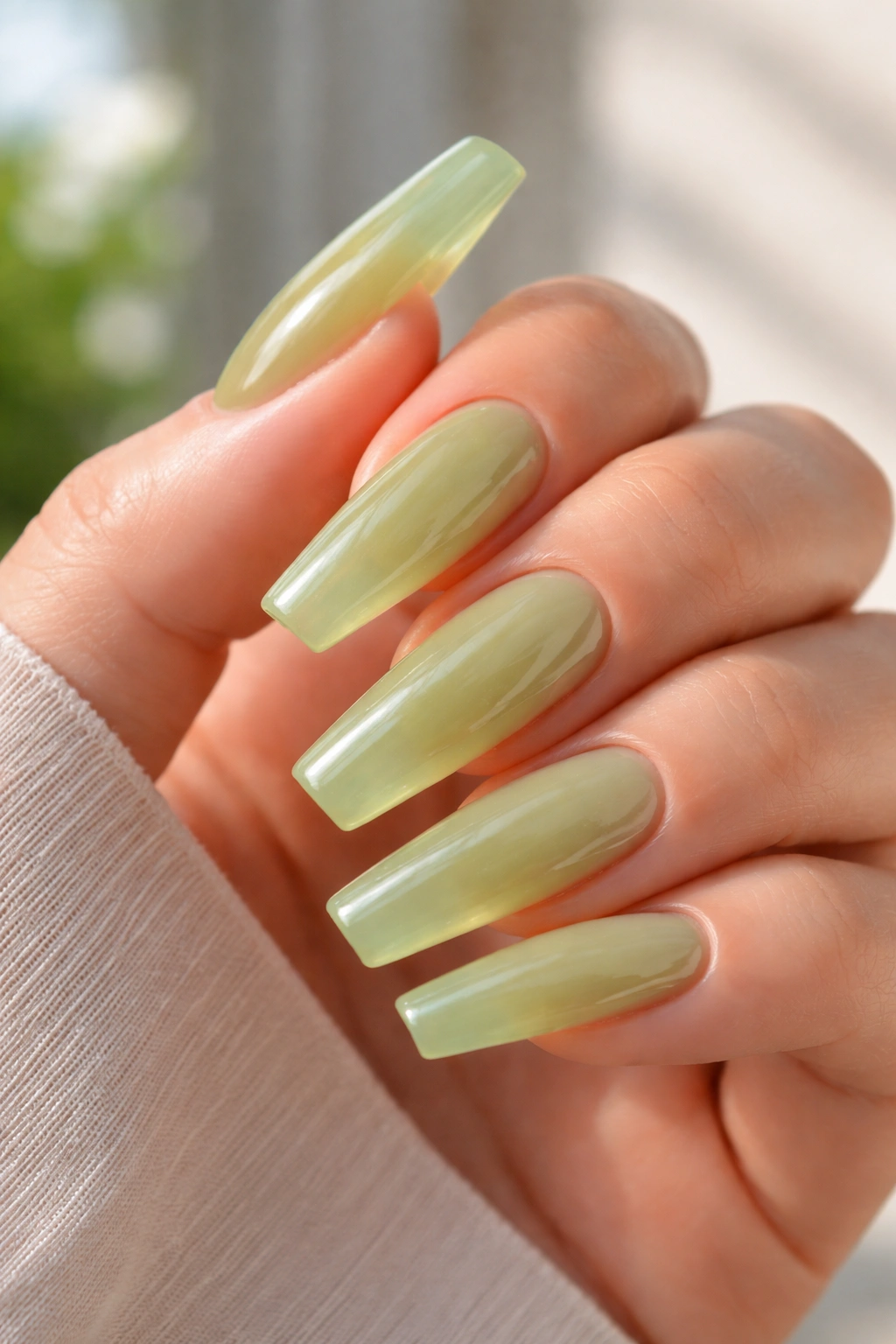
I like this one in daylight. Indoors it looks soft; outside, it picks up that translucent tea-like green that gives jelly nails their charm.
Matcha jelly works because it doesn’t pretend to be opaque. You can still see light moving through the layers, which keeps the set airy even when the shape is longer. That matters on ballerina nails, where solid color can sometimes feel heavy from cuticle to tip.
The trick is building the color in three thin coats, not two thick ones. Thick jelly polish loses its glassy look and starts to wrinkle or cure unevenly near the edges. A sheer nude or milky base underneath gives the green a smoother backdrop and keeps the free edge from looking too stark.
A few details make or break this design:
- Pick a yellow-leaning soft green, not neon lime
- Keep the shape medium-long so the translucency has space to show
- Use a high-gloss top coat only; matte ruins the jelly effect
- Cap the free edge carefully, because chips show faster on sheer finishes
- Skip chunky nail art and let the color do the work
Matcha jelly is one of those designs that looks lighter than it is. If you want green ballerina nails without the visual weight of full crème polish, start here.
5. Forest Green Velvet Cat-Eye
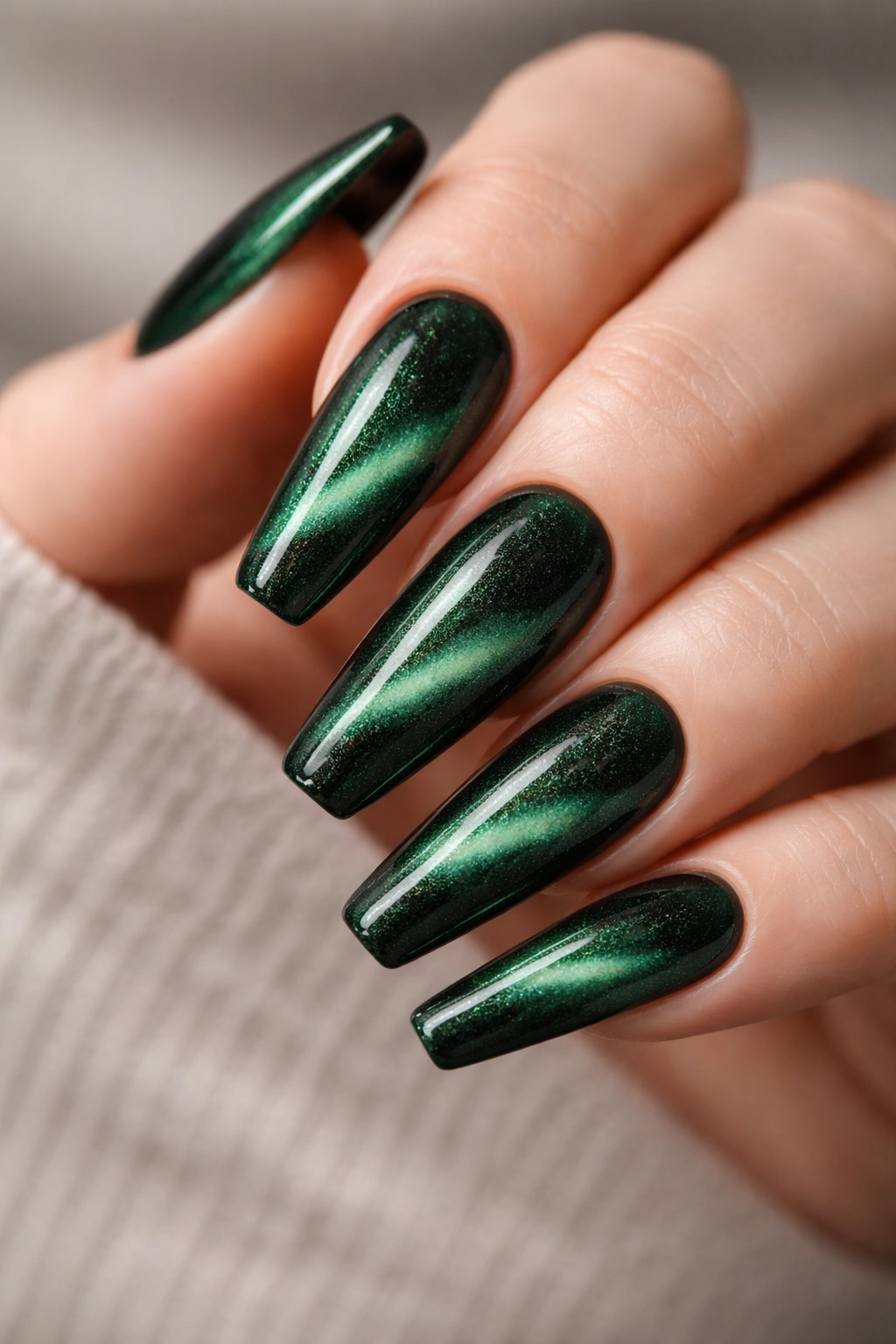
This finish looks almost fabric-like when it’s done well. Not glittery. Not metallic in the usual way. More like the surface is holding light under the polish.
That is why forest green velvet cat-eye suits ballerina nails so well. The magnetic shimmer follows the length of the nail, and the tapered shape makes the highlight look cleaner, almost stretched. Pull the magnet diagonally and you get a softer, smoked effect. Pull it straight down the center and the set turns more dramatic, closer to a gemstone stripe.
Depth matters here. Pale cat-eye greens can look thin on a long ballerina shape. Forest green has enough darkness to ground the magnetic pigment, so the movement stays rich instead of frosty. I like a base that sits between pine and bottle green, with a fine magnetic particle rather than a chunky one. Chunkier sparkle can make the surface look grainy under salon lighting.
There is one catch. Prep has to be sharp. Velvet finishes show lumpy builder gel, uneven apex placement, and crooked sidewalls right away. If the surface is smooth and the magnet placement is consistent, the result is gorgeous. If not, the nails look busy from two feet away.
Flash-cure each nail after magnetizing it for 5 to 10 seconds, then do a full cure once the whole hand is set. The pattern shifts if you wait too long.
6. Pistachio and Cream Color-Block
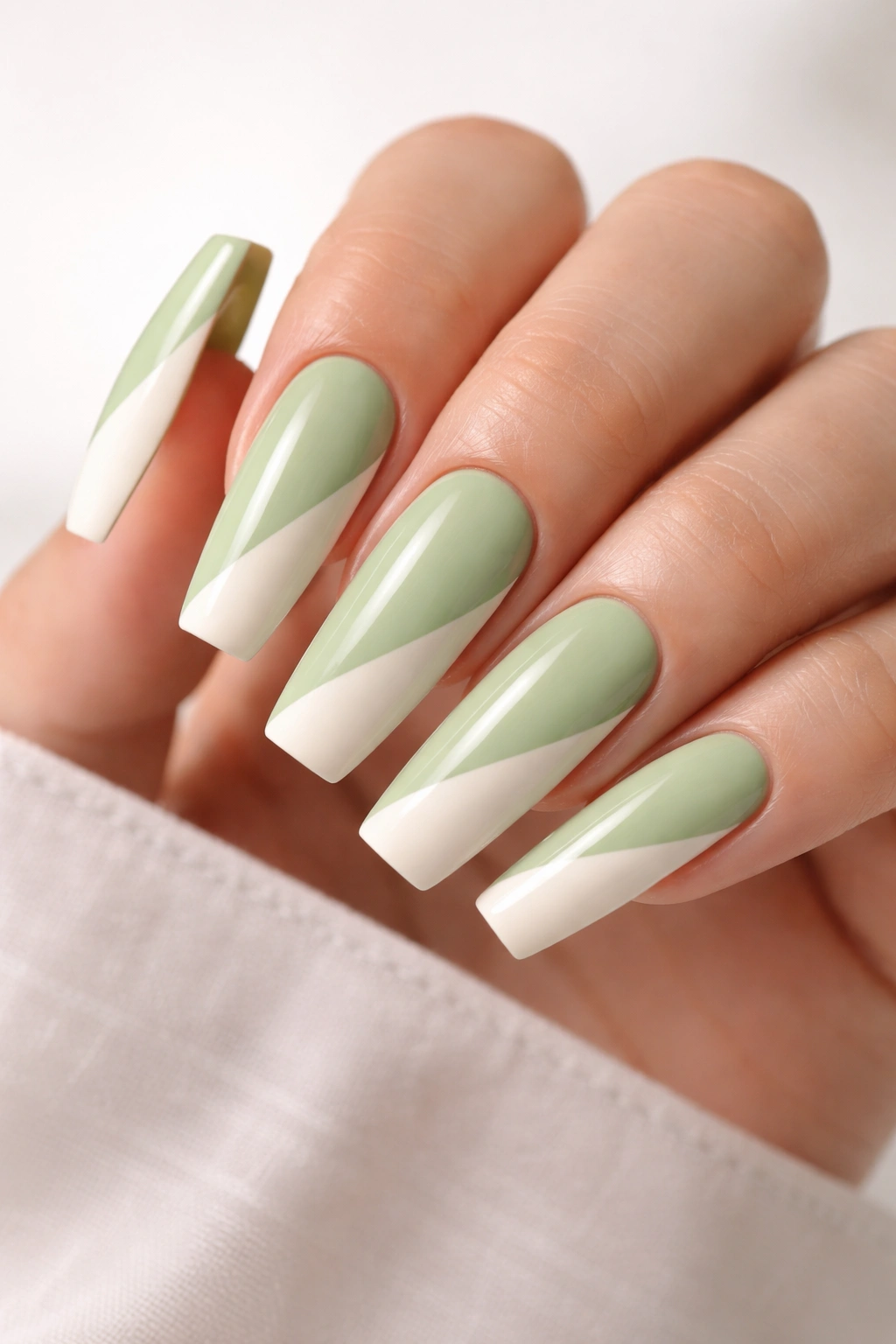
Unlike a full pastel green set, pistachio with cream color-blocking has contrast built in. That contrast is what keeps it from looking chalky.
Pistachio alone can wash out on some skin tones, especially when the nail plate is wide or the ballerina shape is kept short. Add a warm cream panel, a diagonal split, or a half-moon detail, and the green suddenly gets more definition. You’re not relying on one soft color to carry the whole design anymore.
Who does this suit best? Anyone who likes lighter nails but finds baby pink boring. It also works well if your hands run a little red, because cream softens the coolness that minty pastels can exaggerate.
A diagonal side-split is my favorite layout on this shape. It follows the taper and makes the nail look longer. Center-blocking can work too, though it needs cleaner symmetry to look polished. Keep the split line crisp with a liner brush, and do not let the cream drift yellow.
If I were ordering this set, I’d ask for 6 pistachio nails and 4 accent nails with cream-and-green blocking, all in glossy finish. More accents than that starts to feel overworked.
7. Jade Marble with Thin Gold Veins
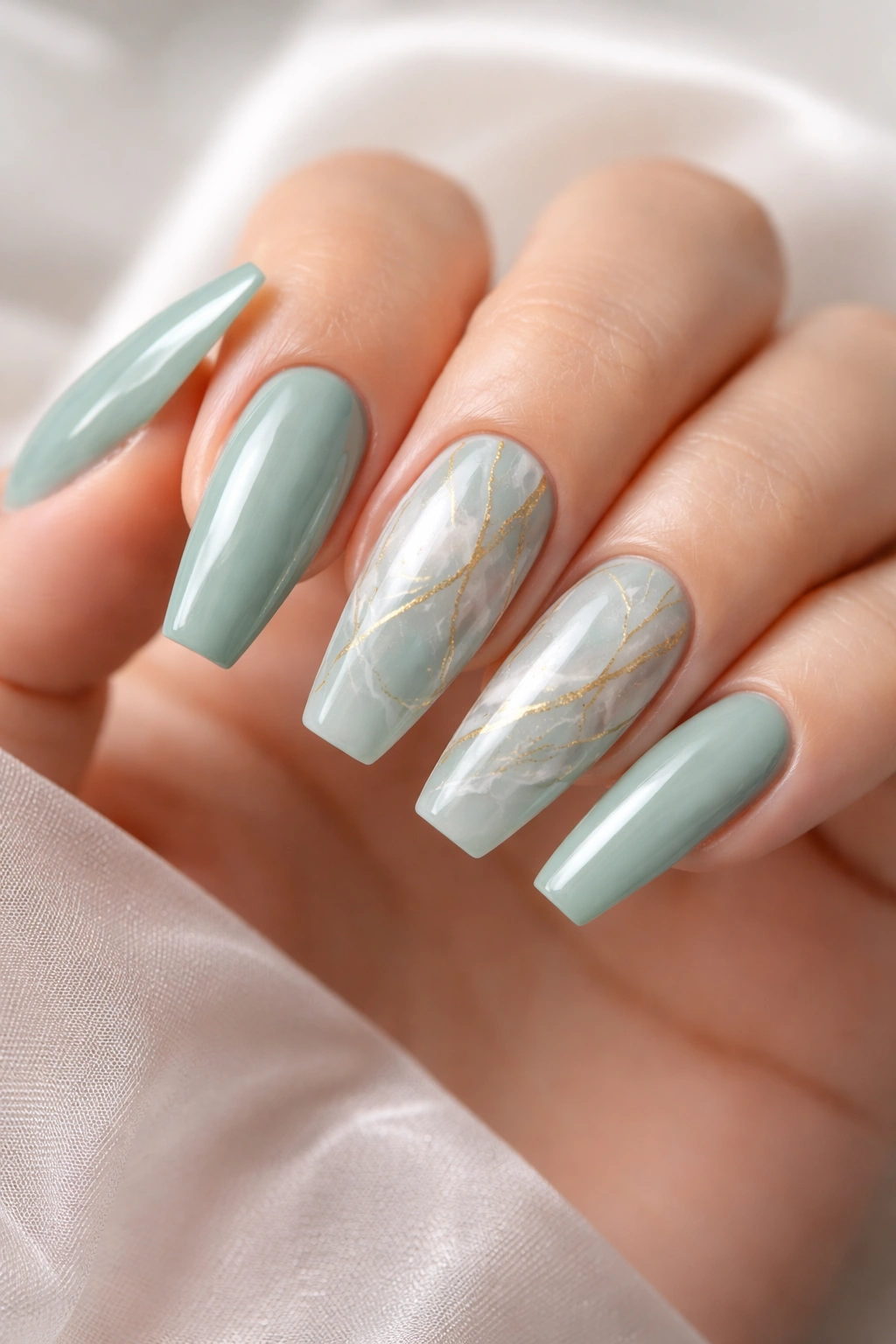
Marble can get messy fast. The version that keeps its cool uses soft jade tones, plenty of negative breathing room, and gold lines that stay thread-thin.
Jade marble looks best when the green sits in translucent layers instead of hard blobs. A milky base gives the design that stone-like depth, and a little white feathering keeps it from turning murky. The gold is not there to shout. It is there to suggest the crack lines you’d see in polished stone.
The trick that keeps marble from looking chaotic
Do not marble every nail.
Two accent nails per hand is enough for most sets. Four can work if the rest are a matching solid jade or creamy sage, but once all ten nails are fully marbled, the design loses its elegance and starts looking crowded.
Best details for this set
- Use a milky jade base, not a bright green crème
- Keep the marbling soft and slightly blurred at the edges
- Apply gold liner gel in hair-thin strokes only where the eye needs movement
- Pair the accents with a solid color pulled from the marble itself
- Stay glossy; matte can flatten the depth
Best move: place the marble on the middle and ring fingers, where the longer nail bed gives the design room to breathe.
8. Matte Moss with Glossy Swirls
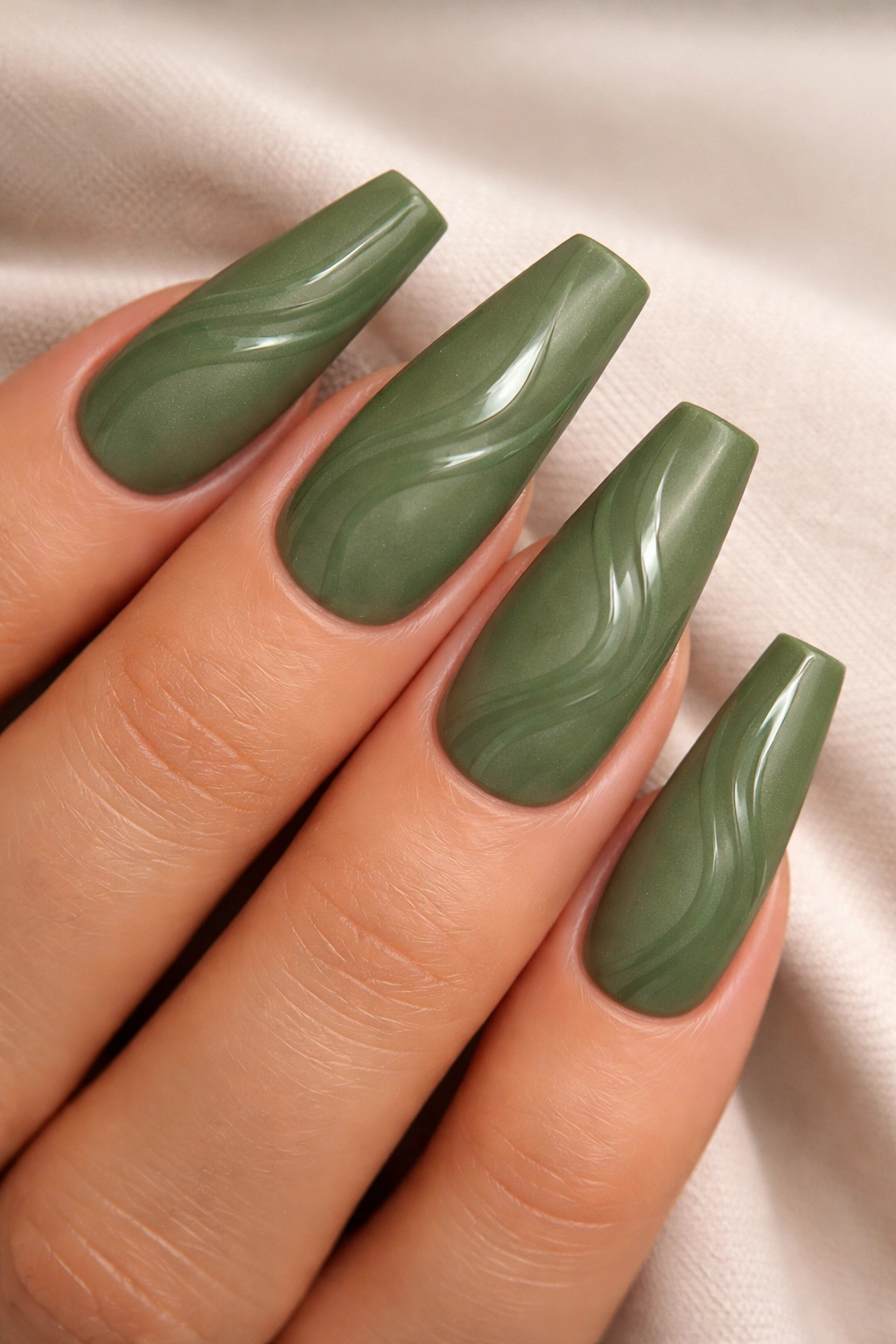
If rhinestones keep feeling like too much, matte moss with glossy swirls is the smarter move.
This set gets its interest from texture, not extra stuff stuck on top. You start with a rich moss green base, seal it with matte top coat, then add raised or flat glossy swirls over the same color family. The pattern shows because light hits the surfaces differently, not because the design is louder.
That tone-on-tone effect looks strong on ballerina nails because the flat tip and tapered sides already give you structure. You do not need a contrasting shade. In truth, contrast can cheapen this look. Black swirls over moss? Too hard. White swirls? Too graphic. Keep the gloss pattern in the same moss or one shade darker.
Moss itself is underrated. It has more earth in it than emerald and more softness than hunter green, which makes it easier to wear in a matte finish. On skin with warm or neutral undertones, it looks grounded. On cooler skin, it can still work if the green has enough gray to calm it down.
Matte top coat can pick up makeup, self-tanner, and hand cream residue. A quick wipe with 70% isopropyl alcohol brings the surface back. Small maintenance step. Big difference.
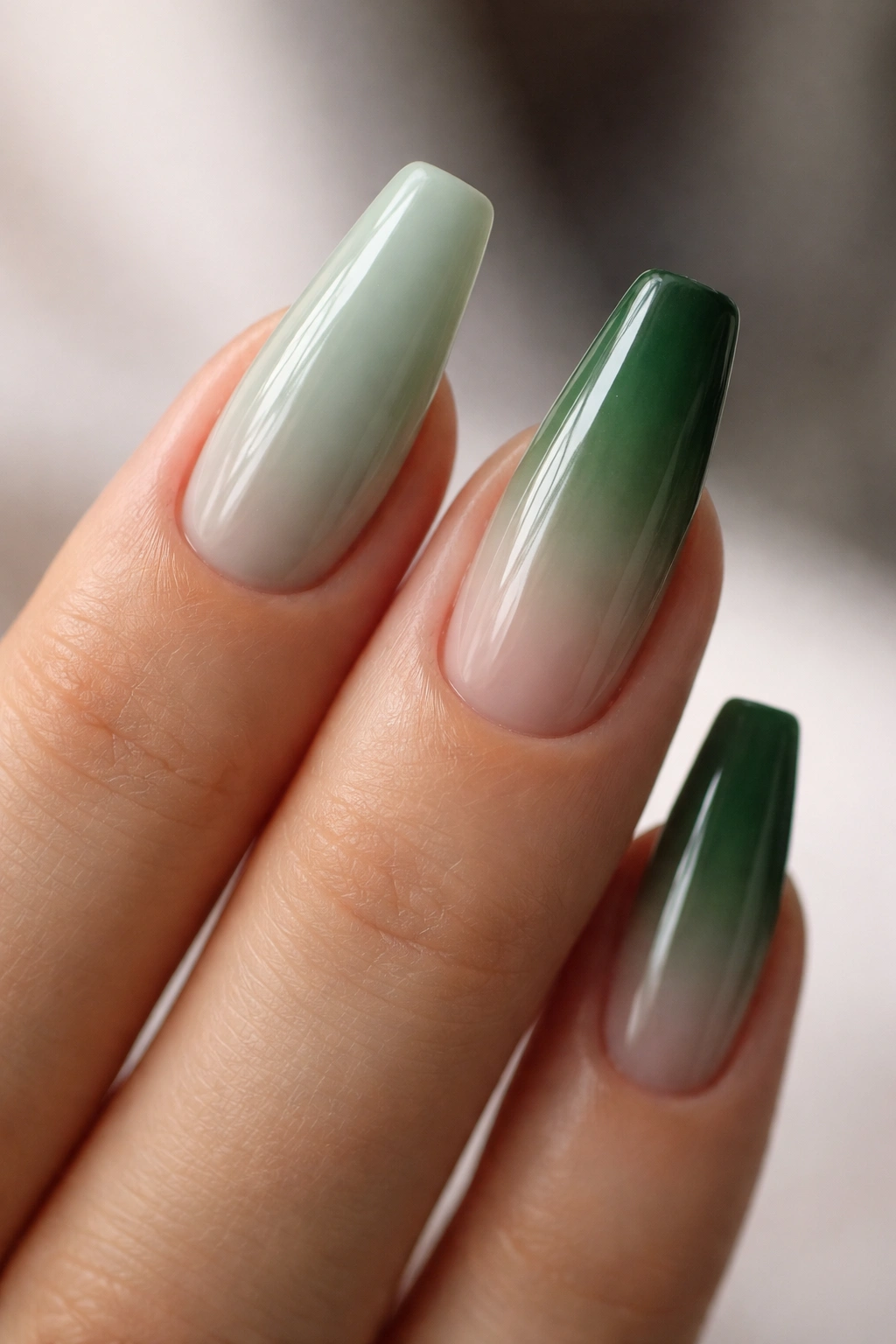
9. Hunter Green Ombré Fade
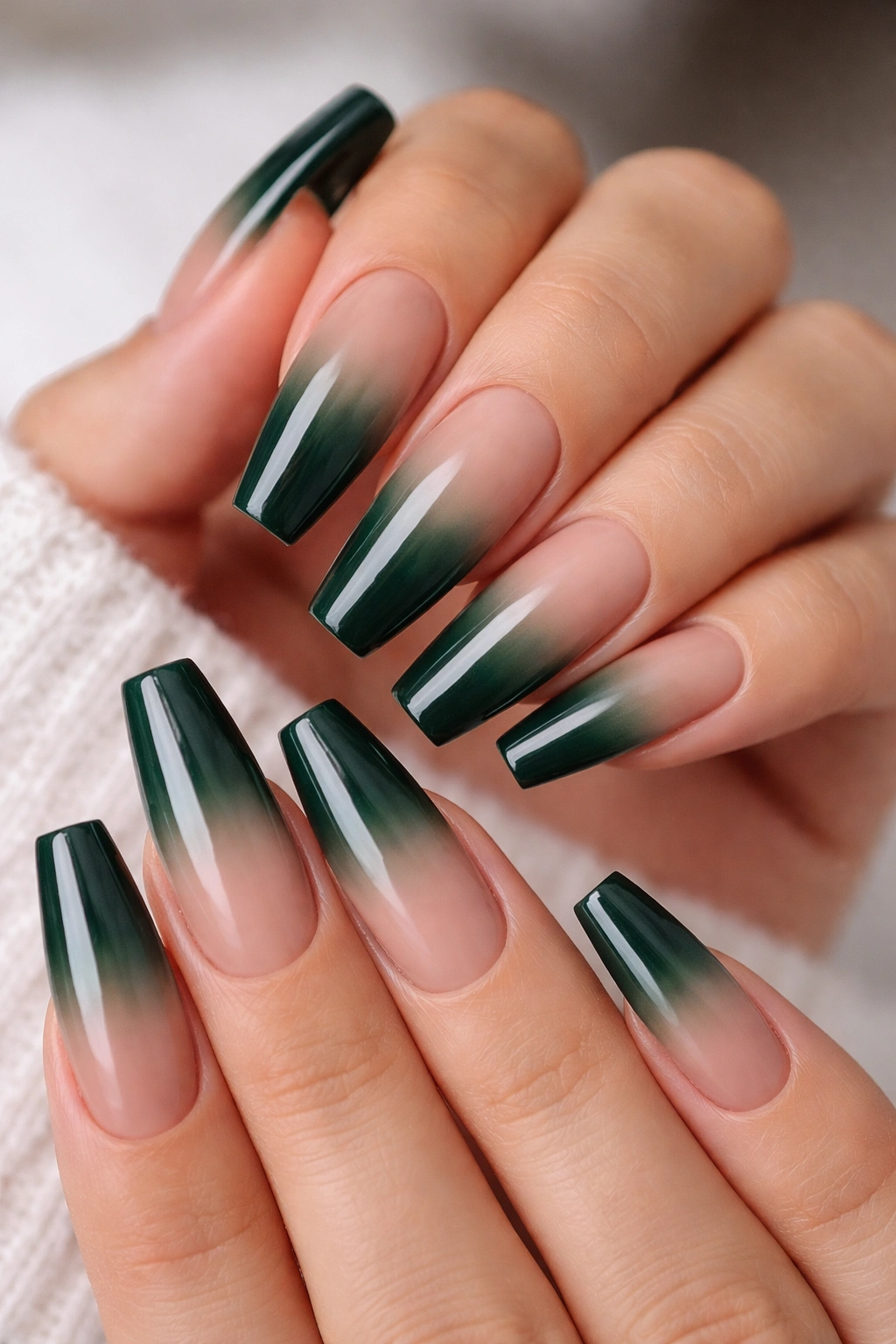
Why choose a dark solid green when a fade gives you the same depth with less visual weight?
That’s the whole appeal of a hunter green ombré on ballerina nails. You get the richness of a dark shade concentrated at the tip or outer edge, while the base stays sheer nude, beige-pink, or milky taupe. The shape still feels long and sleek, but the manicure doesn’t read as one solid slab of color.
A tip-heavy fade works best on this shape. Start the hunter green at the flat edge, then blend it downward until the middle third of the nail softens into the base. That keeps the darkest part where ballerina nails already have structure. A full vertical fade can work too, though it needs a softer hand to avoid striping.
Good placement options
- Classic tip fade from hunter green into nude
- Diagonal ombré from one sidewall toward the center
- Reverse fade with a dark cuticle shadow on accent nails only
Airbrush gives the smoothest result, though a sponge can work if the tech blends in thin layers and cleans the sidewalls between passes. Dark green shows patchiness fast. If you see harsh dots before top coat, ask for another blend pass before curing.
This design wears well between fills because the cuticle area stays lighter. That alone makes it appealing if you like deeper colors but hate watching grow-out after day six.
10. Mint Green Aura Nails
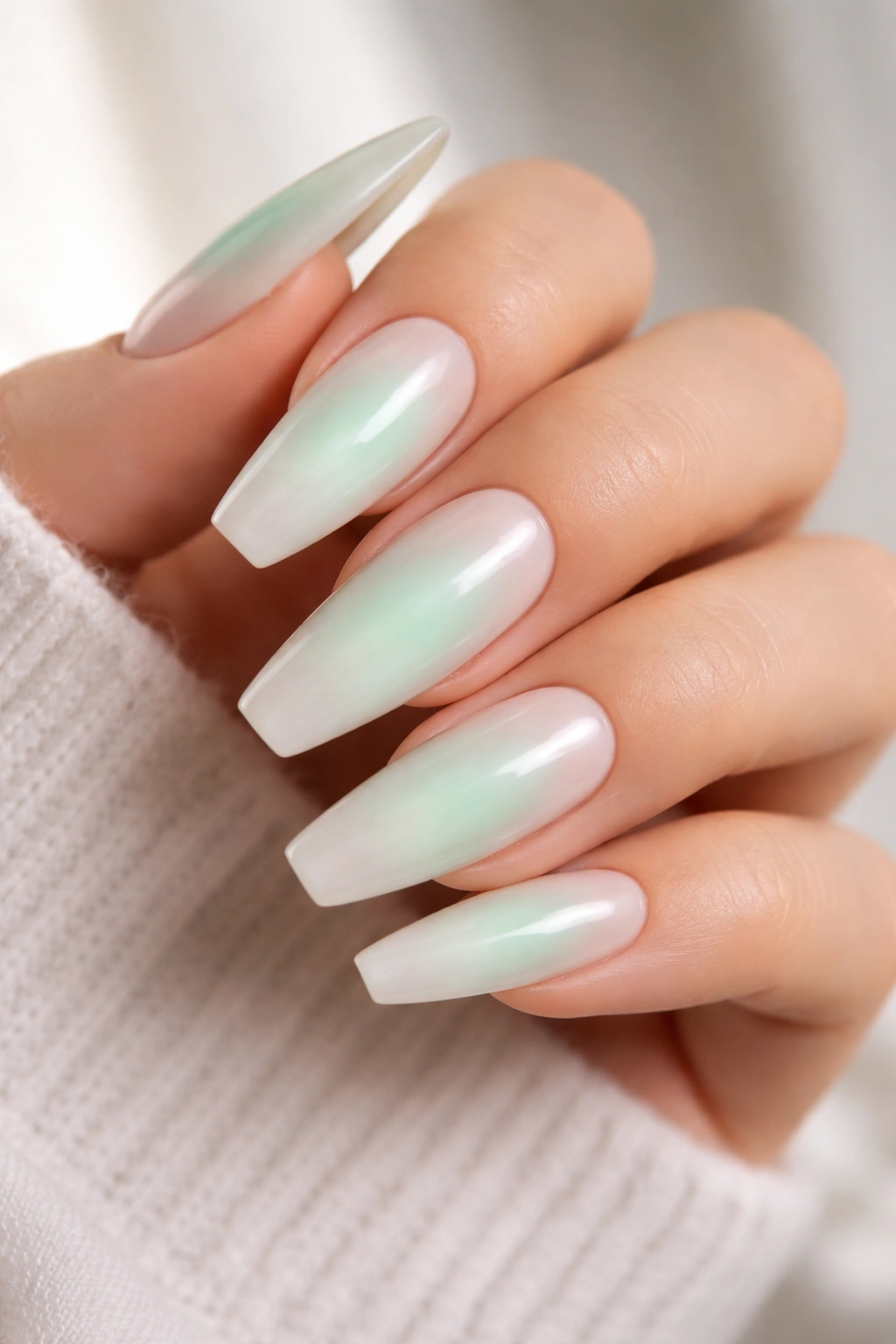
I once thought aura nails were too soft for a ballerina shape. Then I saw a mint halo sitting on a milky nude base with a clean taper and a flat tip, and the whole idea clicked.
The trick is scale. The aura should sit in the center of the nail and take up about 40 to 50 percent of the surface, fading outward before it reaches the sidewalls. If the green cloud grows too large, the design loses that floating effect and starts looking like a blurry full-color set.
Mint works because it brings lightness to a shape that can handle stronger geometry. On a long stiletto, mint aura can look sugary. On ballerina, it gets a bit more edge. I like it over a base with a touch of pink or cream instead of stark white, which can make the green look icy.
A few guideposts help:
- Use airbrush or soft pigment blending for the halo, not hard hand-painted circles
- Keep the outer edge diffused, with no visible ring
- Add chrome or gems only on 1 or 2 nails, if at all
- Medium length looks cleaner than extra-long for this design
Mint aura nails are softer than emerald chrome, softer than moss matte, softer than tortoiseshell. That softness is the whole point.
11. Blackened Green Tortoiseshell Accents
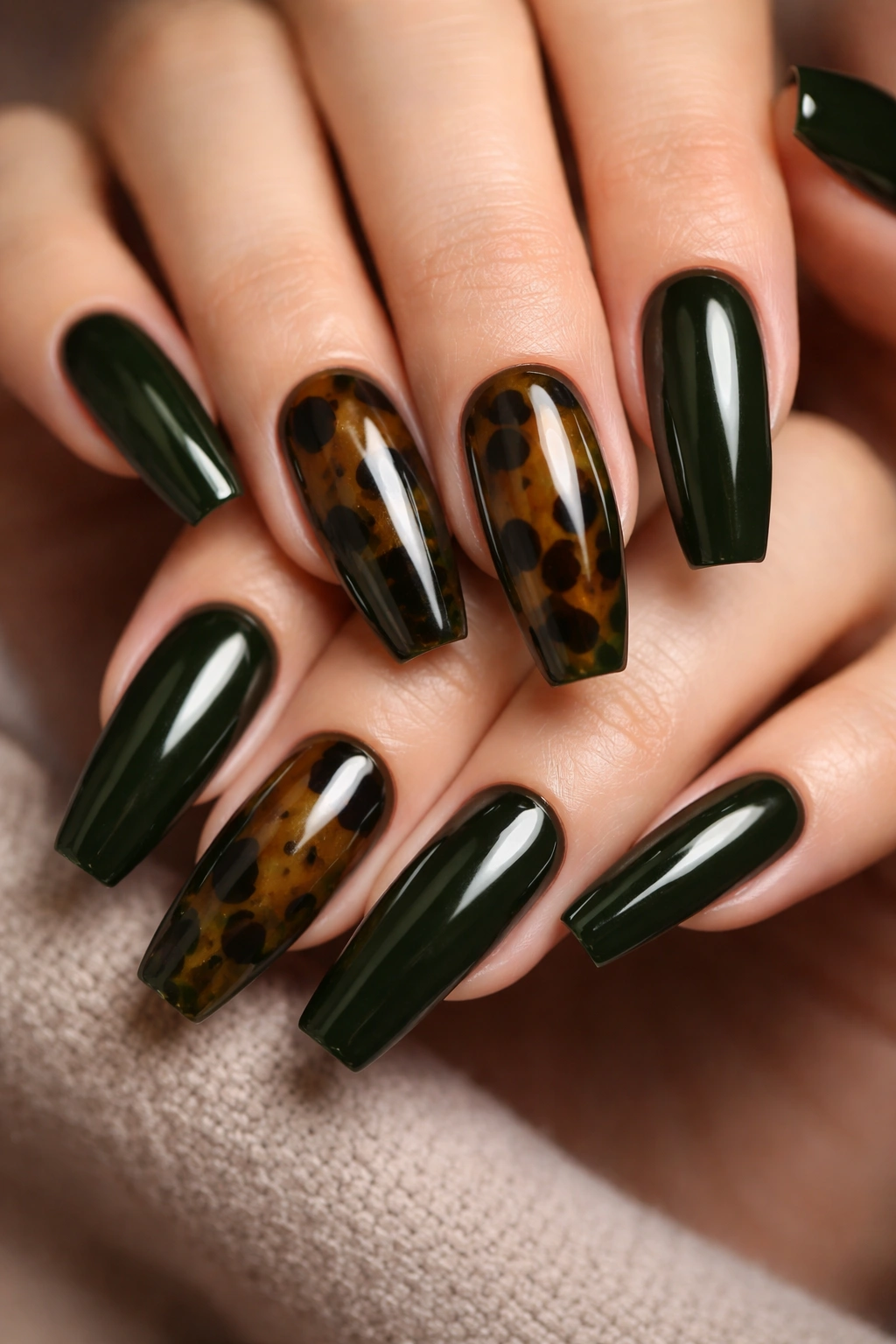
This one has attitude. It also goes bad fast if the colors are wrong.
A good green tortoiseshell set does not lean orange and it does not cover every nail. The version that looks polished uses a blackened olive or bottle-green tint layered with smoky brown and near-black spots on 2 accent nails per hand, then pairs them with solid dark green on the rest. That mix gives you texture without chaos.
The jelly layers matter. Tortoiseshell should look suspended, not painted on like leopard print. A translucent olive wash first, then scattered patches of brown-black, then another sheer layer over the top. That sandwiching creates depth. Without it, the pattern sits flat on the surface and the manicure loses its richness.
Ballerina nails help because the broad tip gives the pattern enough room to form. On very short rounds, tortoiseshell can look cramped. On a medium ballerina, the spots can breathe and the surrounding solid nails keep the whole set anchored.
Gold jewelry loves this manicure. Cream knitwear loves it too. It has a slightly moody, editorial feel without needing chrome or crystals. If you like nail art that looks grown-up and a bit sharp, this design earns a second look.
12. Chartreuse Outline French Tips
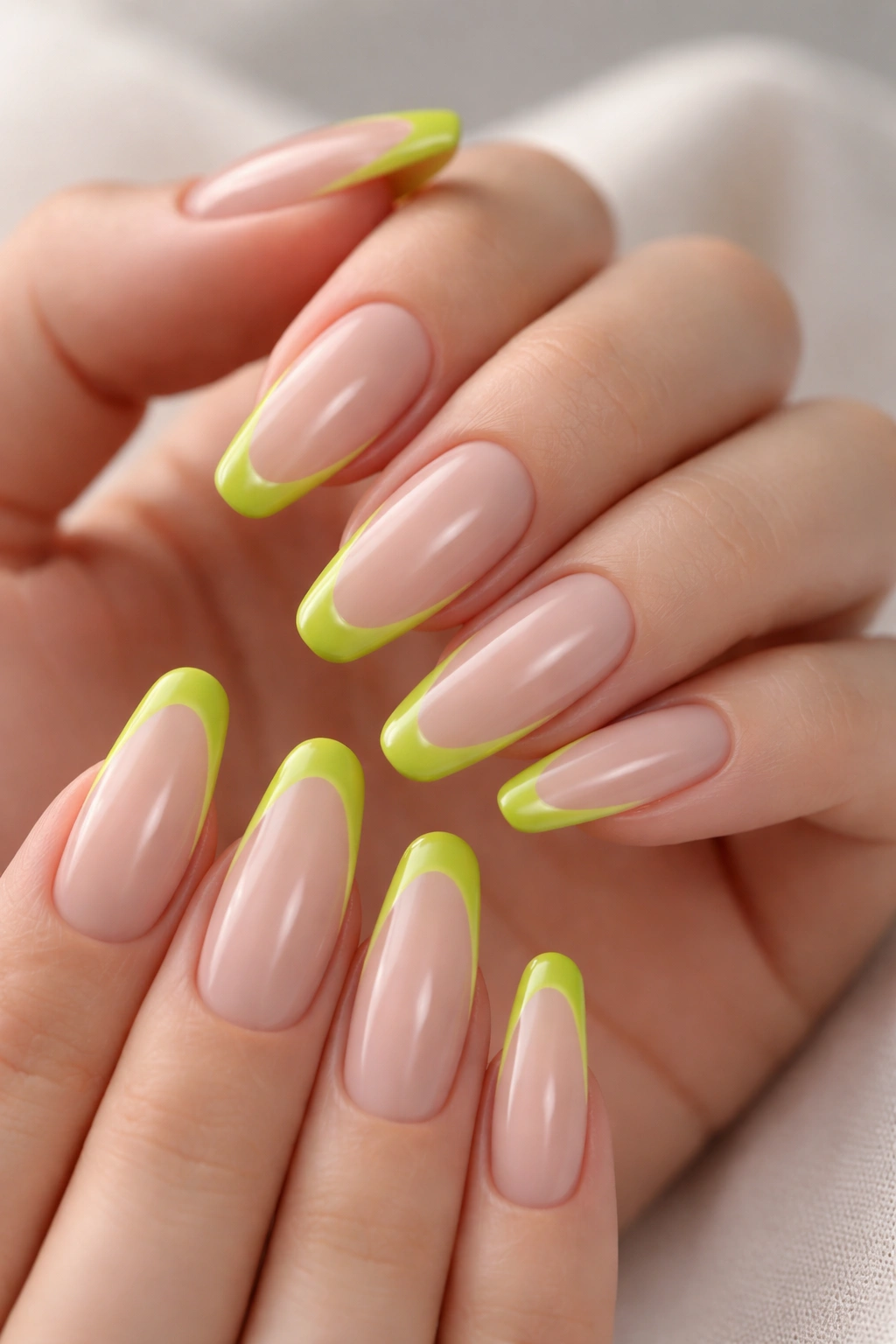
Unlike full chartreuse polish, which can be hard to pull off on ten nails, chartreuse outline French keeps the color on a leash.
Instead of painting the whole tip, the tech traces a thin line along the sidewalls and across the flat edge, almost like framing the nail. On a ballerina shape, that outline highlights the geometry in a way most shades cannot. Chartreuse has enough bite to show the shape instantly.
Who should pick this? Anyone who likes fashion-forward color but hates bulky-looking manicures. It’s also a strong choice if your nails are on the shorter side of ballerina, because the outline adds shape without swallowing space.
Precision is everything here. The line wants to stay 0.5 to 1 millimeter thick, smooth at the corners, and symmetrical on both sides. If it widens near one shoulder, the nail will look crooked even if the file work is fine. I prefer a soft nude base rather than sheer pink for this one; chartreuse looks cleaner against neutral beige.
My recommendation: keep all ten nails in the same outline design, no accent art, no glitter topper. Chartreuse already gives enough tension. More decoration weakens the graphic effect.
13. Sea Glass Sheer Green Ballerina Nails
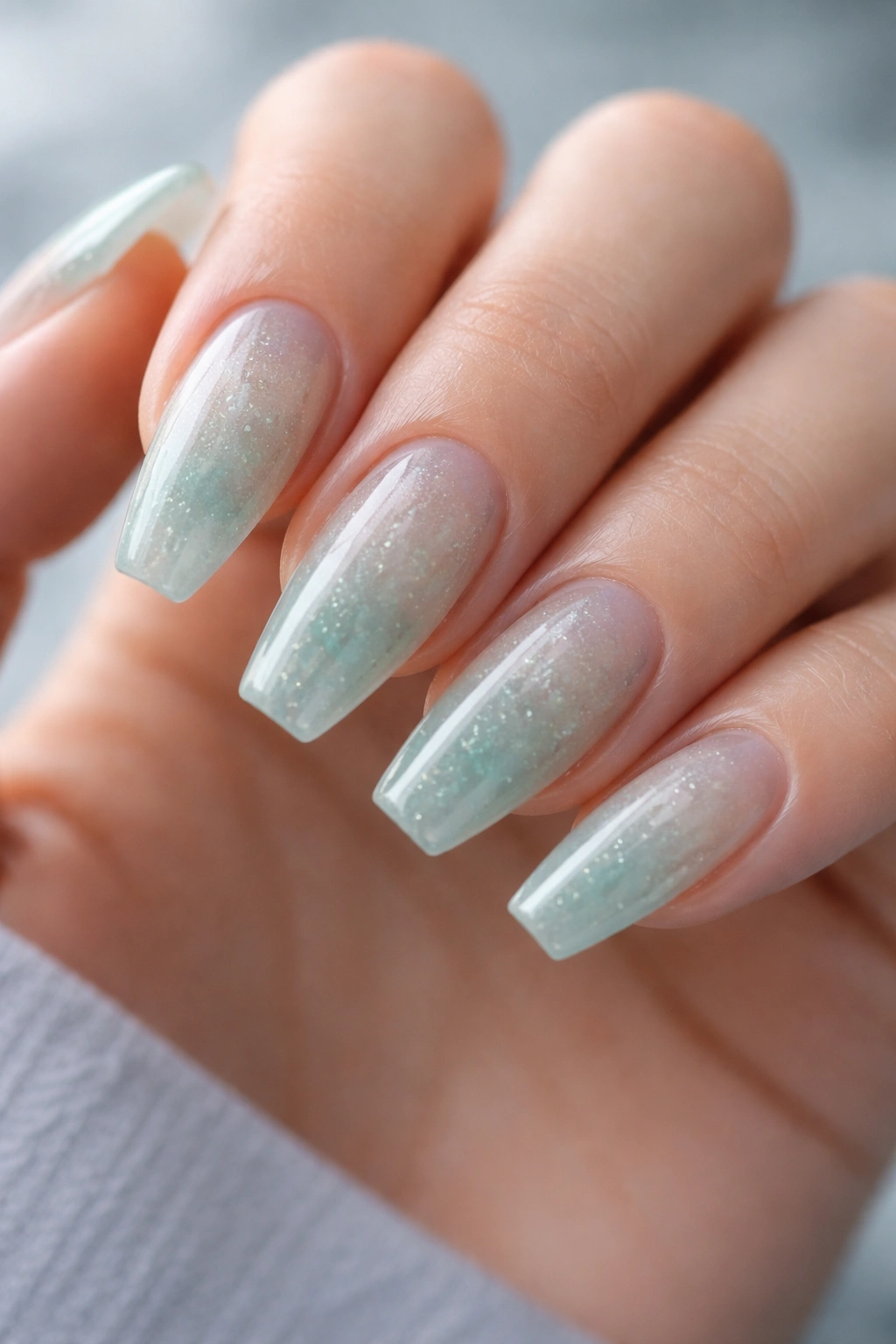
If milky sage feels too creamy and jelly matcha feels too playful, sea glass green sits in the middle.
This look uses a sheer blue-green or soft aqua-green base with tiny reflective flakes or a whisper of pearl suspended inside. You still get translucency, though the finish has a faint misty texture that makes the manicure feel cooler and more atmospheric than a straight jelly. On a ballerina shape, that slight frostiness looks clean instead of beach-costume.
Why this finish flatters shorter lengths
Shorter ballerina nails can struggle with heavy dark colors because the shape has less room to taper. Sea glass fixes that. The sheer finish keeps the nail from feeling stubby, and the flecks catch light along the flat edge, which helps the shape stand out.
Details that make it work
- Keep the length at 3 to 5 millimeters past the fingertip
- Use fine shimmer or micro flake, not chunky glitter
- Choose a blue-green that stays muted, closer to worn bottle glass than tropical teal
- Seal with a smooth glossy top coat so the surface feels glassy, not gritty
Best move: wear this on all ten nails with no art at all. The finish gives enough texture on its own.
14. Celadon Floral Minimalist Nails
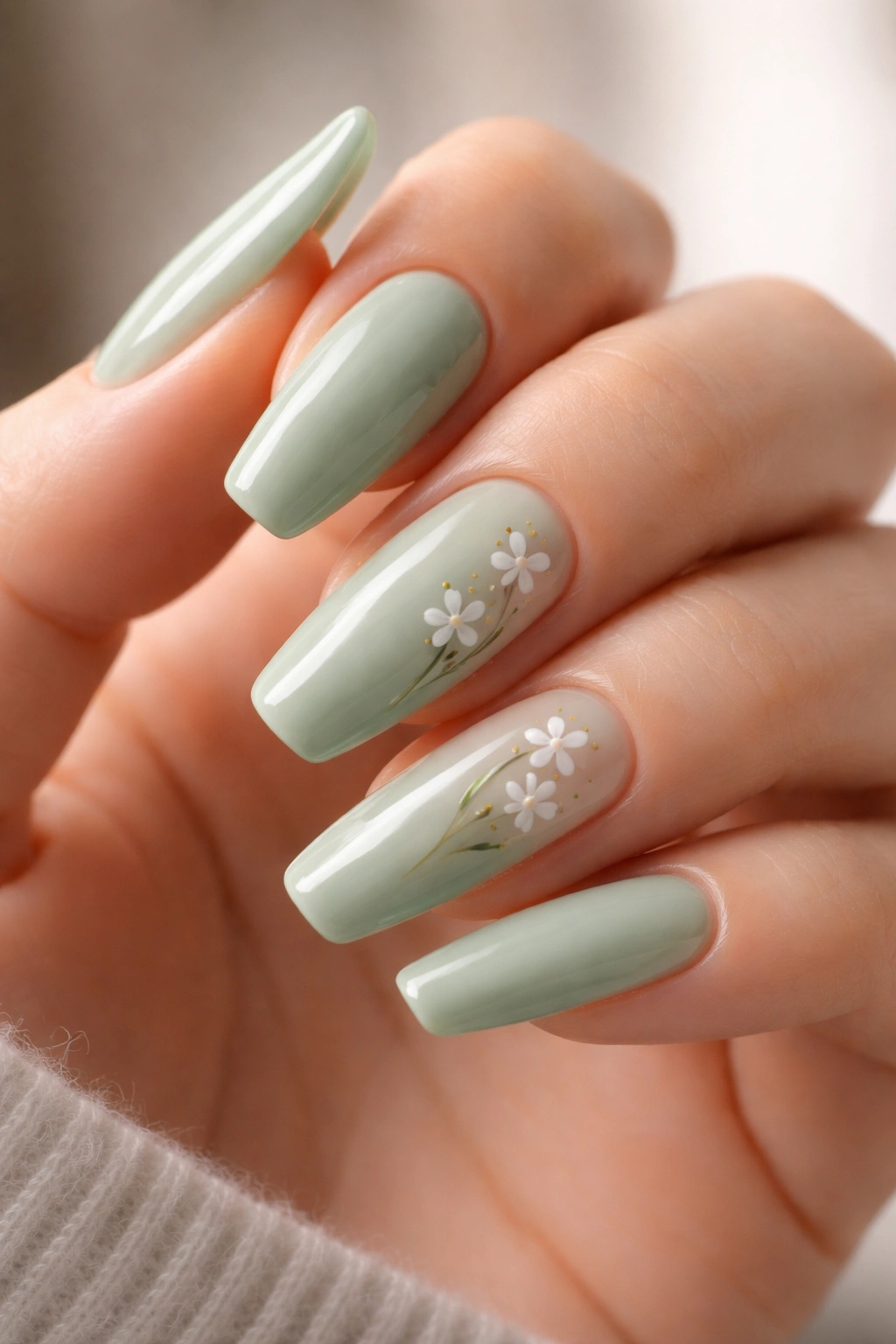
Tiny florals on celadon can look chic. Big florals on celadon can look like a phone case. Scale is the difference.
Celadon is one of the most wearable greens because it sits low in saturation. It has gray, cream, and green all mixed together, so it doesn’t shout. That makes it a smart background for minimal flower art on ballerina nails, where a bit of detail can look refined if it’s placed with restraint.
The flowers should stay small—3 to 5 tiny petals, maybe on two nails, with thin olive stems or a dot center. I like them near one corner or drifting up from the sidewall instead of parked dead-center on every nail. Leave space. That empty space is what keeps the set from tipping into craft-store cute.
A glossy celadon base works best. Matte can make the floral details look dusty, and chrome makes the whole thing lose its quiet charm. White petals are clean. Soft cream also works. Bright yellow centers? Skip them.
This design is good when you want green nails that still feel gentle. Not timid—gentle. There’s a difference, and celadon gets it right.
15. Bottle Green with Tiny Crystal Cuticles
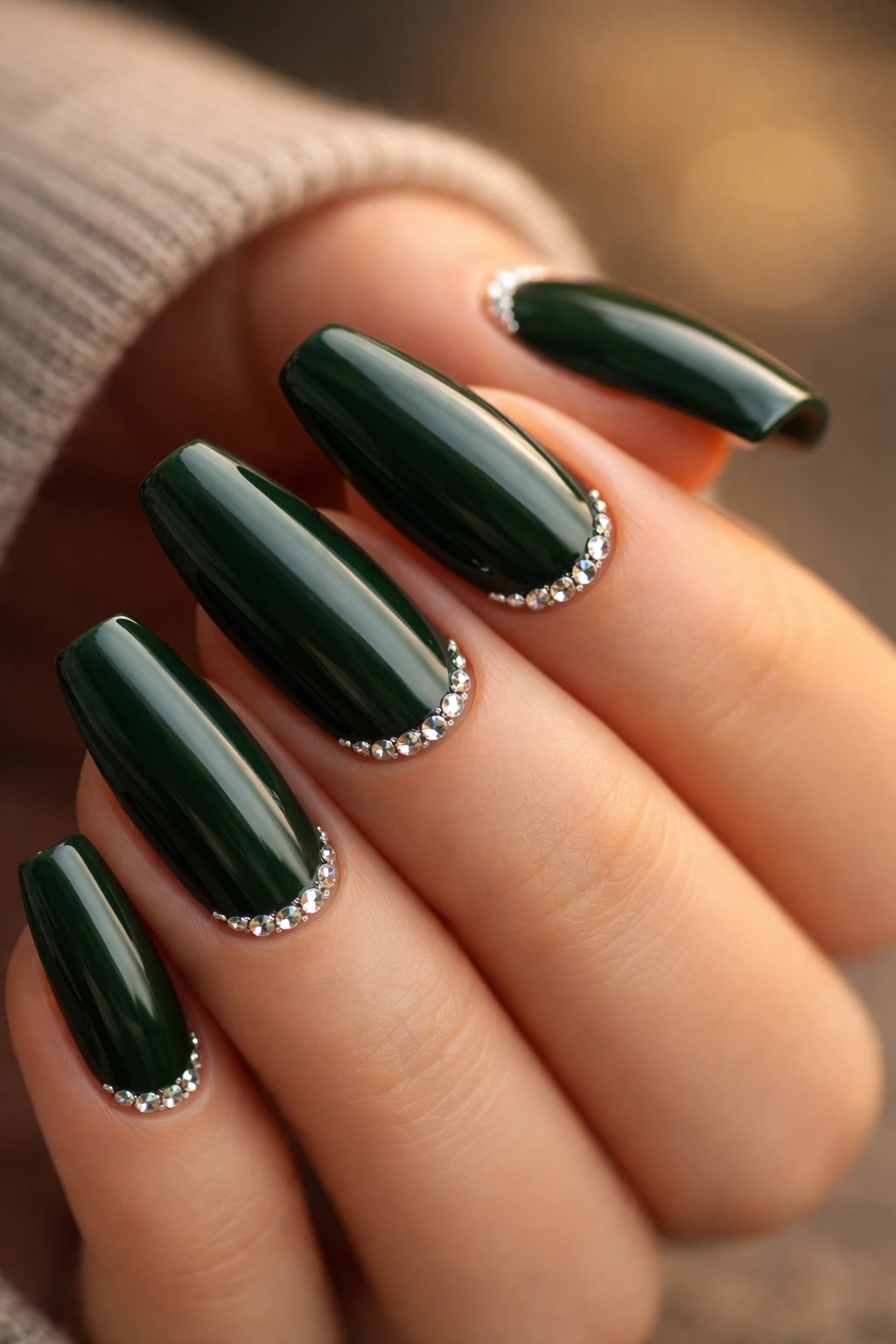
Deep bottle green already carries enough drama. The crystal detail should whisper.
That’s why I like micro crystals at the cuticle instead of full gem clusters. One SS3 or SS5 stone placed at the base of each nail, or three tiny stones on the ring fingers only, gives the manicure a point of light without dragging it into pageant territory. Ballerina nails help here because the shape is sharp enough to balance the sparkle.
Bottle green is richer than plain forest and less blue than emerald. It has that almost-ink quality that makes glossy polish look deep, especially under low evening light. Pair it with tiny clear crystals and the contrast feels clean. Pair it with oversized gems and the whole set gets heavy fast.
Placement matters. Set the crystal a hair above the cuticle line so it doesn’t lift as quickly, and seal around the base with gel rather than flooding over the top, which can dull the shine. If you use stones on every nail, keep them tiny. If you want a little more decoration, limit the fuller cluster to one accent nail per hand.
This is the set I’d pick for a formal event, a dinner, or any time you want green nails that feel dressed up without looking overworked.
Picking the One You’ll Still Like After a Week
The best design on paper is not always the best one on your hands. Nail length, skin tone, your usual jewelry, how rough you are on your hands, even the shape of your nail beds—all of that changes what looks right.
If you want the safest starting point, go with milky sage, olive micro-French, or hunter green ombré. They wear well, they grow out kindly, and they do not demand perfect lighting to look good. If you want more drama, emerald chrome and forest velvet cat-eye are stronger picks, though they need cleaner prep and more careful shaping.
Bring two reference photos to the salon, not eight. One should show the shade and finish you want. The other should show the shape and length. That keeps the appointment focused and saves you from the classic problem where the color is right but the file shape is wrong—or the opposite, which is somehow more annoying.
Final Thoughts
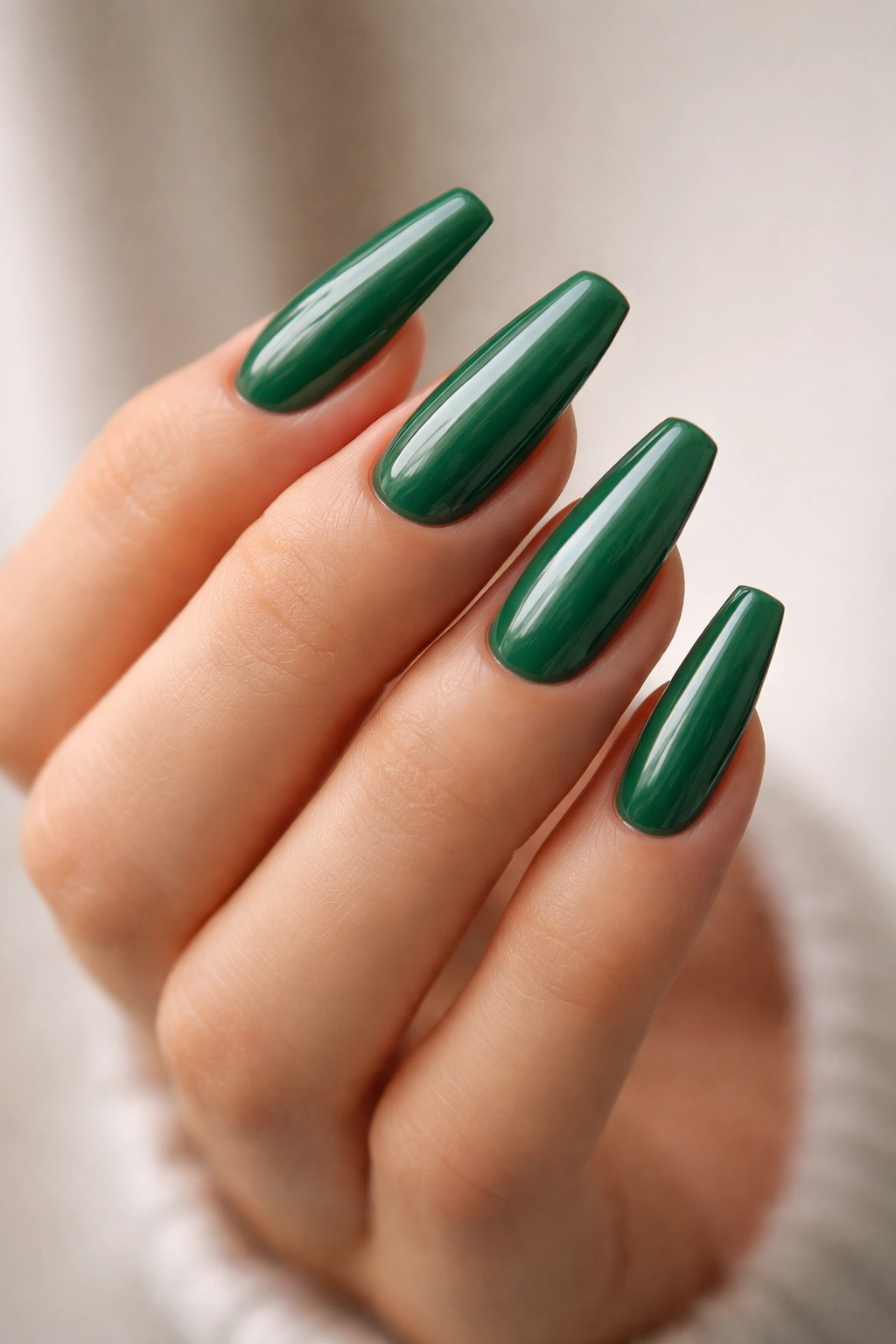
Green works on ballerina nails when the color has a clear job. Soft greens look best when they stay creamy or sheer. Dark greens need shape discipline. Loud greens need restraint somewhere else—thinner lines, fewer accents, a cleaner base.
If I had to narrow the field to the sets with the widest appeal, I’d keep coming back to milky sage, olive micro-French, jade marble accents, and bottle green with micro crystals. Those four cover a lot of moods without drifting into novelty.
The shape does more than people give it credit for. Get the taper right, keep the sidewalls slim, and green stops looking risky. It starts looking like one of the smartest manicure colors you can wear.