

Picking pink and white coffin nails sounds easy until you sit down with a dozen saved photos and realize they’re all doing different things. One has a sheer ballet-pink base and bright white smile lines. Another fades from soft blush into milk white with no visible edge. A third uses white only as a razor-thin outline, which looks polished in the photo but can disappear on shorter nails.
That difference matters more than most people expect. Coffin nails have straight sidewalls, a tapered body, and a squared-off tip, so every detail gets amplified. A white tip that looks balanced on a medium-long set can look heavy on a shorter one. A cool pink can make skin look fresh and clean on one hand, then a little gray on another. Tiny shifts change the whole manicure.
I’ve always liked pink and white most when it leans intentional instead of default. Not plain. Not overloaded. Just sharp enough that the shape does some work, the color placement does the rest, and your hands look neat the second you wrap them around a coffee cup or a steering wheel.
Start with the structure, then the design. That’s where the good sets separate themselves from the ones you’re tired of after four days.
Why Pink and White Coffin Nails Never Get Boring
Some nail color pairings date themselves fast. Pink and white doesn’t.
Part of that comes from the French manicure history behind it, but coffin shape changes the mood. On a rounded tip, pink and white can read soft and conventional. On a coffin nail, the same colors look cleaner, sharper, and a little more fashion-forward—there, I said it, even though the shape itself is doing most of the heavy lifting.
The contrast is what keeps this combo alive. White brings edge. Pink keeps that edge from feeling harsh. When the balance is right, you get a manicure that can lean bridal, office-safe, polished for dinner, or a touch dressier with chrome, lace, or 3D details.
There’s also a practical reason people keep coming back to it. Growth is easier to disguise with pink and white than with dense color blocking. A sheer pink base near the cuticle softens the grow-out line, and a white detail at the tip draws your eye away from the back of the nail.
Coffin nails help because the flat tip gives white polish a clear stage. Straight lines look sharper. Smile lines look more deliberate. Little art details—bows, swirls, outlines, half-moons—have room to breathe instead of bunching together at the edge.
How Length, Smile Line, and Pink Tone Shape the Set
A pink-and-white set can miss the mark even when the art is technically good. The issue is usually proportion.
Nail length changes the mood first
Short coffin nails, or what many techs call short ballerina, look best with lighter coverage and slimmer white placement. Think micro-French, diagonal corners, or a soft ombré. Heavy blocks of solid white can make the nail look wide.
Medium and long coffin nails give you more room for drama. Deep smile lines, reverse French crescents, marble accents, and layered white art all sit better because the eye has space to travel from cuticle to tip.
The smile line matters more than people think
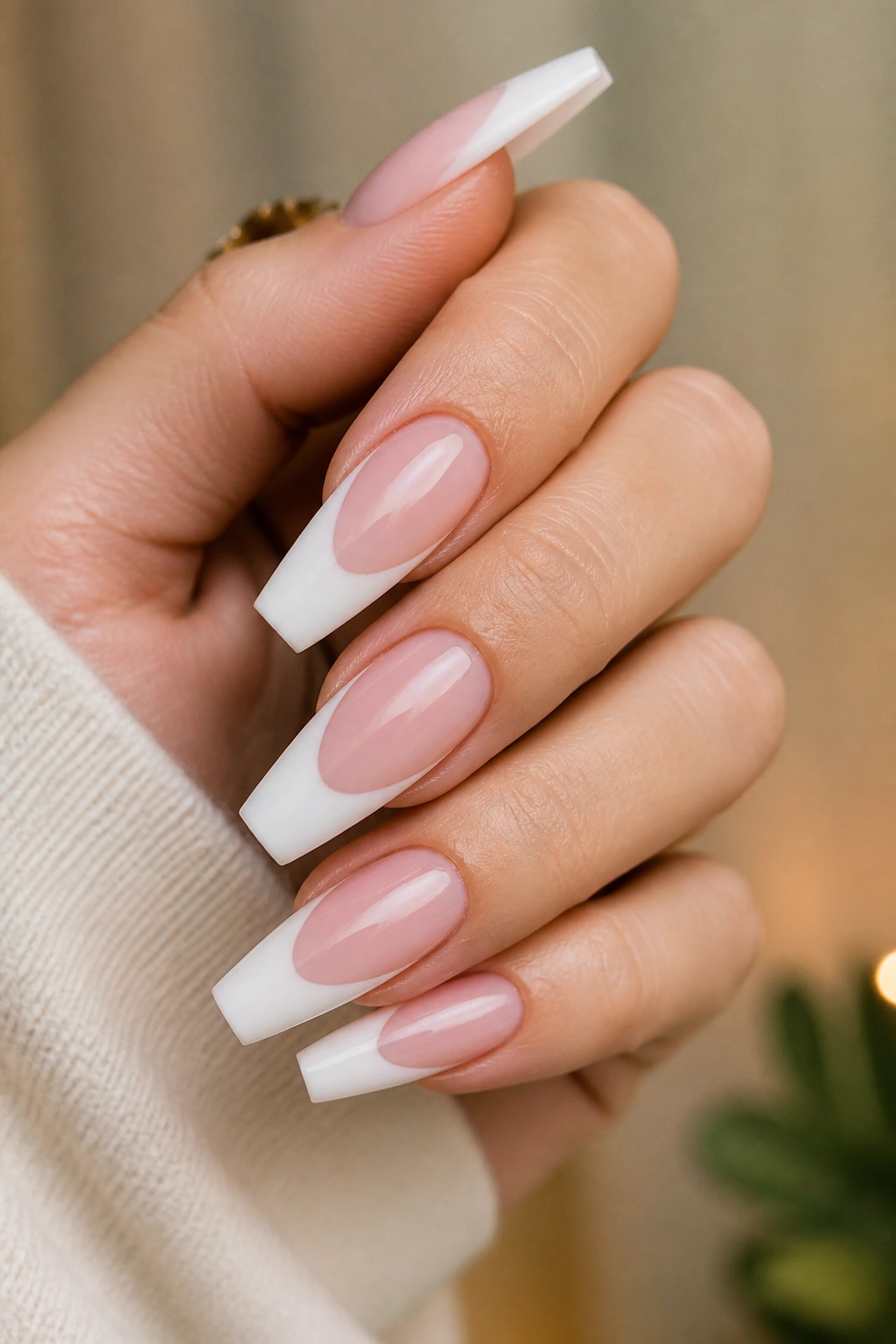
A deep smile line—the curved border where pink meets white in a French set—makes nails look longer. It pulls the eye upward. A flat smile line does the opposite and can shorten the nail visually, especially if the white section takes up one-third of the whole tip.
That’s why classic salon French tips sometimes look clunky on coffin nails. The shape wants precision. If the smile line is too straight or too thick, the whole set can feel heavy.
Pink undertone changes the whole hand
Not all pink bases do the same job.
- Milky pink softens contrast and gives a cleaner, creamy look.
- Sheer blush pink lets the natural nail show through and feels lighter.
- Cool ballet pink can make the white look crisper.
- Warm nude-pink tends to flatter deeper or golden skin tones better than icy pinks.
- Opaque baby pink turns the set from French-inspired to design-led.
If you are choosing from a wall of swatches, hold two pinks side by side against your skin before you commit. One small shift—from cool rose to warm blush—can decide whether the manicure looks fresh or slightly off.
What to Ask for Before the First Brushstroke
Salon communication is half the manicure. The photo helps, but the words you use with your nail tech matter just as much.
A few details are worth saying out loud before anyone files the first sidewall:
- Ask for the exact length in millimeters or by visual checkpoint. “Past the fingertip by about 10 to 12 mm” is clearer than “medium.”
- Say whether you want a soft coffin or a sharp coffin. Soft means slightly gentler taper and corners; sharp means stronger sidewalls and a flatter tip.
- Mention the pink opacity. Sheer, milky, jelly, or opaque are four different looks.
- Describe the white. Crisp bright white, creamy ivory, pearl white, sugar white, chrome white—those are not interchangeable.
- Tell them where you want the visual weight. Tip-heavy, center detail, cuticle detail, or one accent nail changes the balance.
One more thing. If your natural nails bend when you press the free edge, say so. Coffin nails keep their shape best with structure, and a builder gel overlay or acrylic base often holds a crisp tip longer than a bare natural nail with gel polish alone.
Dermatology advice around manicures also tends to land on one unglamorous point: protect the skin around the nail. Ask your tech not to cut living cuticle too aggressively, and do not let anyone over-file the natural plate until it feels hot. A good set should look sharp, not leave your nails sore for two days.
Now for the fun part.
1. Soft Milky Pink French Fade
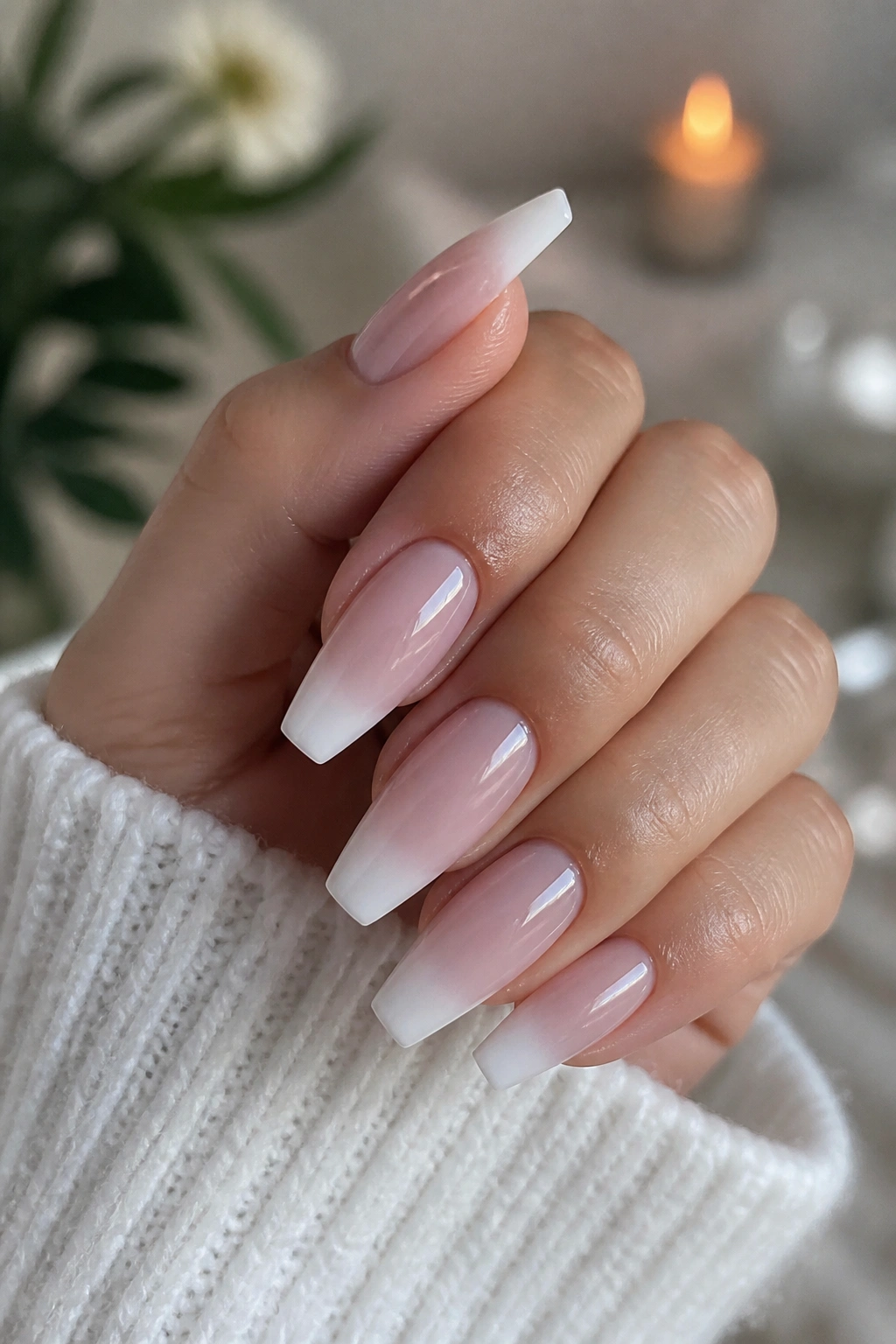
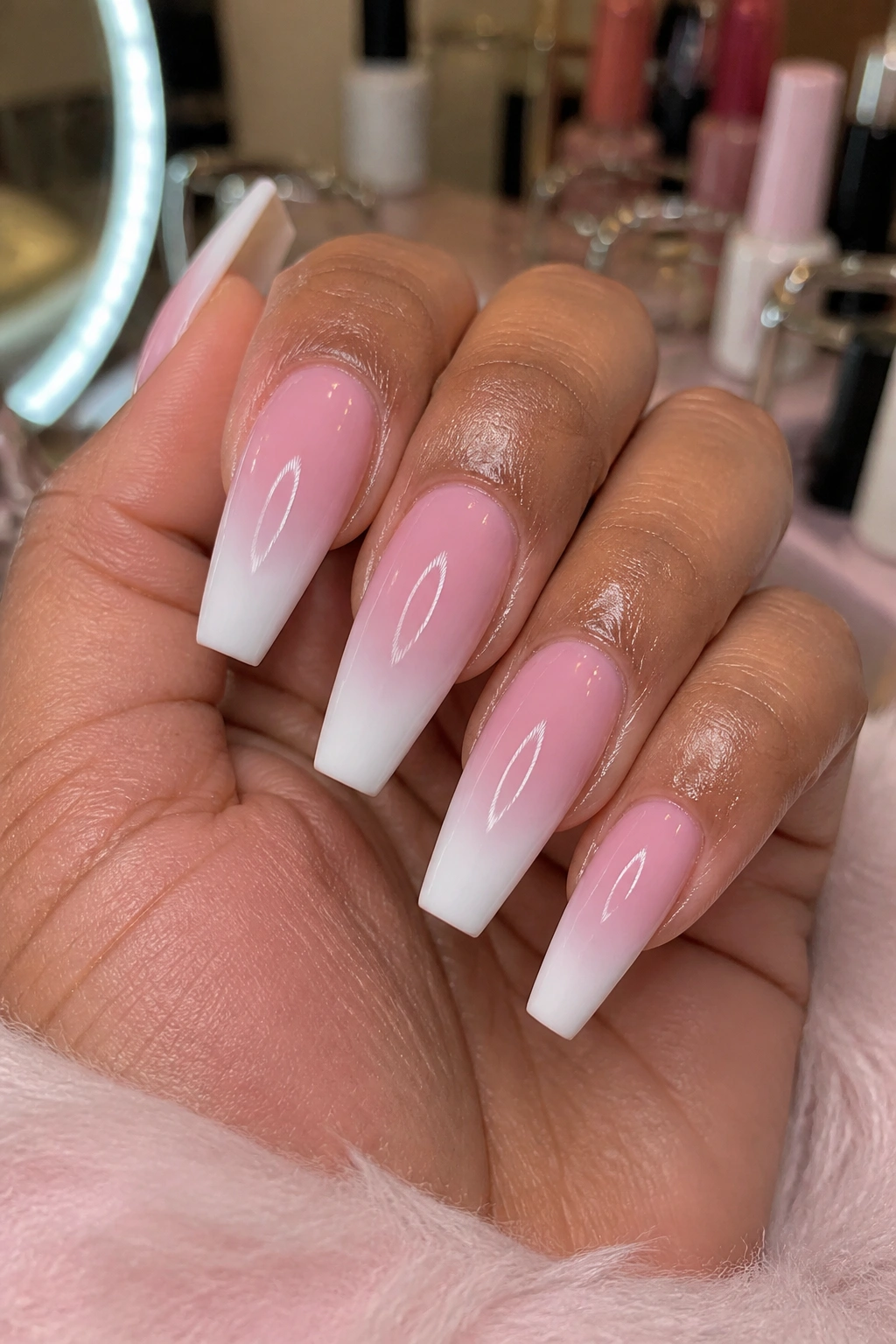
Milky pink changes everything. When white fades into a translucent pink instead of stopping at a hard line, the whole set looks smoother and more expensive.
Many techs call this a baby boomer or French fade set. On coffin nails, it works best at medium length or longer because the fade has room to stretch. Too short, and the transition can look compressed, almost chalky.
Why it works on coffin nails
The coffin silhouette already has strong geometry. A blurred white-to-pink fade softens that edge without losing shape, which is why this style sits in that sweet spot between polished and easy to wear.
A good fade should start brightest at the tip, then melt upward with no clear stripe. If you can point to where the white “begins,” the blend needs more work.
Quick details to ask for
- Ask for a milky pink cover rather than a clear pink if you want a creamy finish.
- Choose soft white powder or gel instead of stark paper-white for a smoother transition.
- Keep the free edge flat and crisp so the coffin shape still reads from a distance.
- Add a high-gloss top coat if you want the fade to look cleaner under indoor light.
Best salon note: Tell your tech you want the white concentrated on the last 25 to 30 percent of the nail, not halfway down.
2. Deep Smile Line White French Tips
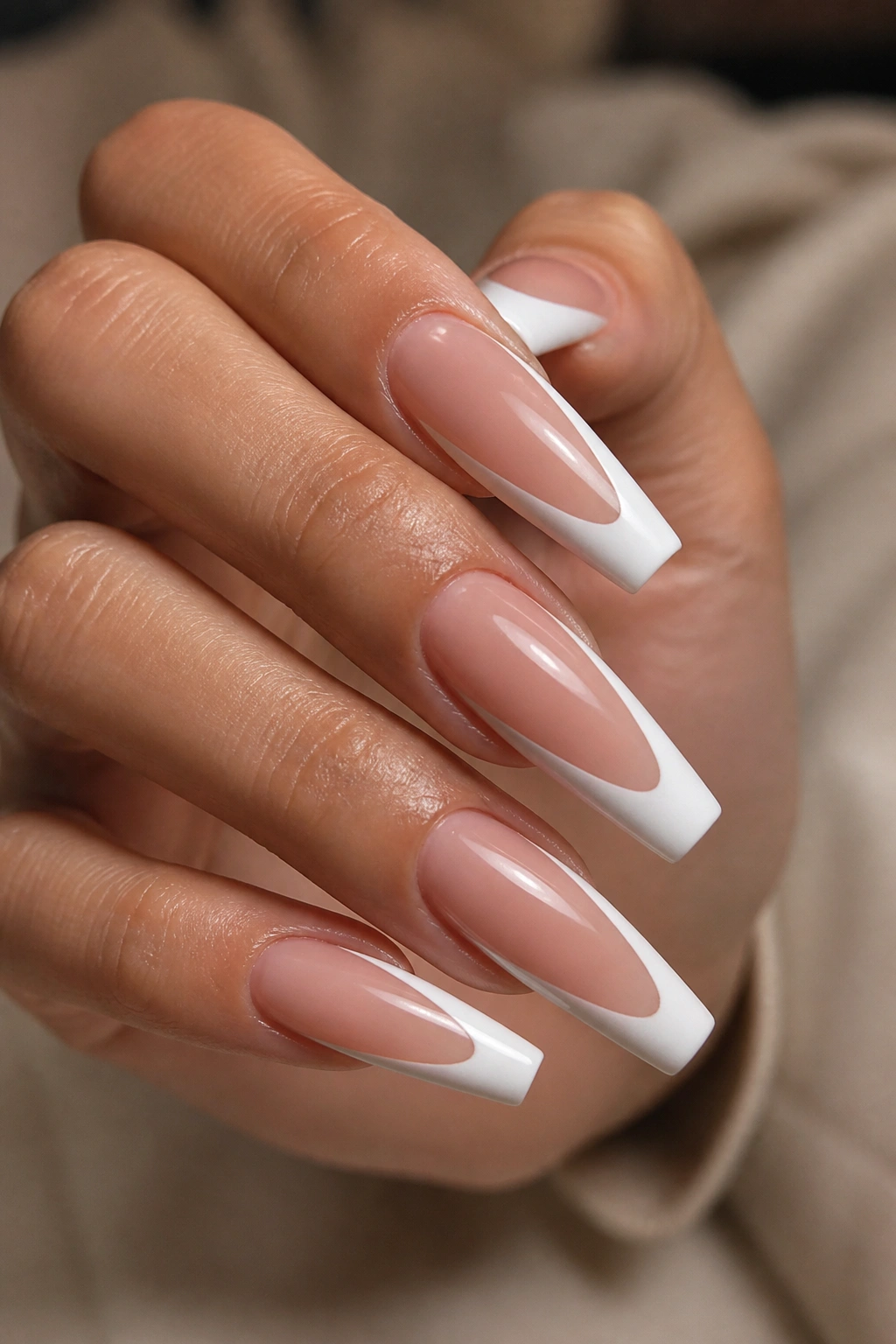
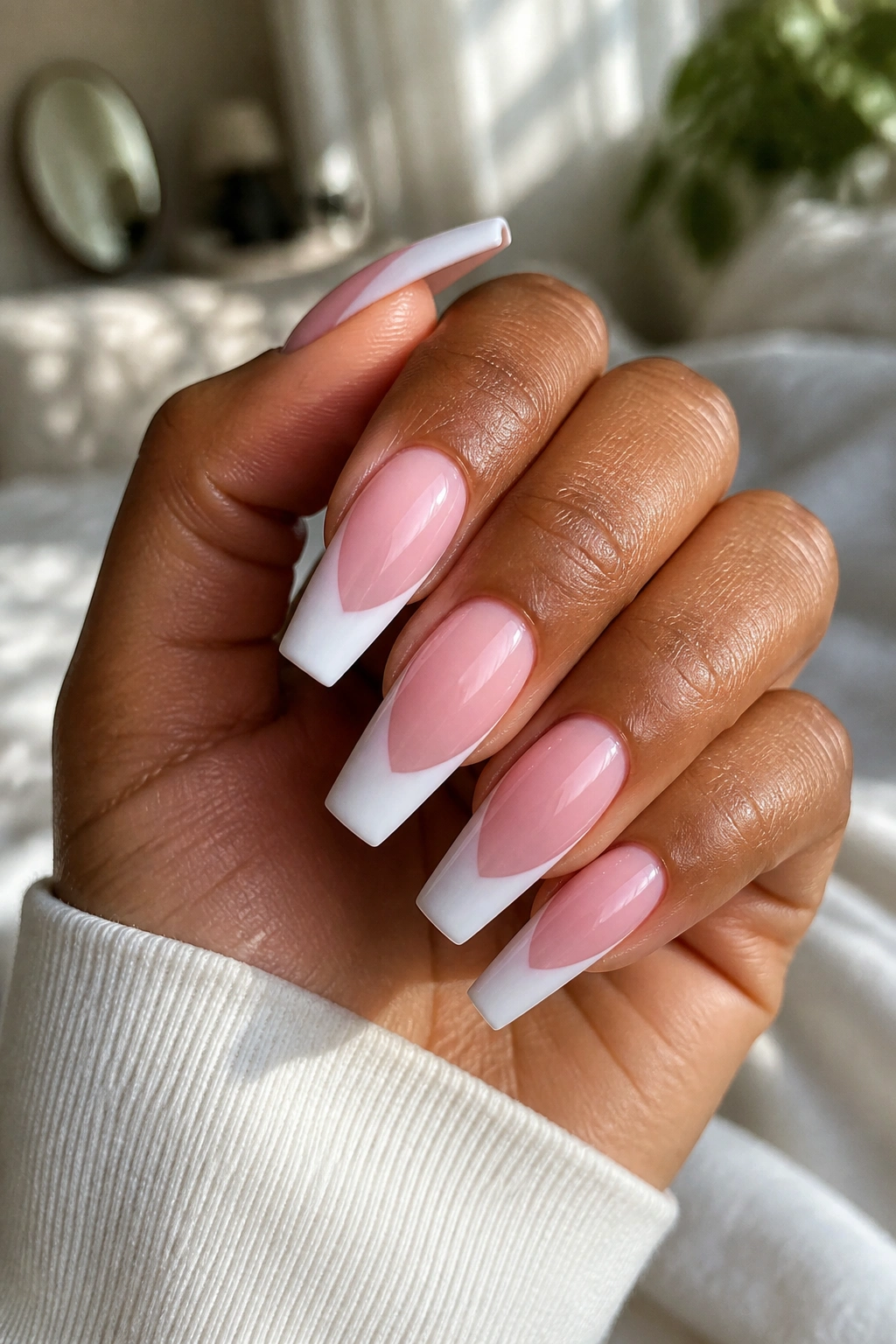
If you want the sharpest version of pink and white coffin nails, this is it. A deep smile French has a strong curved line that dips farther down the sides of the nail and rises high at the center, which stretches the look of the finger in a way a flat tip never can.
This one has zero patience for sloppy application. The white needs a clean border, the pink base needs even coverage, and the sidewalls have to stay straight. Get one of those wrong, and the shape starts to look bulky.
I like this design most on medium to long coffin nails with a sheer blush or soft nude-pink base. Dense opaque pink can make the deep smile feel too heavy unless the nail is long enough to carry it. On shorter lengths, ask for a narrower white tip and a slightly shallower curve so the white doesn’t swallow the front half of the nail.
There’s a reason nail competitions have leaned on pink-and-white sculpted French sets for years: precision shows. You notice the architecture right away.
3. Blush Pink Coffin Nails with a Skinny White Micro-French
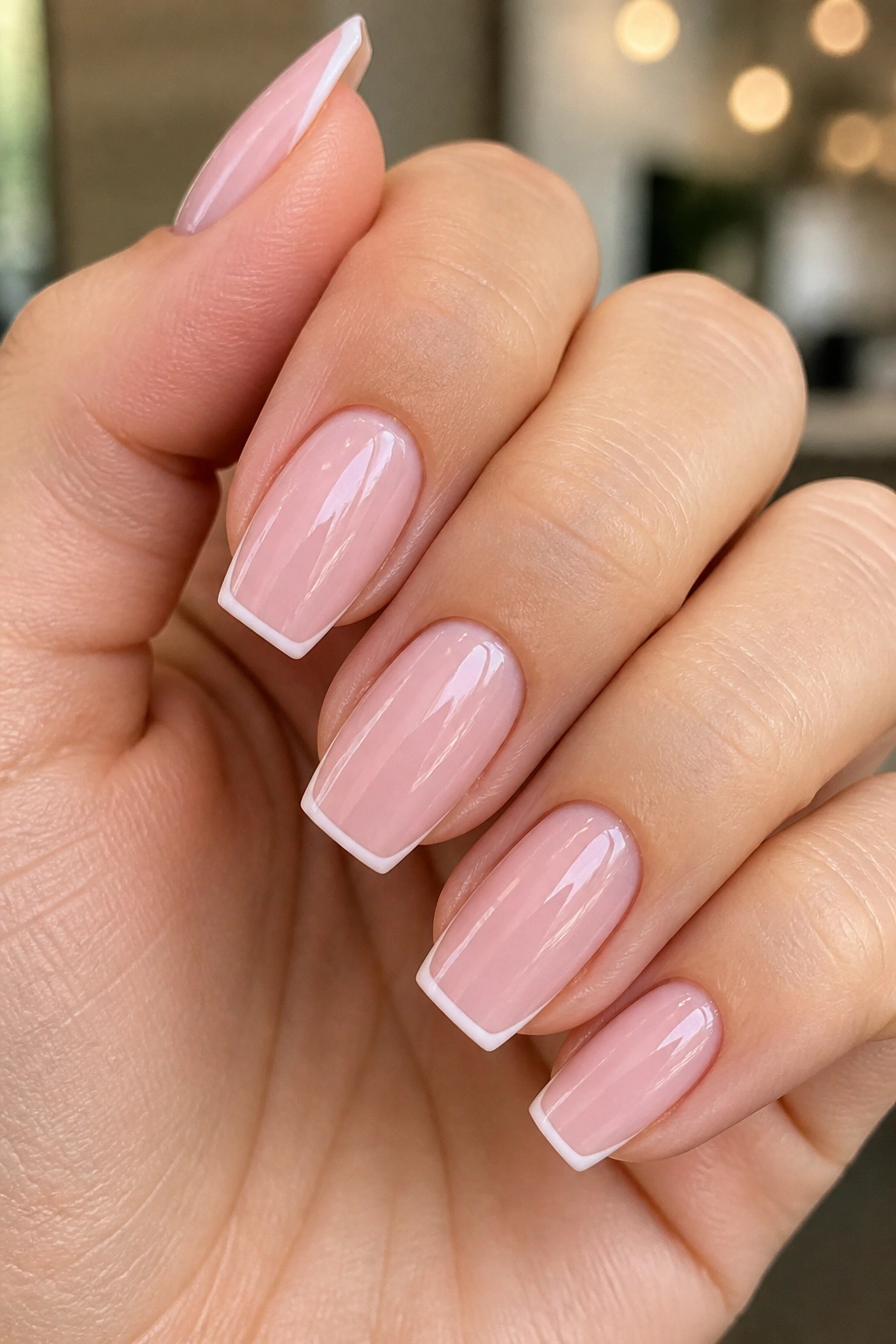
What if you like white tips, but you do not want a full French look?
That’s where the micro-French earns its keep. Instead of painting a thick white tip, your tech runs a slim line—often 1 to 2 mm—across the flat edge of the coffin shape. The result is crisp, minimal, and far better on shorter coffin nails than a traditional thick tip.
A micro-French also fixes a common problem. Some pink and white sets look wider because the white section visually spreads across the tip. A thinner edge does the opposite. It keeps the nail looking long and lean.
How to wear it well
Choose a pink base with a touch of milkiness so the white line doesn’t look disconnected from the rest of the nail. If the base is too transparent, the design can read unfinished from arm’s length.
You can also ask for the white line to wrap a hair around the sidewalls, not much, just enough to frame the shape. On coffin nails, that tiny wrap makes the geometry look cleaner. Matte top coat can work here, though glossy gives the line more pop.
4. White V-Tips on a Sheer Rosy Base
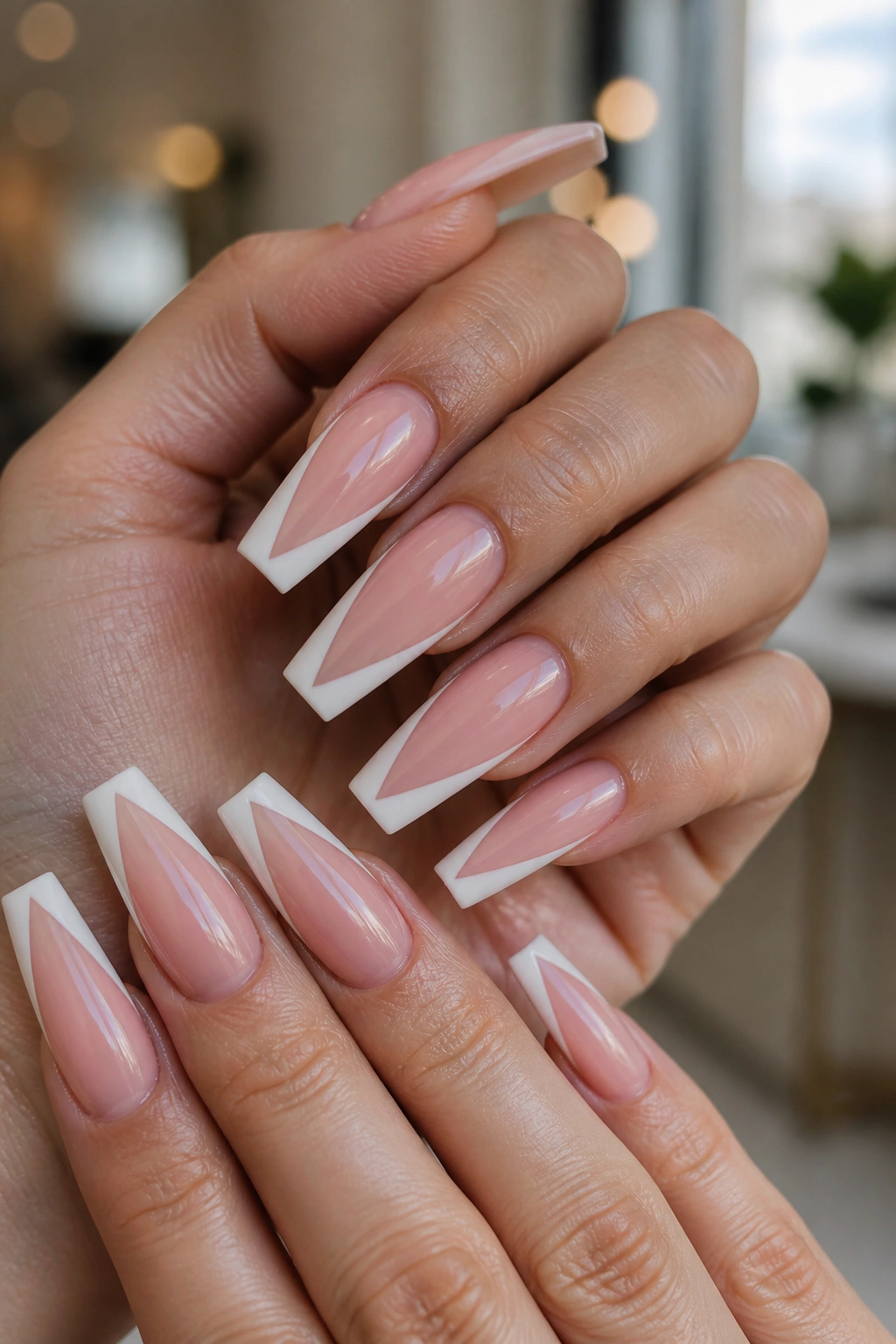
Picture the tip of the nail coming to a visual point in the center, even though the edge stays flat. That’s the trick of a white V-tip.
This design takes the coffin shape and pushes it harder. A standard French follows the tip. A V-tip cuts inward and creates more movement, so the nail looks longer and a bit sharper without adding actual length.
A sheer rosy base keeps it from turning too graphic. You still get contrast, but the pink softens the angles.
What makes this one different?
- The V should hit the center of the nail cleanly, not wander left or right.
- A thin V looks refined; a thick V looks bolder and more fashion-led.
- Negative space near the sidewalls helps the tip stay light.
- Long coffin nails carry this style best, though medium length can work with a narrow V.
I would skip chunky stones with this design. The line work is the main event. Pile on gems and the eye loses the structure that makes it good.
5. Reverse French Half-Moons in Pink and White
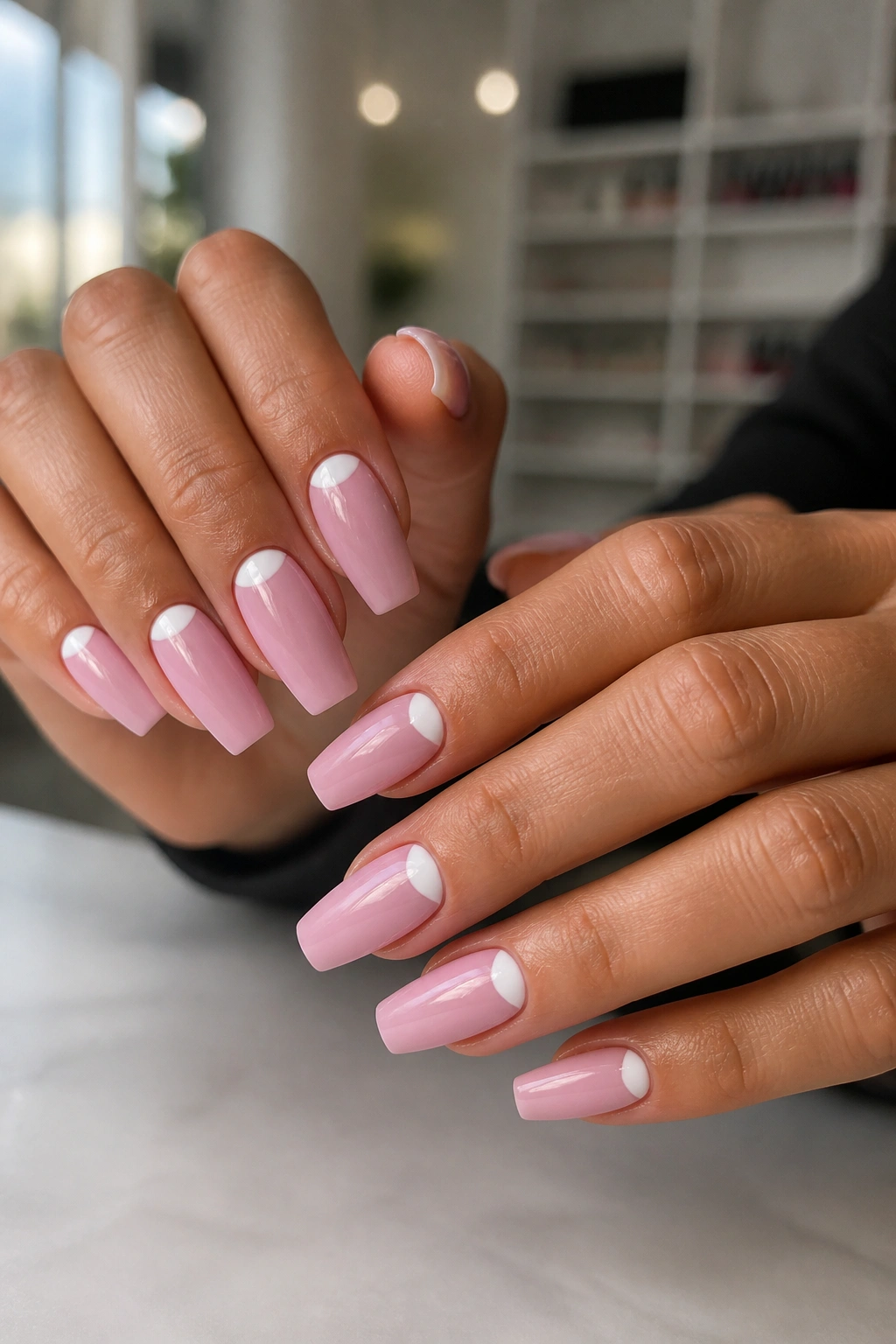
This set is quieter at first glance, then smarter the longer you look at it. Instead of putting white at the tip, the white hugs the cuticle in a half-moon shape while the rest of the nail stays pink.
That small shift changes the whole manicure. Cuticle-area art draws the eye upward, which can make the nail bed look longer. It also gives you a design that grows out a little more gracefully than dense tip art, since the half-moon can blur visually into the regrowth line after a week or two.
I like reverse French half-moons most with an opaque or semi-opaque pink base. Sheer pink can work, though it tends to make the white crescent feel detached. An almond shape would turn this soft. Coffin gives it needed structure.
There is one catch. Placement has to mirror the natural curve of each cuticle. A half-moon that sits too high on one nail and too low on the next will bother you every time you look down. Symmetry matters here more than almost any other design on this list.
Keep the rest of the set clean. No extra swirls, no chrome, no random glitter stripe. This manicure wins by restraint.
6. Glossy Ombre Pink and White Coffin Set
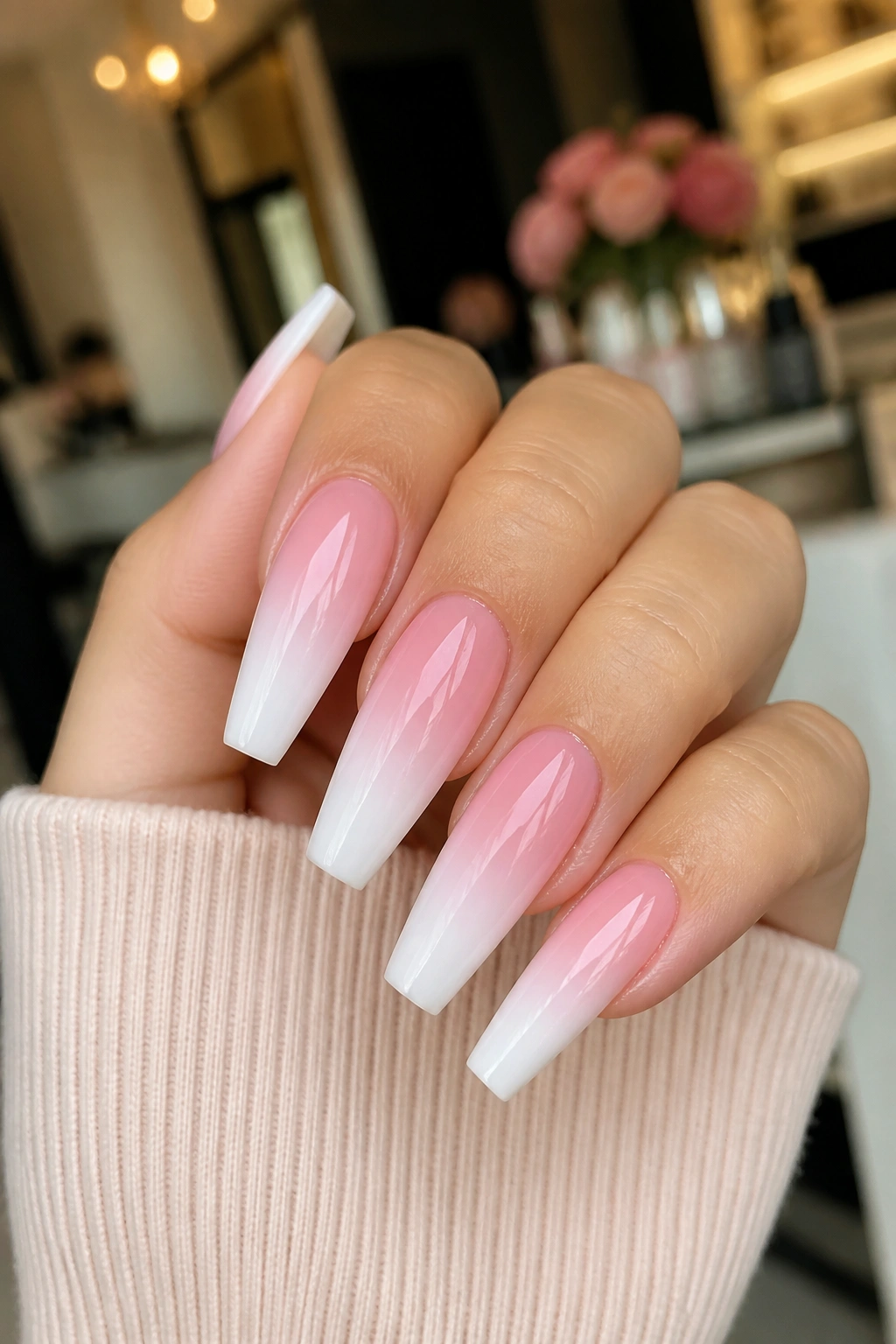
Unlike the baby boomer fade, which usually leans milky and soft, a glossy ombré set can push the color contrast harder. You still blend pink into white, but the pink is often denser and the white can be brighter, which gives the set more definition.
That difference sounds small. On the hand, it is not.
A dense ombré works well if you want pink and white coffin nails that feel polished but not traditional. The fade softens the line. The stronger color still gives you presence. I’d pick this over a standard French if your style skews clean, glossy, and a little more statement-making than bridal.
Medium length is the sweet spot. Short nails can wear it, though the blend zone gets tight. Extra-long coffin nails look strong with it, especially if the pink starts sheer at the cuticle and turns creamier through the middle.
Ask for the ombré to fade on the nail, not just in the airbrush effect of the photo. You want the color shift to look smooth from the side too, because people see your hands moving, not frozen under bright salon lights.
7. Pearl-Glazed Pink and White Tips
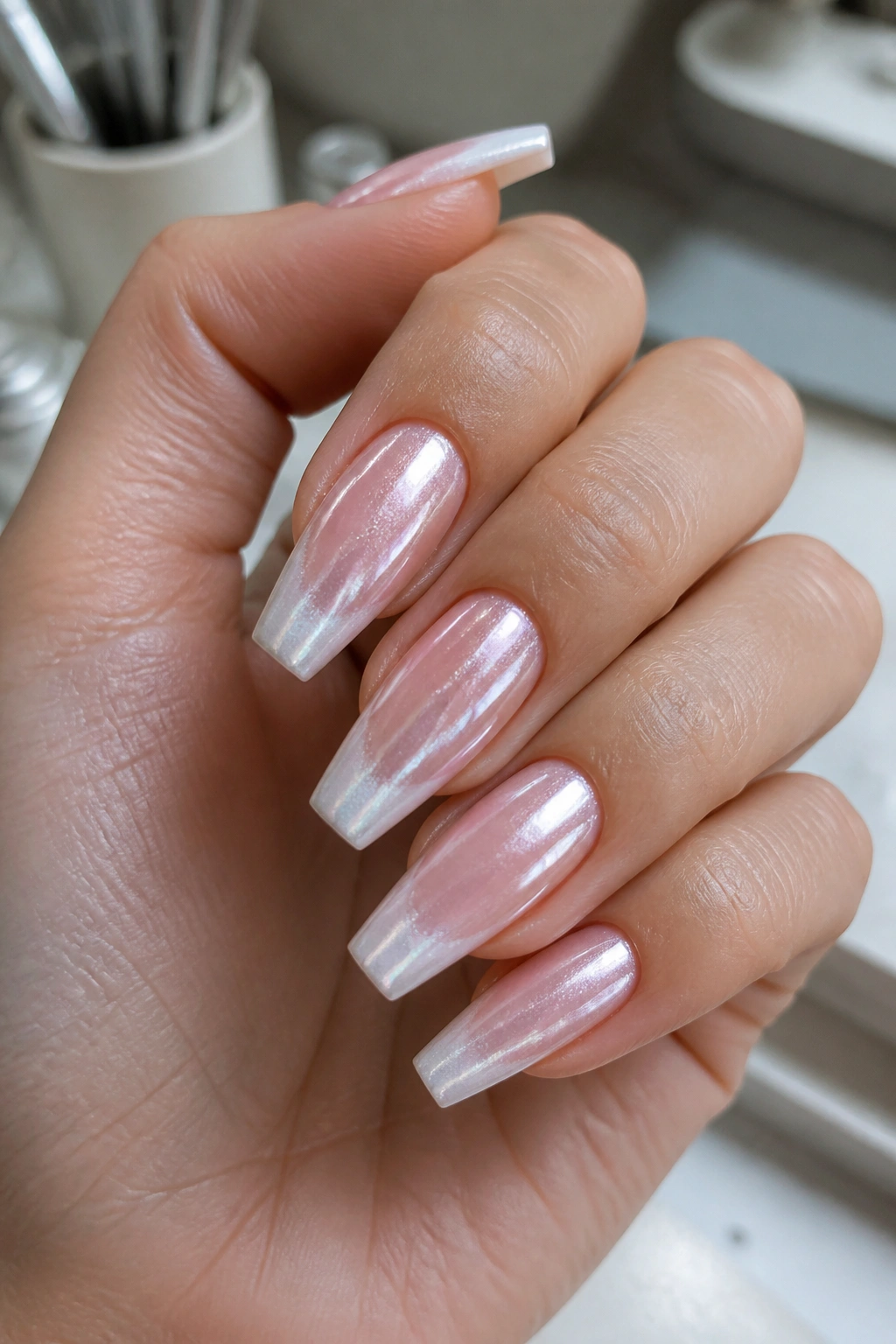
A pearl glaze top coat over pink and white is one of those choices that sounds minor and changes the manicure more than expected. White tips pick up a soft shell-like sheen. Pink bases turn silky instead of flat.
The finish is the point
This design depends on surface reflection, so the prep has to be clean. Any bumps, lumps in builder gel, or ripples in the top coat will show faster under pearl chrome than they do under standard gloss.
On coffin nails, pearl glaze works best when the underlying design is simple. Think deep French, ombré fade, or micro-French. Swirls plus pearl plus crystals usually tip into clutter.
What to ask for
- A fine pearl chrome rather than a mirror silver rub
- A milky or sheer pink base, not a hot pink
- Soft white tips instead of blue-white if you want a creamier finish
- A smooth apex and even sidewalls before the glaze goes on
Small warning: pearl glaze can make white read a touch warmer under yellow indoor lighting. If you want a colder white, say so before the top coat goes on.
8. Cloudy White Swirls Over Soft Pink
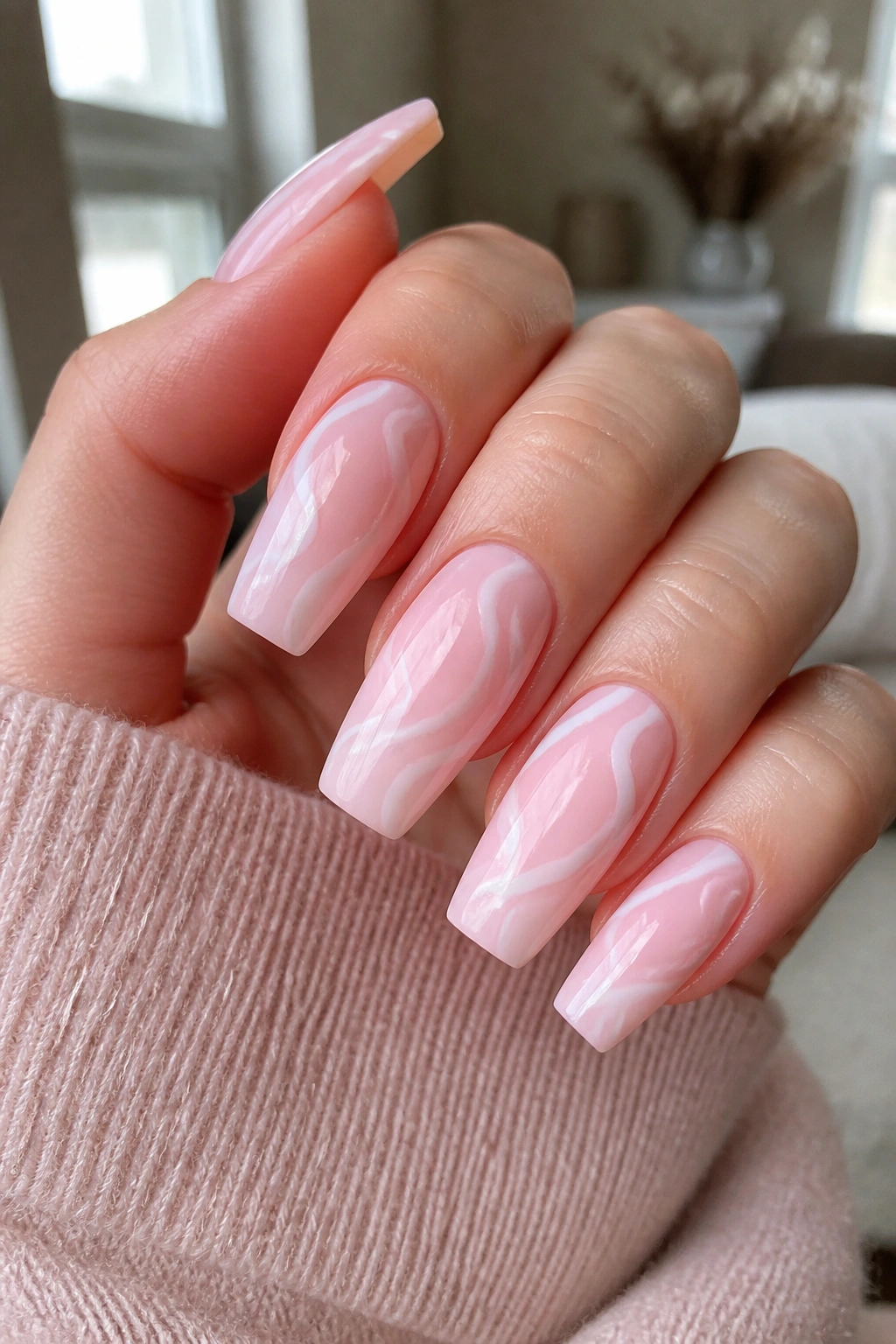
This is the set I’d choose when plain French feels too expected but full nail art feels like too much work to live with. A soft pink base with white swirls gives movement without losing the clean look that pink and white does so well.
The best swirls are not all identical. One nail might get a broad S-curve, another a pair of thinner lines, another a swirl concentrated near the tip. That variation keeps the hand from looking stamped out.
Placement matters. On coffin nails, swirls look best when they follow the length of the nail rather than running straight across it. Horizontal lines can make the shape look wider. Long, curved strokes keep the eye moving up and down.
You can mix finishes here. Gloss all over feels fresh. Matte pink with glossy raised white lines adds a tactile look, almost like piped icing, though it requires more maintenance because texture catches lint and makeup faster. If you use swirls on every nail, keep the white thin. If you want bolder swirls, confine them to two accent nails and let the rest stay soft pink.
9. White Chrome-Capped Tips on a Nude Pink Base
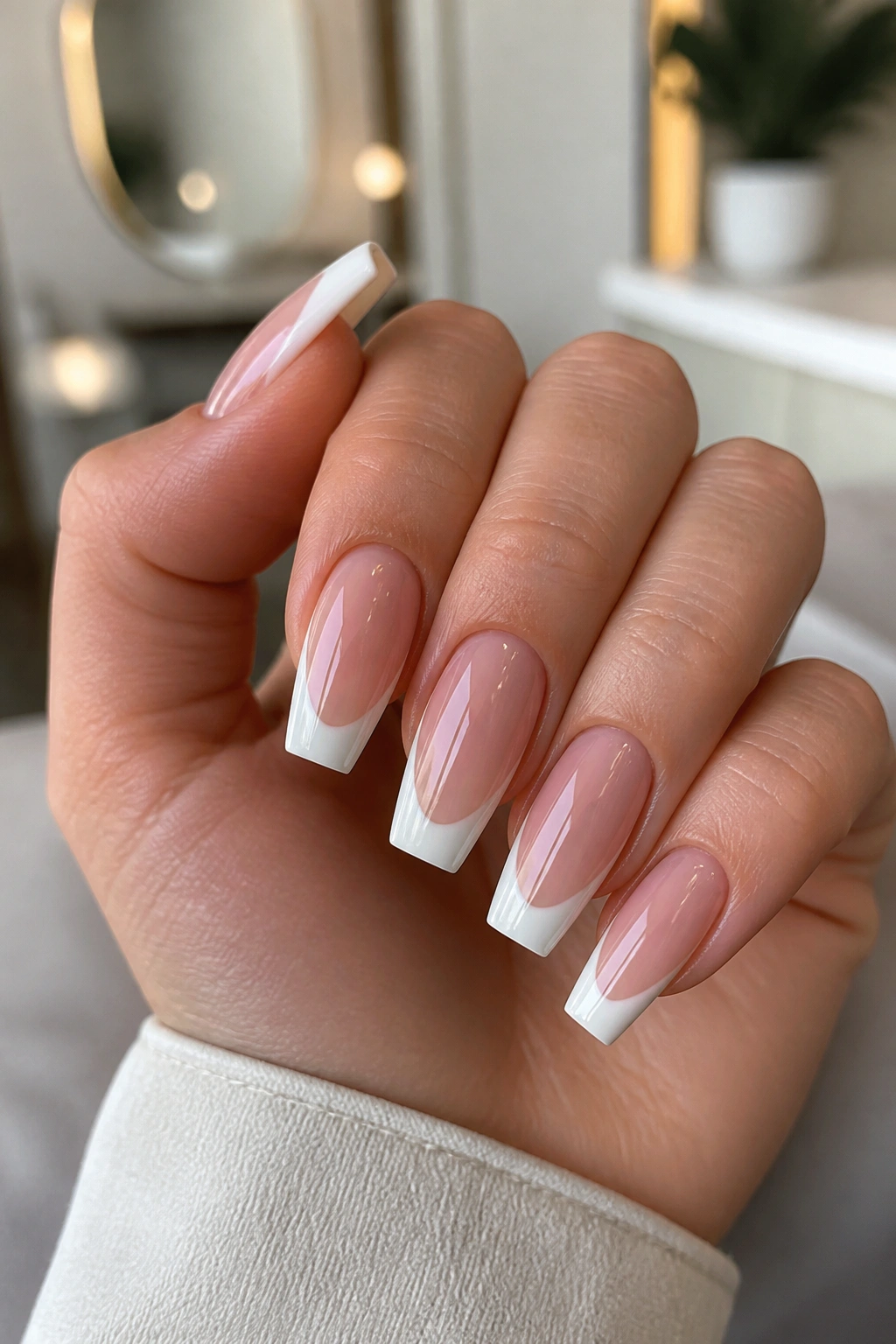
Why choose between classic French and chrome when you can split the difference? A chrome-capped tip starts with white at the edge, then adds a white-pearl or glazed metallic finish only on that tip area. You get brightness, reflectivity, and shape definition in one move.
This design feels sharper than a pearl-glazed full set because the shine is concentrated. The nail bed stays calm. The tip does the talking.
How to use it without overloading the set
Keep the pink base nude or blush, not candy pink. You want contrast between natural-looking warmth and the cooler sheen at the tip. Also, cap only the white section. A full chrome nail pushes this into another category.
Longer coffin nails show this best because you have room for both the pink base and the capped tip. On medium nails, a slim chrome edge can still work and looks cleaner than a thick metallic band. Pair it with square jewelry—think signet rings or flat bands—and the lines make sense together.
10. White Marble Accent Nails with Pink French Companions
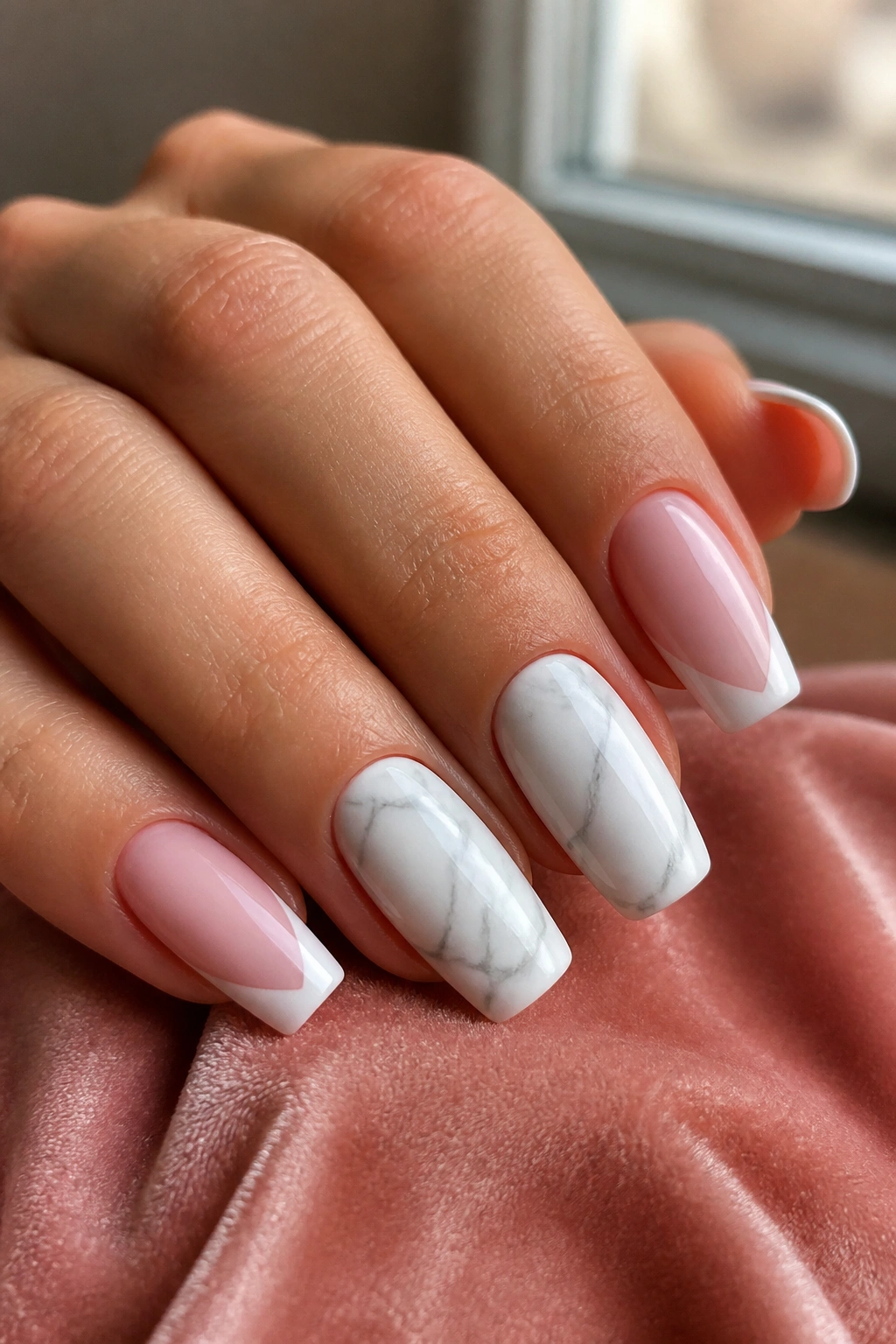
Here’s a smarter way to wear marble: keep it off most of the hand. Use two marble accent nails—middle and ring finger is the usual choice—then anchor the rest with pink-and-white French tips.
That combination works because marble has visual noise. The veining pulls the eye in different directions. French tips restore order.
A good white marble nail should have fine gray or soft taupe veining, not thick black cracks unless you want a harder look. On a pink-and-white set, thin lines are easier to live with and keep the design tied to the softer palette.
A few practical notes help here:
- Use marble on one or two nails per hand, not all five.
- Keep the veining thin and irregular so it looks natural.
- Match the pink on the accent nails to the pink on the French nails.
- Choose a gloss top coat; matte kills the stone illusion.
This design suits people who want a little texture in the look without moving into bows, flowers, or heavy art.
11. Matte Blush Pink with Glossy White Tips
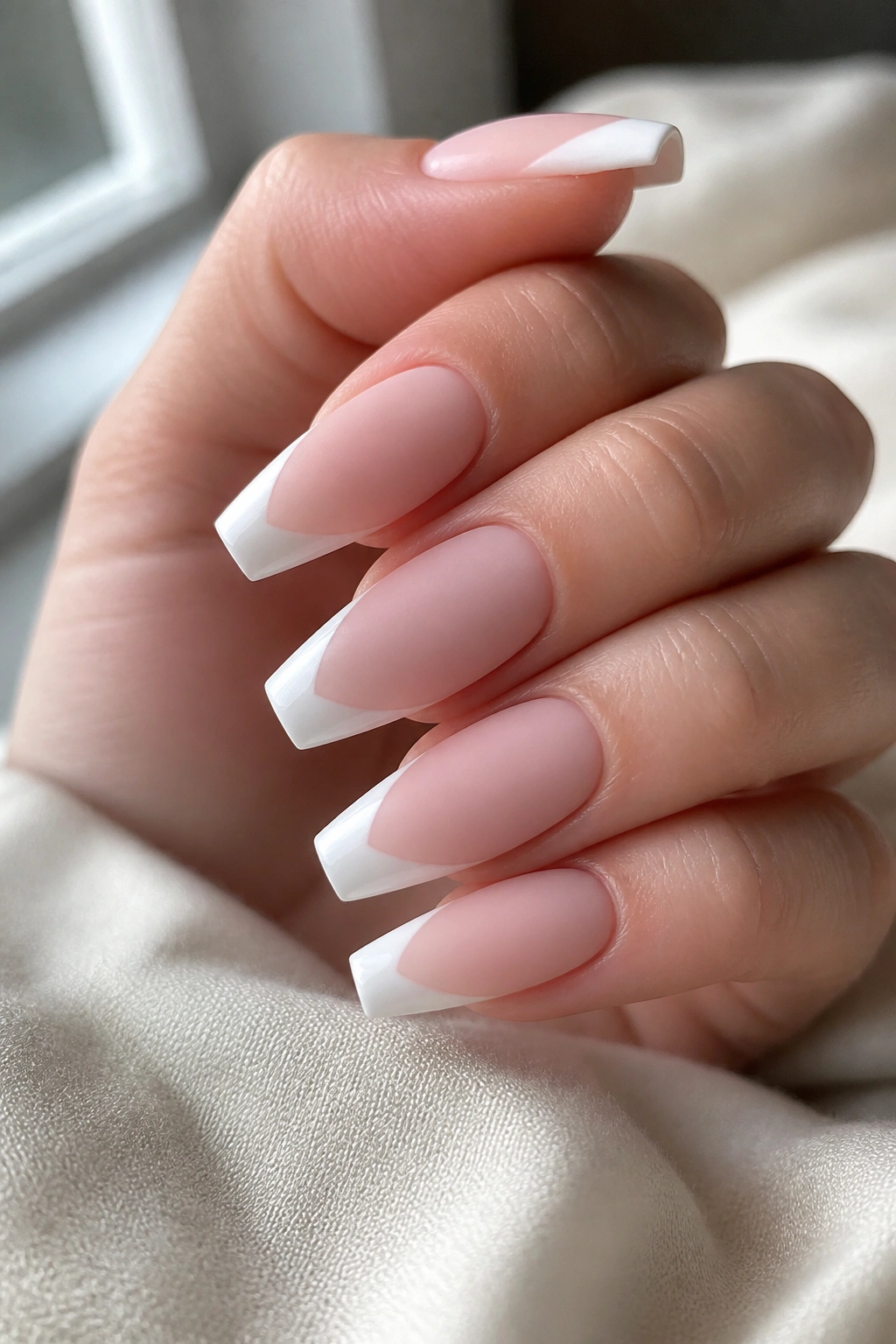
Matte and gloss on the same nail can go wrong fast if the contrast has no purpose. Here, it does. The matte blush base softens the hand. The glossy white tip catches light at the edge and shows off the coffin shape each time you move.
You need clean prep for this one. Matte top coats expose scratches, dust, and uneven buffing. Gloss tips expose crooked smile lines. No hiding places.
I like this combination on medium coffin nails worn a touch shorter than statement length. That keeps the matte finish from feeling heavy. The white tip can be standard French, deep smile, or micro-French, though I’d avoid an ombré. The whole point is finish contrast, not color fade.
One small thing people forget: matte top coat gets duller if you use heavy cuticle oil and hand cream and then touch your nails all day. It’s still worth it. Just know that the manicure often looks freshest right after a quick wipe with alcohol or a gentle cleanser on a lint-free pad.
12. Pink Jelly Coffin Nails with Floating White Hearts
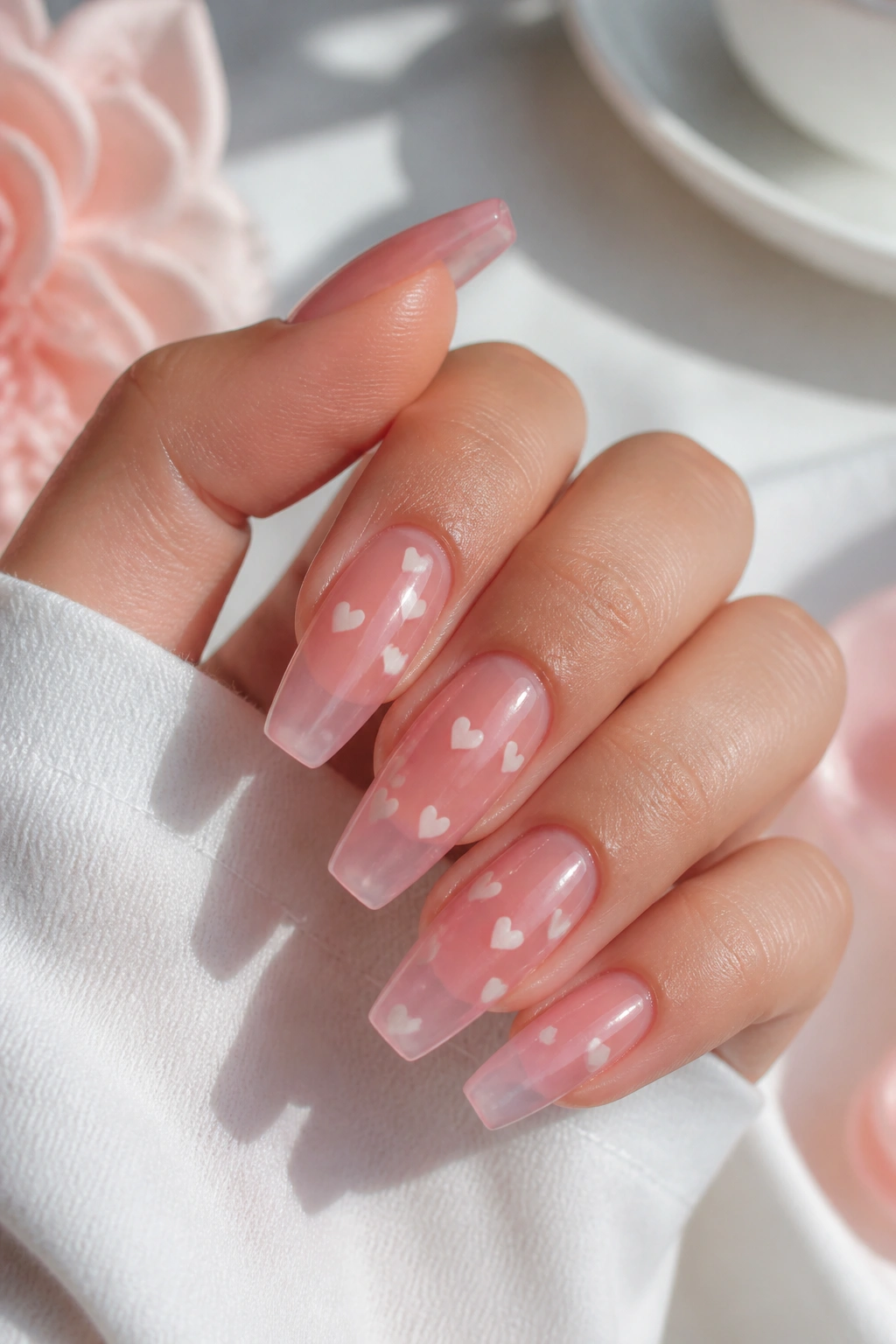
Unlike opaque baby pink, a jelly pink base lets light through. That transparency gives the manicure a lighter, candy-glass feel, and it makes tiny floating white hearts look almost suspended inside the nail.
This one can get childish if the hearts are too big. Keep them tiny—2 to 4 mm across is plenty—and place them on two or three nails, not every finger. Coffin shape helps by adding edge. Without that sharper silhouette, hearts can turn saccharine fast.
Who should pick this? Anyone who wants pink and white coffin nails with a playful note but still wants the set to read grown-up. A sheer rosy jelly paired with bright white mini hearts does the job. Add a thin French edge on the non-heart nails and the whole set looks connected rather than random.
Skip 3D charms here. The jelly finish already has enough personality.
13. Double French Lines in Pink and White
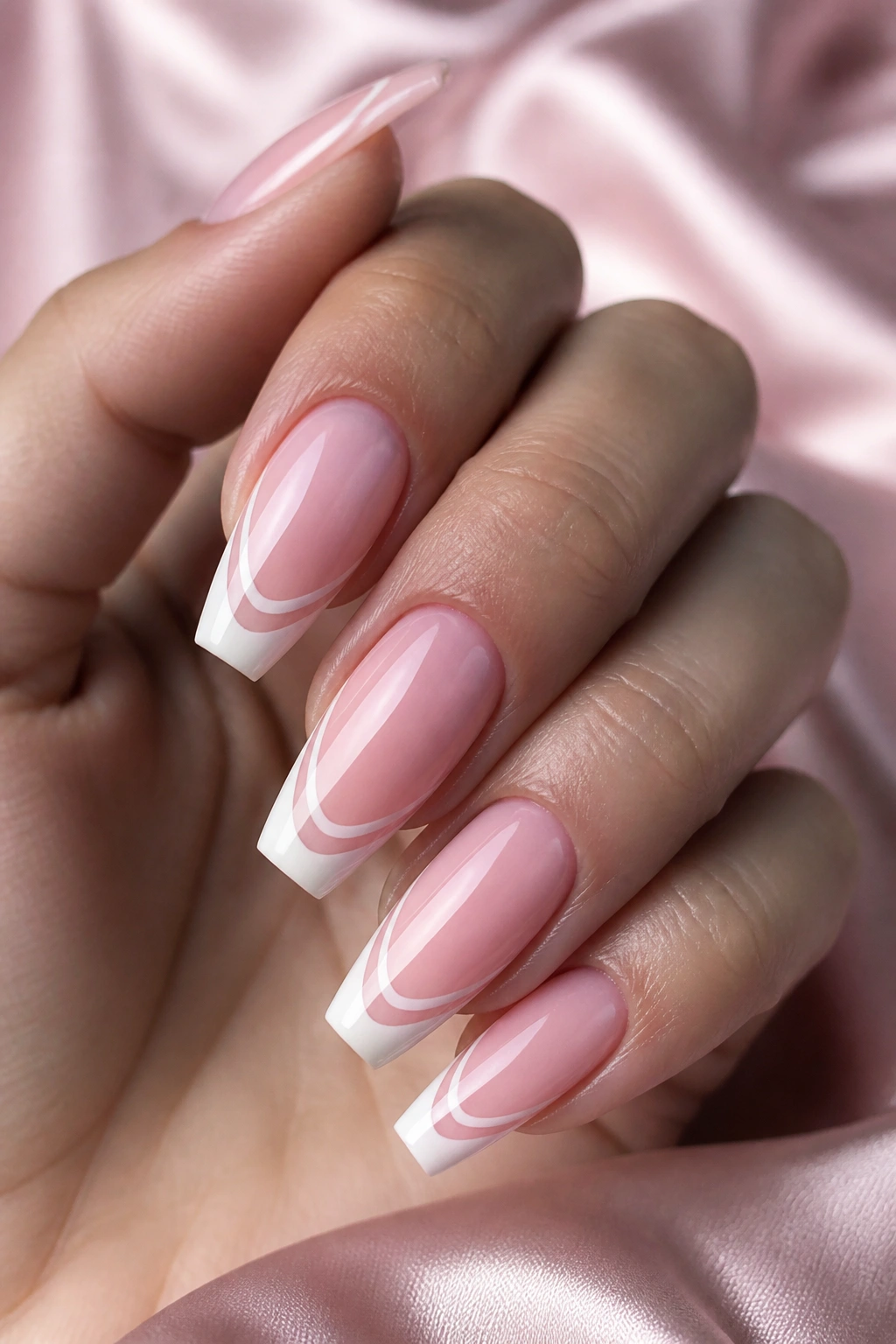
Two lines, not one. That’s the whole idea, and it’s a good one.
A double French usually uses a standard white tip plus a second slim white line tracing the smile line or sitting a few millimeters above it. On coffin nails, that extra stripe adds structure and makes the design feel custom even when the palette stays simple.
Where this design earns its keep
If you like minimal manicures but want more detail than a standard French, double lines are a smart middle ground. They photograph sharply, hold up well with most outfits, and still look clean from close range when your hands are moving.
Details that make it better
- Leave 1 to 2 mm of pink space between the two white lines so they do not blur together.
- Use thin liner-gel work rather than thick painted bands.
- Keep the tip line slightly thicker than the upper line for balance.
- Choose a sheer pink base so the white detail stays crisp.
My take: this design looks best when every nail matches. Accent nails usually weaken the graphic effect.
14. Soft Pink Base with White Lace Veil Art
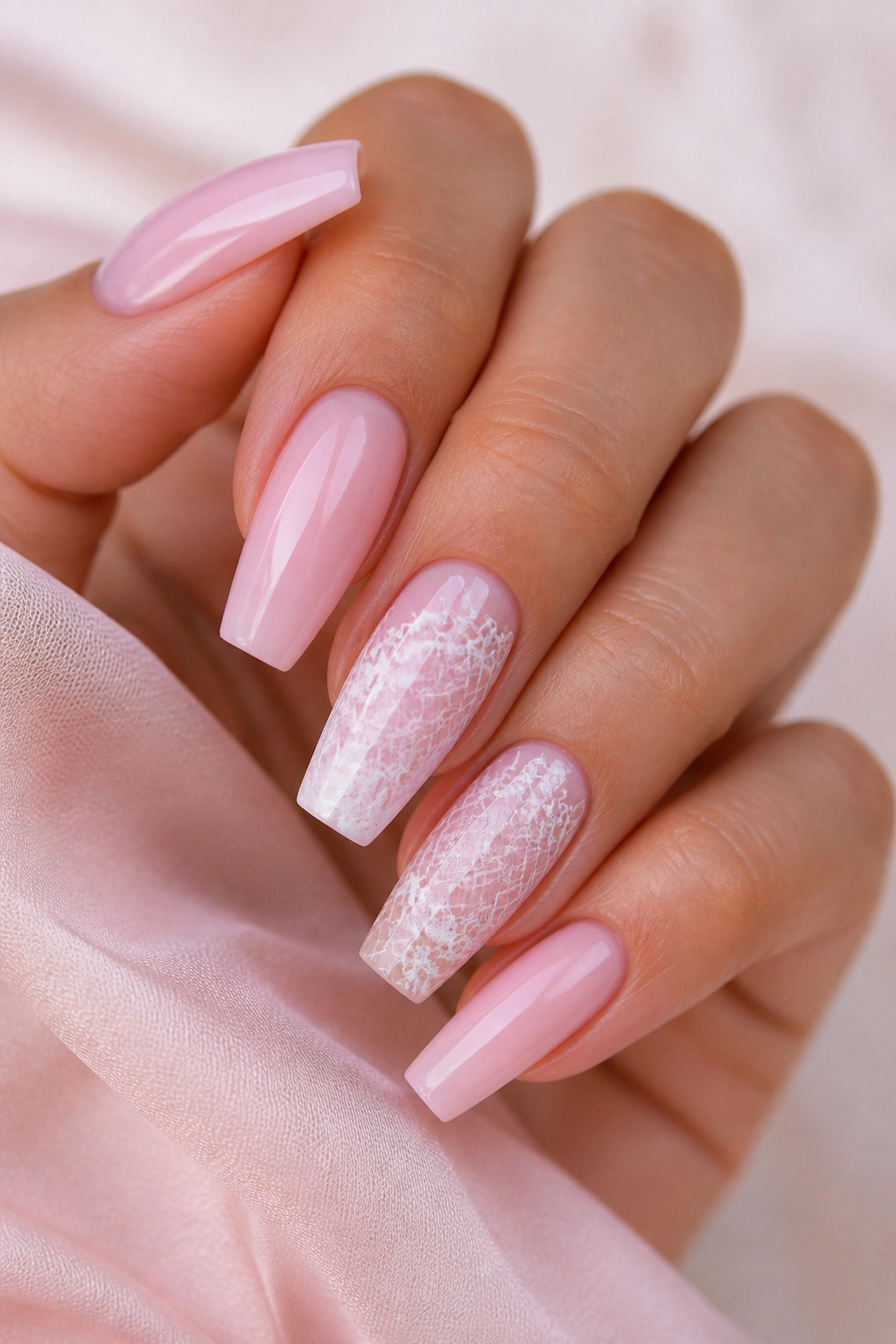
There’s no halfway version of lace art. If the lines are shaky or the pattern is too thick, the design falls apart.
Done well, though, white lace over soft pink coffin nails can look refined and bridal without turning the hand into a pile of decoration. The trick is scale. Tiny mesh details, floral arcs, and dotted borders belong on one or two nails. The rest should stay simple—French tips, soft pink gloss, or a faint ombré.
Lace sits best on a milky or semi-opaque pink base. Too sheer, and the pattern lacks contrast. Too opaque, and the art can look pasted on top instead of integrated into the manicure. I also prefer lace placed near one area of the nail—cuticle corner, side panel, or upper third—instead of centered like a sticker.
A hand-painted lace veil has more character than a stamped one, though stamp art can look neat if the scale is right. You want thread-like lines, not thick white blobs pretending to be lace. That sounds harsh. It’s still true.
15. White 3D Flower Accents on Baby Pink Coffin Nails
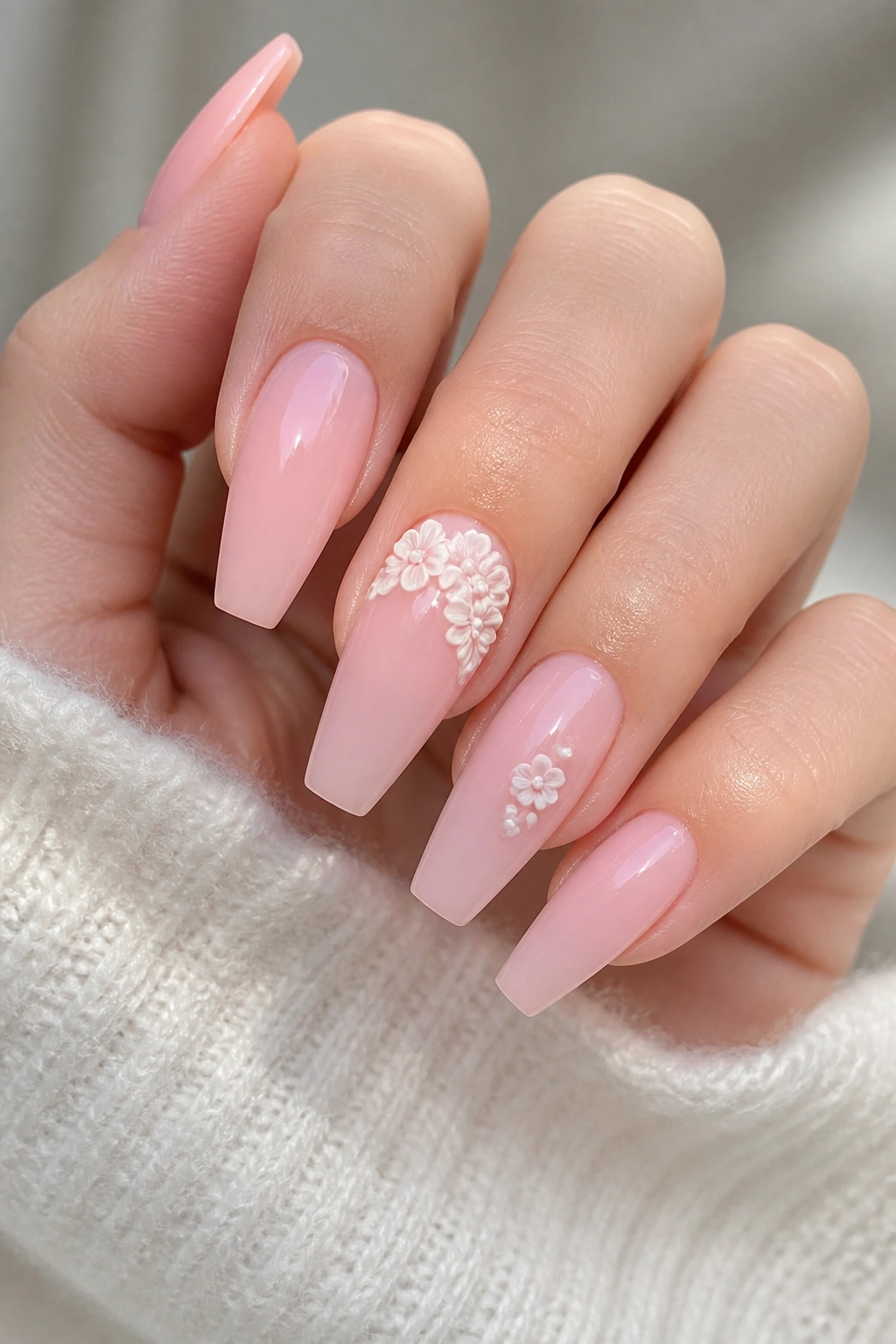
Want something softer than rhinestones but still dimensional? Small 3D white flowers on a baby pink base do that job.
This design lives or dies by restraint. One flower on each ring finger can be enough. Two clusters across the whole hand often looks balanced. More than that, and daily life starts fighting you—hair snags, pockets, sweaters, makeup brushes, all the unglamorous stuff.
Why the coffin shape helps
The straight edges and flat tip keep the set from turning too sweet. A round or oval nail pushes 3D florals toward a softer mood. Coffin keeps a little tension in the look, which is what makes baby pink and white petals feel polished instead of sugary.
Best ways to wear it
Place the flower near the cuticle or off to one side, not dead center on every nail. Tiny pearl centers can work if the flower itself stays small. Pair the accents with plain soft pink nails or clean white French tips on the rest of the hand so the texture has room to stand out.
If you type all day, ask for low-profile petals rather than raised sculpted blooms. You’ll thank yourself by dinner.
How to Keep Pink and White Coffin Nails Crisp Between Appointments
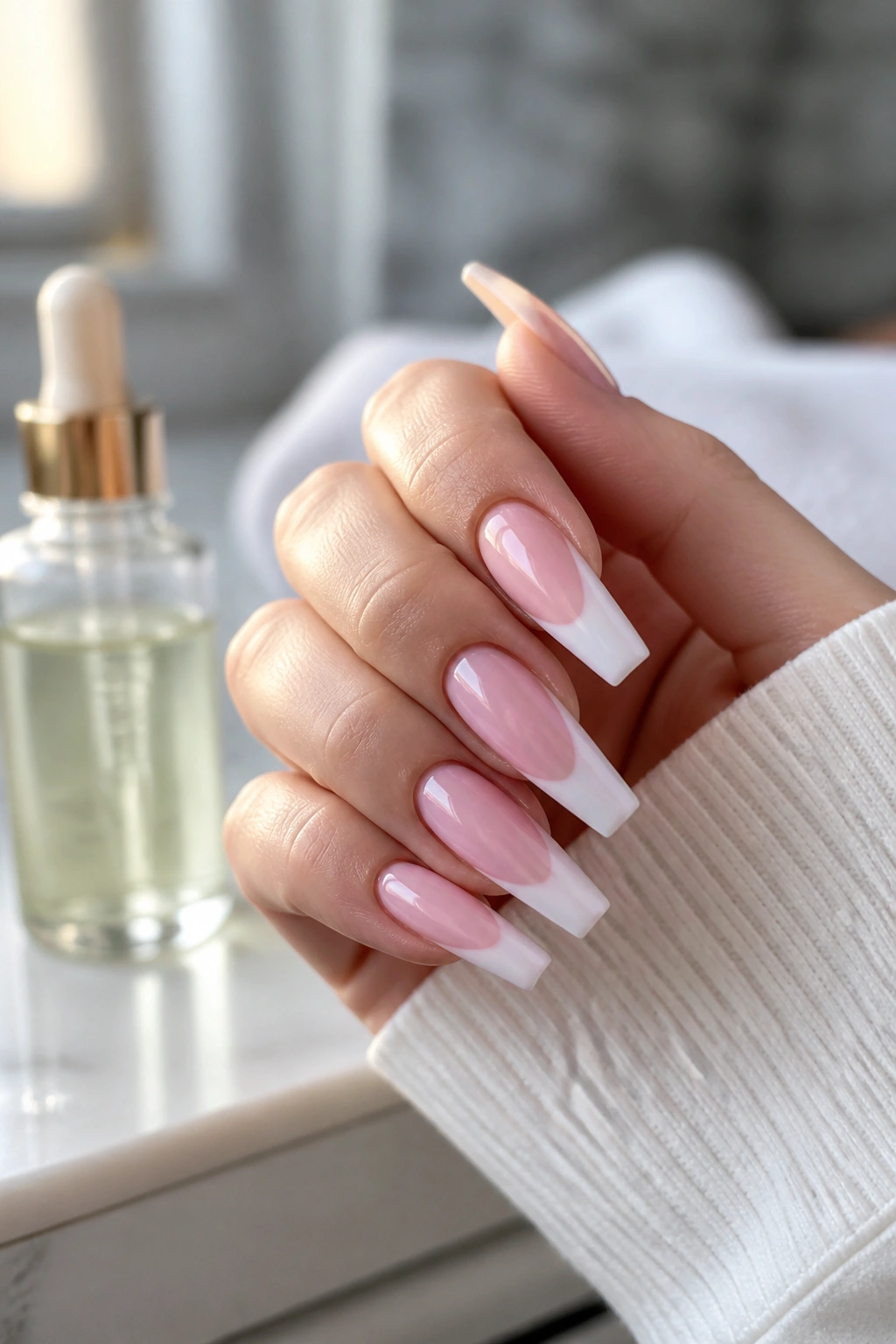
A clean pink-and-white set shows wear faster than dark polish. Chips, yellowing, lifting at the sidewall, and a dingy top coat all stand out because the palette is so light.
The easiest fix is also the least glamorous: cuticle oil twice a day. Morning and night is enough for most people. It keeps the surrounding skin from looking dry and makes fresh growth blend in better with a sheer pink base.
A few habits make a bigger difference than people expect:
- Wear gloves for dishwashing, cleaning sprays, and long hot-water chores.
- Use the pads of your fingers, not the nail tips, to open cans, peel labels, or dig in bags.
- File snags with a 180-grit file in one direction so the free edge stays sharp.
- Wipe matte or pale nails with a soft cloth and a little alcohol if lotion residue dulls the finish.
- Book fills or a rebalance around 2½ to 3 weeks if you wear medium-to-long coffin length.
If your white tips start looking dull, do not scrub them with random home solvents. That can cloud the top coat or weaken the seal at the edge. A quick fix appointment costs less than repairing a broken corner after you’ve picked at a lifted spot for three days.
Final Thoughts
The best pink and white coffin nails are not always the busiest set on the screen. More often, they’re the ones with the right pink, the right amount of white, and a coffin shape that stays crisp from thumb to pinky.
If you want my honest take, start narrower than your impulse tells you. Thinner tips, smaller art, cleaner lines. You can always add chrome, lace, or 3D flowers next time. Pulling back by 15 percent usually gives the manicure more mileage.
Save the photos you like, sure. Then pay attention to why you like them—the fade, the smile line, the finish, the placement. That’s how you walk into a salon wanting pink and white and walk out with a set that actually feels like yours.