


Burgundy matte coffin nails do something glossy red cannot. They make your hands look sharper, your rings look richer, and even a plain black sweater feel a little more considered. The color has weight to it. The matte finish strips away reflection, so the shape and tone do all the talking.
That is also why this manicure can go wrong fast.
A burgundy shade that leans too purple can fight with your skin tone. A coffin shape with too much width near the tip can make the whole set look bulky. And matte top coat—while I love it on dark shades—shows every ridge, dent, and uneven patch if the base underneath was rushed. Dark pigment is honest like that.
The payoff, though, is worth it. When the taper is clean, the sidewalls stay crisp, and the color sits somewhere between red wine and oxblood, burgundy matte nails hit that sweet spot between dramatic and polished. They feel dressed up without looking noisy. They also give you more room to play with detail than people think: micro-French edges, soft ombré fades, half-moons, tone-on-tone swirls, tiny stones used with restraint.
Some nail designs beg for extra glitter to feel finished. Burgundy matte coffin nails don’t need much. They just need the right idea.
Why Burgundy Matte Coffin Nails Work So Well on a Tapered Shape
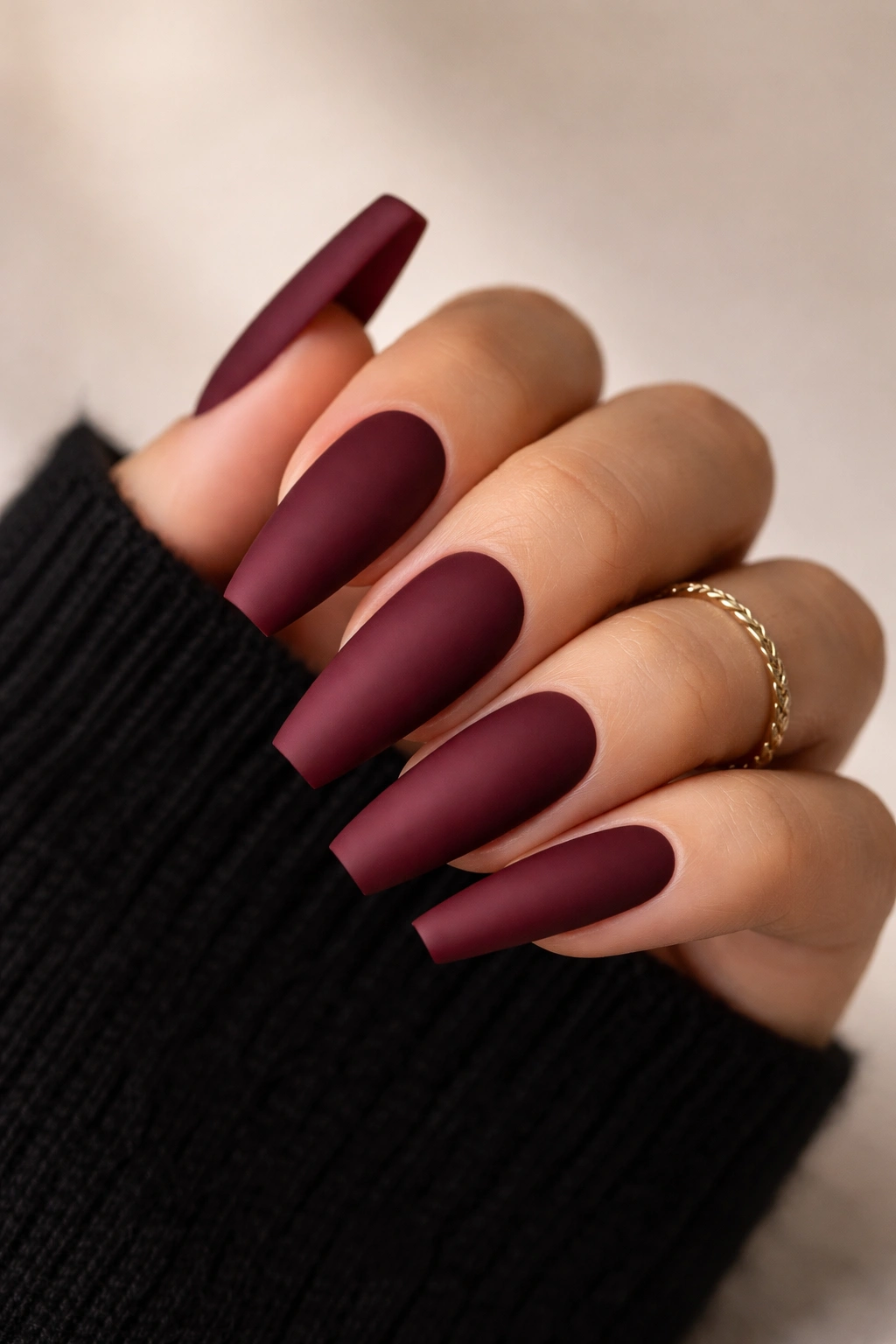
The coffin shape does one thing better than almost any other nail silhouette: it gives dark colors a clean runway. Because the nail narrows from the sidewalls and ends in a squared tip, your eye travels down the length of the nail in a straight, neat line. Burgundy loves that. A rounded shape can make deep shades feel softer. Coffin gives them edge.
Matte finish changes the color more than people expect. A glossy burgundy reflects light in bright streaks, which can make it read brighter and redder. A matte top coat scatters that light, so the polish looks deeper, flatter, and more velvety. The result sits closer to wine, cherry skin, or oxblood leather than candy-apple red.
Length matters here. Medium coffin nails—usually with about 4 to 8 millimeters extending past the fingertip—tend to show burgundy best without making daily tasks annoying. Longer sets can look amazing, but they need a balanced apex and sidewall structure or the dark color will make every little shape problem more obvious.
Then there’s contrast. Burgundy is already carrying a lot of visual weight. Put it on a soft square and it can feel safe. Put it on a coffin shape with a matte finish and the same color suddenly reads leaner, sharper, more deliberate.
That’s the whole appeal.
The Small Details That Keep a Matte Burgundy Set From Looking Flat
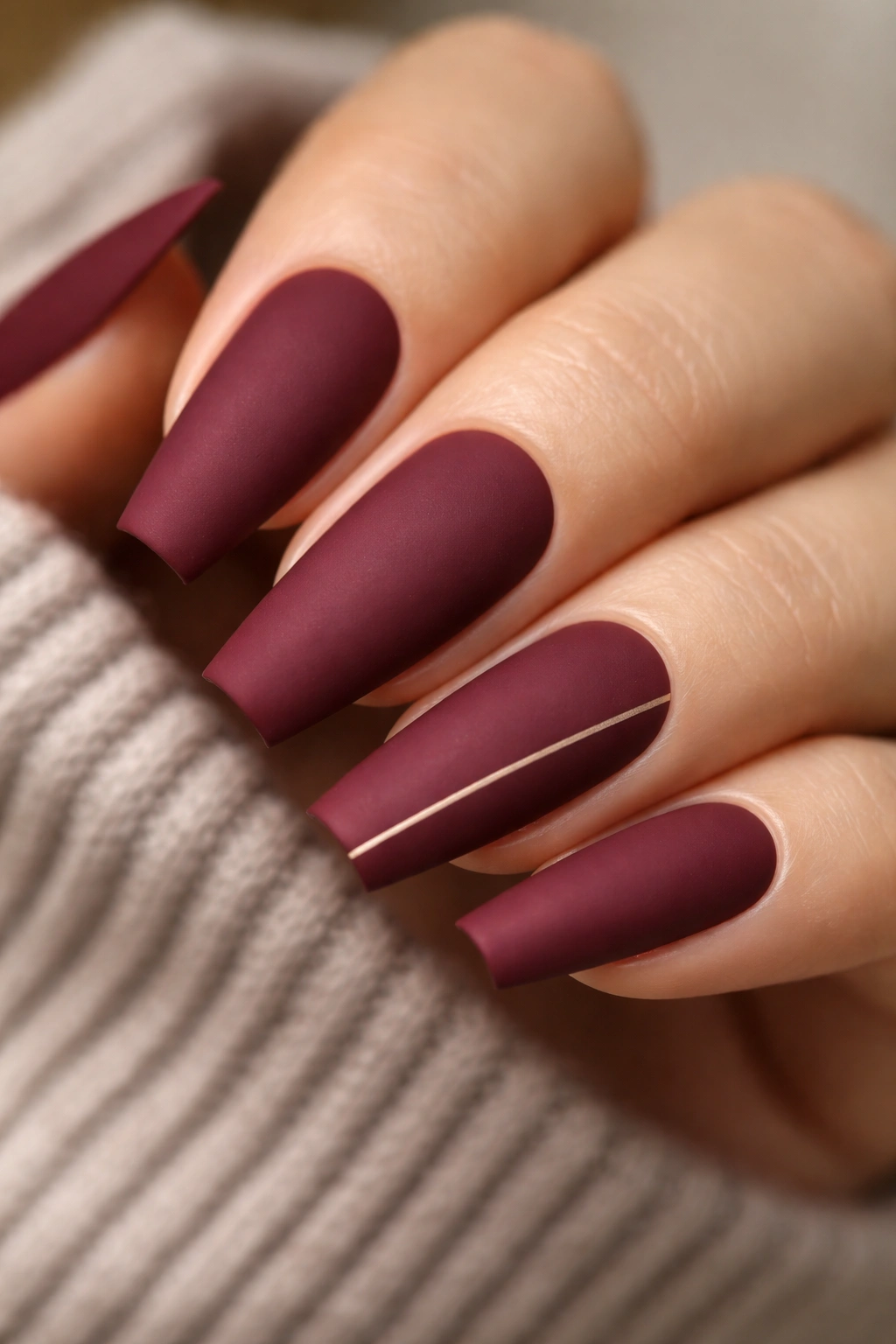
A matte manicure should look soft, not dusty. That difference usually comes down to prep and proportion.
Nail techs who do dark matte sets well pay close attention to the surface before color goes on. If the nail plate has bumps, leftover builder gel bulk, or a lumpy acrylic overlay, matte top coat will highlight it instead of hiding it. Burgundy is unforgiving in the best and worst ways. It looks rich on a smooth base and cheap on a rough one.
A few design choices help a matte set stay crisp:
- Choose the undertone on purpose. Blue-based burgundy feels cooler and moodier. Brown-based burgundy feels warmer, a touch softer, and often pairs better with gold jewelry.
- Keep accent work thin. A gold line that is 1 millimeter wide looks refined. A thick stripe can break up the nail too harshly.
- Use contrast sparingly. One glossy detail, one stone cluster, or one nude panel is usually enough on a dark matte set.
- Watch the tip thickness. Coffin nails look their best when the free edge stays slim rather than chunky.
- Seal the edges well. Matte top coats can wear shiny at the tips if the free edge wasn’t capped.
There’s another trick I come back to with dark matte colors: leave a little breathing room somewhere. Negative space, a slim French edge, a cuticle halo, one nude accent. A full ten-nail solid set can look excellent, yes, but even a small break in the color makes the shape look cleaner.
Now for the fun part.
1. Classic Solid Burgundy Matte Coffin Nails
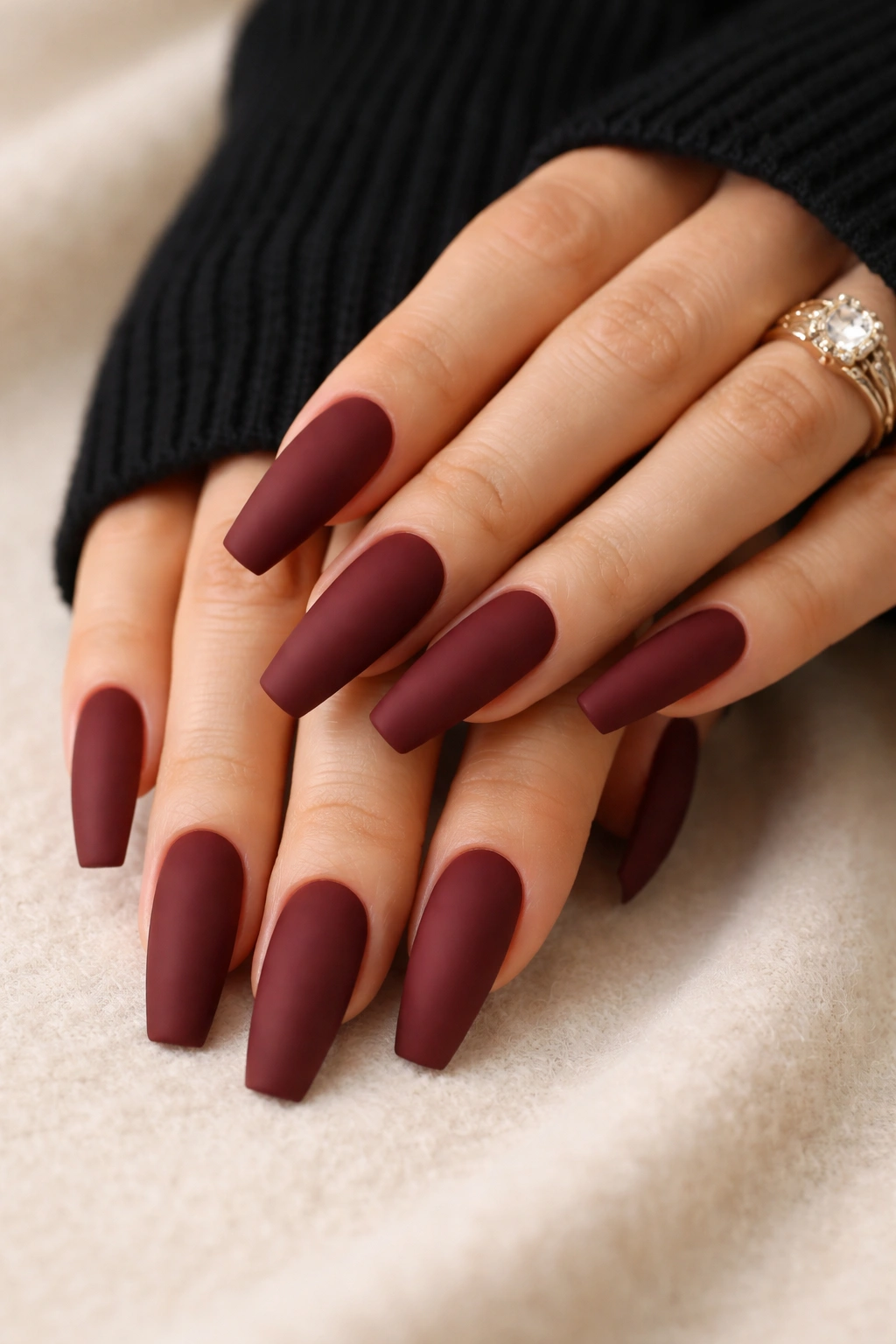
Start with the cleanest version first. A full set of solid burgundy matte coffin nails has nothing to hide behind, which is exactly why it works. If the shape is right, the color does all the heavy lifting. No glitter. No art. No apology.
This look leans on precision. The sidewalls need to taper evenly, the tip has to stay straight, and the color should be fully opaque in two to three thin coats rather than one heavy layer. On medium-length nails, a shade sitting between black cherry and merlot looks especially strong because it keeps depth without turning nearly black indoors.
Why the plain version still wins
Solid matte burgundy has a tailored feel that busy nail art cannot fake. It works with silver rings, gold bracelets, oversized knit sleeves, leather jackets, and office clothes that would swallow a louder manicure. The matte finish also makes the coffin shape more obvious, because there is no glare competing with the outline.
Details worth asking for
- Ask for a medium coffin shape with a slim tip, not a wide ballerina shape.
- Go for two coats of color plus one matte top coat instead of thick layers that can wrinkle during curing.
- If your nails are long, request a built apex near the stress point so the silhouette stays elegant instead of heavy.
- Pick a shade with a wine or oxblood base, not a bright cranberry red.
Best on: anyone who wants a dark manicure that still feels polished on all ten nails.
2. Burgundy Matte Coffin Nails with Glossy French Tips
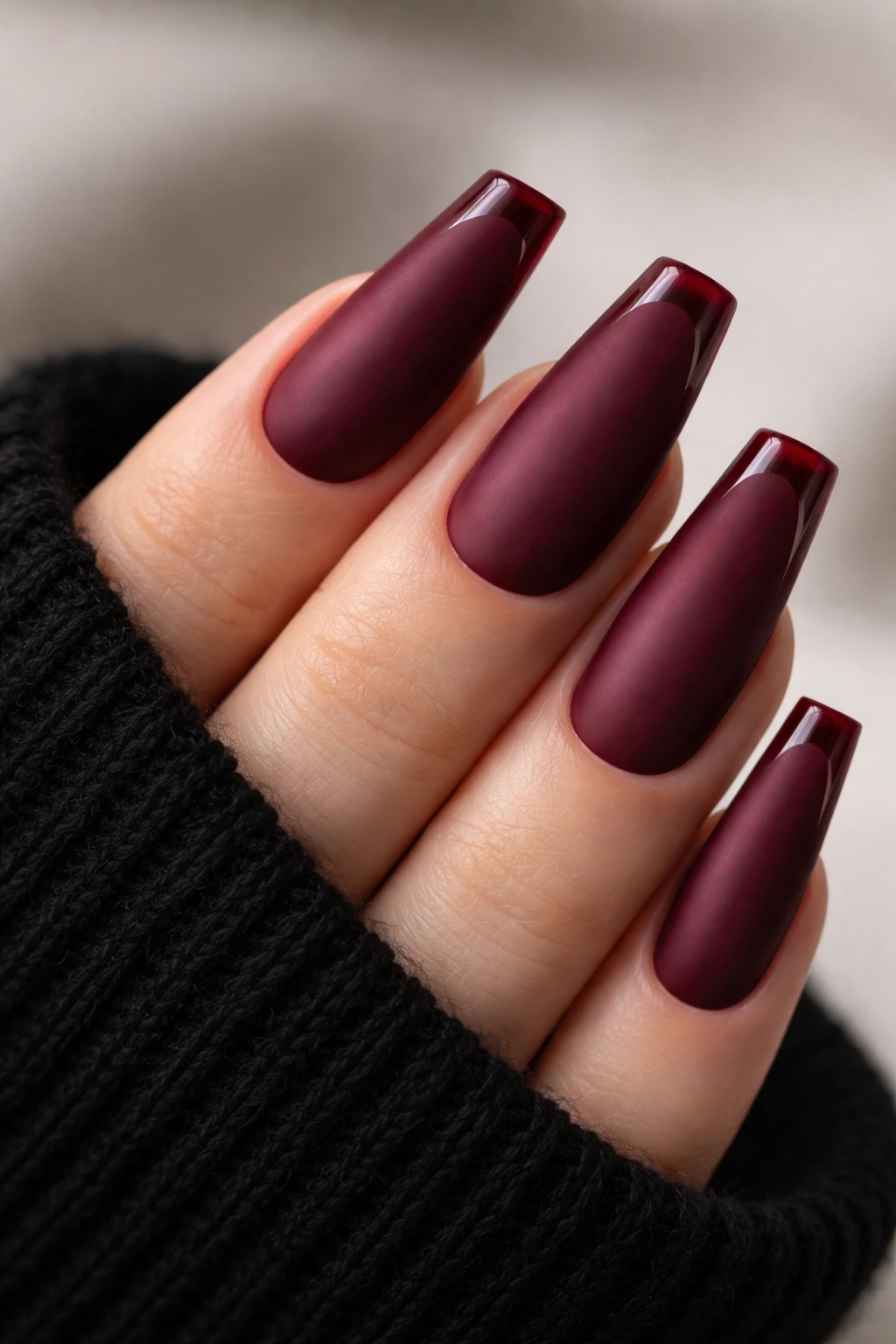
A matte base with glossy French tips looks sharper than a full glossy French set. The contrast is tiny, but your eye catches it right away. On burgundy, that shine difference reads like patent leather against suede.
The key is scale. Keep the French edge thin—around 1 to 2 millimeters on a medium coffin nail. A thick smile line can make the tip look heavy, and on a squared shape that extra width shows fast. I like this design most when the glossy tip follows the coffin edge in a clean, flat band rather than a deep curved smile.
Color match matters more than people think. The glossy tip should use the same burgundy shade as the matte base, not a darker red and not a blackened plum. When the pigment matches and only the finish changes, the design looks intentional. If the color shifts, the whole set can start to feel pieced together.
This one also wears well with jewelry. Since the detail lives at the edge, stacked rings do not compete with it. You still get a little movement when your hands catch the light, only at the tips, which is more interesting than an all-over shine.
Skip extra stones here. The finish contrast is enough.
3. Deep Wine Matte with Thin Gold Cuticle Lines
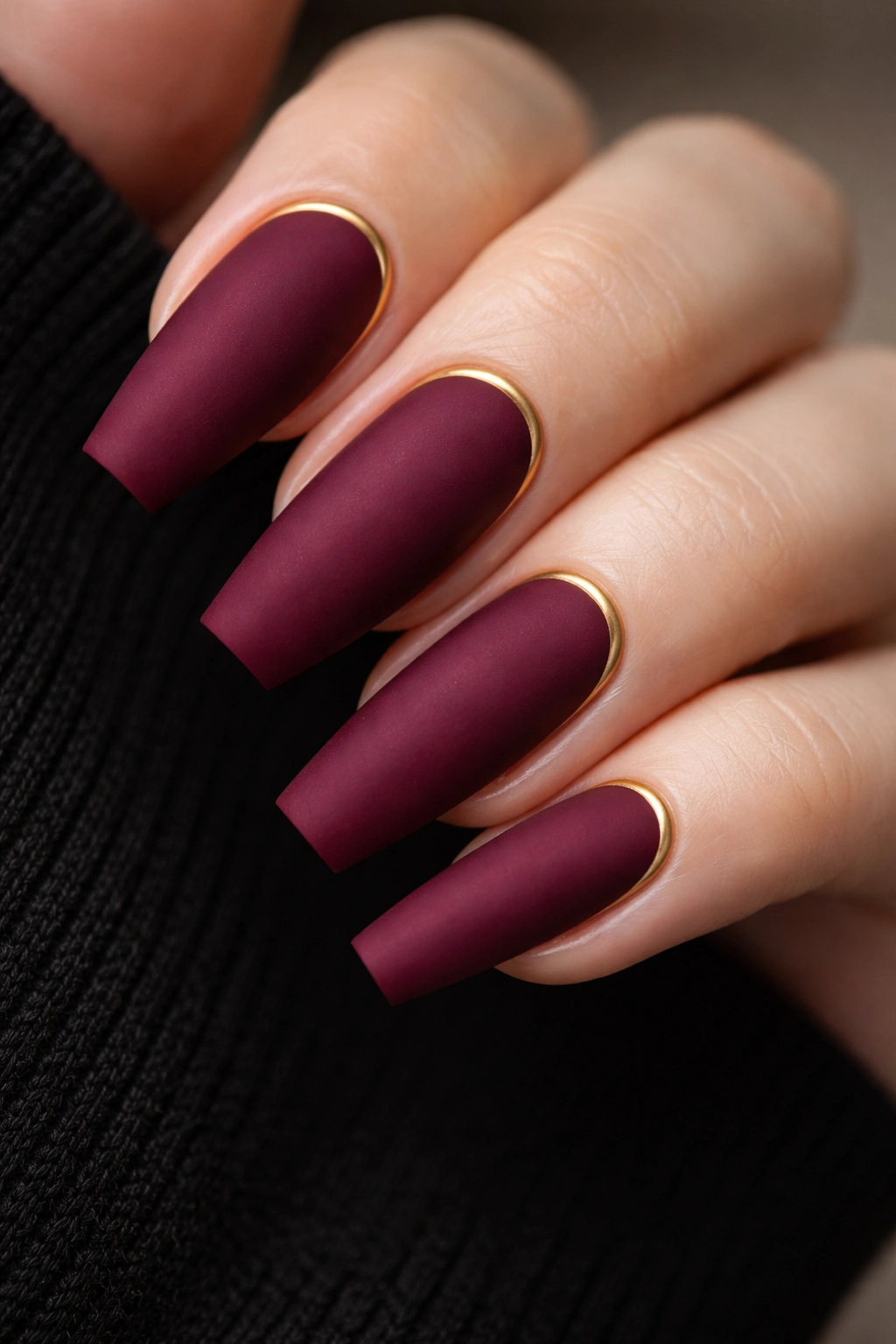
Why does a tiny line near the cuticle make such a difference? Because it frames the nail without interrupting the length. On coffin nails, that matters. Anything horizontal across the middle can visually shorten the shape. A slim gold arc at the base does the opposite—it outlines the growth area and leaves the rest of the nail long and clean.
Use restraint. A metallic line around 0.5 to 1 millimeter looks refined. Anything thicker starts to pull attention away from the burgundy itself, and that would be a waste because deep wine matte polish already has enough character on its own.
Where this design earns its keep
Gold near the cuticle pulls warm undertones out of burgundy shades that lean brown, brick, or dried-plum. The pairing feels rich without needing stones, foil flakes, or chrome powder across the whole nail. It also grows out more gracefully than center-placed art because the detail sits where your eye expects a little visual change anyway.
How to keep it from looking busy
Ask for one of these two versions:
- A single gold half-moon line on every nail
- Full burgundy nails with the gold line on only two accent fingers per hand
A fine painted line usually looks cleaner than metallic striping tape, which can lift at the edges if it was not sealed flat.
If you wear warm metals most days, this set makes sense fast.
4. Burgundy Matte Ombré Fading into Black Tips
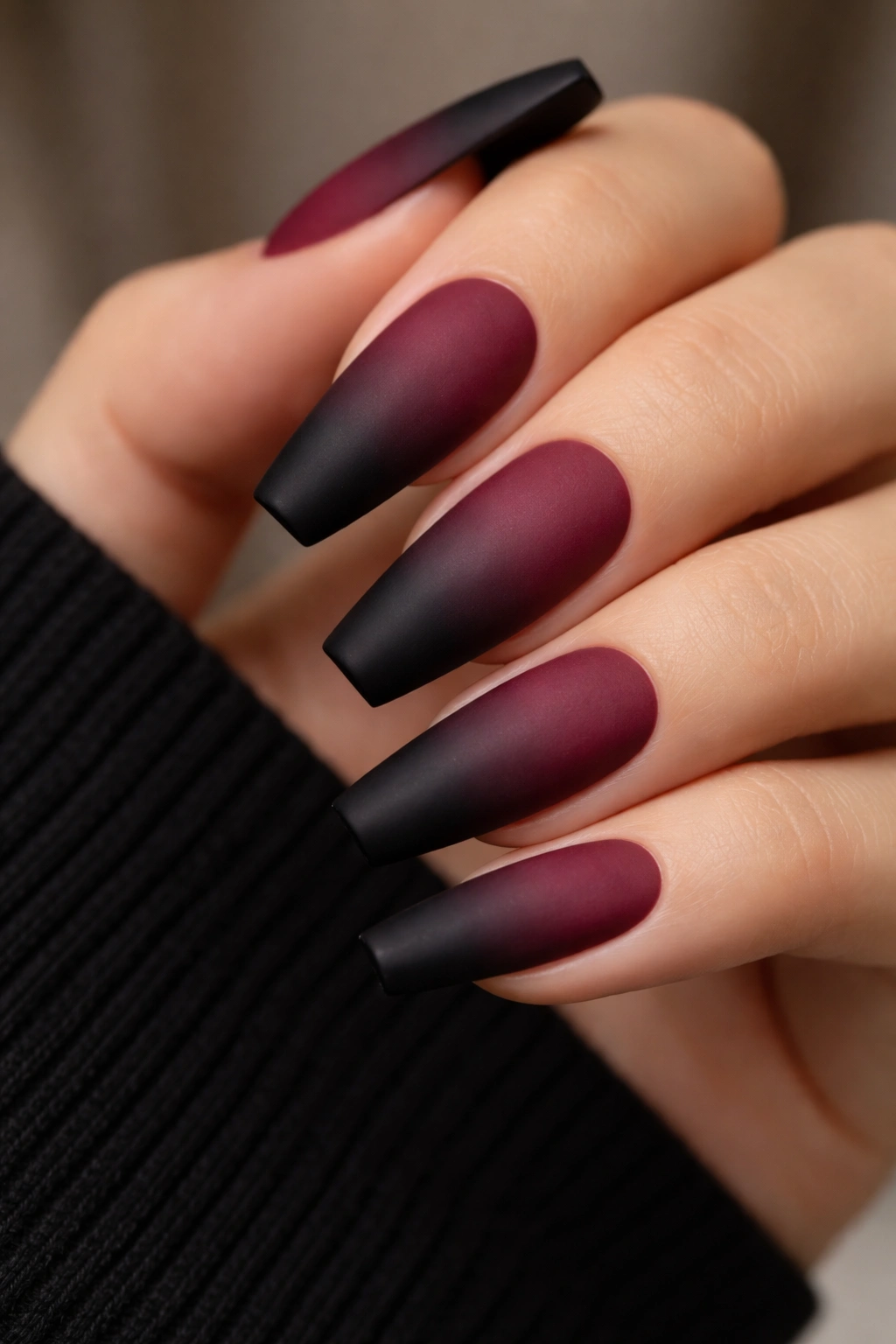
Picture the nail from a few feet away. You don’t see two colors first. You see a shadow deepening toward the tip. That is why this design works so well on coffin nails. The shape already narrows toward the edge, and the black fade makes that taper look even cleaner.
The blend needs a soft hand. A harsh halfway line kills the effect. On a medium or long coffin shape, the fade should start around the last third of the nail, with the darkest point concentrated near the free edge. Too much black too early and you lose the burgundy. Too little and the ombré looks accidental.
A sponge blend can work, though on gel sets an airbrushed fade or finely blended brush technique usually looks smoother. Matte top coat softens the transition another step, which helps. What looked a little strong under gloss often settles down once the shine comes off.
A few things make this design sing:
- Longer coffin nails show the fade better than short ones
- Blue-based burgundy creates a moodier blend with black
- No extra art keeps the gradient clean
- Black on all ten tips looks stronger than using ombré on one accent nail
There is a slight downside. Tip wear can show earlier because the darkest pigment sits where nails hit keyboards, drawers, steering wheels, and everything else. If you’re rough on your hands, ask your tech to cap the free edge carefully and add a fresh matte top coat when shine starts to creep in.
5. Shorter Coffin Nails in Soft Merlot Matte
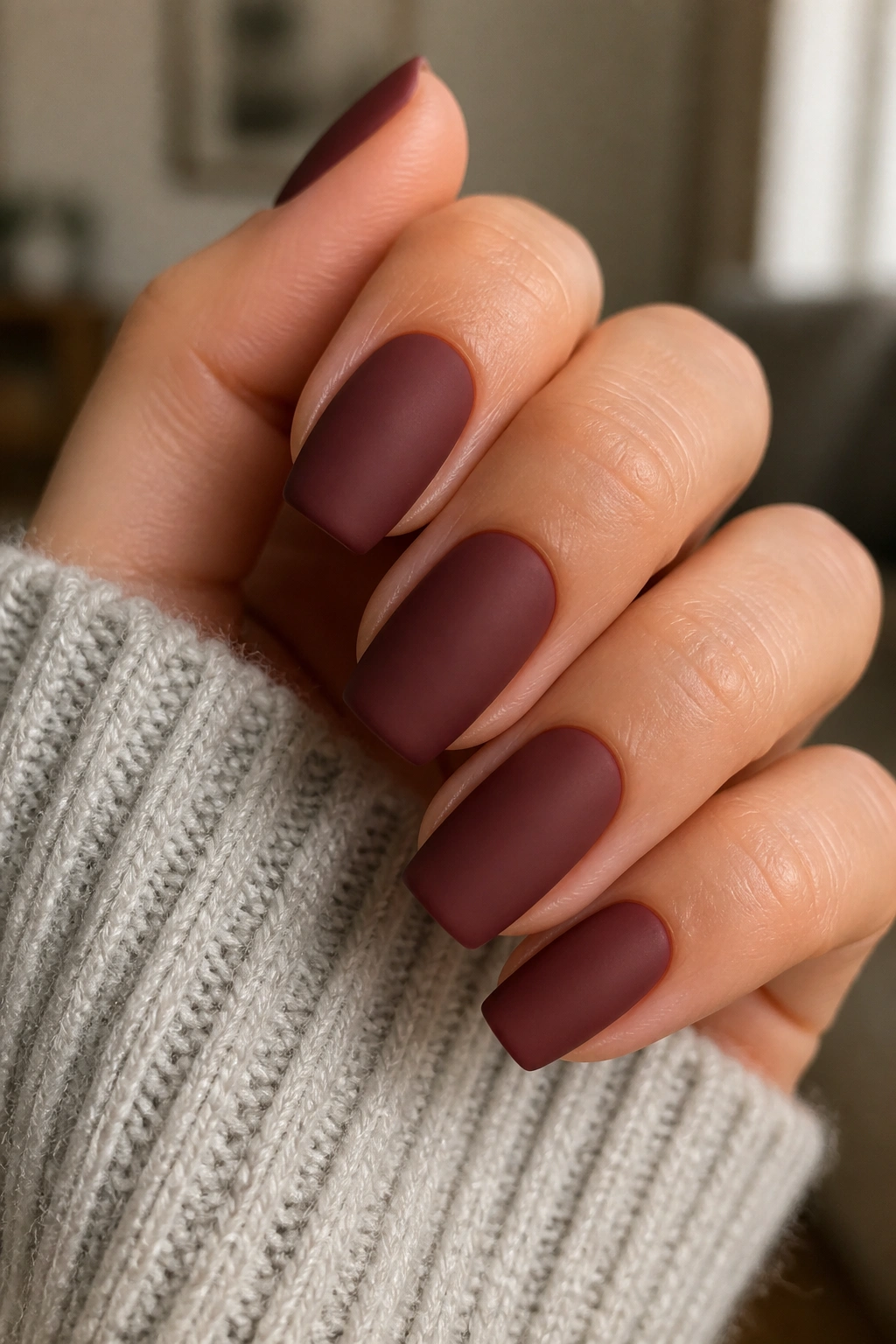
Not every coffin set needs dramatic length. A shorter coffin—something neat, with a flat tip and only a little taper—can make burgundy feel smarter and easier to wear. Think less nightclub, more polished weekday manicure with better shape than a plain square.
This version works best in a merlot tone that has a touch more red in it. Go too dark on a short nail and the color can collapse into near-black, especially indoors. A softer wine shade keeps dimension in the pigment so the manicure still reads burgundy from arm’s length. Matte top coat helps it look velvety instead of shiny and loud.
Short coffin nails also fix a problem some people have with deep dark manicures: they can feel too severe on wide nail beds. Trimming the length back by 2 or 3 millimeters and choosing a gentle coffin taper keeps the look balanced. You still get that squared-off edge, only without the full drama of a long set.
I like this style for people who type all day, lift weights, cook a lot, or simply hate babying their nails. The shape stays practical. The color still has bite. And because the design is plain, grow-out is less distracting than on sets with heavy art placed near the cuticle.
There is a reason nail techs often steer hesitant clients toward this kind of set first. It gives you the mood of burgundy matte without demanding that your whole routine change around your manicure.
6. Matte Burgundy Nails with One Glossy Accent Nail
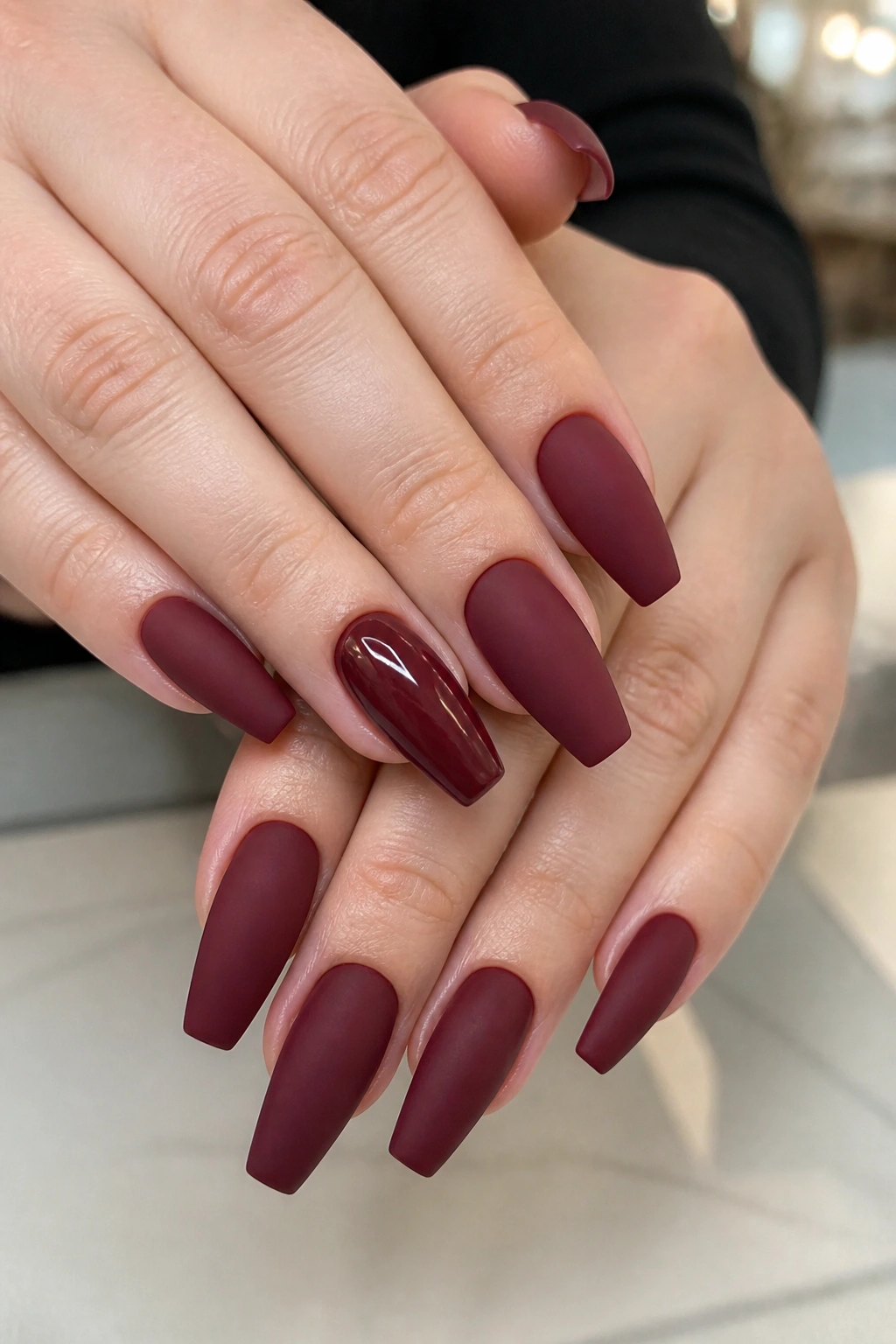
Unlike glossy tips, which keep the shine at the edge, a single glossy accent nail gives the set a focal point. One nail per hand—usually the ring finger or middle finger—stays glossy while the other nails wear the same burgundy in matte. That tiny shift makes the color look deeper on both finishes.
Who is this best for? People who like a dark manicure but want a little contrast without dealing with line work, stones, or hand-painted detail. It is also a smart pick if your salon does clean color application better than detailed art. A finish contrast is hard to mess up when the polish itself is applied well.
The strongest version uses the exact same shade on every nail and changes only the top coat. That matters. If the accent nail uses a darker burgundy, it can look like the tech ran out of one bottle and grabbed another. Matching pigment keeps the difference crisp.
I’d keep the glossy nail plain. No foil. No rhinestones. No chrome stripe. Matte versus shine already gives enough texture play, and the restraint is what makes the set feel deliberate rather than random.
If you want a manicure that still feels dark and tidy from a distance but shows a little more character up close, this one hits the mark.
7. Burgundy Matte Coffin Nails with Negative-Space Half Moons
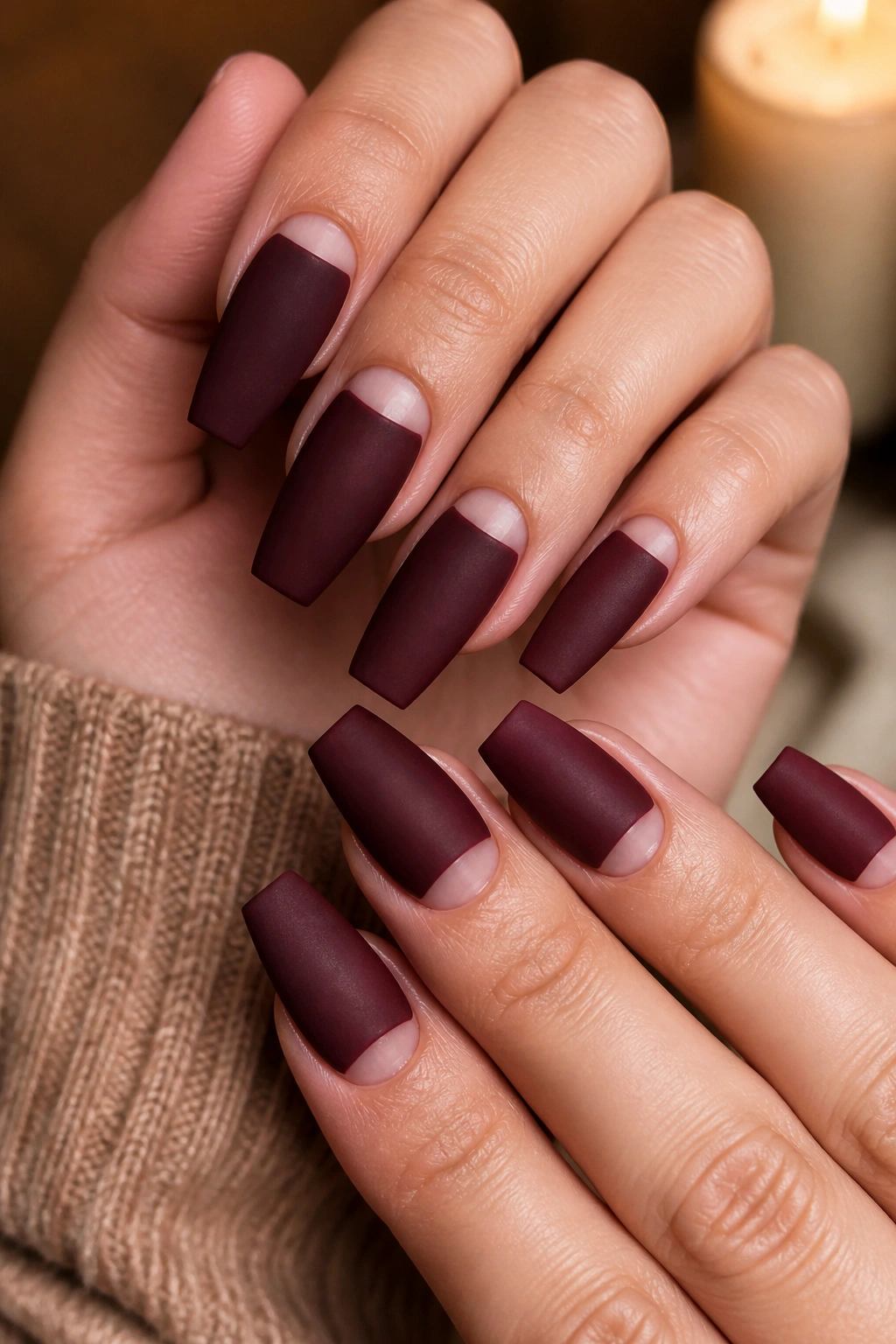
Some designs need sparkle to break up a dark shade. This one uses empty space instead, and it looks cleaner for it. A negative-space half moon leaves a slim crescent near the cuticle bare or sheer nude while the rest of the nail wears burgundy matte.
That gap does two useful things at once. It lightens the set, and it makes grow-out less harsh. If your manicures stretch past the two-week mark, you’ll appreciate that. The new growth blends into the design rather than interrupting it.
Why the placement matters
Cuticle-focused details work well on coffin nails because they preserve length. A half moon sits at the base, where the eye naturally starts, and leaves the long central panel untouched. The shape still reads sleek and narrow. Put the empty space in the middle instead and the nail can look chopped into sections.
Two ways to wear it
- Bare crescent with full burgundy coverage on the rest of each nail
- Sheer pink or beige half moon if you want a softer line at the base
Use a thin, crisp curve. A chunky half moon can look retro in a way that fights the coffin shape. A slim crescent—about 2 to 3 millimeters at its tallest point—keeps it neat.
There’s a quiet confidence to this one. The set feels designed, not decorated.
8. Dark Cherry Matte with Tiny Rhinestone Clusters
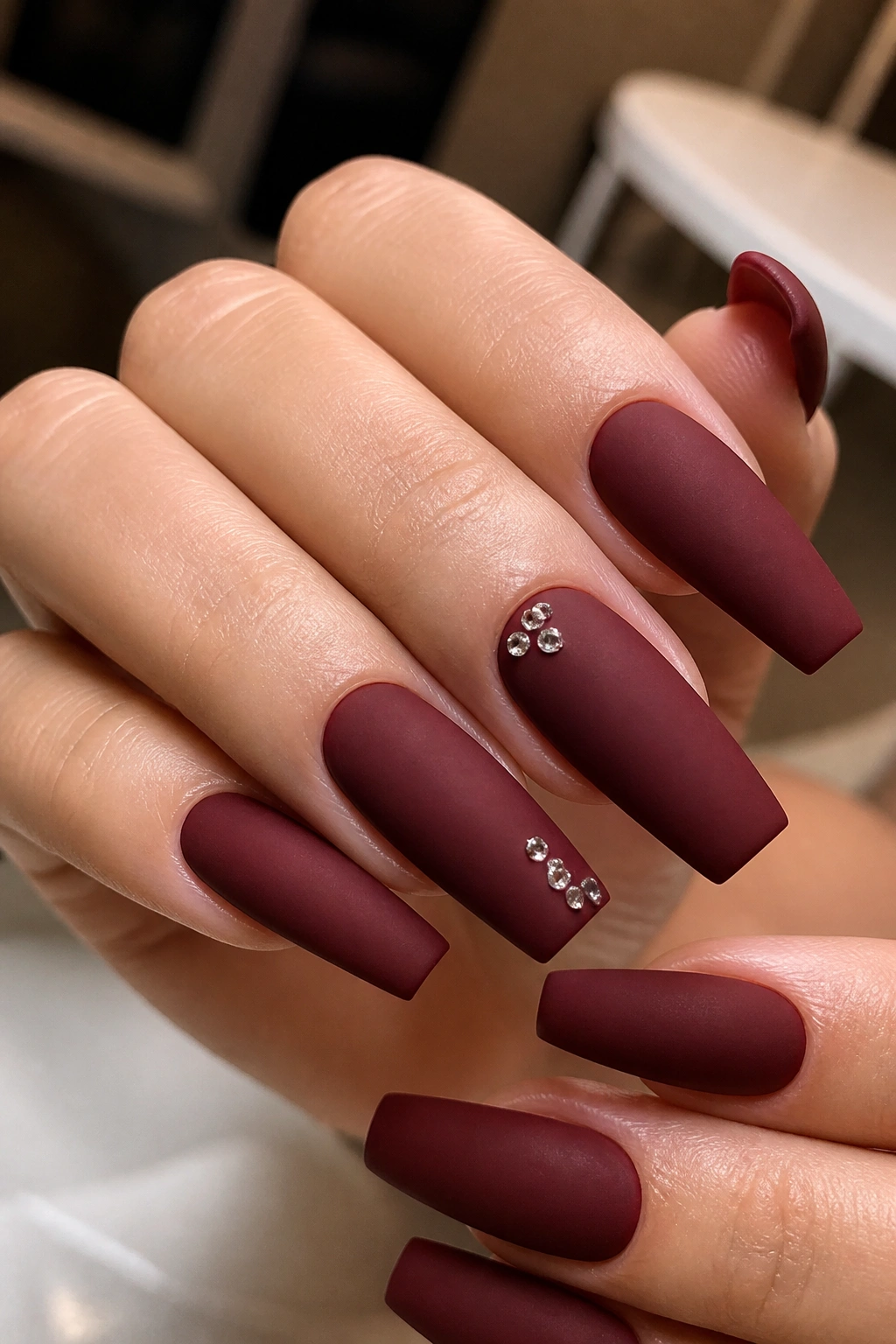
Stones on matte nails can go sideways fast. Too many and the whole set loses its soft, velvety effect. Tiny clusters, though—two or three stones placed with care—add a little light without dragging the manicure into costume territory.
Dark cherry is the shade I’d pick here rather than the deepest oxblood. It keeps enough red in the polish so the matte finish still has life once you add crystal detail. On a nearly black burgundy, stones can look disconnected, almost pasted on. On a cherry-wine base, the contrast feels more natural.
Placement is everything. The cleanest option is a small cluster near one side of the cuticle on one or two nails per hand. Not centered. Not repeated on every finger. A triangle made from one 3-millimeter stone and two 1.5-millimeter stones gives enough sparkle without lifting the profile too much.
A few quick rules keep this design on the right side of restraint:
- Use clear or deep garnet stones, not rainbow crystals
- Limit the embellishment to 2 to 4 nails total
- Keep the rest of the set plain matte burgundy
- Ask for stones to be set into gel rather than glued on top if you want better wear
This is a good party manicure, yes, though it also works when you want dark nails with one bright point of light and not much else.
9. Velvet-Effect Burgundy Matte with Tone-on-Tone Swirls
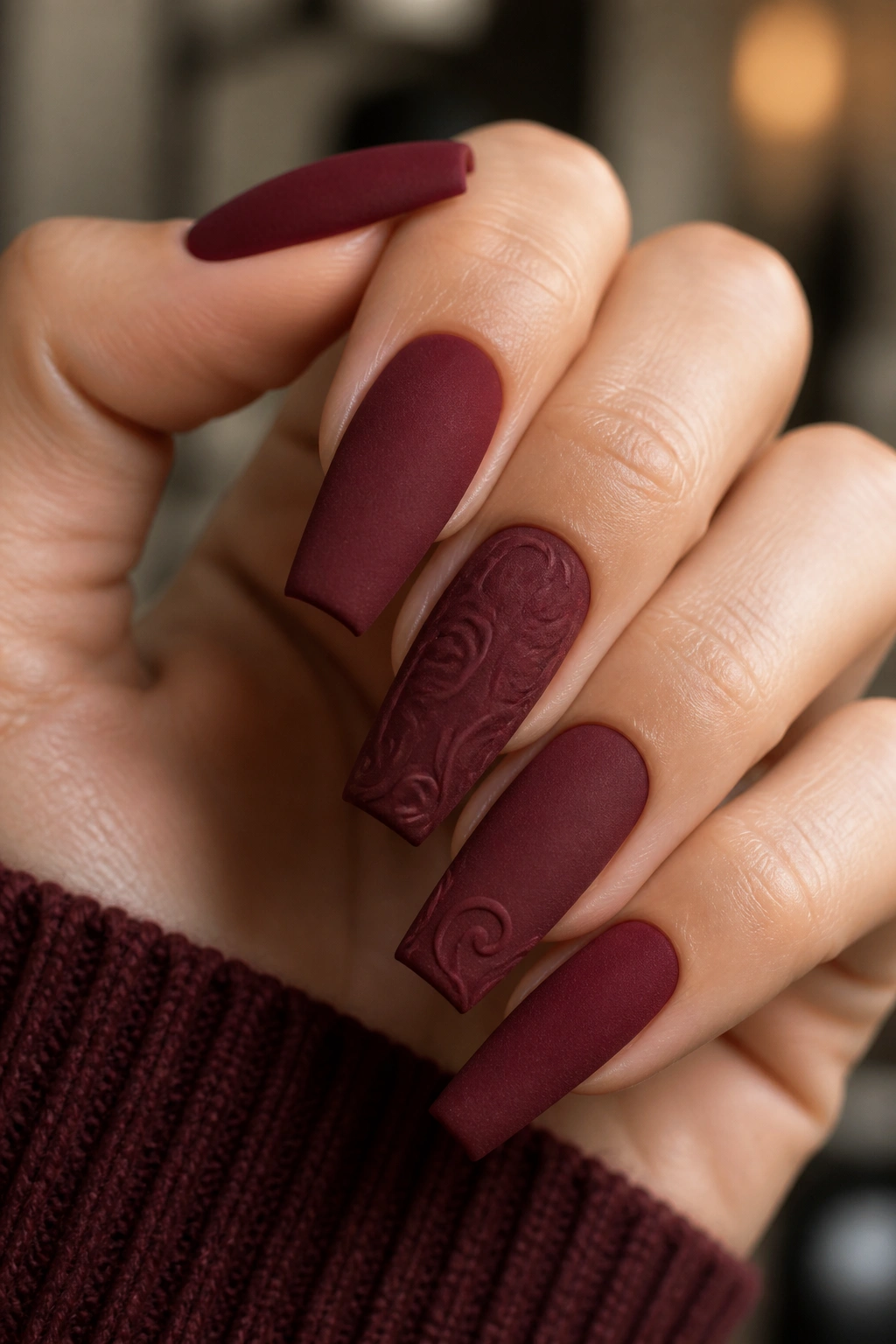
This one is subtle in a way that photos do not always catch. The base stays matte burgundy, then slightly darker or slightly glossier burgundy swirls move across one or two nails like smoke in red wine. From some angles you notice the pattern right away. From others it almost disappears.
That disappearing act is the charm.
Because the color difference stays tight, the design looks textured rather than loud. On coffin nails, long S-curves and narrow wave lines work best because they follow the length of the shape. Thick blob-like swirls can make the nail look crowded. Ask for lines that taper in and out, almost like marbling, with open space left between them.
You can get this effect a few ways. Some techs paint the swirls with the same shade and switch only the top coat, leaving the pattern glossy against a matte base. Others use a deeper burgundy gel by one or two shade steps. I lean toward the finish change rather than the color change because it keeps the manicure cohesive.
This design suits people who want nail art that doesn’t announce itself from across the room. It rewards a closer look. There’s also less risk of clashing with clothing because the palette stays narrow—burgundy on burgundy, maybe with one nail left plain for balance.
A small warning, though. Swirls need clean line work. Muddy, thick curves will ruin the effect faster than almost any other detail on this list.
10. Matte Burgundy and Nude Color-Block Coffin Nails
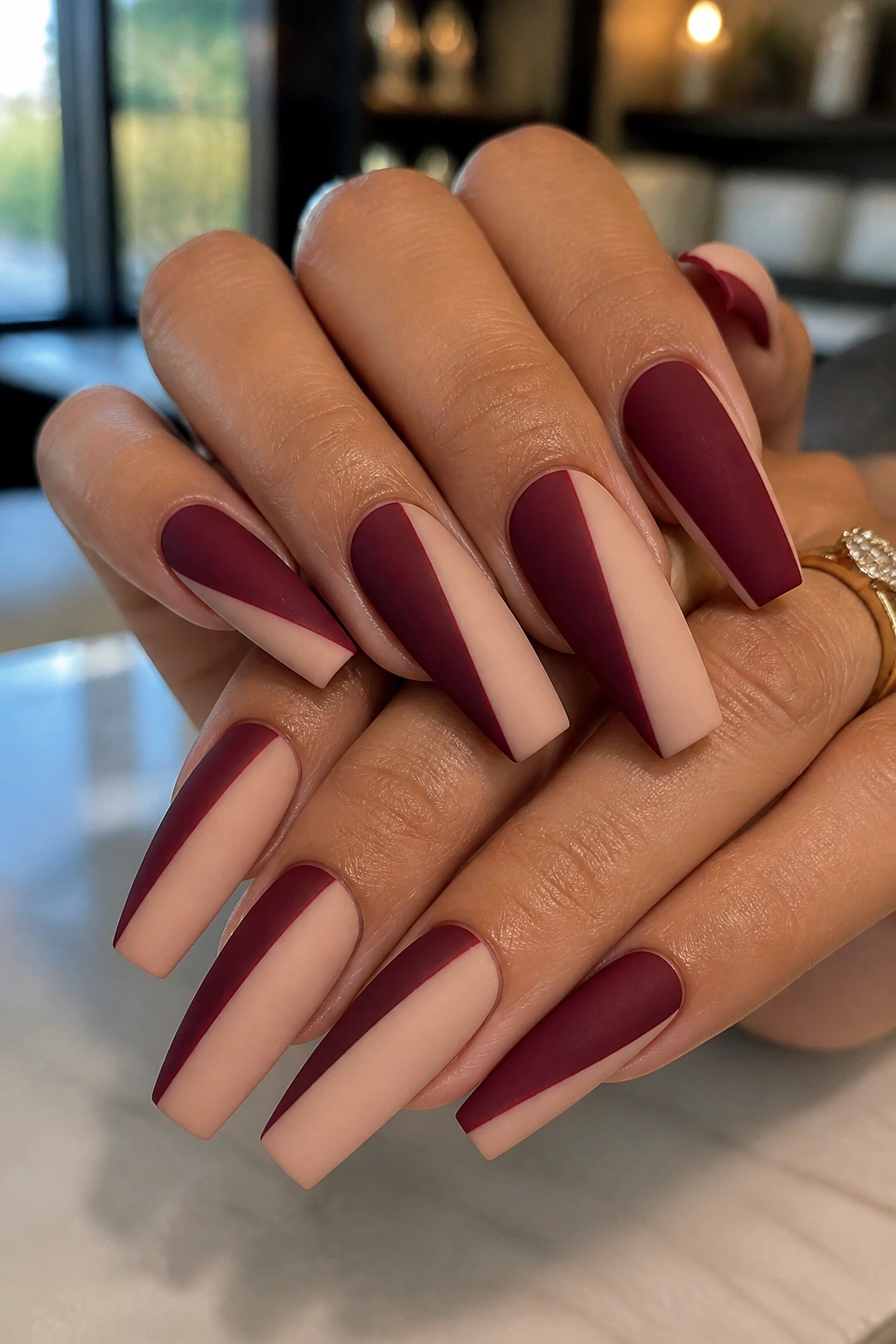
Can a dark manicure still feel light? Yes—if part of the nail stays nude.
Color-blocking burgundy with a soft beige or pink-nude panel is one of the easiest ways to keep coffin nails from looking too heavy, especially on longer lengths. The nude section gives your eye a place to rest. The burgundy section keeps the manicure grounded. On a slim coffin silhouette, diagonal blocks work better than horizontal ones because they preserve length.
Where this design works best
Longer nail beds and long extensions handle color-blocking well because there is enough room for each section to breathe. On short nails, the blocks can start to look cramped unless the nude panel is small and placed near one side.
Clean versions worth saving to your idea folder
- Diagonal split: burgundy on one side, nude on the other, divided by a fine line
- Side panel: a narrow nude strip running from cuticle to tip along one edge
- Inverted tip block: nude at the base, burgundy covering the upper two-thirds of the nail
A matte top coat over both colors gives the set a softer, editorial feel. Leaving the nude glossy while the burgundy stays matte can work too, though I would only do that if the salon is sharp with crisp lines. Color-blocks expose crooked edges instantly.
For anyone who likes burgundy but wants something lighter on the hand, this design earns a spot high on the list.
11. Burgundy Matte Coffin Nails with Black Micro-French Edges
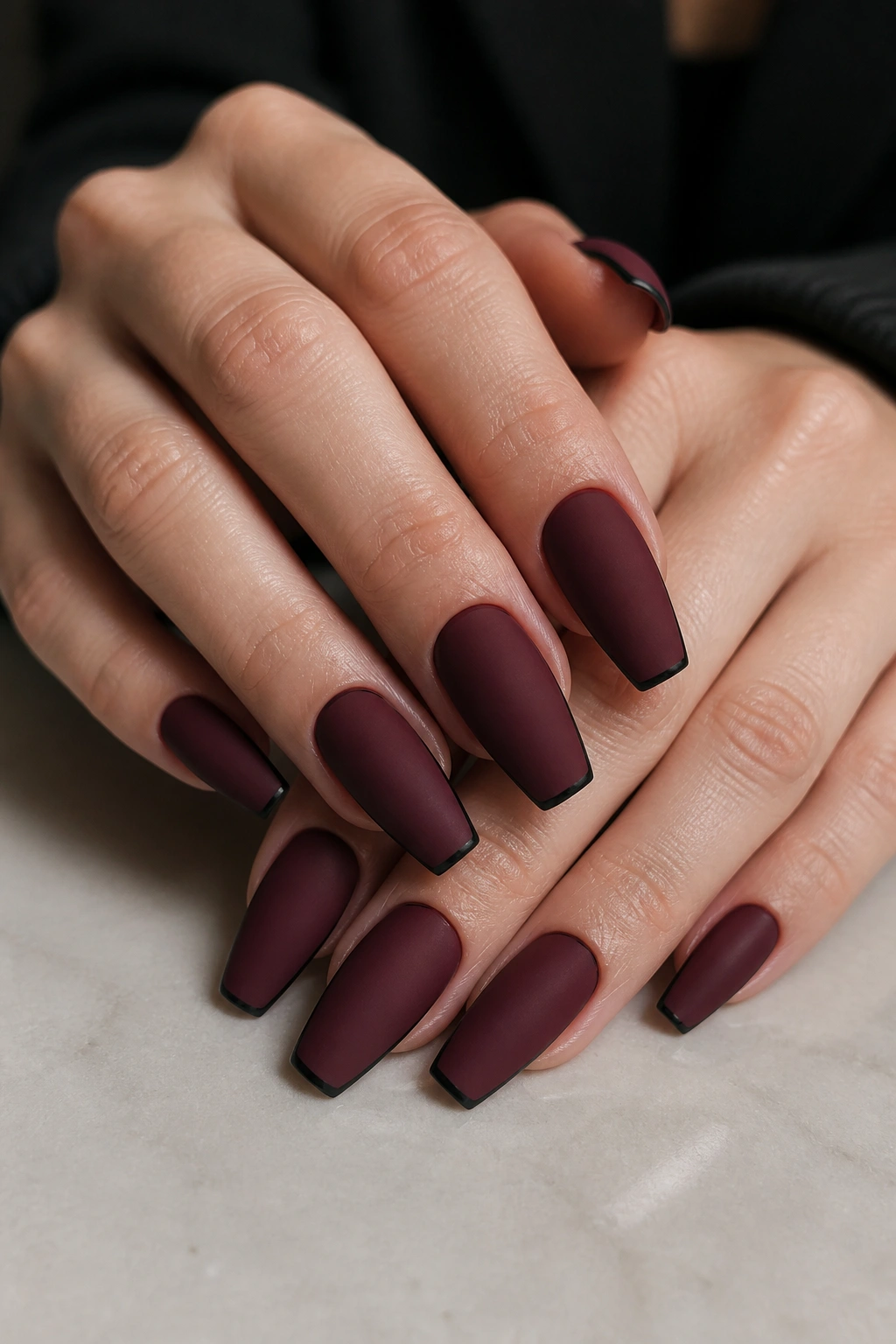
If the glossy French tip is the polished cousin, the black micro-French is the sharper one. A whisper-thin black line along the flat coffin edge gives burgundy matte coffin nails a cleaner, more graphic finish than a same-color tip ever will. It looks precise. A little strict. In a good way.
The line needs to stay tiny. Think hairline to 1 millimeter, not a thick black band. Once the black gets too wide, it takes over the manicure and turns the burgundy into background. The best version feels like the tip was outlined with ink.
This design shines on medium and long coffin nails because the square edge gives the black line a clear place to sit. Almond nails do not carry the same crisp contrast. Coffin does. That flat edge is the whole point.
I’d choose a burgundy with a cooler base for this pairing. Blue-red wine shades, dark cherry, plum-red—those sit more naturally beside black than warm brick burgundies do. Keep every other detail stripped back. No crystals. No foil. Maybe one full solid nail if you want variation, though I’d wear all ten the same and let the micro-edge do its job.
It’s a manicure for people who like dark colors but hate fuss. You glance at it and think, yes, that was thought through.
12. Matte Oxblood Coffin Nails with Subtle Chrome Details
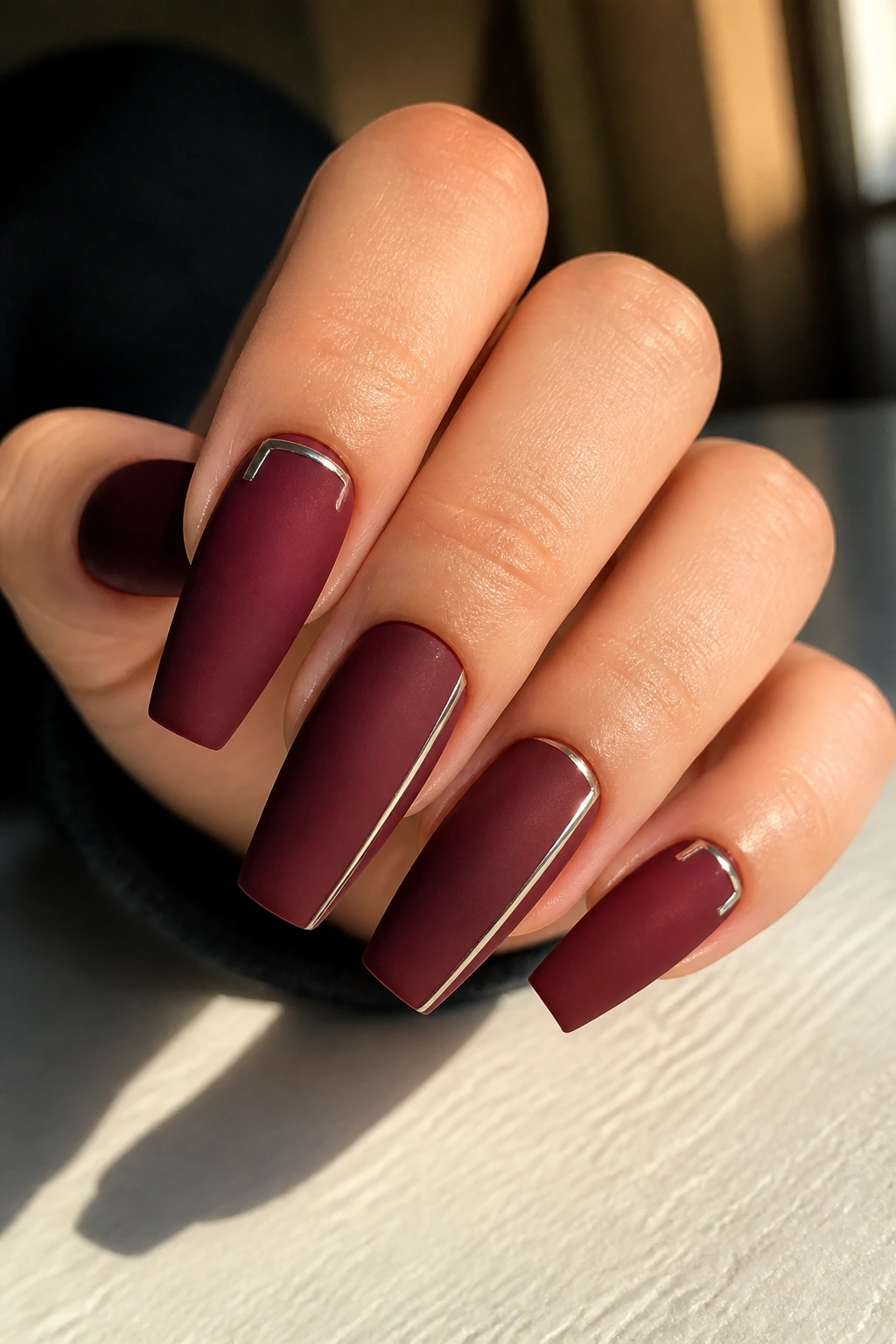
Chrome on matte nails sounds like a clash until you keep it controlled. Oxblood matte polish paired with the thinnest chrome accent—one line, one corner detail, one cuticle slash—looks less flashy than you might think. The matte surface swallows most of the light. The chrome only flashes in small hits.
The color here should lean deep, brown-red, almost dried-blood oxblood, not bright wine. That heavier base gives the metallic detail something to bite against. Silver chrome feels colder and cleaner. Old-gold chrome warms the set up and pairs better with tan, olive, and deep skin tones.
The details that work best
- A single vertical chrome line down one side of two accent nails
- A tiny chrome corner frame hugging one upper edge
- A fine chrome cuticle slash placed off-center rather than in a full arc
What to skip
- Full chrome accent nails
- Thick metallic bands across the middle
- Mirror powder rubbed over large sections of the nail
- More than two chrome placements per hand
Less is the whole strategy. Once chrome starts taking up too much space, the matte finish loses its point. Keep it lean and the contrast feels smart.
How to Ask for the Set You Actually Want

A photo helps, though the words you use matter almost as much. “Burgundy matte coffin nails” is a solid start, but it still leaves room for at least five different reds, two coffin widths, three lengths, and a pile of finish choices. Nail techs work faster when you narrow it down.
Be specific about the shade first. Say black cherry, merlot, deep wine, oxblood, or brown-based burgundy. Those words give more direction than “dark red.” If you have a preference between cool and warm tones, say that too. Cool burgundy often flatters silver jewelry and cool clothing palettes. Warm burgundy tends to sit better with camel, cream, bronze, and gold accessories.
Shape comes next. “Coffin” can mean slim and sharp or wide and soft depending on the salon. Ask for a narrow coffin with straight sidewalls and a slim flat tip if you want that cleaner editorial look. If you need the set to stay practical, ask for a shorter coffin with only a small free-edge extension past the fingertip.
Then talk about the finish and accents in plain language:
- “Same shade, matte base, glossy French tip”
- “Matte burgundy with one glossy accent nail”
- “Deep wine matte with a thin gold cuticle line”
- “Ombre from burgundy into black at the tips”
- “Matte all over, no glitter, no chunky stones”
One small thing people forget: ask whether the design is being done in gel polish over natural nails, builder gel, acrylic, or hard gel. Dark matte colors look different depending on how smooth and even the base product is. If your natural nails have ridges, builder gel under a matte dark shade often gives a cleaner final result.
How to Keep Matte Burgundy Nails Looking Soft Instead of Shiny
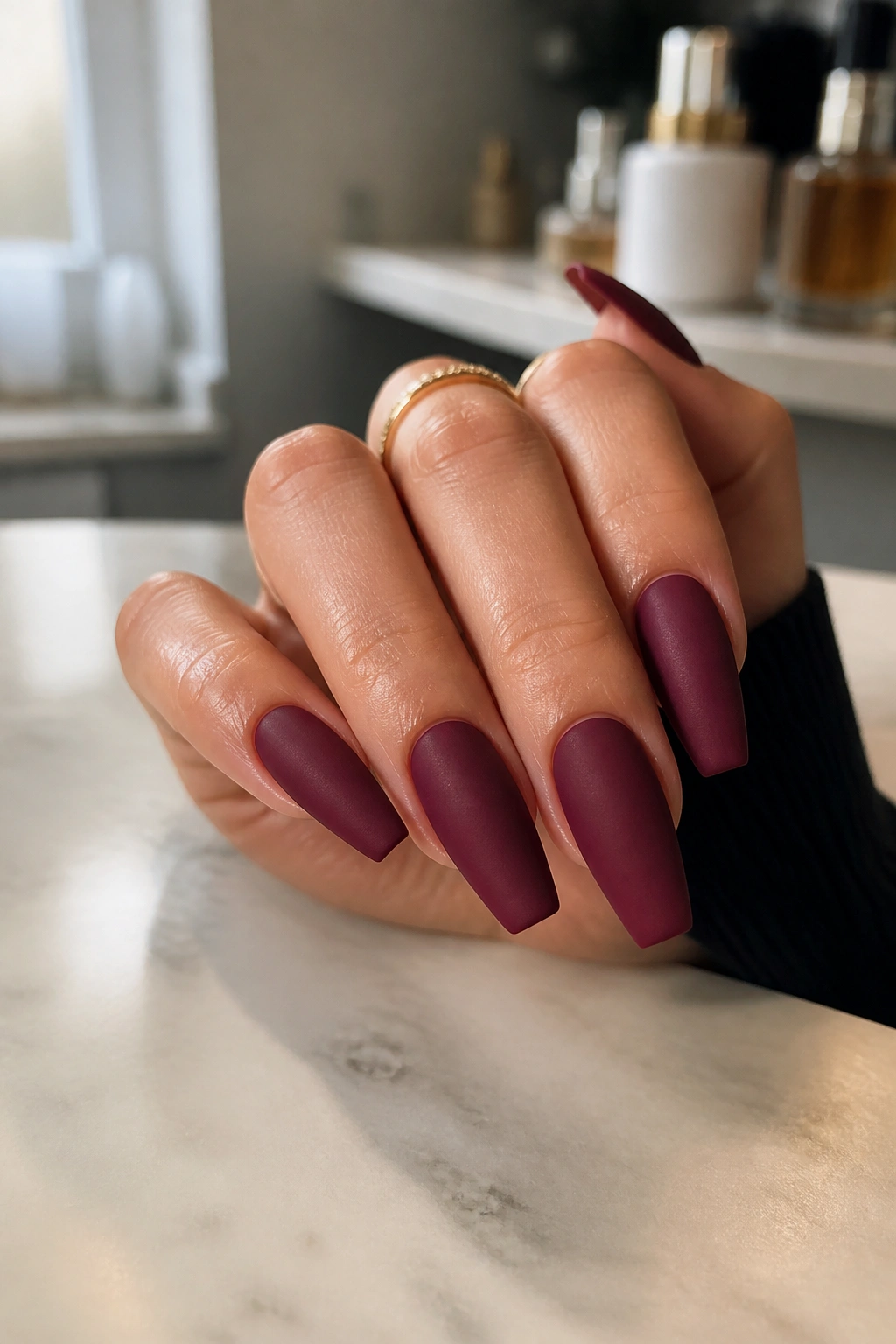
Matte top coat wears differently from gloss. It does not chip on command or fall apart faster by default, but it can develop shine on the high-contact spots—usually the tips, side edges, and thumb area—because friction slowly polishes the surface. You’ll notice it first after typing, opening cans, digging in bags, cleaning, and all the other glamorous parts of life.
The fix starts before the manicure, not after. A smooth structure matters more with matte than with gloss, so do not skip proper prep. If you do your own nails, file the shape, refine the surface with a fine buffer, remove dust, dehydrate the nail plate, and keep each polish layer thin. Thick matte top coat can wrinkle or dry unevenly.
A few habits help the finish stay clean longer:
- Use cuticle oil every night, but wipe the nail surface afterward if it starts looking greasy
- Wear gloves for cleaning and dishwashing because detergents and friction can wear the finish shiny
- Cap the free edge whenever you refresh the top coat
- Do not buff the matte surface once it is finished unless you plan to re-top-coat the whole nail
- Book a top-coat refresh if the design is still intact but the finish has turned patchy
You can also clean matte nails with a soft lint-free wipe and a little isopropyl alcohol if lotion residue is dulling the color unevenly. That helps more than people expect. Matte picks up residue fast, especially dark shades.
One more thing. Burgundy shows growth, but not in the harsh way black often does. If the cuticle area is tidy and the design leaves a little negative space, your set can still look neat as it grows out.
Final Thoughts
The best burgundy matte coffin nails are not always the busiest ones. Shape, undertone, and finish do more work than extra decoration ever will. Get those three right and even a plain solid set looks considered.
If I had to narrow this list down, the standouts are the classic solid matte set, the glossy French tip version, and the negative-space half moon. One is clean and sharp, one plays with finish, and one buys you a softer grow-out. Three different moods. Same rich color family.
Dark nails ask for confidence from the design, not chaos. Burgundy already brings depth. Matte gives it texture. Coffin gives it structure. Pick the version that matches how you actually dress and use your hands, and the manicure will make sense the second it’s on.