

Maroon coffin nails do something bright red almost never pulls off: they look expensive from across the room. The color has depth, the coffin shape gives it a clean runway, and the right finish can make a dark manicure feel closer to polished leather, red wine, or lacquered wood than plain nail polish.
You can also spot a bad one fast. If the tip is too thick, if the sidewalls flare out, or if the maroon leans muddy instead of rich, the whole set falls flat. Dark shades do not forgive shaky cuticle lines, and coffin nails punish lazy filing even harder.
That’s why I keep coming back to this color family. A blue-toned oxblood has a sharper, dressier edge. A brown-wine maroon feels warmer and softer. Change the topcoat alone—gloss, matte, chrome, jelly—and you get a completely different mood from the same base shade.
Small choices matter more than piling on extras. One sliver of foil can do more than a full blast of rhinestones, and a crisp micro-French often looks richer than a heavy, overloaded set. The best maroon nail ideas know when to stop.
Why Maroon Coffin Nails Read More Expensive Than Basic Red
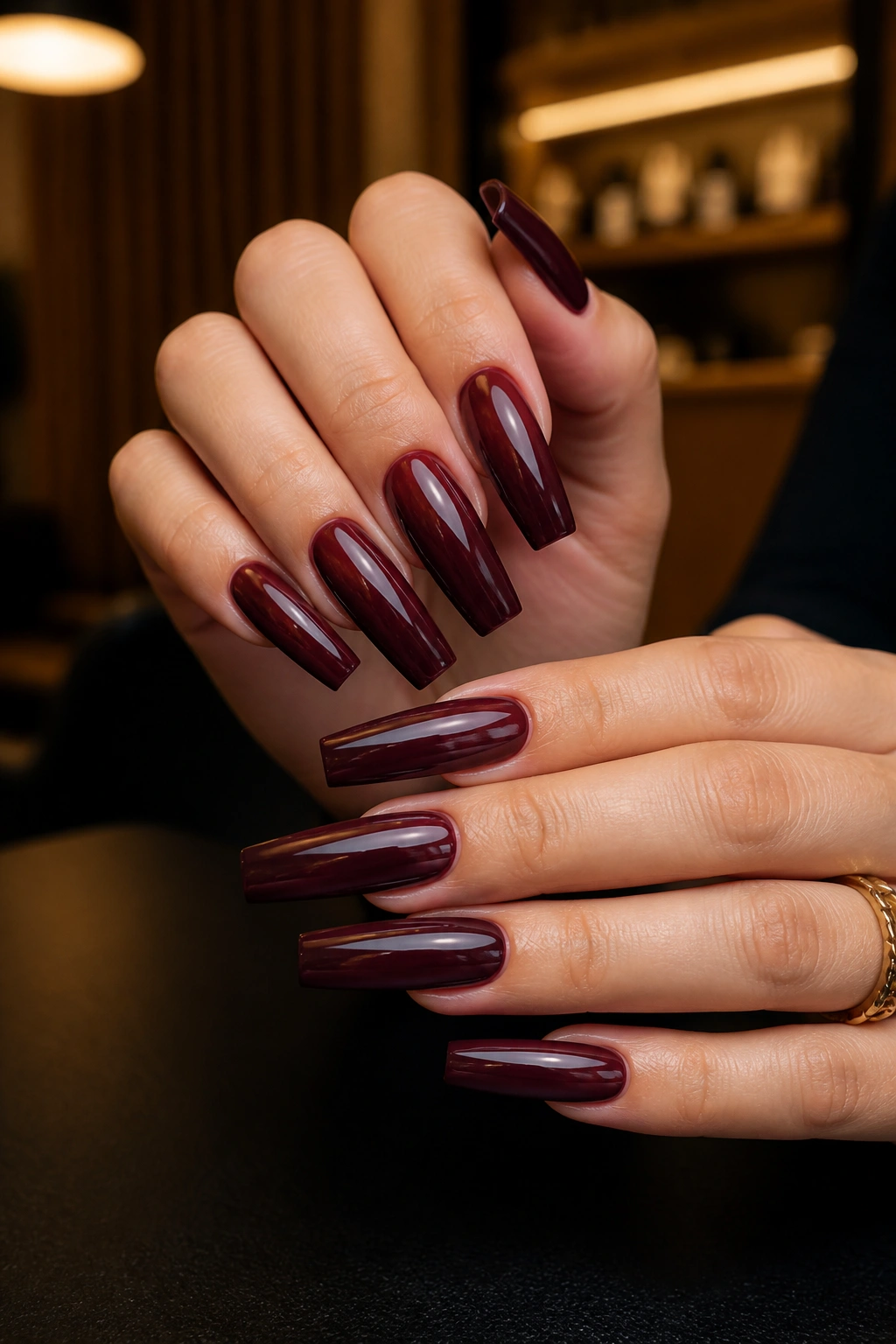
Depth is the whole point. Standard cherry red looks lively and classic, but maroon has more shadow in it, which gives the eye something to hold onto. That extra depth makes the color feel heavier, moodier, and more dressed than a bright primary red.
Coffin shape helps too. The straight sidewalls create a long visual line, and the softened square tip gives dark polish a clean stopping point. On round nails, deep maroon can look a little compressed. On stilettos, it can go harsh. Coffin hits the sweet spot.
There’s a color theory piece here that nail techs and makeup artists both know well: blue-leaning maroons tend to look sharper and cooler, while brown-leaning maroons read warmer and earthier. Neither is better. They just tell a different story on the hand.
Finish changes the story again. High gloss makes maroon look wet and dense. Matte makes it look like suede. Jelly versions let light pass through the edge, which can make longer coffin nails look lighter and less blocky. Same color family. Different attitude.
Phone cameras flatten dark shades, which is why some sets that look dull in photos have striking depth in person. The reverse happens too—a thick, bulky manicure can hide under salon lighting and then look clumsy the second you step outside.
The Shape Details That Keep Dark Coffin Nails Looking Polished
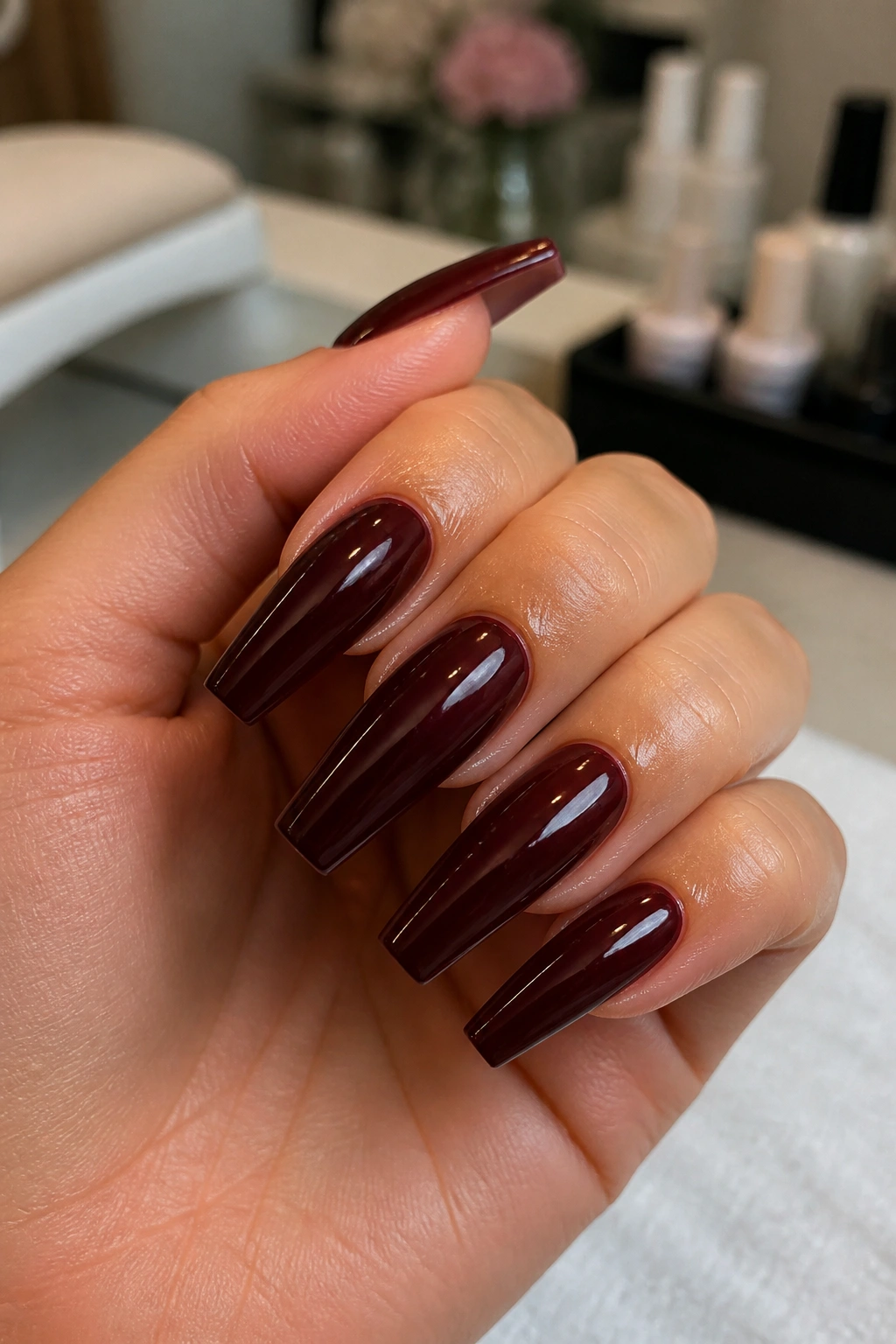
Want maroon nails to look rich instead of heavy? Shape comes first, not art. I would take a plain maroon set with disciplined filing over an elaborate design with thick tips any day.
A good coffin nail should taper through the last third of the nail, not from the cuticle down. If the taper starts too early, the nail bed looks narrow and pinched. If there is no taper, the shape turns boxy and loses that sleek coffin line.
Thickness matters more on dark colors. Keep the free edge slim—around 1 millimeter at the tip is a solid target for many salon sets—because maroon highlights bulk. A chunky black or nude nail can sometimes slide by. Maroon won’t let that happen.
Cuticle work has to be tight. Dark polish shows every wobble, every flood line, every messy gap. You want that curved cuticle line to look clean and deliberate, almost like it was drawn with a pen.
A few details make a huge difference:
- Straight sidewalls make the nail look longer and more refined.
- A slim tip keeps the coffin shape from turning into a shovel.
- Two thin coats of color usually look better than one thick, gloopy coat.
- A topcoat matched to the design matters; matte for texture, gloss for depth, chrome for reflection.
- Cuticle oil does more than add shine around the nail. It frames the whole manicure.
One quick detour, because it matters: custom press-ons can absolutely give you this look if the sizing is right. If the side tabs sit on your skin or the tip width is wider than your natural nail, the expensive look is gone before the color even goes on.
1. Glossy Oxblood with Razor-Clean Edges
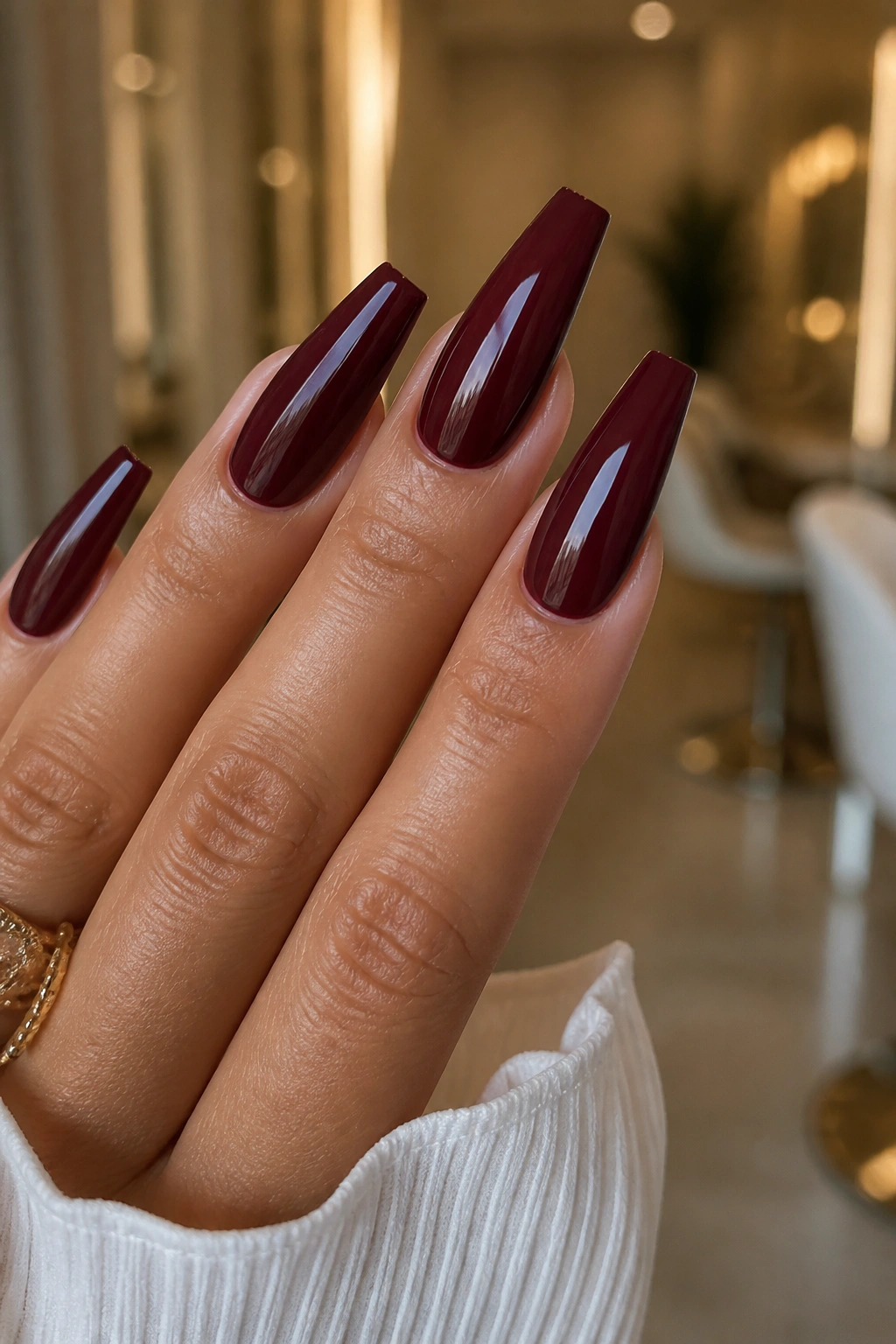
Nothing beats a classic when the classic is this good. Glossy oxblood is the maroon coffin manicure I’d point most people toward first, because it relies on shape, color, and shine instead of gimmicks.
The color should sit right between deep burgundy and black cherry. Too red, and you lose that dense luxury. Too brown, and it can start to look flat unless the undertone is chosen carefully.
Why the shine matters
A glassy topcoat gives oxblood the look of depth inside depth. You catch one shade in direct light, another in shadow, and a darker rim along the sidewalls. That movement is what makes the color feel costly.
This style works best when the cuticle line is curved and snug, the sidewalls are straight, and the tip is crisp. No extra art needed. Honestly, extra art can weaken this one.
Quick style notes
- Best length: medium to long coffin, around 3 to 8 millimeters past the fingertip
- Best finish: high-gloss gel topcoat floated over two thin color coats
- Best undertone: blue-based maroon if you want a sharper look
- What ruins it: bulky builder gel, uneven filing, cloudy topcoat
My tip: ask for a slim free edge and a topcoat that fully self-levels. Glossy dark nails show every dent.
2. Matte Maroon with Slim Gloss French Tips
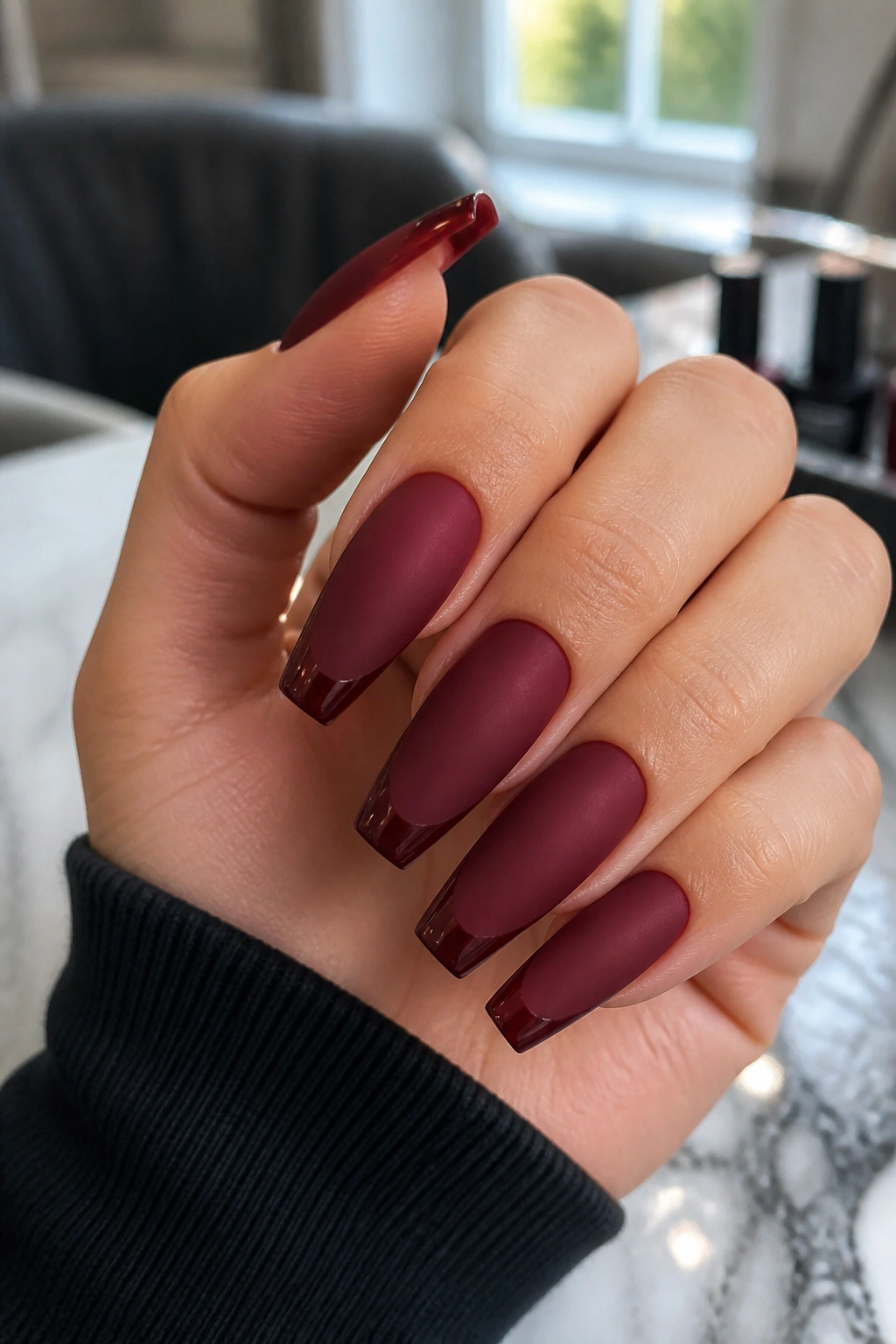
This one looks more expensive than it sounds. Matte base, glossy tip. That contrast gives your nails shape even before anyone notices the color.
The trick is restraint. The French line should stay thin—about 1 to 2 millimeters at most on most nail lengths. Once the glossy tip gets wide, the whole set starts to look heavy, and the matte effect loses its bite.
I like this design on a cooler wine shade or a deeper brown-maroon. The matte surface absorbs light across most of the nail, while the glossy strip catches it at the edge. That push-pull makes the coffin shape look sharper. You’re not adding another color. You’re using finish as the design.
Shorter coffin lengths do well here. On extra-long nails, the tip can start to dominate unless the line is kept razor thin. Medium length gives you the cleanest balance.
One thing people do wrong: they choose a dusty, chalky matte topcoat. Bad matte looks tired. Good matte feels soft, velvety, almost fabric-like. There’s a difference, and you see it fast in daylight.
Gold rings look strong next to this set. So does a tailored black sleeve. It has that kind of mood.
3. Black Cherry Jelly Maroon Coffin Nails
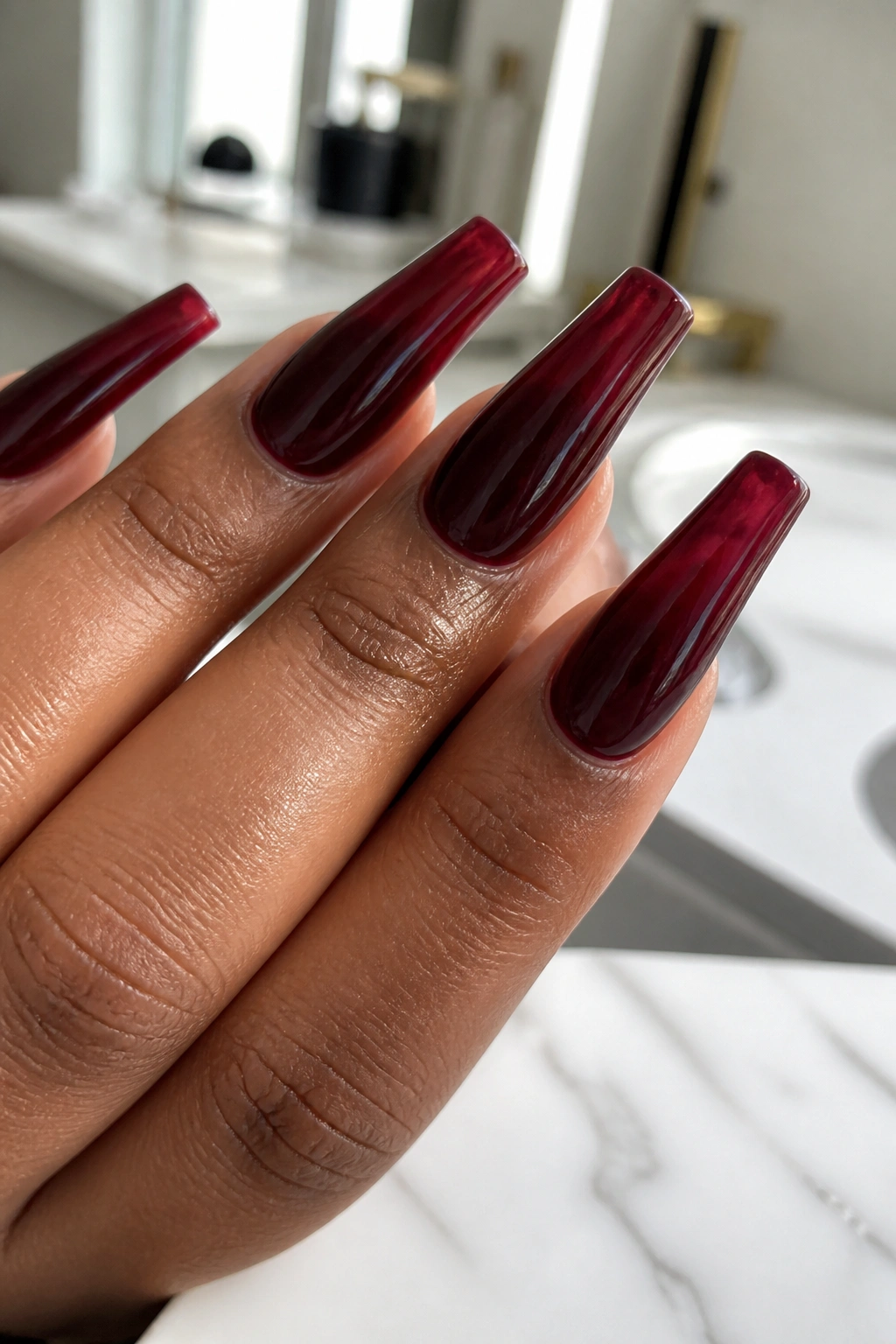
Why do jelly nails work so well in maroon? Because transparency takes weight out of a dark color.
A full-coverage deep shade can look dense and dramatic, which is great when that’s the goal. A jelly finish keeps the richness but lets light travel through the free edge. On longer coffin nails, that little bit of translucency makes the set feel lighter and more modern.
Black cherry jelly is the version I like most. It sits between a stained-glass red and a dark fruit syrup tone. When the layers are thin, the nail looks darker at the nail bed and slightly clearer toward the tip. That gradient happens almost on its own.
This design shines on clear or milky extensions because the base underneath helps the jelly color glow. Natural nails can wear it too, though you’ll often get a softer, less glassy effect unless the nail plate is smooth.
What to ask for at the salon
Ask for two to three thin jelly layers, not one thick coat. Thick jelly loses that syrupy depth and can wrinkle during curing.
If you want more dimension, request a darker maroon base near the cuticle and a slightly clearer layer over the full nail. That tiny shift gives the coffin shape more lift.
Skip chunky glitter here. Jelly maroon already has movement.
4. Deep Maroon with Gold Foil at the Cuticle
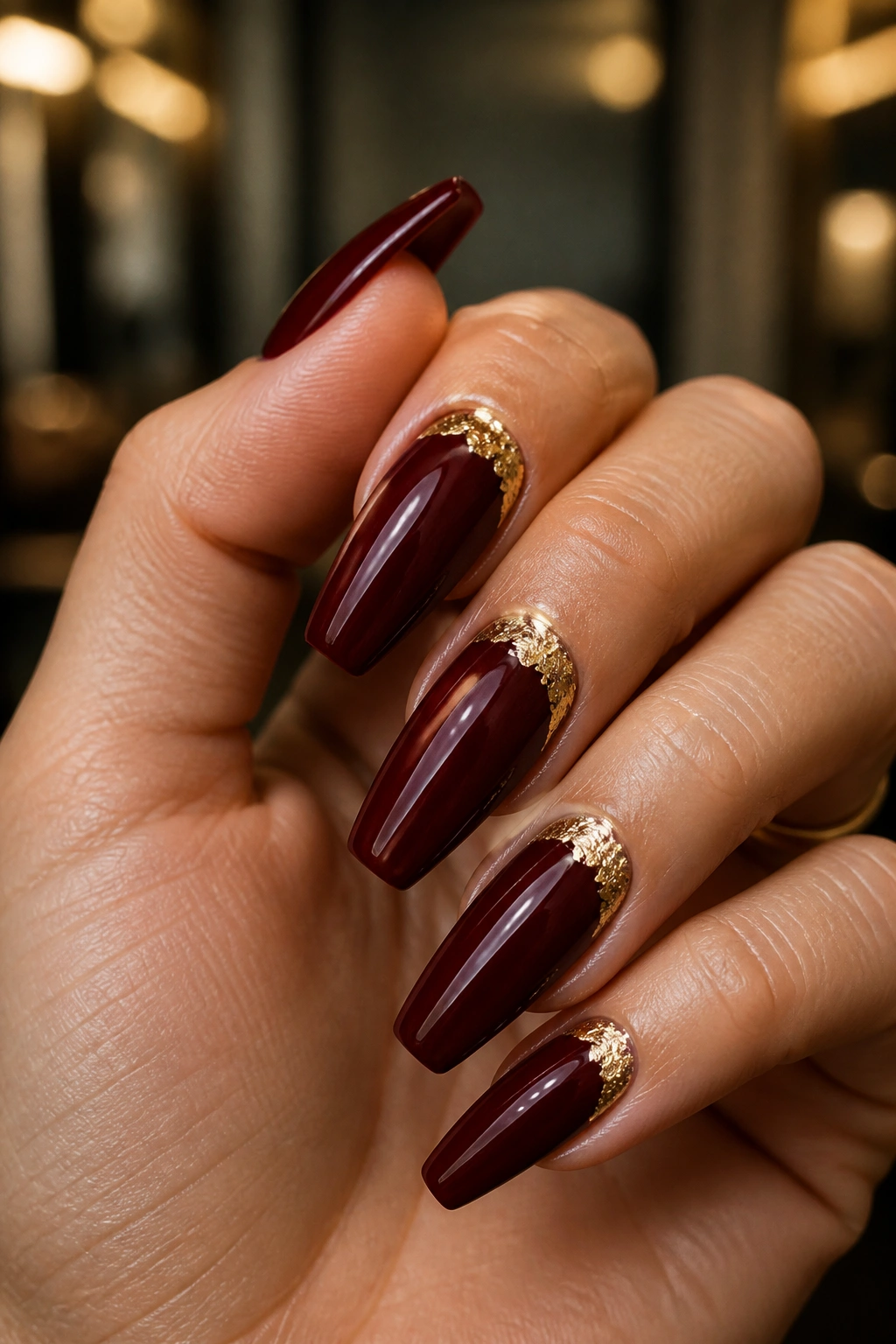
Picture a clean wine-colored set, then one flicker of metal right where the nail begins. That’s all you need. Gold foil near the cuticle turns maroon into something that feels styled, not stuffed with decoration.
Placement matters more than quantity. A small irregular foil patch on one or two nails per hand gives you a jewelry effect. Cover all ten nails and the design loses discipline fast.
Warm maroon shades work best with gold—think merlot, garnet, brown-wine, brick-maroon. Cooler oxbloods can still wear gold, though the contrast is sharper and a little dressier.
A few rules keep this idea strong:
- Use fragmented foil, not big flat chunks
- Keep it near the cuticle or pressed lightly along one sidewall
- Limit foil accents to 2 to 4 nails total
- Finish with a thick glossy topcoat so the surface feels smooth
I like this look for events because it catches low light in a subtle way. Not flashy. Not dull either.
If you wear a lot of yellow gold jewelry already, this design ties the hand together fast. One warning, though: messy foil placement can make nails look accidental. You want controlled irregularity—the kind that still looks placed on purpose.
5. Suede Matte Wine Nails on a Medium Coffin Shape
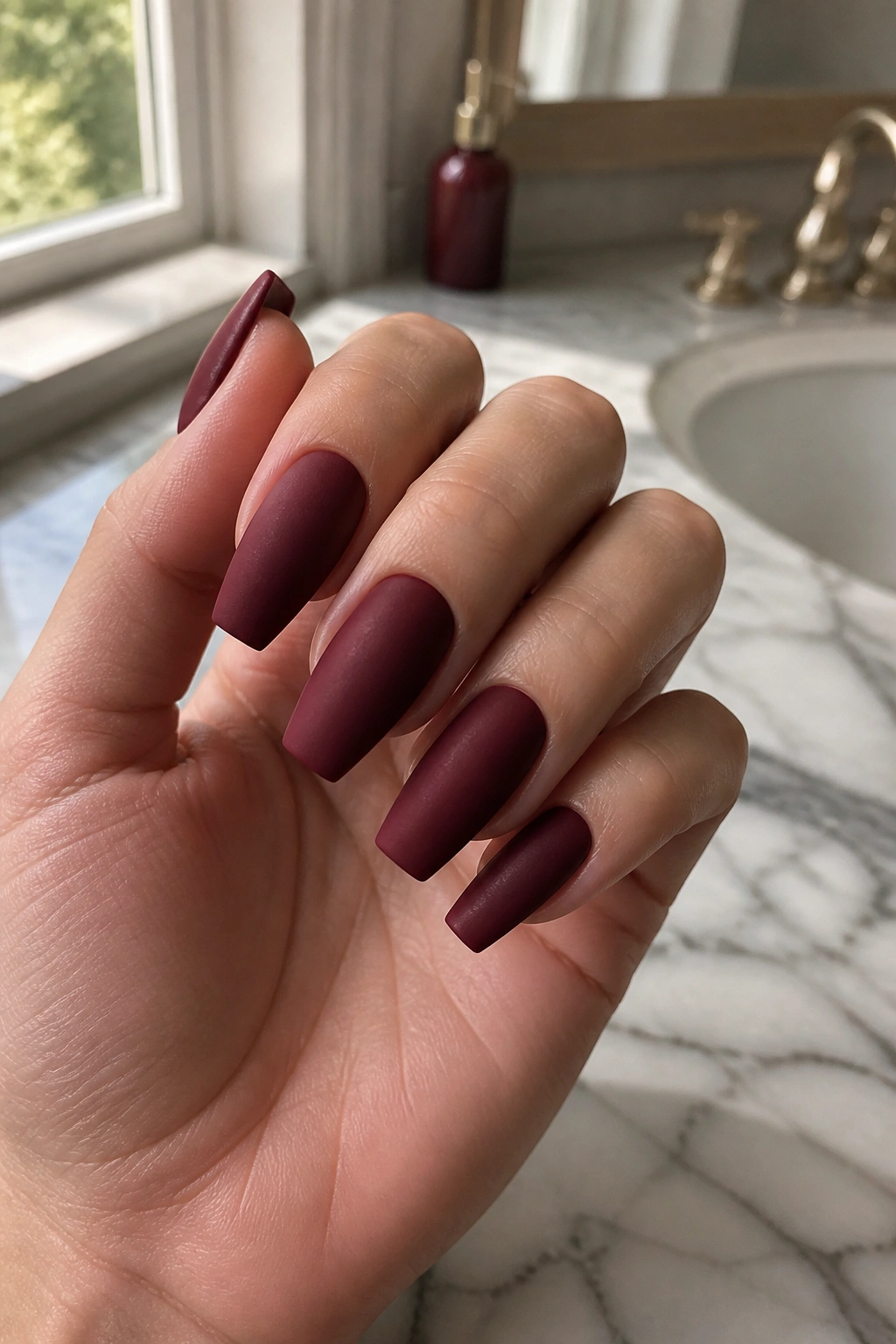
Short rant: not every rich manicure needs sparkle. A full suede-matte wine set can look more polished than art-heavy nails that are trying too hard.
This style lives or dies on surface prep. Matte topcoat shows ridges, dents, and uneven filing with zero mercy. Buff the structure smooth first. Then apply color in thin, even layers. Then matte.
Medium coffin length is where I think this design hits hardest. Extra-long matte nails can drift into costume on some hands, while medium length keeps the shape sharp and wearable. Around 4 to 6 millimeters past the fingertip is a sweet spot.
Color choice matters. Go for a wine maroon with a little black or plum in it. A shade that is too red can lose the suede effect and start reading flat. A shade with deeper shadow holds the texture better.
This is also one of the few dark manicures that looks strongest with almost nothing else going on. No foil. No chrome. No crystals. Maybe one accent nail in gloss if you cannot help yourself—but I usually prefer all matte here.
It feels dressed. That’s enough.
6. Sheer Nude Base with a Maroon Micro-French
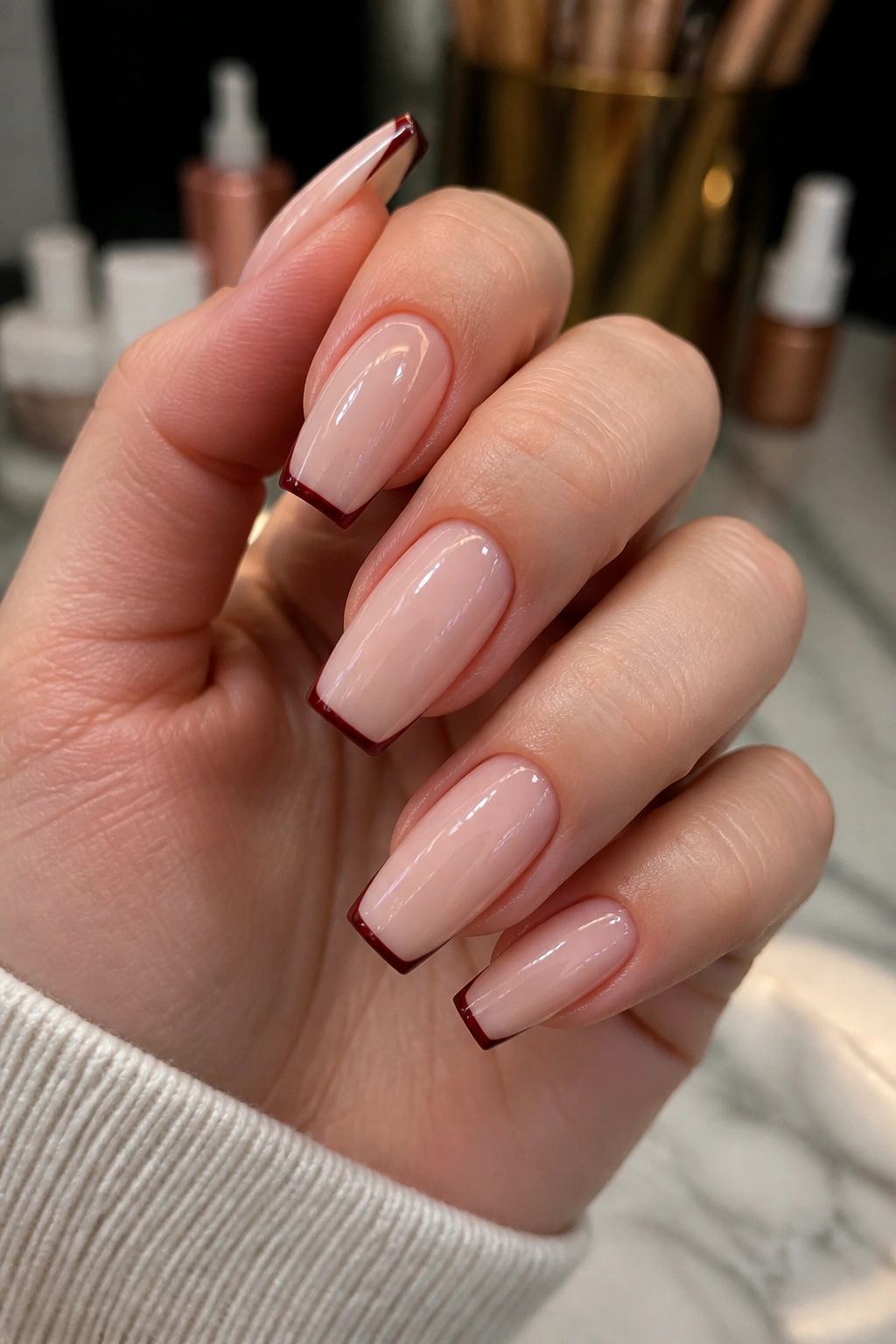
Unlike a full dark set, a maroon micro-French gives you breathing room. You still get that rich wine color, but only at the edge, which makes the manicure look lighter and cleaner from the front.
The base should be sheer nude, sheer pink-beige, or a milky neutral that matches your nail bed closely. Then the maroon tip goes on thin—again, around 1 millimeter is where the expensive look usually lives. Wider than that and it starts sliding toward regular French territory.
This design grows out well, which is one reason people keep coming back to it. The natural nail area blends with new growth, so the manicure stays tidy longer than a full-coverage maroon set. If you’re hard on your hands or push appointments too far apart, that matters.
It also suits people who want coffin nails but do not want them to feel heavy. The shape is still there. The color is still there. You just get more air around both.
I like a cooler maroon tip with a neutral beige base, especially if you wear silver jewelry or black clothing often. Warmer maroon tips over peachier nudes give a softer look. Both work.
If your nail tech freehands French lines well, great. If not, ask for them to map the smile line first. On a thin micro-French, one crooked arc throws off the whole hand.
7. Velvet Cat-Eye Maroon Coffin Nails
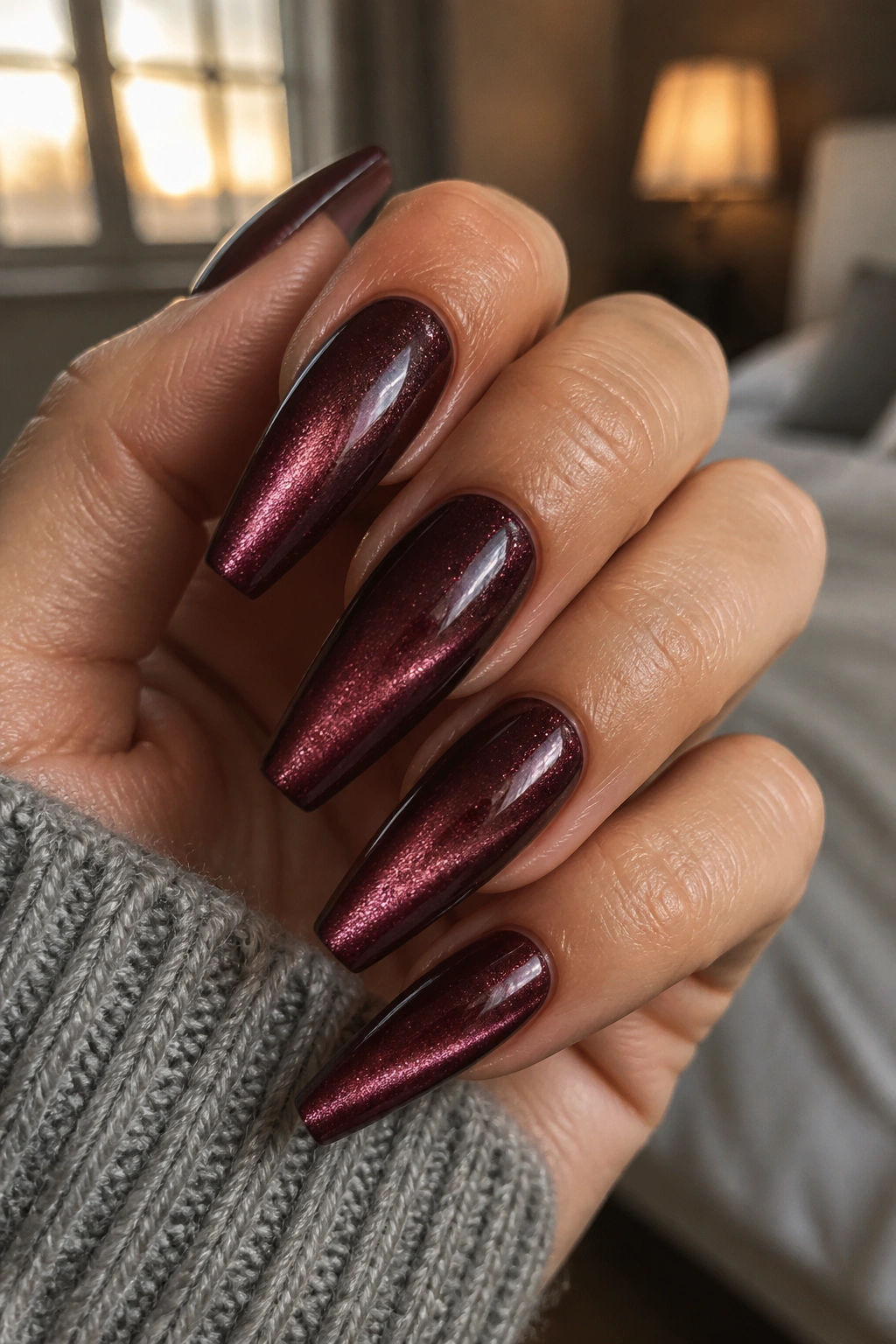
Three seconds with a magnet can change the whole manicure. Velvet cat-eye maroon coffin nails are all about moving light, and coffin shape gives that light enough space to stretch.
This effect comes from magnetic particles suspended in gel polish. Before curing, the tech holds a magnet near the nail to pull the shimmer into a band, halo, or soft glow. In maroon, the result looks deep and plush—almost like crushed velvet or satin ribbon folded in shadow.
Why this finish looks so rich
Cat-eye works because the nail never looks one flat shade. You see a darker border, a lighter center, then a shifting flash when the hand turns. That movement keeps maroon from looking dense or muddy.
A diagonal pull usually flatters coffin shape best. Straight vertical lines can work, though diagonals often make the nail look longer and a touch slimmer.
What to ask for
Ask for a deep wine or black-cherry magnetic gel, not a bright ruby. Hold the magnet in place for 5 to 8 seconds per nail before curing so the pattern stays crisp.
One more thing: this set looks best with glossy topcoat and minimal extra art. The light movement is the art.
I would not bury this under stones. That would be a waste.
8. Croc-Embossed Maroon Accent Nails
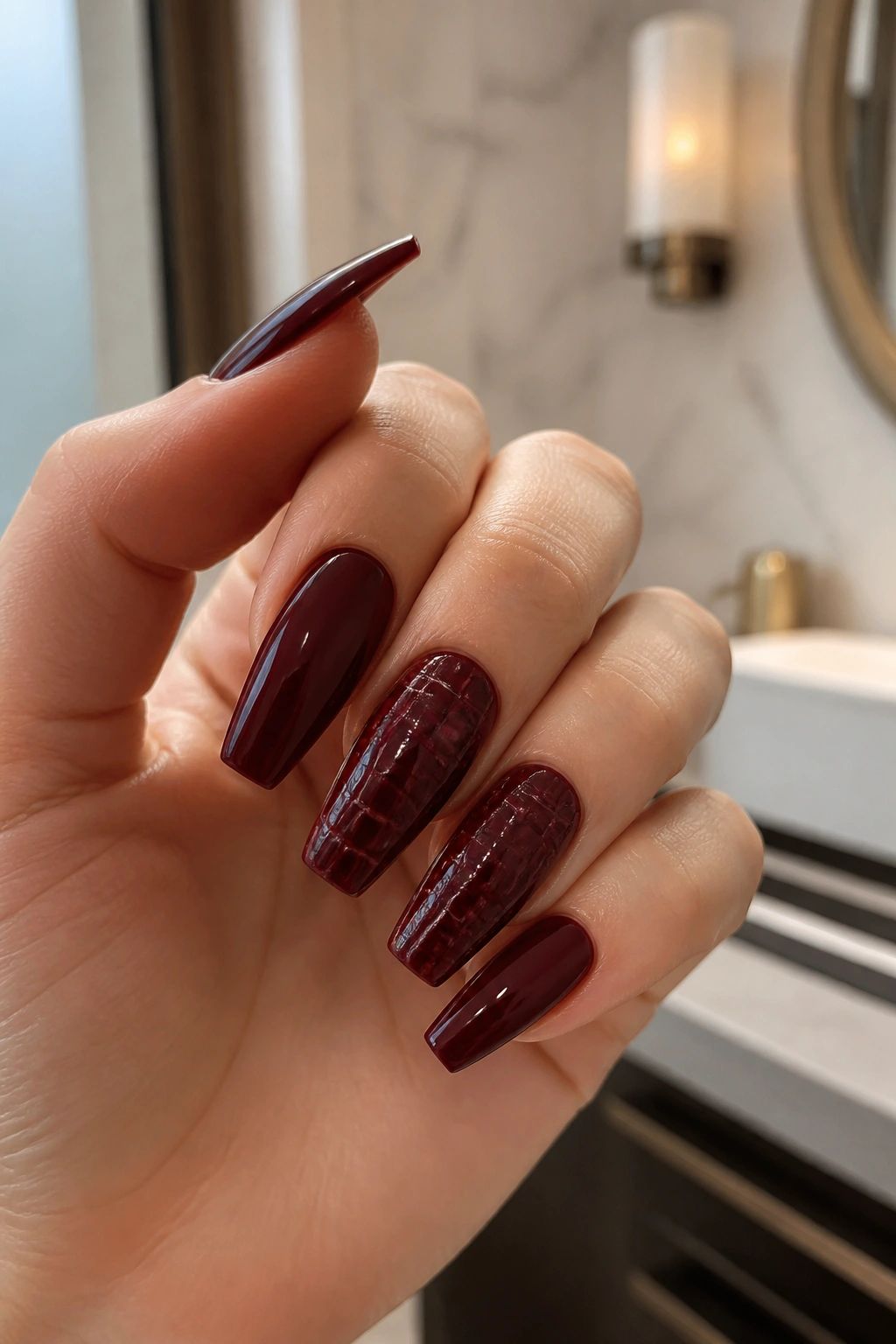
Texture can go wrong fast. That is exactly why croc-embossed maroon works best as an accent, not a full ten-finger commitment.
The effect usually comes from builder gel, blooming gel, or a raised gel pattern layered under a glossy topcoat. In maroon, especially a dark oxblood or brown-wine shade, the pattern looks closer to embossed leather than novelty art. That’s the lane you want.
One or two textured nails per hand is enough. Index and ring fingers work well, or ring finger only if you like a quieter set. Keep the rest of the nails solid glossy maroon so the eye has a place to rest.
Gloss beats matte here. A raised glossy texture catches the light on the high points and keeps the low points darker. That contrast is what gives croc pattern its depth. Matte croc can read dusty unless the color underneath is strong and the texture is clean.
Skip oversized charms with this design. Croc texture already gives you a tactile surface, and too many extras turn it bulky. If you want one more detail, add a thin gold line on a single solid nail, not on the croc itself.
Done well, this one looks expensive in a fashion-editor way. Done poorly, it looks like a phone case.
9. Plum-to-Maroon Ombre with a Soft Fade
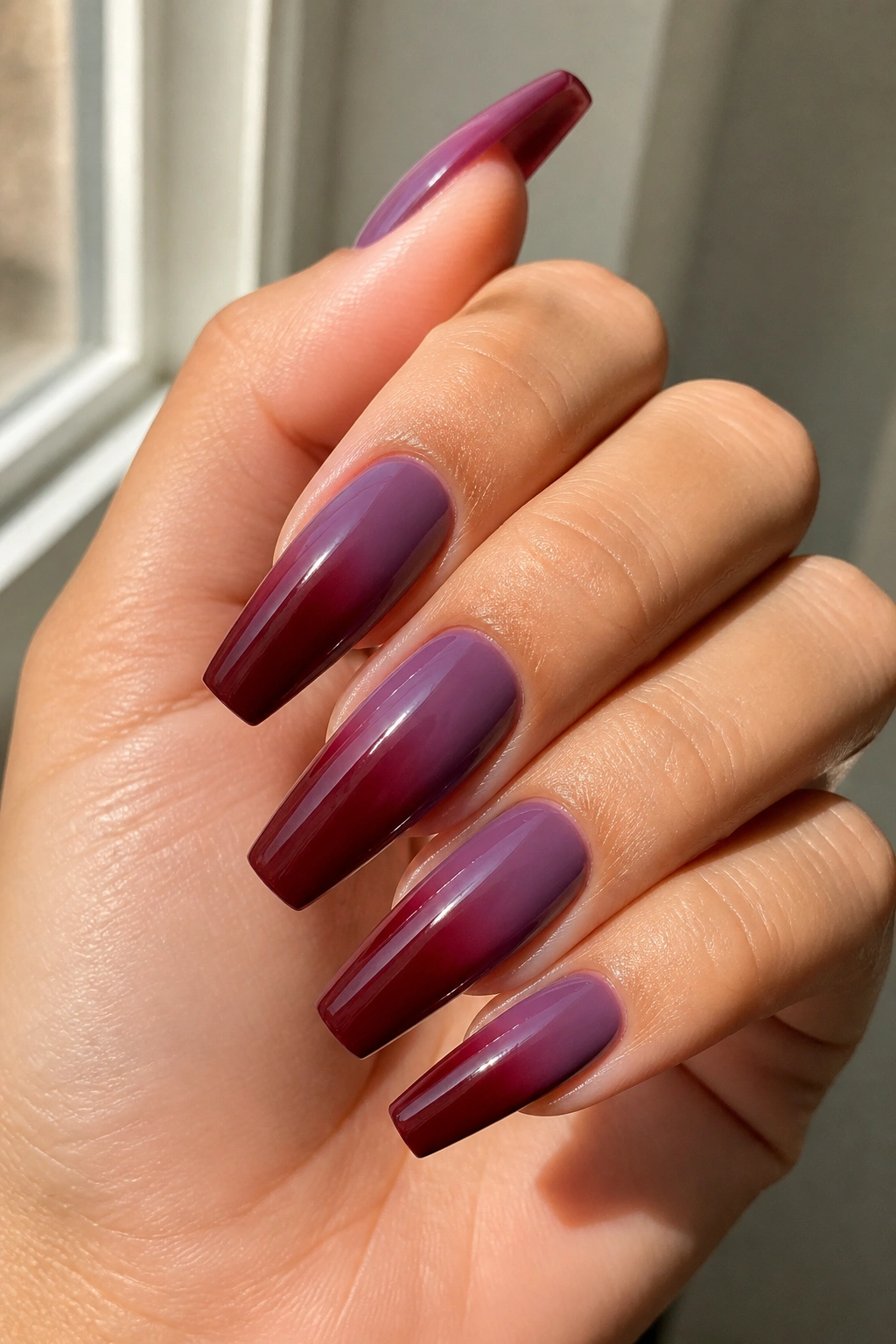
The best ombré nails do not scream “ombré.” They shift gently, almost like the color is deepening while you look at it. Plum melting into maroon is strong because the shades sit close enough to blend cleanly.
I prefer plum at the cuticle fading into maroon toward the tip, though the reverse works too. Plum near the base adds cool depth around the nail bed, and maroon at the edge keeps the coffin tip defined. Black can be blended into maroon, sure, but that combo goes heavy much faster.
Airbrush gives the smoothest fade. A sponge blend can still work if the polish is thin and the gradient is softened with one final sheer layer over the top. Some techs use blooming gel for a smoke-like transition, which can look good on longer nails.
This style suits medium-long to long coffin shapes because the fade needs room. On short nails, the colors can crash into each other and lose that soft transition.
A glossy topcoat keeps the blend looking deep. Matte makes it moodier and more velvety, though the fade will read less dramatic from a distance. I lean gloss here because the shine helps both colors stay distinct.
10. Glossy Maroon with a Thin Crystal Cuticle Line
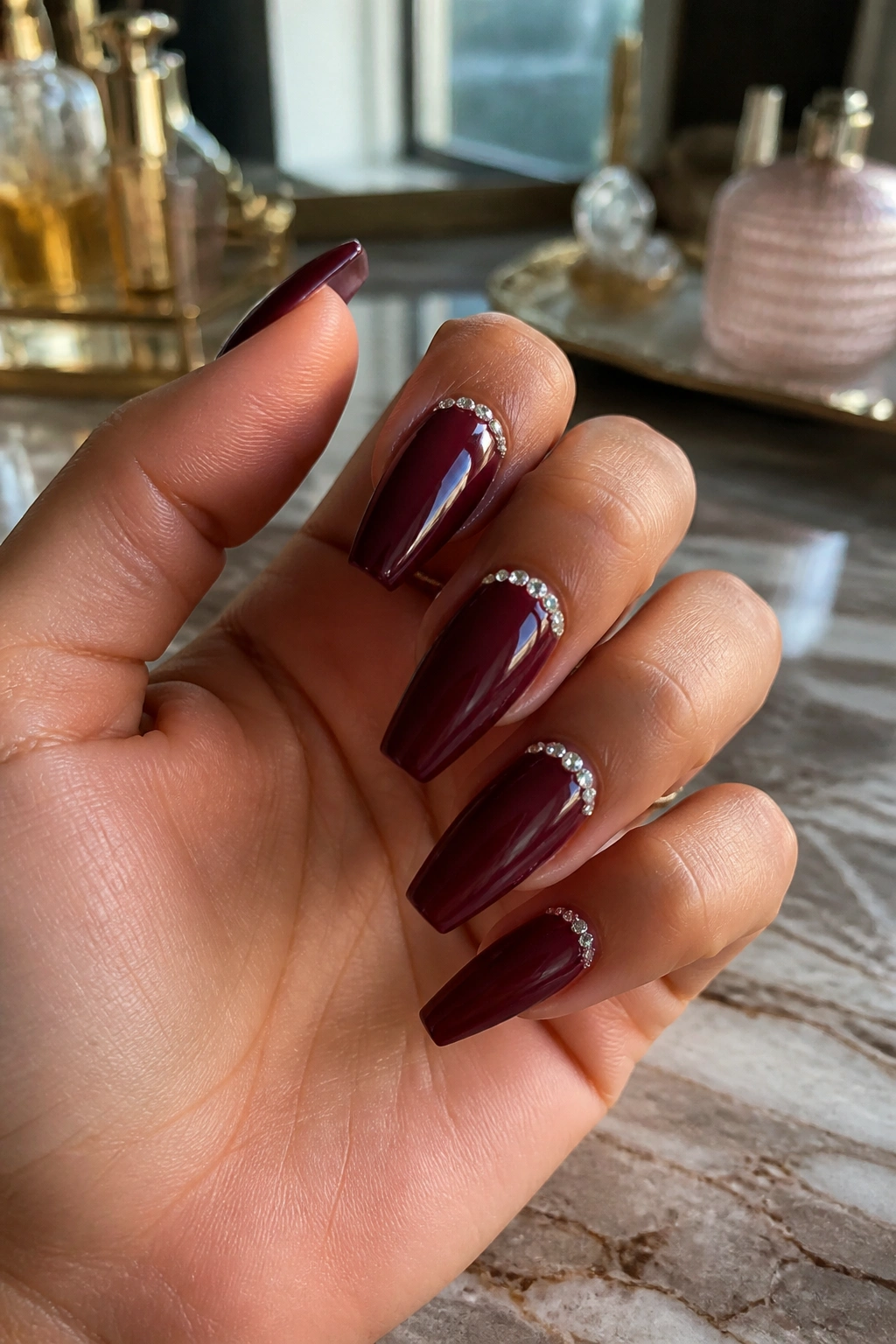
A thin line of crystals at the cuticle can look expensive. A full crown of gems on every nail usually does not. Scale is the whole game with this design.
What you want is a light catch, not a chandelier. Use tiny stones—ss3 to ss5 size works well on most nails—and place them on one or two fingers per hand. A neat half-moon row near the cuticle or a tiny cluster off to one side is enough.
A few crystal rules worth following:
- Keep the base color solid and glossy, not glittered
- Limit crystal placement to accent nails only
- Use 3 to 6 stones per accent nail, depending on nail width
- Skip large center stones and hanging charms
- Seal the edges well so hair does not snag
Cool-toned maroon with clear stones has a crisp, evening look. Warmer maroon with champagne stones leans softer and more luxe. Both can work. I usually prefer clear stones because they keep the color in charge.
This is also one of those designs that needs fresh maintenance. Lose one crystal and the set looks unfinished. If you’re hard on your hands, pick foil or chrome instead. If you don’t mind a little upkeep, the payoff is strong.
11. Mirror-Finish Maroon Coffin Nails
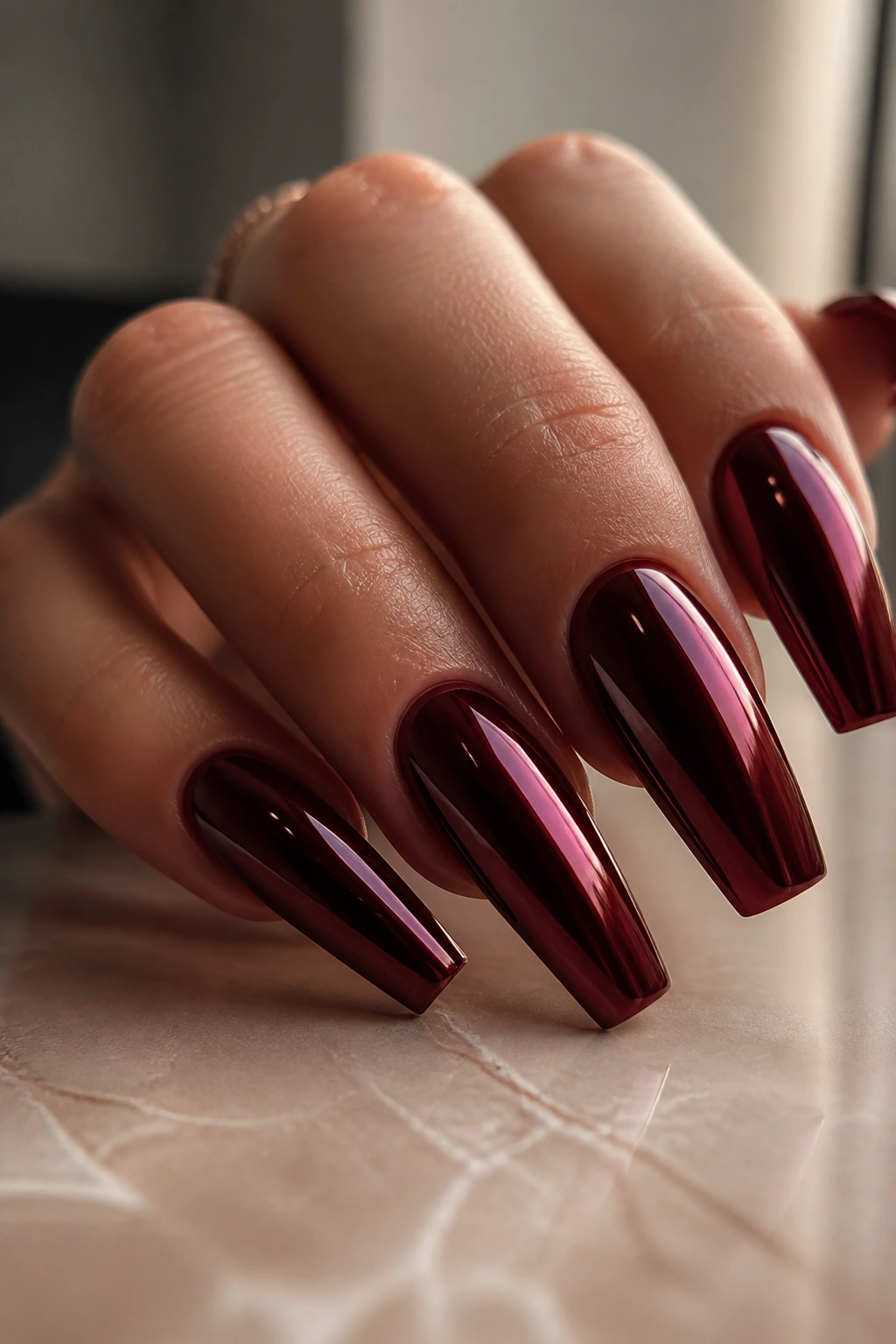
Chrome is not always tacky. It gets tacky when the base color is wrong or the surface under it is lumpy.
Maroon chrome on a coffin shape can look almost liquid if the prep is clean. The best version starts with an oxblood, wine, or black-cherry base, then a red or burgundy chrome powder is rubbed over a no-wipe gel topcoat. What you get is not a flat metallic red. It is deeper than that—more like polished metal tinted with wine.
Coffin shape helps because the straight edges give the reflection room to travel. Almond chrome is softer. Stiletto chrome is sharper. Coffin chrome feels structured and expensive when it’s filed well.
Surface perfection matters here more than with almost any other design in this list. Chrome shows every bump, every ripple, every dent near the apex. If the nail structure is off, chrome will announce it.
I like this look best on medium-long nails with no extra art at all. Maybe one chrome accent if you want to mix finishes, though a full set is usually stronger. Red chrome can drift flashy on some shades, so keep the base dark enough to anchor it.
Choose this when you want maroon with edge. Not cozy. Not soft. Edge.
12. Reverse French Half-Moon in Deep Wine
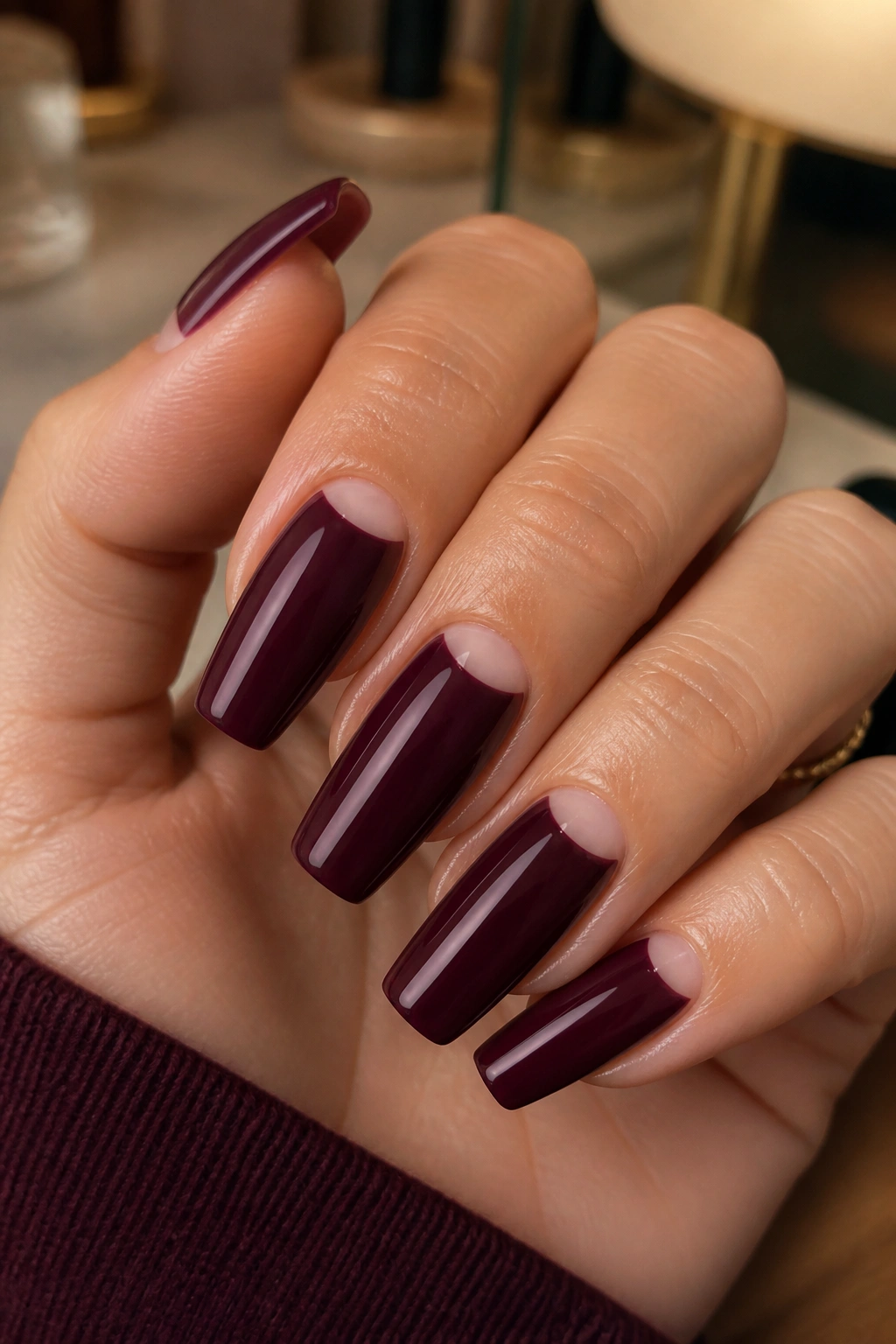
Ever notice how some nail art looks smarter because it leaves part of the nail alone? Reverse French half-moon designs do that. Instead of painting the tip, the design highlights the lunula area near the cuticle.
You can do this two ways: leave a clean crescent of negative space, or fill that crescent with a sheer nude while the rest of the nail wears deep wine maroon. I usually prefer the nude crescent because it keeps the look refined as the nails grow out.
Why the half-moon works
That curved empty space breaks up a dark color and adds structure near the base. On coffin nails, it also draws attention to the long lines of the shape instead of making the whole nail read as one block of color.
The crescent should stay narrow and even. Too large, and it can look retro in a costume-ish way. Too tiny, and the effect disappears. Around 2 to 4 millimeters at the deepest point works on many nail beds.
This style has a vintage polish-ad feel that I enjoy, especially with glossy finish and no other art. If you want one extra touch, a slim metallic outline around the half-moon can work. Keep it hairline thin.
Anything chunkier ruins the elegance.
13. Espresso-Maroon Marble with Fine Veining
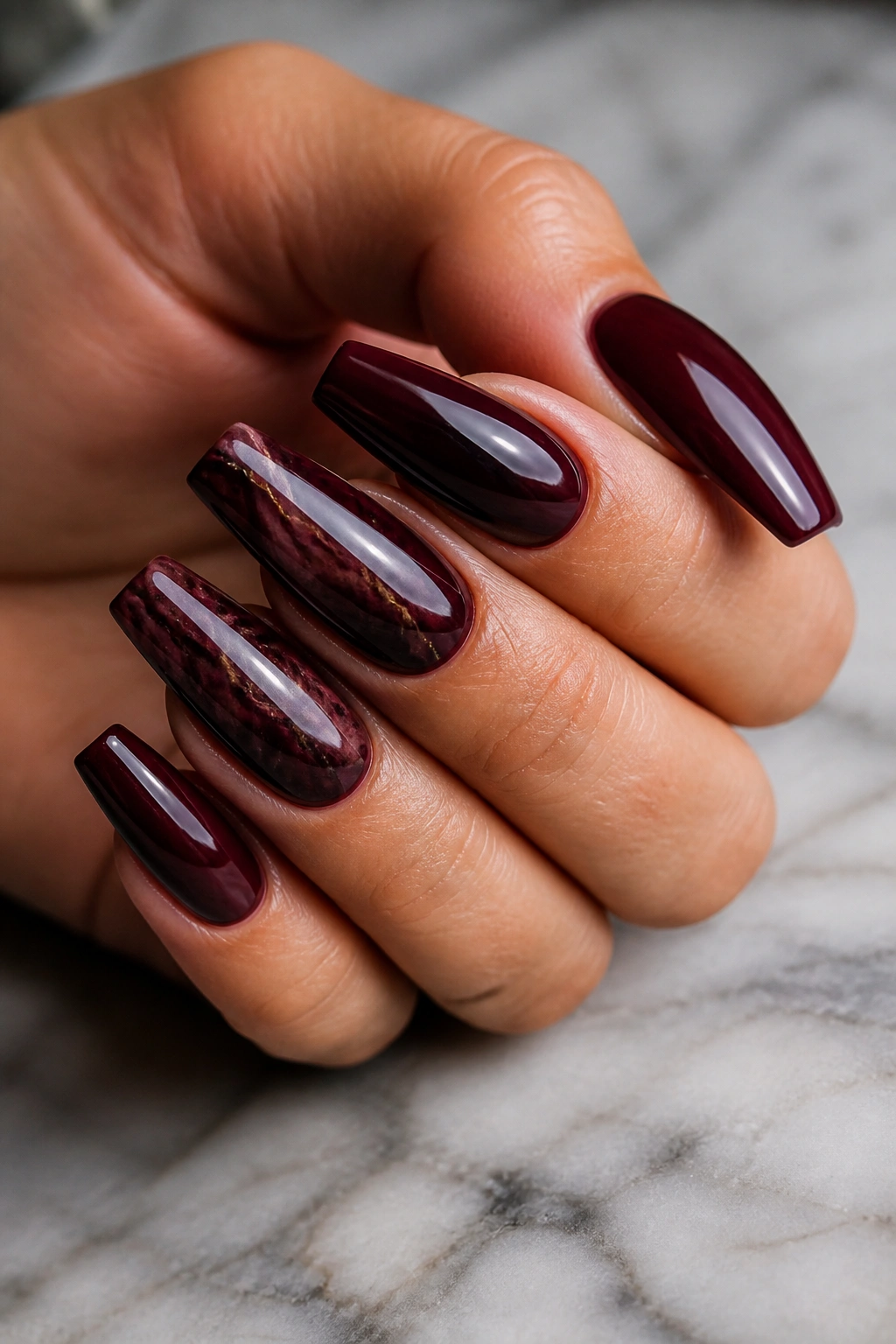
I once saw a marbled maroon set under low restaurant light, and it looked less like nail art and more like polished stone. That’s the sweet spot. Espresso-maroon marble should read mineral, smoky, and layered—not swirly.
The best color mix uses maroon, espresso brown, and a trace of black softened with blooming gel or a feather-light drag from a liner brush. Then you add a fine vein in ivory, bronze, or muted gold. Fine means fine. Think hairline cracks in stone, not bold lightning bolts.
A few details matter here:
- Keep marble to 2 to 4 nails, not all ten
- Use soft blurred edges, not harsh stripes
- Add one thin vein, maybe two, per accent nail
- Pair the marble with solid maroon nails for balance
Glossy topcoat almost always wins. It deepens the smoky layers and makes the veining look embedded under glass. Matte can work if you want a dry stone look, though that version feels moodier and less polished.
Longer coffin nails show off marble best because the pattern needs room to breathe. On short nails, go simpler or use the marble on one accent only.
This one takes skill. If the tech’s marble work is muddy, walk away.
14. Maroon and Tortoiseshell Accent Mix
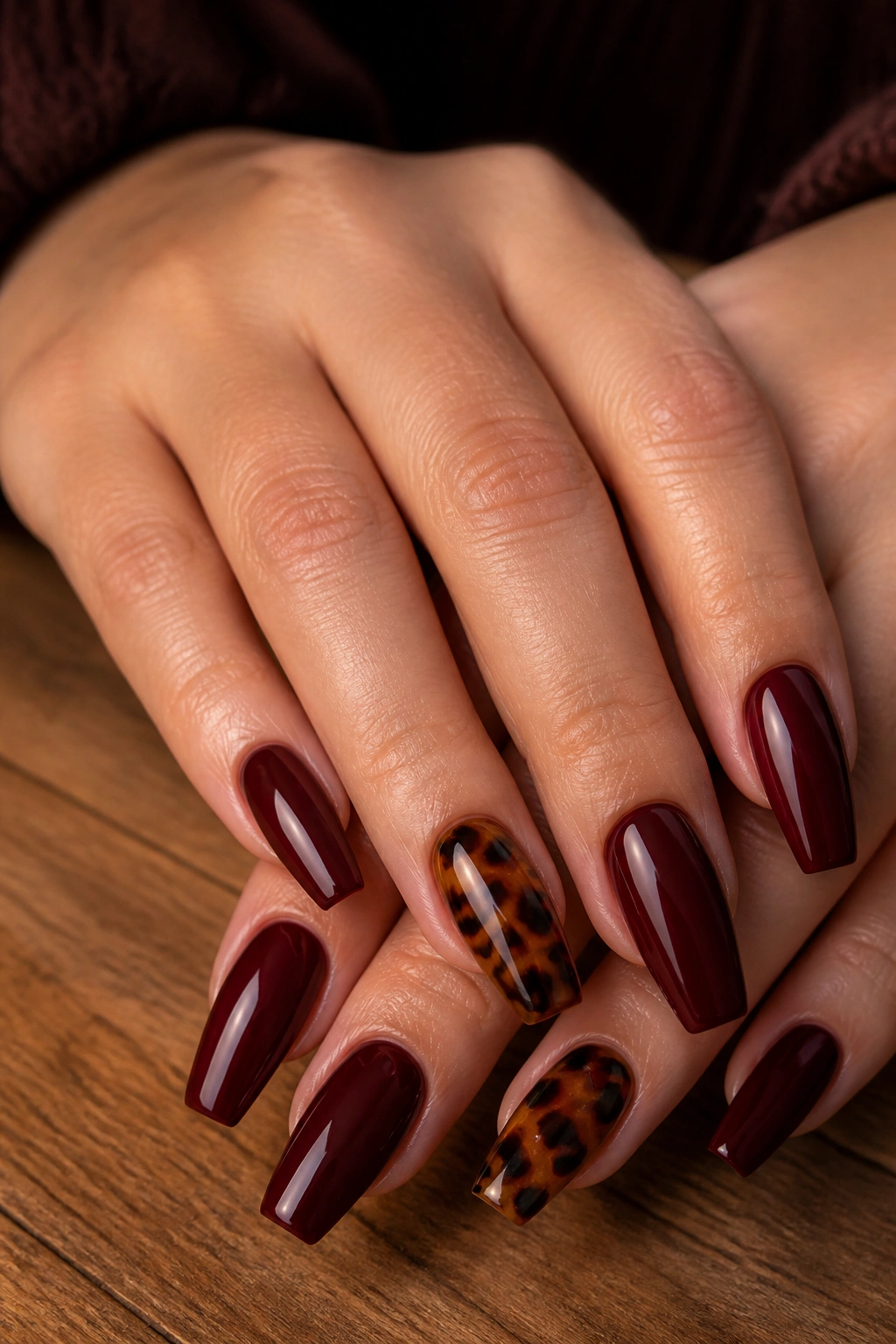
This combination should not work as well as it does, yet it does. Maroon with tortoiseshell accents gives you warmth, depth, and pattern in the same set, and the colors naturally belong together.
The key is choosing the right tortoiseshell palette. You want honey amber, caramel brown, and dark brown-black spots layered over a translucent warm base. Then the maroon on the other nails should lean slightly warm too. A cool purple-maroon next to amber tortoise can clash.
Accent placement makes the difference between styled and busy. Two tortoiseshell nails per hand is plenty. Ring and middle finger is a common pairing, though index and ring can look sharper on longer hands. Keep the rest of the nails solid maroon, glossy, and clean.
Gold jewelry sits well with this design because the amber and wine tones pull in the same direction. If that sounds too coordinated, fair. Still, it works.
I do not love adding glitter to this mix. Tortoiseshell already has enough visual movement, and maroon already has enough depth. Add glitter and the set starts fighting itself. A thin gold stripe on one maroon nail, maybe. Anything beyond that, I’d skip.
15. Deep Maroon with Black-Edged Tips
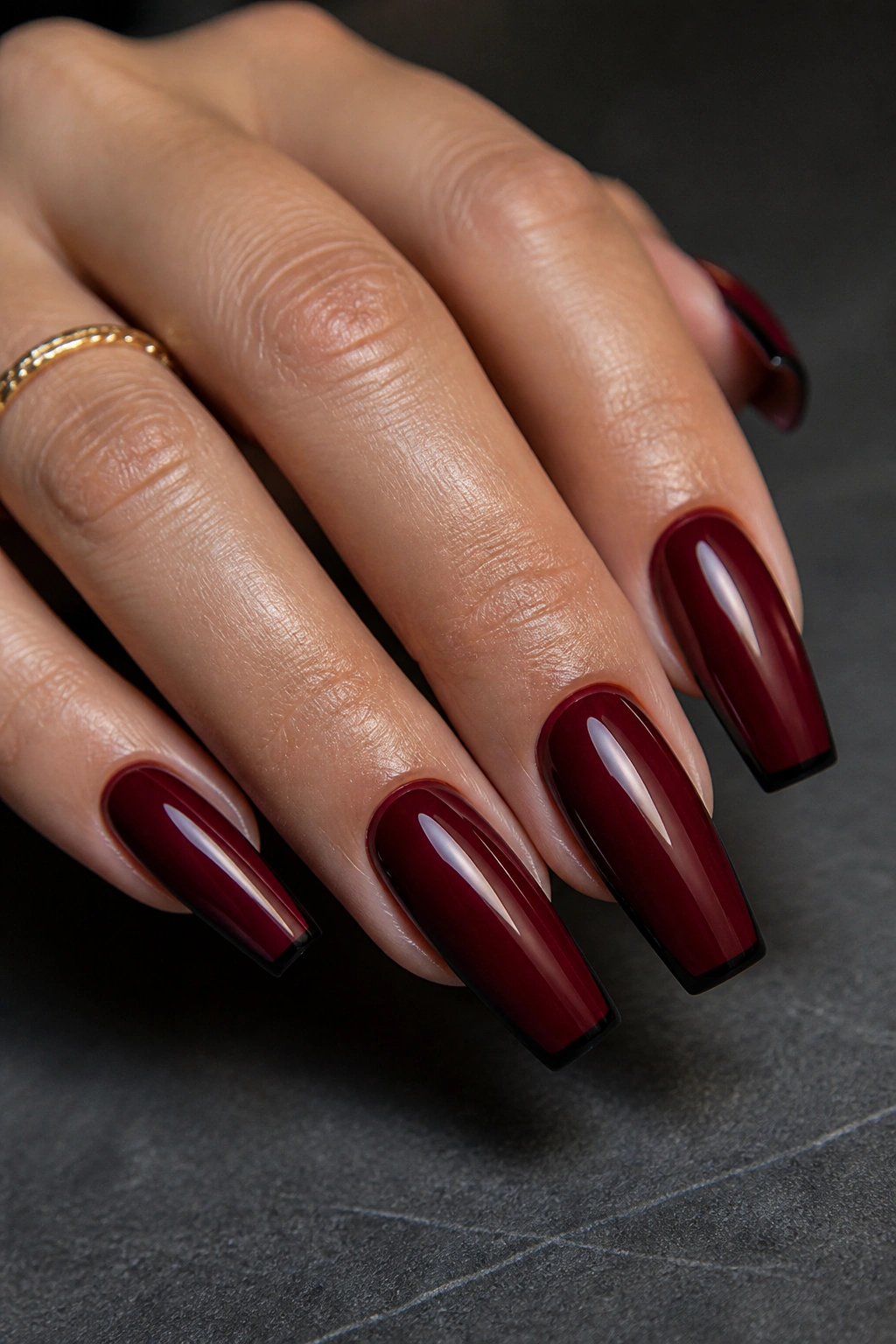
Sharp. That’s the word for this one.
A deep maroon base with thin black edging along the tip gives coffin nails an outline that makes the shape look cleaner and more deliberate. The effect is subtle from a distance, then suddenly obvious when the hand turns.
The black line should stay narrow—around 0.5 to 1 millimeter. It can follow the straight tip only, or wrap lightly along the upper sidewalls for a framed look. Either way, it needs a fine liner brush and a steady hand. Thick black borders make the manicure look cartoonish.
This design works best on glossy maroon because the black edge stands out more against shine. Matte can work, though the contrast softens and the line loses that inked precision. I prefer a cooler maroon here, something close to oxblood, because it keeps the palette sharp and tailored.
What I like most is how modern it feels without using trend-heavy extras. No chrome powder. No stones. No foil. Just two dark shades used with discipline.
If you wear a lot of black clothing, silver rings, sharp tailoring, leather jackets—yes, that whole mood—this set lands hard.
Final Thoughts
If you want the safest pick, go with glossy oxblood. It flatters almost everyone, it hides less than people think, and it makes coffin shape look intentional when the filing is good.
If you want more texture, matte-with-gloss tips, velvet cat-eye, and croc accents give maroon extra depth without burying it under decoration. That’s the line I’d hold. The expensive look comes from one strong idea, not five medium ones fighting for attention.
And if you remember only one thing, make it this: dark nails are shape-first manicures. Pick your maroon carefully, keep the tip slim, keep the cuticle line clean, and let the color do its job. Maroon already knows how to make an entrance.