

You can tell within a few seconds when a pale manicure is working. The nail looks clean, elongated, and soft—not chalky, not bulky, not like a flat pastel slab sitting on top of your fingers. Light pink coffin nails hit that look better than almost any other neutral set because the shape gives gentle color a bit of edge.
The catch is that soft pink shows everything. A thick apex, a blunt tip, the wrong undertone, one coat too many—small mistakes stand out fast when the color is this light. I’ve seen nail sets go from polished to powdery just because the pink leaned too blue against warm skin, or because the free edge was built too thick and blocked the clean taper that coffin nails need.
And pale pink isn’t boring. Not even close.
Once you start paying attention to finish, opacity, placement, and scale, you get a whole range of looks: milky, glossy, airy, pearly, sheer, softly sculpted, a little romantic, sometimes almost architectural. Start with the shape, because that’s what decides whether soft pink looks expensive or washed out.
Why Coffin Shape Keeps Pale Pink From Looking Flat
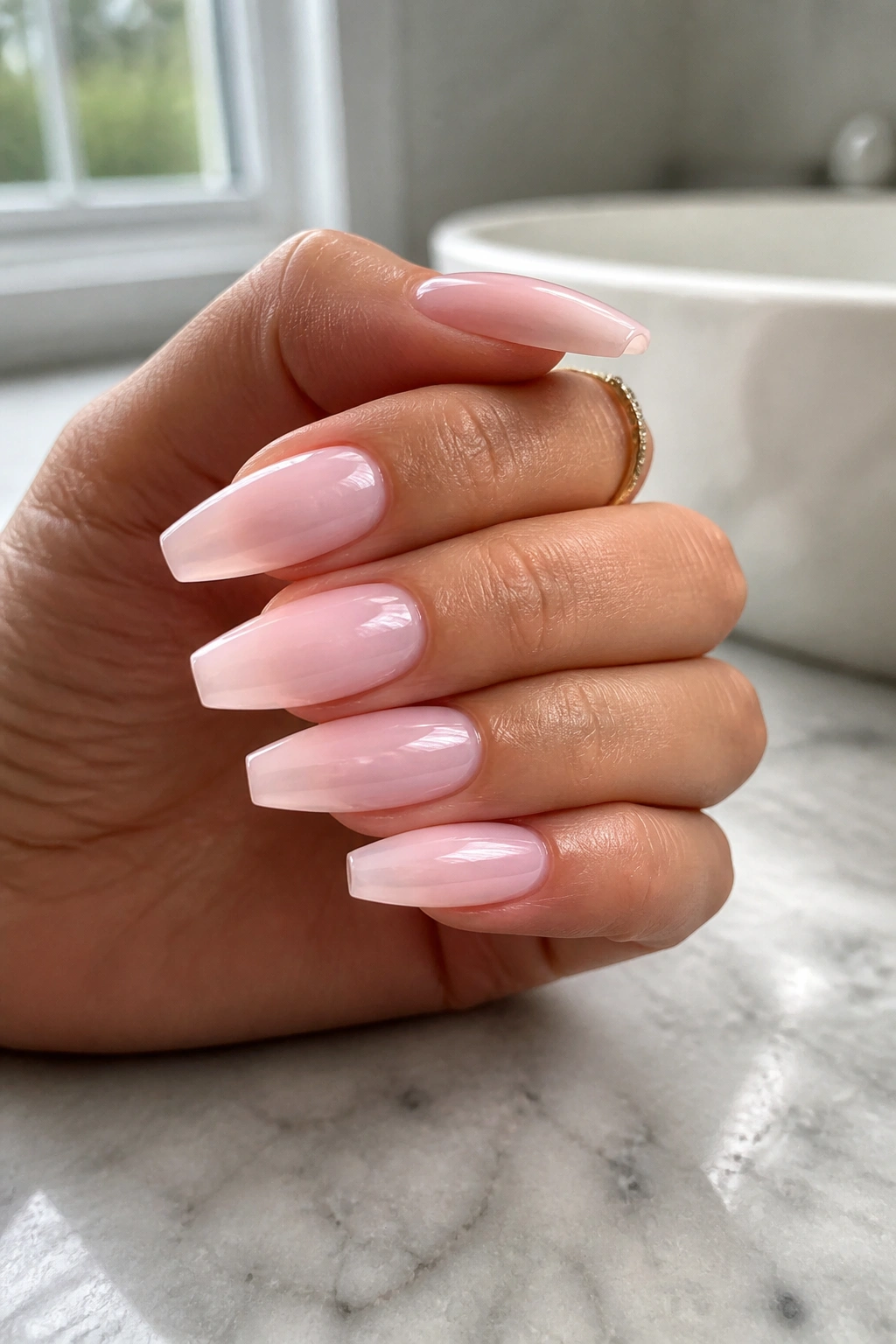
Coffin nails give pale polish structure. That’s the whole advantage. On a rounded or squoval nail, a light pink can fade into the hand if the shade is too close to your skin. Coffin shape fixes part of that problem by narrowing the sidewalls and giving the eye a clean line to follow.
Length matters here more than people admit. A coffin nail usually looks best with at least a small free edge—enough space for the taper to show. Around 14 to 20 millimeters from cuticle to tip is where soft pink starts to look intentional on most hands. Short coffin can work, but if the nail is too short, it slips into square territory fast.
The other detail is bulk. Pale colors magnify thickness because light bounces off every ridge and hump. A well-built coffin nail needs a smooth apex placed a little back from center, crisp sidewalls, and a free edge that doesn’t look heavy from the side. If you’ve ever loved a pink shade in the bottle and hated it on your hands, that may have been the issue—not the color.
The finish changes the whole mood
Gloss makes pale pink look moist, smooth, and a bit translucent even when the color is creamy. Matte turns the same shade into something quieter and more powdery. Chrome shifts it into pearl territory. Same base. Different finish. Completely different manicure.
When I’m looking at a soft pink set, I pay attention to these details first:
- Tapered sidewalls that stay straight rather than ballooning outward
- A thin free edge so the color doesn’t look blocky
- A balanced apex that supports the nail without making it look puffy
- A clean cuticle blend with no ledge where regrowth will show too soon
- A finish that matches the design—gloss for milky looks, matte for dusty pink, pearl for a satin sheen
Get those right, and even the quietest pink looks deliberate.
Picking the Right Undertone for Light Pink Coffin Nails
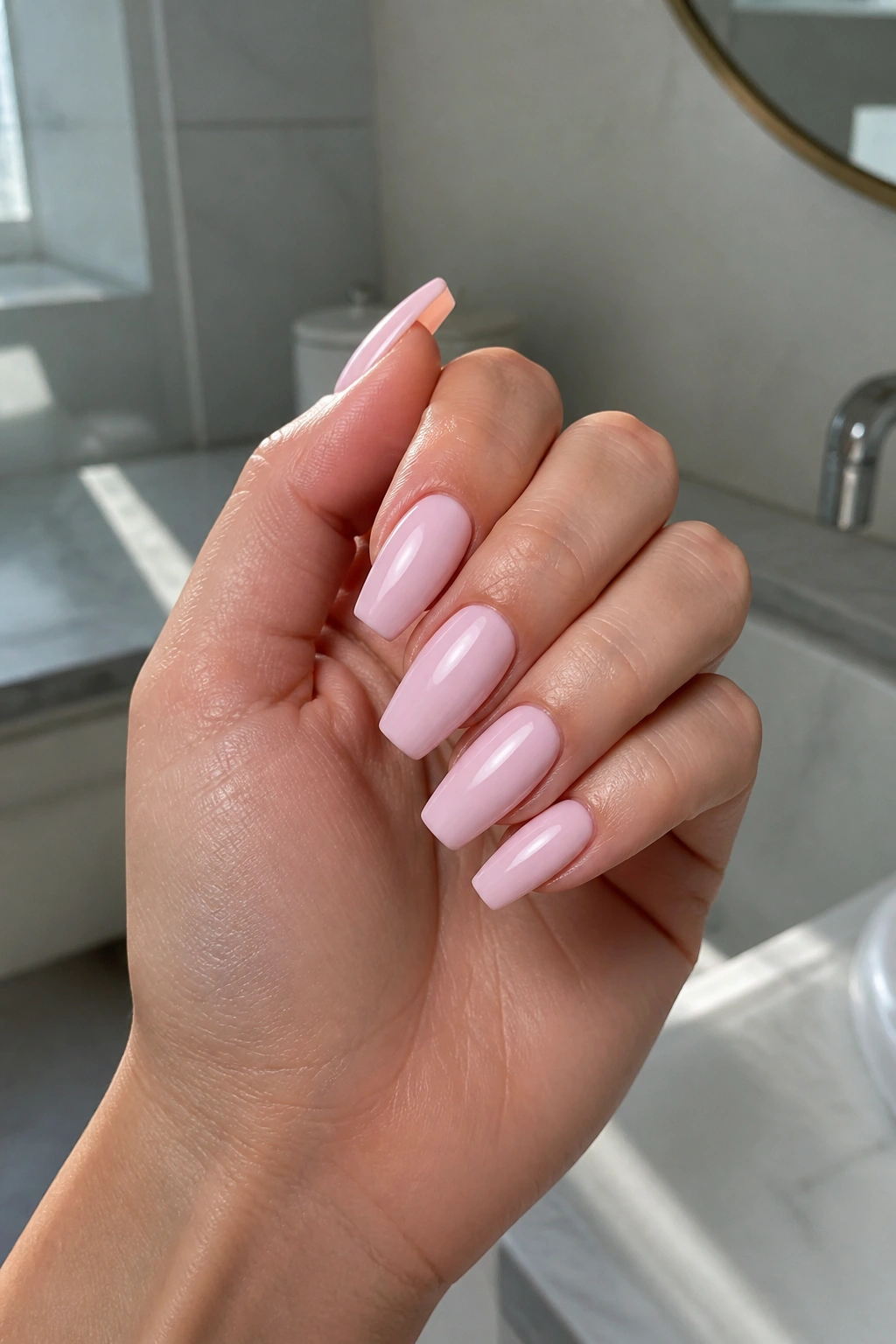
What ruins a soft pink manicure faster than anything else? The wrong base tone. Not the shape. Not the art. The undertone.
A bottle labeled “light pink” can lean peach, beige, rose, blue, or milky white. On the nail wheel those differences seem small. On your hands, they do not. Cool baby pink can turn gray against olive skin. Warm ballet pink can look orange on strongly rosy skin. You don’t need to overthink it, but you do need to compare shades in daylight, not only under salon lamps.
Here’s the quick cheat sheet I come back to:
- Cool or rosy skin: look for petal pink, blush with a blue-rose base, or milky pink that doesn’t lean peach
- Warm or golden skin: try beige-pink, peach-pink, or soft ballet pink with a hint of cream
- Neutral undertones: balanced milky pinks usually work best, especially semi-sheer ones
- Deeper skin tones: go for rose milk, warm blush, or translucent pink with depth; stark pastel can turn ashy
Opacity matters too. A sheer pink lets your natural nail tone come through, which often makes the manicure look more natural. A fully opaque pink has more impact, though it needs stronger shade matching or it can sit on the hand like correction fluid. If you’re stuck between two shades, I’d pick the one with a touch more warmth and ask for two thin coats instead of three heavier ones.
Pale pink is unforgiving, but it is not mysterious.
1. Milky Sheer Light Pink Coffin Nails
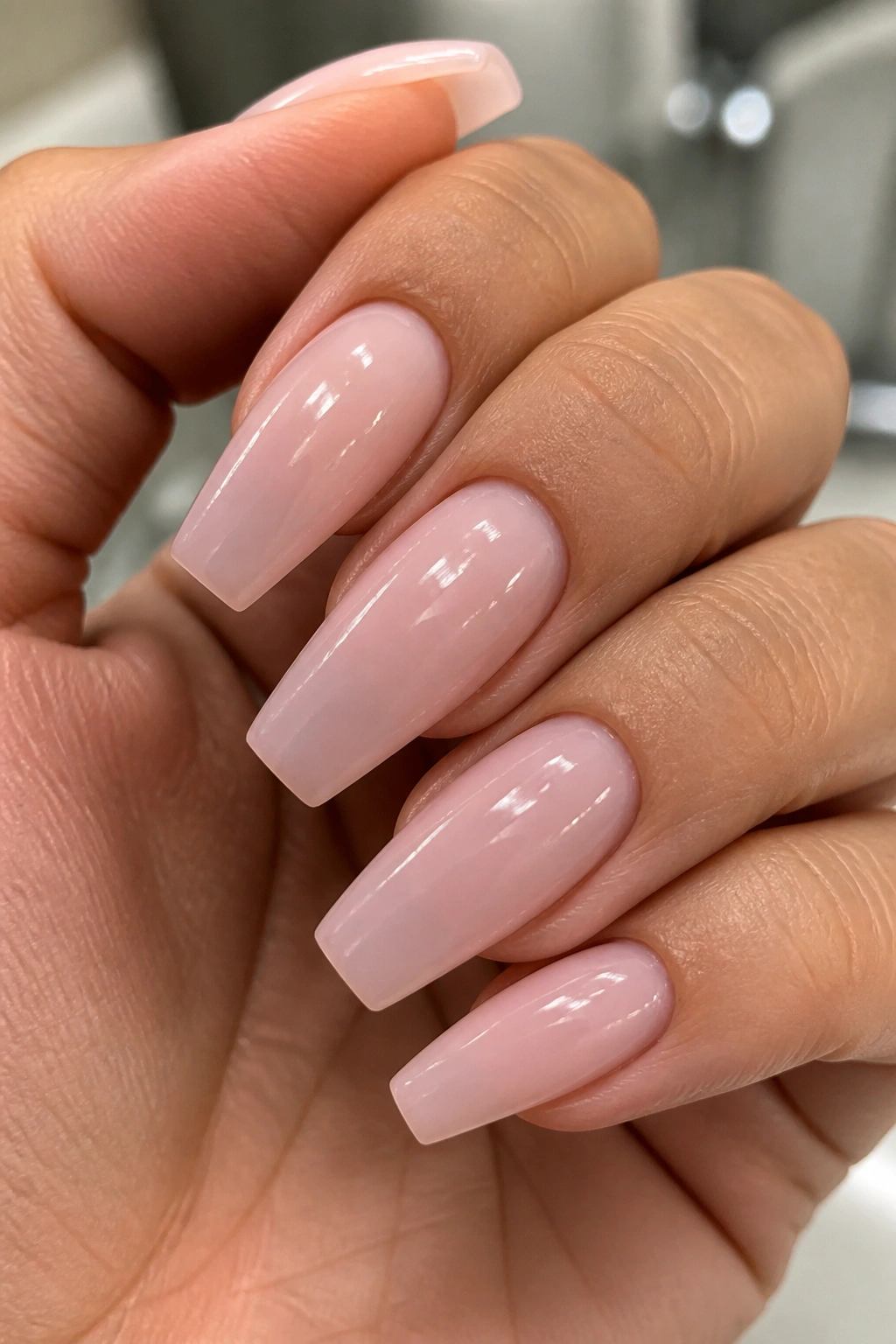
Think of the inside of a seashell—that soft, cloudy pink with a little translucence left in it. That’s the mood here. Milky sheer light pink coffin nails are my first recommendation when someone wants a manicure that looks polished up close and effortless from arm’s length.
This style works because it doesn’t try to hide the nail completely. A little natural nail line showing through the tip makes the set look cleaner, especially on medium coffin lengths. Two whisper-thin coats of milky pink gel over a neutralized base usually do the trick; three coats can push it into chalky territory.
Why this one works so well
The slight transparency softens the coffin shape without erasing it. You still get the long, tapered outline, but the color feels airy instead of dense. On hands that carry rings or bracelets often, that lightness matters—a heavy opaque pink can fight with jewelry, while a milky wash tends to sit quietly.
Quick details to ask for at the salon
- Use a rubber base or builder base in a neutral nude if the natural nail has strong discoloration
- Keep opacity around 60 to 70 percent so the finish stays soft
- Choose medium length if you want the most natural version of coffin shape
- Seal with high-gloss top coat for that wet, smooth surface
Best pick if you want one set that works with everything in your closet and never feels overdone.
2. Creamy Baby Pink Gloss Coffin Nails
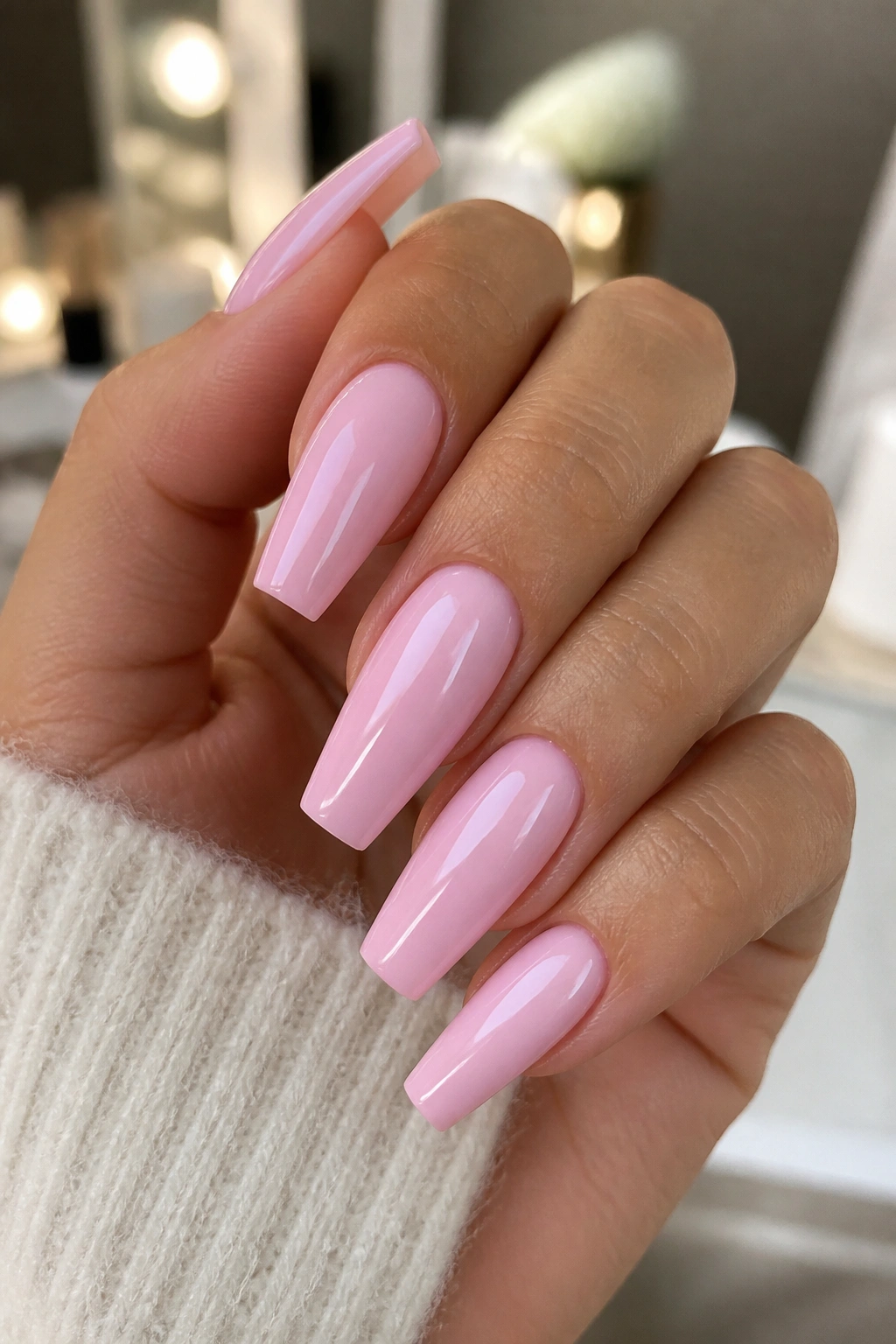
If you want the cleanest polished look, creamy baby pink with a glassy top coat is hard to beat. No shimmer. No fade. No crystals. Just even color, sharp shaping, and that high-shine finish that makes the nail surface look almost lacquered.
The trick is stopping one step before pastel. That’s where people go wrong. A baby pink that leans white can make coffin nails look thick even when the structure is fine. I prefer a shade that still has a little skin tone in it—something around 80 percent opacity, not a full blank canvas. You want softness, not school-supply pink.
This set looks strongest on a medium-to-long coffin where the sidewalls are crisp and the corners are softened, not boxy. A square-off tip with harsh corners makes creamy pink feel heavier. A narrow taper keeps it clean.
I also like this design for people who do not want obvious nail art but still want their manicure to register as intentional. It reads neat, put-together, and calm. If your nail tech knows how to float a top coat without adding bulk, this one has that smooth salon finish people notice without always being able to name why.
3. Rosy Nude-to-Pink Ombré Coffin Nails
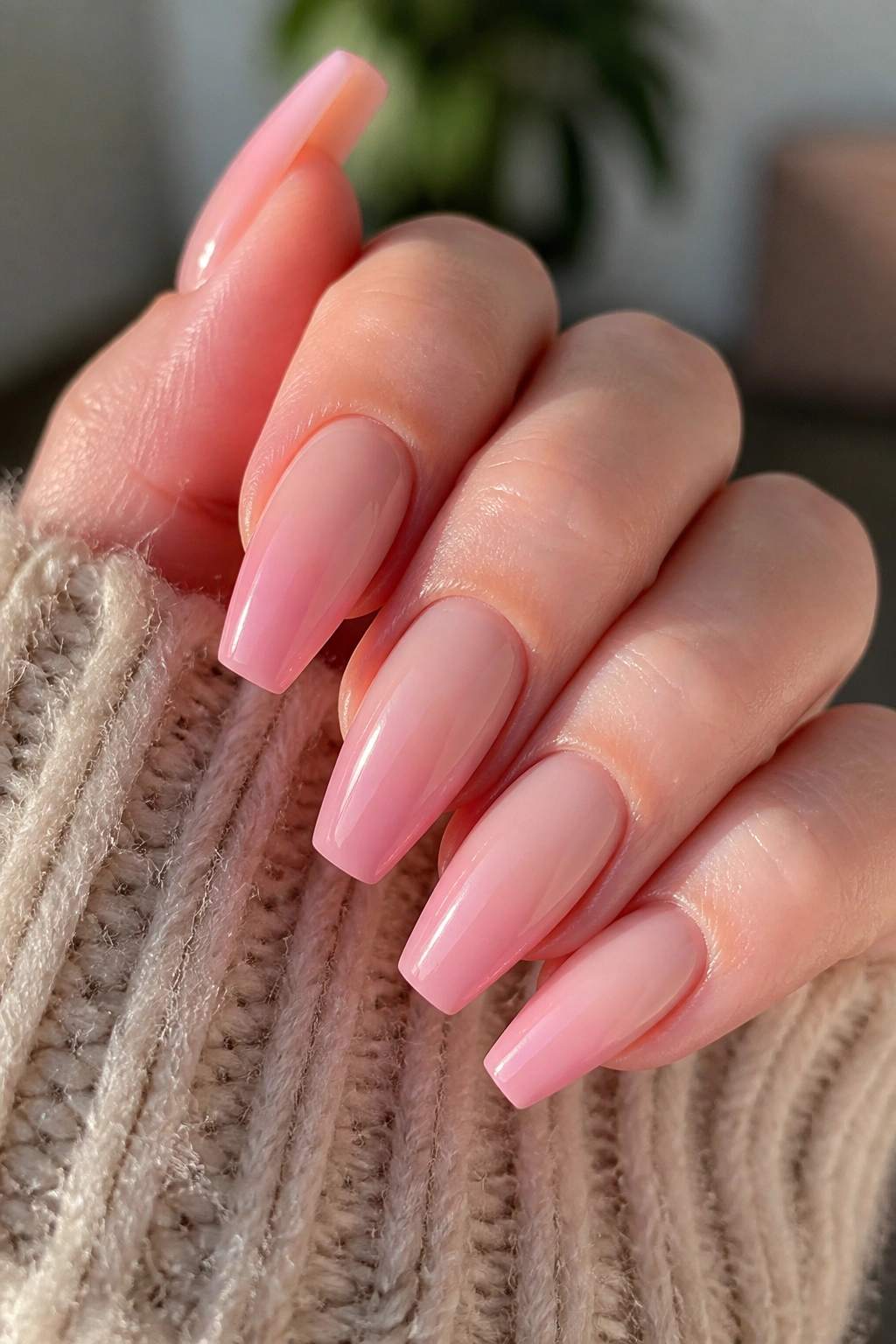
Why does this blend flatter so many hands? Because it borrows from two color families at once. A nude base near the cuticle ties the manicure to your skin tone, while the soft pink at the tip keeps the set light and fresh.
A good ombré should not look striped. The fade needs to move gradually from nude or beige-pink into a rosier light pink over about half the nail length, with no sharp line in the center. Airbrush gives the smoothest finish, though a sponge blend can work well if the layers stay thin. On coffin nails, that fade also lengthens the nail bed visually, which is a nice bonus if your natural nail bed runs short.
Regrowth is kinder with this design too. Because the cuticle area is closer to your own tone, the grow-out line doesn’t scream at you after ten days. You still need fills on schedule, though the manicure stays softer-looking between appointments than a solid opaque pink does.
How to wear it well
Keep the color shift gentle. If the nude is tan and the pink is candy-bright, the set loses its softness. I like a difference of one to two shade steps, no more. A glossy finish suits this best; matte can flatten the blend and make the fade look dusty.
4. Soft French Fade Coffin Nails
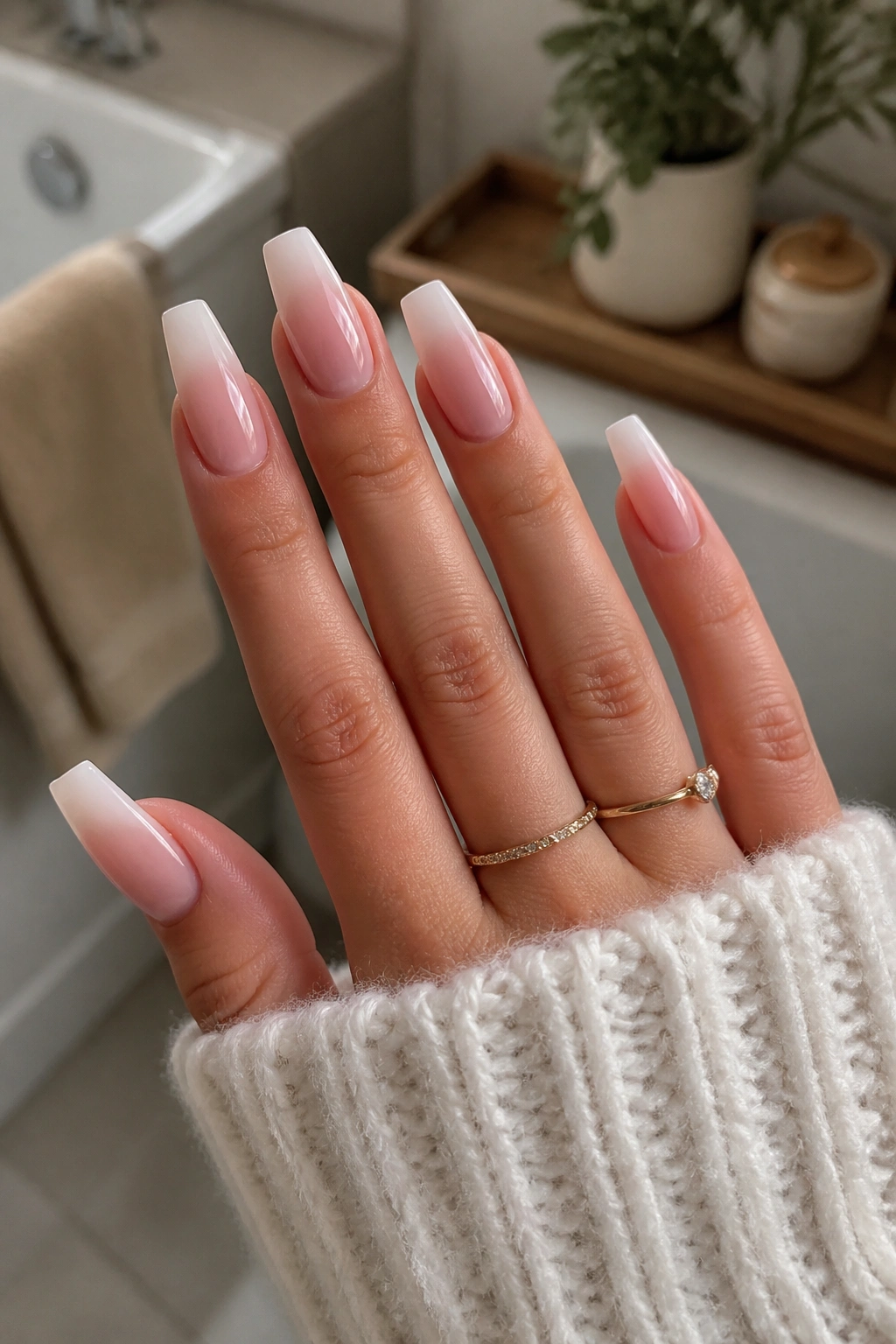
If a sharp French tip feels too stark on your hands, the French fade is the answer I keep reaching for. You still get the fresh white-at-the-edge effect, but the line melts into the pink base instead of sitting there like a stripe.
The classic version uses a pale pink base with a diffused white tip—sometimes called a baby boomer set. On coffin nails, it looks especially clean because the straight sidewalls hold the fade in place. The trick is restraint. You want the white concentrated on the last 4 to 6 millimeters of the nail, not dragged halfway down.
What makes this one softer than a standard French is the lack of contrast. There is no hard smile line to break the nail visually. The whole manicure looks longer and more blended.
A few details matter:
- Choose a pink base with some warmth so the white doesn’t turn the whole set icy
- Ask for a feathered fade, not a cloudy patch
- Keep the tip white soft, not bright paper white
- Use a glossy top coat so the gradient stays smooth to the eye
This design also hides minor wear better than a crisp French. Tiny tip chips stand out less when there isn’t a sharp border to break.
5. Light Pink Coffin Nails With Micro White Tips
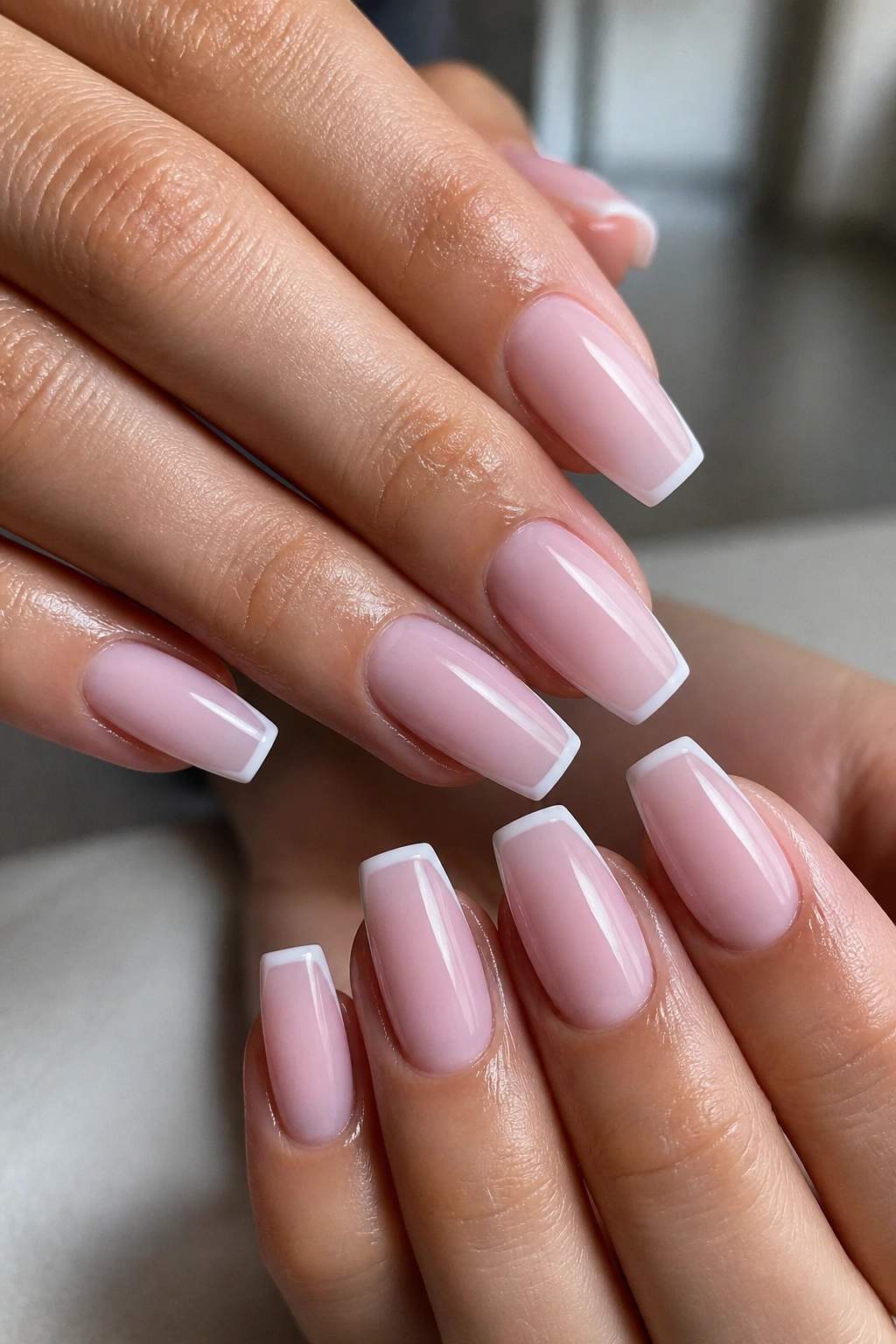
A full French tip can feel formal. A micro tip feels modern, cleaner, and lighter. That thin white edge—usually 0.5 to 1 millimeter wide—adds just enough contrast to frame the coffin shape without taking over the whole manicure.
I like this look best on short-to-medium coffin nails because the line gives definition where length is limited. On longer nails, it still works, though I’d keep the base a little sheer so the design doesn’t feel too graphic. The white should sit exactly on the free edge, not dip deep at the sides. Once the line gets too thick, the softness disappears.
You also need the right brush. A long striping brush gives a more even edge than trying to stamp the line on with a bottle brush. And if the natural free edge isn’t symmetrical yet, builder gel can clean the shape before color goes on. That extra prep makes a bigger difference than people think.
What I love here is the discipline of it. Tiny line. Soft pink base. Clean coffin taper. No wasted detail. On hands that already have a lot going on—stacked rings, tattoos, busy sleeves—this kind of manicure keeps things composed.
6. Matte Ballet Pink Coffin Nails
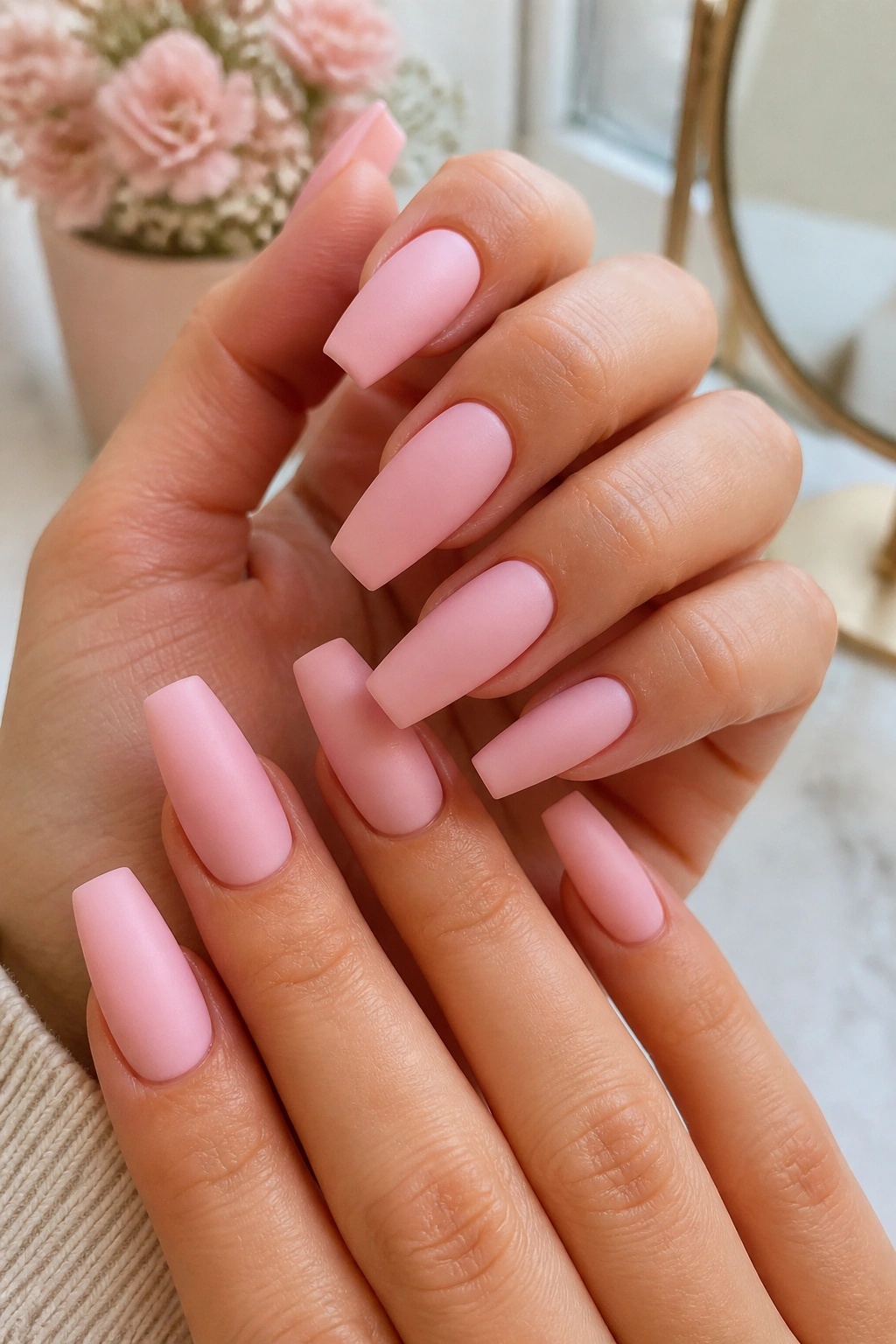
Unlike glossy pink, matte ballet pink absorbs light and softens the nail’s outline from a distance. That can look quiet and elegant on coffin shape—though only if the color has enough warmth to survive the matte finish.
Here’s the issue: matte top coat makes pale shades look a little lighter and drier. A pink that looked healthy under gloss can turn chalky once the shine is gone. That’s why I tell people to go one shade deeper than they think they need when choosing matte ballet pink. Dusty rose-pink, muted ballerina blush, and cream-warm pinks tend to hold up best.
This design is not for everyone. If your skin is dry around the cuticle, matte will highlight it. If the nail surface has any lumps, matte will show those too. Gloss is more forgiving. Still, when the prep is clean and the color is right, matte pink on a long coffin shape feels calm and a little editorial—less bridal, more intentional.
I’d reserve this one for those who like low-shine fashion details: brushed gold jewelry, soft fabrics, neutral makeup, clean lines. Ask for a matte top coat that stays velvety rather than rubbery, and keep cuticle oil on hand because dry skin beside matte nails stands out fast.
7. Pearl-Chrome Light Pink Coffin Nails
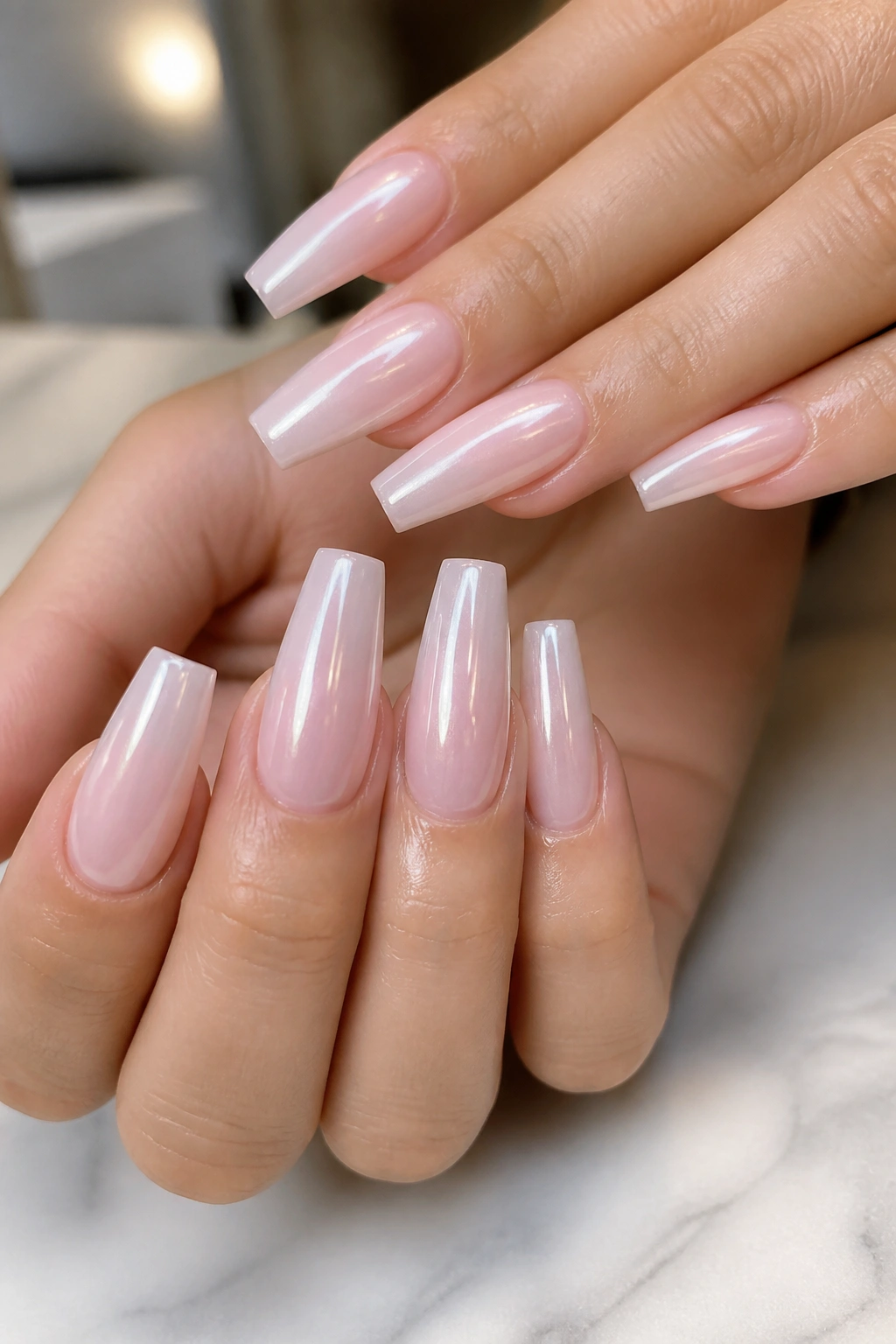
There’s a version of chrome that looks harsh and mirror-like. Skip that. The one worth asking for here is the pearl veil finish—a soft, nacre-like sheen over a pale pink base that shifts when your hands move but never turns metallic.
On coffin nails, pearl chrome gives dimension without adding bulk. I like it over a sheer or milky pink because the undertone still comes through, and the chrome sits like a thin film on top rather than a separate color. It’s less “silver nail” and more polished shell.
What makes the finish work
Fine pigment is the whole story. The powder should read pearl or opal, not steel. A cool pearl gives a cleaner icy cast; a warm pearl leans creamy and softer. Both can work. The base pink decides which direction feels better on your skin.
Quick notes before you book it
- Use a translucent pink base rather than fully opaque pastel
- Keep the chrome layer sheer so the pink stays visible underneath
- Choose a smooth gel top coat because texture kills the satin effect
- Best on medium and long coffin lengths where the sheen has room to show
If you want soft pink with a little movement, this is one of the best upgrades you can make.
8. Jelly Blush Coffin Nails
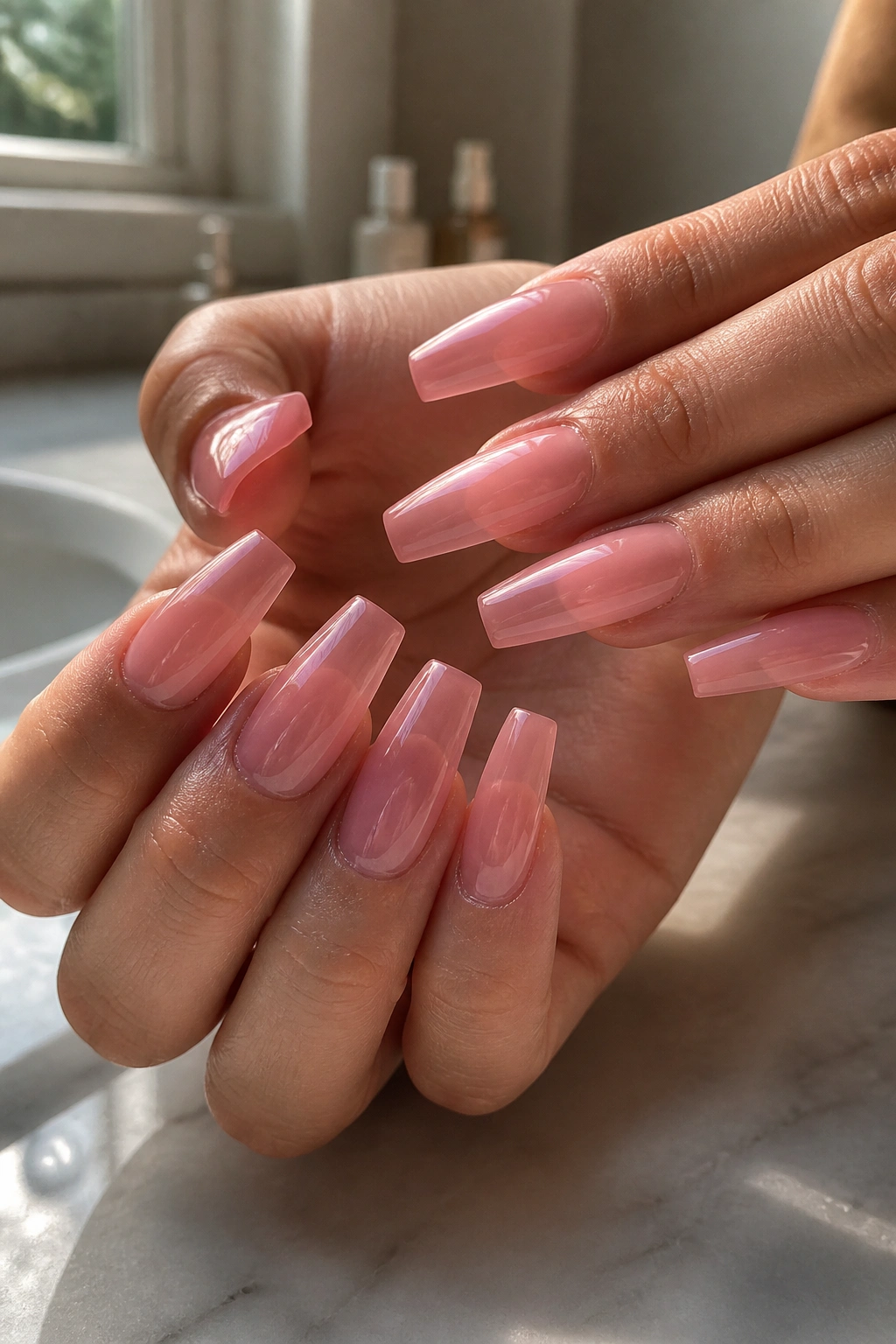
Jelly pink is the fastest way to make long coffin nails feel lighter. The transparency takes visual weight off the shape, so even extra length doesn’t look stiff.
This finish has that syrupy, glass-like look where you can still see depth through the color. Think hard candy, but toned down into blush. Two to three thin coats of jelly gel usually get you there. More than that, and you lose the point of the style. The slight see-through effect is what keeps it soft.
I love jelly blush on structured gel extensions because the surface stays smooth and the nail feels almost illuminated from within. Acrylic can do it too, though you need careful product control or the color gets muddy. This set also looks fresh with encapsulated tiny details underneath—one dried flower, a wisp of foil, a tiny decal—but I’d keep those extras sparse.
There is a downside. Repairs and fill lines can show more through jelly than through creamy pink, so maintenance matters. If you tend to stretch appointments too long, pick a milky design instead. If you stay on top of fills, jelly blush is one of the prettiest ways to wear coffin nails without making them feel heavy.
9. Light Pink Coffin Nails With Cuticle Glitter Dust
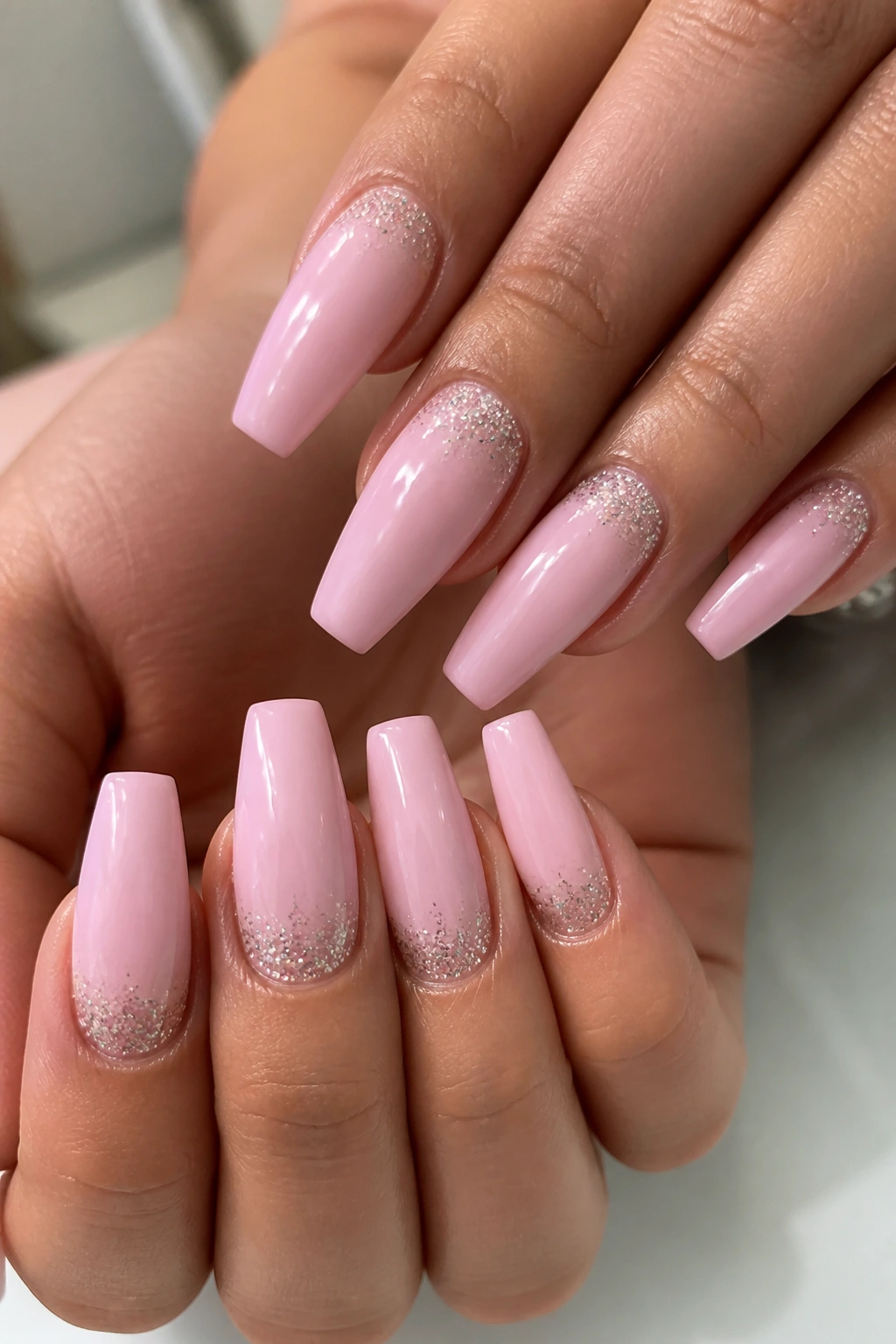
Can glitter still look soft? Yes—when the sparkle sits near the cuticle and fades out before it hijacks the whole nail.
This design works because the glitter behaves like a highlight, not a statement. Use ultra-fine shimmer in pink, champagne, or opal, packed into the first 2 to 3 millimeters near the cuticle and brushed upward until it disappears into the base. Chunky glitter ruins the mood. Fine dust keeps the effect airy.
Placement matters here more than color. Glitter on the tips can feel party-ish fast. Glitter at the base looks subtler and has a practical benefit too: it helps blur regrowth for a bit longer, especially on a sheer pink base. That makes it a smart option if you like your nails soft but still want one small detail.
Keep the sparkle controlled
I’d use the glitter on all nails only if the application is whisper-light. Another route I like more is full set in soft pink, accent glitter dust on two or four nails. You get light play when your hands move, but the manicure still reads as pink first, sparkle second.
10. Pink Quartz Marble Coffin Nails
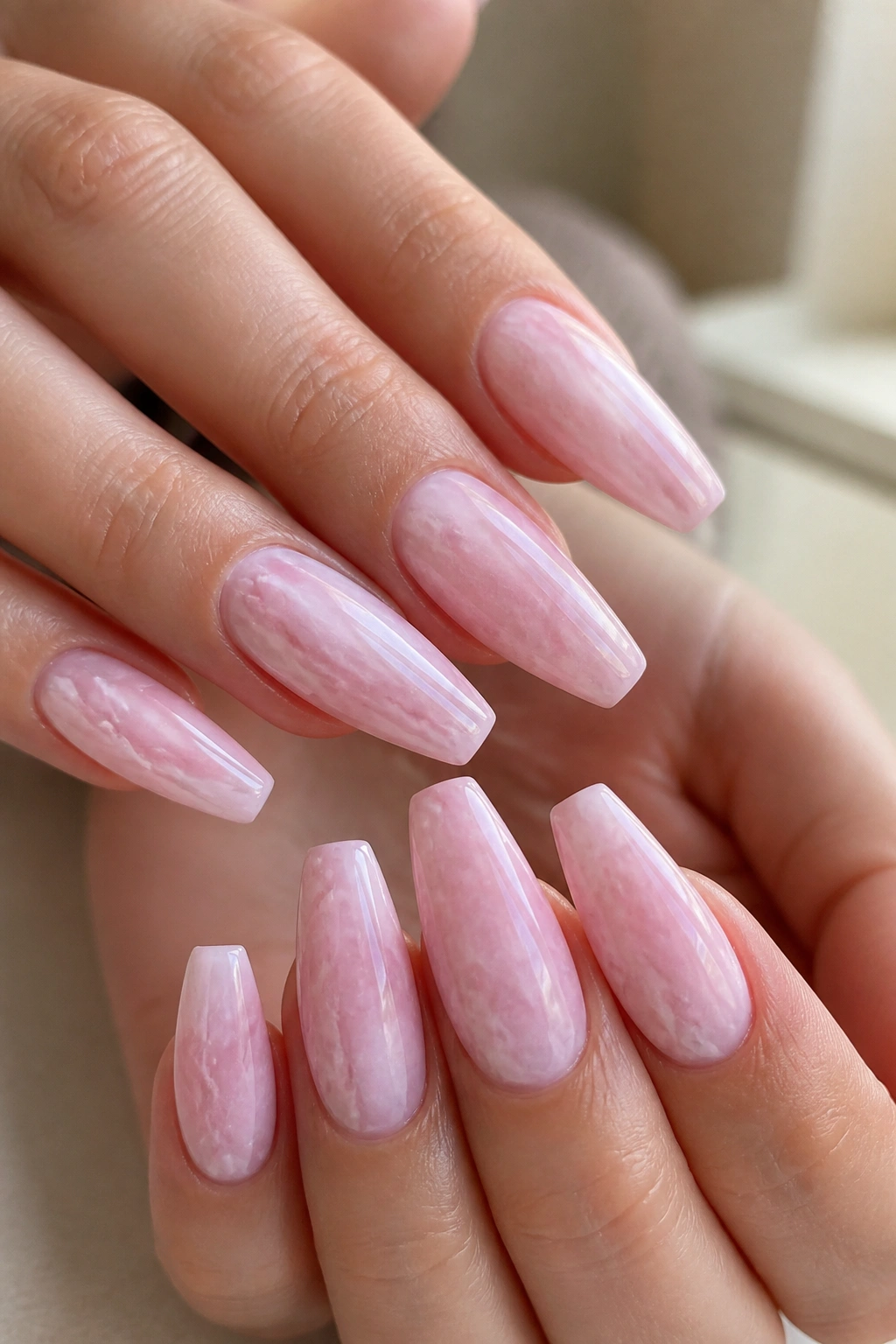
I keep coming back to this one when someone wants nail art but hates high contrast. Pink quartz marble gives you detail through layering rather than loud color, so the finished set still feels calm.
The base should be a translucent pink or milky rose, not opaque baby pink. Over that, thin white veins are drawn in loose, broken lines—not thick zigzags—then softened with another sheer pink layer so they look buried inside the nail. A tiny touch of silver or champagne foil can work, though I usually prefer leaving it out. The softer version looks more convincing.
This design looks best when you use it with restraint. One full marble nail on every finger is too much for a soft look. Two accent nails, maybe three, are enough.
What keeps it chic rather than busy:
- Veins should stay hair-thin, never chunky
- Color contrast should stay low, with white softened by pink glaze
- Accent placement matters—ring finger and thumb usually carry it best
- Gloss is the right finish because stone effects need depth
When it’s done well, the manicure has that layered mineral look without turning costume-like.
11. Light Pink Coffin Nails With Tiny White Florals
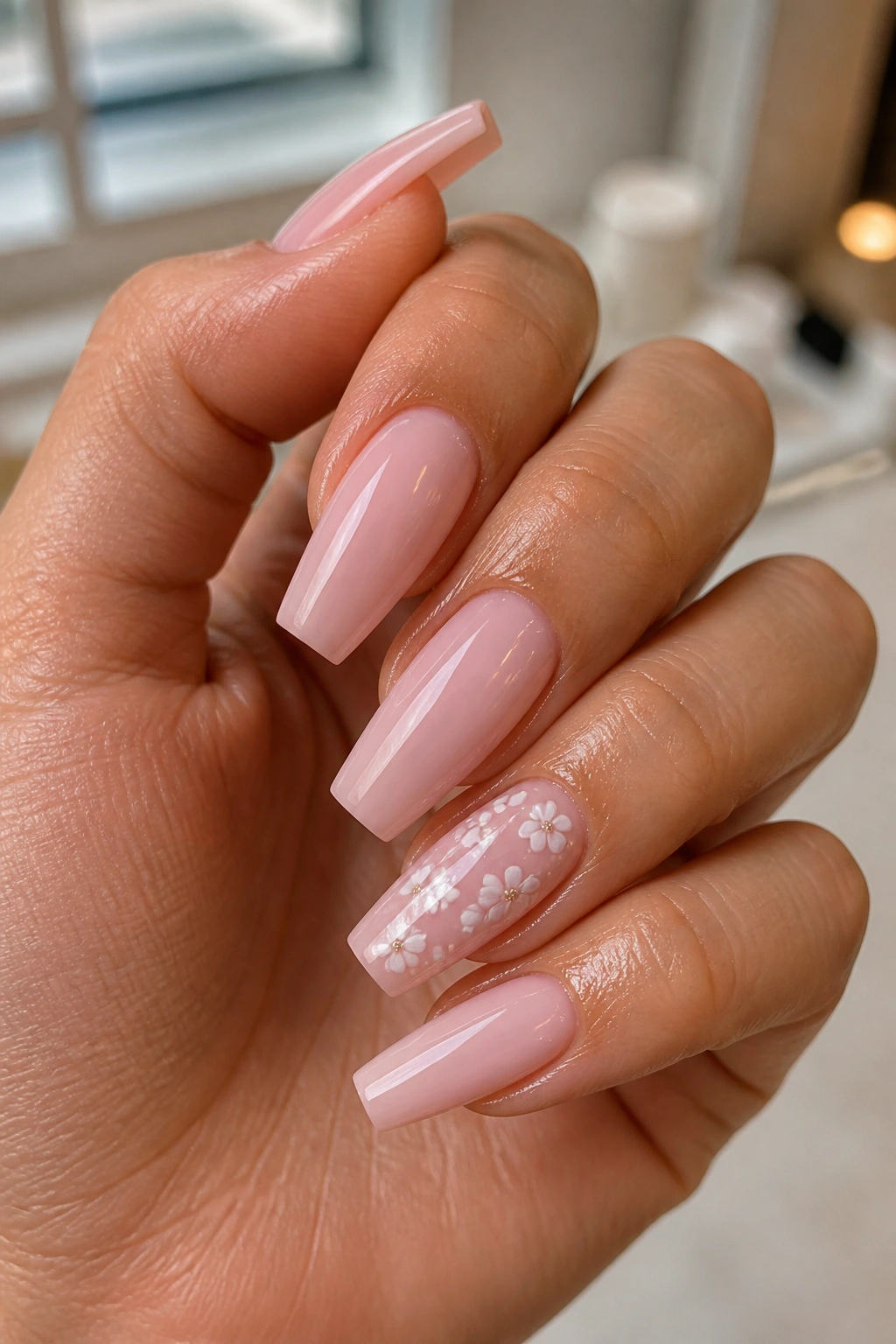
Florals go wrong when they’re too large, too bright, or scattered on every nail. Keep them tiny and the whole set changes. Suddenly the manicure feels airy instead of sweet in a heavy-handed way.
On a soft pink coffin base, I like single miniature flowers about 3 to 4 millimeters wide, painted on one or two accent nails with a dotting tool or a fine brush. White petals work best because they stay quiet against pale pink. Yellow centers can be cute, though I often skip them for a cleaner finish. A tiny crystal in the middle can work too, though only if the rest of the set is plain.
Placement decides whether the design feels grown-up. One flower near the sidewall, a trailing pair near the tip, or a small cluster in a corner looks far better than a centered daisy on every nail. Decals can do the job, but hand-painted flowers usually sit better with the shape because the size can be adjusted to the nail width.
This is one of those designs that sounds softer than it is, so edit hard. Fewer petals. Fewer nails. More negative space. That restraint is what keeps the manicure light.
12. Reverse French Light Pink Coffin Nails
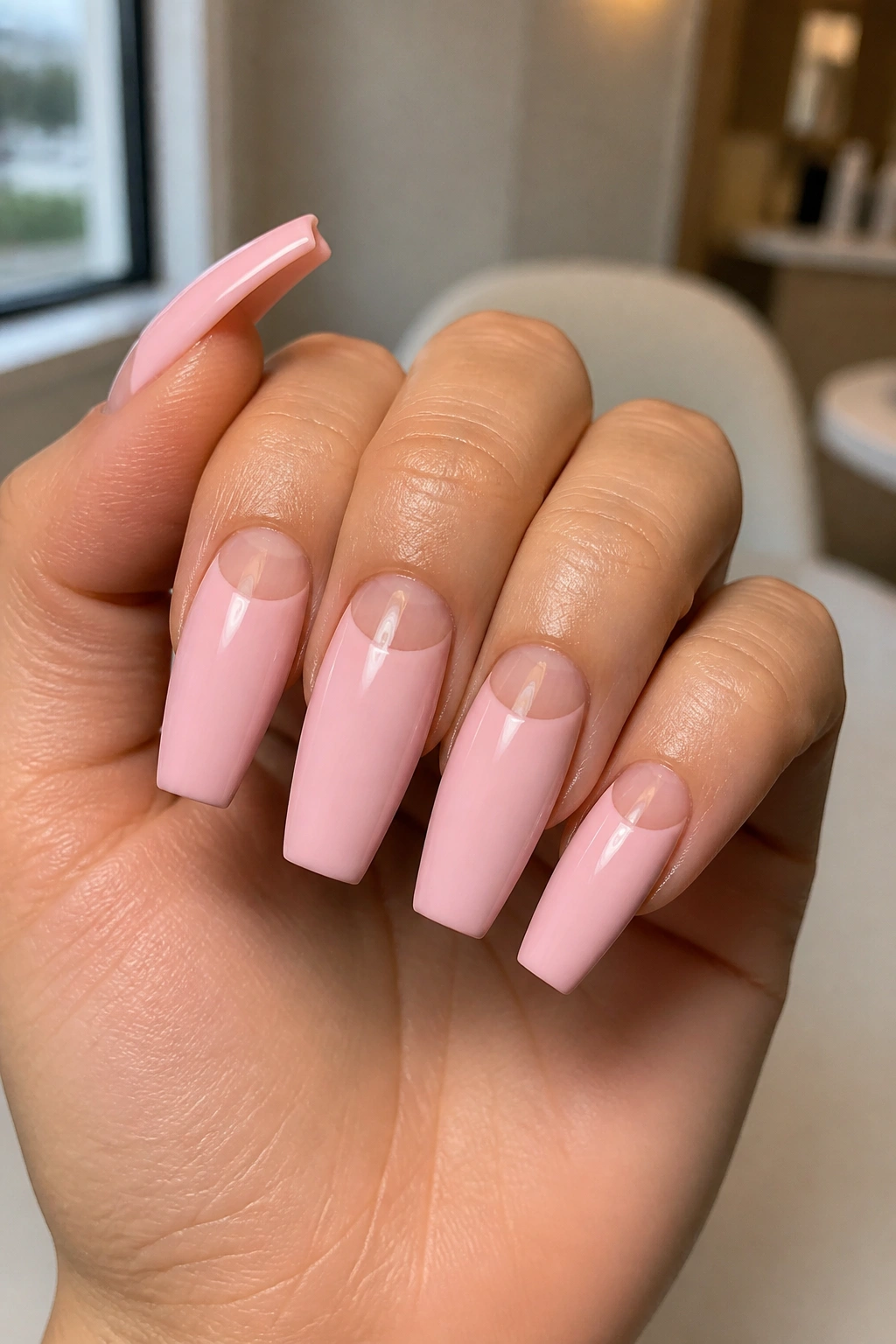
A reverse French does something a standard French cannot: it makes grow-out look cleaner while still giving you a defined design. Instead of highlighting the tip, it frames the cuticle area with a half-moon and lets the rest of the nail carry the pink.
The softest version uses a nude or clear crescent at the base—about 2 to 3 millimeters deep—with light pink covering the rest of the nail. Because the cuticle zone stays close to your natural tone, regrowth is less abrupt. That makes this design useful for people who love neat nails but hate seeing a strong fill line after ten days.
Compared with a full solid pink set, reverse French feels more graphic. Compared with a standard French, it feels quieter because the contrast sits near the cuticle, not at the widest visible edge of the nail. On coffin shape, that can be flattering because the taper stays uninterrupted.
I’d recommend this style to anyone who likes structured nail art with a clean finish and no sparkle. Ask for a crisp half-moon and a warm pink if your skin carries gold or olive tones. Cool rose works better on pinker skin. Small detail, big difference.
13. Tone-on-Tone Swirl Coffin Nails
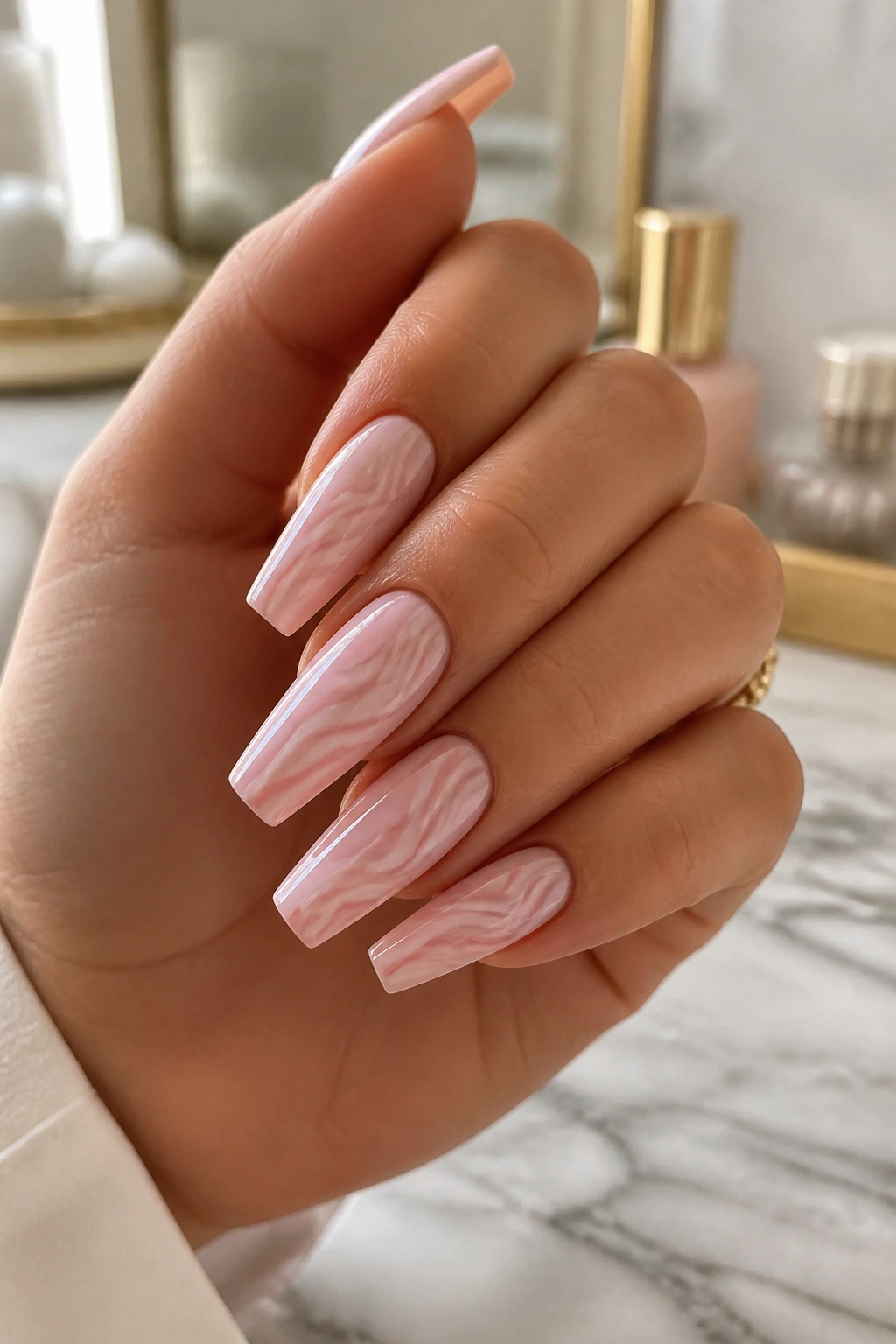
Swirls can get loud fast. The fix is keeping the whole design inside one pink family. A soft blush base with slightly deeper rose swirls gives you movement without turning the nails into miniature posters.
I like this most on medium coffin lengths where there’s enough room for a curve or two, but not so much room that the design starts sprawling. The swirl lines should stay fine and loose, almost like ribbon dragged through wet polish. Thick, high-contrast waves kill the softness right away.
What keeps the look calm
Stay close in color. Your swirl shade should be only one or two steps darker than the base, and the line work should leave plenty of open space. If every nail is packed with loops, the manicure loses air.
Design notes worth giving your tech
- Use a glossy milky or creamy pink base
- Limit swirls to two or three lines per nail
- Mix full-design nails with plain pink nails so the set can breathe
- Avoid black, bright white, or gold outlines if softness is the goal
This is a good choice when you want nail art that reads modern but still quiet.
14. Airbrushed Pink Aura Coffin Nails
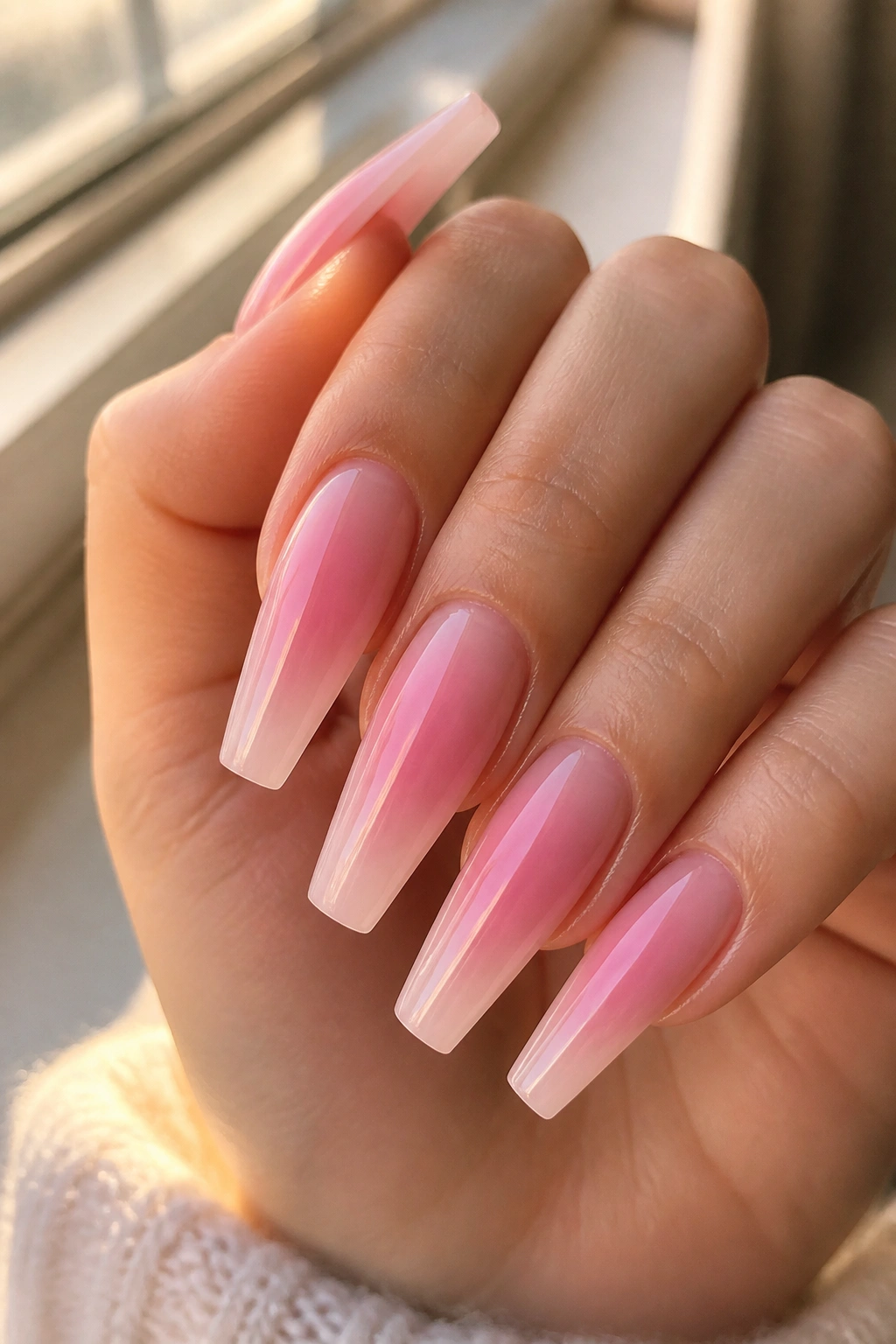
A soft aura nail looks like blush diffused through the center of the nail plate. On coffin shape, that hazy center glow adds dimension without breaking the long, straight outline at the edges.
The best version starts with a milky or sheer pink base, then places a deeper rosy pink in the center—usually around 30 to 40 percent darker than the base—and blends it outward until the color fades before reaching the sidewalls. Airbrush gives the smoothest effect, though sponge work can mimic it if the pigment stays sheer. Neon aura is everywhere in inspiration photos; skip that. Soft pink aura works because it stays whispery.
I like this design more on longer coffin nails than on short ones. Longer length gives the center color room to bloom, and the edges stay pale enough to keep the nail looking narrow. Too little space and the aura turns into a dot.
There’s something flattering about the way this style draws the eye inward. It makes the nail surface look deeper, almost domed, even when the structure is clean and slim. If you want something more artistic than a plain pink manicure but still want the whole set to feel gentle, this one earns its place.
15. Light Pink Coffin Nails With Single Pearl Accents
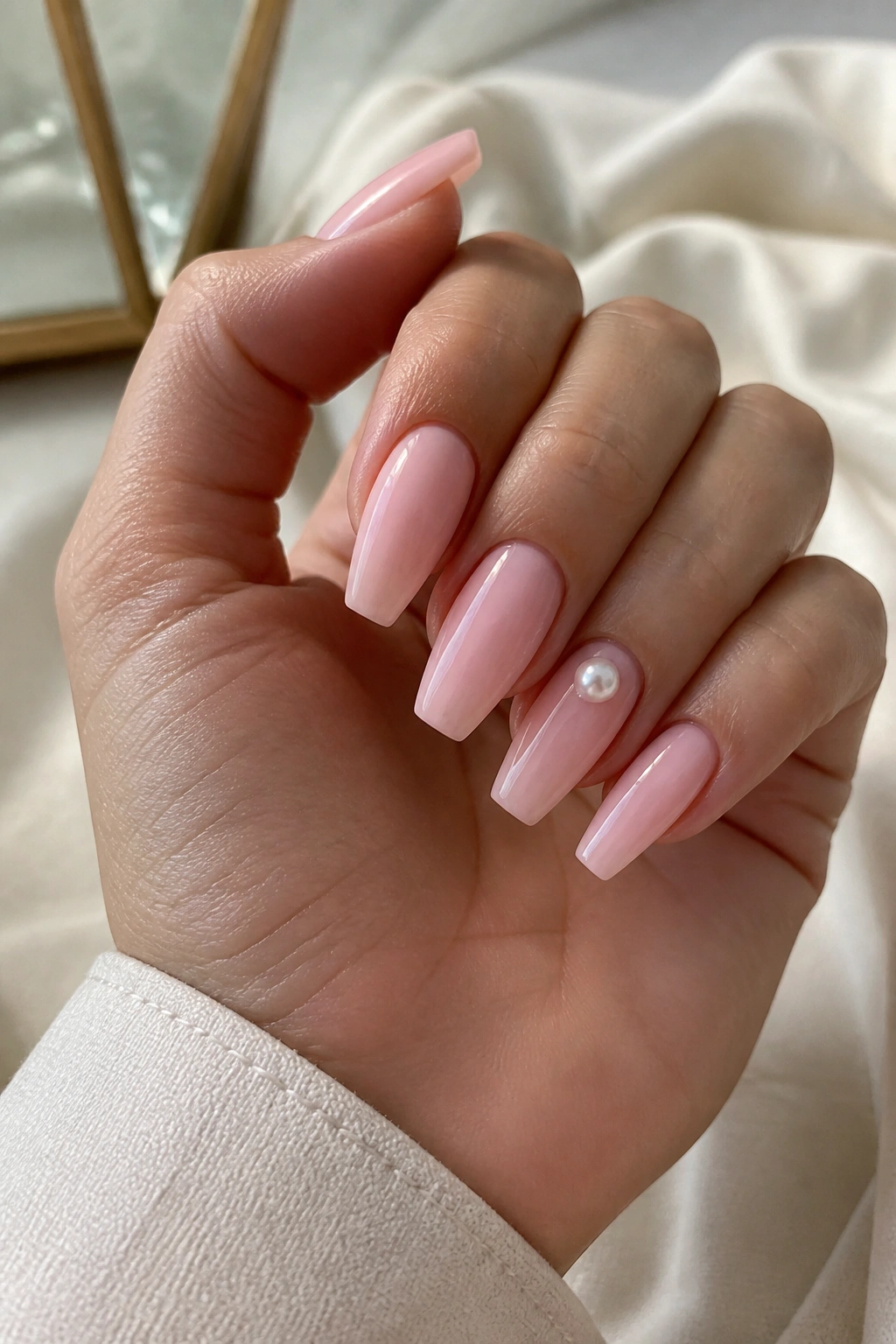
Do pearls belong on a soft pink set? They do—if you stop at one. Maybe two. Beyond that, the manicure starts reading bridal costume instead of polished detail.
The nicest version uses a glossy light pink base and one flat-back pearl around 1.5 to 2 millimeters wide placed near the cuticle or off to one side on an accent nail. Thumb and ring finger usually wear pearls best because they give the eye a focal point without repeating the same detail across every finger. You can add a second pearl beside the first on one nail, though I’d leave the rest plain.
Tiny pearls suit a soft look better than rhinestones because they share the same gentle color family as the base. They also work well with coffin shape, which can sometimes feel sharp; the round accent softens that geometry.
Placement is everything
Seal matters here. A pearl that isn’t secured well will snag hair, lift at the edge, and annoy you by day two. Use small flat-backs, set them into gel, and cap around—not over—them so they keep their shape. If you want one detail that feels dressed-up without shifting the whole manicure into sparkle territory, this is the one I’d pick.
Keeping Light Pink Coffin Nails Fresh Between Fills
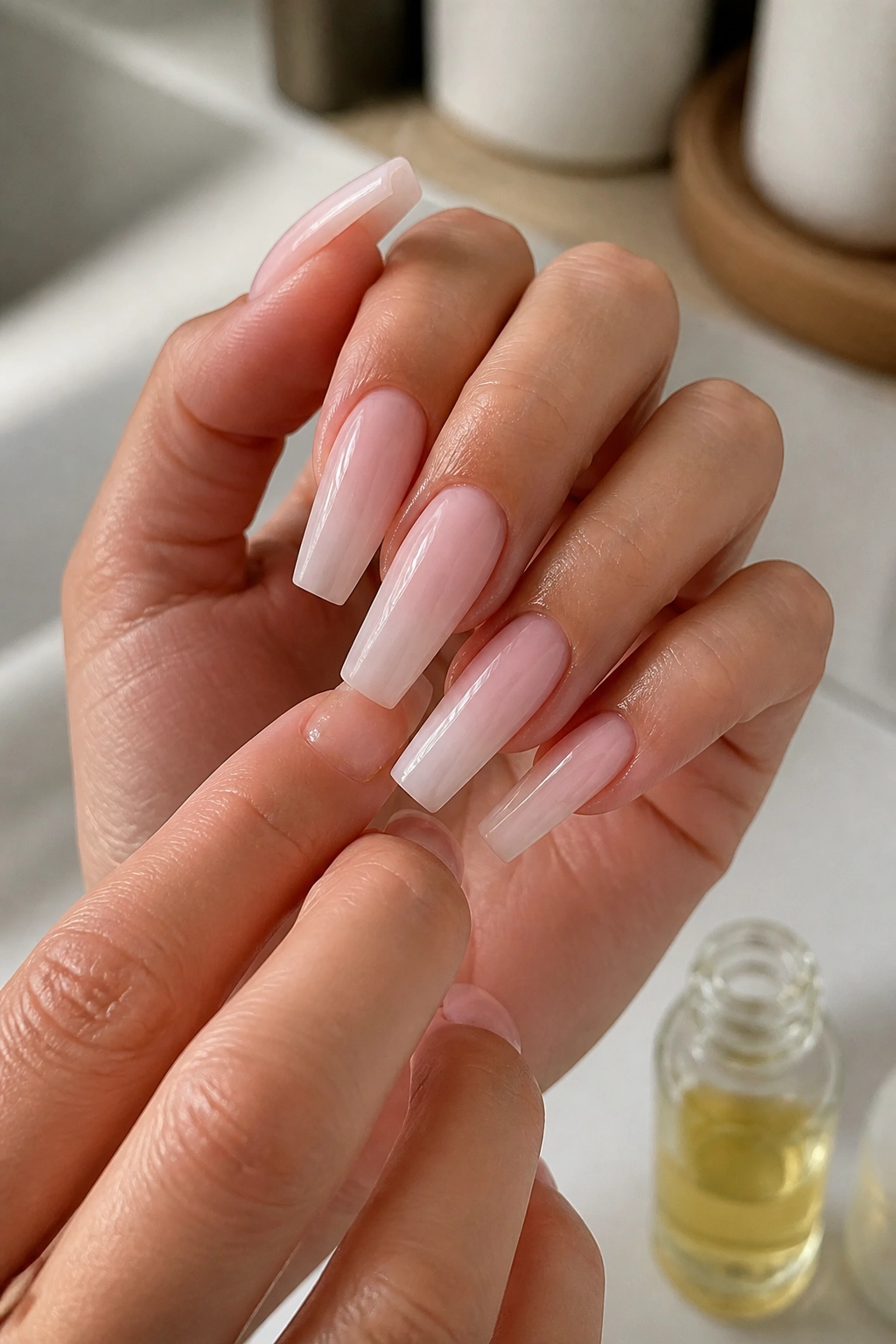
Pale pink is less forgiving than deep burgundy or black. Chips show. Stains show. Dry cuticles show. If you want that soft look to last, maintenance is part of the design.
The American Academy of Dermatology has long warned against aggressive cuticle cutting, and I’m fully on their side here. When the skin around the nail is inflamed, red, or nicked, a light pink manicure loses its clean finish fast. A gentle push-back after showering, plus cuticle oil once in the morning and once before bed, does more for the look than another layer of top coat ever will.
A few habits make a real difference:
- Book fills every 2 to 3 weeks if you wear medium or long coffin shape
- Use cuticle oil twice a day so pale polish doesn’t sit next to dry, white skin
- Wear gloves for dishes and cleaning because detergents dull top coat and dry the sidewalls
- File tiny snags with a 180-grit file instead of picking at them
- Clean under the free edge with a soft brush so the manicure keeps that fresh pink look
- Avoid thick self-tanner, hair dye, and pigmented makeup sitting on the nail plate for long stretches
One more thing. If your pale pink manicure starts looking dull after a week, it may not be the polish. Lotion residue, sunscreen, and everyday grime leave a film. A quick wipe with a lint-free pad and a little alcohol on the nail surface—not the skin—can bring the shine back.
Final Thoughts
Soft pink works best when the details stay disciplined. Undertone, opacity, and shape matter more than decoration. Get those right and even a plain milky set looks thoughtful.
If you’re torn between options, I’d start with either milky sheer light pink or a soft French fade. Those two designs flatter the widest range of hands, hide wear better than most, and make coffin shape look clean instead of severe.
Then, once you know which pink family suits you, add one small twist—pearl chrome, a micro tip, a tiny flower, a whisper of glitter near the cuticle. Pale pink doesn’t need much. That’s why it works.