

Most marble manicures miss the mark for one simple reason: they try too hard. The veining gets thick, the colors get muddy, the glitter piles on, and what should have looked like polished stone ends up reading like a craft project. Marble ballerina nails can look rich, sharp, and expensive-looking—but only when the shape, color mix, and finish all pull in the same direction.
That ballerina shape does a lot of heavy lifting. With its tapered sides and flat tip, it gives marble nail art a longer canvas than a rounded squoval or short almond, which means the veining has room to stretch and breathe instead of bunching up near the center. Done well, the pattern looks closer to cut stone: soft movement, thin lines, clean edges, no chaos.
There’s another detail people skip. High-end marble nails almost always leave some visual quiet space. Real stone has depth, yes, but it also has restraint. A milky base with two thin gray veins will often look pricier than five colors, foil flakes, rhinestones, and a chrome top coat all fighting for attention on one finger.
And that’s where the fun starts—because there isn’t just one way to make this style look expensive.
Why Marble Looks Richer on a Ballerina Shape
A short square nail can carry marble. A ballerina nail shows it off.
The reason is mostly visual. Marble patterns need direction. Veins want to travel, fade, split, and thin out, and a ballerina shape gives them a straight, elongated path. On a nail that extends about 10 to 15 mm past the fingertip, those lines can start near one sidewall, drift toward the center, then taper out before they hit the flat tip. That movement reads like stone, not printed nail art.
The flat end matters more than people think. On almond nails, marbling can look softer and more fluid, which is nice when you want a watercolor mood. Ballerina nails give you a crisper finish. The squared-off tip acts like a frame, and that frame makes white marble, black onyx, taupe smoke, and green malachite patterns look more intentional.
Length helps too—but not endless length. Once you get too far past 16 or 18 mm of free edge, some marble sets start to look theatrical instead of polished. If you want the expensive version, ask for medium-long rather than extra-long. Enough room for detail. Not so much that the shape starts wearing you.
One more thing. Ballerina and coffin nails are close cousins, and salons often use the names interchangeably. If you want the softer, pricier look, ask for a ballerina shape with slightly narrowed sidewalls and a flat tip that isn’t too blunt. That little tweak changes the whole mood.
The Details That Separate Expensive-Looking Marble From Muddy Nail Art
A marble manicure can go wrong in under 30 seconds.
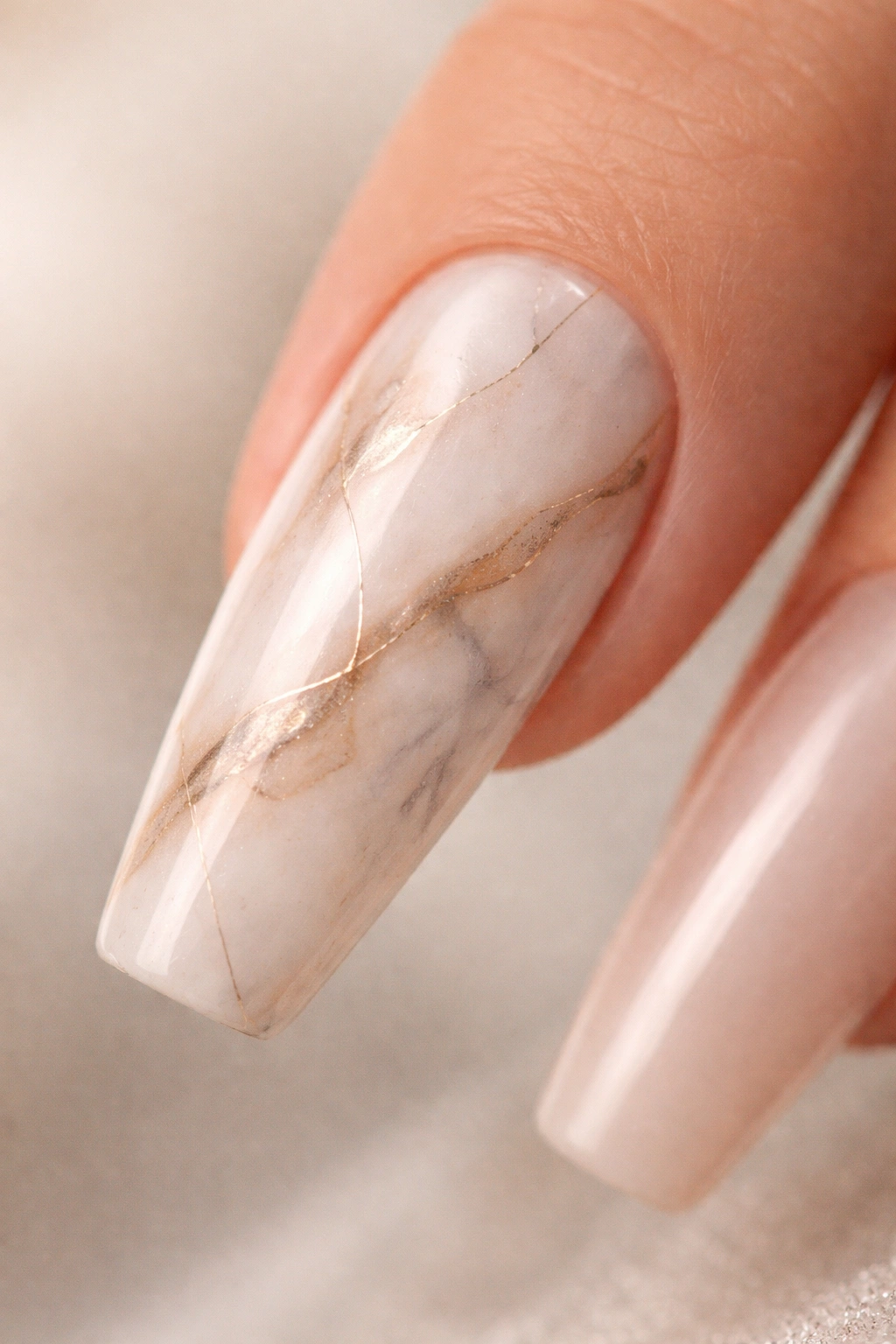
Usually it happens during blending. Someone drags two or three wet colors together too many times, the lines spread, the contrast disappears, and the design loses that stone-like snap. High-end marble nails stay controlled. You can still see where one shade ends and the next begins.
A cleaner set usually follows a few quiet rules:
- Stick to 2 or 3 main tones on each nail, not 5 or 6.
- Use a sheer or milky base when you want depth. Opaque white can look flat if the veining sits on top like stickers.
- Keep vein lines thin as thread in some spots, then widen them only where the design needs a break.
- Leave roughly one-third of the nail calm and open so the pattern has room to breathe.
- If you add metallic detail, choose one accent metal—gold or silver, not both on the same hand.
Top coat choice changes the mood fast. Gloss gives white, beige, pink, and green marble that polished-stone effect. Matte can work, though I only like it when the base color is smoky or earthy—taupe, slate, mushroom, espresso. Matte over bright white marble tends to kill the depth.
Placement matters, too. Not every nail on the set needs full marbling. In fact, some of the chicest ballerina nail ideas use marble on 2 to 4 nails per hand, with the others staying nude, French, or softly glazed. That contrast makes the patterned nails look expensive because they get room to stand out.
1. Milky White Carrara Marble Ballerina Nails
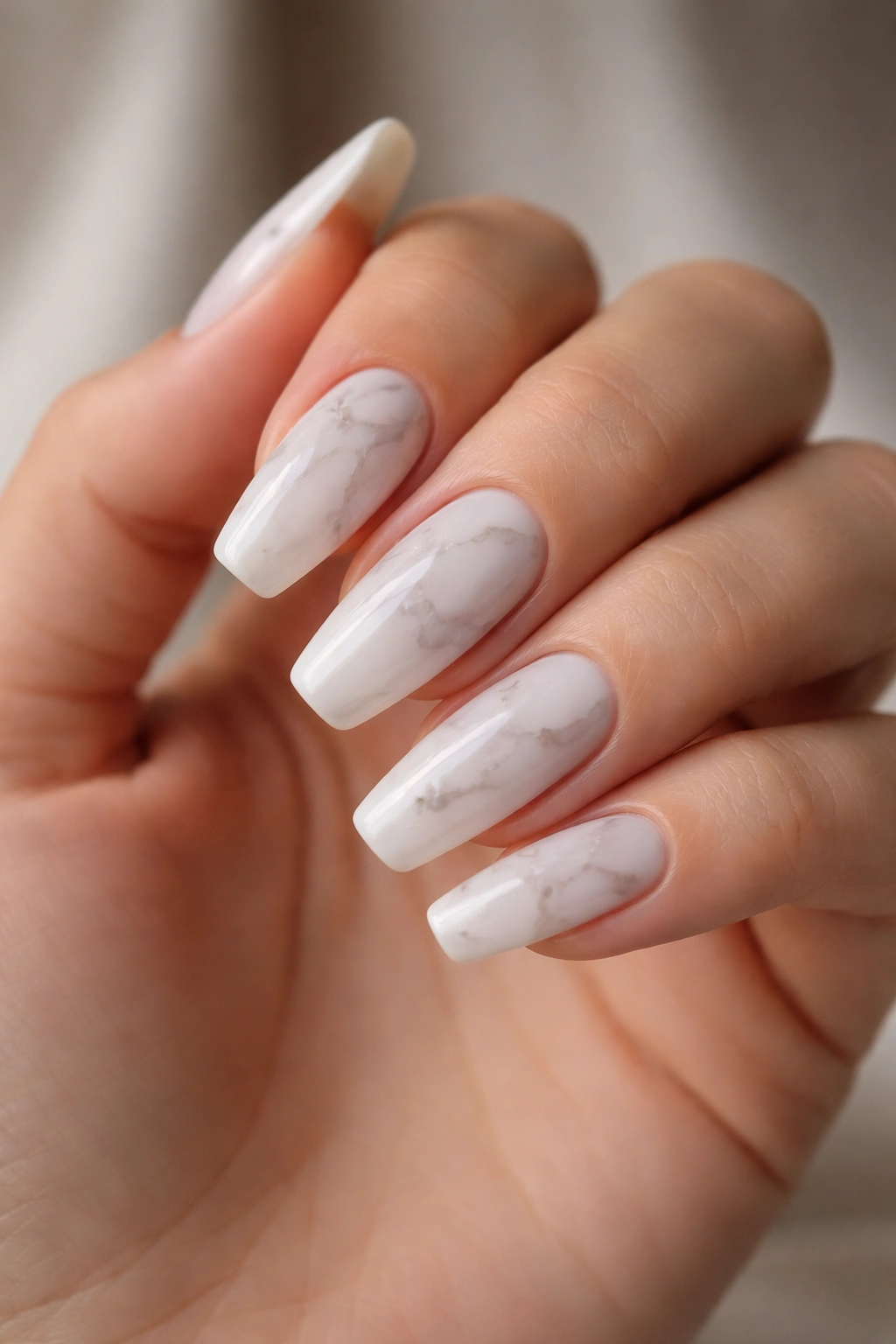
If you want the cleanest path into marble ballerina nails, start here. Milky white Carrara marble is the design that almost never looks dated when it’s done with restraint, and on a medium ballerina shape it has the same quiet polish as a white silk blouse or a pale stone countertop with soft gray movement.
The base should not be chalk white. That’s the mistake. Ask for a semi-sheer white or soft milk base, then add fine gray veining with one or two whisper-thin lines of charcoal. A tiny touch of diluted beige near the cuticle can help the design look less stark and more like real stone.
Why this one reads expensive
Carrara works because the contrast stays controlled. You’re not seeing thick black lines slapped over white polish; you’re seeing soft depth, a little shadow, and enough transparency to make the nail feel layered.
What to ask for at the salon
- A milky builder gel base rather than a fully opaque white gel polish
- Gray veins that fade at the ends instead of stopping bluntly
- Marbling on 3 to 6 nails total, not every finger unless the set is kept minimal
- A high-gloss top coat to mimic polished stone
Best on: medium to long ballerina nails with a cool or neutral nude beneath the marble.
2. Nude Beige Marble With Fine Gold Veins
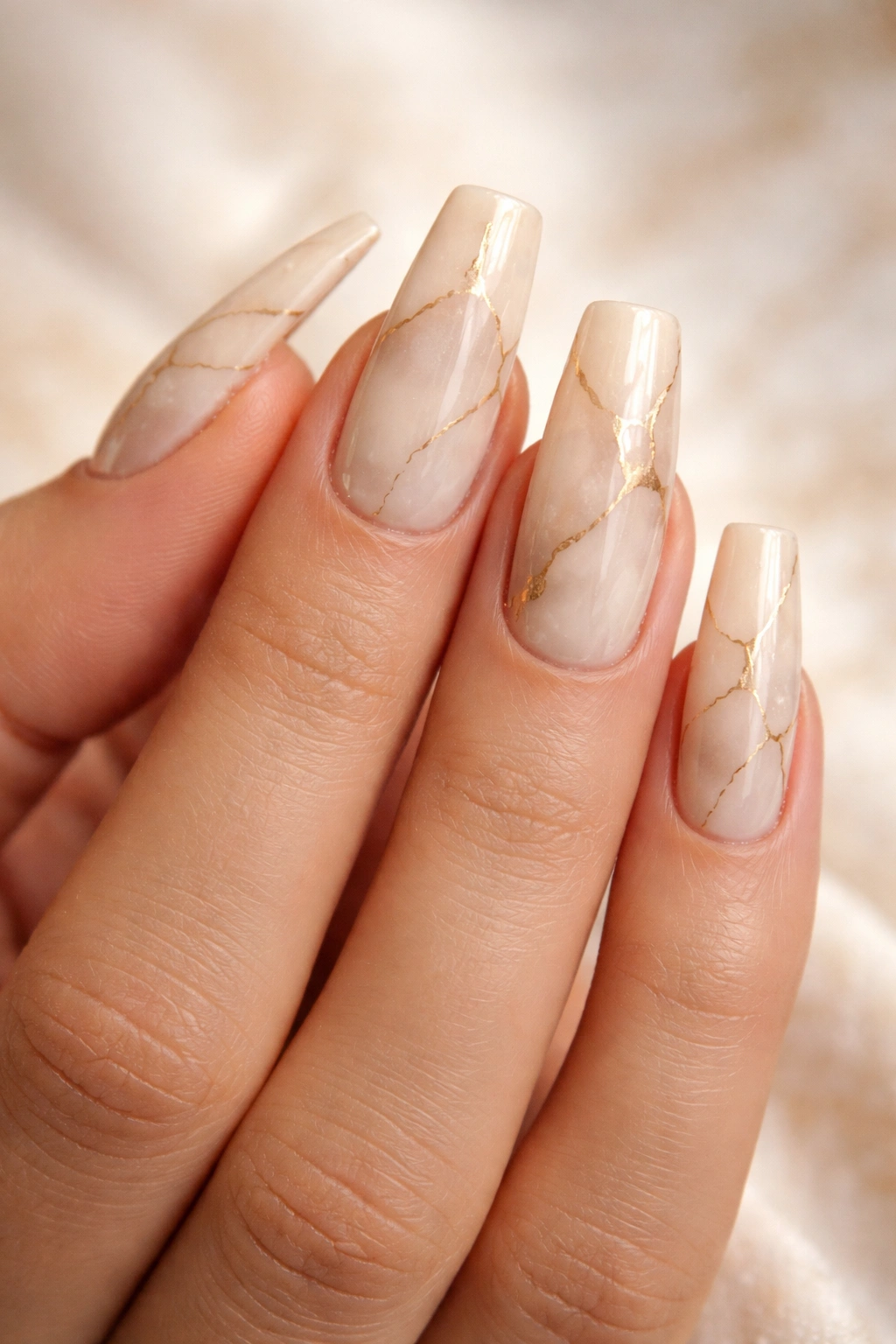
This is the set I’d point to first for someone who wants “quiet money” nails without saying the phrase out loud. Beige marble on ballerina nails has a softer finish than white Carrara, and the gold detail—used with a light hand—adds that jewelry note without turning the manicure into a costume.
The trick is keeping the beige cool enough. If the base leans too orange, it starts to look like melted caramel polish. A better version uses a putty nude, pale taupe-beige, or creamy sand tone, then threads through a few cloudy white swirls. After that, a detail brush can place one or two broken gold lines across part of the pattern. Broken is the key word. A full gold stripe from cuticle to tip looks stiff.
I like this design most on longer ballerina nails, around 12 to 16 mm past the fingertip, because the marbling has space to stretch and the gold can sit off-center instead of cutting the nail in half. Pair it with short, neat cuticles and no extra crystals. The metal is already doing enough.
There’s a reason beige marble shows up so often in expensive-looking manicure boards. It flatters a wide range of skin tones, it hides regrowth a little better than bright white, and it looks polished with gold rings, cream knits, camel coats, black tailoring—basically the whole grown-up wardrobe.
3. Black Onyx and Ivory Split Marble
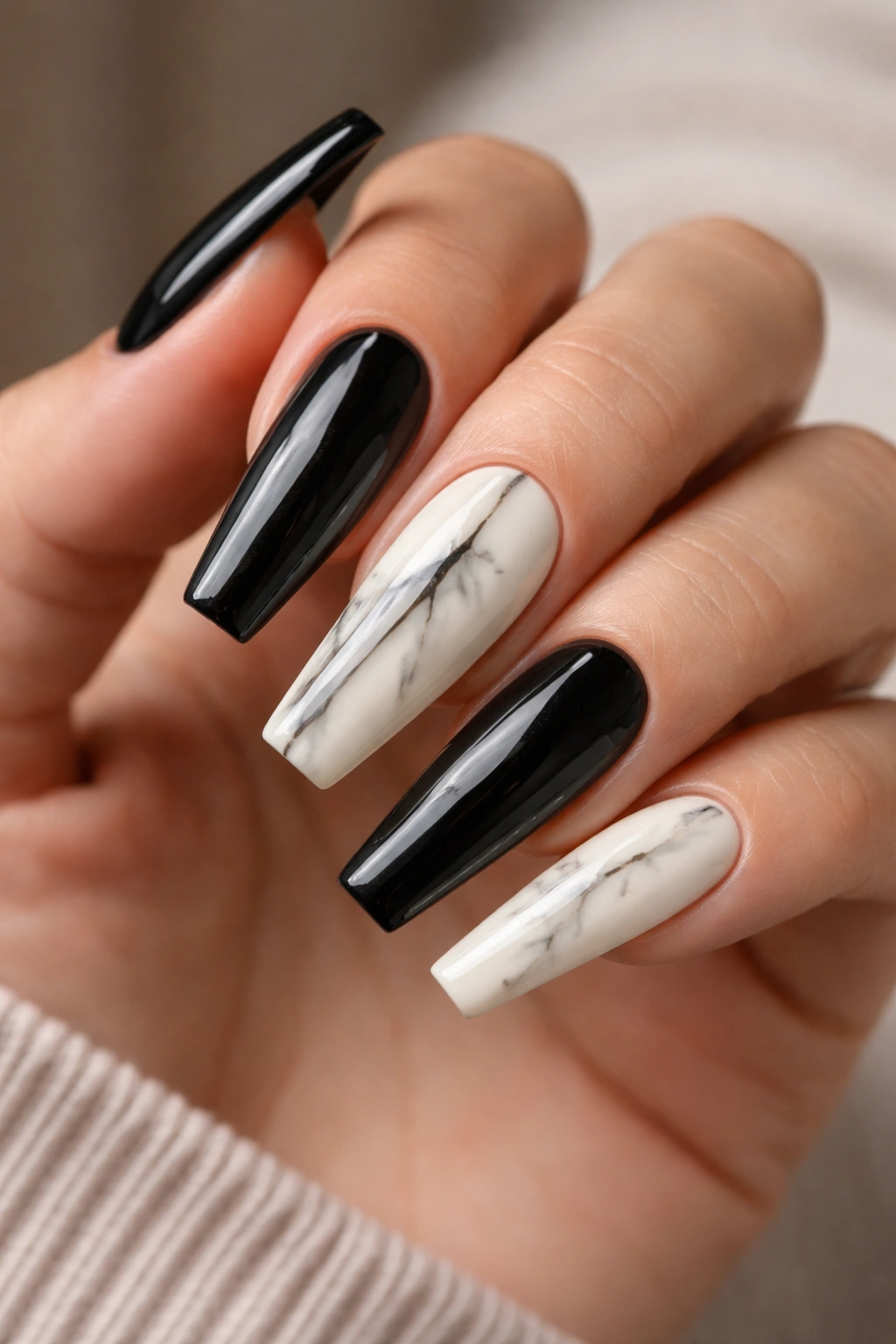
Why does black marble look pricier than plain black polish on a ballerina shape? Because it gives the darkness depth. Solid black can look flat, harsh, or a little blunt. Onyx-style marbling breaks that surface and makes the color feel layered, almost glassy in spots.
A good onyx set uses inky black gel, sheer smoky black, and a touch of ivory or off-white to create contrast. I like the split version best: one side of the nail stays darker while the other side softens into pale veining, almost like sliced stone. That asymmetry keeps the design from feeling heavy.
How to keep it from looking harsh
Use ivory, not paper white. Bright white against black can look graphic in a way that reads more fashion-week editorial than polished daily wear. Ivory softens the contrast and makes the marbling feel richer.
Skip chunky glitter here. Skip thick silver foil too. Black marble already has drama.
Best finishing choices
- Glossy top coat if you want the nail to look like polished stone
- Shorter medium length if you use black on most nails
- One accent nail in solid black to anchor the set
- Thin silver or white micro-lines only if the marbling feels too dark
This one suits someone who wears a lot of black, charcoal, or sharp tailoring. It has edge, no question. But with clean veining and a controlled shape, it still feels grown-up.
4. Rosé Quartz Translucent Pink Ballerina Set
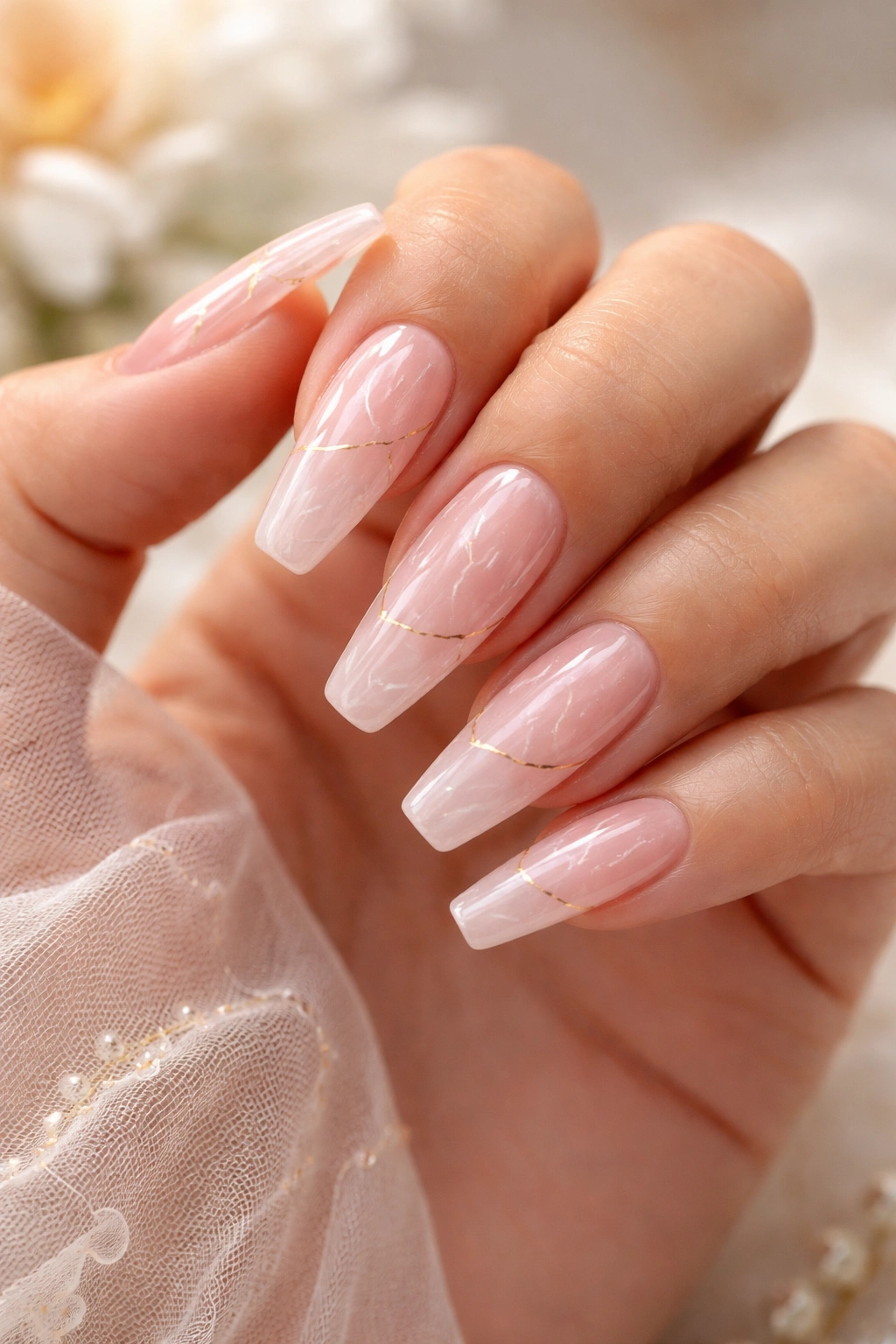
Picture a sheer pink nail that still lets light pass through near the tip, with cloudy white ribbons floating under the surface and a faint gold crack running across one side. That’s the mood. Rosé quartz marble works because it feels soft without turning sugary.
The base matters more than the veining here. If the pink is too opaque, you lose the stone effect and drift into regular swirl nail art. Ask for a jelly pink or translucent blush base, then build the pattern with diluted white and the palest mauve. Some nail artists add a tiny bloom of clear builder gel between layers so the veins blur under the surface.
A set like this looks strongest on a slightly slimmer ballerina shape, not a chunky coffin. The taper gives the pink marble a cleaner line.
Details that make it land
- Keep the pink in the cool blush family, not peach bubblegum
- Add gold only on 1 or 2 nails
- Use soft clouding near the center, leaving the sidewalls cleaner
- Choose a glassy top coat rather than matte
I’d wear this for weddings, dinners, work events, weekend brunch—honestly, anything short of a muddy camping trip. It has enough polish to pass with tailoring and enough softness to work with knits and denim. That range is rare.
5. Sage and Cream Stone-Swirl Marble
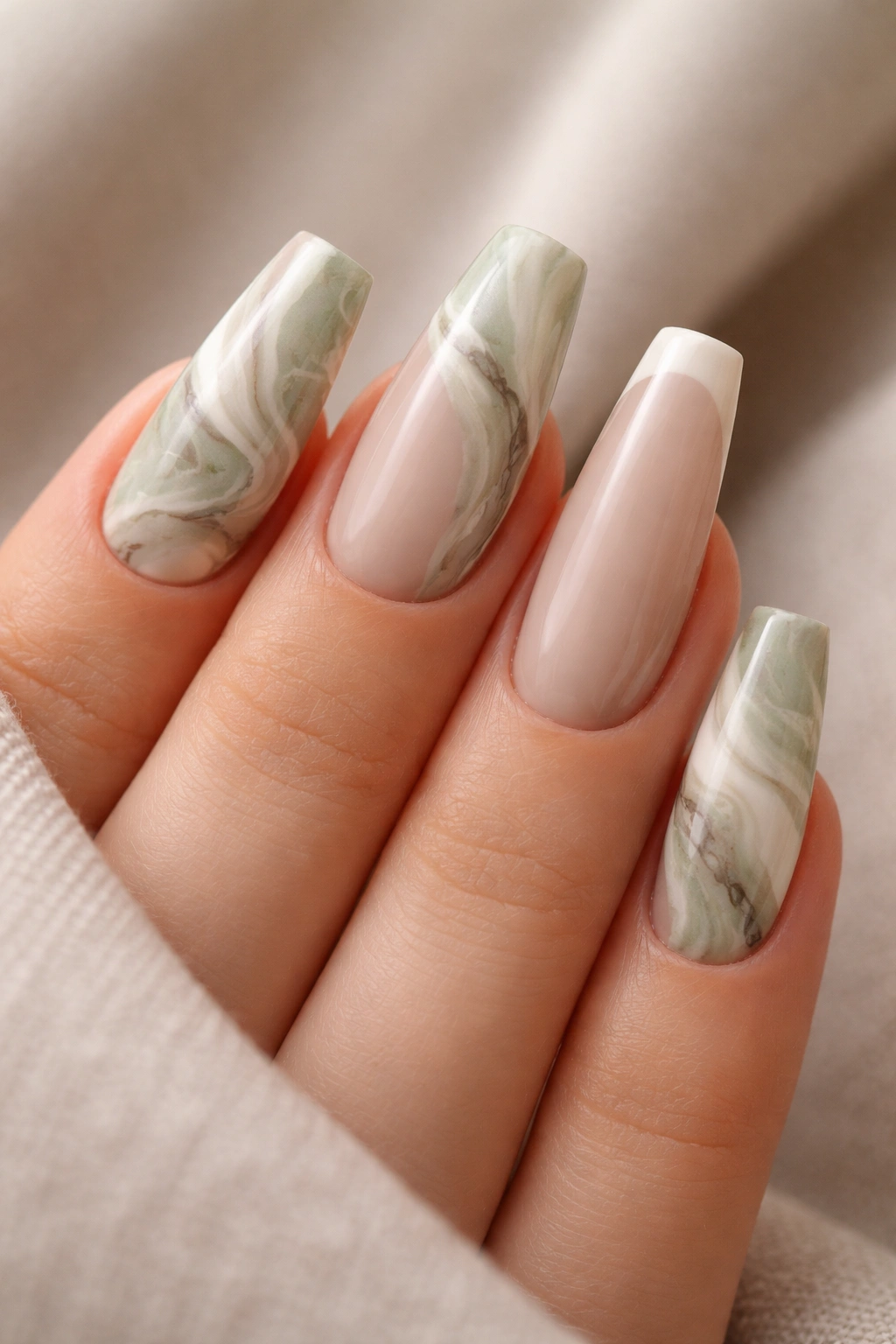
Green can go wrong fast on nails. Too neon, too minty, too saturated, and the whole set feels playful when what you wanted was polished. Sage avoids that problem because it already has gray built into it. That dusty, muted cast is what makes it look expensive.
On ballerina nails, sage marble looks best when the base sits between green and stone. Think celery diluted with ash, not bright matcha. Layer in cream swirls, a hint of mossy depth, and one thin brown-gray vein to stop the design from reading pastel. The result looks closer to carved stone than candy color.
I like this set when only half the nails carry the full marble effect. Try two marble nails, two sheer sage-nude nails, and one nail with a slim cream French tip. That mix keeps the green from taking over your whole hand.
Matte can work here, though not every matte top coat is equal. A chalky matte kills the richness. A soft velvet matte—or a satin finish, if your salon has one—keeps the color grounded and a little earthy. Gloss is easier, though, and safer if you’re unsure.
This design shines in colder months, but I wouldn’t box it into one season. Sage has a quiet neutrality that outlasts trend cycles. If white marble feels too expected and pink quartz feels too sweet, this is a smarter turn.
6. Espresso Agate Marble With Caramel Ribbons
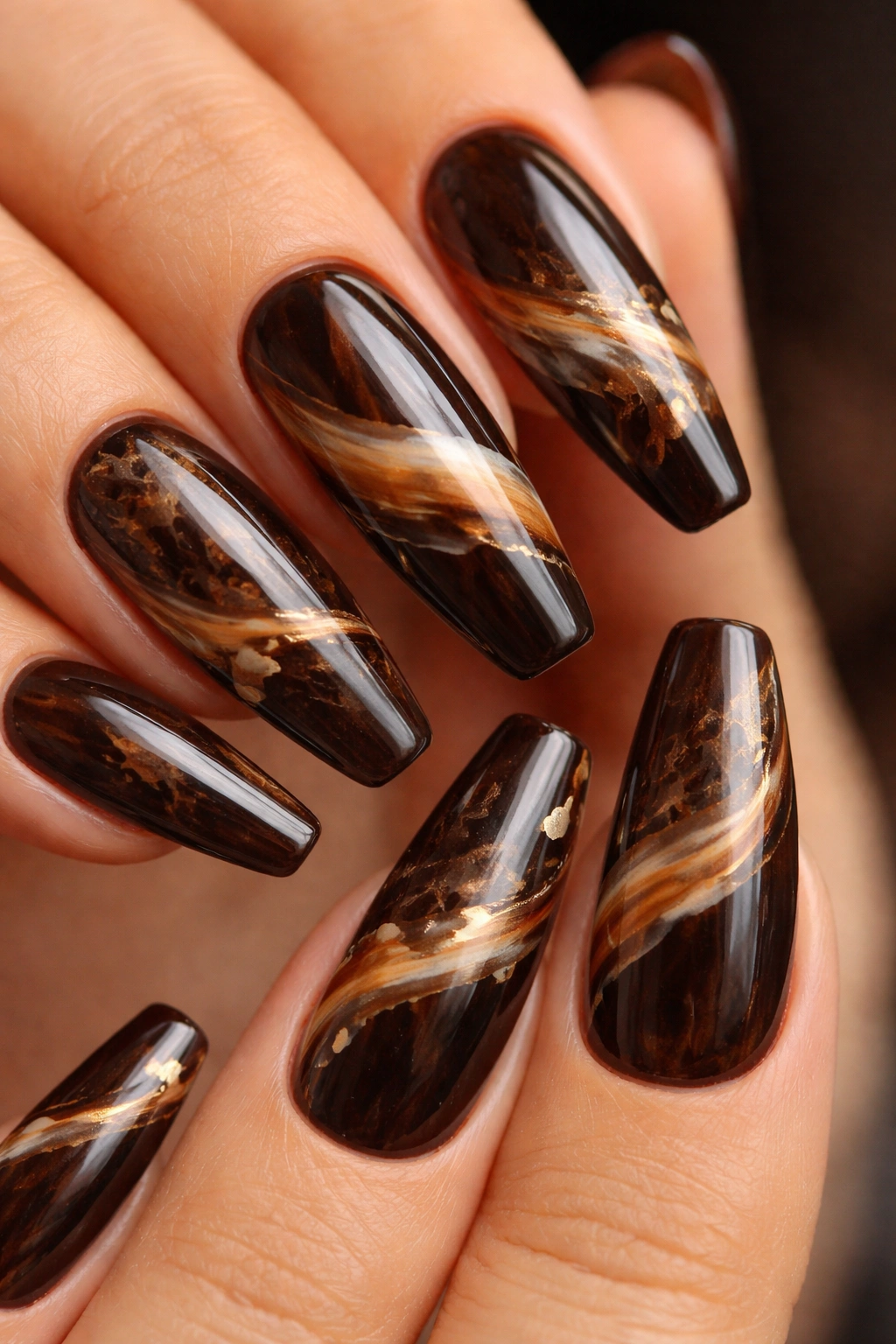
Unlike white marble, espresso agate nails don’t ask for attention with contrast. They get there through tone. Deep coffee brown, soft caramel, translucent amber, maybe a little smoke—that mix feels richer than flat mocha polish because the colors shift as your hand moves.
This design works best when the base has some see-through depth. A solid dark brown nail with lighter swirls painted on top can look thick. A better version uses sheer brown gel layers, then builds darker and lighter bands through them so the pattern looks suspended inside the nail.
Who is this best for? Someone who wants marble ballerina nails that feel expensive but not bridal, not icy, not too polished in the formal sense. There’s warmth here. It looks sharp with tan, black, cream, olive, and even denim.
A few specifics make a difference:
- Ask for caramel ribbons near the center, not wrapped around the whole nail
- Keep the edges deeper brown so the nail still has structure
- Add gold foil only in pinch-size fragments, never full flakes
- Pick a gloss top coat so the darker shades look deep rather than muddy
I’m picky about brown manicures, and this one earns its place. It feels like stone, resin, and polished wood had a better-behaved child.
7. Matte Taupe Smoke Marble
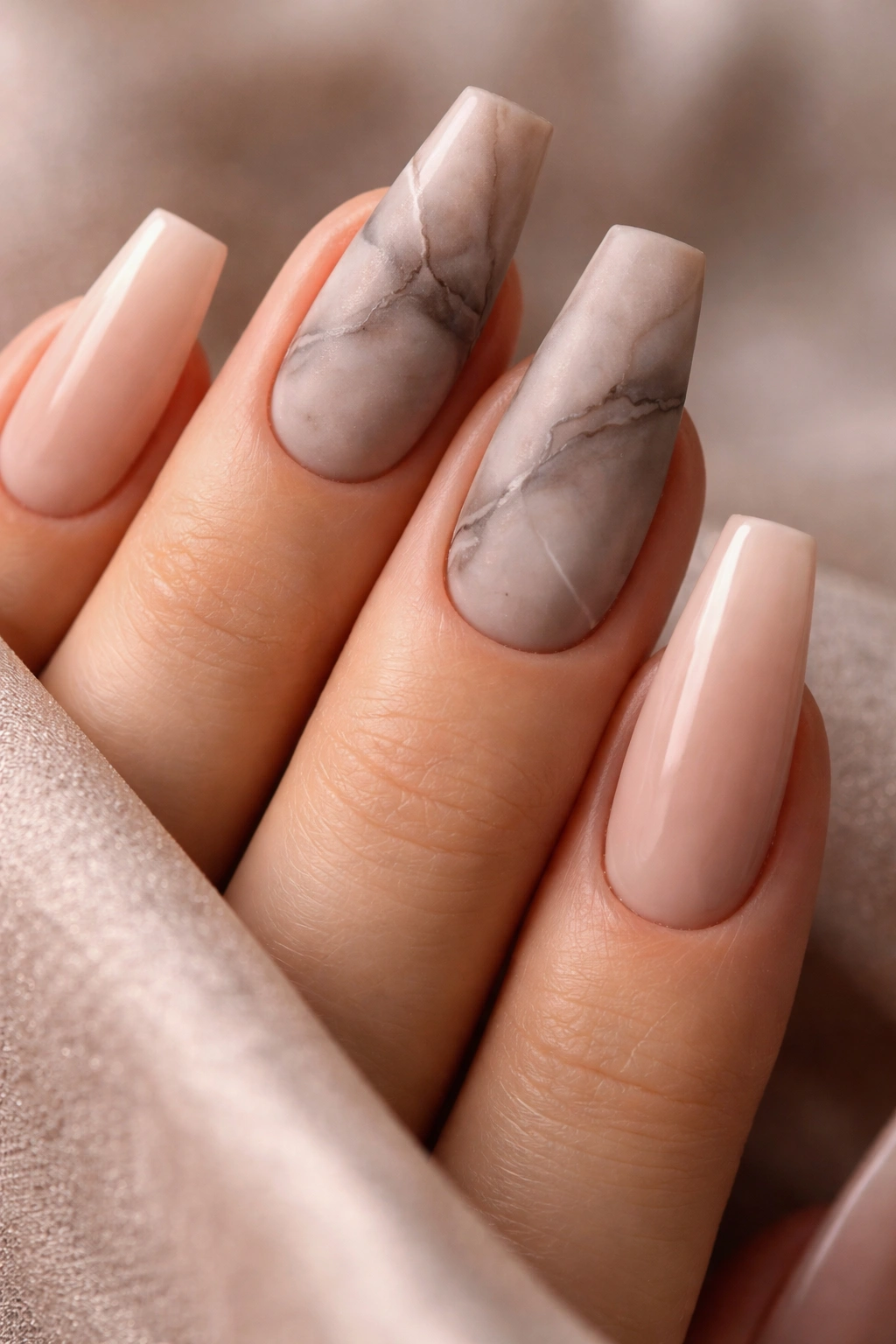
Matte marble is harder to pull off than glossy marble. There, I said it.
A lot of matte sets lose depth because the finish flattens everything. Taupe smoke marble survives that problem because the color story is already subtle. With a base of mushroom-beige, gray-brown haze, and a wisp of white or charcoal, the design doesn’t need shine to read clearly.
Why matte works here
Taupe has enough softness to handle a velvety surface. The eye still catches the movement because the marble lines sit in different values—light, mid, dark—even when the gloss disappears.
Ask for these details
- A cool taupe base, not warm tan
- Veins in soft charcoal and pale cream
- A satin or velvet-matte top coat instead of a dry, chalky matte
- Nails shaped with a narrow sidewall and crisp flat tip
One smart move is mixing finishes on the same hand. Keep 2 matte marble nails, then make the rest glossy nude or translucent taupe. That contrast makes the matte marble look intentional rather than accidental. It feels edited.
Skip this design if your nail tech tends to overblend. Smoke marble needs soft movement, yes, but it still needs visible lines.
8. French Tip Marble Ballerina Nails With a Bare Nude Base
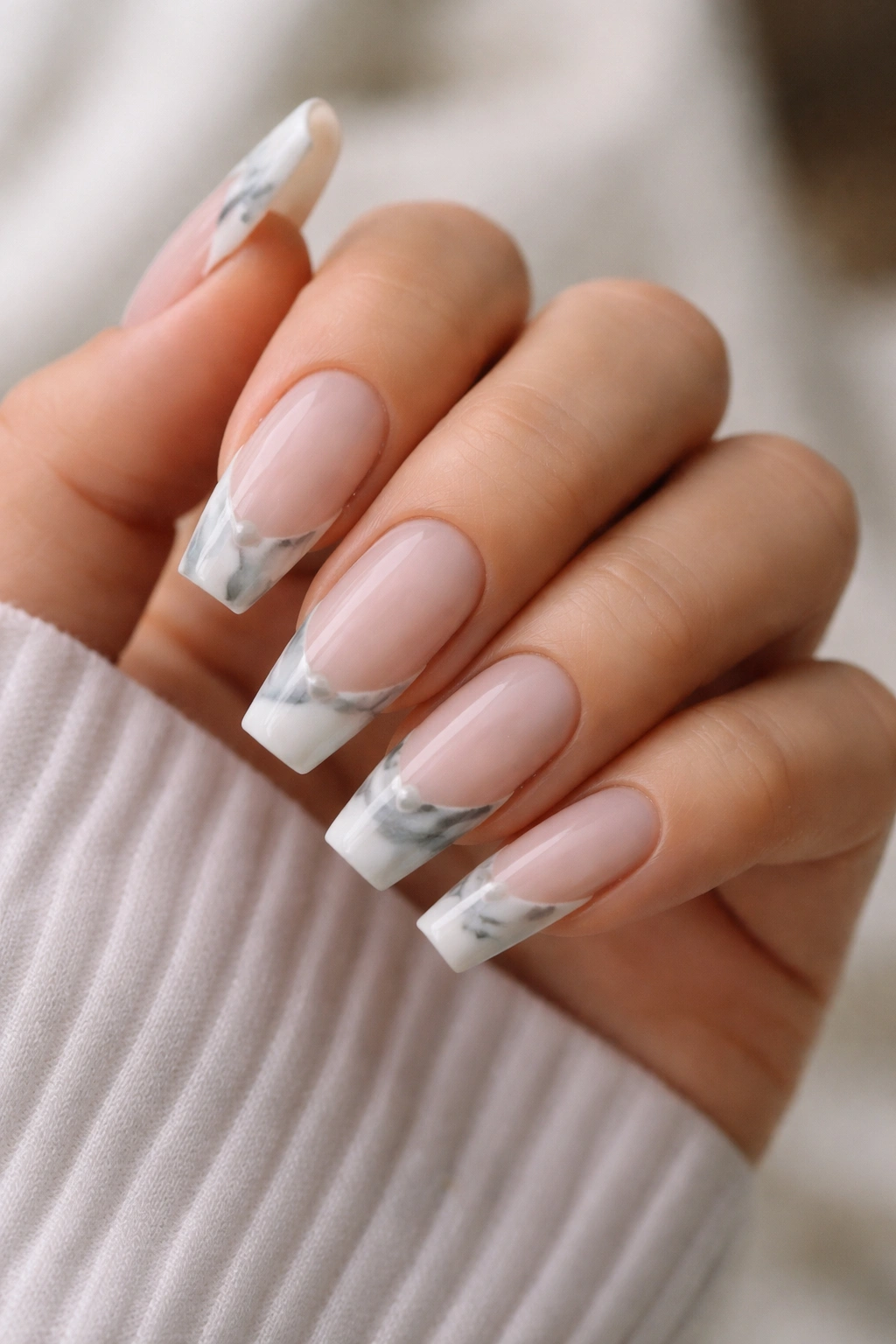
French tips and marble don’t need to compete. On a ballerina shape, they can make each other look sharper.
The idea is simple: keep most of the nail close to your natural nail bed with a sheer nude or pink-beige base, then place marble only at the tip, usually in a diagonal French, deep smile line, or squared micro-French. Because the lower two-thirds of the nail stays clean, the marble gets all the attention without swallowing the hand.
A diagonal marble French looks strongest on medium to long nails. That slant stretches the finger and gives the marbling a bit more space than a straight-across tip. White-and-gray Carrara works well here, though beige, sage, and slate-blue marble tips can look even more polished because they feel less expected.
I like this design for anyone who loves a clean manicure but wants more personality than plain nude gel. You still get the neatness of a French set. You just swap the plain tip for something with texture and movement.
One warning, though. The smile line has to be crisp. If the edge between the nude base and the marble tip is fuzzy, the whole manicure loses its expensive feel. This is one of those sets where precision matters more than extra decoration.
9. Malachite Green Marble With Fine Gold Mapping
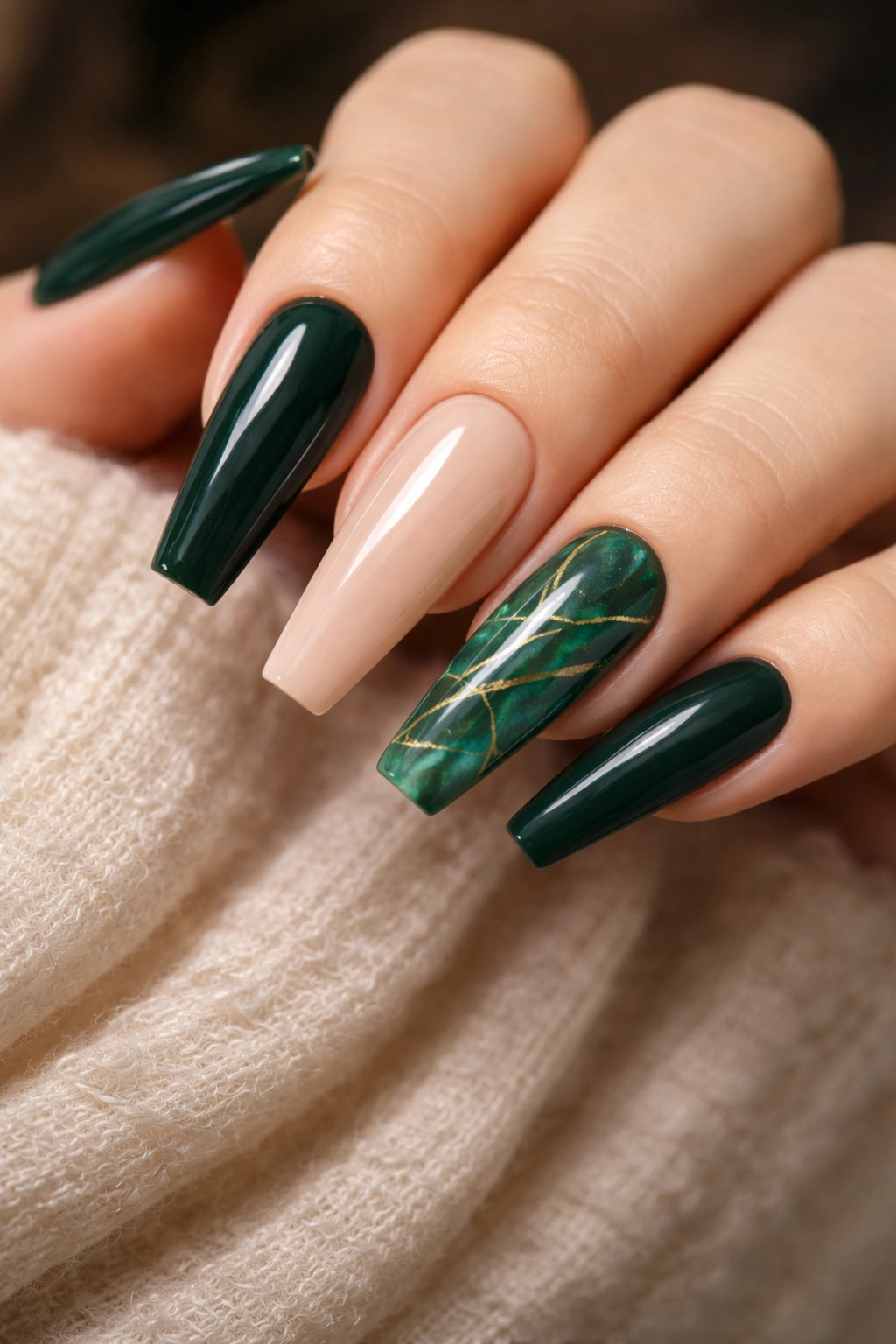
Malachite is bold, and that’s why restraint matters twice as much.
The stone itself has those ringed, wavy green lines that can look rich or loud depending on how they’re translated to nails. On ballerina nails, the expensive version uses deep forest, emerald, and blackened green, then traces one or two of the natural bands with a fine gold line. Not every stripe. One or two.
What makes this different from sage marble
Sage is dusty and quiet. Malachite is darker, glossier, and more dramatic. It has more contrast, more motion, and more jewelry energy.
How to wear it without overdoing it
Keep the full malachite effect on 2 accent nails per hand. Then use solid deep green, glossy nude, or soft black-green jelly on the others. If every nail has detailed malachite rings and gold, the design can start pushing into costume territory.
Try this set with shorter jewelry stacks and clean skin around the nail. Malachite already brings a lot of pattern, and the gold mapping reads best when the rest of the hand stays calm.
One sentence of blunt honesty: if your salon can’t paint fine curved lines, skip this design. Thick gold tracing ruins it.
10. Lavender Cloud Marble With Mirror-Chrome Edges
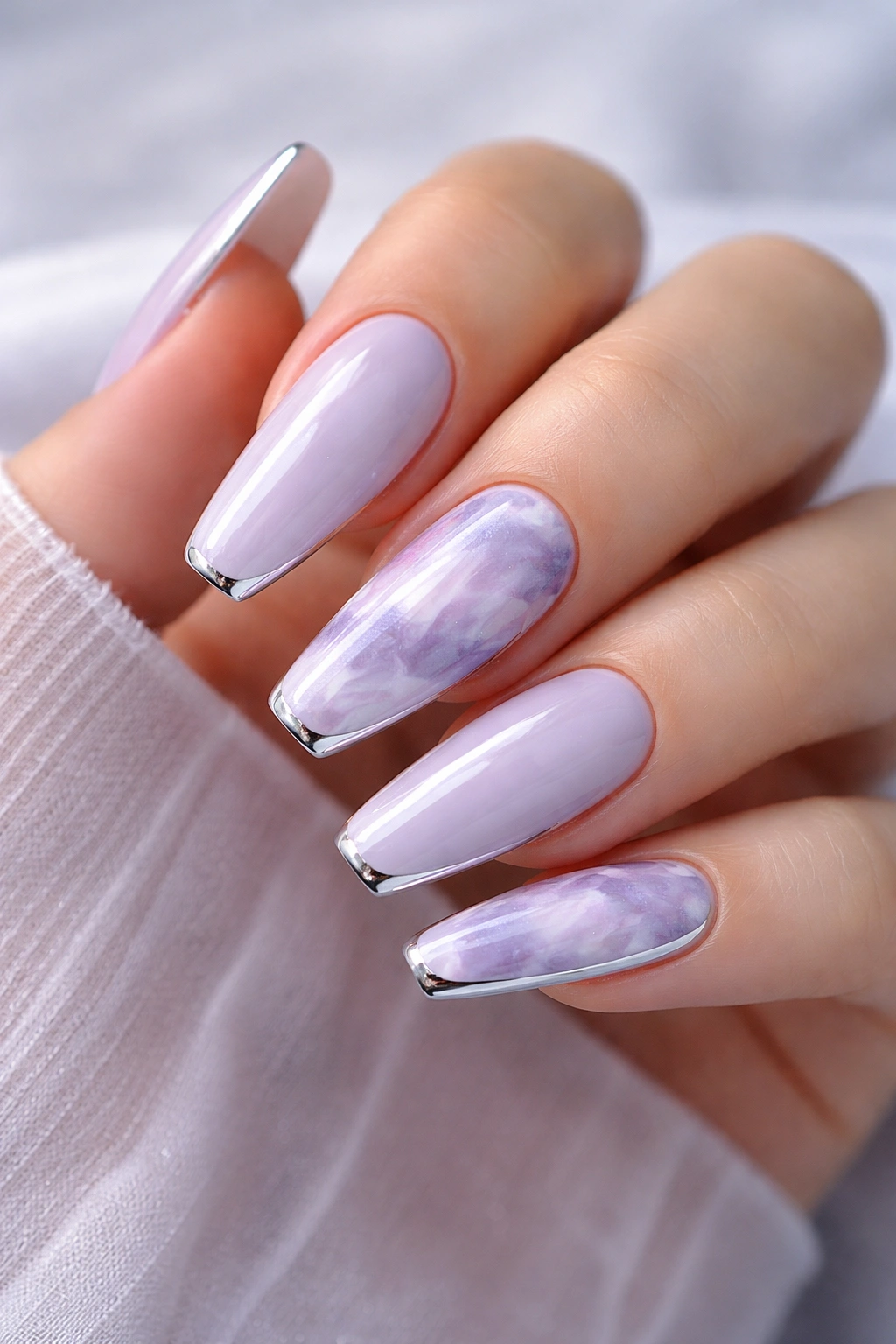
This one sounds like it could go sugary. It doesn’t have to.
Lavender cloud marble works when the purple is pale, cool, and slightly gray, almost like lilac mixed with fog. The marble itself should look airy rather than sharply veined—soft white blooms, hazy lavender patches, a faint smoke thread. Then, instead of foil running through the nail, use a chrome outline along one sidewall or the tip edge. That tiny flash changes the mood from soft pastel to polished fashion manicure.
The chrome detail needs discipline. A full chrome border around every nail can look costume-heavy on ballerina shapes because the flat tip already creates a frame. I prefer a partial silver outline on only two nails, leaving the others glossy and clean.
Where this set earns its keep
- Cool-toned wardrobes: gray, navy, black, white, icy pink
- Medium-long ballerina extensions
- Spring events, dinners, gallery nights, city weekends
- People who want color without bright color
There’s a sweet spot here. Too much purple and it feels juvenile. Too much chrome and it turns theatrical. But when the balance is right, the set looks expensive in a way most pastel nails don’t.
11. White Marble With Cuticle Crystal Placement
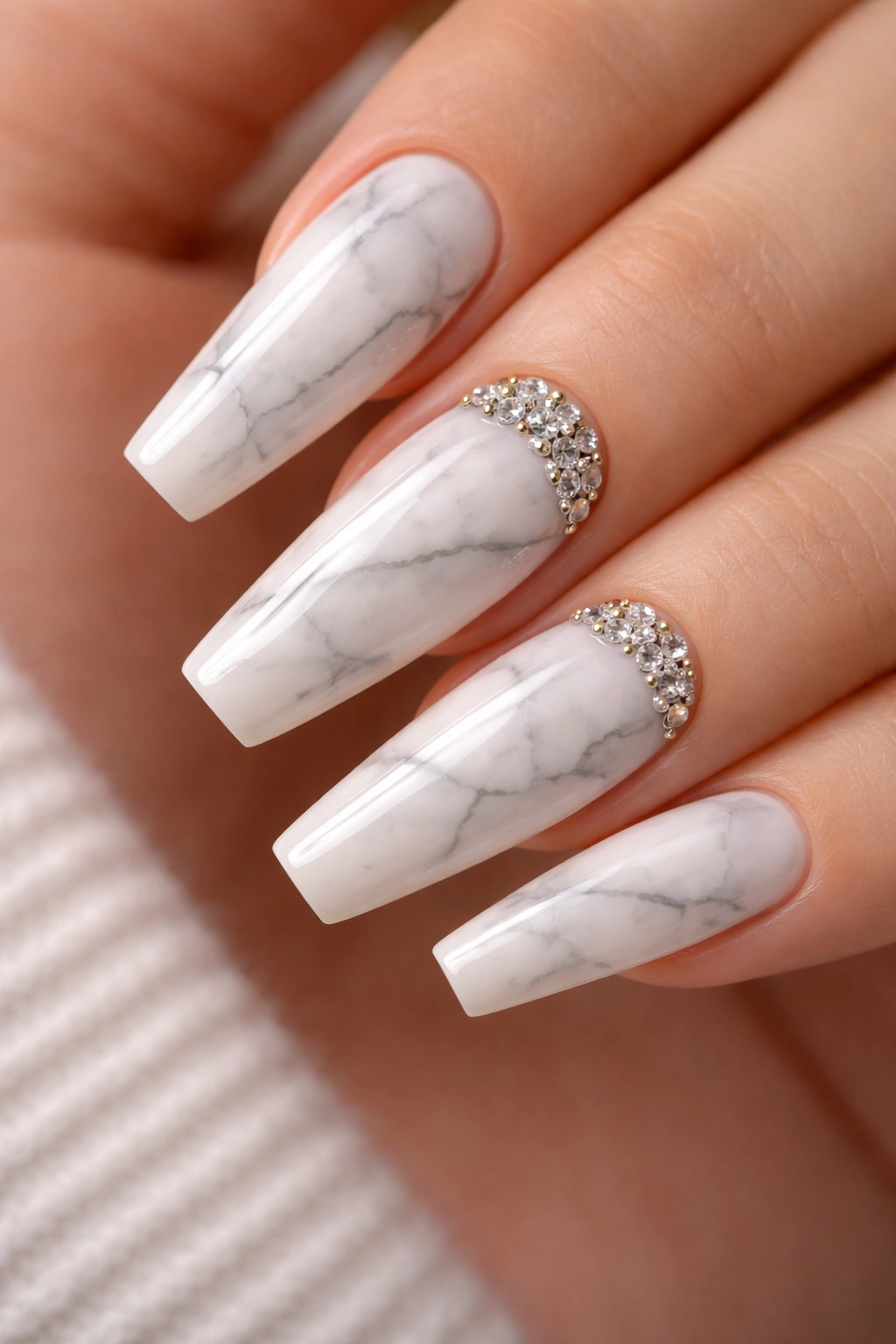
A single crystal can do more than a full strip of gems if you place it well.
That’s the whole appeal of this look. Start with classic white marble ballerina nails—milky base, light gray veining, high gloss—and add a tiny crystal cluster near the cuticle on one or two nails. Not halfway down the nail. Not across the tip. Right at the base, where jewelry placement feels deliberate and clean.
The size matters. I’m talking 1.5 to 3 mm stones, not chunky rhinestones you can spot from across the room. A little trio works well: one small round crystal, one micro bead, one tiny accent stone. Silver settings suit cool white marble. Gold settings can work if the gray in the marble is warm.
Placement changes the effect. A centered cuticle cluster reads bridal. An off-center cluster near one sidewall feels more editorial and less formal. Neither is wrong. They just signal different moods.
This design is useful when you want something a bit dressier but still want marble to stay front and center. The crystal should act like an earring, not a chandelier. Keep the rest of the set quiet, and it lands.
12. Mocha Ombre Marble Ballerina Nails
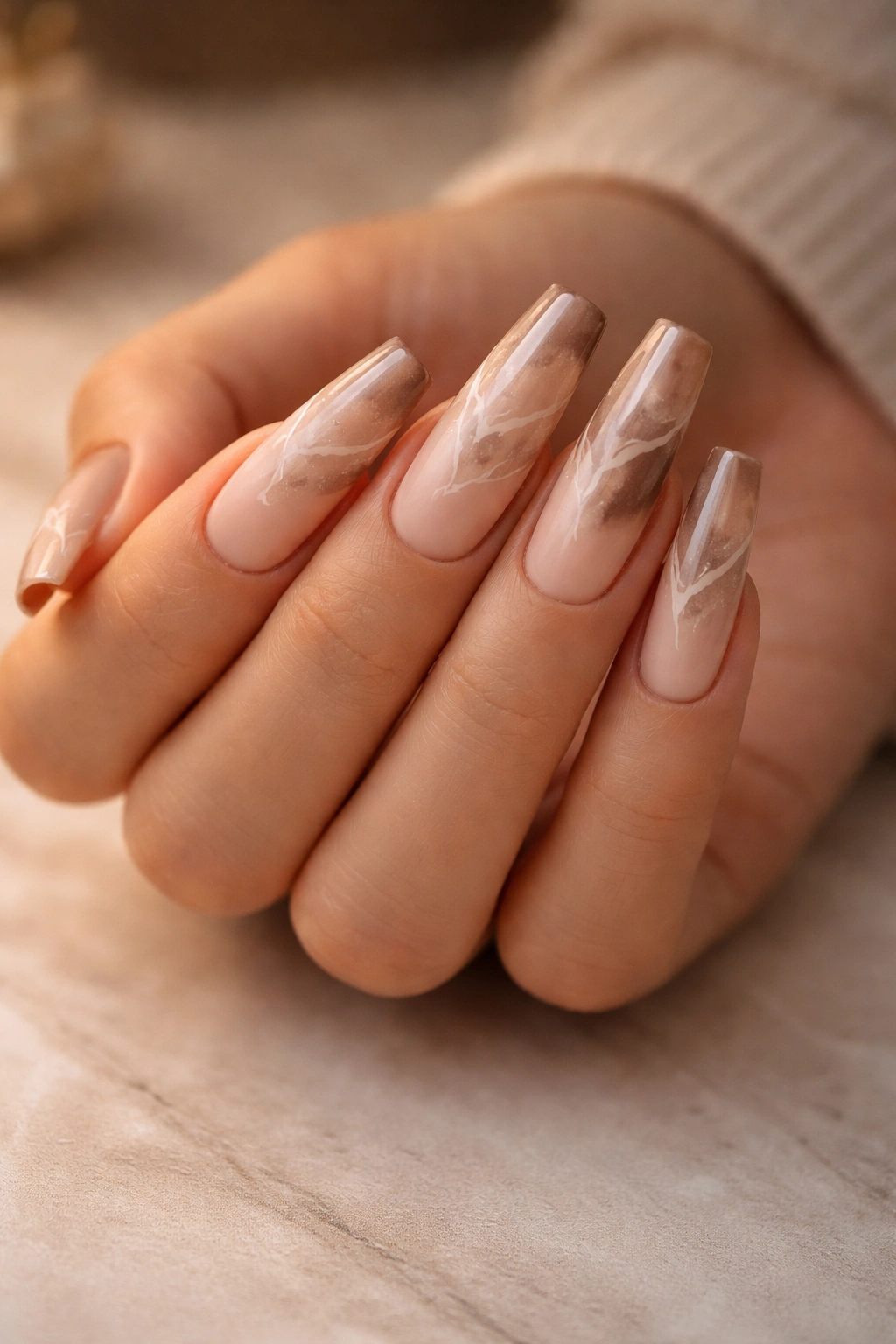
Unlike a straight brown marble set, mocha ombre marble uses fade as part of the design. One end of the nail sits in a soft latte or nude-mocha shade, then darkens into cocoa, espresso, or smoky chocolate toward the tip, with marble veining layered through the shift in color.
That fade does two things. First, it makes regrowth a little less obvious when the lighter shade starts near the cuticle. Second, it gives the marble more depth because the veins move across a changing background rather than one flat tone.
Who gets the most out of this look? Anyone who likes neutrals but finds plain nude manicures a little boring after a week. You still stay in that clean, wearable color family, yet the design has more movement and more edge.
A few choices make or break it:
- Keep the ombre soft and airbrushed, not a hard two-tone block
- Use ivory or beige veins, not stark white
- Add one smoky line in deep cocoa for structure
- Finish with gloss, unless you want the whole set more muted and earthy
Brown ombre marble looks especially good on medium skin, deep skin, olive skin, tan skin—honestly, almost any skin tone can carry it if the mocha is matched well. That adaptability is part of its charm.
13. Blue-Gray Slate Marble With Silver Veining
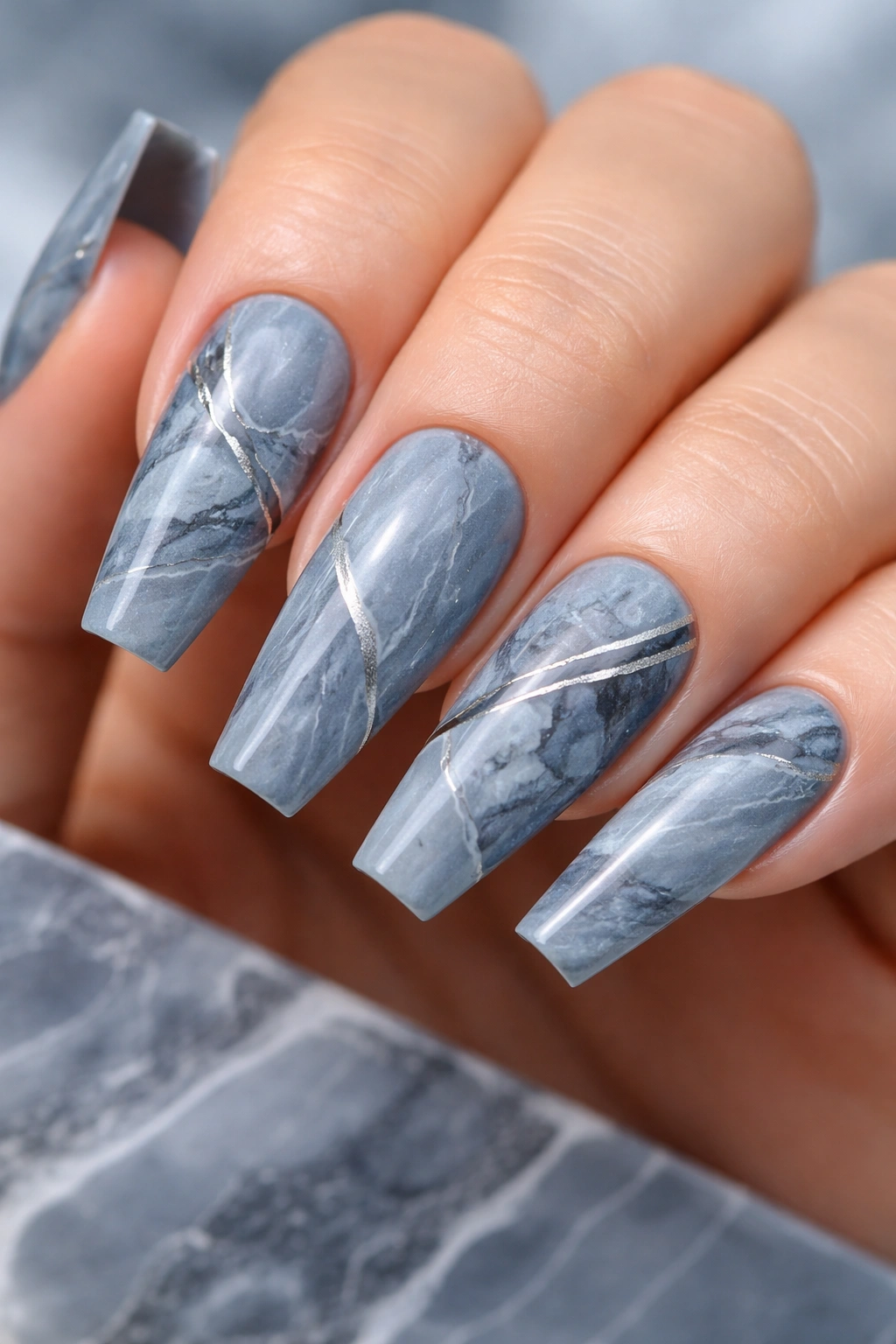
Blue-gray marble has a colder mood than white or beige, and that’s exactly why I like it. It feels tailored. Slate tones on ballerina nails bring that same crispness you get from charcoal wool, pale concrete, brushed steel, and stormy glass.
A good slate marble set starts with a desaturated base—somewhere between powder blue, gray, and stone. Then the veining comes in with white, deeper graphite, and a trace of silver. Not glitter silver. A thin metallic line or chrome paint pen effect. Used with a light hand, silver gives the design an architectural edge.
Where it shines
This one looks sharp with silver rings, black coats, denim, navy knits, white shirts, and cool-toned makeup. It’s less romantic than pink quartz and less expected than Carrara white.
Nail artist notes worth asking for
- Keep the blue muted, not baby blue
- Let the veins run diagonally, which suits the ballerina shape
- Use silver on 1 or 2 nails only
- Leave at least one solid or sheer slate nail in the set for balance
Best mood: polished, cool, urban, slightly sharp.
14. Sheer Jelly Marble With Encapsulated Foil
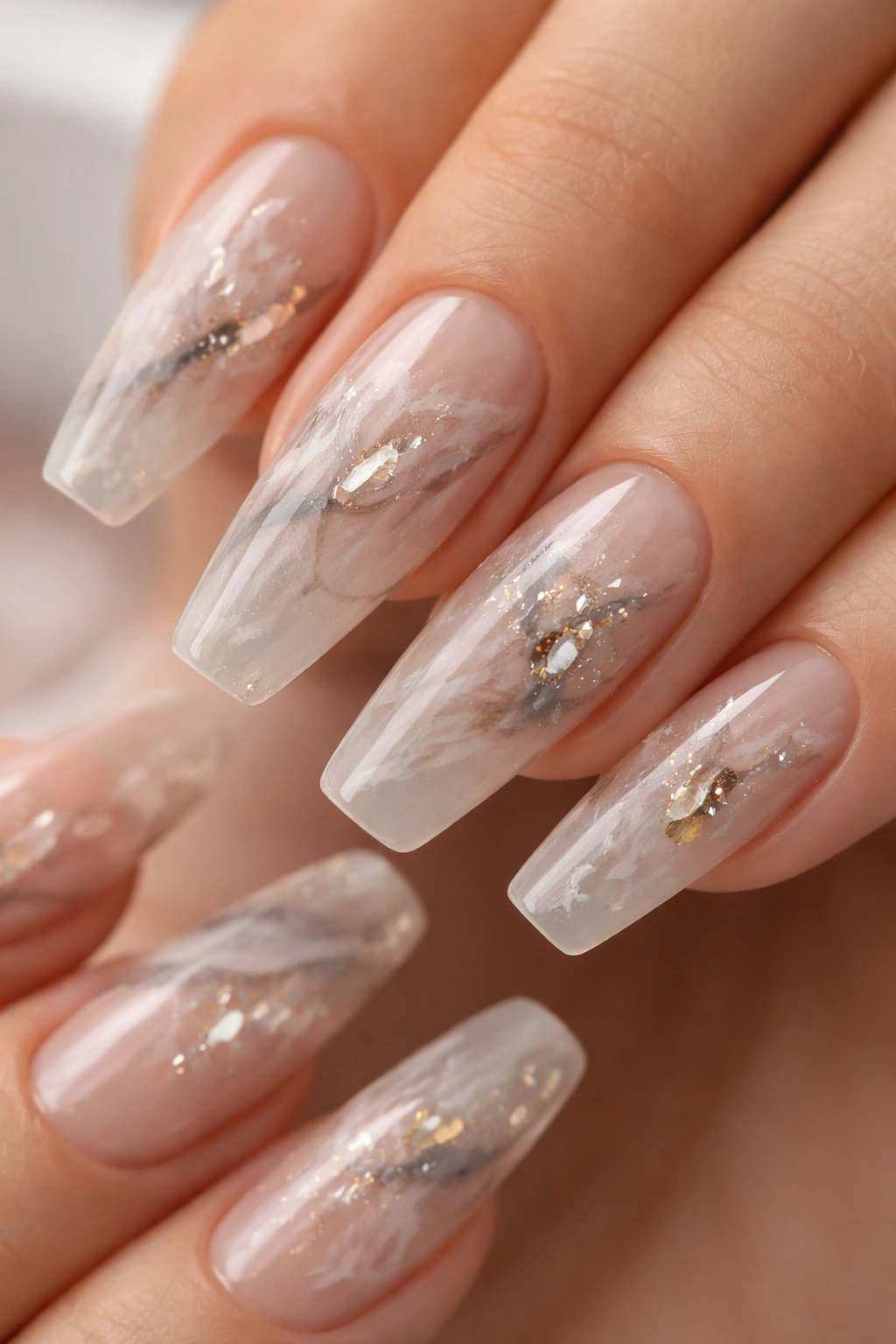
Some marble nails look expensive because they mimic stone exactly. This style takes a different route. The luxury comes from depth under the surface.
A sheer jelly marble set uses translucent gel—clear nude, soft tea rose, smoky beige, pale gray, amber—then suspends cloudy marble lines and tiny foil fragments underneath builder gel layers. Because the foil is encapsulated rather than sitting on top, the nail catches light in a quieter, more layered way. You don’t get that scratchy, raised look cheap foil sets often have.
The foil needs editing. Tiny shards or torn flecks work. Full sheets do not. I like champagne foil in beige or pink jelly marble, silver foil in slate marble, and pale gold in warm brown or green. Keep it to one layer and sparse placement, with most pieces staying closer to the center of the nail.
This set asks for a skilled tech. Encapsulation takes patience, and thick application can make ballerina nails look bulky from the side. Ask for a slim apex and a side profile that stays neat. If the nail looks like a dome, the expensive vibe disappears the second you turn your hand.
When it’s done right, though, few marble manicures look more dimensional.
15. Minimal Nude Ballerina Nails With One Marble Accent
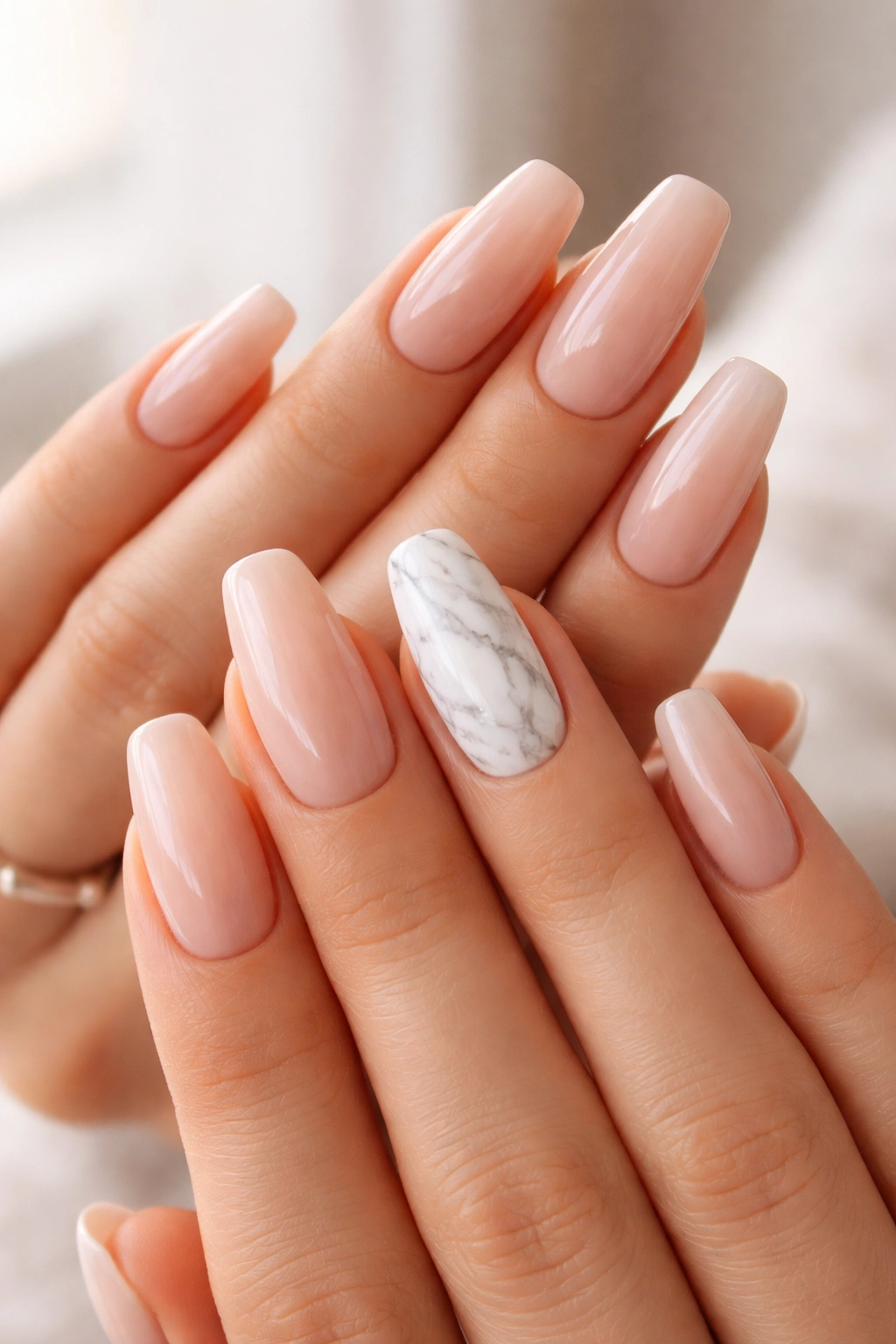
A full marble set isn’t always the answer. Sometimes the expensive move is doing less.
That’s why I love a nude ballerina manicure with one or two marble accent nails. The base nails stay sheer beige, pink-nude, or milky almond, finished with a glassy top coat. Then one ring finger, or maybe ring and thumb, gets the marble treatment. White Carrara, beige stone, taupe smoke, blue-gray slate—pick one direction and keep it tight.
Why this works so well
The contrast does the styling for you. When most of the hand stays clean, the marble accent looks deliberate, almost like a small piece of jewelry built into the manicure.
Smart ways to build the set
- Use one accent nail per hand if you want the cleanest look
- Add a micro French tip to one extra nail if the set feels too plain
- Match the nude base to your skin undertone so the manicure looks seamless
- Keep the marble accent full nail, not half-and-half, so it reads confidently
If you wear your nails for work, type all day, or get bored with loud nail art after three days, this is probably the most wearable option on the list. And wearability—when it still looks polished—is its own kind of luxury.
How to Keep Marble Ballerina Nails Looking Fresh for Two to Three Weeks
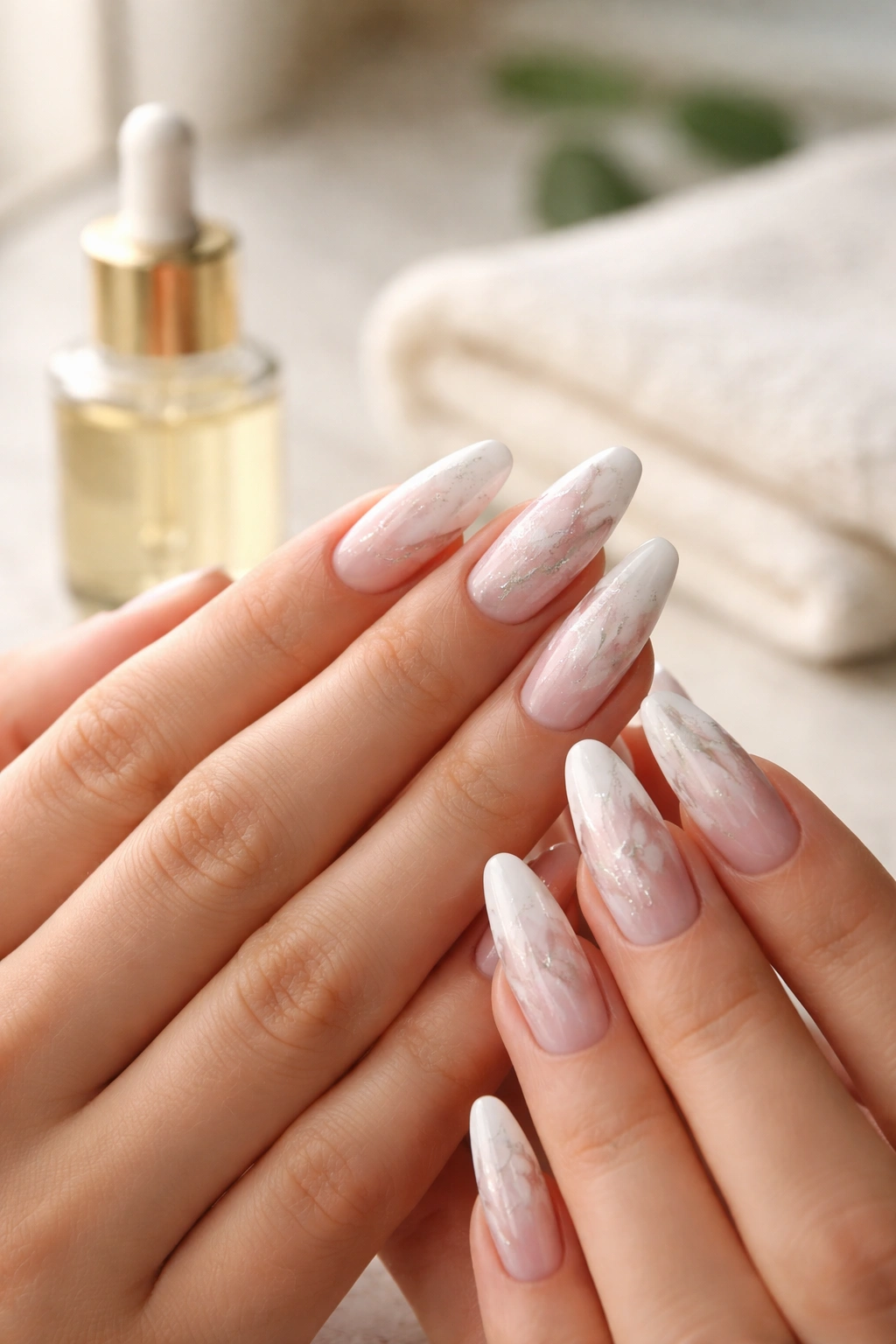
Shape is the first thing to go when a ballerina set starts looking tired. The flat tip softens, one sidewall gets filed down by daily wear, and the whole manicure loses that clean, expensive line. If you want the set to stay sharp, file lightly with a 180-grit file every few days, keeping the tip flat and the sidewalls even. Small touch-ups beat one aggressive reshaping session.
Oil your cuticles. Daily. Twice a day is better.
That little habit does more for the look of a manicure than people want to admit. Marble nail art can be immaculate, but if the skin around it looks dry or frayed, the set stops reading polished. A drop of jojoba-based cuticle oil in the morning and before bed is enough. Massage it in for 20 to 30 seconds.
A few more habits help:
- Wear gloves for dishes and heavy cleaning
- Avoid using the nail tip to pry open cans, boxes, lids, or tape
- Reapply a clear top coat after 7 to 10 days if your set tends to dull
- Book fills around the 2- to 3-week mark, before the grown-out area gets too obvious
One last thing. Marble designs look best when the surface stays smooth. If you feel raised foil, lumpy gel, or bumps in the marbling after a few days, that’s usually a build issue, not normal wear.
Final Thoughts
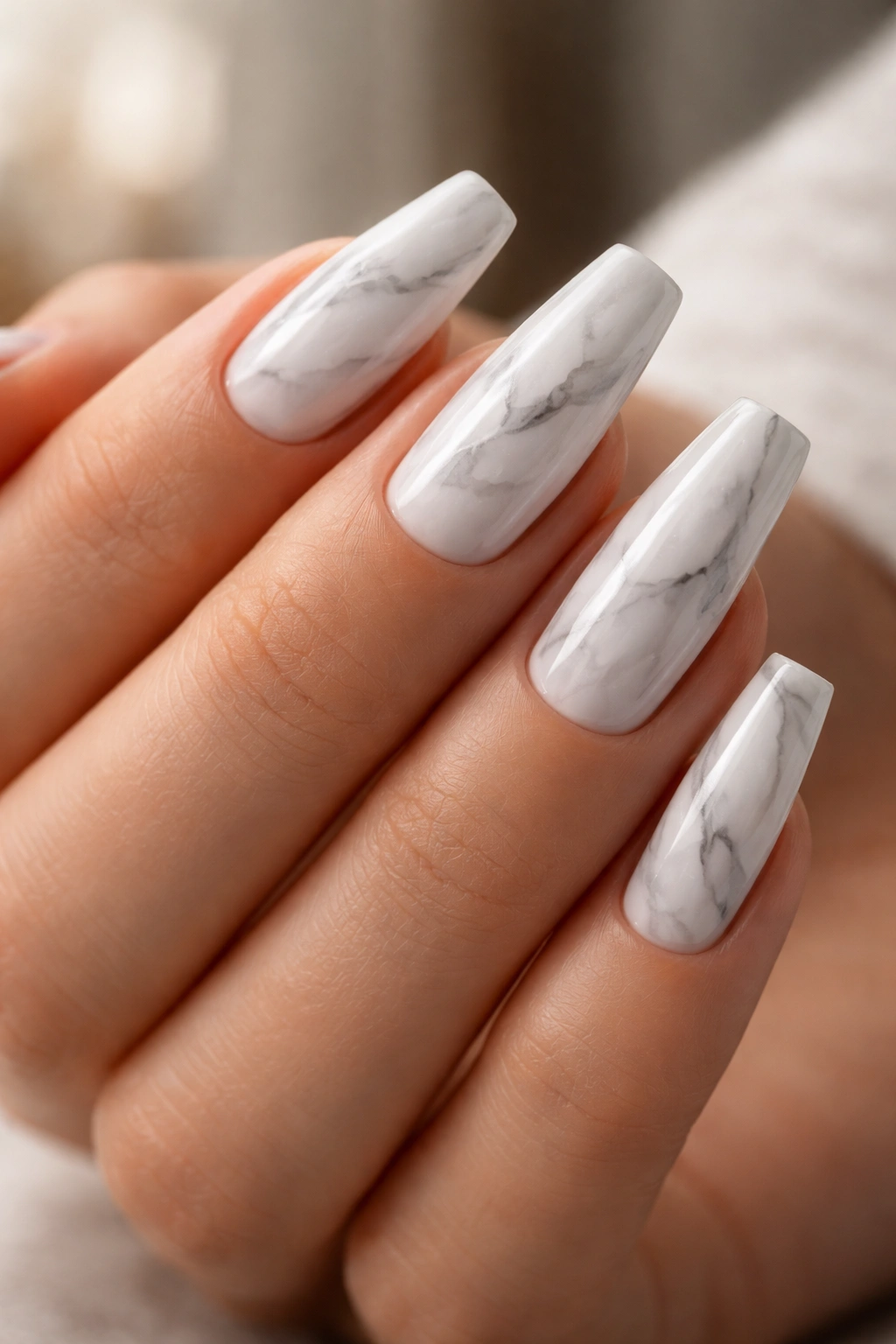
The expensive version of marble ballerina nails isn’t the loudest one. It’s the one with control—better color choices, thinner veining, cleaner shape, and enough empty space for the pattern to breathe.
If you’re torn between two designs, pick the quieter one first. White Carrara, nude beige with gold, slate gray, or a single marble accent nail will usually give you more mileage than a full set loaded with chrome, crystals, and five competing colors.
And if you do go bold—malachite, onyx, espresso agate—keep one hand on the brakes. That little bit of restraint is usually what makes a marble manicure look like it belongs in a high-end salon instead of a trend collage.