


Dark coffin nails do not fade into the background. They tap against a coffee cup, wrap around a steering wheel, and make the whole hand look sharper, longer, a little more deliberate. If you want a manicure with a moody look, this shape-and-color pairing is one of the fastest ways to get there.
There is a catch, though. Deep shades are less forgiving than pale pinks and sheer nudes. A streak near the sidewall shows. A lumpy top coat shows. If the coffin shape is even slightly off—one side filed tighter than the other, the tip too narrow, the corners too blunt—you will see it right away.
That is also why dark shades suit coffin nails so well. The shape already has structure: tapered sides, a squared-off tip, and enough flat surface to show color, texture, chrome, foil, or a clean matte finish. Put blackened plum or smoky charcoal on top of that, and the nail starts to look more architectural than decorative.
I keep coming back to the same point because it matters: with moody nails, finish is half the design. Black can read patent-leather glossy, suede matte, jelly-like, metallic, or almost stone-like depending on what you do on top. The ideas below lean dark, but they do not all look the same—and that is where this nail shape gets interesting.
Why Dark Coffin Nails Make the Shape Look Sharper
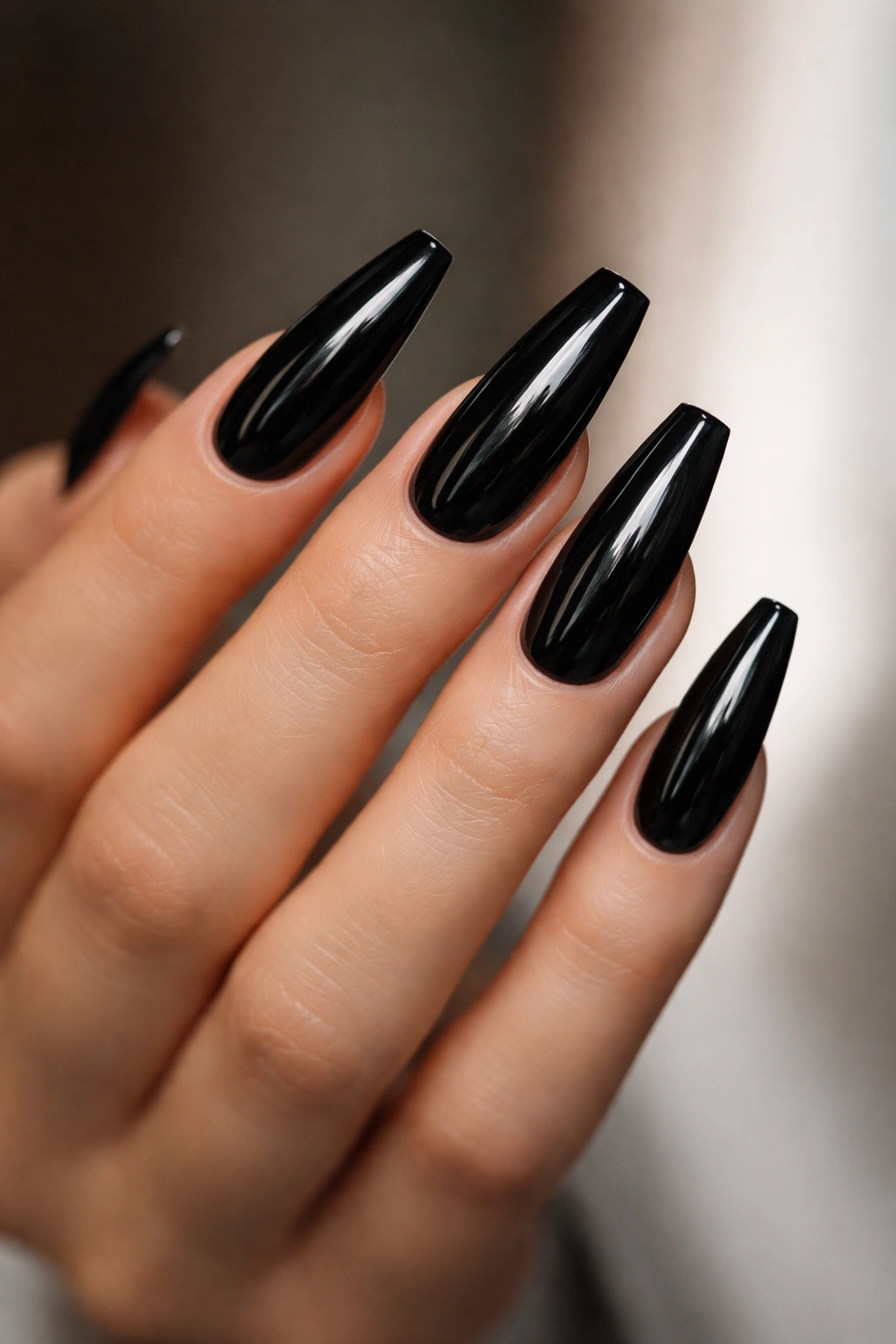
Dark polish acts like an outline. It traces the sidewalls, defines the free edge, and makes the coffin silhouette look cleaner than it does in soft beige or milky pink. If your goal is length, that visual outline helps more than most people expect.
Coffin nails need enough length to taper without turning stubby. On a natural nail, that usually means a little free-edge growth or a short extension. Around 3 to 6 millimeters past the fingertip gives a small coffin shape room to read as coffin instead of square. Once you get past that, deep shades like black cherry, oxblood, navy, and charcoal start to stretch the hand in a way pale shades often do not.
Finish changes the effect. Glossy dark coffin nails look sleek and hard-edged, almost like lacquered glass. Matte dark nails soften the glare and make the shape look thicker, moodier, more velvety. Add chrome and the same base color turns colder and sharper.
If you are choosing a shade at the salon chair and cannot decide, use this quick filter:
- Black gives the strongest outline and the cleanest graphic look.
- Burgundy and oxblood feel richer and warmer, especially on medium coffin lengths.
- Deep navy and forest green read dark from a distance but show more personality up close.
- Charcoal and slate suit anyone who wants mood without the heaviness of black.
Short version? The darker the polish, the more precise the shape needs to be—and the better a well-shaped coffin nail looks.
How to Keep Dark Coffin Nails From Chipping at the Tips
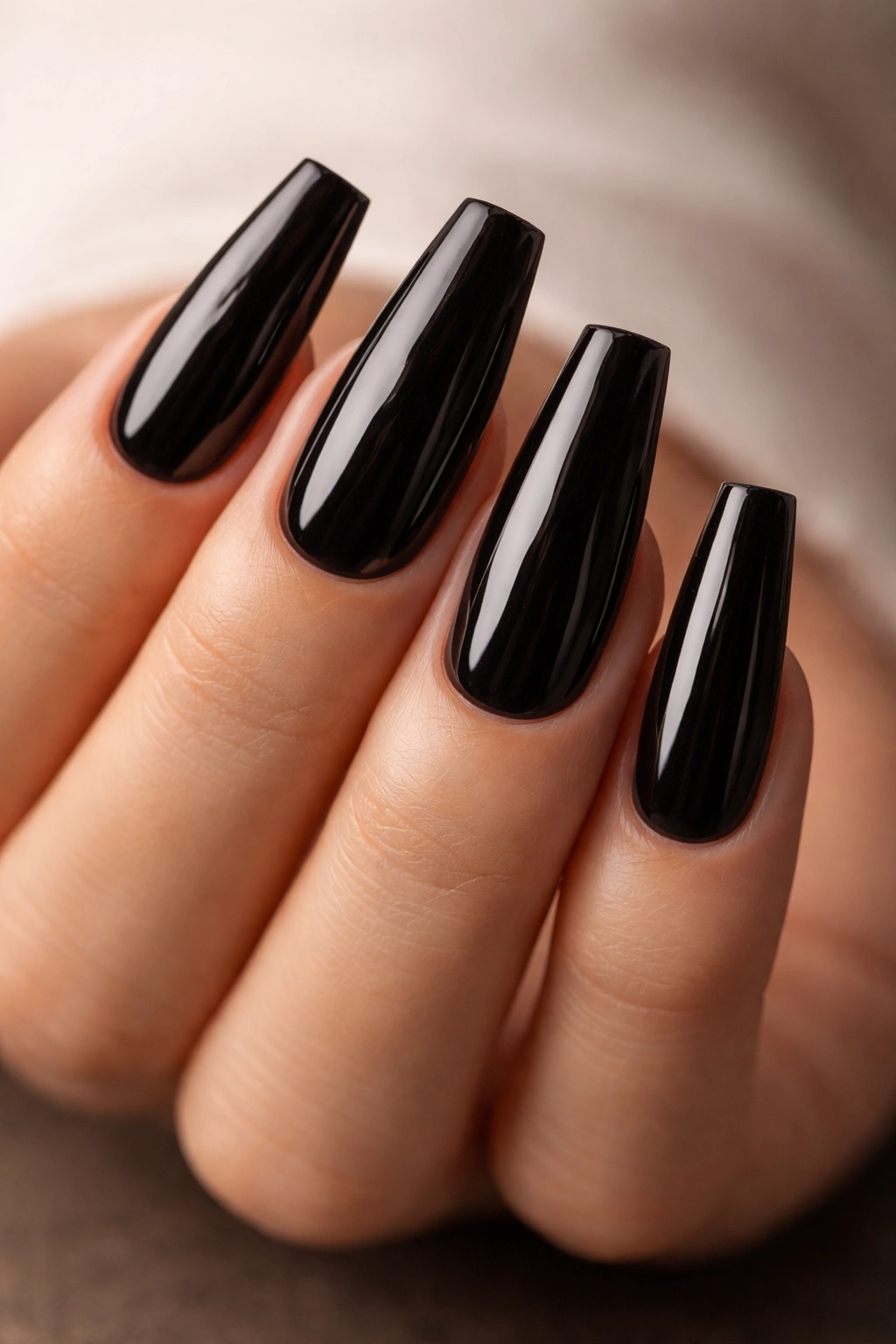
Why do dark manicures seem to chip faster? Most of the time, they do not chip more. You just notice the damage sooner because a tiny break at the tip throws a light line against a dark surface.
Prep makes more difference than color
A smooth base matters more with deep polish than with sheer shades. Buff only enough to remove shine, push the cuticle back, and clean the plate with alcohol or acetone so oil does not sit under the product. If your nails have ridges, a ridge-filling base coat earns its spot. Dark polish loves to highlight every little dip.
Thin coats win here. Two thin layers of black or burgundy cure and level better than one thick one, especially near the sidewalls where flooded cuticles can make the whole manicure look messy. Ask your tech to cap the free edge—that means dragging a small amount of color and top coat across the tip. It is boring. It works.
Small habits stretch wear time
You do not need a complicated routine, but dark coffin nails hold up longer when you do a few things on purpose:
- Use cuticle oil twice a day, not once every few days.
- Wear gloves when washing dishes or scrubbing a sink.
- Avoid using the nail tip to pry open cans, scratch labels, or dig at stickers.
- Reapply a clear top coat every 2 to 3 days if you wear regular polish.
Acetone cleanup is part of the look. A thin angled brush dipped in remover can erase a shaky edge in about 20 seconds, and that tiny cleanup step is often the difference between “home manicure” and “salon-fresh.”
1. Ink Black Patent Coffin Nails
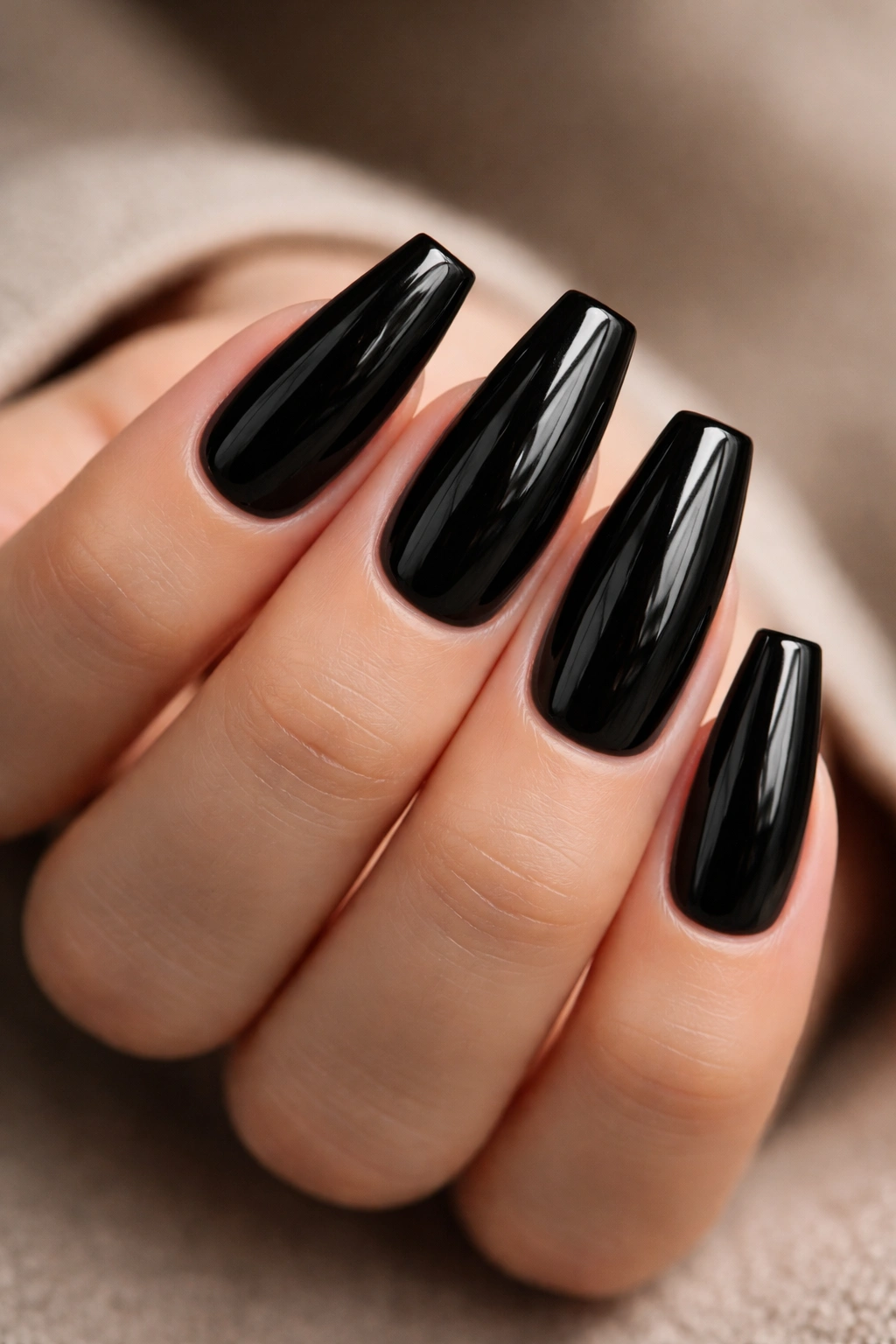
Fresh black polish under a high-gloss top coat has a certain bite to it. On coffin nails, that shine makes the flat tip stand out and gives the whole manicure a polished, almost vinyl finish.
Why this version hits so hard
Glossy black is unforgiving, which is part of the appeal. You see the symmetry of the shape, the neat curve near the cuticle, the sharp sidewalls. If the coffin shape is clean, ink black patent nails look expensive even with no art at all.
This style works best on medium to long lengths because the shine emphasizes every angle. On shorter coffin nails, keep the taper soft and the tip a touch wider so the nail does not look pinched. A black gel color in two thin coats usually gives the smoothest coverage.
Quick notes that matter
- Choose a plump, glassy top coat rather than a thin one if you want that lacquered look.
- Square the tip lightly; an over-filed point can make black look harsh in the wrong way.
- Pair this style with short jewelry stacks or silver rings if you want the hands to look cleaner.
- Skip heavy glitter accents. The point of this set is restraint.
Best move: ask for a slightly rounded square tip, not a knife-edge end. It keeps the manicure sharp without making daily wear annoying.
2. Smoked Plum Velvet Coffin Nails
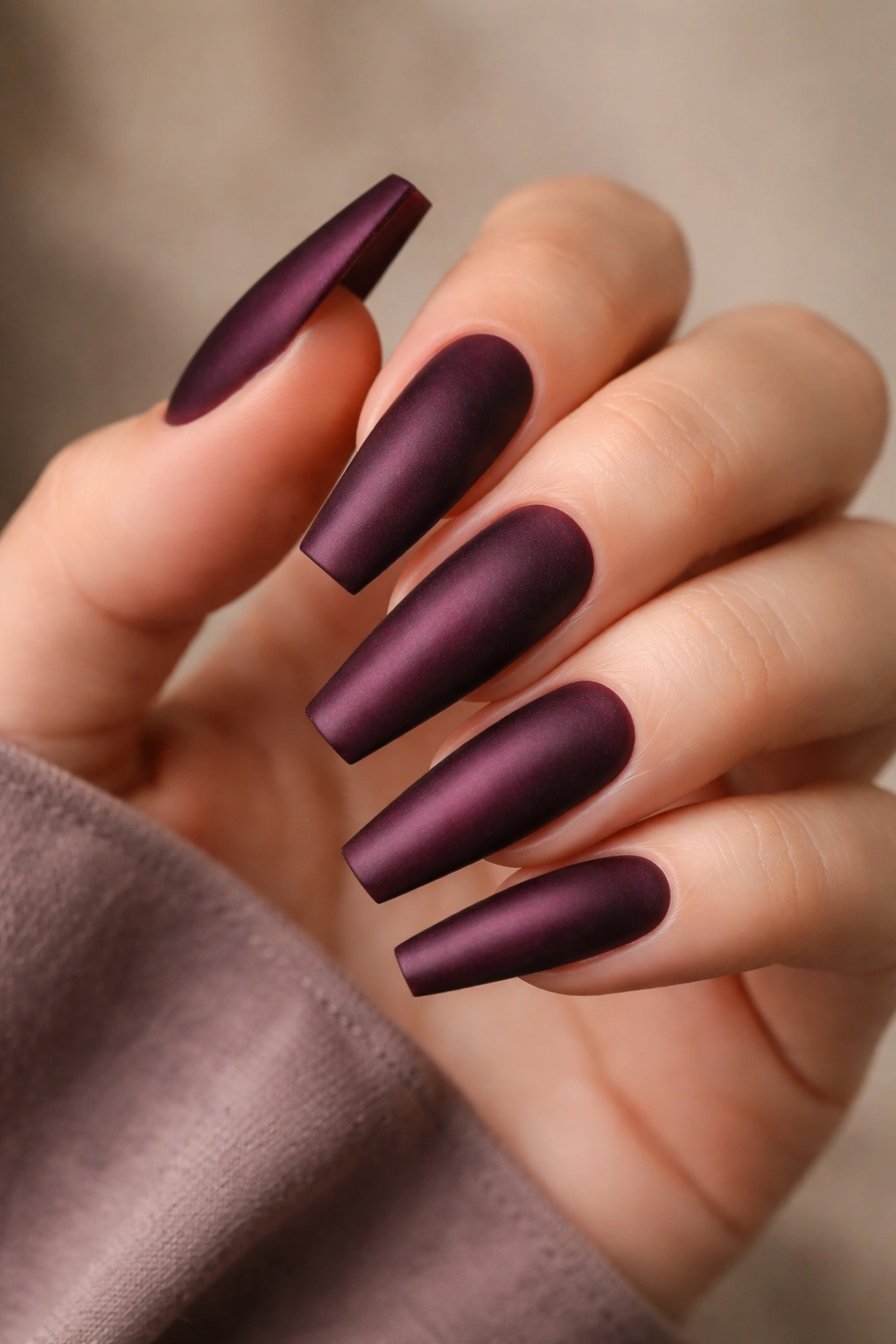
Black is not the only dark shade with attitude. A smoked plum base with a velvet-matte top coat has more depth than flat black and more warmth than gray, which makes it one of my favorite moody nail colors when you want something dark but not severe.
The reason this color works on coffin nails comes down to tone. Plum carries red and brown undercurrents, so the shade shifts under indoor light and looks richer across different skin tones. On olive skin it can lean wine-dark. On deeper complexions it takes on a bruised eggplant cast. On fair skin, it reads like dark fruit and smoke.
Texture does a lot of the heavy lifting here. Matte top coat turns plum from polished to almost fabric-like, and coffin nails give that finish enough surface area to show. If you want a little extra detail, add one glossy diagonal slash or a thin cuticle crescent on two nails. That bit of contrast stops matte from looking flat.
Keep the shape balanced. Plum velvet looks strongest when the sidewalls stay straight for most of the nail, then taper only near the tip. File too aggressively, and the soft richness of the shade gets replaced by something more costume-like, which is not the goal.
3. Oxblood Glass Coffin Nails
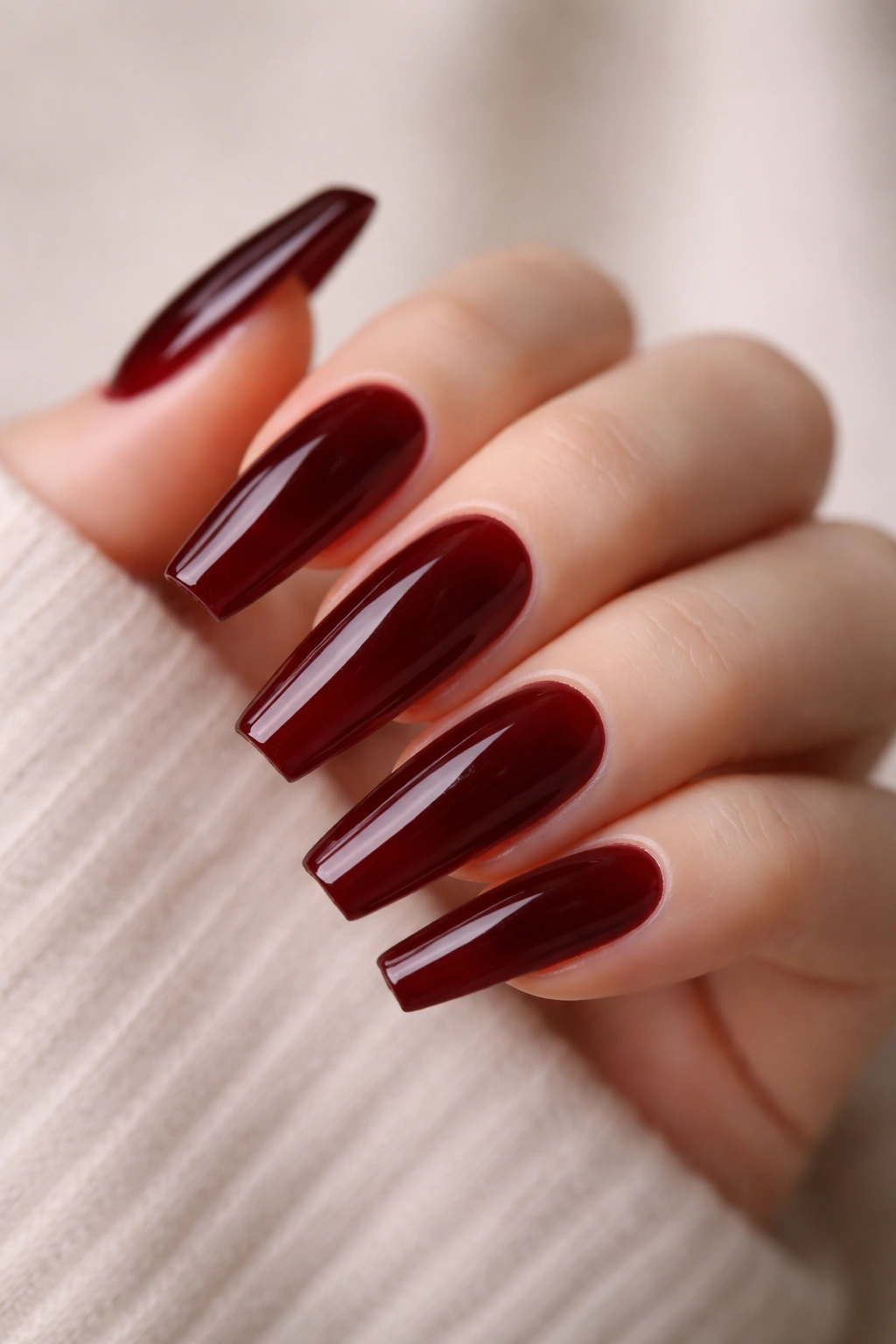
Why does oxblood feel richer than plain red? Because it sits in that narrow space between burgundy, brown, and black, and coffin nails give it room to show all three at once.
With a glass-like finish, oxblood turns syrupy rather than creamy. The color looks almost translucent at the edges and denser through the center, especially if your nail artist layers a jelly burgundy over a dark base. That trick gives the manicure depth instead of a flat wine stain.
A small warning: this is one of those shades that can look muddy if the undertone is off. Ask for red-brown depth rather than purple-burgundy if you want the moodier, blood-wine effect. Purple-heavy oxblood can drift toward plum, which is a different lane.
How to wear it so it feels intentional
Medium coffin length is the sweet spot here. On long nails, oxblood glass starts to look theatrical unless the rest of the set stays clean. No rhinestones. No random glitter. Maybe one accent nail with a dark tortoiseshell or a thin gold line near the cuticle, then stop.
If you wear gold jewelry often, this set tends to look richer than black. If you wear silver, it still works—the red undertone just gives the metal a cooler contrast. Either way, oxblood glass nails are moody without feeling flat, and that is harder to pull off than it looks.
4. Matte Charcoal Coffin Nails With Glossy French Tips
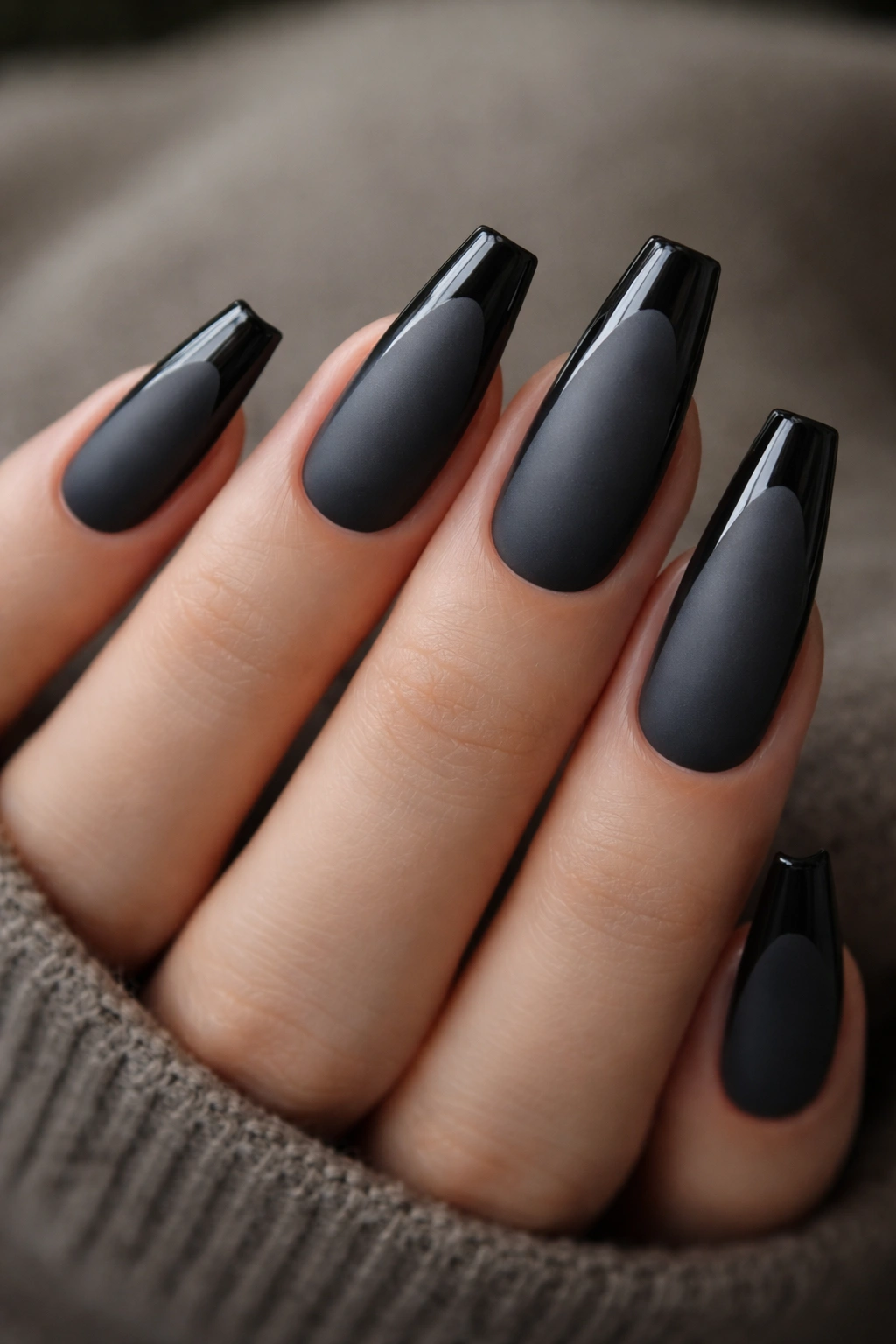
Picture a charcoal matte set from a distance. It looks soft, almost chalky. Then your hand moves, light hits the tips, and a slim glossy French edge flashes across the end of each nail. That contrast is what makes this design good.
It is also one of the cleaner ways to do dark nail art without loading the nail with decals or stones. Charcoal keeps the mood heavy but not as hard as black, while the gloss-on-matte tip gives structure right where the coffin shape wants attention anyway.
A few details make or break it:
- Keep the French tip narrow—around 2 to 3 millimeters on medium nails.
- Match the base and the tip color; the finish contrast should do the talking.
- Use a deep charcoal, not medium gray, or the look loses its edge.
- Ask for a crisp smile line with straight outer corners, not a rounded soft curve.
This set has range. It suits office wear, heavy knits, leather jackets, silver jewelry, and plain black basics without asking for extra styling help. You still get a design, though. Not loud. Not busy. Just enough contrast to make the coffin shape feel engineered.
5. Black Cherry Chrome Coffin Nails
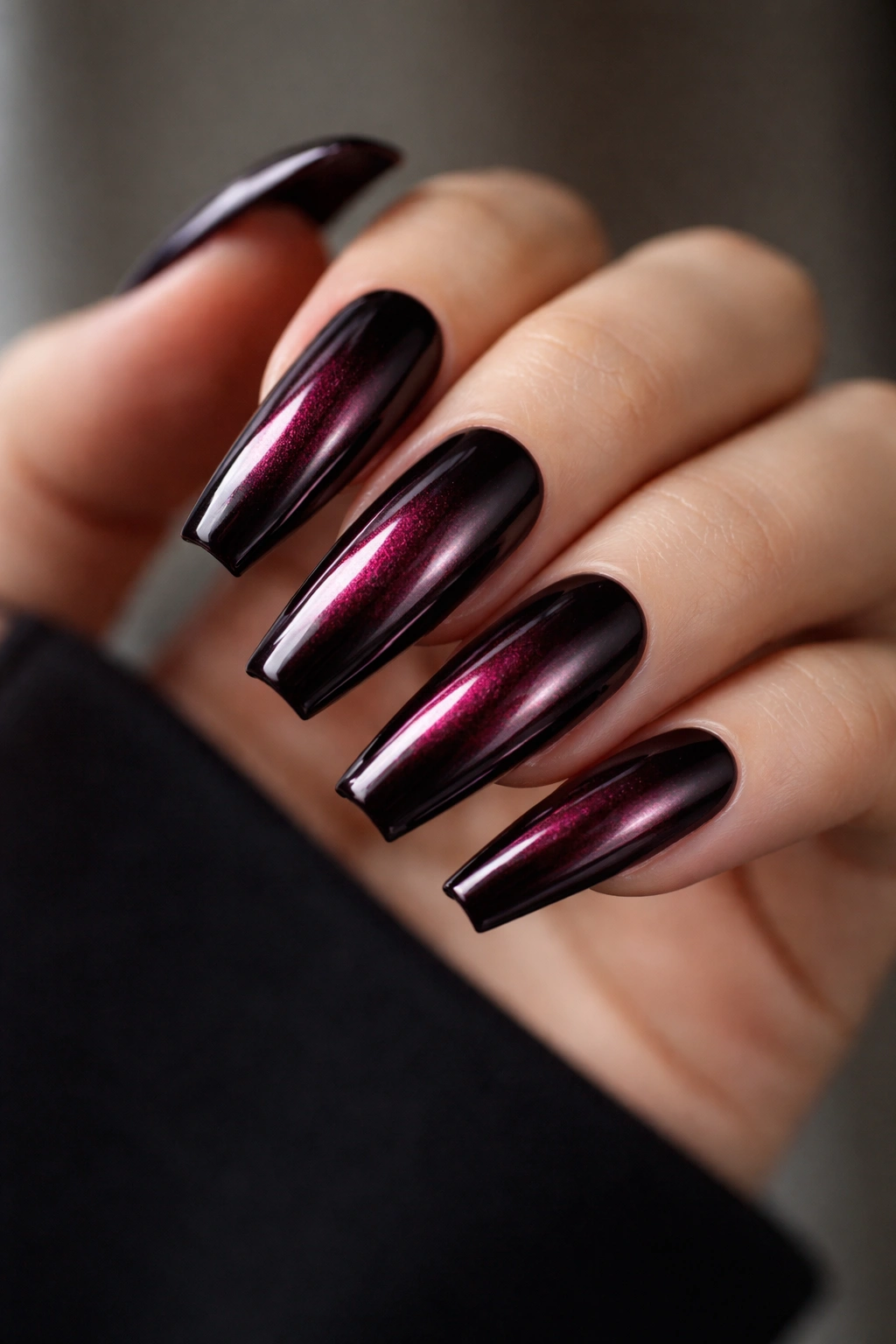
Chrome can go tacky fast. There, I said it. But over a black cherry base on coffin nails, it can look cold, dark, and expensive instead of mirror-bright and loud.
The base color matters more than the powder. Start with a shade that looks almost black in low light but flashes cherry-red when the hand turns. Then rub a fine chrome pigment over a no-wipe top coat so the metal sheen sits on top rather than swallowing the color underneath. You want a wine-metal flash, not a silver helmet.
This design looks strongest on long coffin nails because the elongated surface lets the color shift show from cuticle to tip. On shorter sets, chrome can make the nail look squat unless the shape is narrow. If you want shorter nails, use a thinner, pearlized chrome instead of a dense mirror one.
There is also a styling angle here. Black cherry chrome has a colder mood than oxblood glass, so it pairs better with gunmetal, silver, charcoal, and black clothing than warm camel or cream. That is not a hard rule. It is more about the vibe of the hand.
Keep accent nails out of it unless you have a clear plan. The chrome itself is already the event.
6. Midnight Navy Coffin Nails With Fine Silver Specks
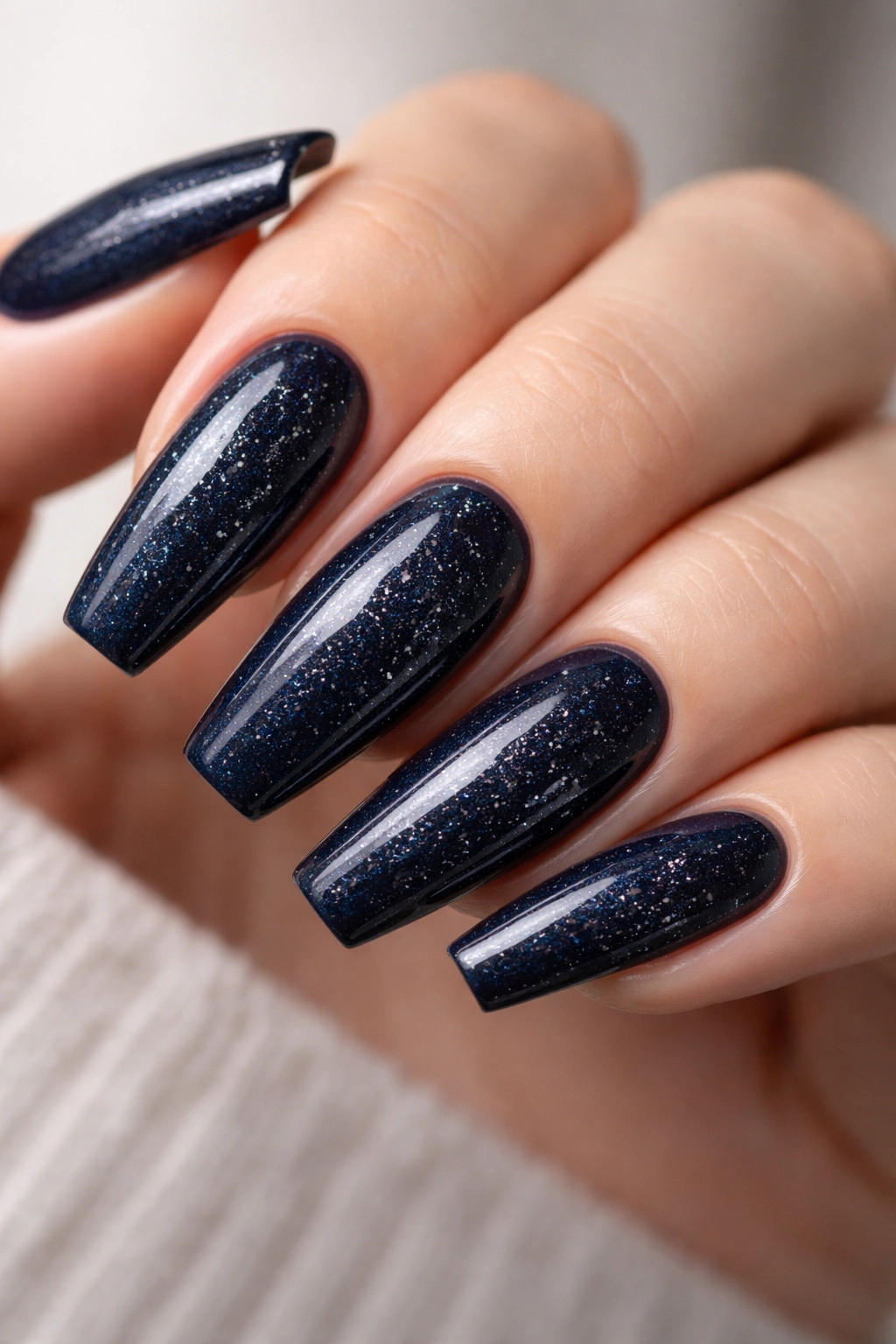
Unlike black polish, midnight navy gives you darkness with a little air in it. It reads near-black from across the room, then shifts blue when light hits the curve of the nail. Add a fine silver speckle—more dust than glitter—and the whole thing starts to look like a night sky seen through a cold window.
This style wins when you want mood without the heaviness of a flat black manicure. Navy also hides tiny application flaws better than true black, which makes it a smart pick for home painters who love coffin nails but do not enjoy cleanup work.
Use restraint with the sparkle. Big hex glitter pieces ruin the effect. What you want is micro-shimmer or fine reflective pigment, the kind that looks scattered rather than placed. A dense glitter top coat can make the nail chunky, while a sheer silver dusting keeps the finish smoother.
Who suits it most? Anyone who likes black but wants a softer version. It also works well on shorter coffin lengths where black might feel too sharp. Pair it with glossy top coat for a sleek finish, or use satin for a softer, brushed-metal feel. Either route keeps that deep blue glow alive.
7. Deep Forest Green Coffin Nails With Gold Foil Fragments
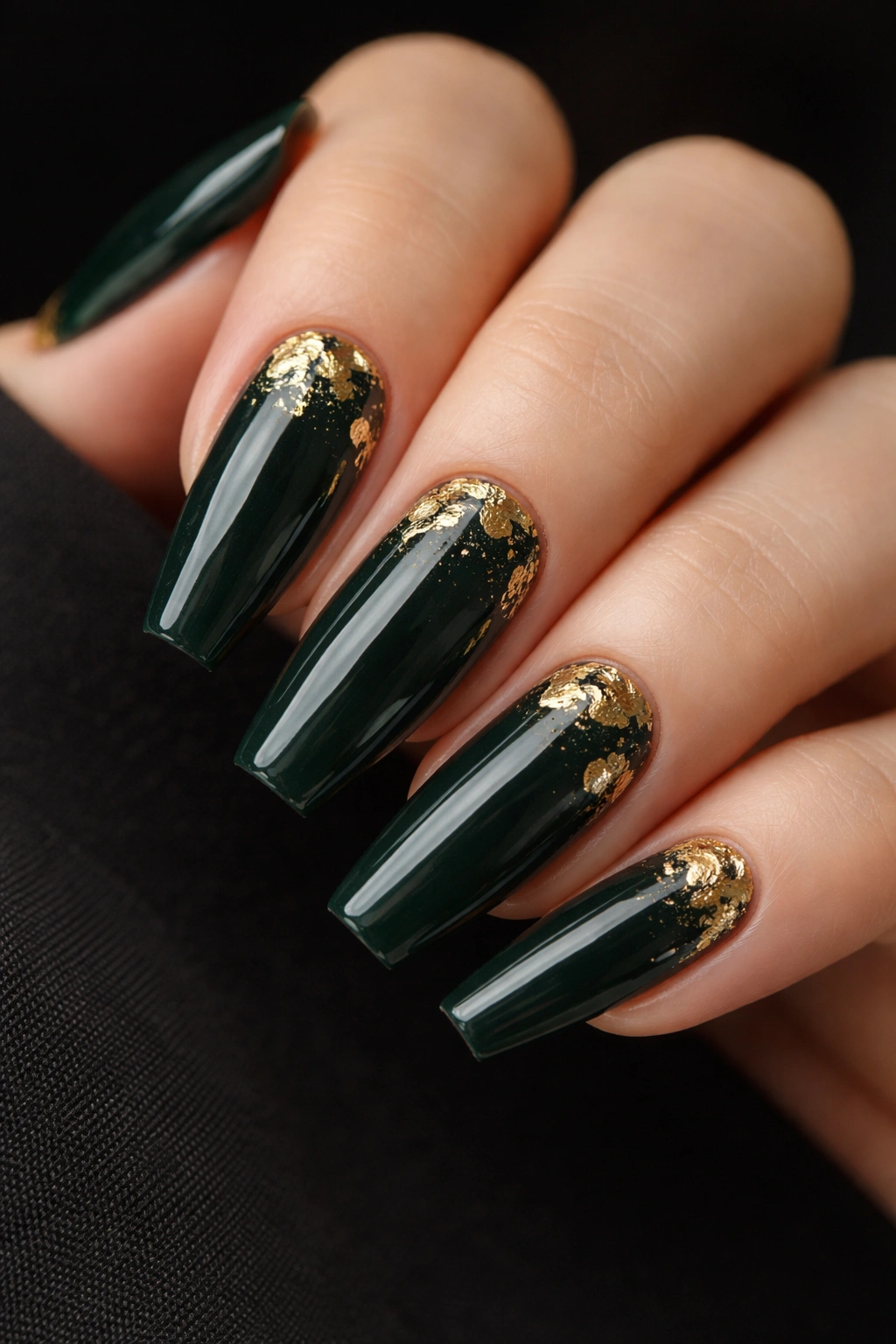
Green gets overlooked in dark manicure lineups, which is a mistake. A blackened forest green on coffin nails feels richer than black, less expected than burgundy, and more dimensional than charcoal.
What makes this one different
Forest green has a hidden luxury to it, especially when the base leans cool and resin-dark rather than bright emerald. On its own, it already has enough depth for a moody set. Add tiny pieces of irregular gold foil, and the design starts to look like old lacquer, antique glass, or a dark bottle pulled from a wooden cabinet.
The foil placement matters. Scatter it lightly near one sidewall, cluster it near the cuticle, or float a few fragments through the middle of the nail. What you do not want is a full foil blanket.
Placement tips worth asking for
- Keep foil pieces smaller than a grain of rice on medium nails.
- Use foil on 2 to 4 nails, not all 10, if you want the green to stay dominant.
- Seal the edges well under builder gel or a thicker top coat so nothing lifts.
- Choose warm gold over icy champagne if the green leans black.
Good call: this set looks sharp with gold rings, but it also holds up against plain black clothing, which is not always true of jewel-toned nail colors.
8. Burnt Aubergine Jelly Dark Coffin Nails
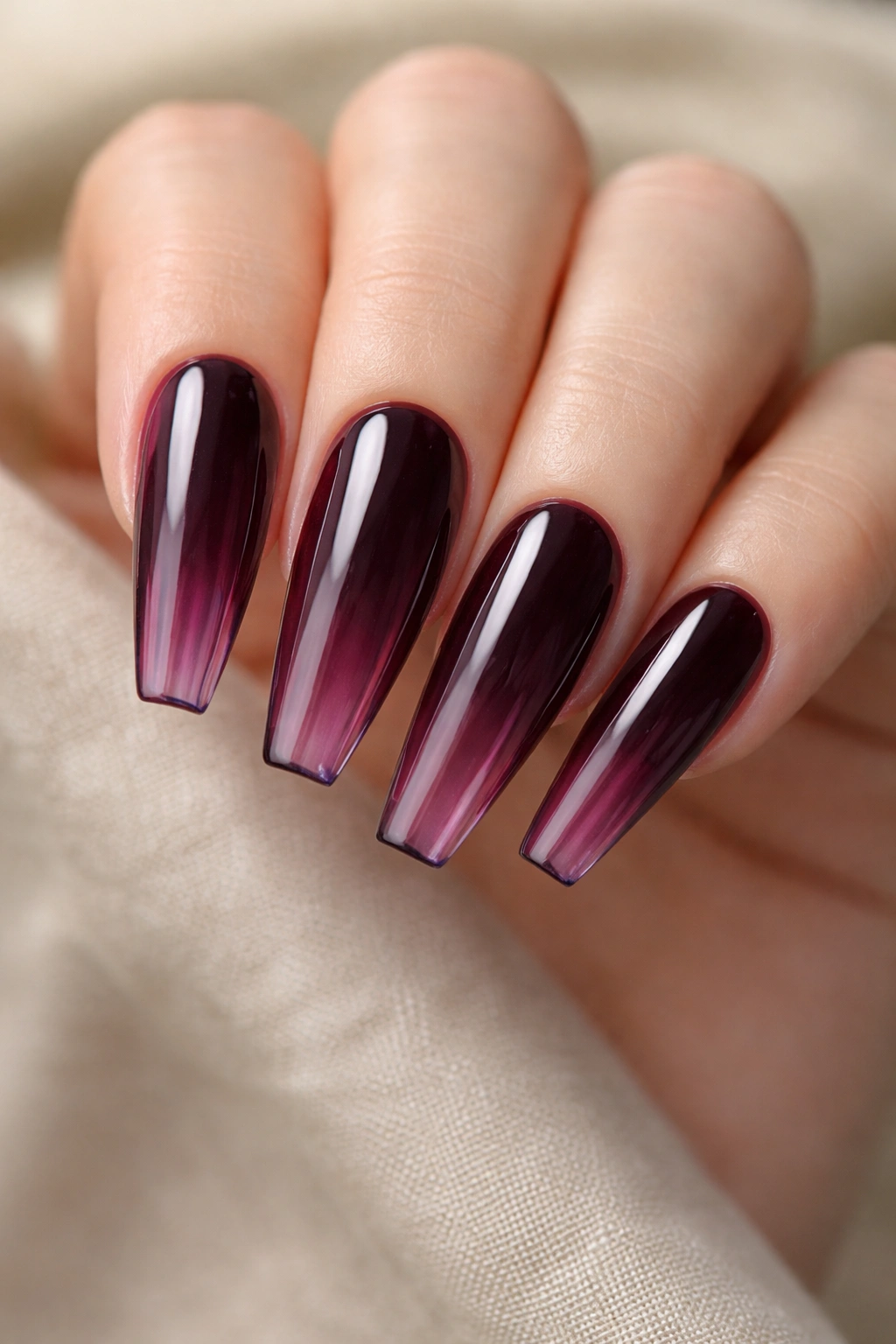
Two sheer coats can sometimes do more than one opaque one. Burnt aubergine jelly nails prove it.
Aubergine sits between plum and black, but the jelly finish changes the whole mood. Instead of looking dense and heavy, the color gains that stained-glass depth where the free edge looks slightly lighter and the apex looks darker. On coffin nails, that depth gives the flat tip a cleaner outline.
There is a technique piece here. Jelly colors need even structure underneath, so this design looks best over a smooth builder base or a well-leveled gel overlay. If the nail plate is uneven, the sheer depth will show every ridge. A black-violet jelly over a soft smoky base can create a deeper, smoked effect than aubergine alone.
This is also one of the best dark coffin nail ideas for anyone who wants mood but still likes light passing through the color. Matte would kill that depth. Keep it glossy, keep it sleek, and do not crowd it with stones or decals.
Aubergine jelly nails have a nice side effect: they do not look flat indoors. That matters more than people think, since most of us see our manicure under office lights, lamps, restaurant lighting, and bathroom mirrors—not direct sun.
9. Black-to-Burgundy Ombre Coffin Nails
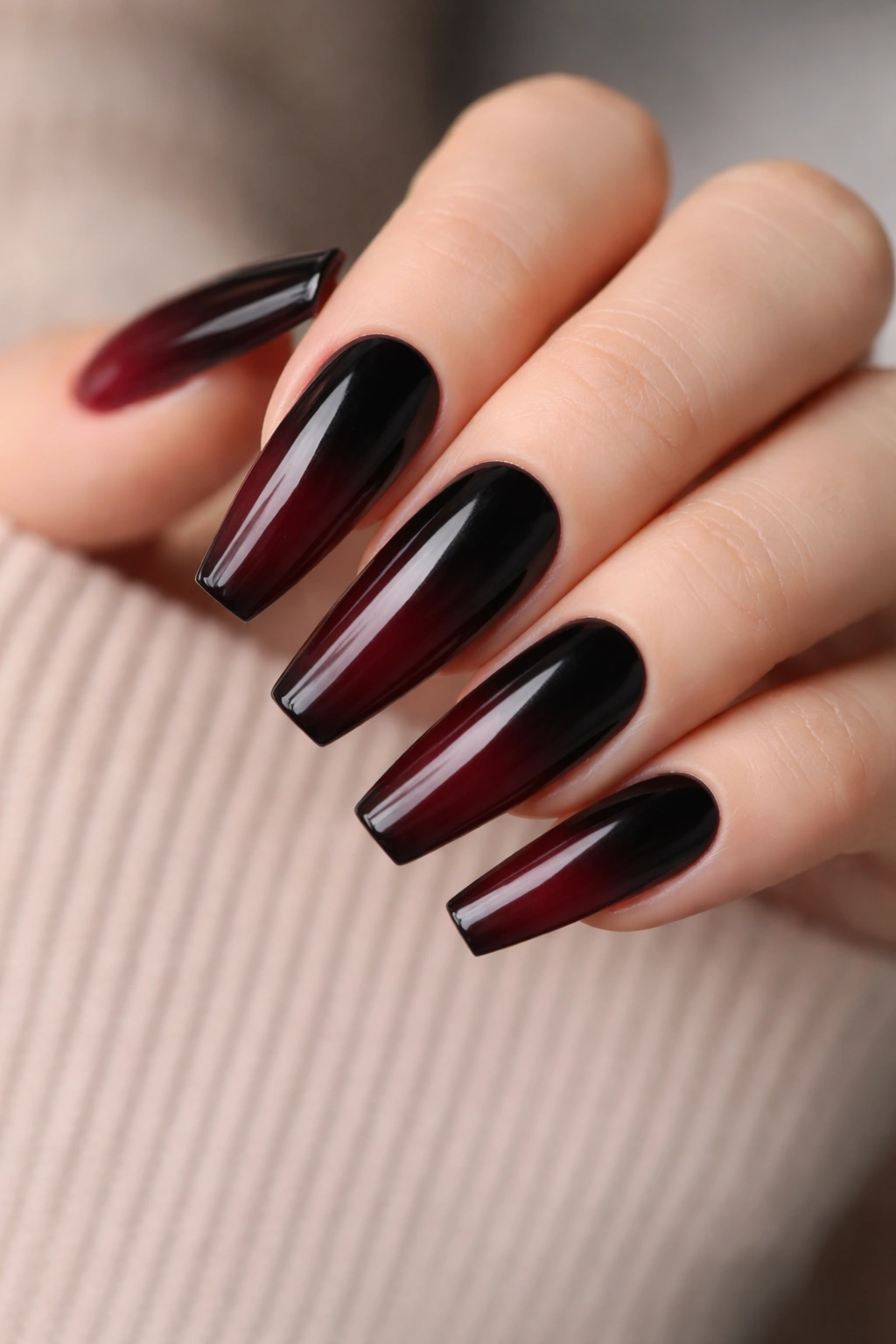
Ombre can look tired fast when the blend is muddy or the colors are too far apart. Black to burgundy avoids that problem because the shades share enough depth to fade into each other without looking striped.
The best version starts with black near the cuticle and melts into burgundy or black cherry toward the tip. That direction keeps the base of the nail looking neat and grounded while letting the color open up at the edge. Reverse ombre can work too, though it usually feels louder.
Why this gradient suits coffin nails
Coffin nails give ombre room to travel. On a short square, the fade can look abrupt. On a medium or long coffin, you get enough length for the black to soften into wine over 6 to 10 millimeters, which makes the blend look intentional.
Application matters. Airbrushed ombre gives the smoothest fade, but a sponge blend can still work if the colors are tapped in thin layers and sealed under a leveling top coat. Heavy sponging leaves texture, and texture on dark polish is the enemy.
If you want one small extra, add a single fine chrome line where the colors meet on one accent nail. Keep it thin. Anything thicker starts to fight the gradient.
10. Espresso Brown Coffin Nails With a Tortoiseshell Accent
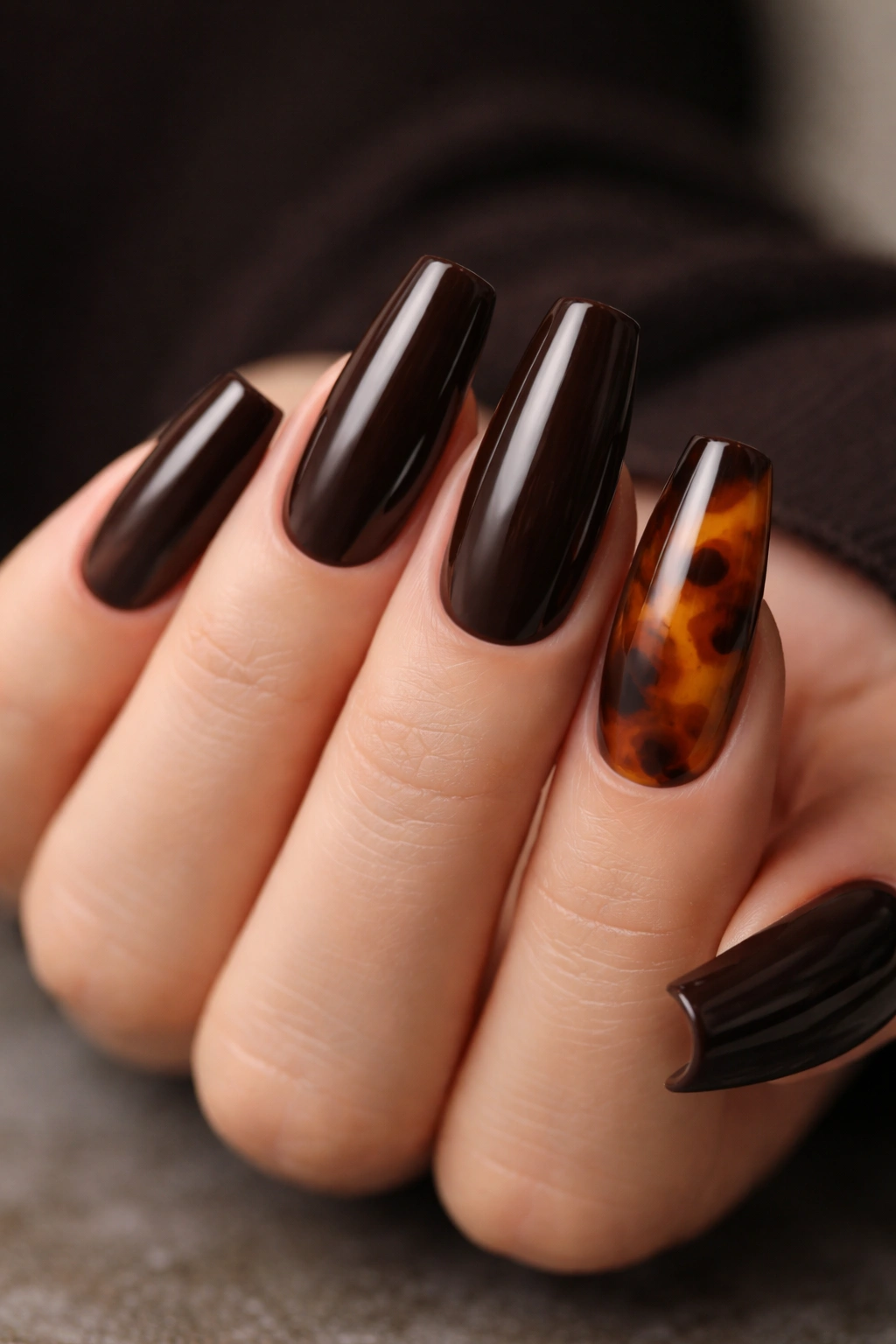
Brown has a way of sneaking back into nail trends because it flatters more hands than people give it credit for. A deep espresso base on coffin nails feels grounded, glossy, and a little softer than black, while one tortoiseshell accent adds warmth without dragging the whole set into busy territory.
The key is keeping the brown dark enough. Think coffee bean, polished walnut, or cola bottle—not milk chocolate. Once the base gets too light, the moody effect drops away.
A tortoiseshell accent works because it shares that same brown-black family. Build it with translucent amber, caramel patches, and tiny black blotches, then blur the edges so it looks layered under glass rather than painted on top. One accent nail per hand is enough. Two can still work. More than that starts to read themed.
This set is easier to wear than it sounds. Espresso nails pair well with gold jewelry, camel coats, black knitwear, dark denim, and cream shirts. They also grow out more gently than black polish, which is a practical win if you stretch appointments a little too long sometimes. And yes, people do that.
11. Slate Gray Marble Coffin Nails
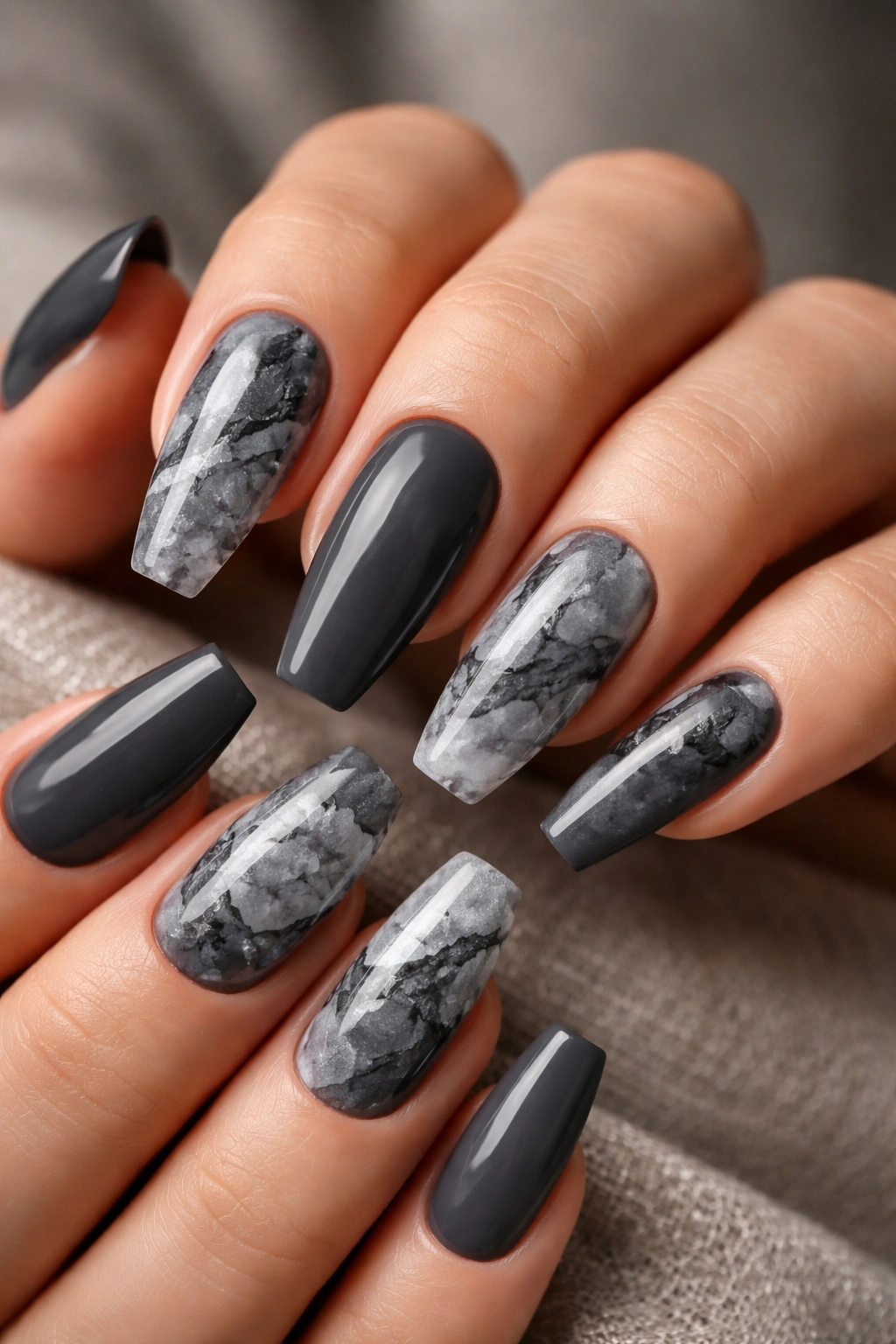
Stone textures have a harsher edge on coffin nails than they do on almond shapes, and that is exactly why slate marble works. The tapered sides keep the look sleek, while the flat tip gives the marbling a clean stopping point.
A good slate marble set starts with a cool gray base, then adds thin charcoal and white veining that bends and branches rather than running in neat parallel lines. Nature is messy. Your marble should be too. One blurred vein crossing another usually looks more convincing than six tiny stripe marks scattered everywhere.
This is one of those designs where negative space helps. You do not need full marble on every nail. Two full marble nails, two slate gloss nails, and one solid charcoal can look stronger than ten marbled nails fighting each other. If you want a metallic touch, a faint silver vein on one or two nails is enough.
There is a tactile feel to this design even though the surface stays smooth. Matte top coat makes it feel chalky and stone-like. Gloss makes it look polished and wet. I lean matte for slate. It gives the design a colder mood, and cold is what this set does well.
12. Dark Teal Cat-Eye Coffin Nails
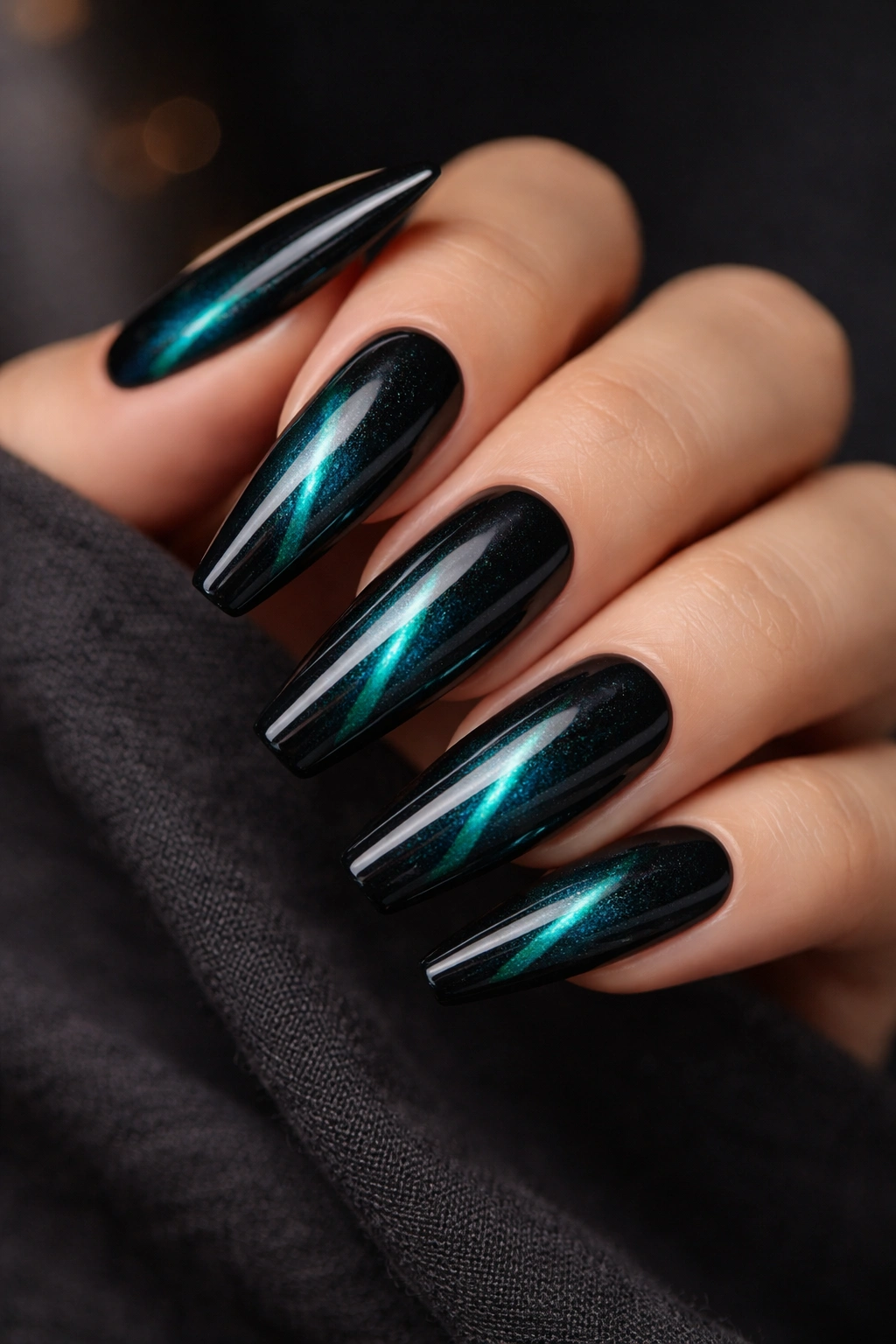
Pass a magnet over dark teal cat-eye gel and you get a narrow beam of shifting light that moves like silk under glass. On a coffin nail, that line can run diagonally from cuticle to corner or sit vertically down the center, and either way the shape looks longer.
Cat-eye nails can slip into cheap territory when the base is too bright or the magnetic stripe is too thick. Keep the teal deep—closer to blackened ocean than peacock—and hold the magnet steady for 5 to 10 seconds per nail so the shimmer line stays sharp. A blurred stripe makes the whole look feel muddy.
This is one of the better moody designs if you want movement without glitter. You get a shift, a flash, a little drama, but the surface still reads sleek. No texture. No raised art. No chunky sparkle catching on sweaters.
Dark teal also has a strange advantage: it reads different depending on the light. Indoors it can look almost black. Under brighter light, the blue-green tone comes forward. That shape-shifting quality gives the manicure depth while staying dark enough for anyone chasing a moodier nail set.
13. Wine Stain French Fade Coffin Nails
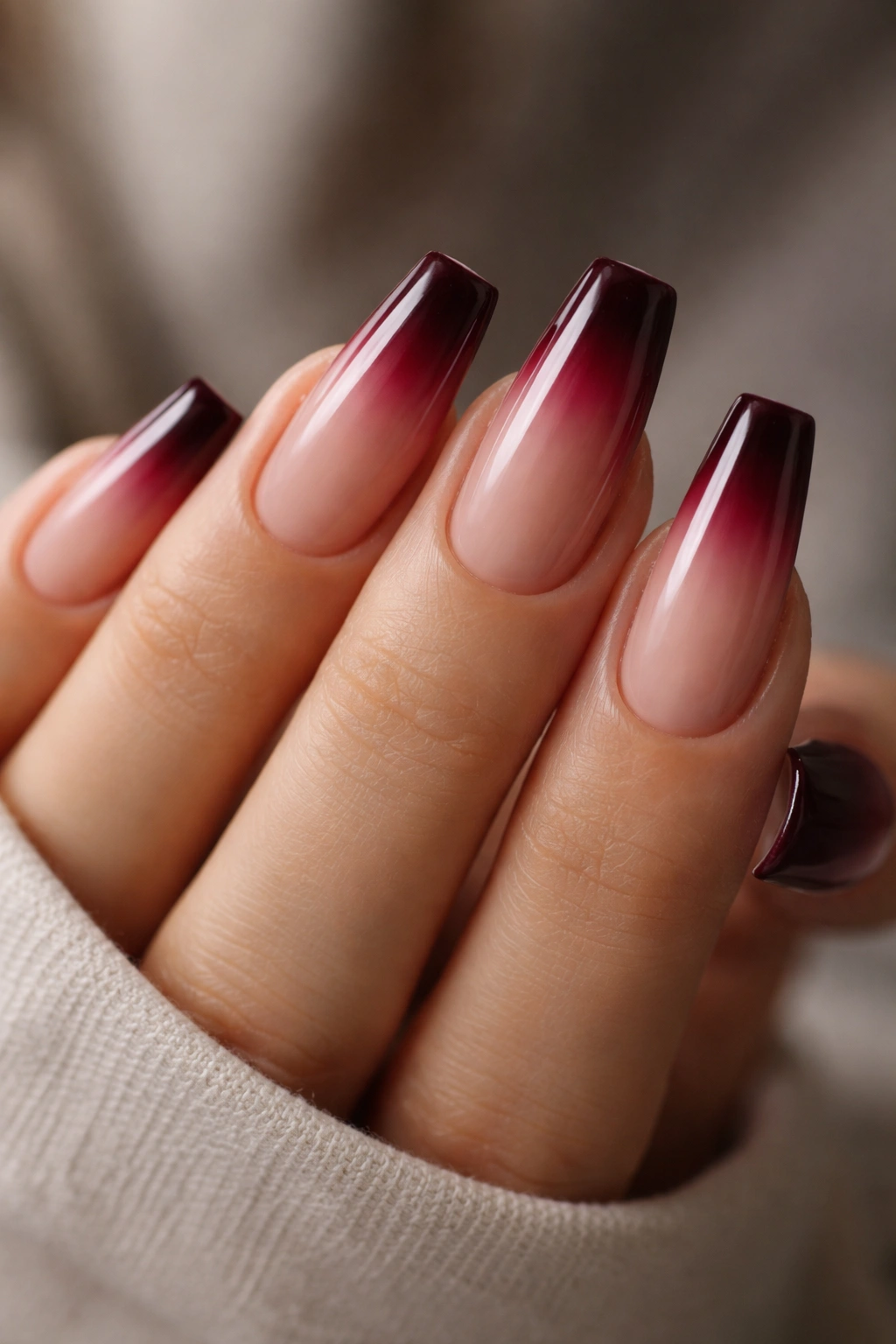
If full dark polish feels heavy on your hands, a wine stain French fade is a smart compromise. You still get the depth of burgundy, but it sits at the tip and softens as it moves downward, leaving part of the nail bed lighter.
What this design actually looks like
Think of a French manicure after a glass of red wine met a sheer pink base. The tip is deepest at the edge—black cherry, merlot, or oxblood—then fades into a soft nude or smoky rose around the middle of the nail. On coffin nails, the squared-off tip gives the dark fade structure, so it looks modern rather than bridal.
Where it works best
- Medium coffin length gives the fade enough travel space.
- A cool nude base keeps the look moodier than a peachy nude.
- Glossy top coat makes the fade look cleaner than matte here.
- Pairing one solid burgundy accent nail with the faded set can anchor the whole design.
Worth asking for: a blurred fade that starts a little lower on the sidewalls than in the center. That placement flatters the coffin shape and keeps the tip from looking blocky.
14. Black Lace Overlay on a Sheer Base
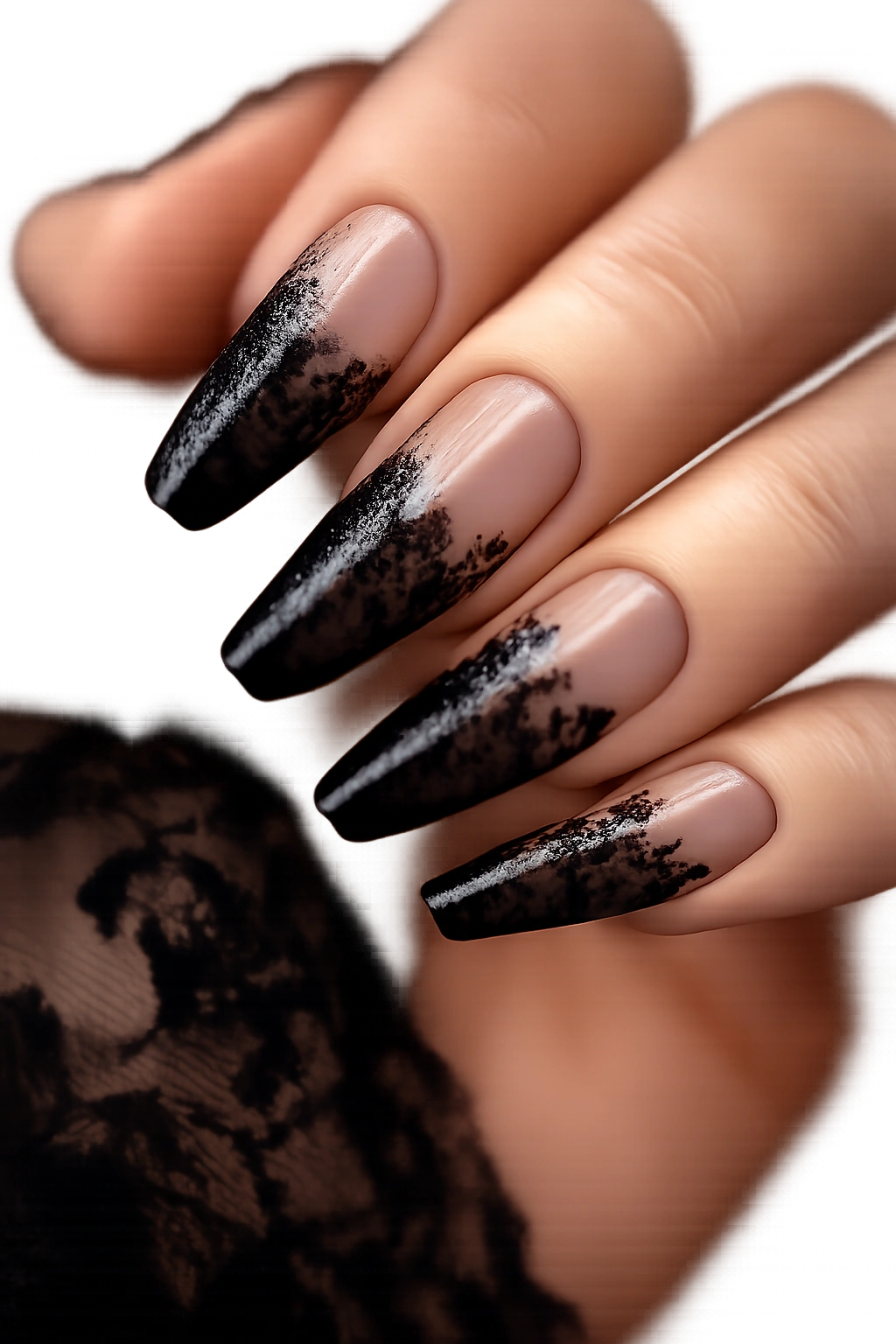
Lace nail art can go wrong in a hurry. Too dense, and it looks like wallpaper. Too crisp and white, and the moody effect disappears. But a black lace overlay on a sheer smoky base can look intricate, dark, and oddly grown-up on coffin nails.
The trick is transparency. Start with a sheer nude, taupe, or gray-beige base rather than an opaque cream. Then place the lace detail on part of the nail instead of covering the whole thing. A diagonal corner, a side panel, or a half-moon near the cuticle tends to look cleaner than full coverage.
Stamping works if the pattern is fine. Hand-painted mesh or lace can look better on long coffin nails where there is room for detail, though it demands a steadier hand. If your artist uses stickers or decals, they need full sealing at the edges or the design can catch and peel.
This set is moodier than floral nail art and sharper than black French tips, which is why it lands so well. It has detail, though the hand still looks clean from a distance. Pair it with glossy black on alternating nails if you want the lace to feel grounded instead of floating on its own.
15. Gunmetal Glitter Gradient Coffin Nails
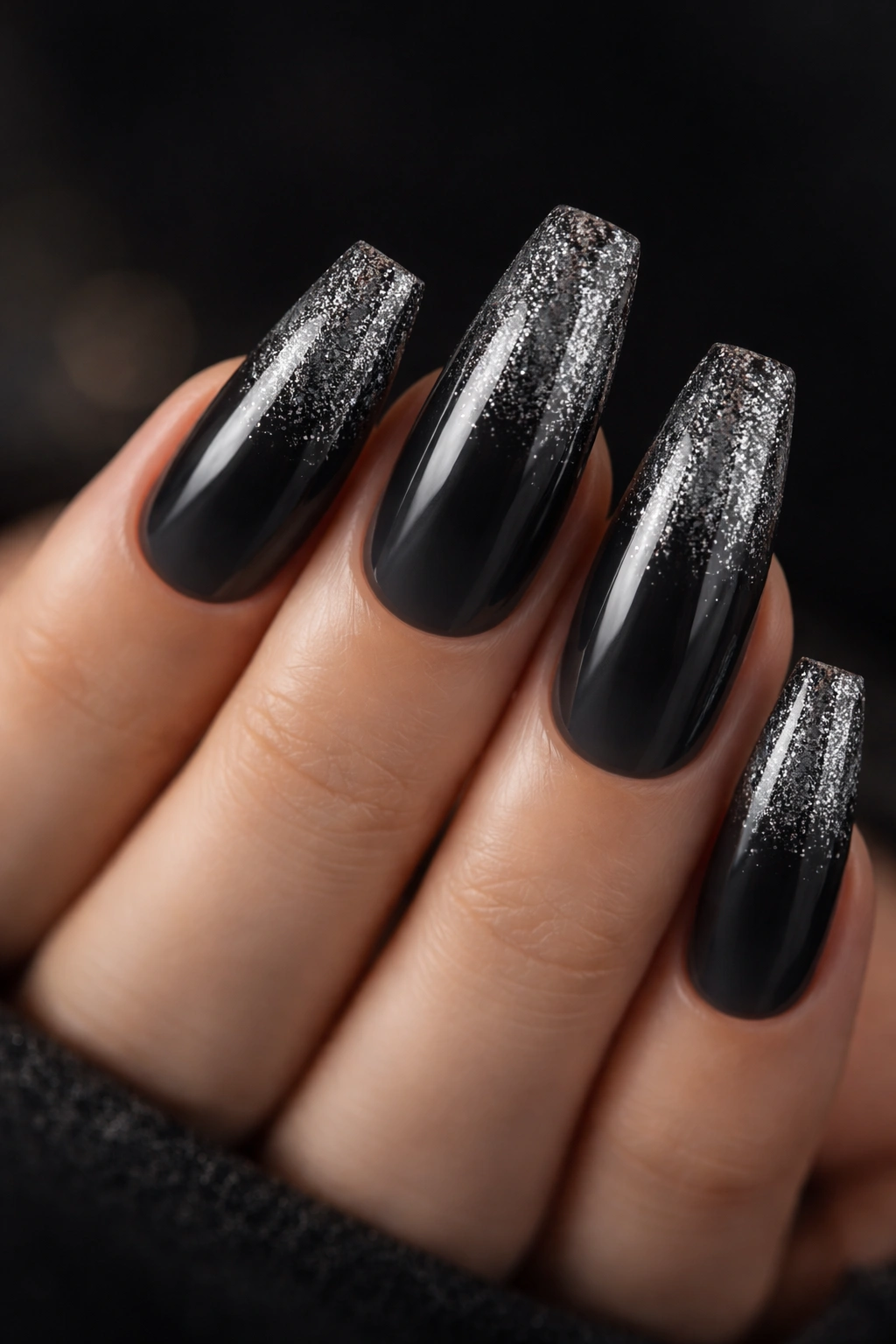
Glitter turns cheap the second it gets too chunky, too thick, or too random. Gunmetal gradient nails avoid all three problems when the sparkle is fine, dense near the tip, and blended into a black or charcoal base.
What makes gunmetal different from silver is the undertone. It is colder, dirtier, and darker, which means it keeps the manicure in moody territory even when it catches light. That matters on coffin nails, since the shape already has enough drama without needing disco-ball glitter on top.
How to get the fade right
Use a black, charcoal, or deep graphite base. Then pack fine gunmetal glitter at the tip and fade it downward using a dry brush or sponge so the particles thin out around the middle of the nail. The densest area should cover about one-third of the nail, not half. Too much glitter and the design loses shape.
A glossy top coat makes the surface look smoother and more reflective. Matte can work, though it turns the sparkle into a softer graphite texture rather than a bright flash. Both have their place. For a night-out manicure, I still lean glossy.
Gunmetal glitter is one of the easiest ways to wear dark coffin nails when you want some light in the look, though not the bright, mirror-metal flash of chrome.
Final Thoughts
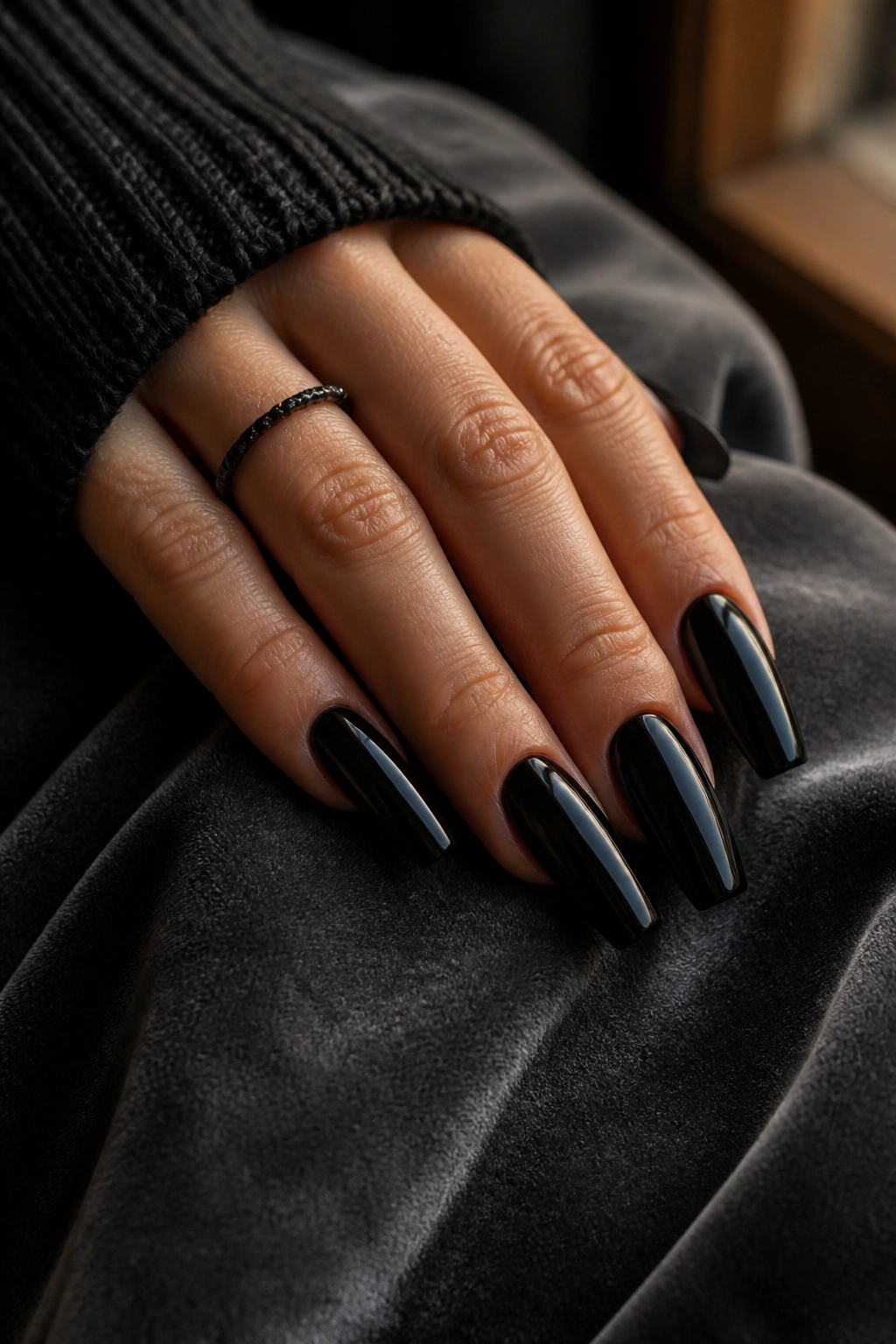
A moody manicure works best when the shade and finish make sense with the shape. Coffin nails already bring structure, so the strongest dark sets usually keep the extra detail focused—one finish contrast, one foil accent, one magnetic stripe, one fade that has room to breathe.
If you are choosing between three ideas and cannot decide, pick by texture first. Gloss looks sleek. Matte looks soft and heavy. Chrome feels colder. Jelly has depth. Color matters, but finish is what changes the mood on your hand.
And if you want the safest place to start, go with either ink black patent, oxblood glass, or smoked plum velvet. Those three cover the sharp, rich, and soft sides of dark coffin nails without asking you to commit to a louder design right away.