


Dark blue ballerina nails solve a problem that soft pinks and beige never can: they make your hands look dressed before you add a ring, bracelet, or sleeve. On the right length, that tapered-square shape already has edge. Add a deep navy, ink blue, or blue-black polish, and the whole manicure starts to feel sharper, moodier, more deliberate.
I keep coming back to this color family because it sits in a sweet spot that black polish does not always hit. Black can look flat on some nail lengths. Baby blue can turn sugary fast. Dark blue has more depth. Under daylight, you catch the blue. Under indoor light, it shifts darker and richer, which gives ballerina nails that crisp, sculpted look people usually want from the shape in the first place.
There is a catch, though. Dark shades show every shortcut. If the sidewalls wobble, you’ll see it. If the cuticle area floods, the whole set looks heavy. If the top coat is thin, navy can lose that inky depth and start looking dusty after a few days. That is why salon photos can be misleading; a shade that looked lush under bright LED lamps can turn dull once you’re out in regular life, holding coffee or typing in office light.
The fun part is that dark blue does not have to mean one plain manicure repeated fifteen ways. You can push it glossy, matte, metallic, sheer, velvety, marbled, jeweled, graphic. Same color family. Completely different attitude.
Why Dark Blue Ballerina Nails Make the Shape Look Sharper
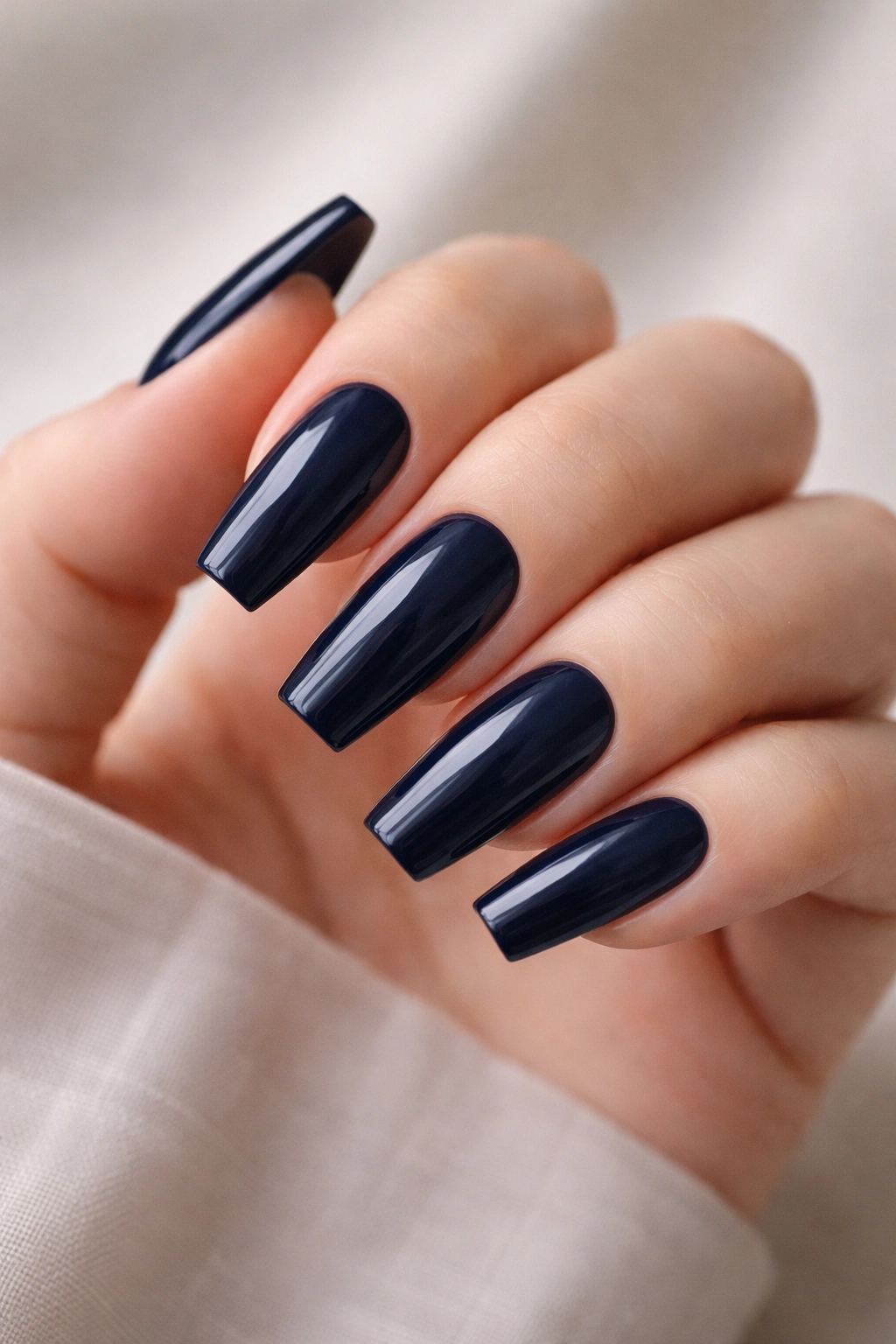
Ballerina nails need clean lines to work. The shape narrows through the sides, then ends in a blunt tip, so your eye follows a long, straight path from cuticle to edge. Dark blue strengthens that line because deep color pulls the whole nail into one solid silhouette.
A pale polish can blur the shape, especially from a few feet away. Navy does the opposite. It outlines the structure without needing extra art. That is one reason darker manicures often make medium-length extensions look more expensive than they are.
Undertone matters more than people think. If your skin pulls warm, try dark blue shades with a drop of teal, sapphire, or cobalt beneath the surface. Cooler skin usually handles true navy, midnight blue, and blue-black with less effort. Neutral skin can swing either way. You do not need to overthink it, but you should swatch against your hand instead of picking from a bottle cap.
Length changes the mood too.
A short ballerina shape in dark blue looks clean and firm, almost tailored. A longer set pushes into drama faster, which can be great if that is the point. Once the free edge goes much past 1/2 inch beyond the fingertip, a deep shade starts announcing itself from across the room. Some people want exactly that. Some do not.
The Prep Work That Keeps Dark Blue Ballerina Nails Looking Clean
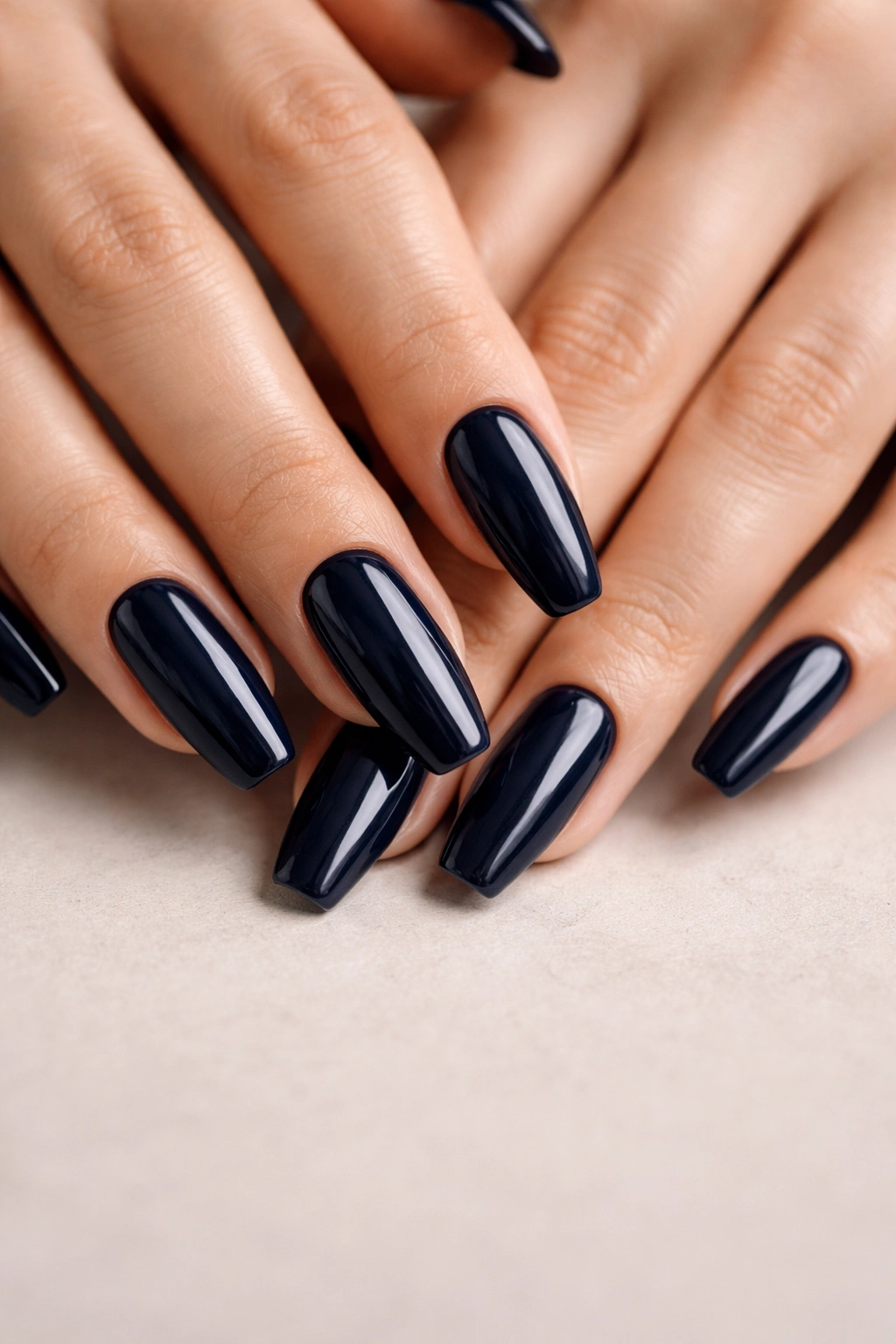
Ask any nail tech who does dark sets all week and you’ll hear the same complaint: clients blame the color when the prep was the real issue. Dark blue does not hide mess. It highlights it.
Cuticle prep has to be tight. Even a thin halo of polish on the skin makes deep navy look bulky. I would rather see a 1-millimeter gap at the cuticle than a flooded application trying too hard to look neat.
Apex placement matters on ballerina shapes, too. If the stress point is weak, long dark nails start to dip or flare, and that elegant coffin line disappears. On medium to long lengths, the highest point should sit a little forward of the natural stress area, not dead center and not all the way back near the cuticle. That balance keeps the nail looking slim instead of thick.
A few salon details are worth asking for:
- Two coats of color, not three heavy ones, unless the polish is sheer by design.
- A capping pass across the free edge to slow tip wear.
- Fine shaping after top coat if the corners lose their crisp line.
- Cuticle oil at the end, then a lint-free wipe if you want photos that do not look greasy.
One more thing. Dark pigments can stain the natural nail, especially blues and greens. If you wear regular polish instead of gel, a proper base coat is not optional.
1. Midnight Navy with a Glassy Top Coat
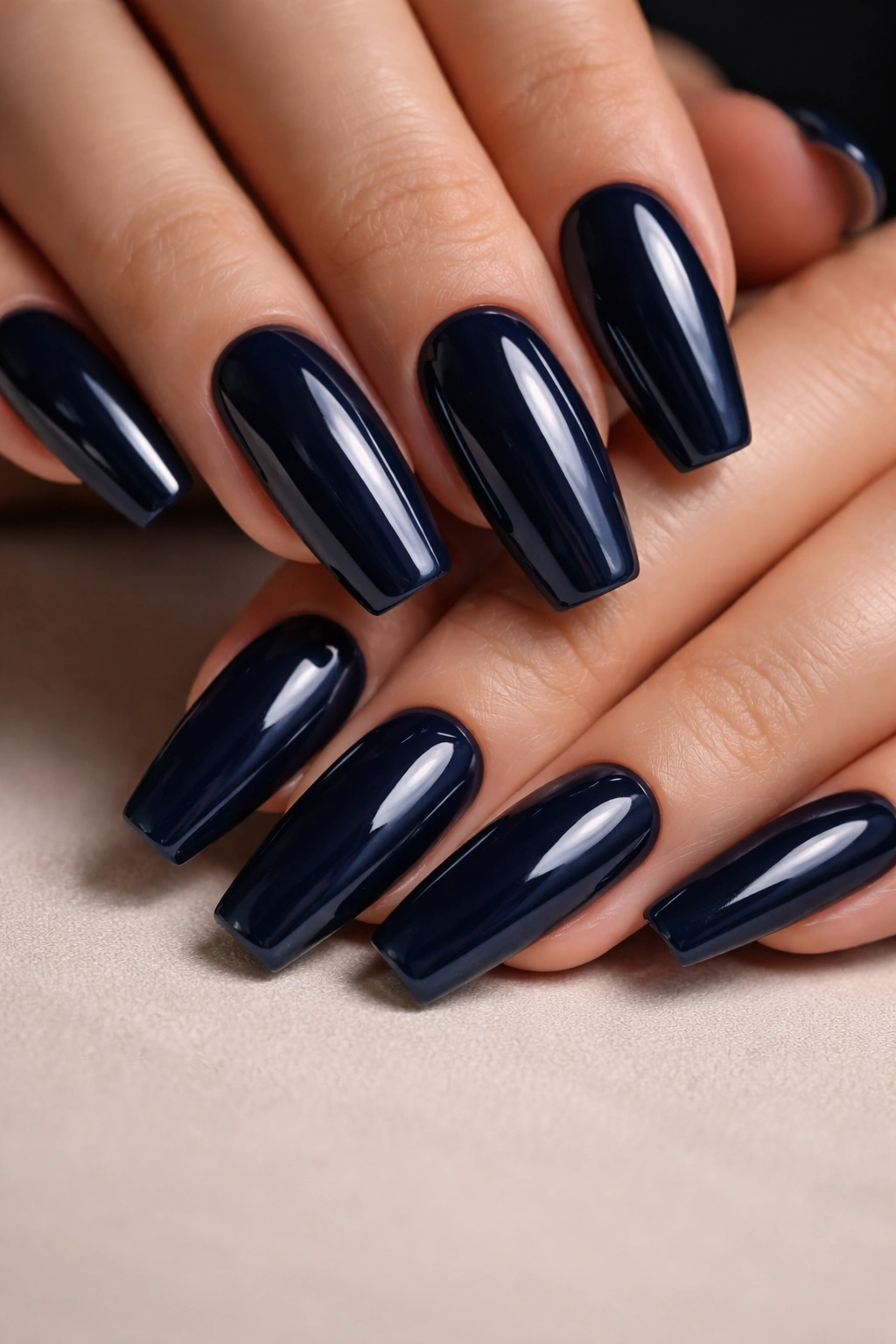
There is no nail art trick here, and that is exactly why this look hits so hard. A pure midnight navy on ballerina nails can look more expensive than busy art if the shape is clean and the finish has real depth.
Why this one works
Midnight navy has enough black in it to feel moody, yet it still reads blue in daylight. That shift is the whole appeal. You get drama without the flatness that some black manicures pick up after three or four days of wear.
Keep the length medium. About 1/4 to 3/8 inch past the fingertip is the sweet spot for most hands because the color stays strong without tipping into costume. A high-gloss top coat matters here more than on any other design in this list. Thin gloss makes dark navy look chalky. A plump gel finish gives it that almost wet, lacquered look people keep trying to fake with extra layers.
Quick salon notes
- Ask for a blue-based navy, not one that leans gray.
- Choose short-to-medium ballerina shaping for the cleanest effect.
- Skip accent nails; this look is strongest when every finger matches.
- Refresh with top coat around day 5 if you wear regular polish.
Best for: work settings, evening events, and anyone who wants a bold manicure without rhinestones, foil, chrome, or extra fuss.
2. Blue-Black Ombre with a Smoky Fade
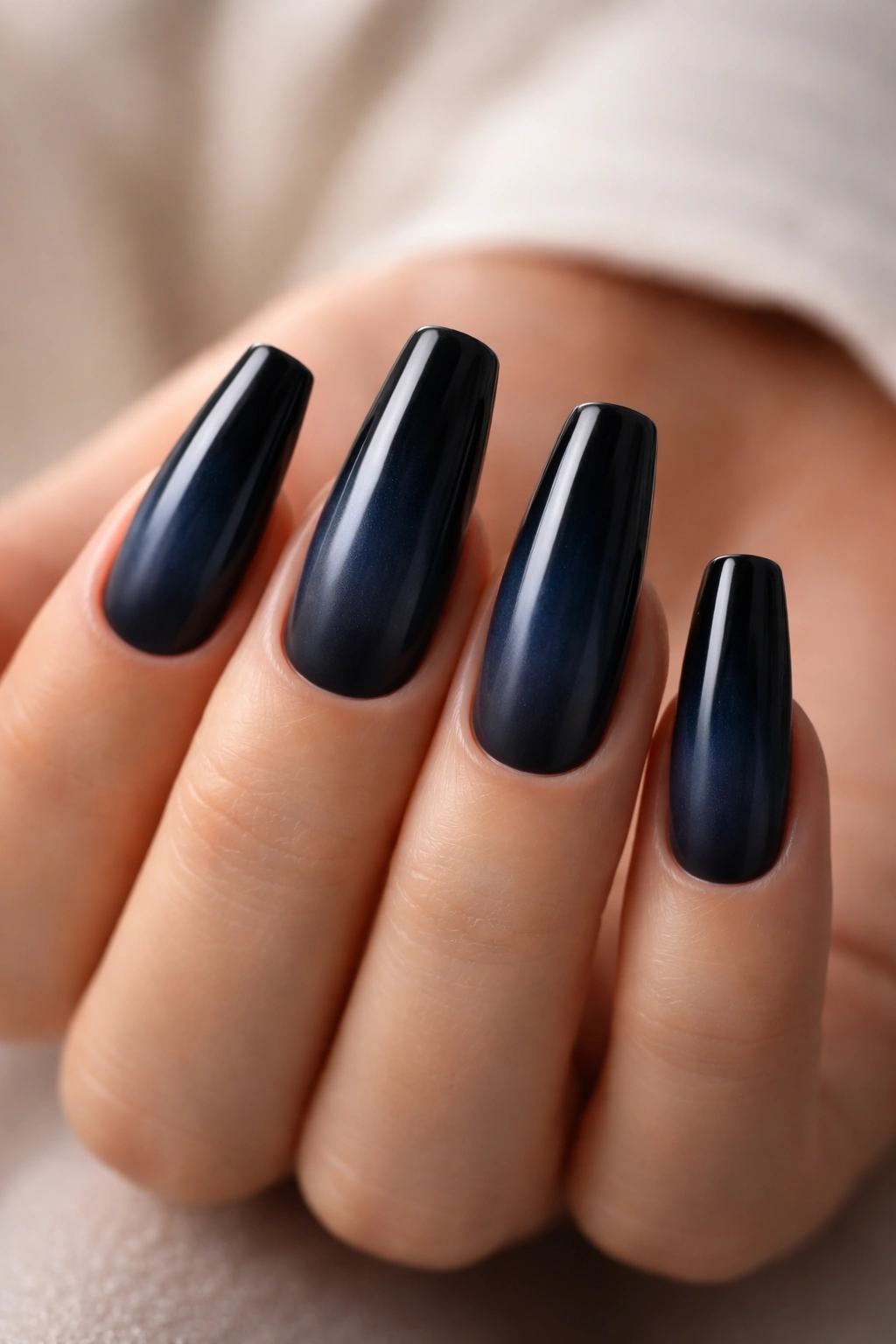
A dark ombre can make ballerina nails look longer than they are. That is the trick. The eye starts at a navy base and slides into near-black at the tip, which stretches the nail without needing extra length.
The fade has to stay soft. A harsh line kills it. On a good set, you should not be able to point to the exact place where the blue ends and the black begins. Sponge blends can do this with regular polish, though gel usually gives a smoother gradient because the tech has more time to move the color before curing.
I like this design most on medium and long sets, where there is enough surface area for the transition to breathe. Short ballerina nails can wear ombre too, but the fade becomes tighter and easier to muddy. If your salon tends to blend with too many strokes, ask them to keep the color shift in the top half of the nail so the cuticle area stays deep, clear, and crisp.
Lighting changes the whole mood. In dim restaurants, these nails can read almost black. Step into daylight and the navy comes back. That little reveal keeps the design from getting boring, even after a week.
3. Dark Blue Micro-French on a Milky Nude Base
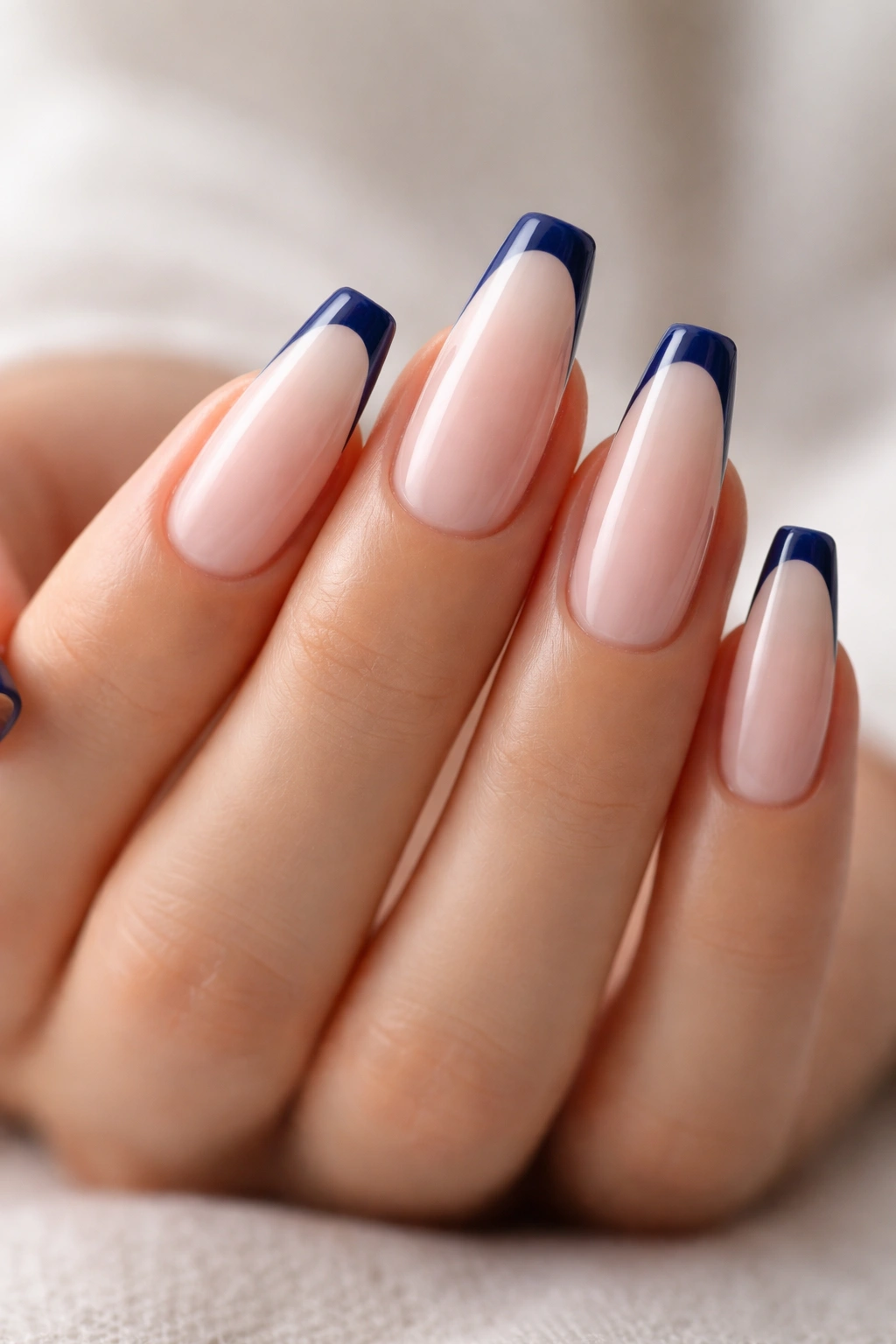
Why does this look feel so polished even when the art is minimal? Because the contrast sits at the edge, right where the ballerina shape is most graphic.
A micro-French in dark blue works best when the nude base is soft and slightly milky, not orange-beige and not stark pink. The line should be thin—roughly 1 to 2 millimeters on most nail lengths. Wider than that, and you lose the crispness that makes the style feel current rather than dated.
The smart move is keeping the tip dark enough to stand out but not so bright that it turns sporty. Deep indigo, ink navy, or midnight cobalt all do the job. If your nail beds are short, a slim V-shaped French can lengthen them more than a straight band.
How to ask for it
Tell your nail tech you want:
- A sheer milky nude base
- A razor-thin dark blue French line
- A ballerina tip with sharp corners, not rounded ones
- Gloss finish unless you want the design to look softer
This is one of my favorite “I want nail art, but I do not want noise” designs. You still get the punch of dark blue ballerina nails, only with more negative space and a little more air.
4. Sapphire Chrome with a Mirror Finish
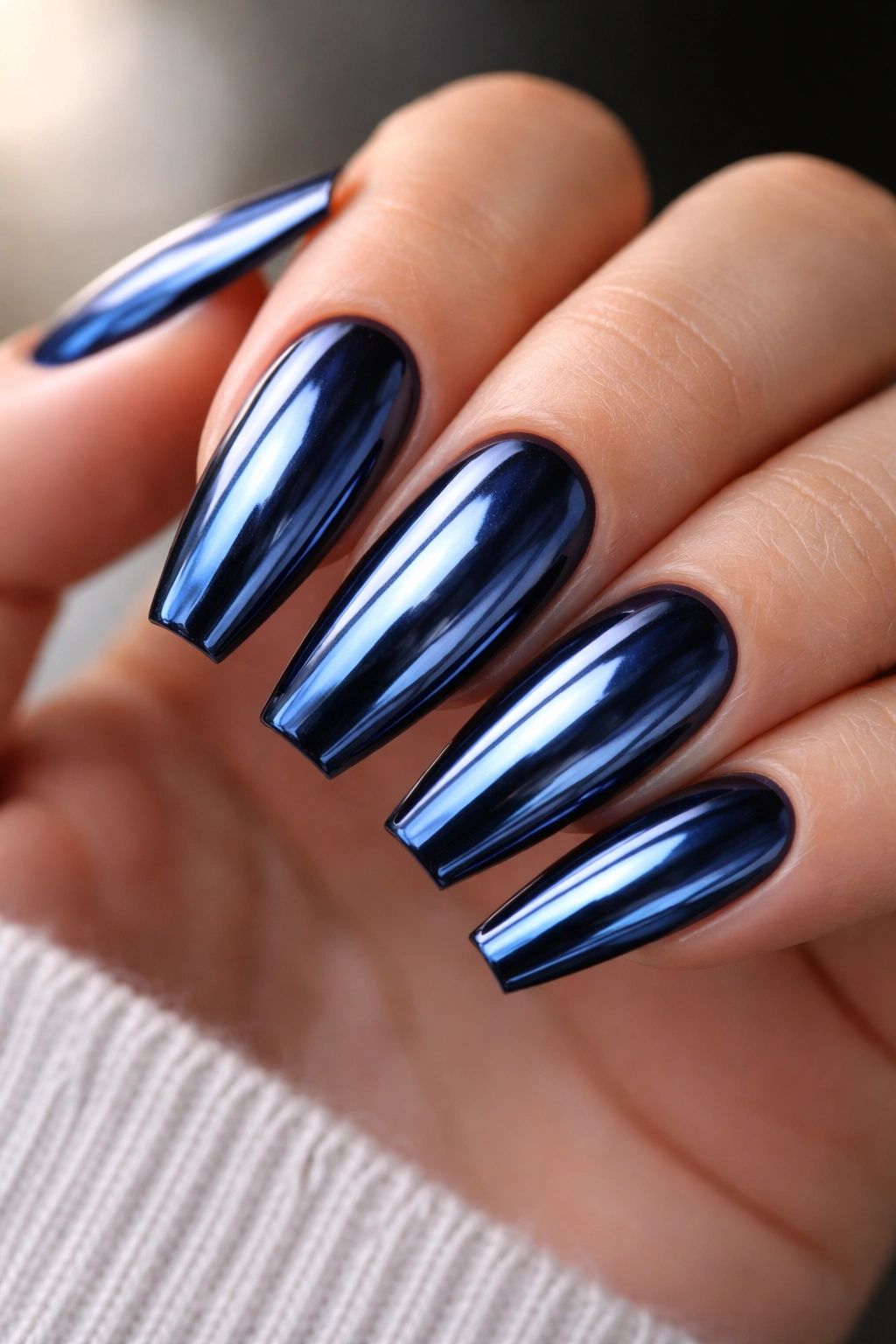
I once saw a sapphire chrome set catch light from a shop window and stop a conversation mid-sentence. That is what chrome does on this shape when it is done right. It does not whisper.
The base color makes or breaks the effect. Chrome powder over pale blue often looks icy and thin. Chrome over a deep sapphire or navy base looks richer, heavier, more liquid. On ballerina nails, that mirror surface emphasizes every angle of the taper.
A few details matter more than people expect:
- Use a dark blue gel base, then rub chrome over a no-wipe top coat.
- Keep the nail surface smooth; chrome highlights dents and uneven builder.
- Medium-long lengths show the reflection best.
- One accent nail is enough if you want balance. Ten chrome nails is a choice—and a loud one.
You do have to accept maintenance with this one. Mirror finishes show scratches sooner than plain gloss, especially if you type hard, handle keys all day, or use your nails like tiny tools. Still worth it for a weekend set or a night out. On the right hand pose, sapphire chrome looks almost molten.
5. Matte Storm Blue with Glossy Side Edges
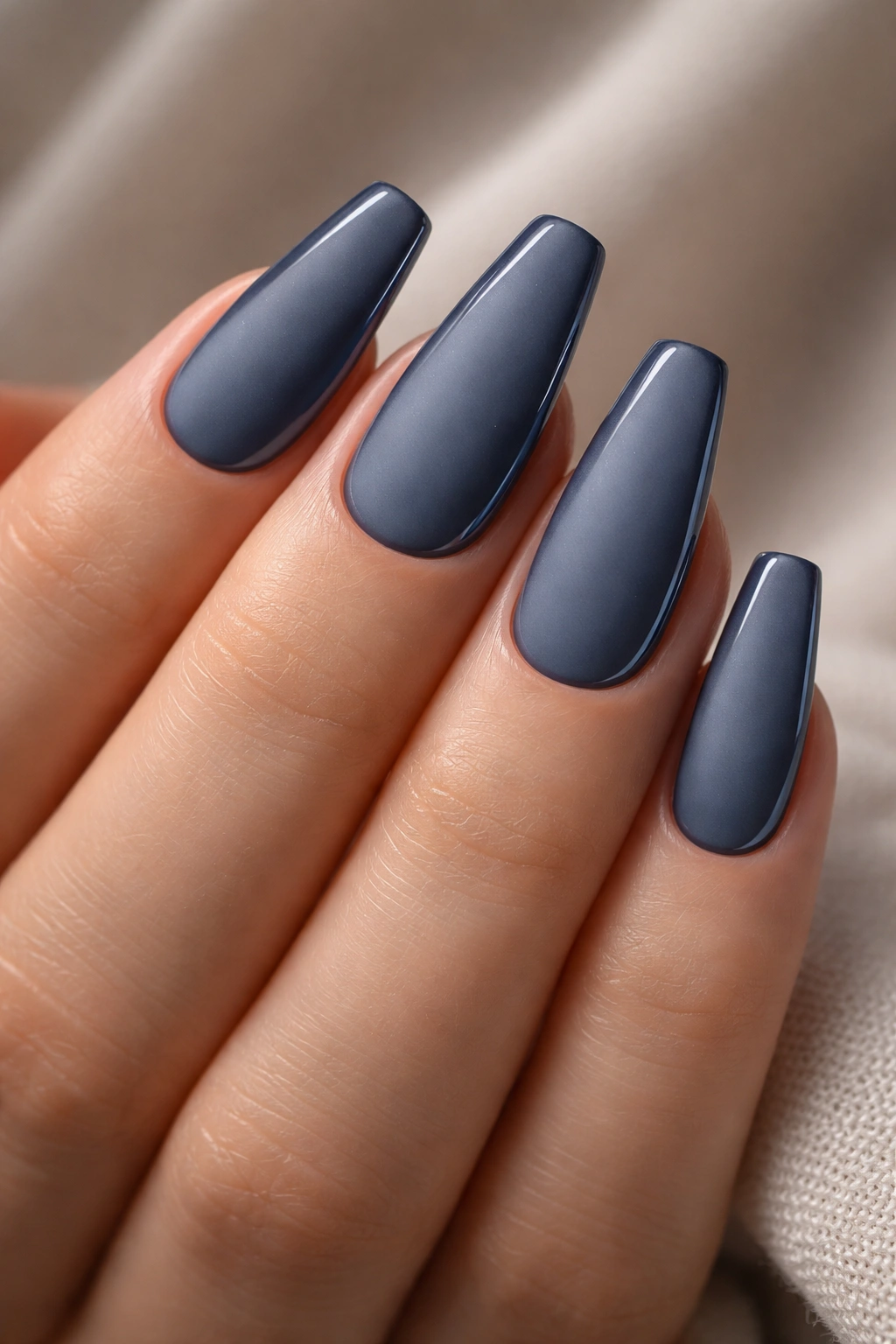
Matte dark blue can go wrong fast. Done badly, it looks dry, dusty, almost tired. Done well, it looks like velvet stone—soft on the surface, dense in color, and much more interesting than standard gloss.
The version I like uses a storm-blue matte base with thin glossy edges tracing the sidewalls or the cuticle curve. That tiny bit of shine gives the eye something to follow, so the manicure does not fall flat. It also keeps the ballerina shape looking intentional, because the contrast points right at the structure.
This is one of those sets that looks better in person than in photos. Matte finishes can absorb light in a way cameras flatten, but your eye catches the difference between the plush center and the slick outline. Wear it on medium length, maybe a touch longer if you like graphic looks. Short matte ballerina nails can work, though the design has less room to breathe.
I would not cover every nail with extra art here. One or two glossy accents are enough. More than that, and the texture idea starts feeling busy. The power of this design is restraint—which, yes, sounds boring until you see how sharp it looks wrapped around a dark blue base.
6. Navy Marble with White and Silver Veining
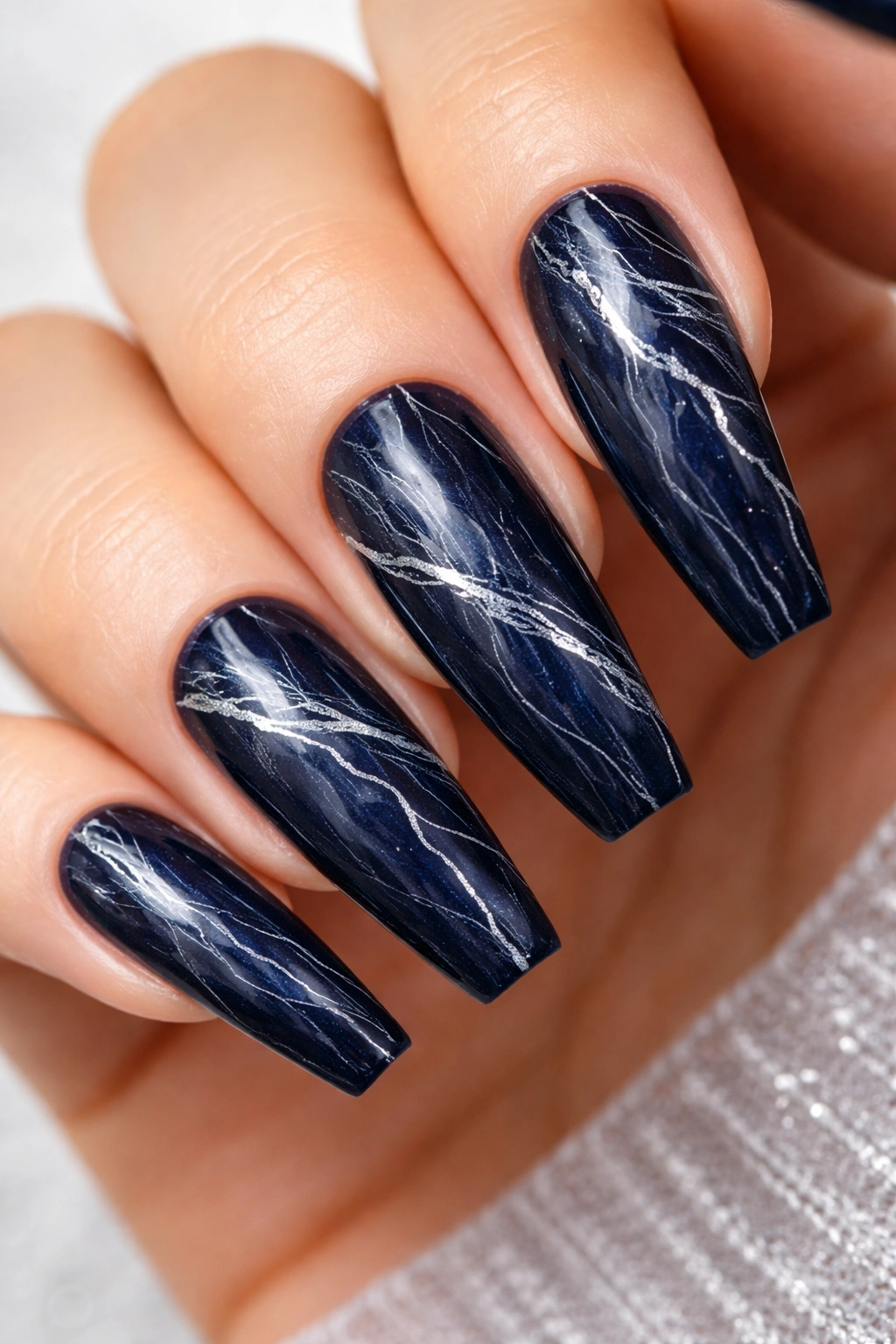
Unlike glitter-heavy nail art, marble gives dark blue a little movement without turning the whole set into a disco ball. It feels expensive when the veining stays thin and irregular. Thick white swirls make it look like bath tile, and nobody wants that on their hands.
The best base for this design is a deep navy with a cool undertone. Then you add soft white trails, maybe a whisper of gray, and a few silver lines placed with care, not sprayed across every finger. Two feature nails are often enough; three can still work. All ten marbled? That can get loud in a hurry.
Who does this suit best? Someone who likes detail but wants the manicure to stay grown-up. Marble still has texture and motion, though it does not fight with rings or patterned clothes the way chunky foil or large gems can.
A good marble set also hides minor regrowth a little better than a flat dark nail, since your eye is already reading variation. Small win, but I’ll take it.
If you try this one, ask for fine veining pulled with a liner brush or blooming gel, not chunky painted zigzags. The difference is easy to spot up close.
7. Dark Blue Velvet Cat-Eye Nails
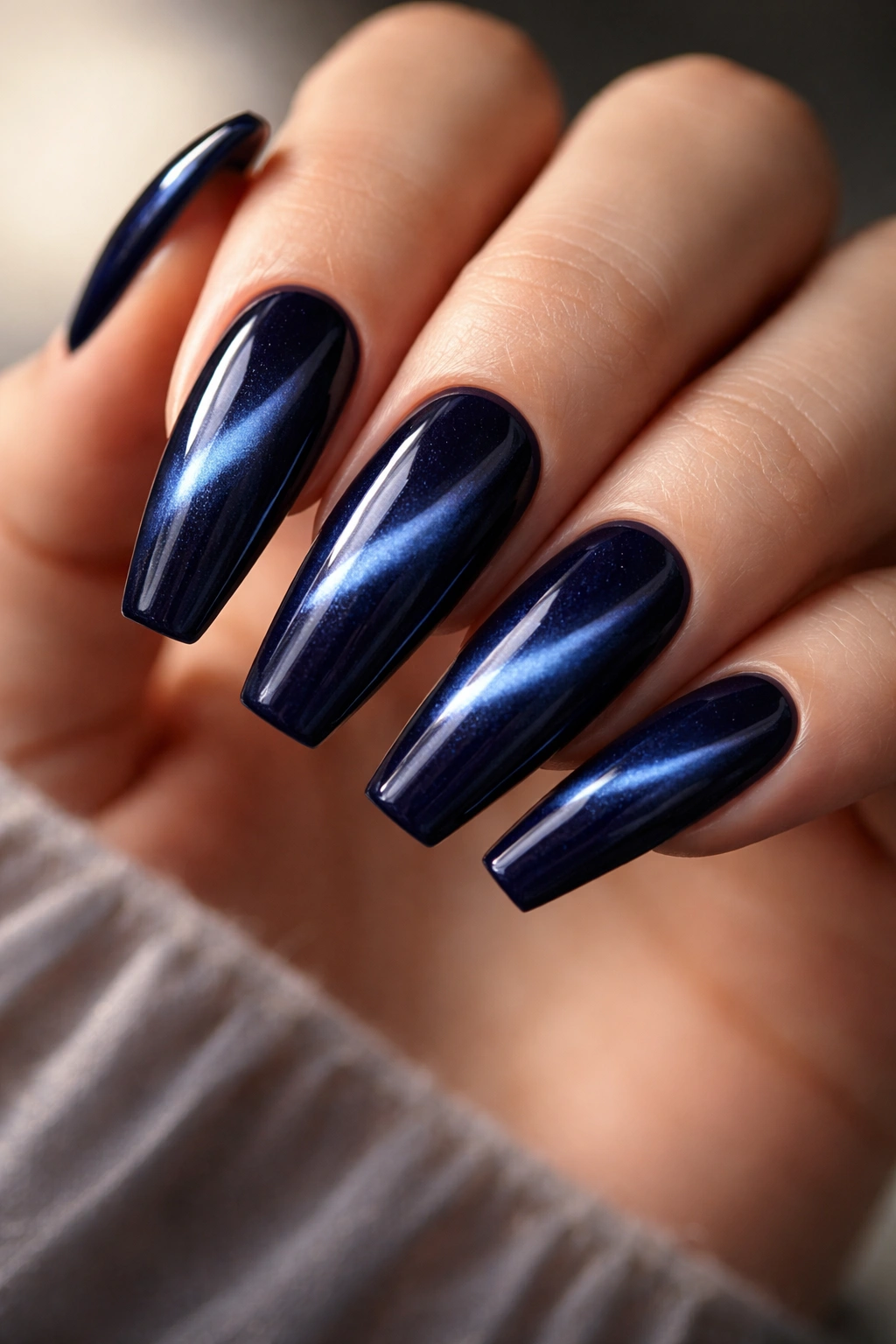
Cat-eye polish has one job: create a moving band of light that shifts as you turn your hand. On dark blue ballerina nails, that band can look almost like brushed silk or a narrow strip of moonlight across water. No flat navy can do that.
The science behind the look
Cat-eye gel contains tiny magnetic particles. Before curing, the nail tech holds a magnet over the wet gel to pull those particles into a pattern. Straight line, diagonal slash, soft halo, even a rounded glow if they know what they’re doing. The darker the base, the stronger the contrast.
A midnight or ink-blue cat-eye has more mood than the greenish versions that were everywhere for a while. It feels cleaner. Less gimmick, more texture.
Wear notes
This style shines on longer ballerina nails because the magnetic effect needs room, but medium length still works if the line stays narrow.
A few smart choices:
- Keep surrounding art minimal
- Use a deep base under the cat-eye layer
- Choose one magnetic direction for all ten nails
- Finish with high shine, never matte
If you like dark nails but get bored with solid color after three days, this one fixes that. Move your hand once and the whole manicure changes.
8. Indigo Jelly Layers over a Black Base
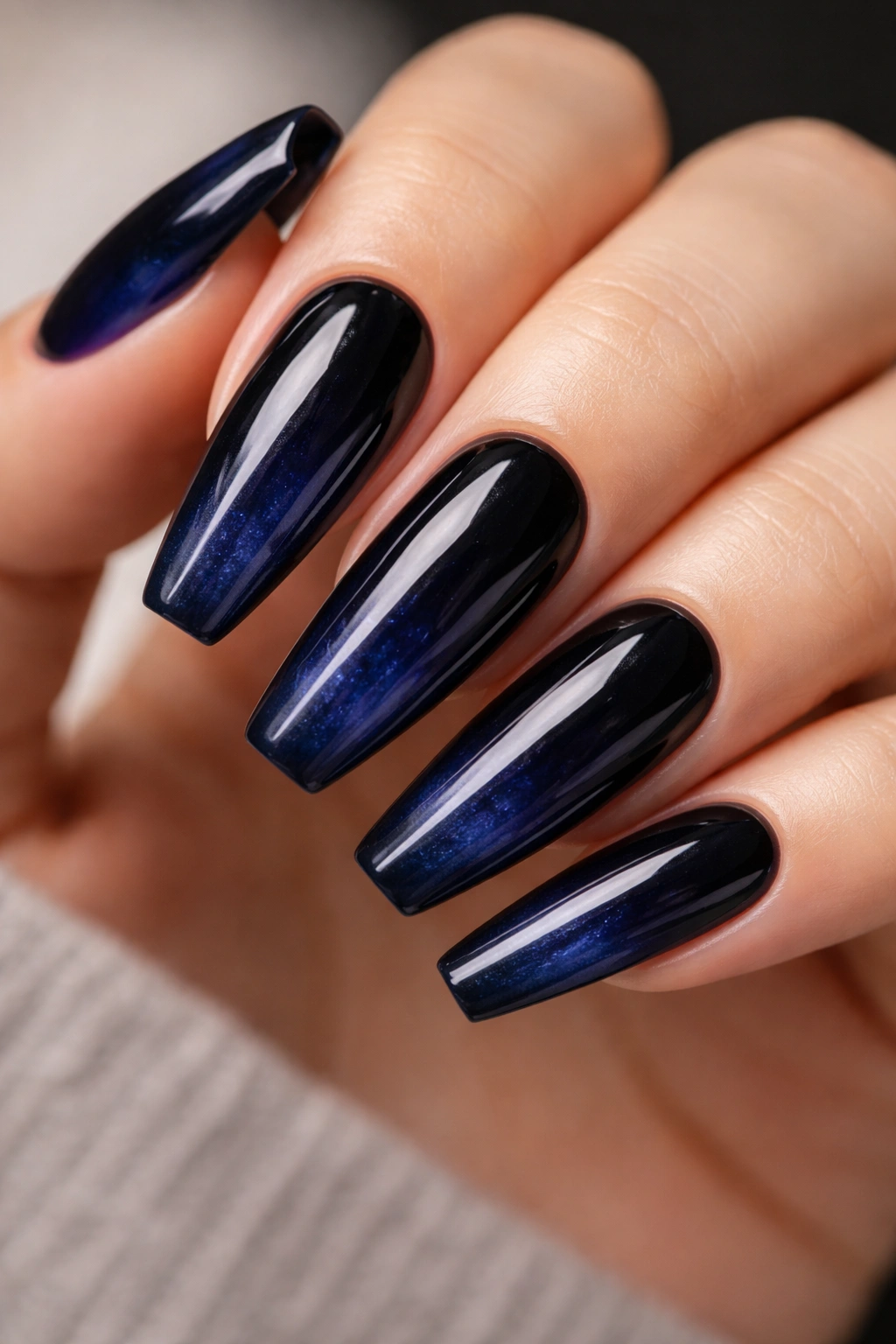
A jelly manicure can feel playful on short round nails. On ballerina nails, layered indigo jelly over black turns moody and a little futuristic. You get depth instead of opacity.
The trick is stacking sheer blue over a darker underlayer so the light passes through the top color before bouncing back. That makes the nail look almost lit from inside, especially near the tip where the product is often slightly thinner. If you have ever looked at a blue glass bottle in sunlight, you already know the mood.
This design is not for every salon. Jelly layering takes a steady hand, and muddy application ruins the effect fast. Three thin coats usually look better than two thick ones. With regular polish, drying time becomes the annoying part. With gel, the process is easier, though the color choice matters more because some “jelly” blues lean too bright and lose that inky tone.
I like this manicure best on medium length with a crisp coffin edge—not too long, not too soft at the corners. Add one tiny metallic accent if you want, maybe a silver dot near the cuticle on the ring finger. More than that and you start covering the whole reason to wear jelly in the first place.
9. Deep Cobalt with Scattered Gold Foil
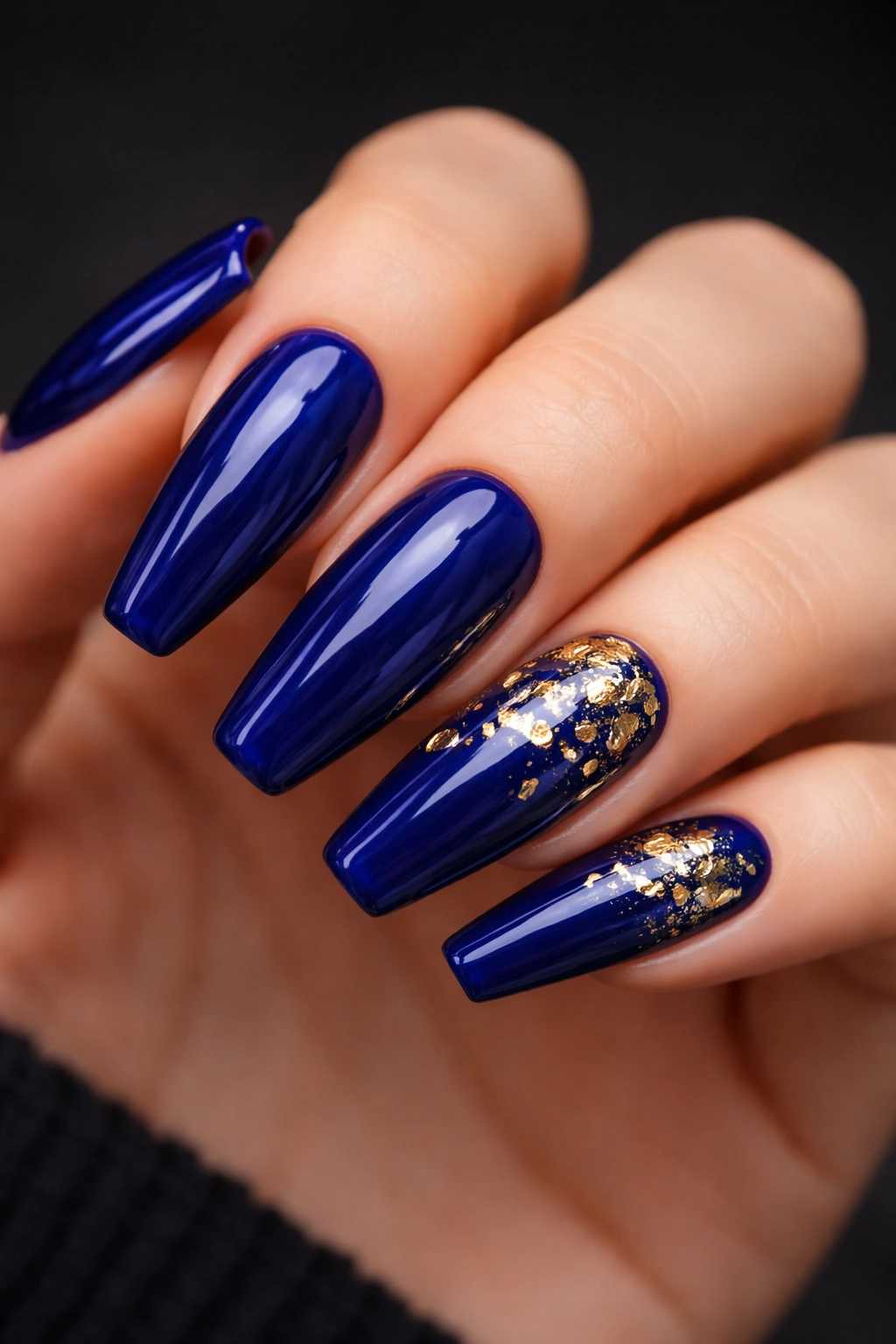
This one has bite. Deep cobalt and gold have an old-world richness that navy-and-silver does not always reach. You see it in ceramics, textiles, old jewelry boxes, and yes, it works on nails when the foil stays sparse.
Cobalt needs a confident blue base. If the polish is too dark, the gold loses contrast. If the blue is too bright, the look turns festive in a way that can read off-season for some people. Aim for a middle ground: dark, saturated, and clean.
The foil placement should look broken and irregular, almost like tiny leaf fragments pressed into wet lacquer. I prefer it near one corner of the nail or drifting diagonally across two accent fingers rather than spread evenly across the whole set. Symmetry can make foil look stiff.
Placement ideas that tend to work
- Ring fingers only
- Thumb plus ring finger if you want balance in photos
- Small foil flecks clustered near the cuticle
- One diagonal trail on each hand, mirrored loosely rather than exactly
Gold foil catches wear less kindly than plain polish, so seal it well. If edges lift, the manicure starts looking rough fast. When it sits flat under top coat, though, cobalt-and-gold ballerina nails have a rich, dressed-up feel that needs almost no jewelry.
10. Navy Negative-Space Side Panels
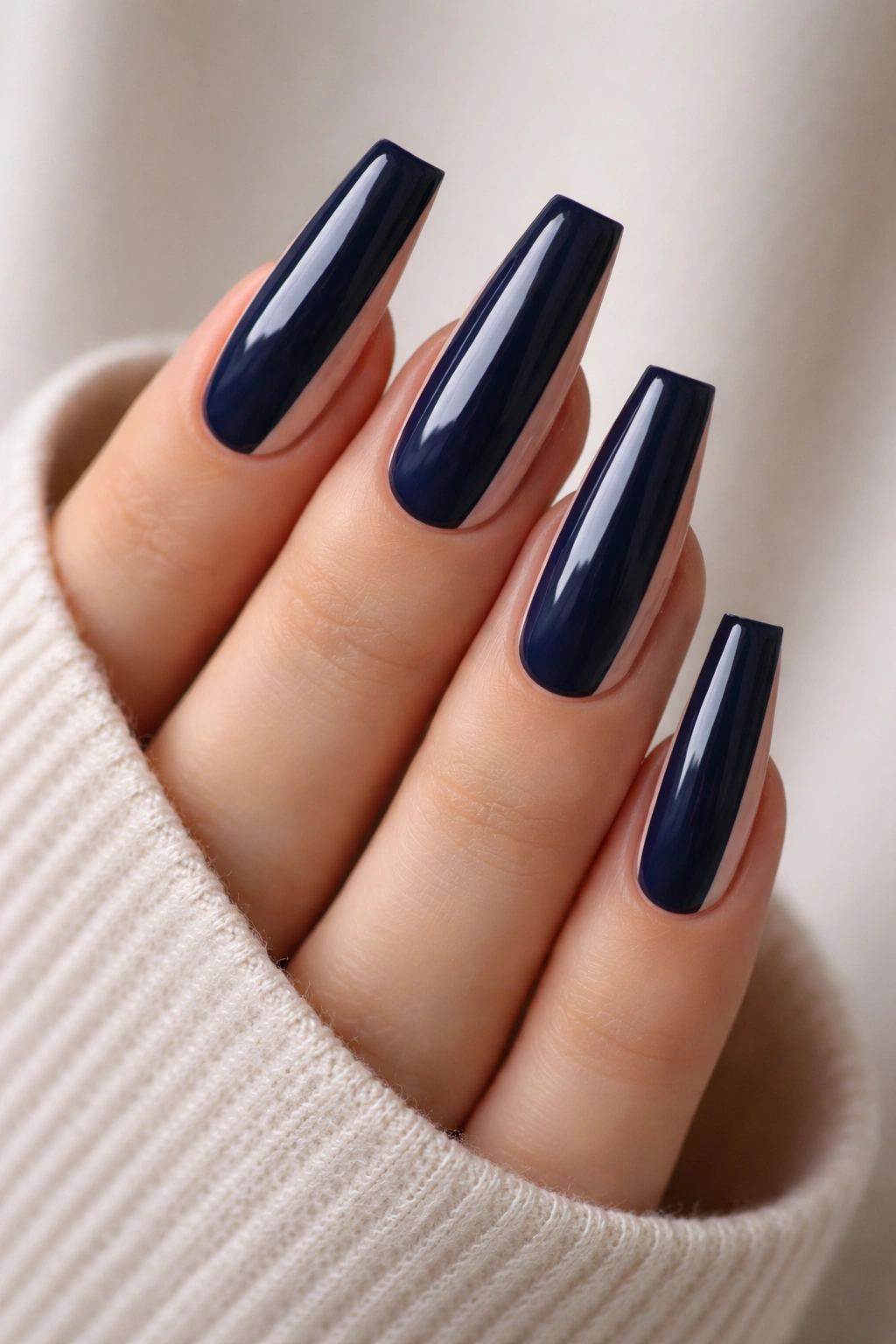
A full dark manicure is not the only route to a bold set. Sometimes the empty space makes the blue look stronger because your eye reads the contrast first.
With side-panel negative space, the center of each ballerina nail stays navy while one slim strip along the side—sometimes both sides—remains sheer or nude. That visual break narrows the nail even more, which is handy if you like the dark look but do not want your hands to feel visually heavy.
The spacing needs discipline. Thin gaps work. Wide ones start looking accidental. A 1- to 2-millimeter side panel is enough on most medium-length sets. Long nails can handle a wider slice, especially if the panel angles inward slightly toward the tip.
This design also buys you a little grow-out forgiveness near the sidewalls, though not enough to excuse bad prep. I would keep the rest of the manicure stripped down: no charms, no glitter clouds, no extra stripes. Negative space already is the art.
There is something architectural about this set. Clean lines. Strong shape. No fluff. If your style leans toward sharp blazers, monochrome outfits, square watches, and hardware-heavy rings, navy side-panel ballerina nails make a lot of sense.
11. Dark Blue Aura Nails with an Electric Center Glow
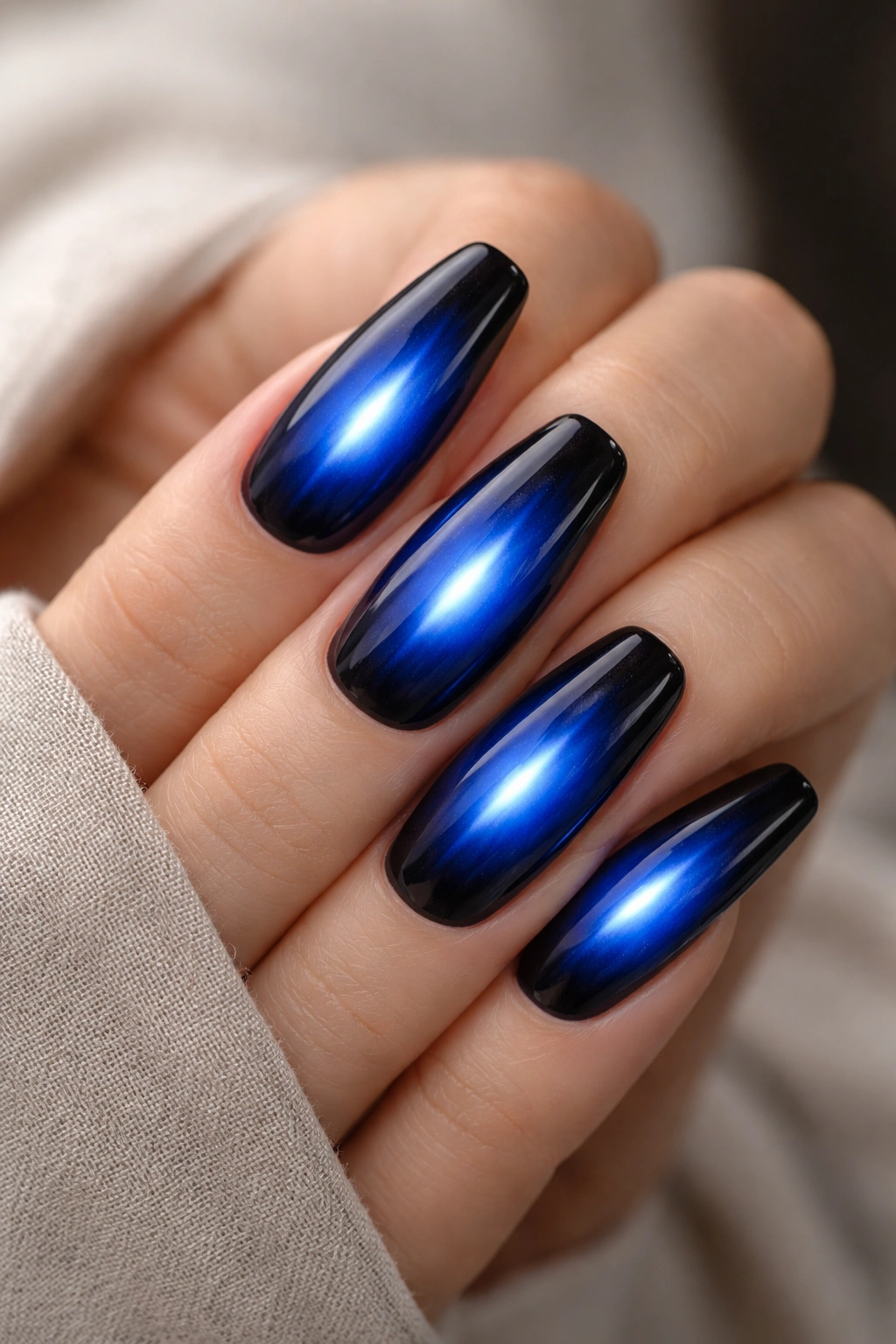
Aura nails can drift soft and hazy, which is fine on almond shapes, but ballerina nails need more control. The version worth trying uses a dark blue outer frame with a brighter cobalt or electric-indigo glow in the center, diffused enough to blend, tight enough to keep the shape crisp.
The easiest way to ruin aura nails is making the center too pale. White-blue centers often look chalky against a dark frame. A better move is keeping the glow in the same family—cobalt, royal blue, even a hint of violet-blue—so the transition feels deep rather than powdery.
I like the center placed a little above the middle of the nail, not dead center every time. Tiny shifts make the set feel hand-done instead of stamped. Airbrush tools give the softest fade, though a sponge can work if the color is tapped lightly and sealed under enough gloss to blur the texture.
You do not need this on every finger. Five aura nails per hand can be a lot. Try aura on index, middle, and ring, then keep thumb and pinky solid navy. That mix gives you motion without exhausting the eye.
12. Ink Blue Sweater Texture on Accent Nails
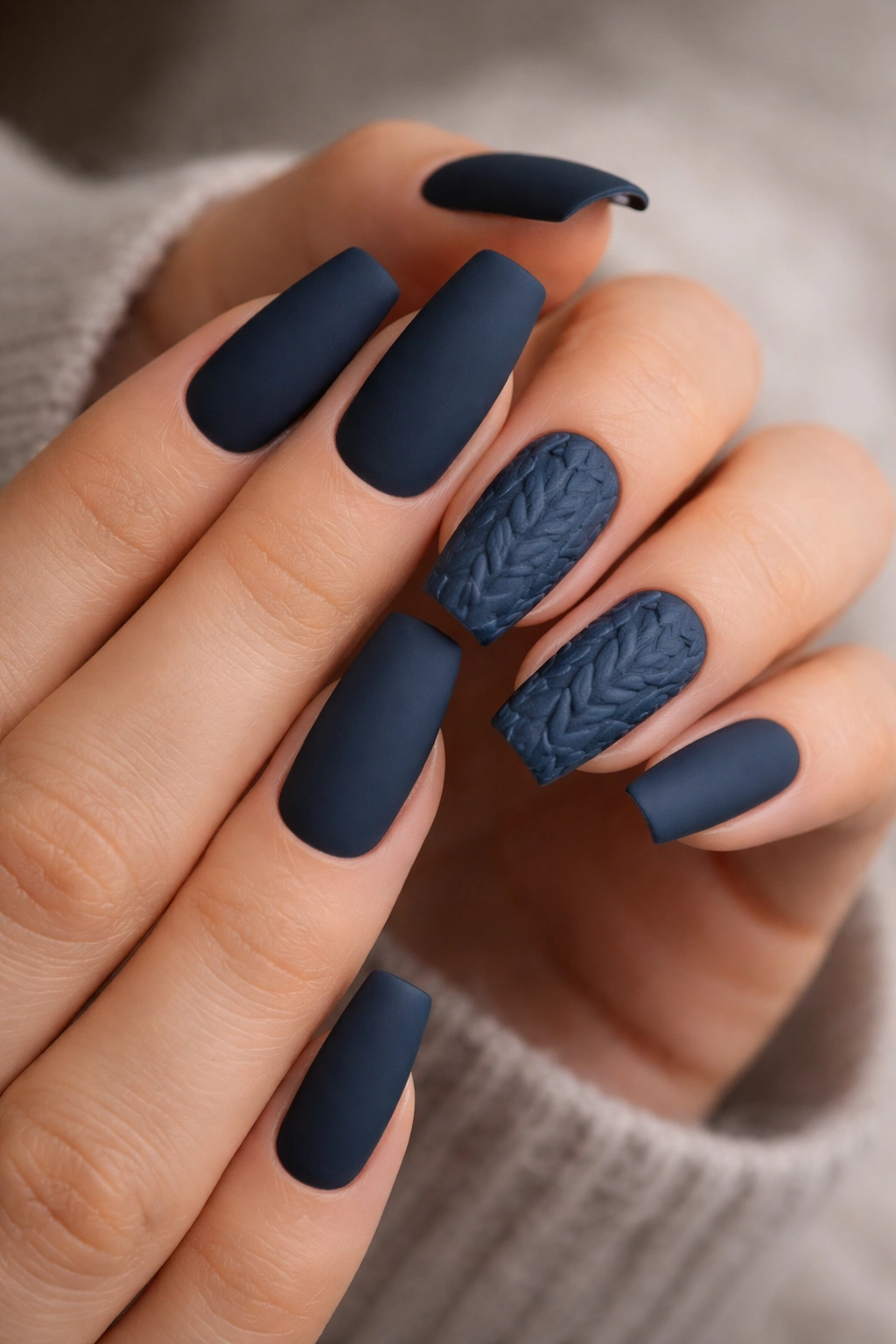
Textured gel is a weird little niche in nail art, and I mean that as praise. When you use it sparingly, it gives dark blue ballerina nails a tactile twist that plain gloss never will.
Picture a solid ink-blue set with one or two accent nails carrying raised sweater-knit lines in the same shade or a slightly lighter one. The effect works best in colder months, though I have seen it paired with soft cashmere or ribbed knits any time the weather drops and it makes immediate sense.
You do have to be practical here. Raised texture grabs lint. It can catch on fine fabrics. If you wear tights, silk blouses, or fuzzy sweaters often, keep the texture limited to the ring finger or one hand. Full textured sets are fun in photos and slightly annoying by day three.
A few rules keep it chic instead of crafty:
- Use one texture pattern, not three mixed ones
- Keep the base dark and solid
- Matte top coat works better than gloss for the raised design
- Medium length is easier to wear than extra-long
This is not the manicure I would pick for a formal event. It is, though, a strong choice if you want something moody, seasonal, and a touch unexpected.
13. Midnight Blue Half-Moons with Tiny Crystals
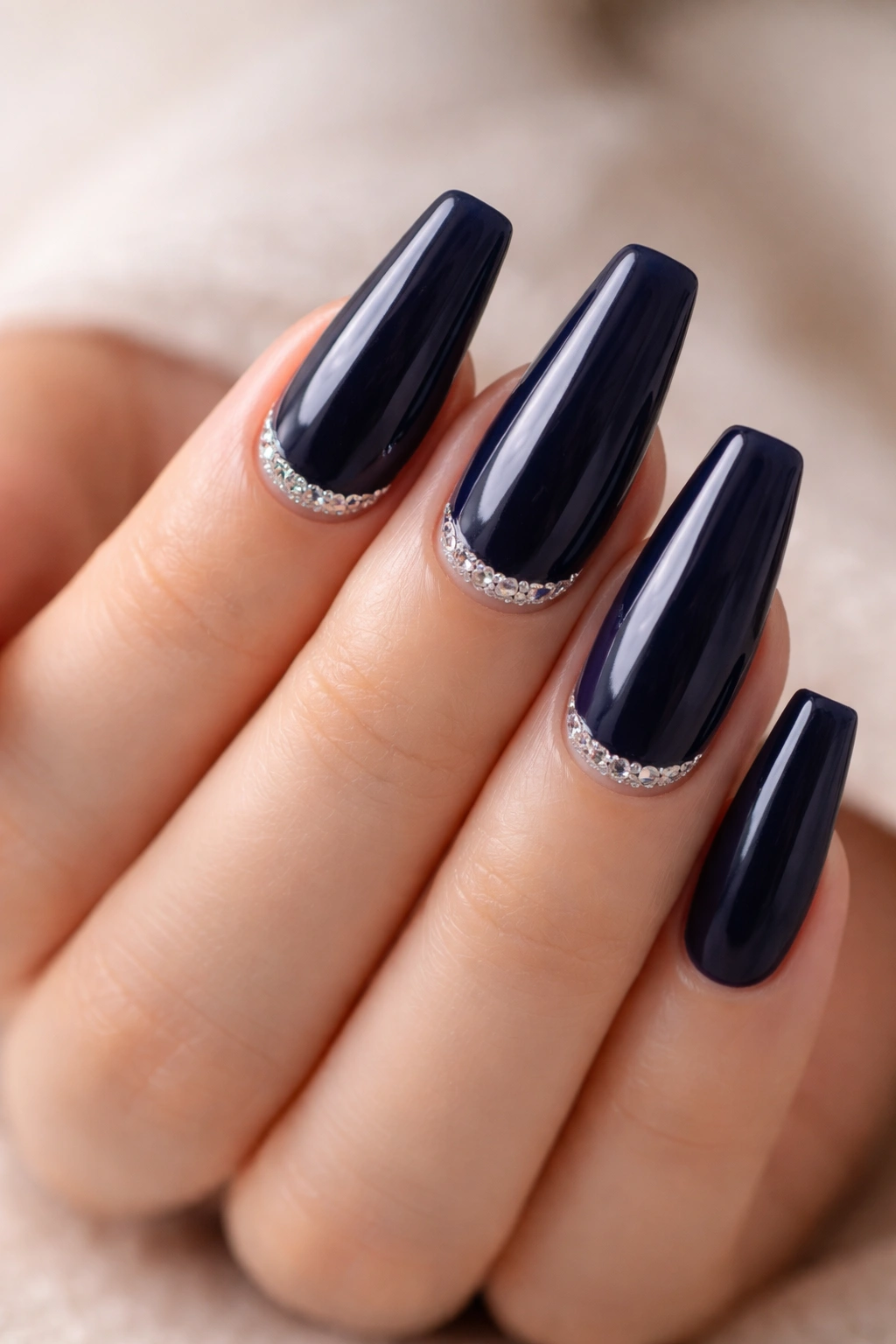
Tiny crystals can cheapen a dark manicure in seconds when they are scattered without a plan. Put them in one clean half-moon at the base of the nail, though, and the whole thing changes. Placement is doing all the work.
The base should stay simple: midnight blue, nearly black in low light, with a glossy finish. Then a few small crystals—ss3 or ss5 size works for most nails—trace the cuticle line on one or two fingers. That is enough sparkle to catch light without making the set feel like costume jewelry for your hands.
I would not use large stones on ballerina nails unless you are heading to an event and plan to wear the set for a short stretch. They snag. They fall off. They make keyboard life annoying. Tiny stones sealed well into builder or top coat sit flatter and age better.
This design suits clients who want dark blue ballerina nails with one sharp focal point. It also works well if you wear rings, because the crystal arc echoes jewelry rather than fighting it. If you want more shine, add a second half-moon on the thumb and stop there. Restraint matters with gems—more than people want to admit.
14. Blue-Black Tortoiseshell with Sheer Depth
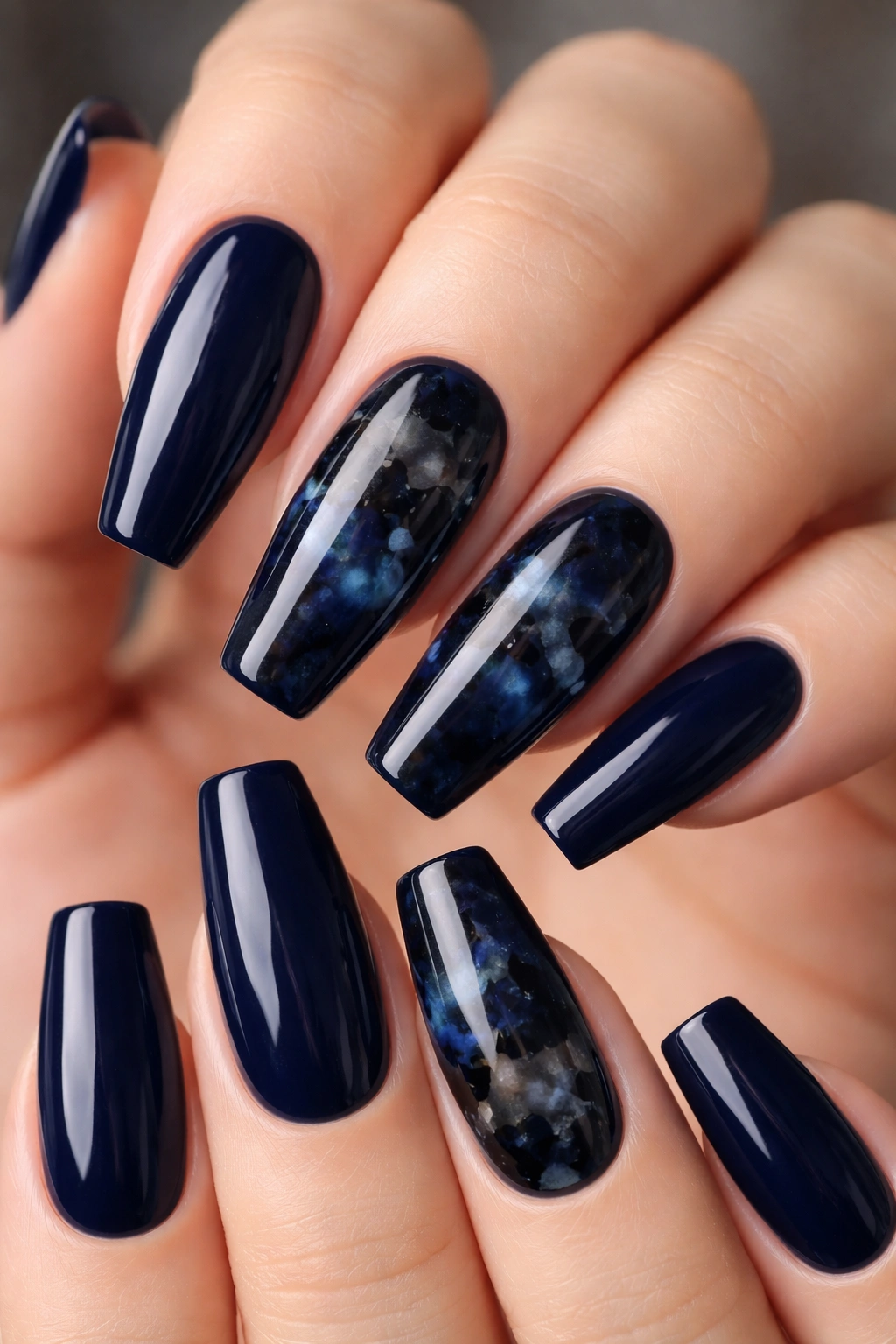
Tortoiseshell is usually done in amber, caramel, and black. Switch that warmth into blue-black, and you get a darker, moodier take that feels less expected. It still has that layered, translucent look, only colder and sleeker.
The technique matters. This is not a matter of painting random blobs and hoping for the best. Good tortoiseshell uses sheer layers: a smoky base, deeper patches floated in, then a tinted top layer that softens the whole thing. Blue-black versions often mix navy jelly, black ink, and touches of smoke gray to create depth.
Because the pattern already has movement, I would use it as an accent design rather than a full set. Two nails per hand is the sweet spot for most people. Pair it with solid midnight blue on the rest, maybe a high-gloss finish across everything so the mixed textures still feel connected.
This is a strong choice for someone who likes dark nails but wants more than one flat color. From a distance, it reads rich and mysterious. Up close, you see the patches and layering. That slow reveal is part of the appeal.
15. Navy Constellation Nails with Fine Silver Stars
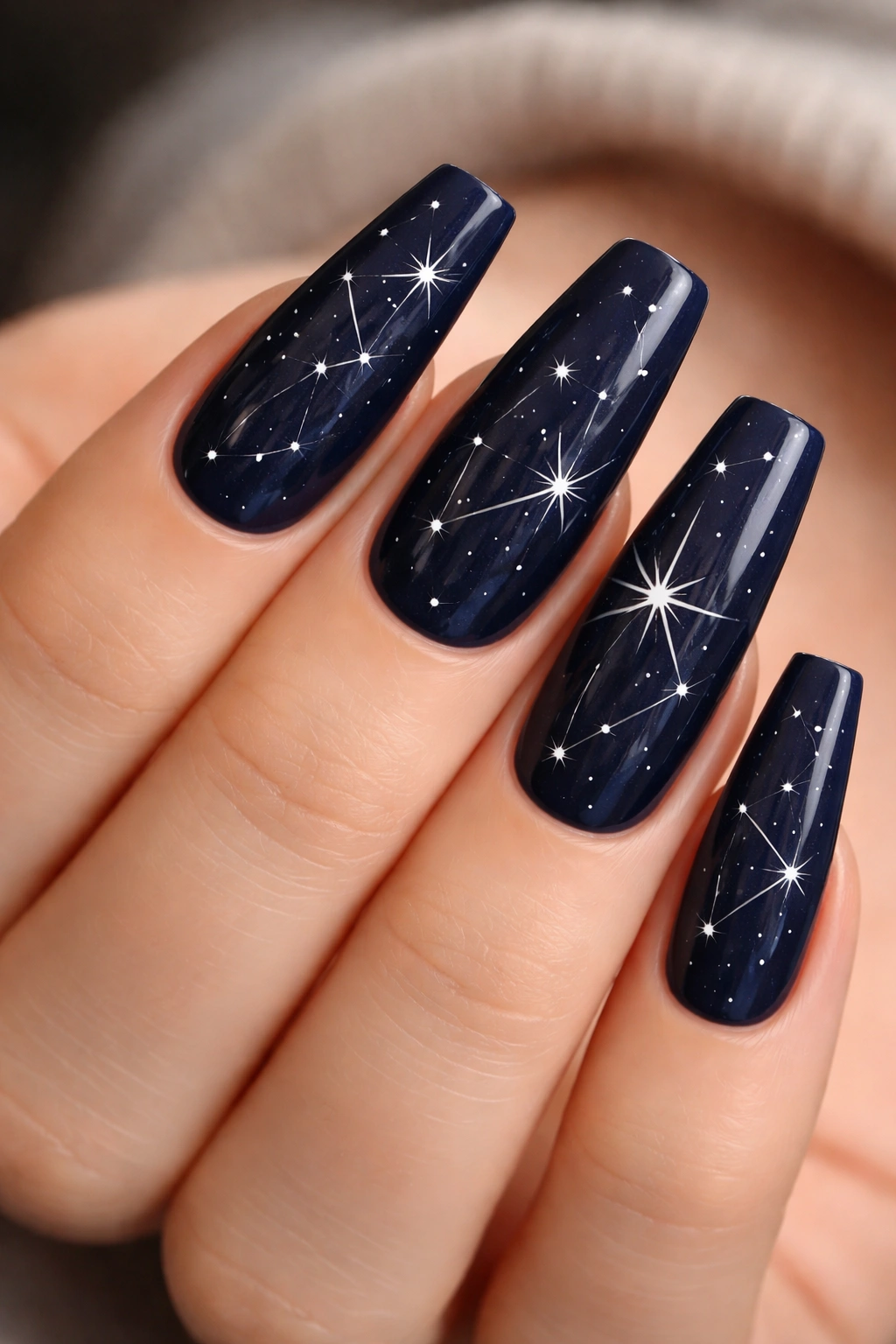
If you want dark blue ballerina nails that lean dramatic without going heavy on stones or chrome, this is the one I would flag first. A deep navy base with tiny silver stars, dots, and thin constellation lines can look striking without swallowing the shape.
The key word is tiny. Big white stars turn cartoon fast. Fine silver detailing, on the other hand, plays nicely with the darkness of the base. A detail brush, silver gel paint, and a steady hand matter more than glitter here. One larger starburst near the cuticle and a few dot clusters toward the tip usually give enough night-sky mood.
You can also mix finishes. Keep most nails glossy and make one accent nail matte before adding glossy star lines on top. That little texture shift gives the set more depth without adding clutter.
A few placement ideas I like:
- Constellation line on the ring finger only
- Tiny star clusters on thumb, middle, and ring
- One hand more detailed, the other more restrained
- Silver studs no larger than 1 millimeter if you want a raised accent
This design has personality. It does not try to look quiet. It also suits the ballerina shape better than round or squoval nails because the straight sides give those tiny celestial details a cleaner frame.
Picking the Right Dark Blue Set for Your Nail Length and Lifestyle
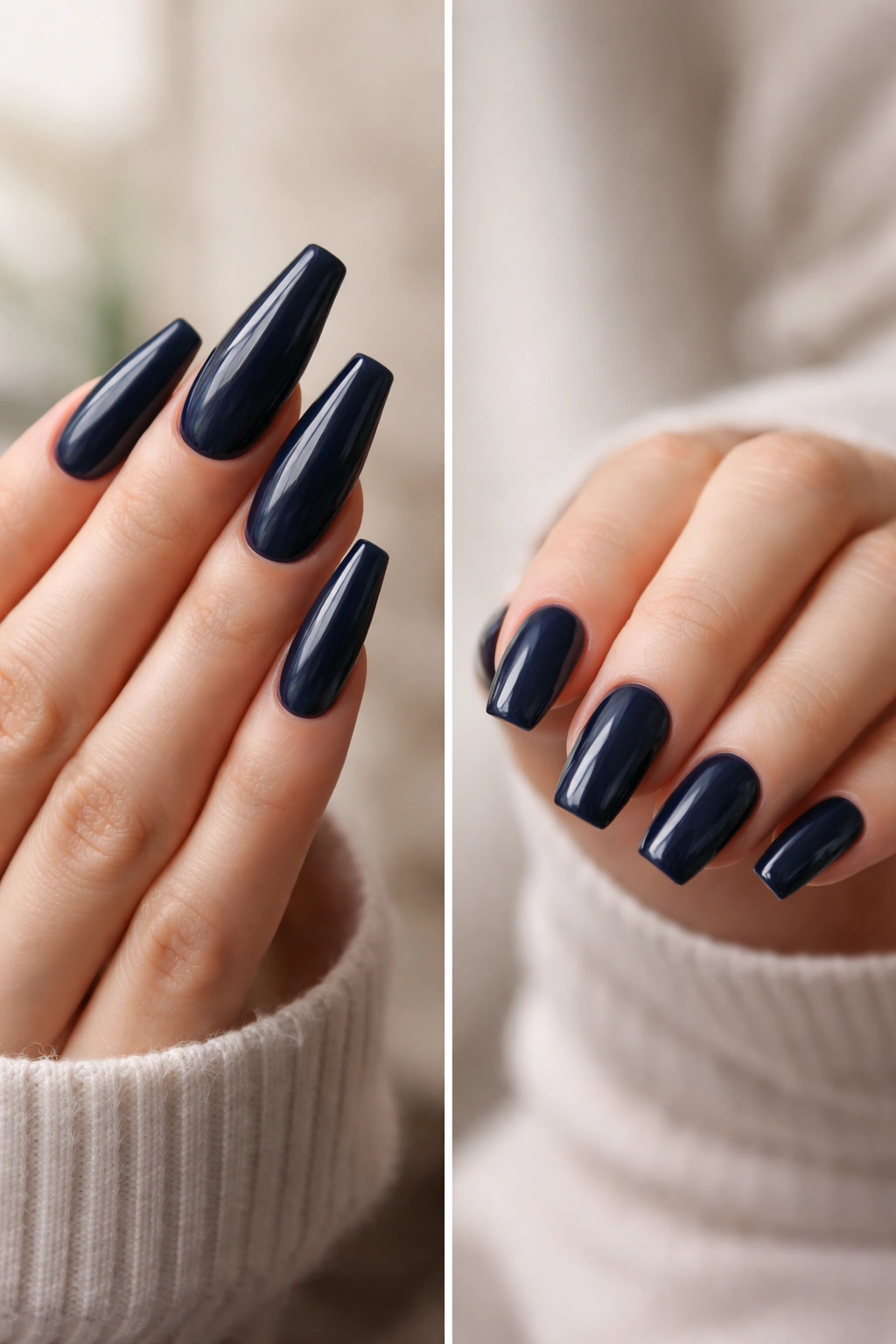
Not every design here wears the same way, and that matters more than trend photos admit. If you type all day, open cans, lift boxes, or use your hands hard, plain gloss, micro-French, side-panel negative space, and soft ombre usually age better than crystals, sweater texture, or mirror chrome.
Long ballerina nails give you more room for cat-eye, aura, marble, and tortoiseshell work. Shorter lengths shine with cleaner ideas—solid navy, slim French tips, a controlled half-moon, maybe a touch of foil. The tighter the canvas, the less visual noise it can carry.
Budget matters too. A plain deep navy set is easier to maintain between fills. Chrome, layered jelly, marble, and hand-painted details take more chair time and more money, which is fair; they also demand more skill. I would rather see a flawless single-color manicure than a complicated design done badly.
One easy test helps. Look at your favorite rings, your coat color, the bag you carry most, the shoes you reach for without thinking. If your wardrobe leans silver hardware, charcoal, black, white, denim, leather, and deep jewel tones, dark blue ballerina nails will slide right in.
Final Thoughts
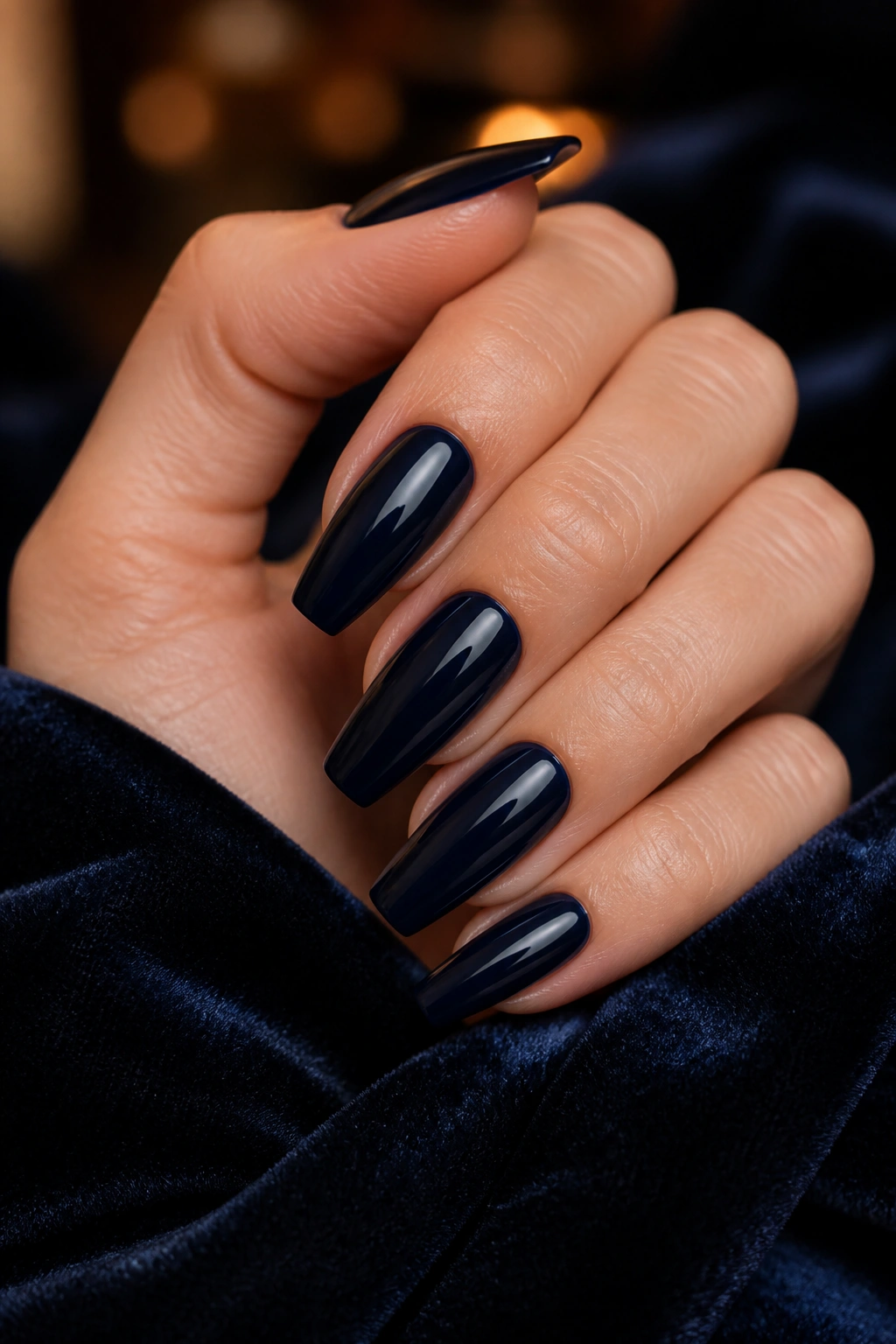
Dark blue works on ballerina nails because the color and shape want the same thing: clean lines with a little attitude. You can keep that idea almost bare with a glossy midnight navy, or push it further with chrome, cat-eye, marble, foil, or celestial detail.
If I had to narrow the list to the sets that give the biggest payoff, I would start with midnight gloss, dark blue micro-French, velvet cat-eye, and navy side panels. Those four cover a lot of ground. One is classic, one is crisp, one moves in the light, and one feels graphic without extra clutter.
Skip the pressure to make every manicure louder than the last one. Sometimes the boldest choice is the one with fewer add-ons and a better shape. Get the structure right, pick a blue with depth, and let the color do its job.