

Black French tip ballerina nails do something that pale polish never can: they draw a clean line that makes the whole hand look more deliberate. Not louder. Not fussy. Just sharper. When the shape is right, the black sits on that squared-off ballerina edge like ink on a fresh page, and the effect is hard to ignore.
That shape matters more than people think. A ballerina nail has tapered sides and a flat tip, so it gives a black French manicure a better canvas than a soft oval or rounded square. You get structure. You get contrast. You also get exposed fast if the tech paints the tip too wide, because black polish has no mercy for crooked lines or bulky edges.
I’m picky about this look for one reason: small changes make a huge difference. Move the smile line 2 millimeters deeper and the set goes from sleek to heavy. Switch the base from sheer pink to a cloudy beige and the black can look cleaner, moodier, colder, warmer—same color, different mood. Even the top coat matters. A glassy finish makes black read like patent leather; matte makes it feel more tailored, almost like crepe fabric.
That’s why some black French tip ballerina nails look expensive and others look like they lost a fight with a striping brush.
Why the ballerina shape makes black tips hit harder
A black French tip needs edges. Ballerina nails already have them built in.
The tapered sidewalls slim the nail from the middle outward, and the flat tip gives the color a landing strip that looks intentional instead of accidental. On a round nail, black tips can lean soft or retro. On a ballerina shape, they look cleaner and more graphic, which is exactly why this pairing keeps showing up in salon inspo boards and acrylic sets that people save for later.
Length changes the mood, too. A short ballerina with a black tip feels neat and strict. A longer set—think 14 to 18 millimeters past the fingertip—starts to look dramatic, almost architectural. Neither is wrong. The trick is matching the tip depth to the nail length so the black doesn’t swallow the nude base.
The geometry does half the work
French tips live or die by proportion.
On ballerina nails, a thin black edge follows the squared-off tip and highlights the file work underneath. That means your tech cannot fake the shape with polish. If one sidewall is wider, you’ll see it. If the corners are blunt, you’ll see that too. The upside is worth it: a clean ballerina file makes black tips look crisp with almost no extra art.
Why black works better here than on softer shapes
Black has weight. That’s the whole point.
Put that weight on a shape with a flat front and tapered sides, and your eye reads it as a deliberate design choice. Put the same weight on a rounded tip and the contrast softens. There’s nothing wrong with soft. But if you want a manicure that looks neat, sharp, and slightly severe—in a good way—ballerina is the shape that gets you there fastest.
What to ask for before your tech paints a single black line
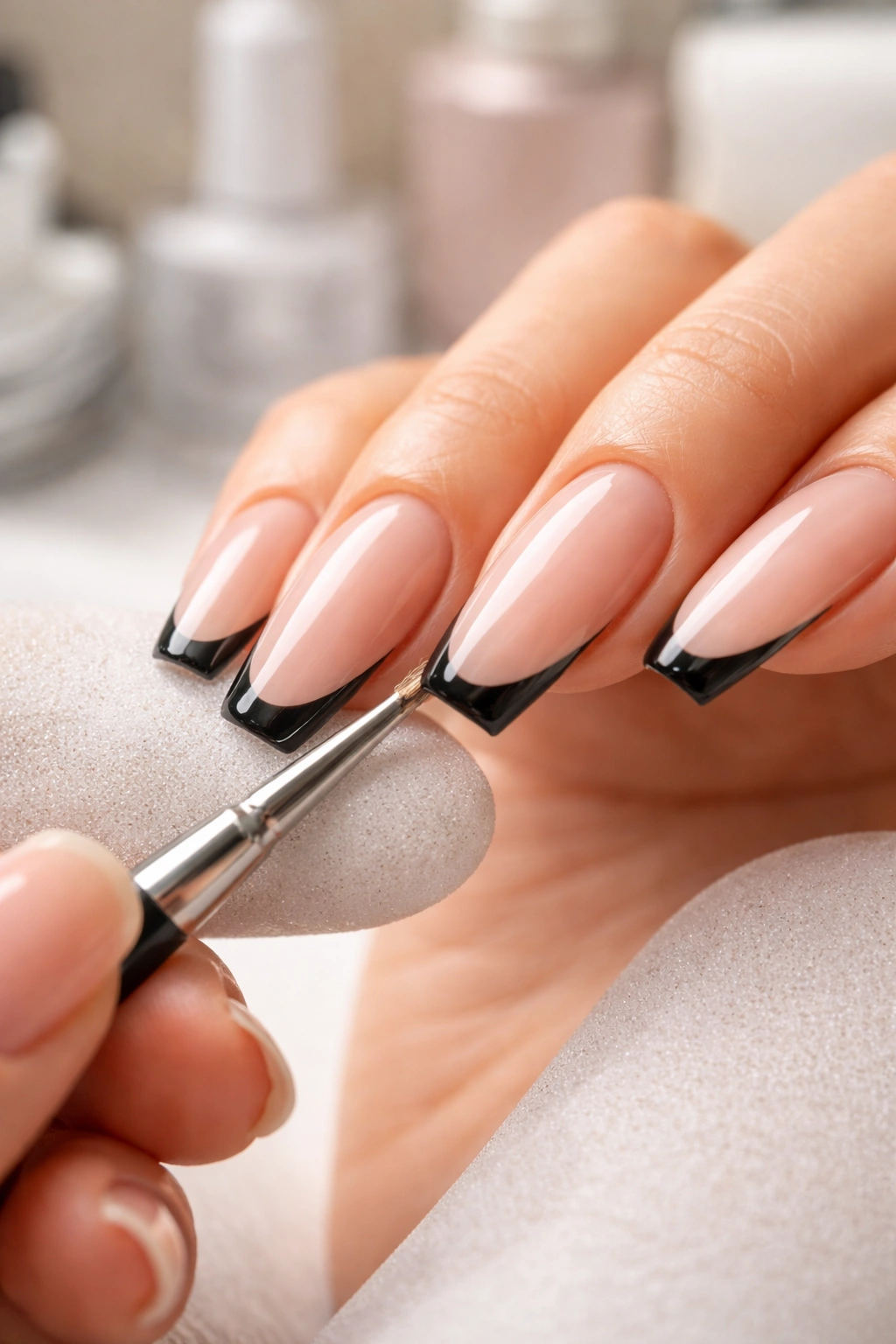
Walk into a salon with one blurry photo and the words “black French tips” and you might leave with thick crescents that eat half the nail. A little direction fixes that.
Ask for a sheer nude, milky pink, or beige base rather than an opaque cover color unless you want a full-coverage look. That slight transparency keeps the manicure from feeling heavy, especially with black at the edge. If your nails are long, say how deep you want the smile line. A 2 to 3 millimeter tip reads refined; 4 to 5 millimeters starts to look bold.
A liner brush matters. So does the polish type. Most nail techs get cleaner black tips with gel paint than with standard bottle polish, because gel paint sits where it’s placed and doesn’t flood the sidewalls as fast. If the line work is the star, that detail is worth asking about.
A short salon checklist that saves disappointment
- Ask for tapered sidewalls and a flat tip before color starts. The black will only look as good as the file work.
- Choose your finish early: high gloss, velvet-matte, or chrome-trimmed. The same design reads different in each finish.
- Mention tip thickness in millimeters. Saying “thin” means one thing to you and another to your tech.
- Request capped edges. Dark tips chip less when the free edge is sealed.
- Bring one front-view photo and one side-angle photo. Shape gets lost in straight-on pictures.
One more thing. If your natural nails bend at the corners, a hard-gel overlay or acrylic base usually keeps black French tips looking straighter for longer than regular polish alone.
1. Classic Glossy Black French Tip Ballerina Nails
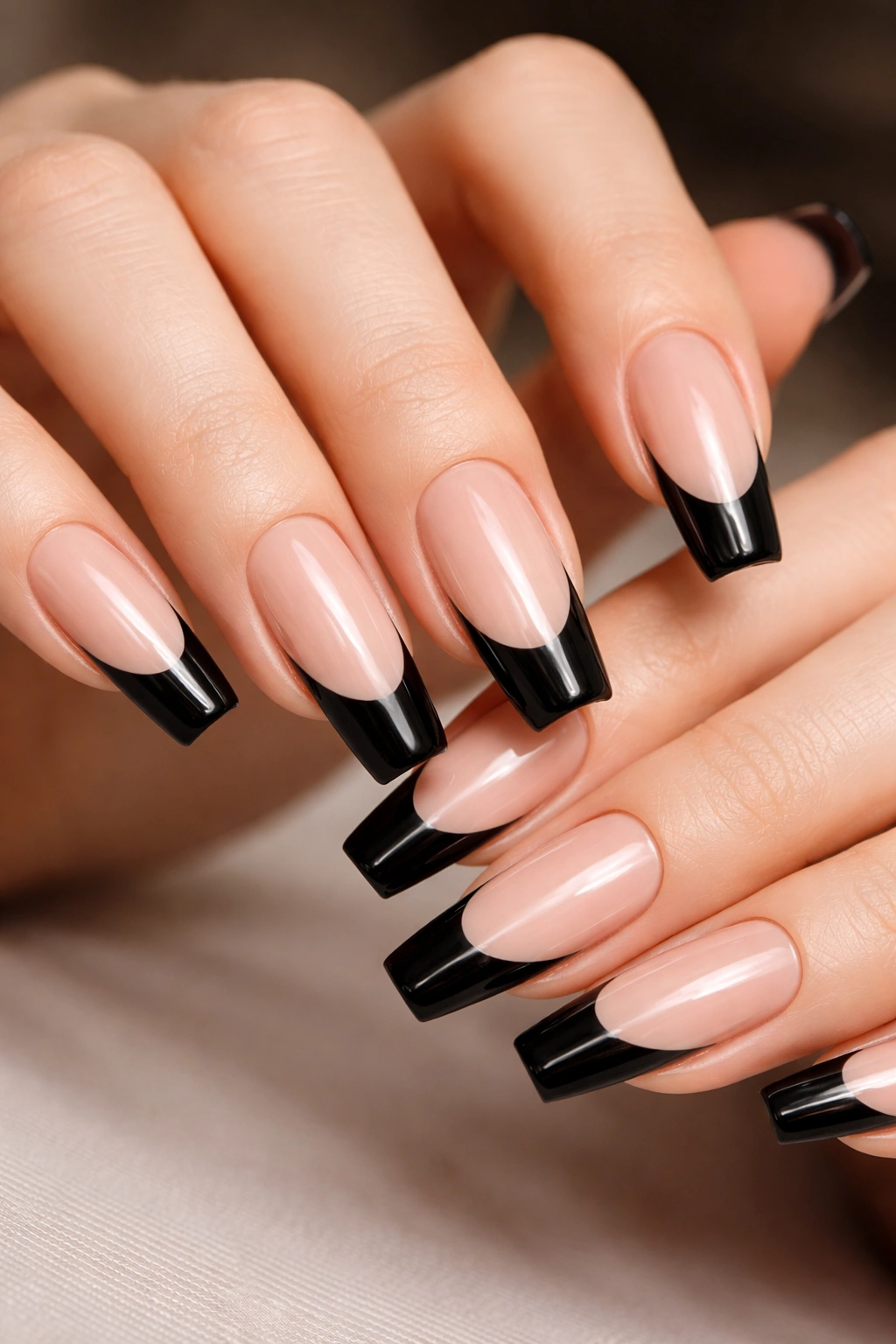
If you want the version that almost never misses, start here. A sheer nude base with a glossy black tip is the cleanest take on the whole idea, and it works because it doesn’t ask the design to do too much. The contrast carries everything.
This look depends on precision more than decoration. The base should be one of those skin-evening nudes that blur the nail plate without turning chalky. The tip should sit at the edge with a smooth smile line and crisp corners, not a bulky black band slapped across the front. Thin wins.
Where the look gets its edge
A glossy finish changes the black from flat color to something closer to patent leather. That shine pulls attention to the tip and makes the squared ballerina edge feel sharper. I’d keep the tip at 2 to 3 millimeters on medium-length nails, then go a touch deeper if the set is extra long.
Quick details that make this one work
- A cool beige or soft pink nude base keeps the black from looking too stark.
- Medium ballerina length, around 12 to 16 millimeters past the fingertip, gives the cleanest proportion.
- Black gel paint gives a smoother smile line than thick black bottle polish.
- A high-shine top coat needs to cover the full nail evenly, or the black tip can look dull at the corners.
Best pick for: someone who wants black French tip ballerina nails that look sharp in work clothes, denim, and eveningwear without changing the design every two weeks.
2. Micro black edge on long nude ballerina nails
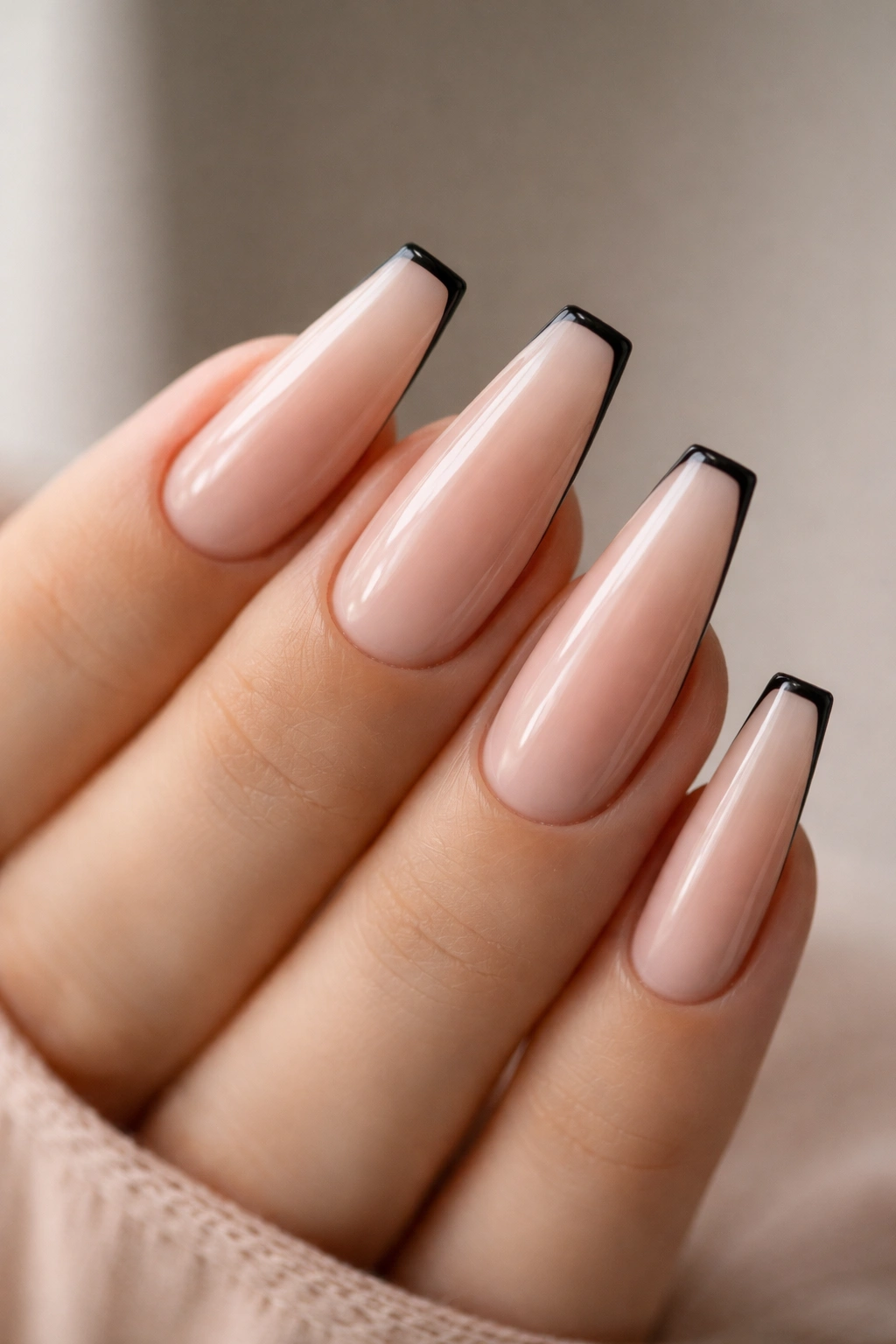
This is the strictest, sleekest version of the black French tip. Instead of a visible arc that takes up the front of the nail, you get a line so slim it almost looks printed on.
That thin edge does two things at once. It makes the ballerina shape look longer, and it keeps the manicure from feeling heavy even when the nails themselves are long. On a 16 to 20 millimeter extension, a full black tip can start to dominate. A micro tip stays sharp and light, which is a harder balance to strike than people think.
I like this style most on a nude base that has a little warmth—sheer rose beige works well—because the base still looks alive against that fine black line. On a flat pale pink, the contrast can read cold. Sometimes that’s the goal. Sometimes it isn’t.
There is one catch. Micro tips show wobble faster than thicker ones. If the line varies from 0.5 millimeters to 1.5 millimeters across the nail, you’ll notice. So will everyone else who stares at hands for a living.
The payoff, though, is huge. This is the set that makes people lean in and ask who did your nails, because it looks controlled instead of decorated.
3. Deep V black French tips with a knife-like center point
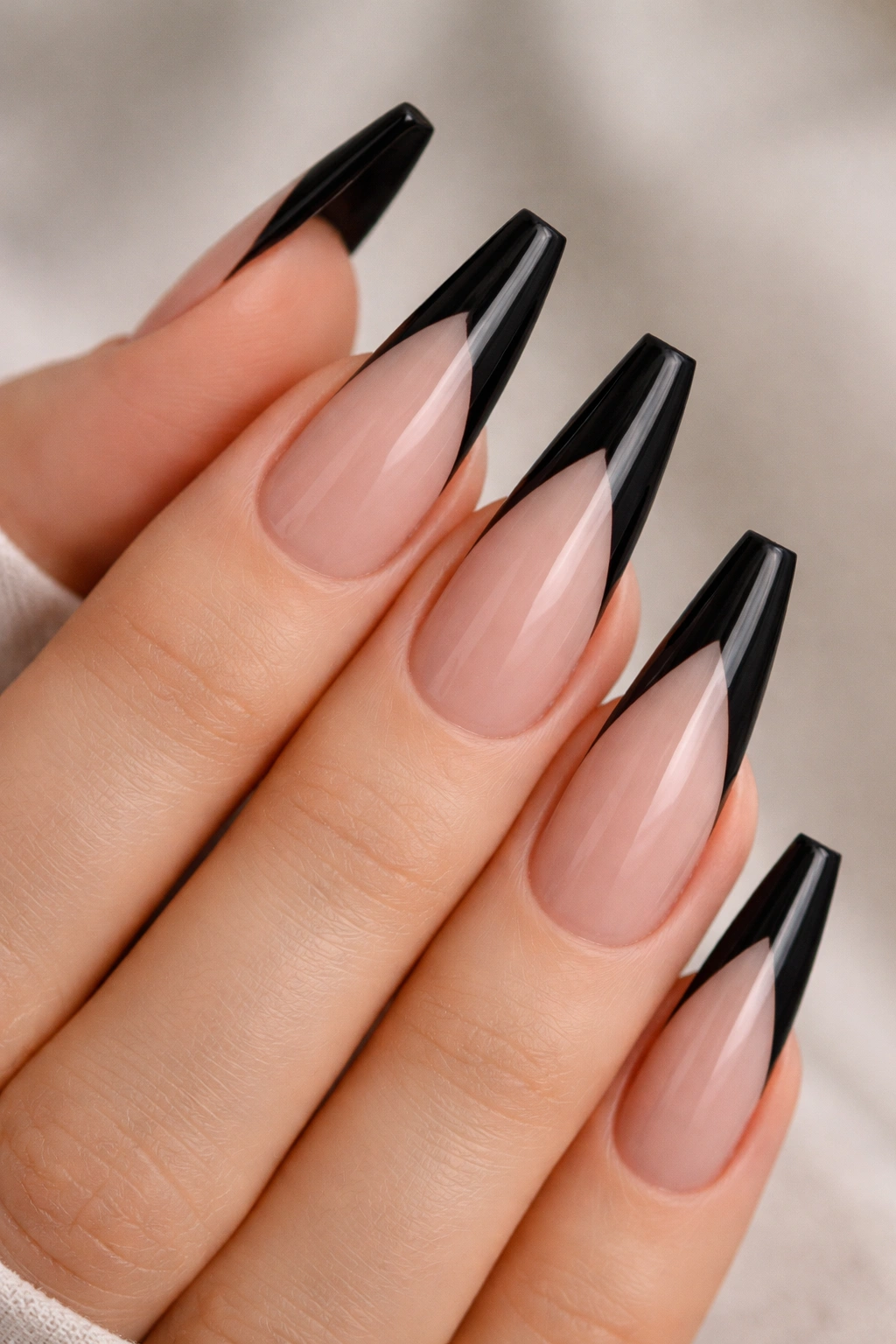
Why does a deep V tip look more aggressive than a rounded French line, even when the color and shape are the same? Because your eye follows the point inward, and that creates more movement than a soft curve ever will.
A V-shaped black tip works best on ballerina nails that already have a longer, leaner silhouette. You need room for the side lines to angle down toward the center without crowding the nail bed. On short nails, the V can eat space fast and make the design look cramped.
The line placement matters more than the point
The obvious part is the center dip. The less obvious part is the side angle.
If those two side lines aren’t even, the whole manicure looks off-center. A good tech usually maps the V before painting, then checks the nail from three angles: straight on, palm-up, and side view. That side check catches crooked corners that front-view photos hide.
How to wear this one without making it look costume-like
Pair it with a quiet base color and skip extra crystals, foil, or heavy glitter. The shape is already doing enough. A clean pink-beige base and a glassy top coat keep the design lean. If you want extra detail, a thin silver outline along the V can work—but once you add more than that, the set starts fighting itself.
This one isn’t subtle. That’s the charm.
4. Matte black tips on a milky beige base
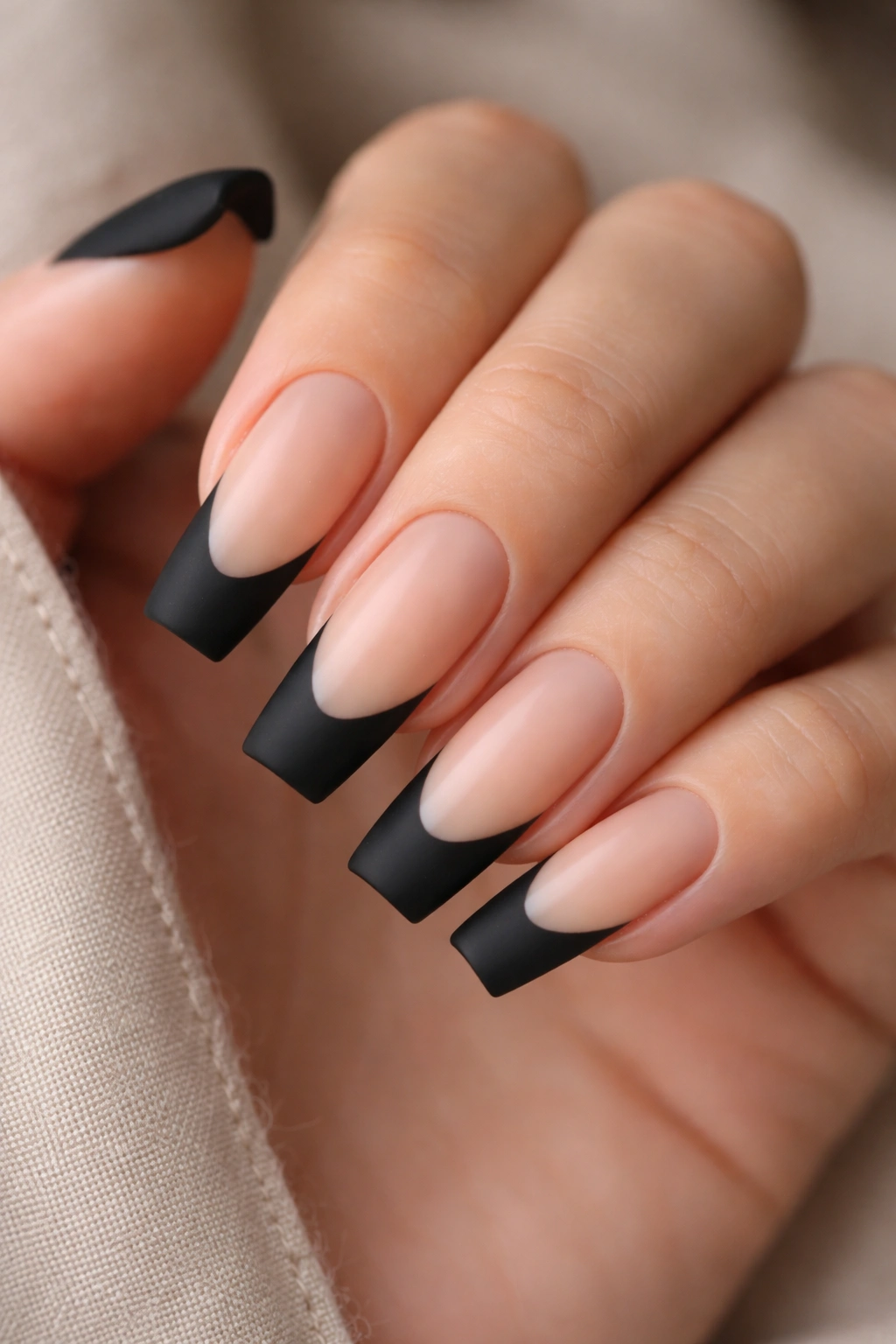
Picture a warm beige base that looks like coffee with cream, then swap the shiny black tip for a matte finish that feels almost velvety. The result is softer than the classic glossy version, though not softer in attitude. It looks tailored.
I’d wear this on medium-length ballerina nails rather than extra-long ones. Matte black has visual weight, and a huge matte tip on a long extension can read blocky. Keeping the free edge modest gives the finish room to look refined instead of blunt.
A milky beige base helps here because it takes the edge off the black without killing the contrast. Sheer pink can work too, though beige tends to make matte black feel richer and less stark. You can think of it like fabric: shiny black is satin, matte black is suiting wool.
Here’s where salons sometimes get it wrong. They matte the entire nail and call it done. Better move: keep the base softly glossy or satin and matte only the tip. That finish contrast makes the black French line stand out even when the color placement is simple.
For people who like dark nails but hate the look of a fully painted black set, this is one of the smartest middle-ground options.
5. Patent-shine black tips with extra-crisp squared ends
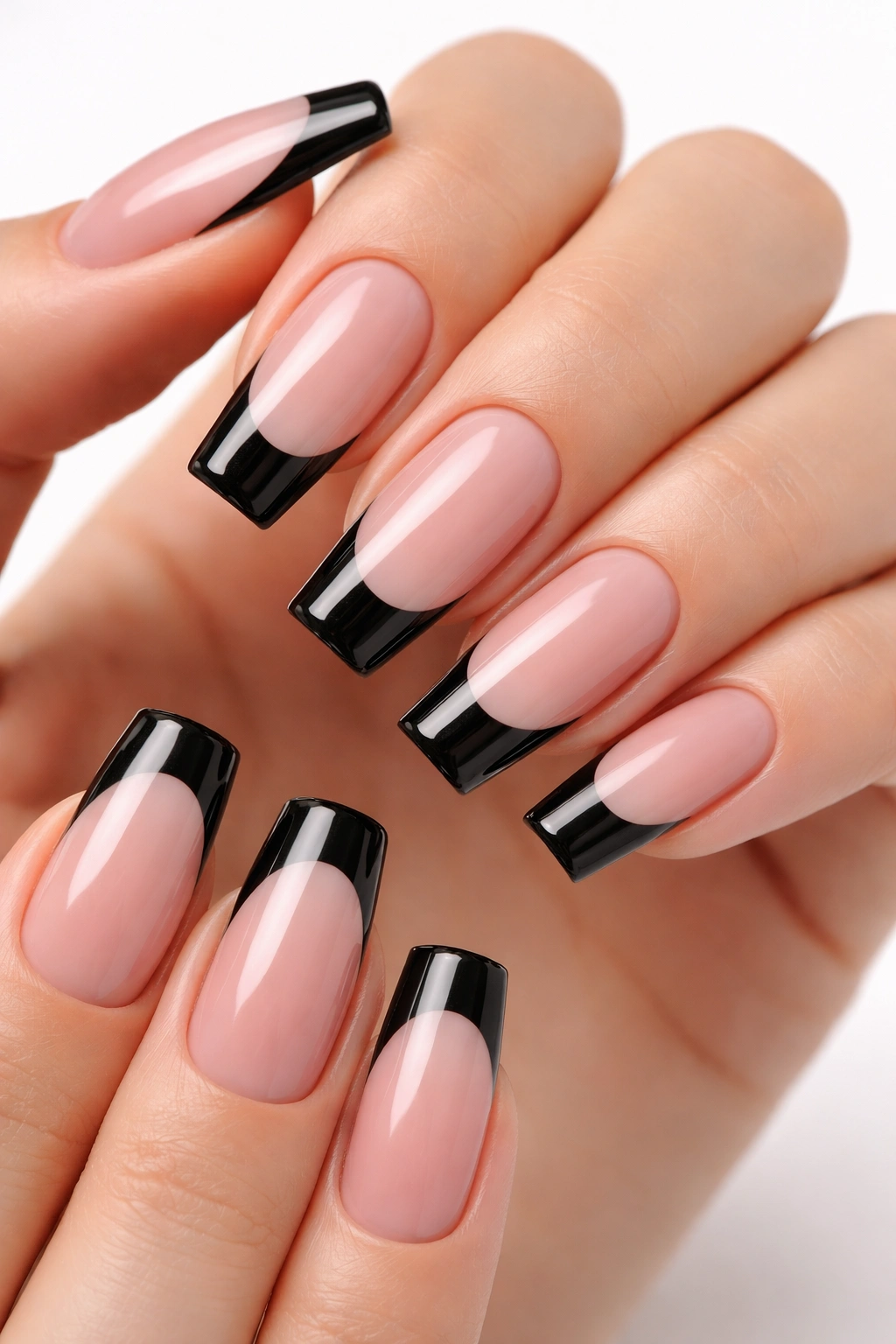
A lot of French tips focus on the smile line. This one is about the front edge. When the black is paired with a ruler-straight ballerina tip and a thick glassy top coat, the manicure starts to look almost lacquered onto the nail.
The squared ends have to stay tidy. Not wide. Not flared. Tidy. If the corners kick outward, the whole look turns clunky. That’s why I’d skip this design on nails that have weak sidewalls unless you’re building them with hard gel or acrylic.
There’s a slight old-school glamour to patent-shine black, but the ballerina shape keeps it from veering into retro territory. It feels more city than vintage—sharp coat, straight hem, clean heel. You get the idea.
A narrower tip depth helps the gloss do the heavy lifting. I’d rather see a 2 millimeter black edge with a mirror finish than a thick 5 millimeter band that tries too hard. And if your top coat yellows or loses shine fast, this design loses half its point, so choose products that stay clear.
No stones. No swirls. No tiny hearts. This one should look almost strict.
6. Double-line black French tips with a floating second arc
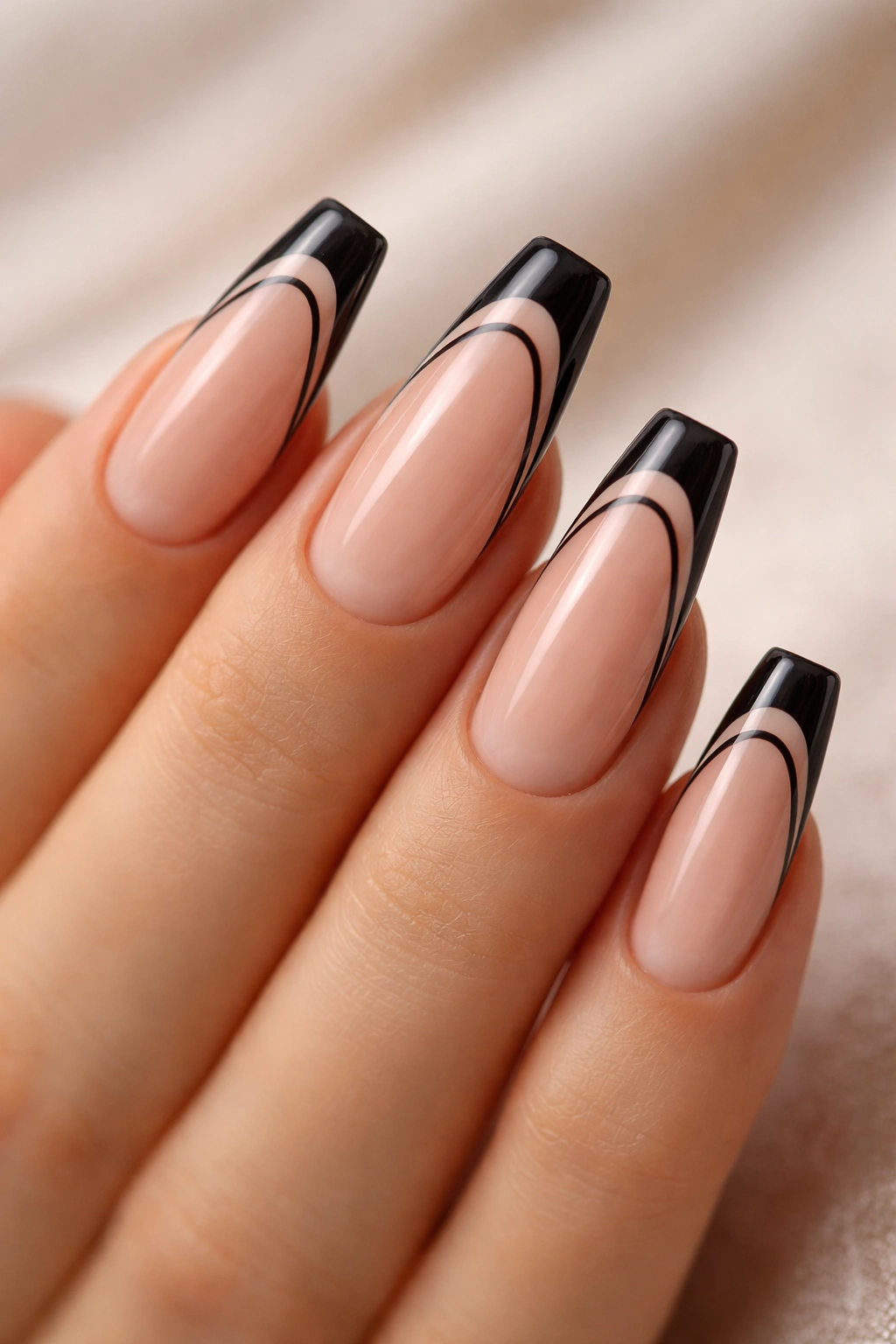
Unlike a standard black French manicure, this version gives you two lines to play with: the main black tip and a second arc sitting just above it, leaving a slim band of nude between them. That floating gap makes the design feel lighter and more technical at the same time.
The spacing has to be consistent. That’s the whole trick. If the nude band widens at the center and narrows at the sidewalls, the look falls apart fast. On medium nails, I like a 1 to 1.5 millimeter gap and a second line that’s thinner than the main tip, almost like an echo.
Who is this best for? Someone who wants a black French tip set that feels more designed than basic, yet still clean enough to wear every day. It gives you more detail without forcing a full-on nail art moment.
You can take the floating line one of two ways. Match it in black for a monochrome look, or make the second line silver chrome if you want more contrast. I lean black-on-black here. It feels calmer, and the negative space does the talking.
There’s a fussy version of this design with three lines, glitter, and gems. Skip it. Two clean arcs are enough.
7. Negative-space black frame tips
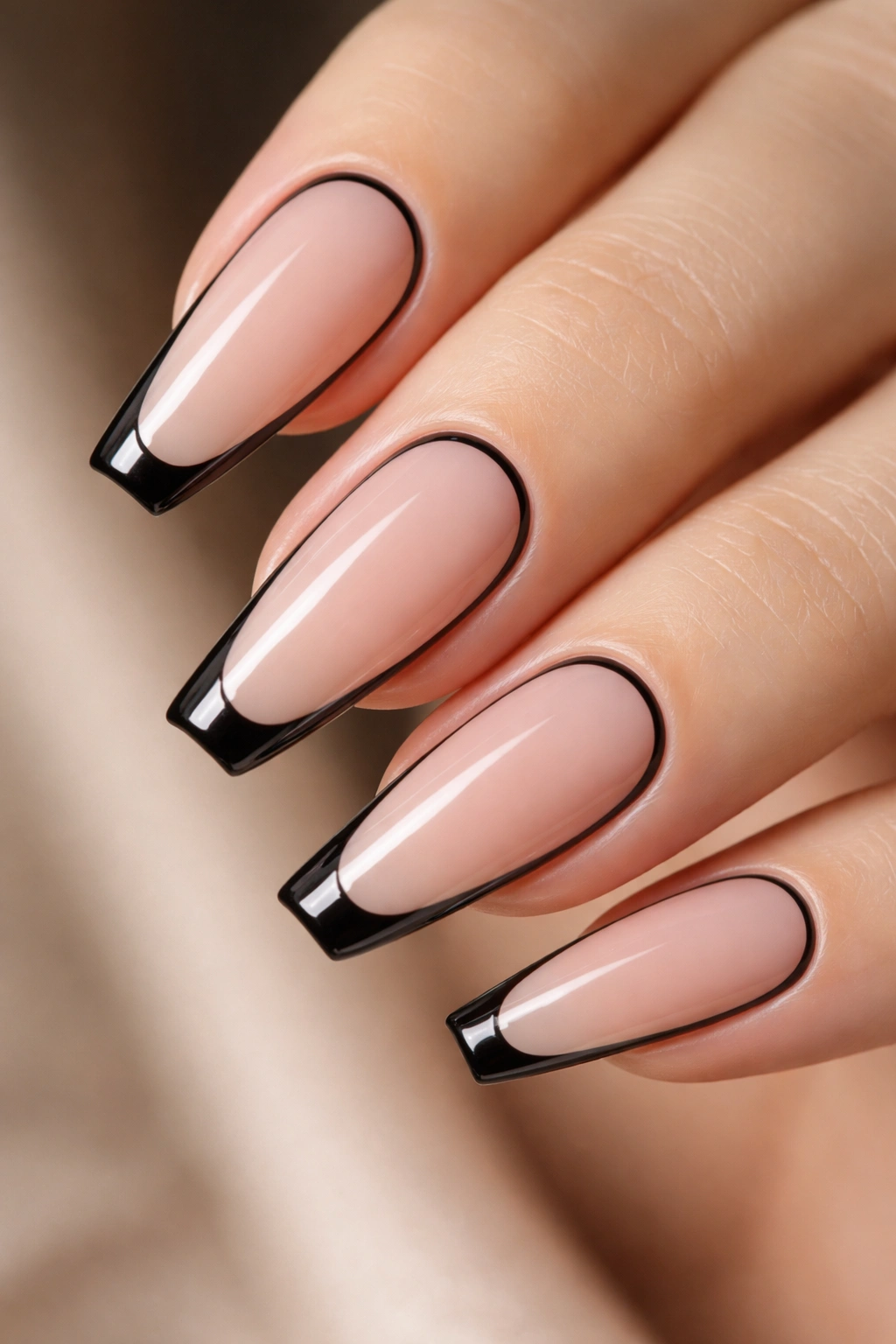
This one starts with a black outline instead of a solid fill. The tip is traced along the smile line and side edges, while the center of the tip stays nude or sheer. It looks like a frame rather than a block of color, which makes it one of the smartest ways to wear black on a longer ballerina shape.
Anecdotally, this is the design people choose when they love black nails in photos but don’t love how dense solid black feels on their own hands. That open center changes everything. The set still reads dark and sharp, though it breathes more.
What gives it that cut-paper look
The side lines need to stay fine—around 0.75 to 1 millimeter—and the corners should be crisp enough to meet the front edge without bulking up. If the outline gets thick, the tip turns muddy fast.
- A sheer pink base keeps the frame light and airy.
- A beige base makes it moodier and a touch more graphic.
- Matte top coat gives the outline a softer edge.
- High gloss makes the empty center look cleaner.
You don’t need extra art here. The empty space is the art.
8. Black French tip ballerina nails with tiny crystal cuticles
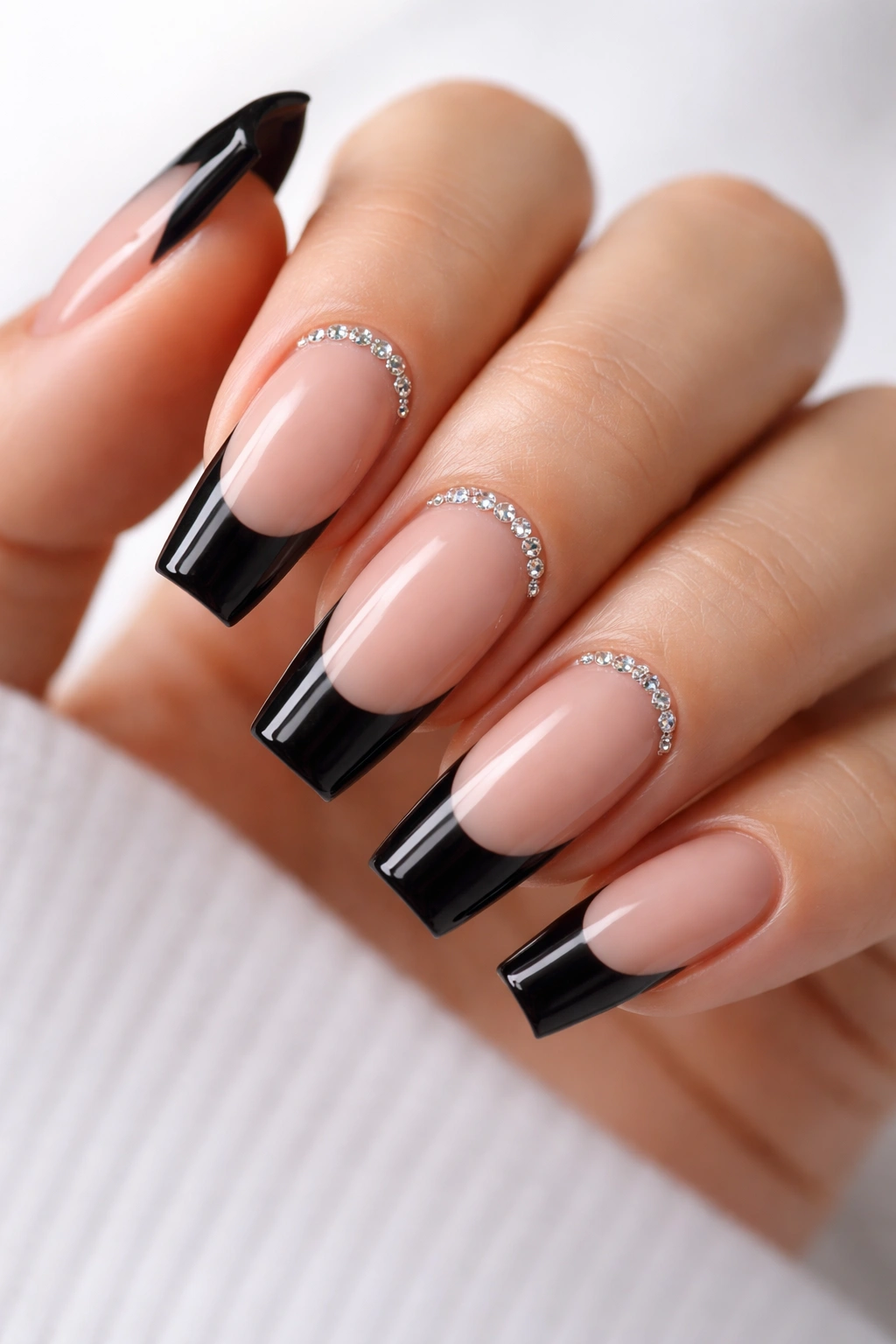
Crystals can cheapen a manicure fast. Tiny ones placed with restraint can do the opposite.
The move here is a clean black tip on each nail, then a single micro crystal or a short trio of stones at the cuticle on one or two accent nails. Not every nail. That’s where people lose the plot. Black already brings contrast; the crystal should act like punctuation, not wallpaper.
This design works because it spreads the detail across the nail instead of piling it on top of the tip. Your eye moves from the dark edge to that small flash at the base, and the nail looks longer in between. On ballerina shapes, that spacing feels elegant and a bit dressy without tipping into bridal territory.
Placement matters more than stone size. A tiny ss3 or ss4 crystal sits flatter and lasts better than a big raised gem that catches on hair. If you want more than one stone, keep them aligned close to the cuticle line so the look stays orderly.
I’d reserve this for glossy sets. Matte black plus crystals can work, though the mix of textures often feels busier than it sounds. With gloss, the whole manicure keeps one clean visual language—and yes, I know that sounds nerdy, but nails are design.
9. Silver-outlined black tips that look like metal trim
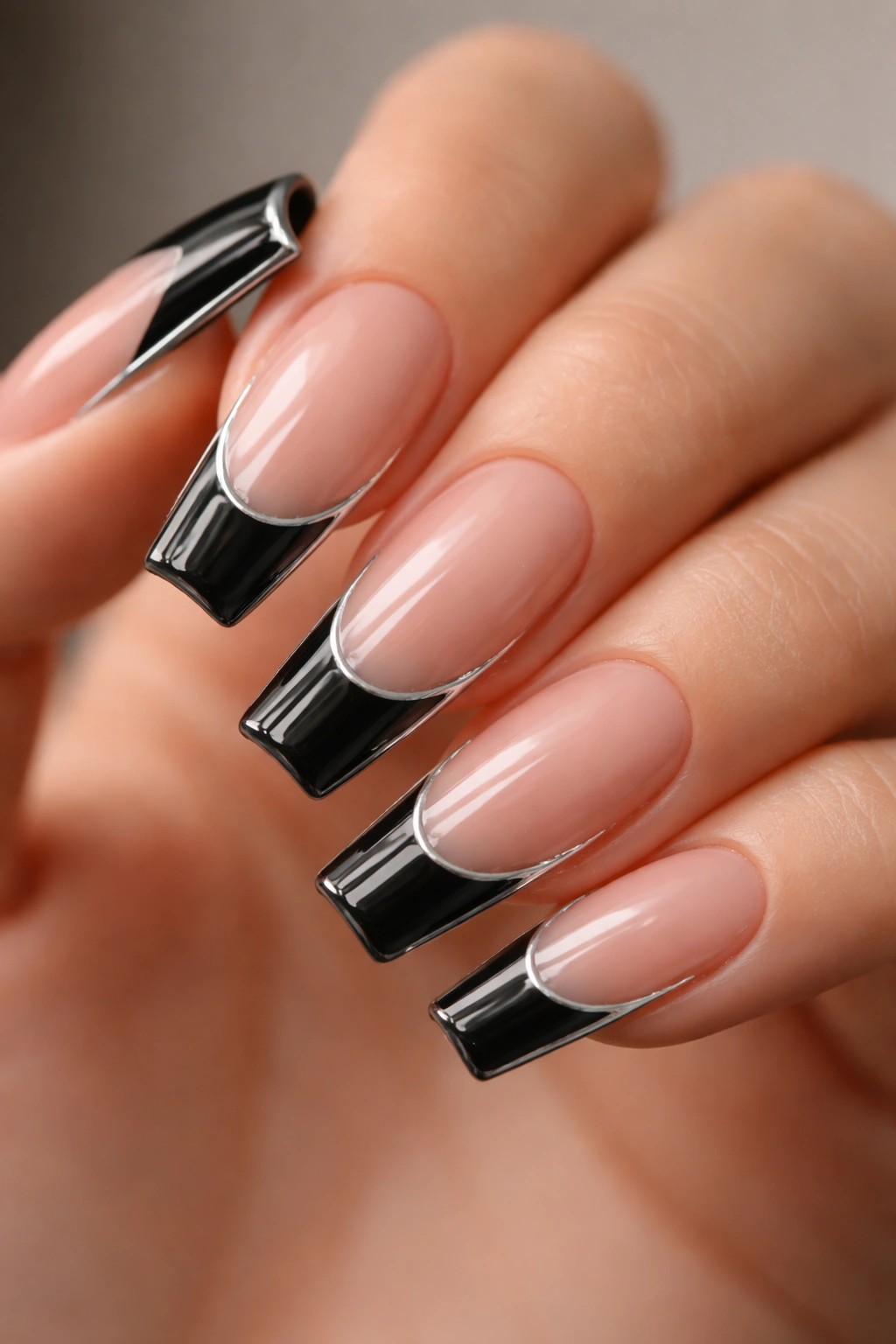
Want black French tips that feel a little colder, a little cleaner, a little more dressed up? Run a silver line between the nude base and the black tip. That slim metallic border turns a simple manicure into something that reads almost like jewelry.
The silver needs a light hand. Too thick, and the design starts looking striped. Too bright, and it pulls attention away from the black entirely. I prefer a chrome line no wider than 0.5 to 1 millimeter, laid right along the smile line so the silver acts as a crisp divider.
One thing I love about this version is how it sharpens the shape even more. Black alone can blur slightly if the smile line is soft. Add that reflective silver trim and the edge looks cleaner, almost etched.
This style pairs well with cool-toned base shades—pink-beige, rosy nude, soft taupe. On warmer peach bases, silver can feel a touch disconnected. Not always. But often enough that I’d check a sample swatch before committing.
If your jewelry wardrobe leans silver, white gold, or steel watches, this one slips in without effort. It feels intentional from fingertip to wrist.
10. Smoked ombré black French tip ballerina nails
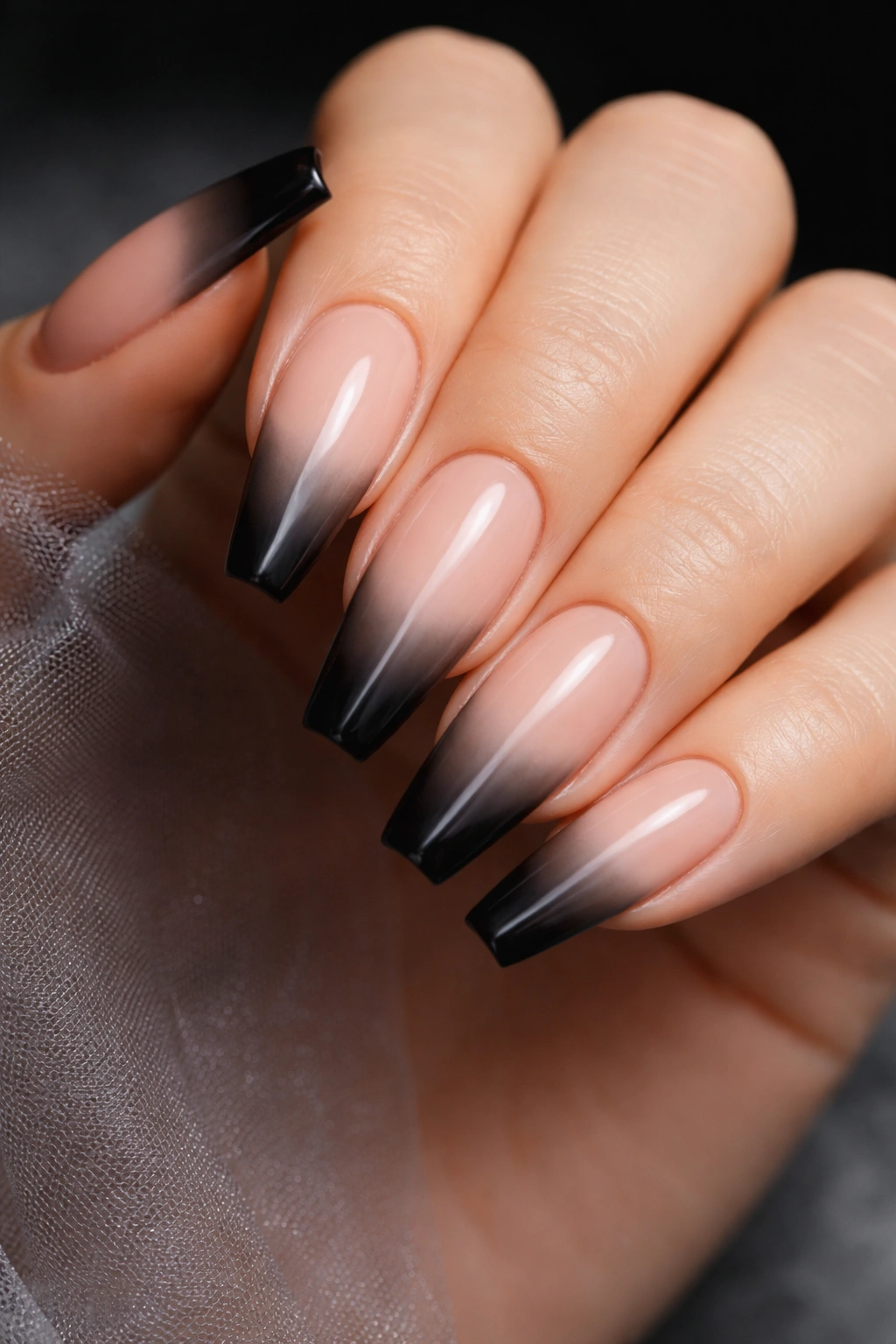
Some black French tips are all line. This one is all fade.
Instead of a hard edge, the black starts at the tip and softens upward into a smoky haze before disappearing into the nude base. You still get the drama of black, though the transition is softer and moodier than a classic French line. On a ballerina shape, the flat tip keeps that fade from looking muddy, which is why this design works better here than on rounded nails.
I’d choose this when you want something dark but less strict. A smoked tip can make the hand look a touch softer because there’s no sharp smile line cutting across the nail bed. It also hides tiny chips better than a crisp painted edge. That matters if you’re rough on your hands.
The color blend needs care. If the black is sponged too high, the whole nail turns gray. If it’s packed too densely at the edge with no taper, you lose the ombré effect and end up with a fuzzy French tip, which is not the goal. A fine airbrush fade or a controlled gel blend works best.
Gloss suits this look more than matte. Matte can flatten the fade. With shine, the black shifts from deep charcoal at the border to ink at the tip, and the depth looks richer.
11. Diagonal side-swept black tips
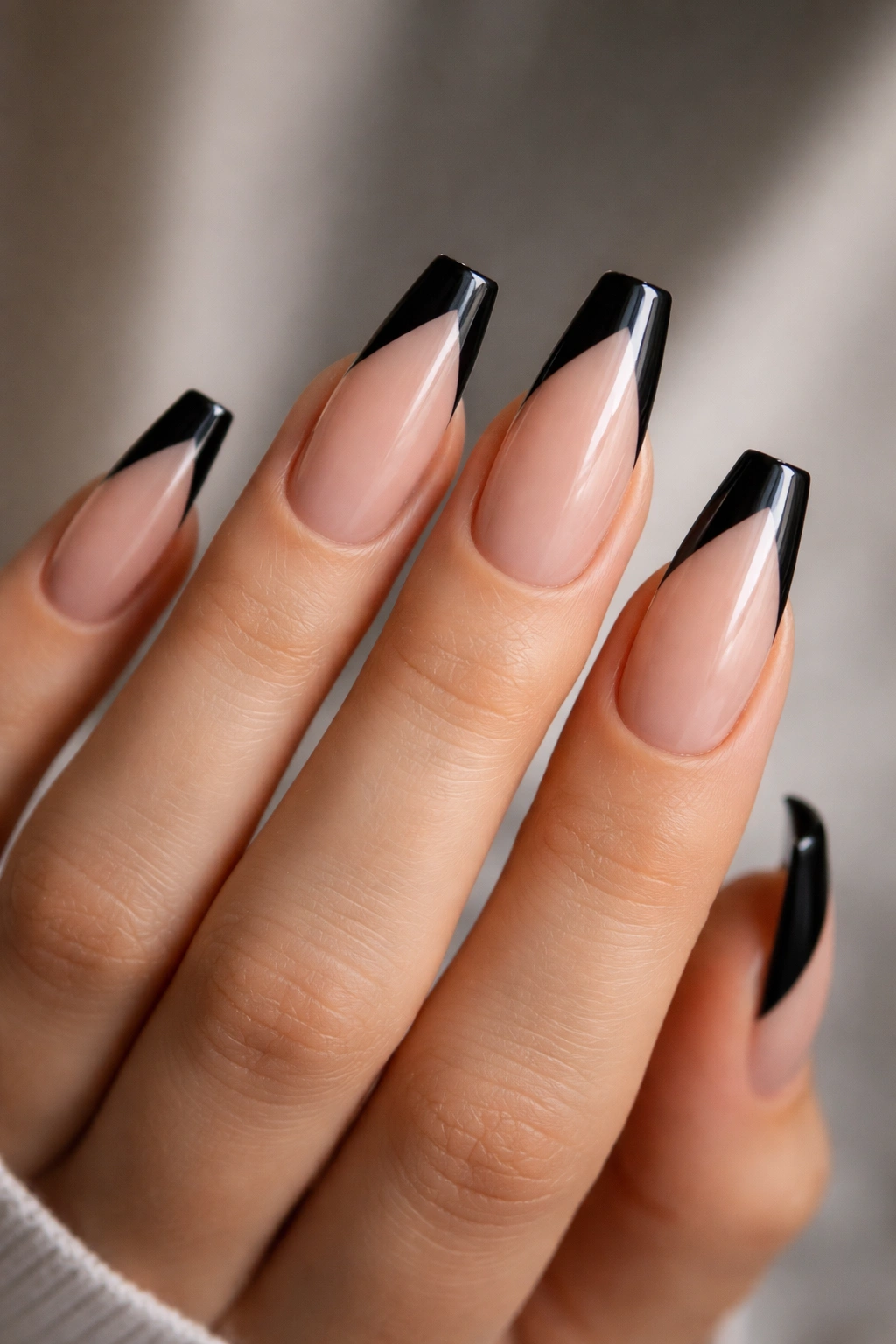
A straight-across French tip is classic. A diagonal tip feels faster.
This design sweeps the black from one sidewall across the tip at an angle, so the line cuts the nail on a slant rather than curving in a standard smile line. It gives a ballerina nail more motion, which is useful if your set feels too plain but you still want a clean black-and-nude palette.
Where this one works best
Medium length is the sweet spot. On tiny nails, the diagonal can look accidental. On long extensions, it starts to read more editorial and less everyday. That may be exactly what you want. Just know the angle adds attitude fast.
The side-swept tip also helps if one nail bed is shorter or wider than the others, because the diagonal line distracts from minor shape differences. It’s one of those quiet salon tricks that makes a set look more balanced without screaming for attention.
I’d leave this design glossy and skip extra detail. The angle is the detail. If you want a touch more edge, make the diagonal steeper on the ring finger and pinky while keeping the rest moderate. Small asymmetry like that can look smart when it’s controlled.
This is one of my favorite options for people who are bored with basic French tips but don’t want art all over every nail.
12. Sheer pink jelly base with slim black corners
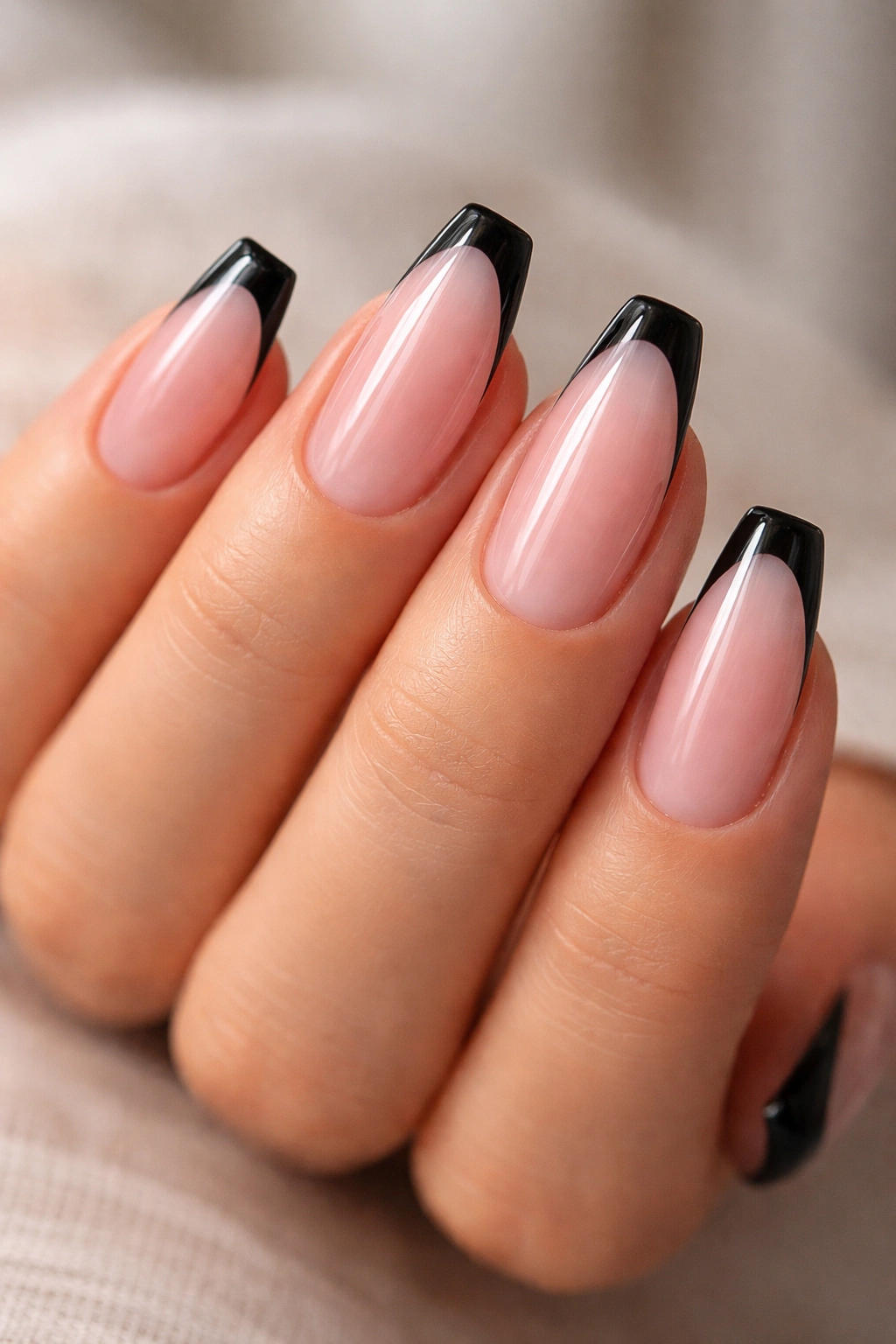
There’s a softer way to do black French tips, and it starts with the base. A sheer pink jelly gives the nail a glossy, almost translucent look, then the black stays slim and concentrated at the corners and front edge instead of spreading across the whole tip.
That jelly base has movement. You can see a little depth through it, which keeps the manicure from feeling flat. Pair that with fine black corners and the shape looks more delicate, even though the color story is still black and nude.
This works well on medium-short ballerina nails where a full, deep black French line might crowd the nail bed. By focusing the color at the edges, you keep the silhouette sharp without reducing the visible base area. It’s a small shift, though it changes the mood a lot.
A thicker pink jelly, the kind that leans syrupy, can blur the contrast too much. I’d choose one or two sheer coats max, then build the black with a fine brush so the corners stay precise. If the tip line gets chunky, the whole airy effect disappears.
If classic nude bases feel a little flat on you, this is the version worth trying first.
13. Short ballerina nails with squared black French corners
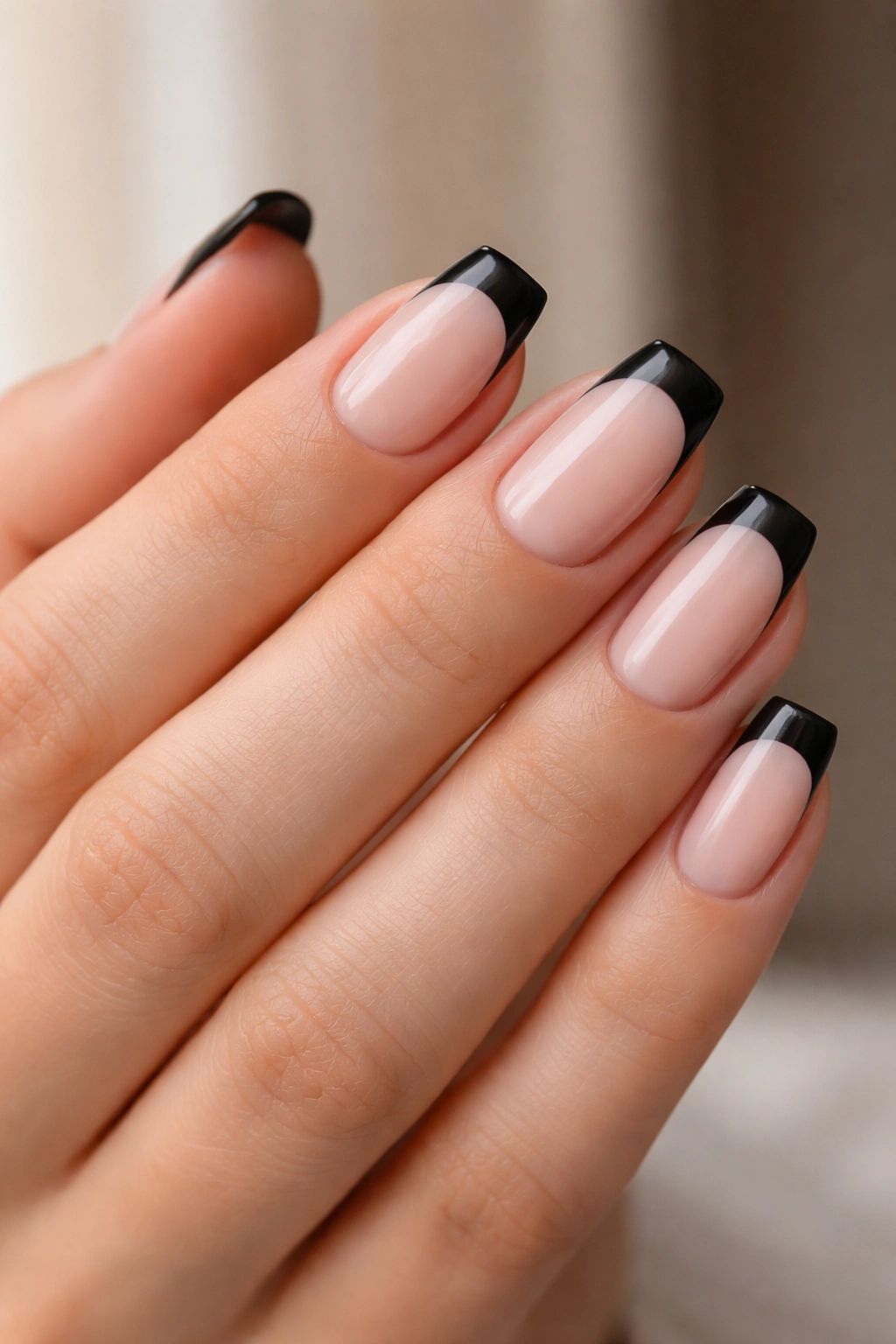
Short ballerina nails are underrated. People assume the shape only works with long acrylics, though a short tapered square with crisp black corners can look cleaner than a dramatic set twice the length.
Here, the black doesn’t need a deep smile line. It needs sharp corners and a tidy front edge. Think of the tip as a narrow cap, maybe 1.5 to 2 millimeters, hugging the free edge without climbing too far down the sides. That keeps the nails looking neat instead of compressed.
Why this one suits everyday wear
- Short length puts less pressure on the sidewalls, so corners stay intact longer.
- You can type, grip, button shirts, and open cans without babying the set.
- Growth shows a bit less dramatically than on long nude-and-black extensions.
- The black still gives enough contrast to make the shape visible from a distance.
This is the set I’d point to for someone who wants black French tip ballerina nails that look sharp but can still survive day-to-day life. You lose a little drama. You gain comfort, speed, and fewer broken corners. Fair trade.
14. Black-on-black French tips with gloss art over matte tips
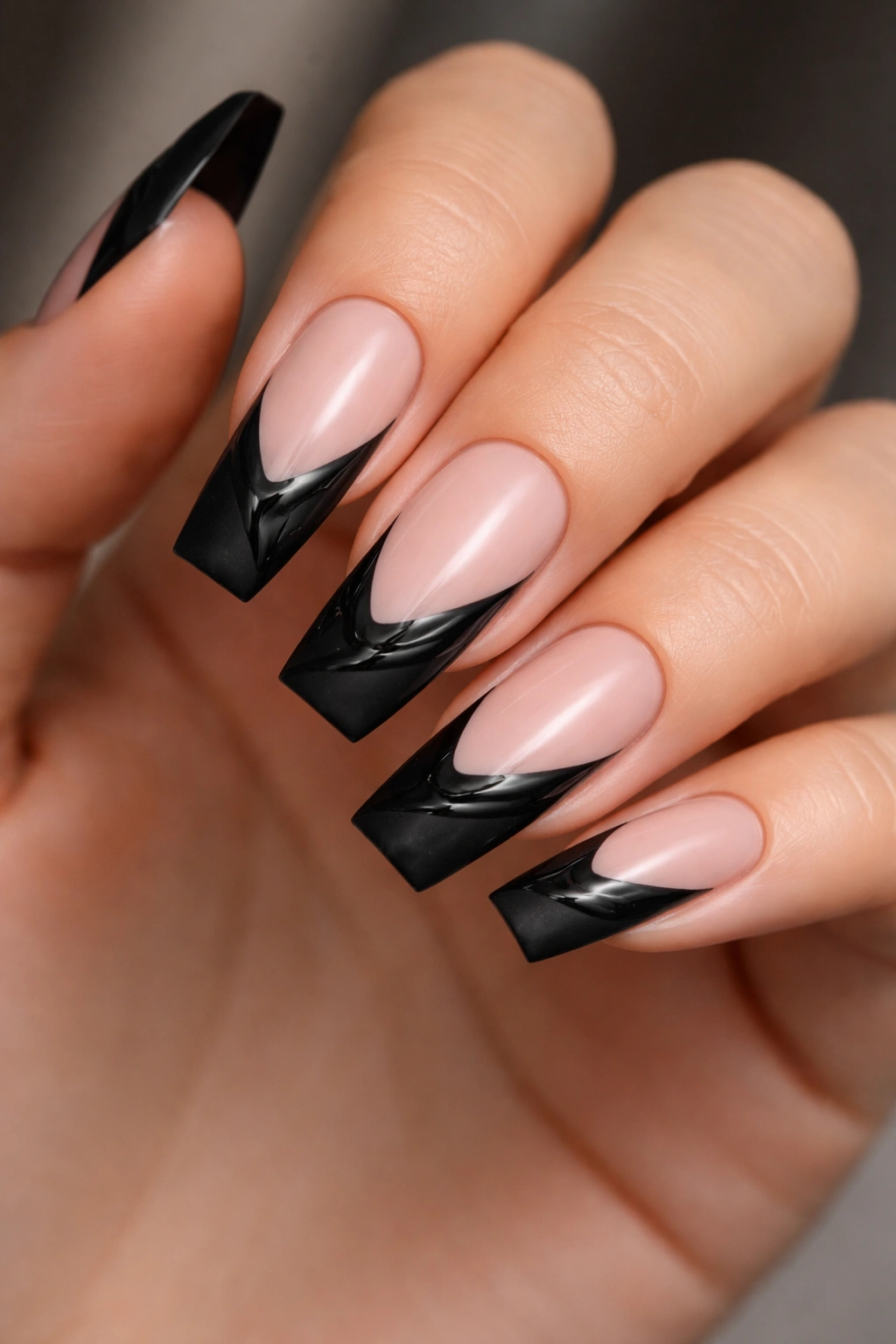
This one is subtle in photos and stronger in person. Start with a nude base, paint the French tip in matte black, then add gloss-black details over the matte area—thin swirls, tiny flames, a curved line, even a faint checker stripe. Same color. Different surface.
Because the art sits inside the tip instead of spreading over the whole nail, the manicure stays disciplined. You’re not stacking random elements. You’re giving the black area texture and movement while keeping the base clean. That restraint is what makes it work.
There’s a practical benefit too. Gloss-on-matte detail shows best when the light hits the nail from the side, which means the design has a quieter feel from a distance and more interest up close. I like that. Not every manicure needs to announce itself from across a room.
Choose the pattern carefully. Fine curved lines suit longer ballerina nails. Small geometric marks fit shorter ones. Thick gloss shapes over matte black can look gummy, so the brushwork should stay light and intentional.
If plain matte tips feel too flat and chrome feels too flashy, this black-on-black finish play lands in a smart middle spot.
15. Black cat-eye French tips with a shifting charcoal sheen
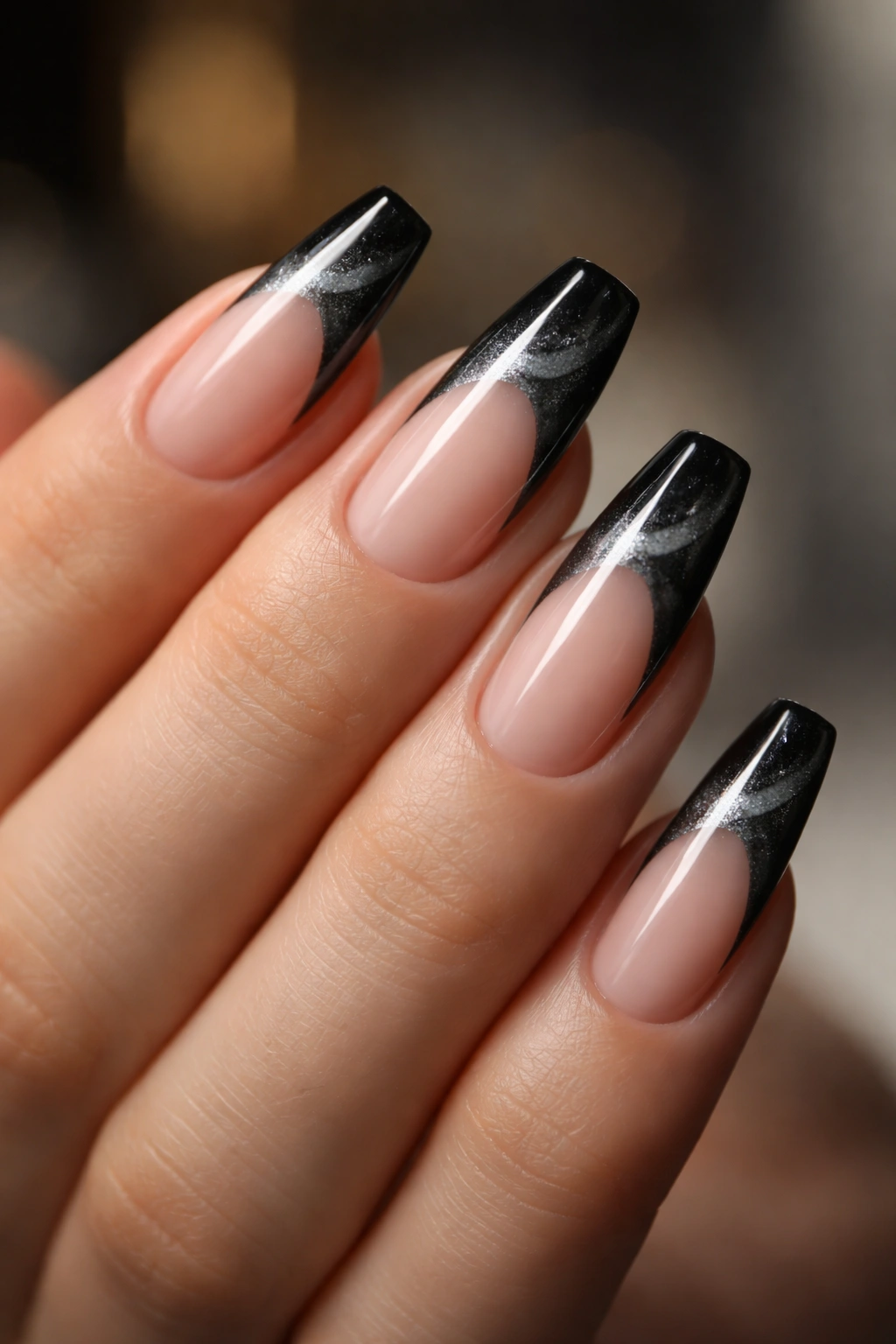
Some nail looks rely on shape. This one adds movement.
A black cat-eye tip uses magnetic gel to pull fine shimmer particles into a soft band across the black, so the color shifts between ink, charcoal, and a dim metallic stripe as you turn your hand. The base stays nude. The tip stays black. The finish gives it a little depth without changing the color story.
What makes this different from glitter
Glitter sits on top and announces itself right away. Cat-eye black feels deeper and smoother.
You still want a clean French edge here. The shimmer should live inside the tip, not distract from the outline. On ballerina nails, that flat tip gives the magnetic effect a straight edge to sit against, which keeps the design looking polished rather than murky.
Best way to wear it
Use this on medium to long nails with a high-gloss top coat and no extra crystals. Let the magnetic stripe be the only special effect. A narrow tip keeps it refined; a deeper tip turns it moodier and more evening-leaning. Both can work. I’d skip matte here, because the whole point is that quiet shift in the black.
This is probably the most dramatic design on the list, though it still reads black French before anything else. That balance is why it works.
Final Thoughts
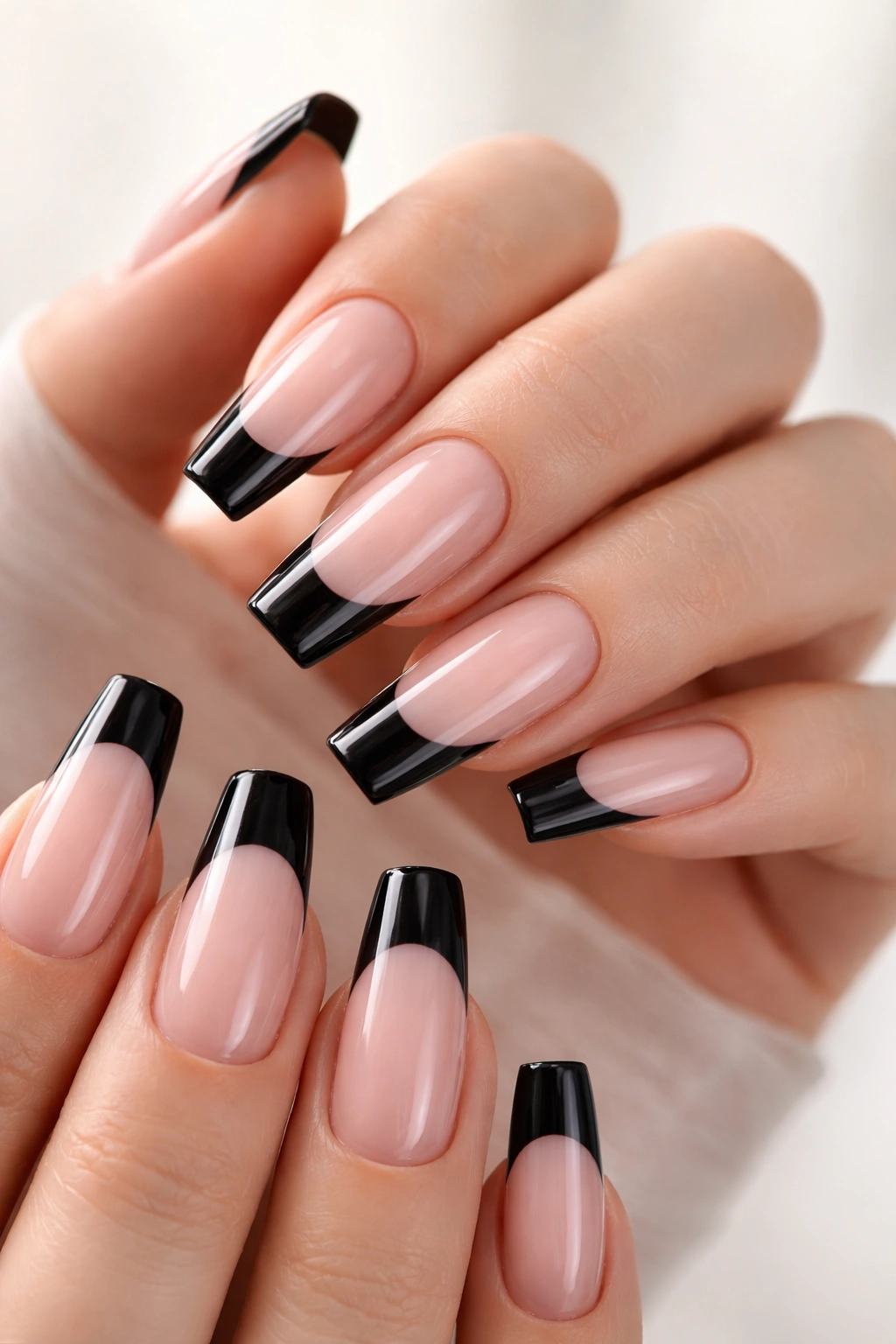
The best black French tip ballerina nails share the same backbone: clean file work, measured tip depth, and a base color that doesn’t fight the black. Get those three right and even the plainest version looks expensive.
If I had to narrow the field, I’d start most people with the classic glossy set, the micro tip, or the short squared-corner version. Those three cover the widest range of lengths, hand shapes, and daily routines. After that, you can push into chrome trims, negative space, matte finishes, or cat-eye effects.
And if you’re saving one photo for the salon, save a side-angle shot too. With ballerina nails, shape is half the design. The black tip just proves whether the shape was done well.