


Black French tips get all the attention until navy catches the light near a window. Navy blue French tip coffin nails have the same clean edge as black, but they read softer, richer, and more considered on a long tapered shape. Indoors, the color can look almost ink-dark. Step outside, and it shifts—midnight, denim, sapphire, sometimes all within a few minutes.
That color shift is the whole reason this manicure keeps pulling people in. Coffin nails already have built-in drama because the sidewalls taper and the free edge stays flat, so a French tip on that shape has more structure than it does on a square or rounded nail. The wrong navy can look chalky. The right navy looks deep enough to swim in.
I’m picky about this combo because small details change everything. A base that leans peach can make a cool navy look muddy. A smile line that sits too low can shorten the nail bed and make even a long coffin set feel heavy. And matte top coat—done badly—can make a crisp French tip look dusty within three days.
When the proportions are right, though, navy French tips on coffin nails look polished in a way that plain nude sets often do not. That’s where the good ideas start.
Why Navy Blue French Tip Coffin Nails Look Richer Than Basic Black
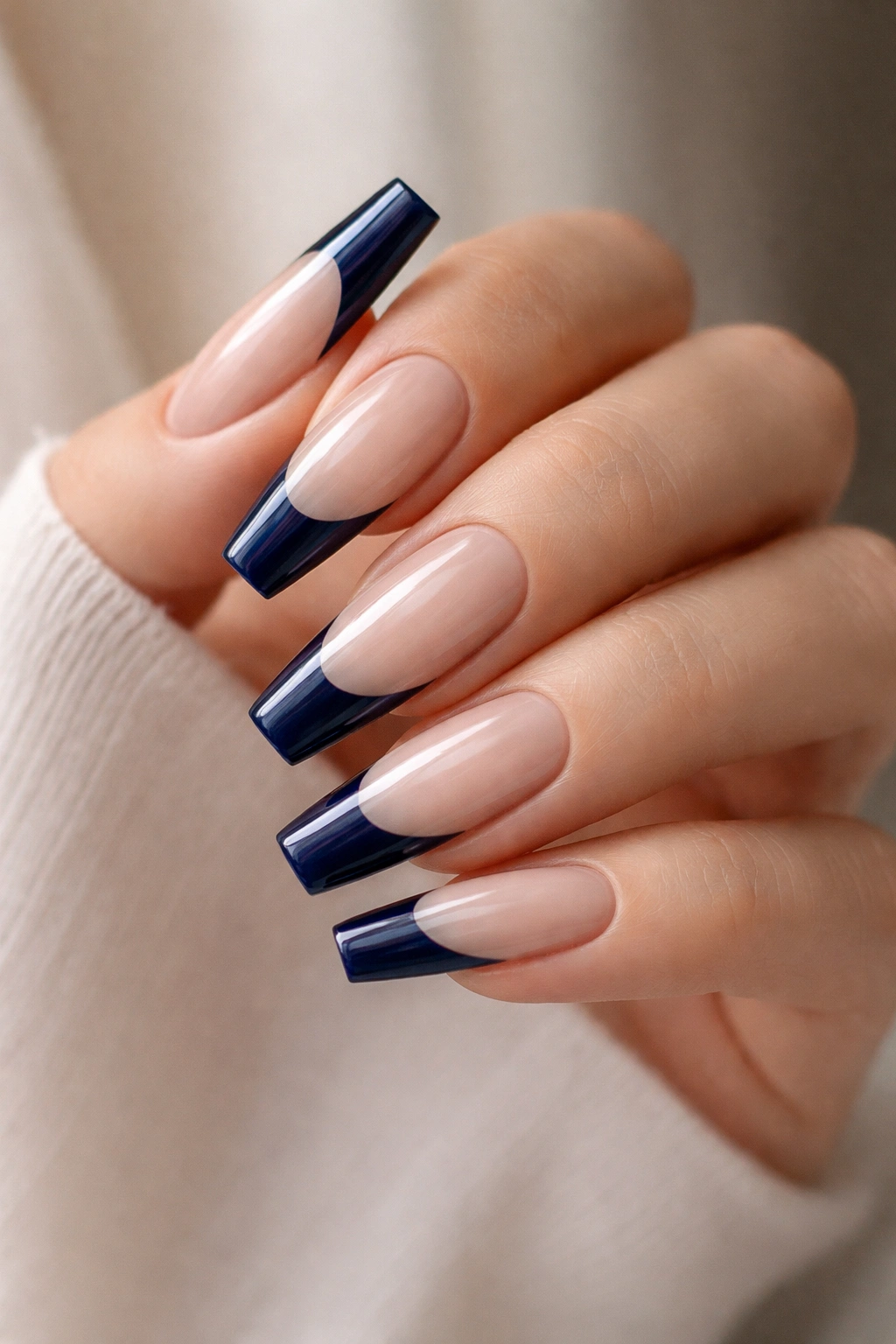
Black isn’t always the strongest dark tip color. On a coffin shape, black can flatten the end of the nail and make the whole set read hard, especially under office lighting or indoor yellow light. Navy holds depth better. You still get contrast, though the finish feels less blunt and more layered.
There’s a color reason for that. Most navy gels have a little undertone movement in them—blue, indigo, sometimes a trace of violet—so the tip picks up light instead of swallowing it. That matters on coffin nails because the shape has broad enough tips to show color, but narrow enough sidewalls that any flat shade can look severe.
Skin tone plays a part too. Cool and neutral undertones tend to make navy look sharp and expensive. Warmer skin can wear it too, though the base color matters more there; a milky beige or soft pink usually keeps the whole manicure from pulling gray.
Jewelry changes the mood. Silver makes navy feel crisp. Gold pushes it toward a dressier, almost regal finish. White gold sits in the middle.
One more thing: navy is far more forgiving than black when the nail grows out. A 1-millimeter gap near the cuticle still looks intentional for longer, which matters if you stretch appointments to the 16- to 18-day mark.
The Base Color and Tip Width That Decide the Whole Look
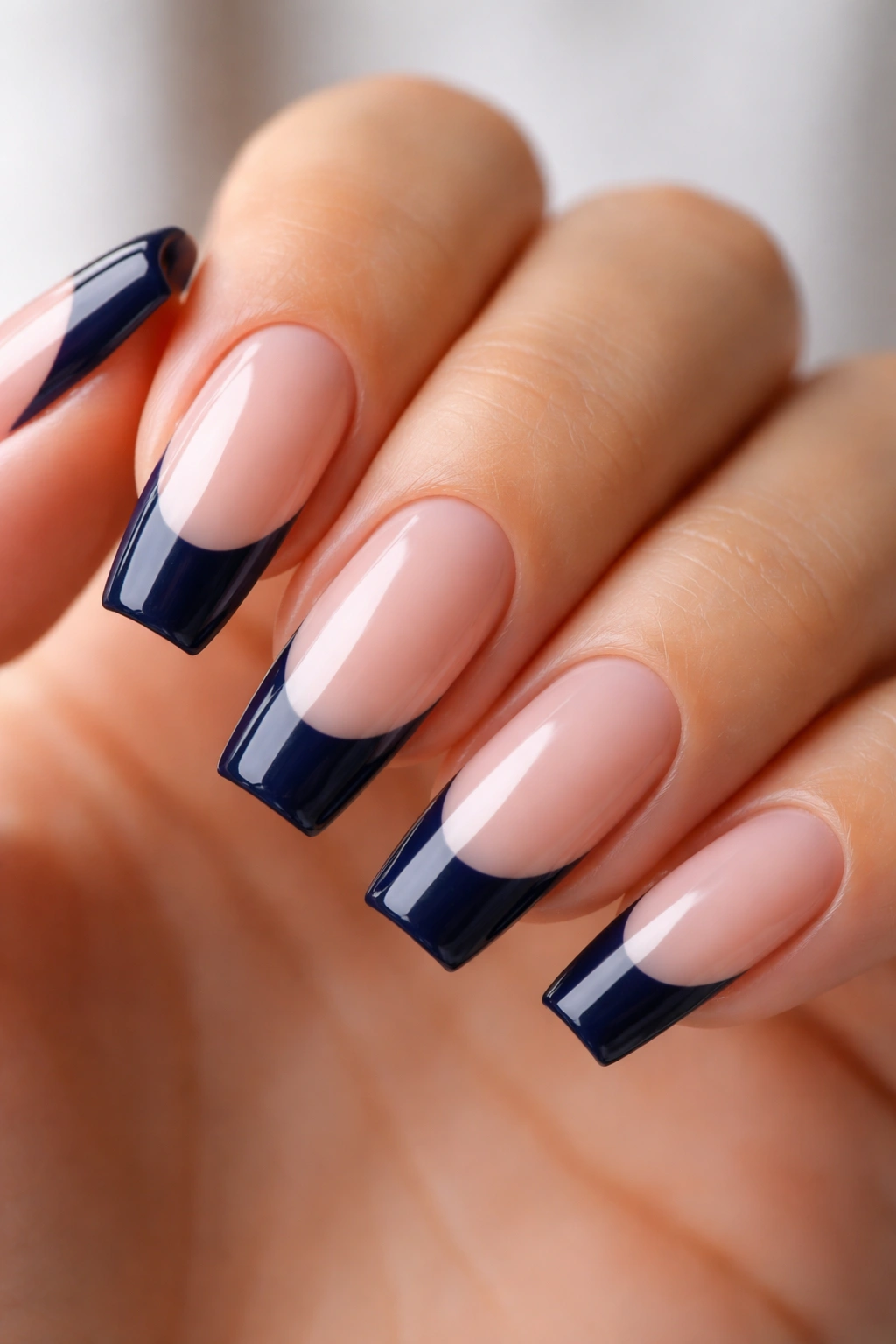
What makes one French set look clean and another look cheap? Nine times out of ten, it comes down to the base and the width of the tip.
For the base, ask for one of these:
- Sheer cool pink if you want the navy to look crisp and bright
- Milky nude if you prefer a softer contrast
- Beige-pink builder base if your nails need more structure and you want a smoother surface
- Semi-opaque neutral if you dislike seeing the natural free edge through the base
Tip width needs the same kind of care. On a short-to-medium coffin nail, a classic French band usually looks best at 2 to 3 millimeters. On a longer coffin set, you can go deeper—4 to 5 millimeters—without making the nail look stubby. Micro tips work too, though they need steadier line work and a longer nail bed to show up.
Ask your tech to keep the smile line lifted, not flat. A high curve elongates the finger. A straight, low tip can make the nail look like it has been cut in half.
That sounds fussy. It is a little. Nails are tiny, and tiny design choices show.
1. Classic Navy Blue French Tip Coffin Nails With a Glossy Nude Base
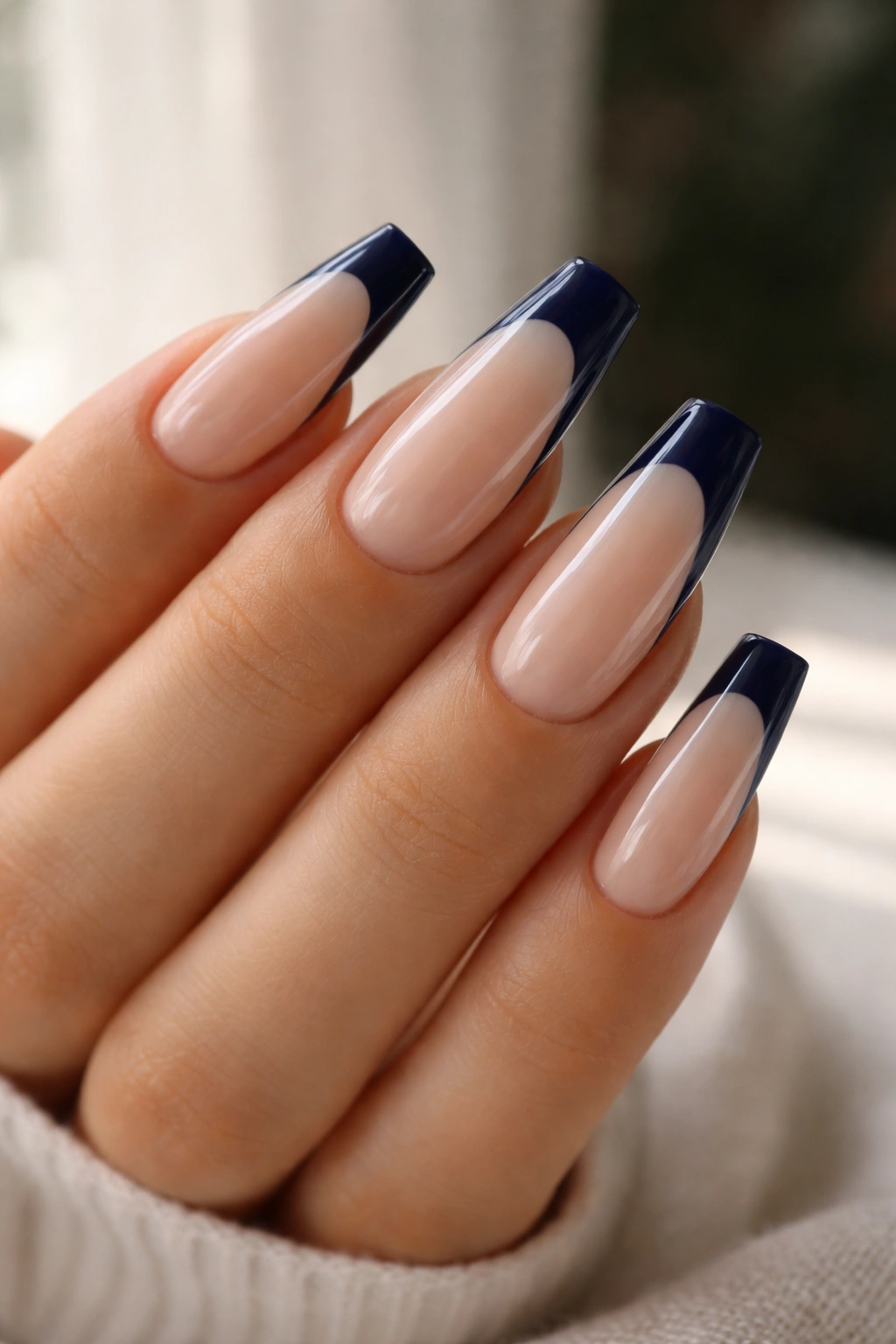
Picture the cleanest version first: a sheer nude base, a deep navy smile line, and a glassy top coat that makes the tips look almost wet. If you want the design that will still feel right after a wedding, a work week, and dinner out on Saturday, this is the one I’d start with.
The beauty of this set is restraint. The coffin shape already gives you structure, so the color doesn’t need extra tricks. Keep the navy band at about 2.5 to 3 millimeters on a medium-long nail, and make sure the smile line curves upward at the sides instead of running straight across. That tiny lift changes the whole hand.
Why It Works
A glossy finish lets navy show its depth. Under cool light, it reads nearly black. Near daylight, you catch the blue. That shift is subtle, though it keeps the manicure from looking flat.
The nude base does heavy lifting too. A sheer pink-beige smooths the natural nail without erasing it, which keeps the French tip effect intact. If the base turns too opaque, the set can slip into color-block territory.
Quick Design Notes
- Best length: Medium to long coffin, roughly 12 to 18 millimeters past the fingertip
- Best base: Sheer neutral pink or milky beige
- Best finish: High-gloss no-wipe gel top coat
- Best for: First-time navy French tip wearers, office settings, events, polished everyday looks
My pick: if you only book one navy French set all year, make it this one.
2. Extra-Thin Navy Micro Tips on Long Coffin Nails
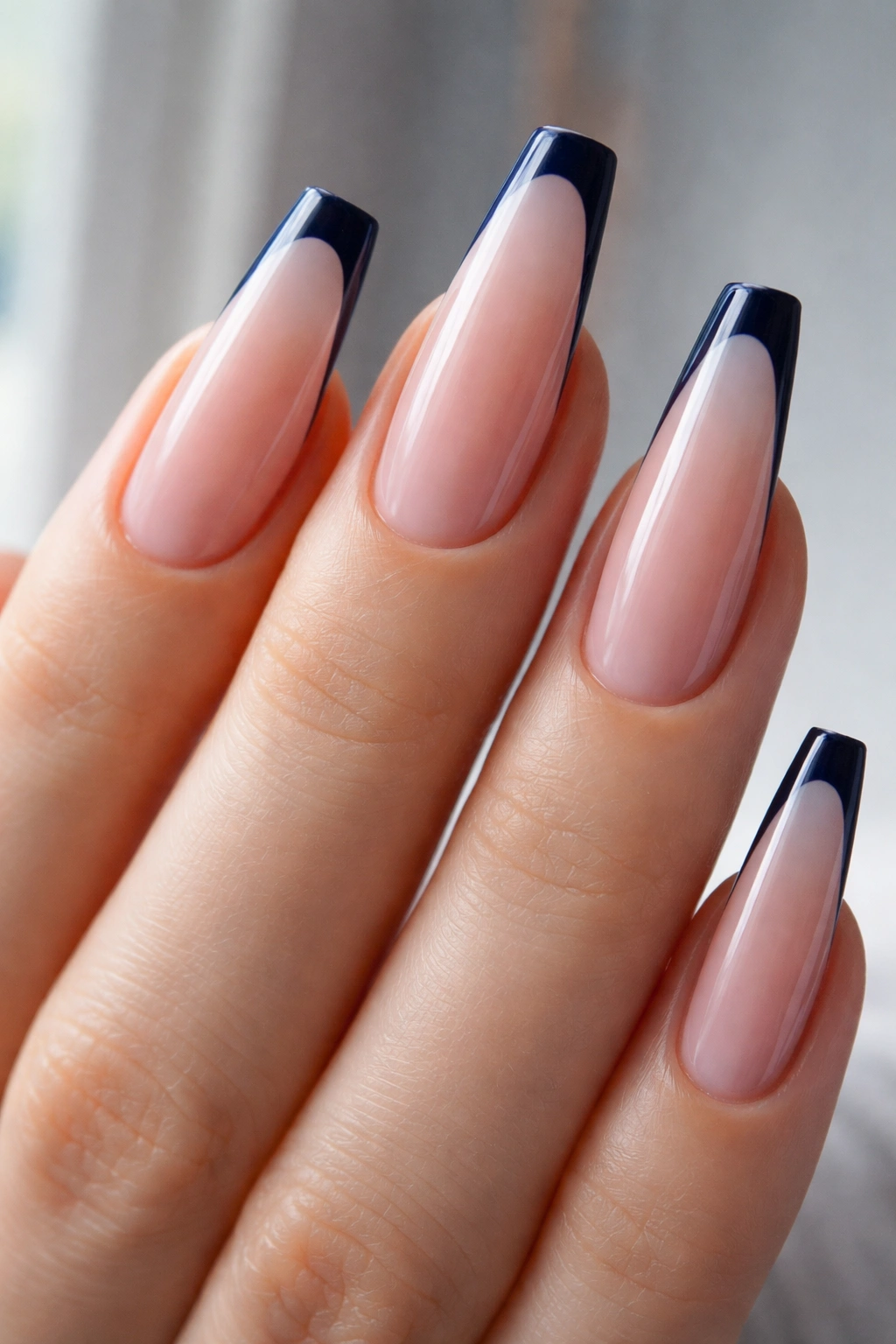
The thinner the tip, the harder it is to fake skill. That’s why micro French lines look so sharp when they’re done well and so disappointing when they are not.
On a long coffin set, an ultra-fine navy edge—around 1 millimeter, maybe 1.5—feels modern and precise. You still get color at the tip, though the negative space does more of the talking. The result looks leaner than a standard French and a little cooler, especially if your nail beds are already long.
This design needs length. On short coffin nails, a micro tip can disappear from straight-on view and look like accidental polish wear. Give it enough room, and the line becomes architectural. The flat end of the coffin shape helps here because it creates a clean runway for that tiny navy strip.
A sheer pink base keeps things airy. Skip chunky rings or heavy accent nails with this one. The appeal is the spare line work, the sort of manicure that gets noticed when someone hands over a card or reaches for a coffee cup—not because it’s loud, but because it’s exact.
I also think this is one of the few French styles that looks better when the sidewalls stay long and narrow. Too much taper, and the line gets pinched. Too little, and it starts looking square.
3. Matte Navy V-French Tips With Sharp Sidewalls
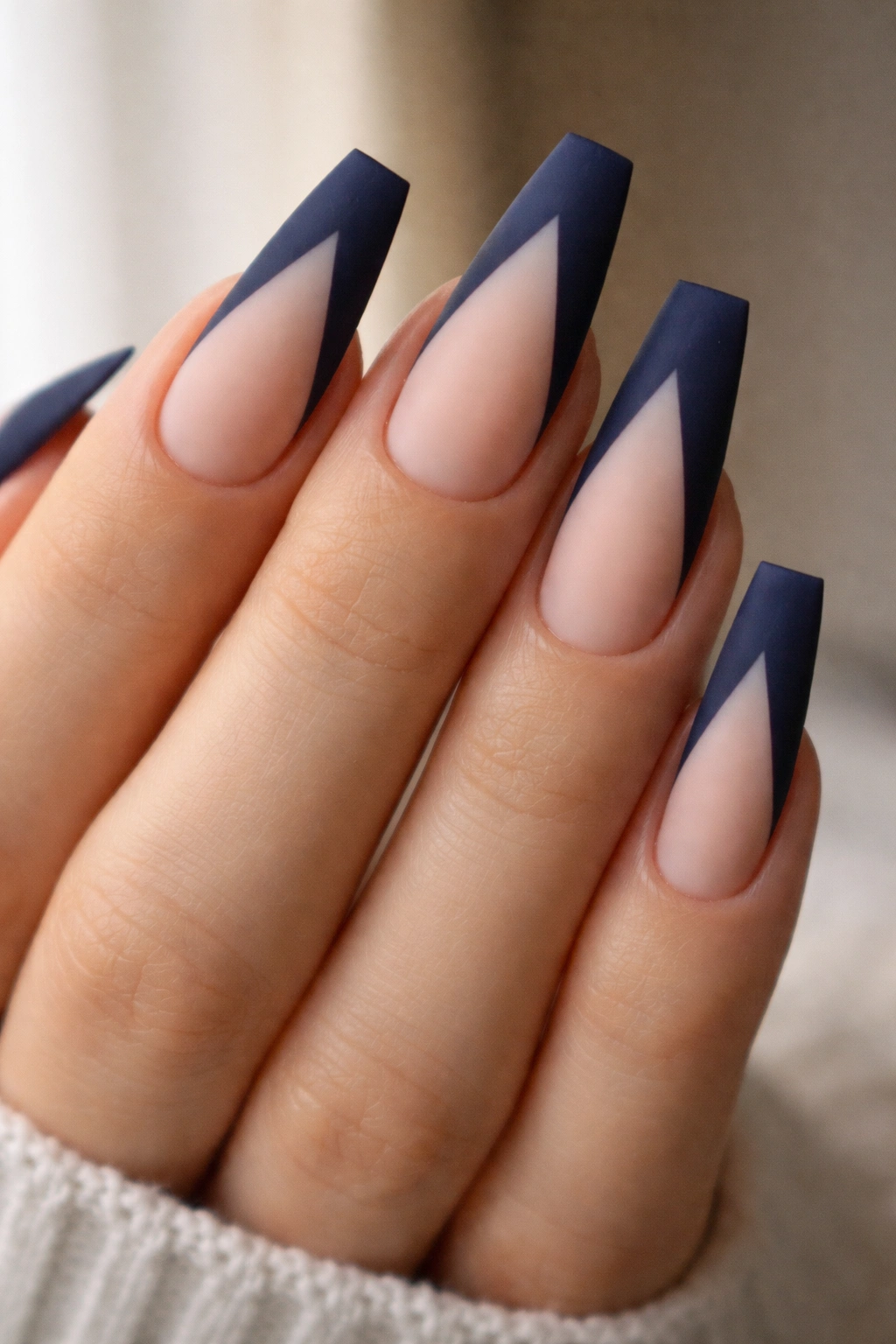
Can matte still look crisp on a French tip? Yes—but only when the shape is sharp enough to carry it.
A V-French swaps the curved smile line for two angled strokes that meet in the center of the tip. On coffin nails, that geometry makes sense. The flat edge echoes the point of the V, so the whole nail feels more graphic and less sweet than a traditional French manicure.
Matte navy gives that structure a softer surface. You lose the reflective shine, which means the line work needs to be stronger. Ask for full-opacity navy gel, not a jelly shade, and keep the V high enough that it lengthens the nail bed instead of cutting across it. On medium-long nails, the meeting point of the V usually looks best sitting 3 to 4 millimeters above the free edge.
How to Keep the V Clean
Use a matte top coat only after the edges are perfected under gloss. That sounds backward, though it helps. Many nail artists refine the shape with a shiny layer first because it shows bumps and wobbles more easily, then seal with matte once the lines are crisp.
Matte also shows wear faster at the tip. If you type all day or open cans with your nails—please don’t—the finish can burnish and turn slightly shiny. A fresh top coat at the 10-day mark fixes most of that.
This look is for people who want navy French tips with a sharper mood. Not harsh. Sharper.
4. Navy Tips Outlined With a Fine Silver Pinstripe
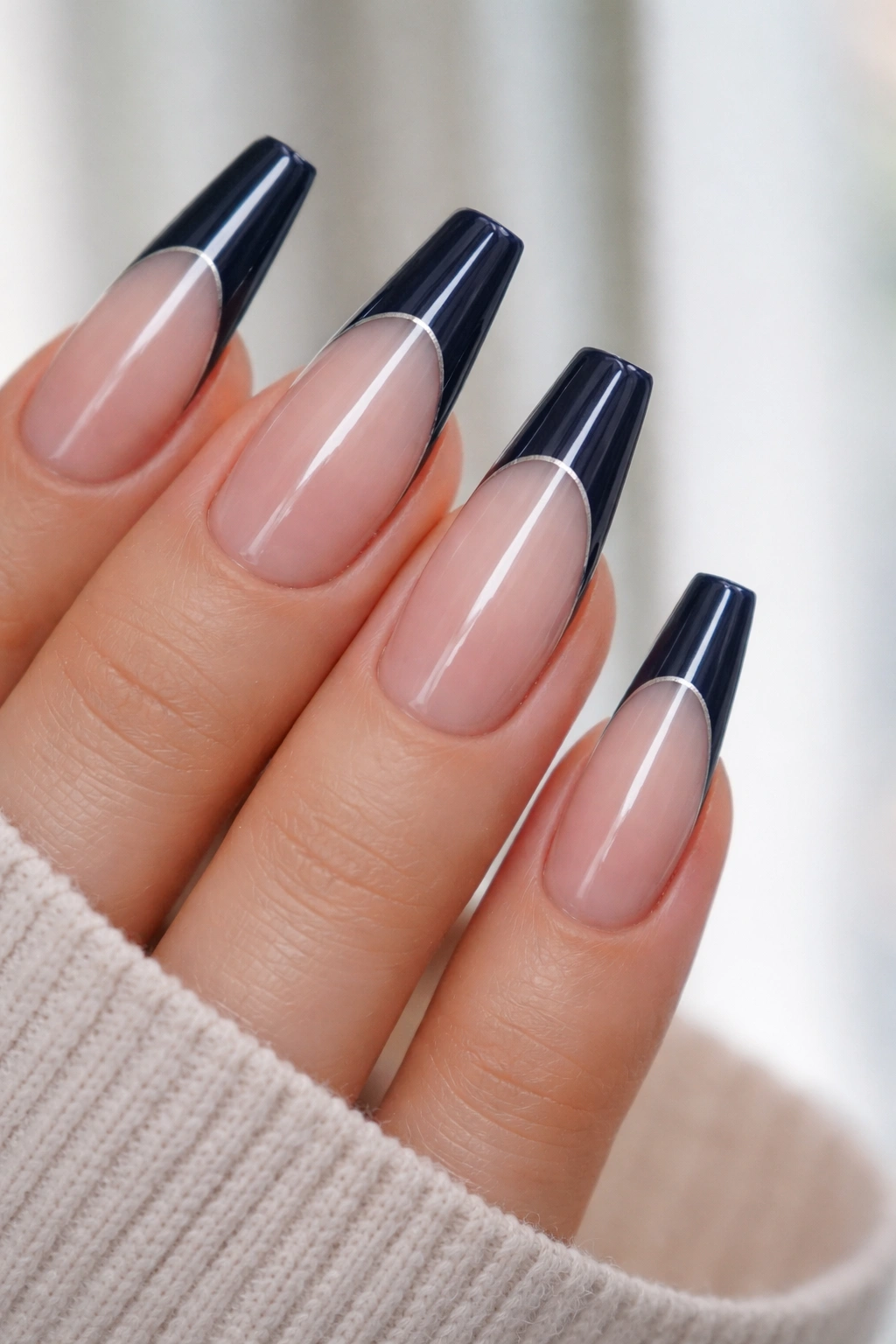
I first noticed how good this looks under dim restaurant lighting. The navy sits deep and quiet, then the silver pinstripe flashes at the seam between the nude base and the tip every time the hand moves.
That thin metallic line does more than decorate. It separates the colors so the French edge looks cleaner, almost cut with a blade. On coffin nails, where the tip has more width than almond nails, that border keeps the design from feeling heavy.
Use restraint. The silver line should stay narrow—about 0.5 millimeter is enough. Once it gets thicker, you no longer have a pinstripe. You have a second tip, and the whole thing starts fighting itself.
The Details That Make It Work
- Choose cool chrome silver, not chunky glitter polish
- Keep the navy opaque and smooth, with no shimmer in the blue itself
- Pair it with a milky or sheer base, not a fully nude-opaque base
- Medium to long coffin lengths show the stripe best
- Silver jewelry pulls the set together fast
A set like this does not need rhinestones, foil patches, or accent fingers loaded with extras. The line already gives you contrast, movement, and a cleaner break between tones. I’d wear this for an evening event before I’d wear a plain glitter nail, every time.
5. Thick Deep-Navy Arcs Over a Milky Pink Base
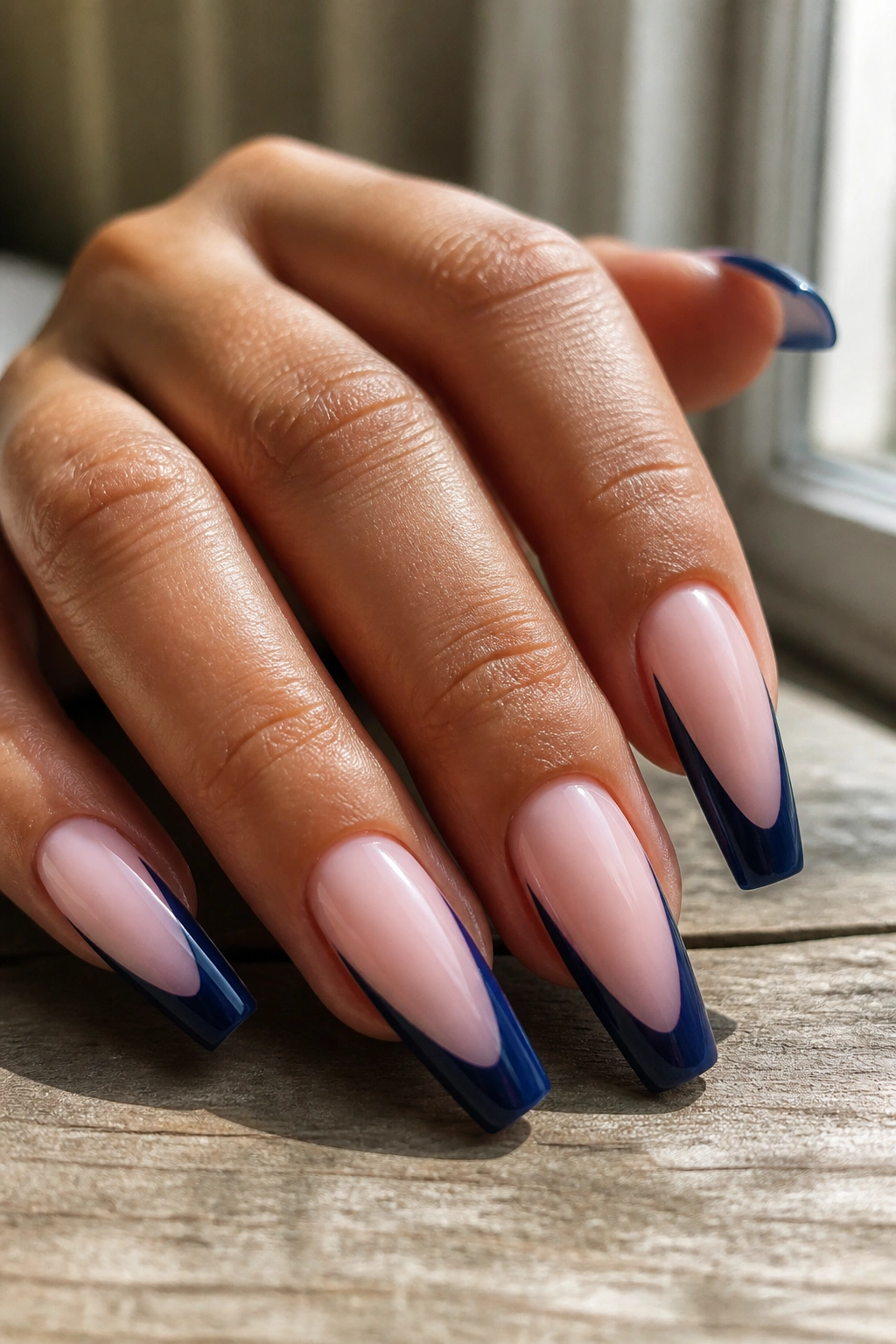
This one has more attitude.
A thick French tip can go wrong fast on coffin nails because a flat, wide band shortens the nail bed and makes the hand look blocky. A deep arc, though, is different. When the navy curves high at the sidewalls and drops lower in the center, you get weight at the tip without losing that stretched shape people want from coffin nails in the first place.
The base matters more here than in most versions. You want a milky pink base with a soft cloudiness to it, not a transparent nude. That haze makes the thicker navy band feel intentional, almost retro, while still reading polished. Against a clear base, the tip can look too abrupt.
The navy should cover roughly the top quarter of the nail on a long set. Less than that, and the design loses its point. More, and it starts to look like a color-block manicure with a naked half-moon left over.
I like this style when the nails are long enough to show shape from across the room—at least 15 millimeters past the fingertip. Shorter than that, and a deep French can crowd the nail bed. Longer coffin nails carry it better because the side taper keeps the thickness in check.
Bold tip placement like this also hides wear better than people expect. Tiny scuffs on the free edge get swallowed by the dark color instead of sitting on top of a sheer base where your eye goes straight to them.
6. Diagonal Side-French Navy Tips for a Longer-Looking Nail Bed
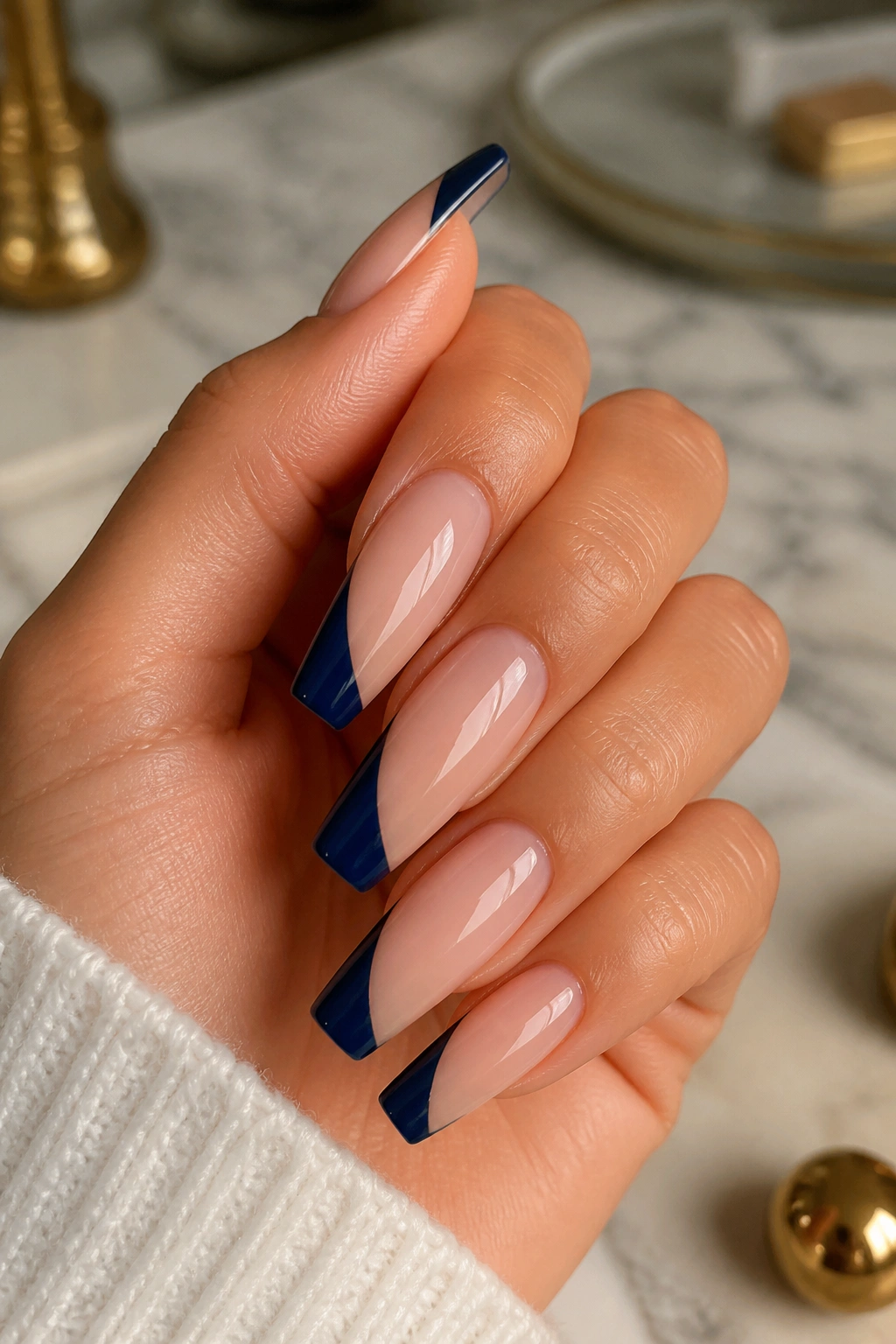
Unlike a centered smile line, a diagonal side-French pulls the eye across the nail instead of straight over the tip. That small shift makes the nail bed look longer, which is useful if your natural nails run short and wide or if your fingers look better with a little more visual length.
The design starts lower on one sidewall and sweeps upward toward the opposite edge. On coffin nails, it works best when the diagonal still respects the flat tip—think angled, not slashed. If the line gets too steep, the shape loses balance.
This is one of those styles that looks smarter than it sounds. From a distance, you still read it as a French manicure. Up close, the asymmetry makes it feel fresher. I’d choose this over a standard smile line if you’ve worn French tips for years and want a change that people notice without needing a speech about it.
Who suits it best? Nail beds that feel short. Hands with broader knuckles. People who like rings stacked on one side of the hand, because the angle echoes that off-center pull.
Ask for the diagonal to begin about 2 millimeters below one sidewall corner and travel upward with a smooth sweep, not a hard triangle. A milky neutral base keeps it grounded. Matte can work, though gloss usually shows the movement better.
7. Navy French Tips With Tiny Crystal Accents at the Cuticle
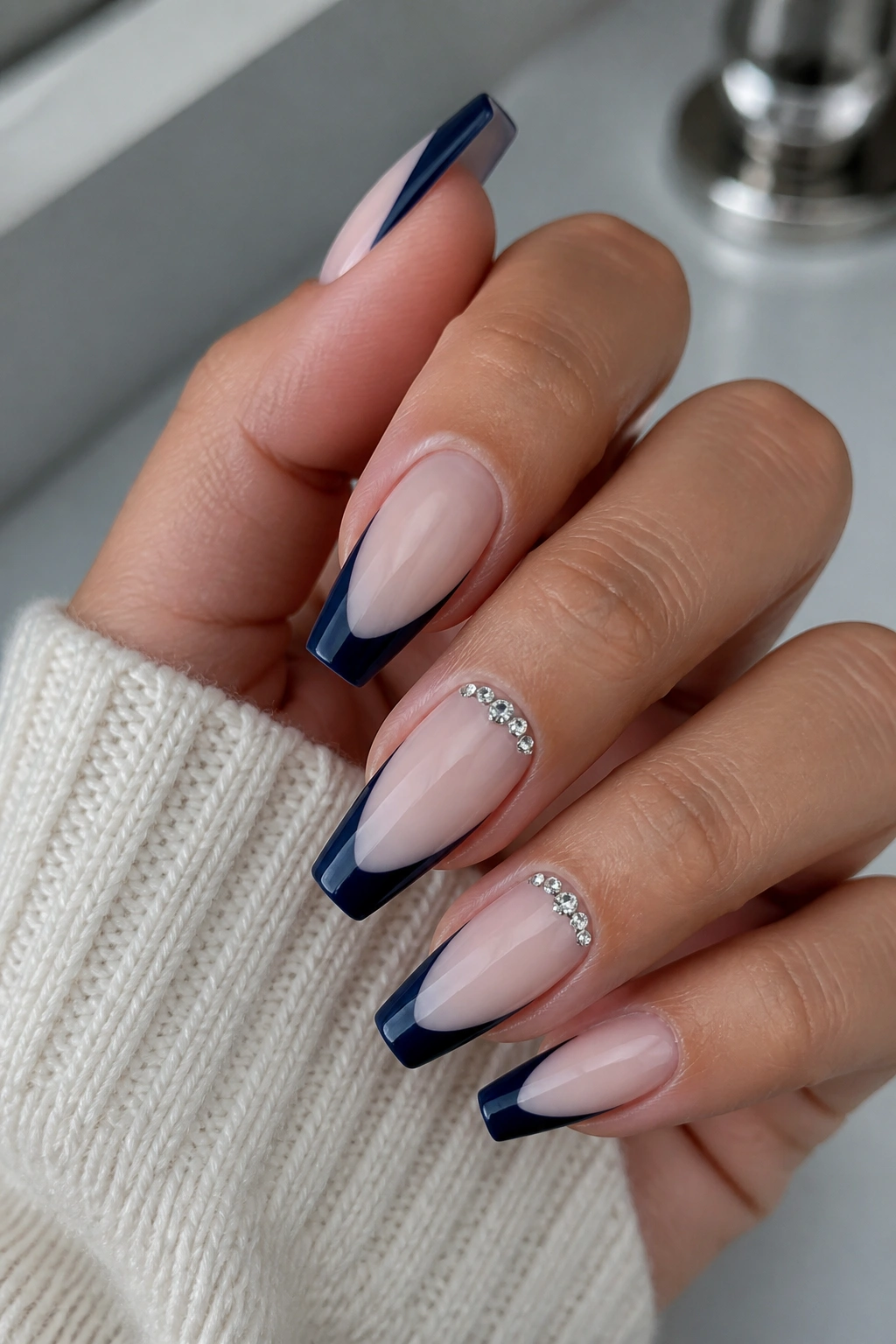
A crystal can ruin a clean French set faster than almost anything else. Too large, too many, or placed too high on the nail, and the manicure stops being about the navy tips and starts looking busy.
Used sparingly, though, one tiny stone near the cuticle gives navy French tips a little lift. I’m talking ss3 or ss5 crystals—small enough to catch light, small enough not to dominate the design. Coffin nails can handle a hint of sparkle because the shape is already structured and a dark tip holds the design in place.
Where the Sparkle Should Sit
Put the crystals low, close to the cuticle line, and leave the tip alone. That spacing creates tension between the dark French edge and the small point of shine near the base. It also makes regrowth less awkward than center-nail gems do.
You can place them on every nail if they stay tiny, though I prefer them on two accent nails per hand. Ring finger and pinky works well. Ring finger and thumb also looks sharp when you hold a phone or a glass.
Quick Placement Notes
- Choose clear crystals, not multicolor AB stones
- Keep the navy tip glossy so the crystal does not outshine it
- Use flat-back stones sealed well at the edges
- Avoid oversized gems on short coffin nails
Best move: ask for one stone per accent nail, no clusters.
8. Navy Tips With a Brushed Gold Foil Border
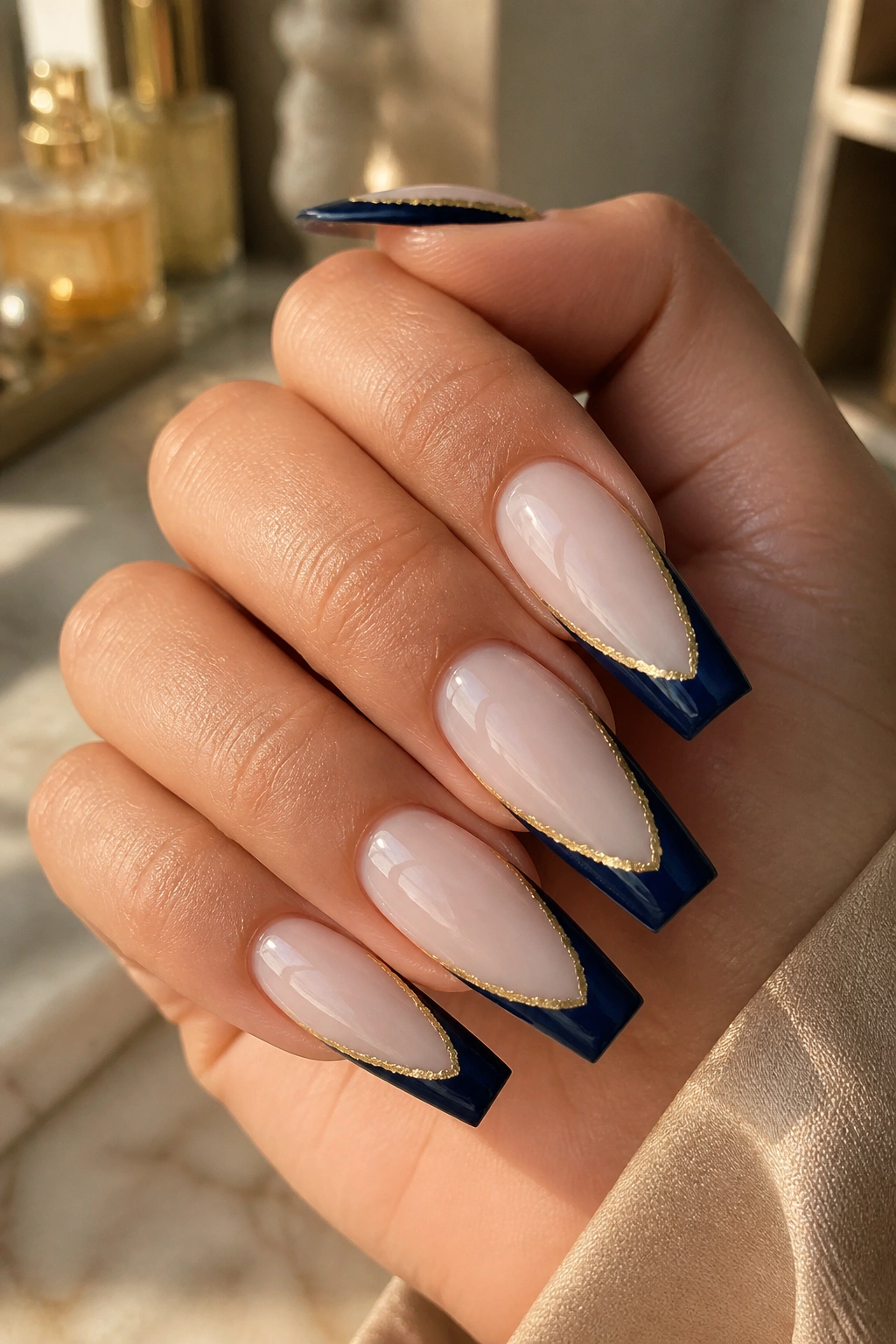
Gold and navy can look expensive fast—or costume-like just as fast. The difference sits in the texture.
A brushed gold foil border works because it is irregular. Instead of a perfect metallic stripe, you get a thin broken seam where the foil kisses the edge of the navy tip. That roughness keeps the manicure from feeling too formal, which matters because coffin nails already carry enough structure on their own.
Use transfer foil or pressed foil flakes in a narrow band right where the base meets the tip. Chunky leaf pieces are harder to seal and tend to catch at the edges after a week. You want the gold to look like a trace, not a patch. On a medium-long coffin nail, even 1 millimeter of foil texture is enough.
This design suits warmer skin tones especially well because the gold adds warmth that a cool navy can sometimes lack. The base should stay soft and milky. A peachy nude can work, though I’d avoid anything orange. Orange under navy is one of those combinations that sounds minor until it is on all ten fingers and suddenly all you can see is the mismatch.
Keep your jewelry consistent. Yellow gold or mixed metals with a gold lead look best here. A brushed top coat effect on the foil is nice too—less mirror, more flicker.
9. Velvet Cat-Eye Navy French Tips
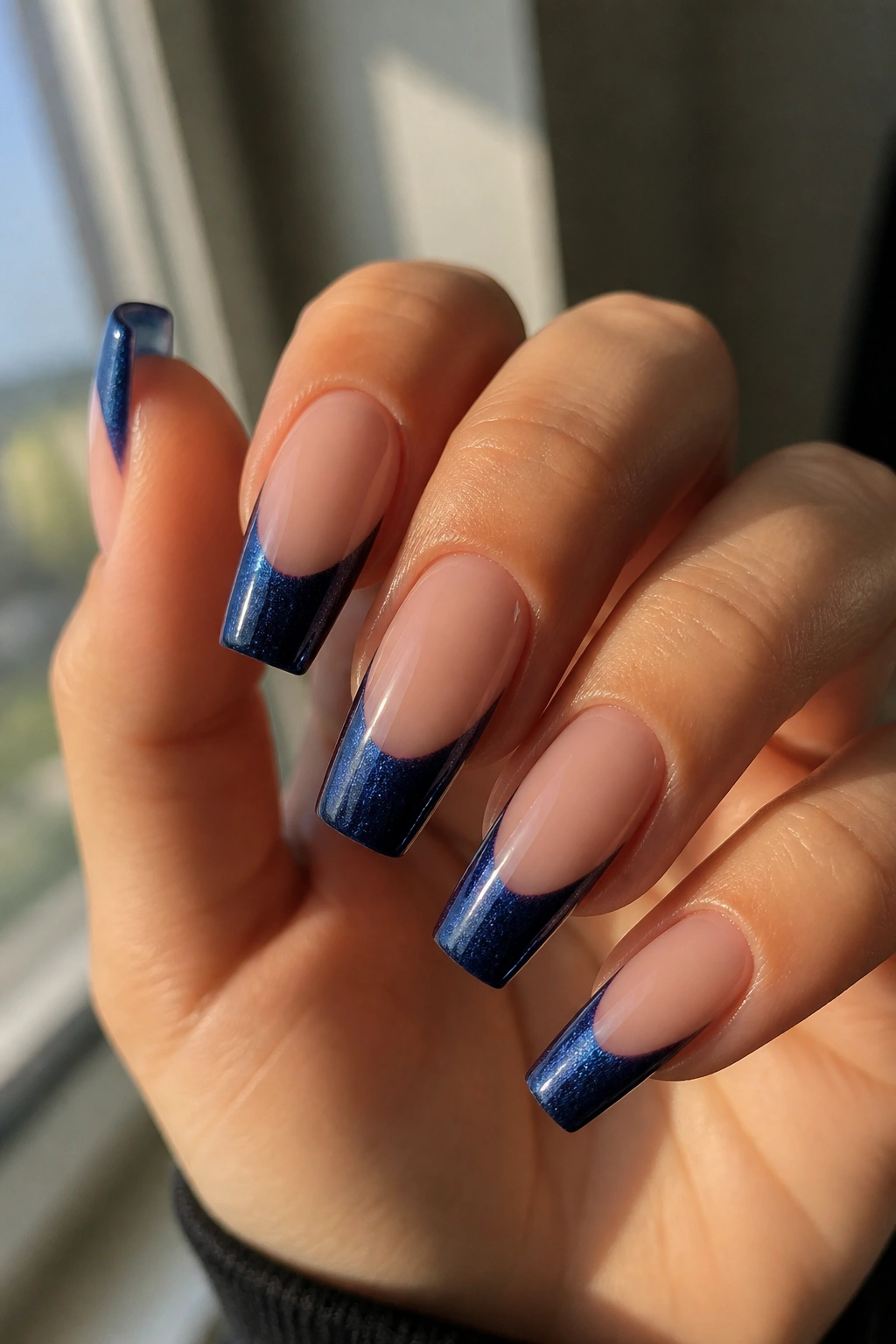
What if you want movement in the color without covering the whole nail in magnetic polish? Put the effect only on the tip.
A cat-eye navy French tip uses magnetic gel on the French section alone, then pulls the shimmer into a soft line or halo before curing. On coffin nails, that moving flash sits right on the broadest part of the nail, so every hand movement changes the look. It is one of the few textured finishes that still feels controlled on a French manicure.
The base should stay quiet. A sheer neutral or cool milky pink gives the cat-eye tip room to show off. If you add shimmer to the base as well, the eye has nowhere to rest and the whole set gets muddy.
How the Magnetic Effect Should Sit
Ask for the magnet pull to run slightly diagonal or softly centered across the tip, not in a harsh straight bar. A diagonal glint complements the coffin shape better. It follows the taper instead of fighting it.
Also, keep the cat-eye fine-grained. Some magnetic gels have large reflective particles that read chunky once confined to a French tip. A tighter shimmer gives you that velvet look people chase—dense, smooth, almost suede-like under certain light.
This style wears best on medium to long nails and in a glossy finish. Matte kills the movement, and movement is the whole point.
10. Navy French Tips With Negative-Space Half Moons
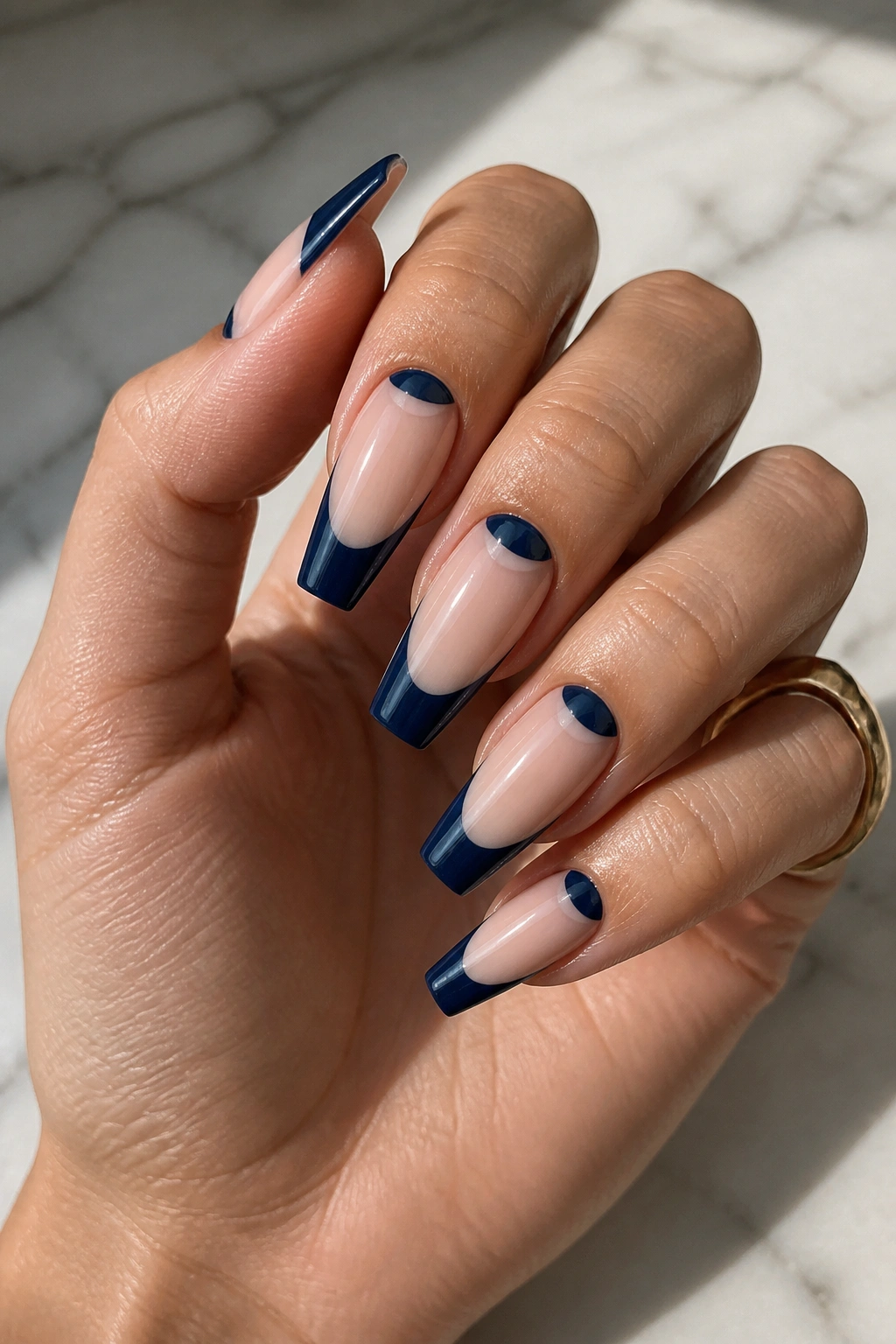
Some people want a nail set that looks designed, not decorated. This is that set.
A negative-space half moon leaves the lunula area near the cuticle bare or covered only with sheer base, while the tip carries a navy French line. The empty space at the bottom and the dark shape at the top create a balanced, almost editorial look on coffin nails. It feels graphic, though still easy to wear if the rest of the design stays clean.
The trick is spacing. You need enough room at the cuticle for the half moon to read—about 3 to 4 millimeters on a medium nail, a little more on a longer set. Then the French tip should echo that curve instead of clashing with it.
Best Ways to Keep It Sharp
- Use a semi-sheer nude base over the whole nail so the negative space still looks polished
- Match the half-moon curve to the smile line curve
- Keep the navy tip at medium thickness; deep tips can crowd the design
- Skip accent stones and foil here
This manicure has a slight vintage edge, though it doesn’t feel costume-heavy the way full moon manicures sometimes do. If you wear tailored clothes, crisp shirts, dark denim, sharp blazers—yes, I know that sounds oddly specific—this design clicks into place fast.
11. Navy French Tips Over a Soft Aura Base
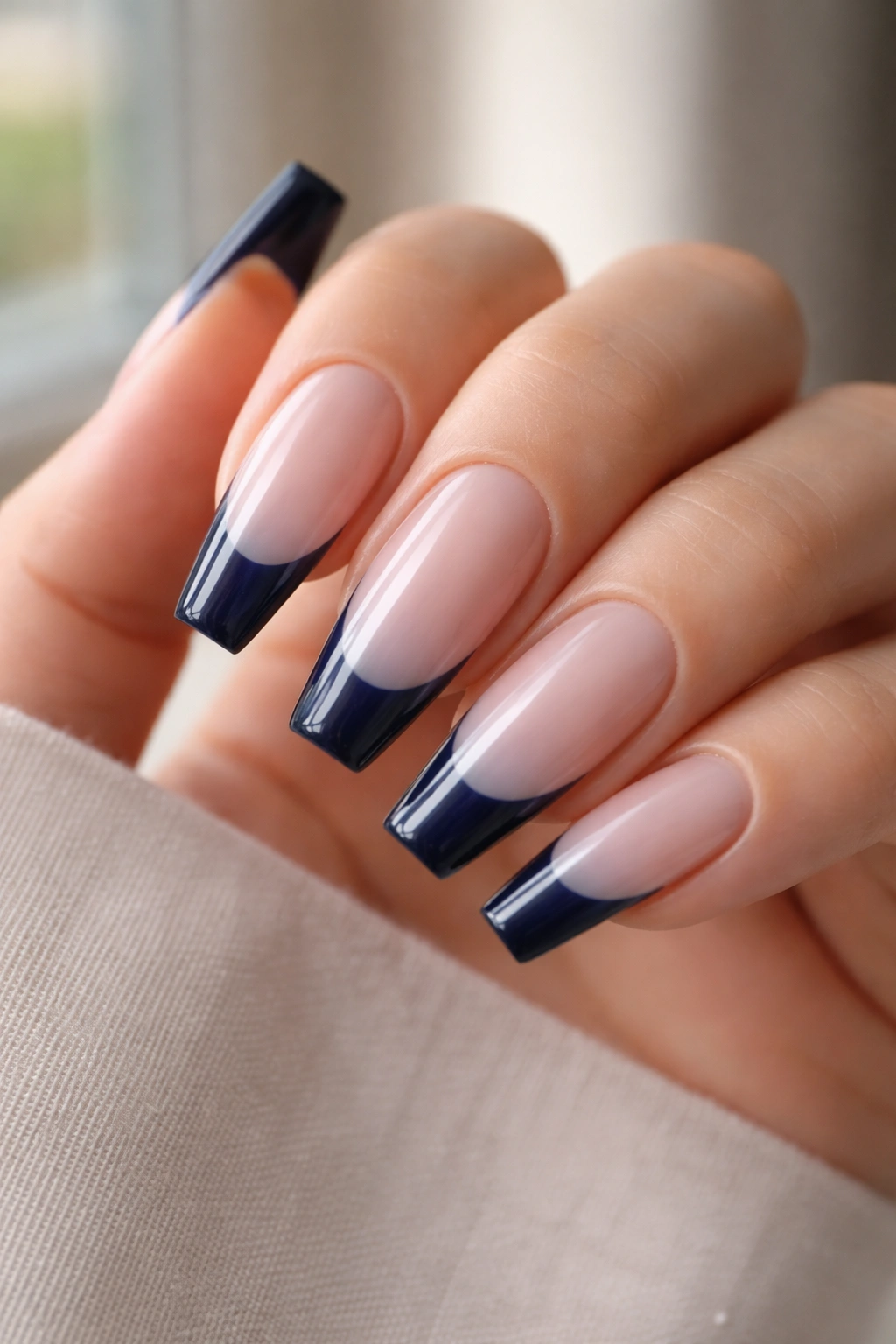
I did not expect this combination to work as well as it does. An aura base sounds like it should compete with a French tip. When the colors stay restrained, it doesn’t.
A soft aura base means the center of the nail gets a faint airbrushed bloom—usually a cloud of cool pink, muted lavender, or pale blue—while the edges fade back into a nude or milky neutral. Add a navy French tip on top, and the result feels layered rather than busy. The tip anchors the design. The aura gives the center a little life.
Subtlety matters. Keep the aura diffused and pale. If the center glow gets too saturated, your eye sticks there and the French tip turns into an afterthought. The best version looks almost like the nail is lit from underneath, then finished with a dark clean edge.
I would only do this on medium-long or long coffin nails. Short nails do not give the fade enough breathing room. The aura needs central space, and the French needs tip space. Cram both onto a short nail and each loses shape.
This style also photographs better in natural light than in overhead salon lighting, which can flatten the fade. Before you commit, ask to see the airbrushed tone against the navy sample on your hand, not only on a plastic swatch. Swatches lie all the time.
12. Celestial Navy Tips With Tiny White Star Details
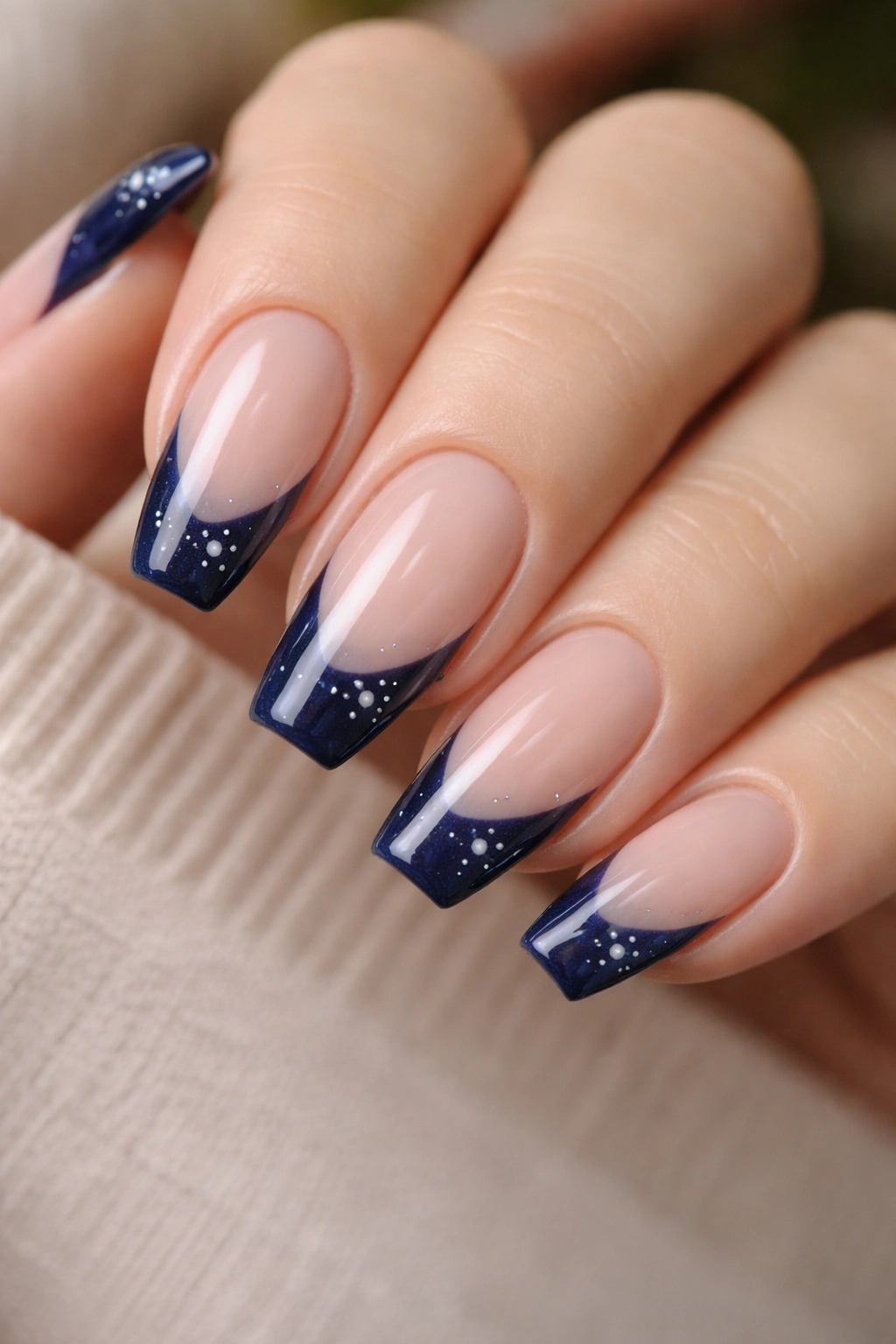
Unlike full galaxy nails, which can turn into a scatter of glitter and dots, celestial French tips stay disciplined. The navy tip gives you a night-sky base. One or two tiny white stars—or a star and a dot constellation—add theme without taking over the manicure.
That restraint is why this version works on coffin nails. The shape already brings enough presence. If every nail gets moons, stars, glitter, chrome, and shimmer, the design starts reading craft-supply drawer. Keep the details hand-painted and sparse. Two accent nails per hand is plenty.
This look suits people who want a little personality in their manicure but still need it to pass through normal life without feeling costume-coded. White star details show best on glossy navy. Matte can work, though the tiny painted stars lose some crispness on a velvety top coat.
My recommendation: keep the stars small enough to fit inside a 3- to 4-millimeter square, place them near one corner of the tip, and leave the rest of the nail alone. A milky base helps the navy pop, while a cooler pink base makes the white details look cleaner.
Done well, this design feels playful in close view and polished from a few feet away. That’s a hard balance to hit. This one actually hits it.
How to Ask for Navy Blue French Tip Coffin Nails at the Salon
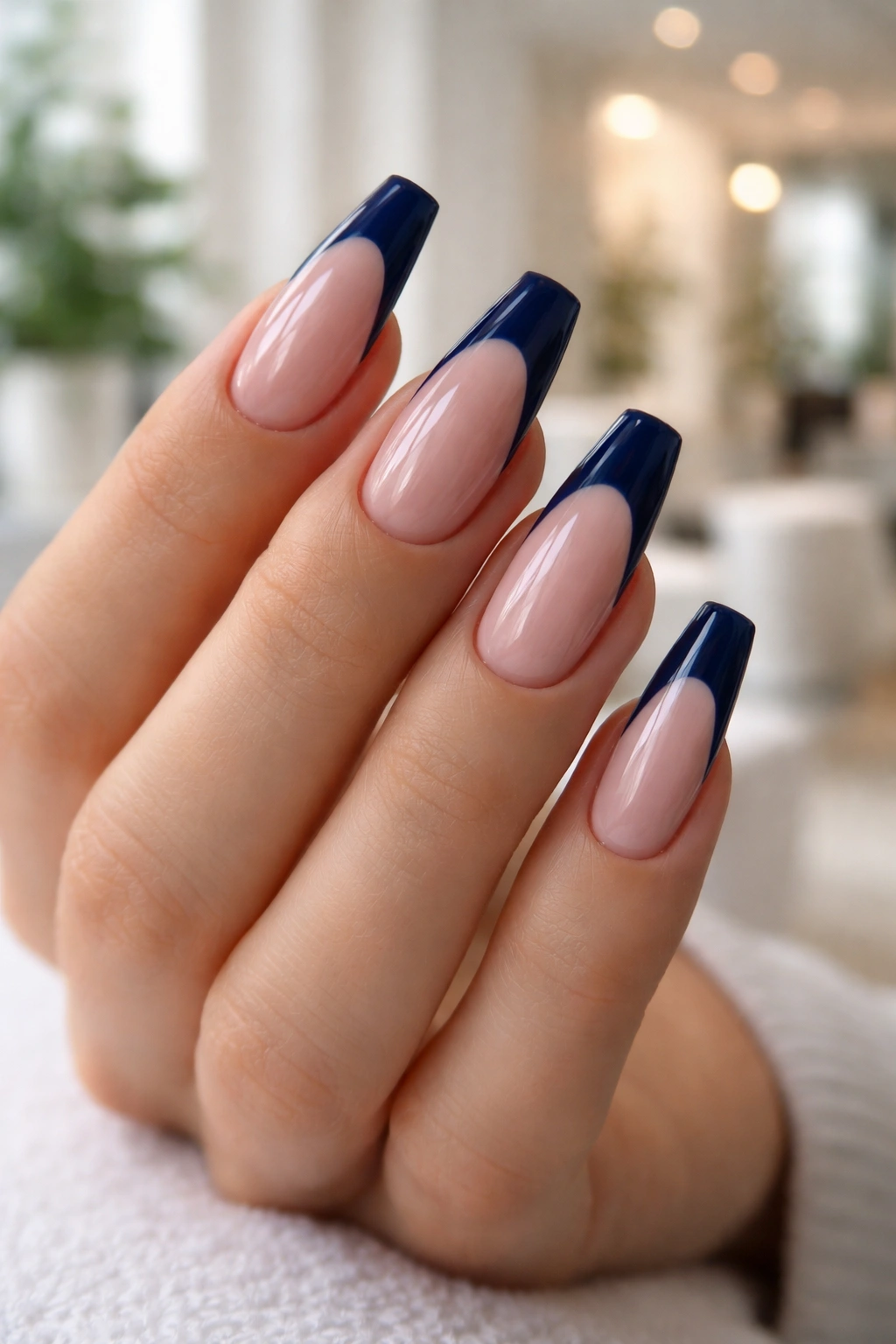
Walking into a salon with only “navy French tips” in mind is how you end up with something close, though not quite right. Coffin shape, tip width, undertone, and finish all need actual words.
A good starting script looks like this: “I want a medium-long coffin shape, a cool milky nude base, and navy French tips with a lifted smile line. Keep the sidewalls straight and the tips crisp.” Then add the finish or detail you want—micro tip, matte V, silver outline, cat-eye, foil, whatever matches the version you picked.
Bring two reference photos, not ten. One photo should show the shape and length. The other should show the tip style or finish. If you bring a photo with almond nails and ask for coffin, or a square set with a rounded smile line and expect sharp V-tips, you’re making the conversation harder than it needs to be.
A few salon notes help:
- Builder gel overlay keeps long coffin nails looking smoother and more even than thin gel polish alone
- Acrylic holds length well if you like a firmer, more rigid feel
- Ask for the navy to be cool-toned, not teal-leaning
- Book fills or rebalancing every 2 to 3 weeks if you wear longer length
- Ask the tech to seal the free edge well; dark tips show chips fast
One last opinion. Check the navy polish sample near a window before it goes on your nails. Some bottles look rich under salon lamps and go flat once you step outside.
Final Thoughts
The best navy French manicure is not the one with the most extras. It’s the one where the base tone, tip width, and coffin shape all agree with each other. Get those three right, and even the plainest version looks strong.
If you lean classic, the glossy nude base with a deep navy smile line will carry you far. If you want something with more edge, the matte V, the side-French sweep, or the cat-eye tip bring a different mood without losing the French structure that makes the look so sharp.
Navy rewards precision. Pick the version that matches how you wear your hands—at work, at dinner, wrapped around a coffee cup on a rushed morning—and the manicure tends to make sense long after the appointment is over.