

A plain white smile line can look sharp on a coffin nail, but French tip coffin nails get far more interesting once you stop treating the tip like a stripe and start treating it like design space. That’s where the modern twist comes in. Not with random glitter dumped on top, not with a full rhinestone situation, and not with a chunky white band that eats half the nail.
Coffin shape changes the math of a French manicure. The sidewalls run straight, the free edge is flat, and the eye notices even tiny mistakes—an uneven line, a tip that’s 1 millimeter thicker on one side, a nude base that turns chalky against your skin. I’ve learned the hard way that when the white edge gets too deep on a medium coffin nail, the whole set starts to look heavy and shorter than it is.
The modern versions that actually hold up are more controlled. A thinner line. A sharper angle. A sheer jelly base instead of opaque baby pink. Maybe chrome used as an outline instead of the whole tip. Little changes, sure, though they completely shift the mood from classic salon default to something that looks current and intentional.
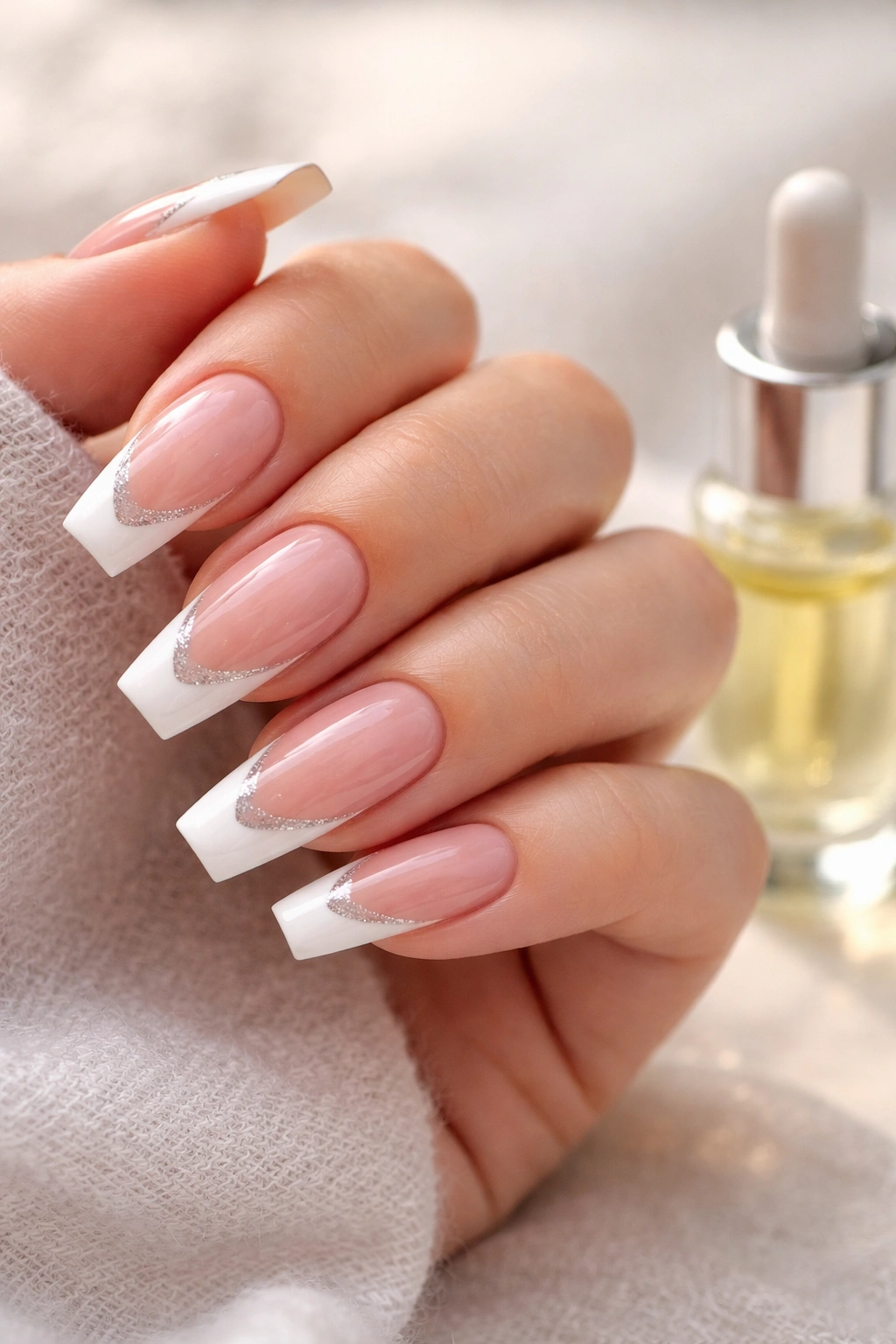
Start with the bones of the set, because the design only works when the shape underneath it does.
What Makes French Tip Coffin Nails Look Modern Instead of Stiff
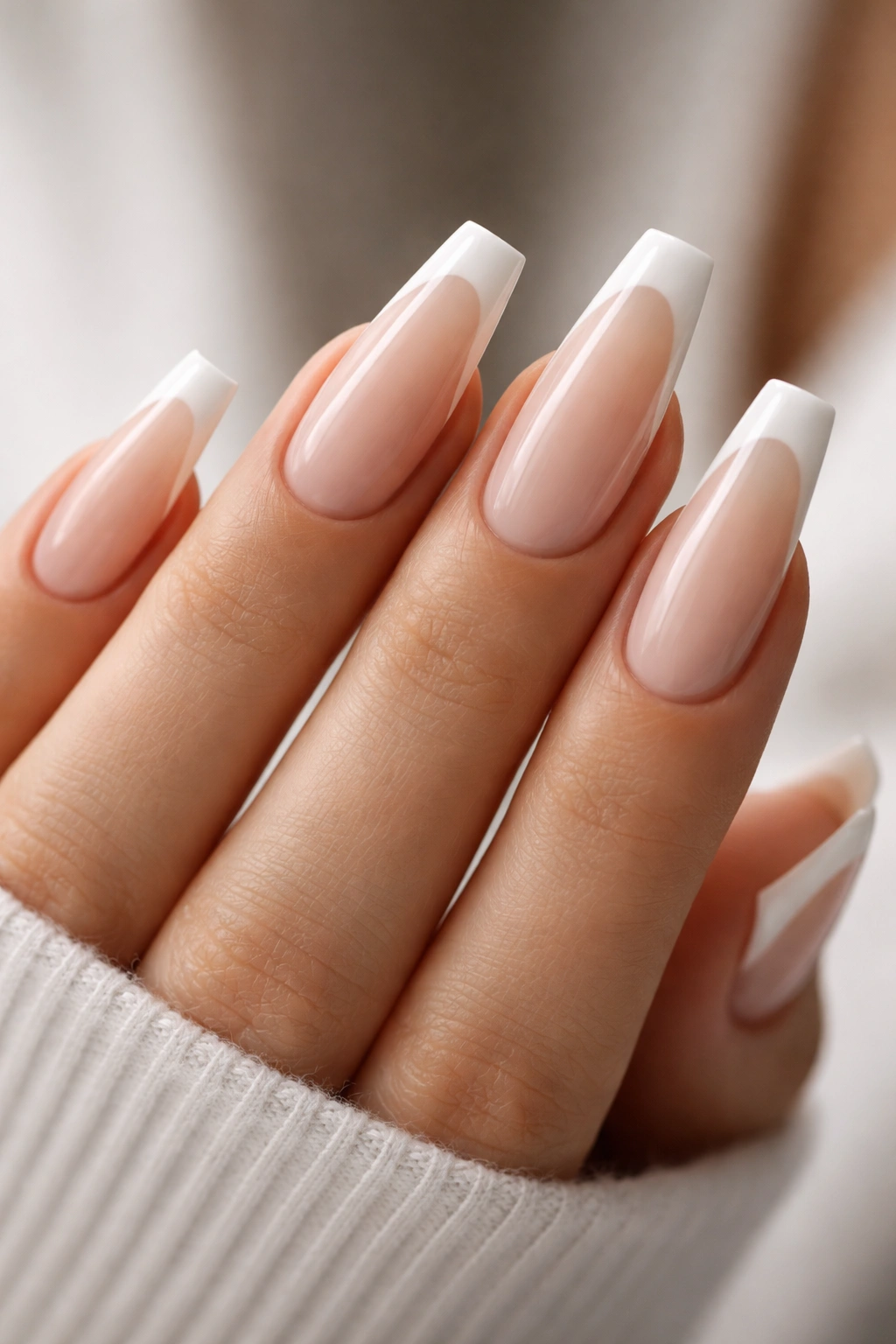
Modern French tip coffin nails are all about proportion. Most outdated sets are not “too classic.” They’re too thick, too bright, too symmetrical, or too loaded up with extras that fight the shape instead of helping it.
Coffin nails already have structure built in. Straight sides. A tapered body. A squared-off end with softened corners. So the French detail has to work with those lines. If the tip is too deep, the nail looks blocky. If the smile line is too rounded, it fights the flat edge. If the nude base is fully opaque, the grow-out starts shouting at you after a week.
The small details that change the whole set
- Tip thickness matters more than color. On a medium coffin nail, a 1 to 2 millimeter tip often looks cleaner than a 4 millimeter one.
- Milky bases age better than flat pinks. A sheer beige-pink or soft peach blur hides regrowth and keeps the nail from looking pasted on.
- Placement can replace decoration. Side tips, V-tips, reverse crescents, and double lines all feel fresher than adding ten charms.
- Finish does part of the work. Matte black, pearl glaze, or chrome edging changes the feel without making the set harder to wear.
That last point gets ignored a lot.
You do not need three trends on one nail. A coffin shape already has presence, so one twist—angle, texture, color, or line placement—is often enough. Once you stack chrome, gems, ombré, and hand-painted swirls on a French tip, the original design disappears.
Prep Work That Keeps a Coffin Shape Crisp for Two to Three Weeks
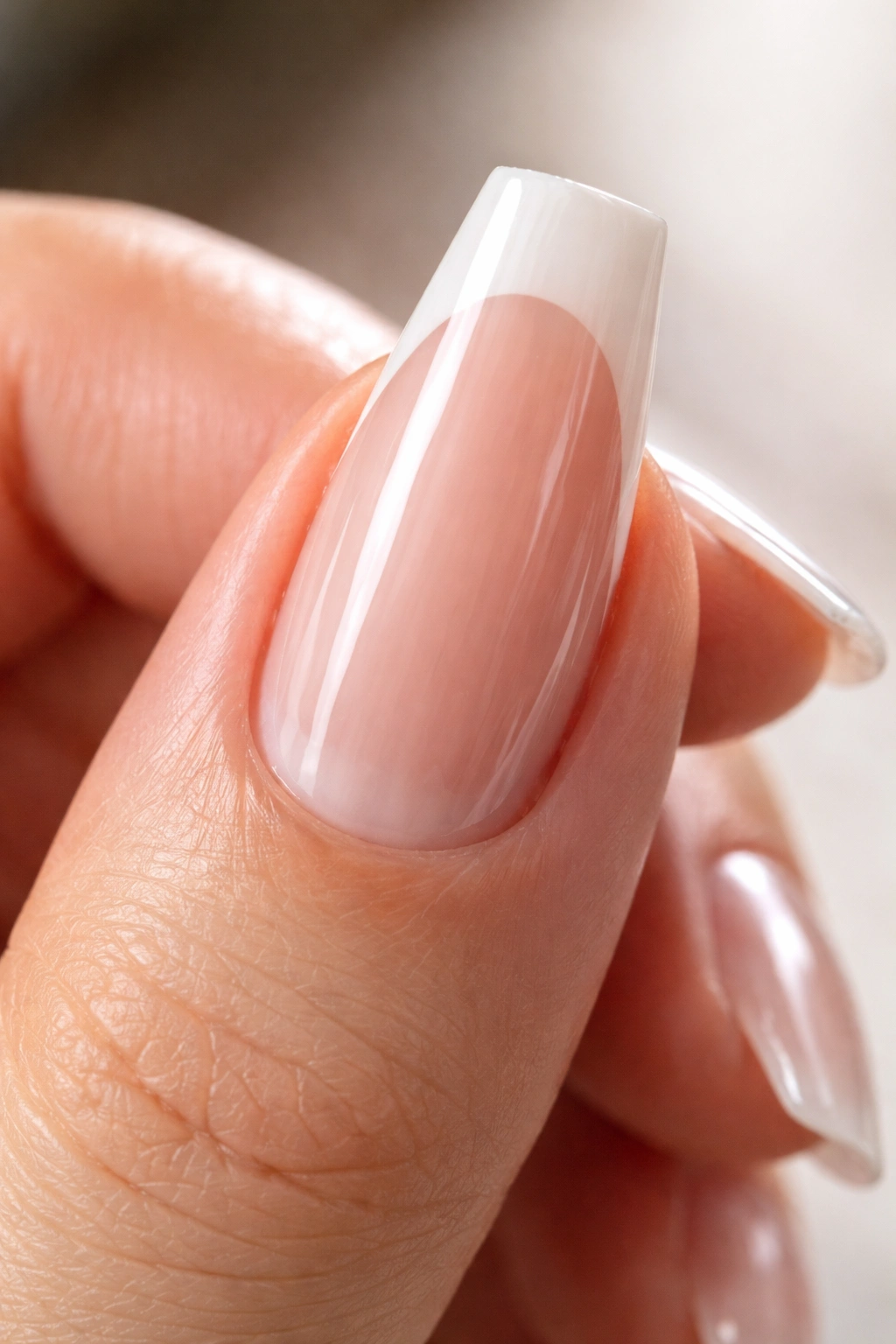
Why do some French sets still look clean on day twelve while others start lifting at the cuticle and chipping along the edge after a few hand washes? Prep. Boring answer, accurate answer.
A coffin nail has exposed corners, even when they’re softened. Those corners catch. If the free edge is not capped well with gel or top coat, the tip design wears first. That matters even more with French styles, because the eye goes straight to the edge of the nail.
A solid prep routine usually includes:
- Cuticle removal that goes past the visible skin. Any dead tissue left on the nail plate can cause lifting near the cuticle line.
- A balanced apex. On medium to long coffin nails, the highest point should sit around the stress area, not in the center of the nail.
- Straight sidewalls. If they flare, the French tip starts looking wide and blunt.
- A sealed underside. A quick swipe of top coat under the free edge helps keep painted tips from peeling at the corners.
Product choice matters too. If your natural nails flex a lot, a modern French tip usually lasts longer over builder gel or a structured gel overlay than over soft polish alone. That does not mean you need dramatic length. Even a short coffin shape benefits from that extra support.
And yes, your nail tech can paint a gorgeous tip over a bad shape. It still won’t wear well.
1. Micro-Line White Tips on a Milky Nude Base
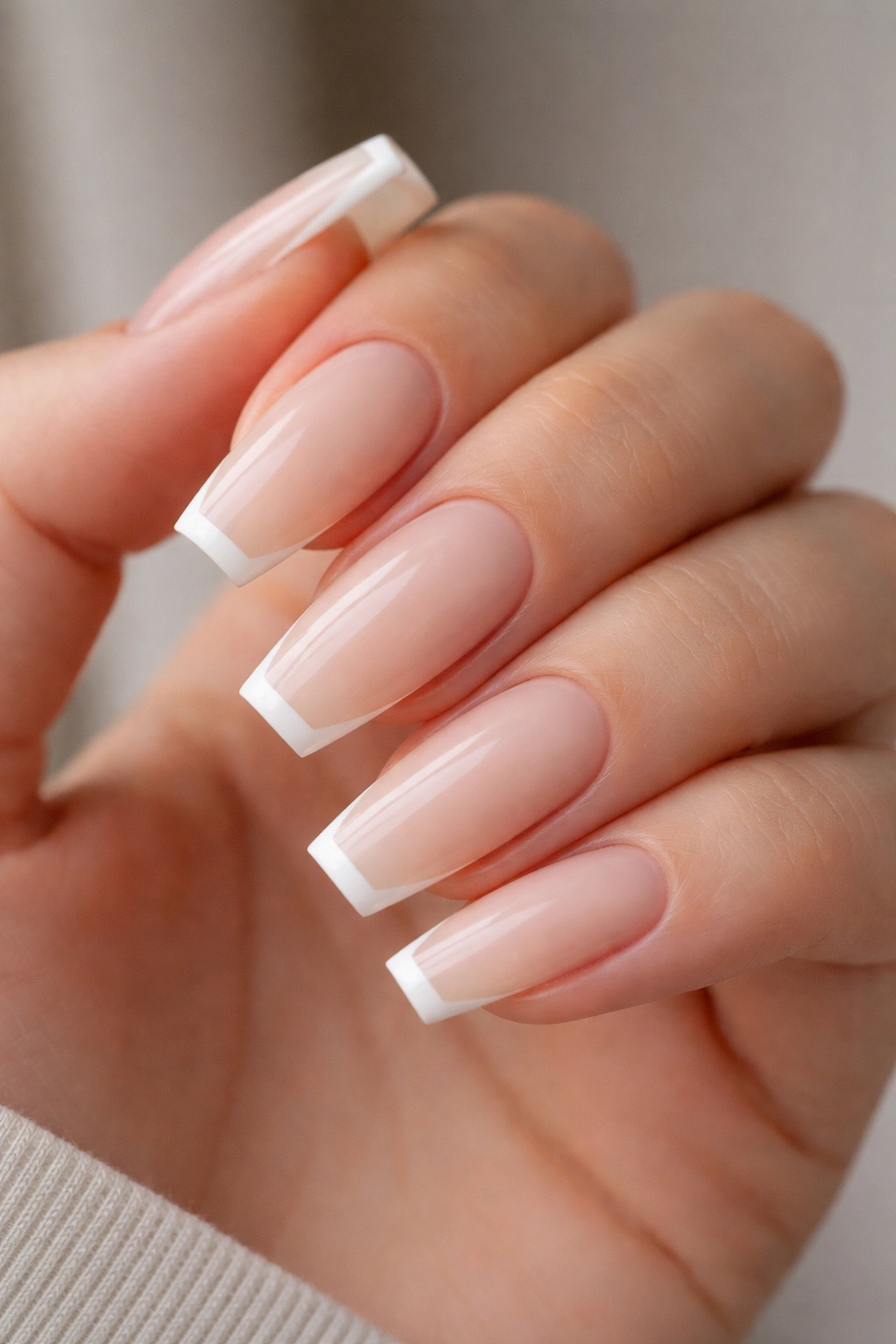
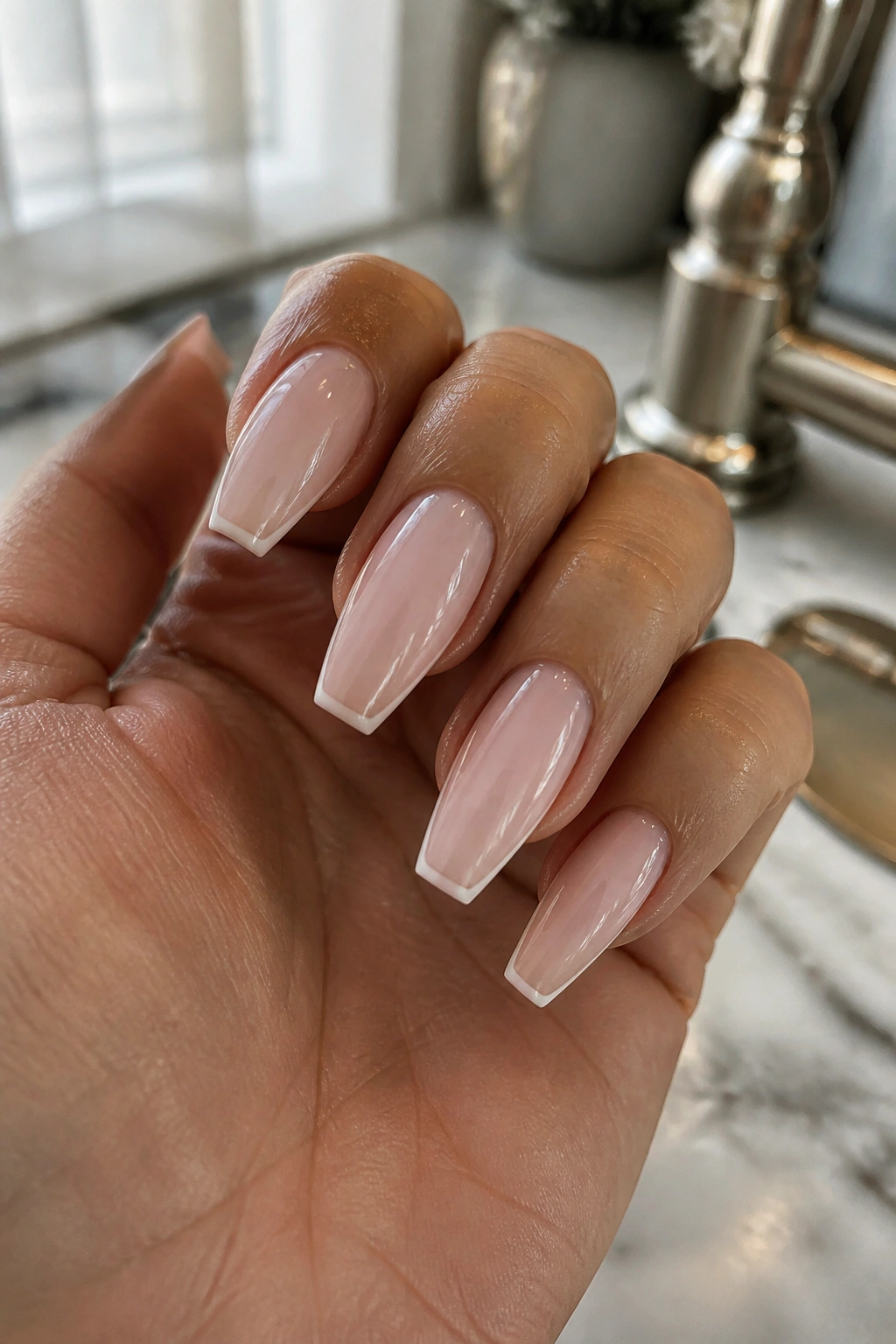
If you love a classic French manicure but hate how bulky it can look on a coffin shape, this is the place to start. Micro-line white tips keep the familiar white edge, though the line is shaved down to the point where it feels cleaner, lighter, and far more current.
The trick is the base. A milky nude—something sheer enough to let the natural nail glow through a little—softens the contrast and keeps the set from looking chalky. On coffin nails, that matters because the shape already brings sharpness. You want the base to take one step back.
Why this one works so well
A narrow white line follows the flat free edge without swallowing it. On medium lengths, I like the tip to stay around 1 millimeter thick in the center, then taper a hair thinner toward the corners. That tiny adjustment makes the nail look longer. A fully even stripe can look stiff.
Ask for these details at the salon
- A soft milky beige or pink base, not an opaque ballet-slipper pink.
- An ultra-fine smile line brush for the tip, rather than painting with the bottle brush.
- A crisp flat edge with softened corners, so the micro line doesn’t look jagged.
- High-gloss top coat, because shine helps the thin line stand out.
I keep coming back to this set because it is low-drama in the best way. You still get the French manicure feel, still get that clean edge when you look down at your hands, yet the whole thing looks leaner.
Best pick for: someone who wants modern French tip coffin nails without straying far from the original idea.
2. Deep Side French Tips With Diagonal Edges
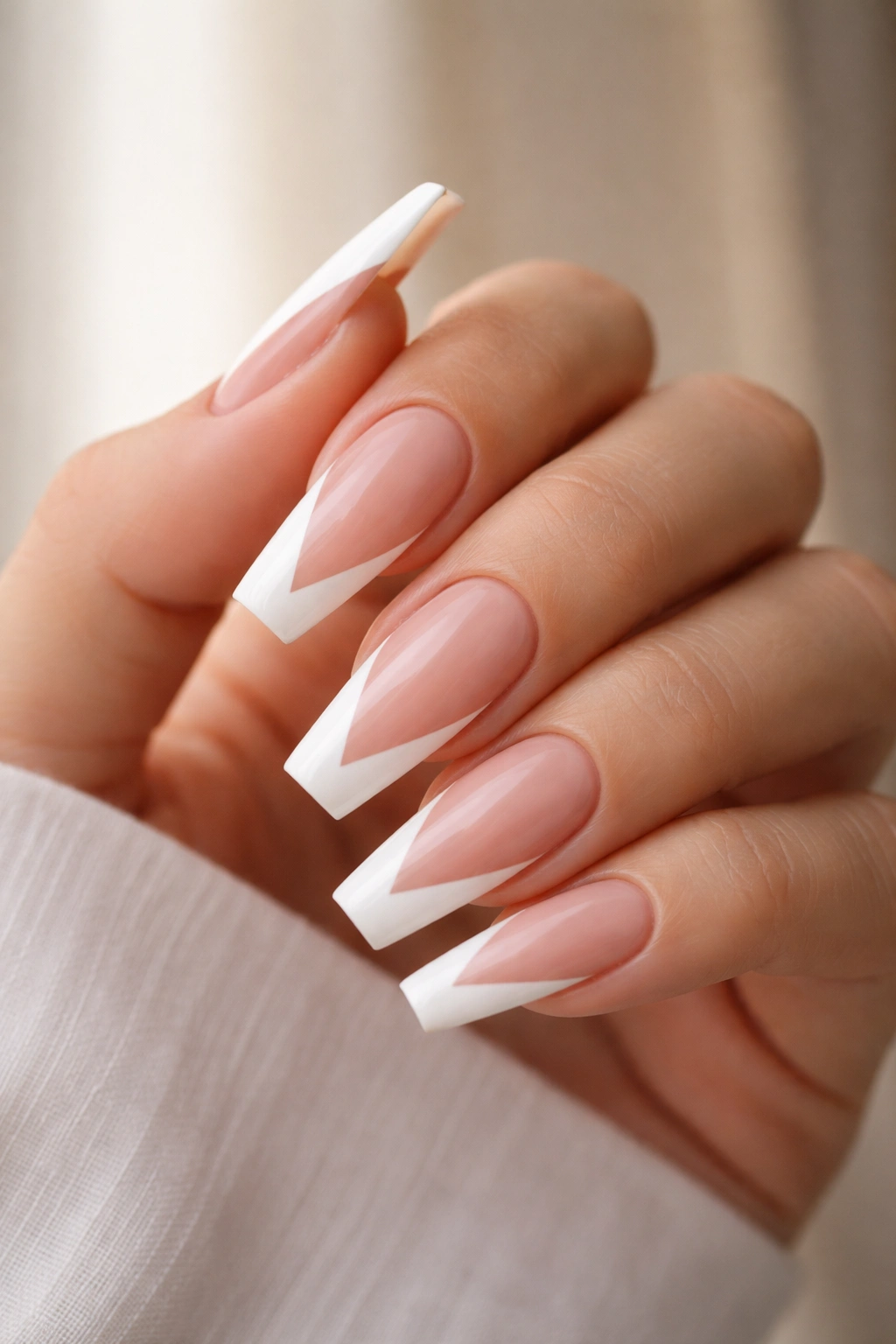
Asymmetry does more for coffin nails than extra sparkle ever will. A deep side French starts at one sidewall and cuts across the tip on a diagonal, leaving part of the nail bare and turning the French line into something sharper.
This design can rescue a shorter coffin shape. A traditional curved smile line sometimes makes short coffin nails look stubby, since the flat edge is already taking up visual space. A diagonal side tip pulls the eye across the nail instead of straight across it, which makes the nail bed seem longer.
Color choice shifts the mood fast. White gives it that clean graphic feel. Black turns it moodier. A muted brown or deep olive reads more fashion-forward without screaming for attention. What I like most, though, is how this design looks on hands in motion. When you hold a mug or scroll on your phone, the angle catches first.
Ask your nail tech to keep the diagonal clean and deliberate—from sidewall to mid-tip, not drifting into the center like a messy half-French. The deepest part of the tip should sit on one side of the nail, with the line cutting down toward the opposite edge.
One caution. If the diagonal line gets too low, it starts reading like a color block instead of a French variation. That can still look good, though it loses the airy effect that makes this style worth doing.
3. Chrome Outlined French Tips With Sheer Pink Nails
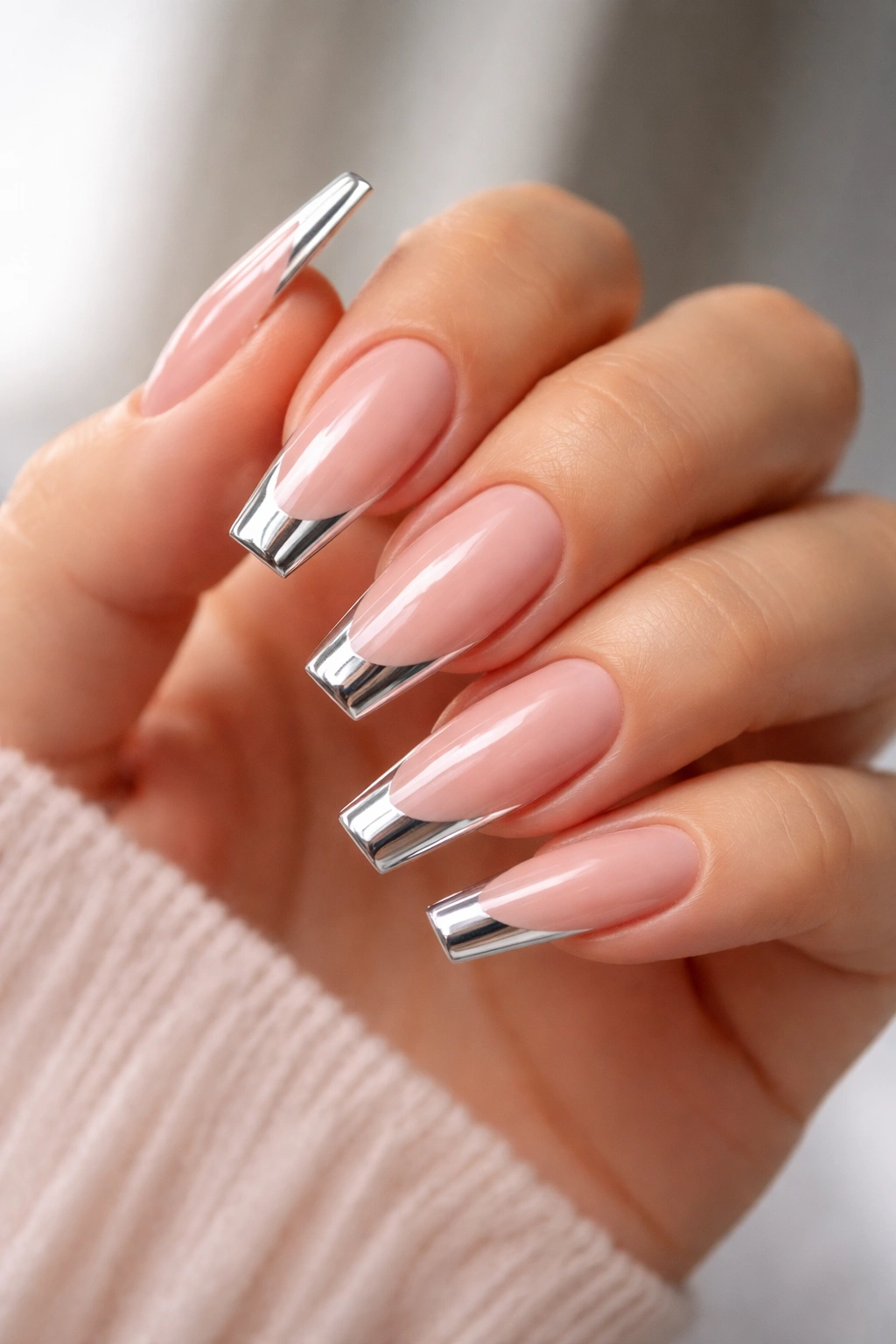
Why does a thin chrome border look sharper than a full chrome tip? Because full chrome can flatten a coffin nail, especially when the tip is wide, while a chrome outline keeps the reflection at the edge where it belongs.
You get flash without turning the whole nail into a mirror.
On a sheer pink or beige-pink base, a silver or soft champagne chrome line feels sleek and lean. It catches light when you move your hands, then settles down the second you stop. That small pulse of shine is what makes it fun. A full metallic tip can feel colder and heavier.
The application matters more than people think. The cleanest version usually comes from painting a thin French line with no-wipe gel, curing it, rubbing chrome powder onto that line, then sealing it carefully so the edges do not bleed. If the whole tip gets chrome and someone tries to refine it later, the result often looks fuzzy near the sidewalls.
How to ask for it
Tell your nail tech you want:
- A sheer pink base with visible softness, not a flat opaque color
- A slim French outline, around 1 millimeter thick
- Chrome only on the border, not across the full tip
- A sealed top coat over the chrome, capped along the free edge
Silver looks crisp. Champagne feels warmer. Pearl chrome can soften the effect if you want something less icy.
This set looks best when the rest of the nail stays quiet. No marbling. No glitter fade. Let the border do the talking.
4. Double French Lines in White and Taupe
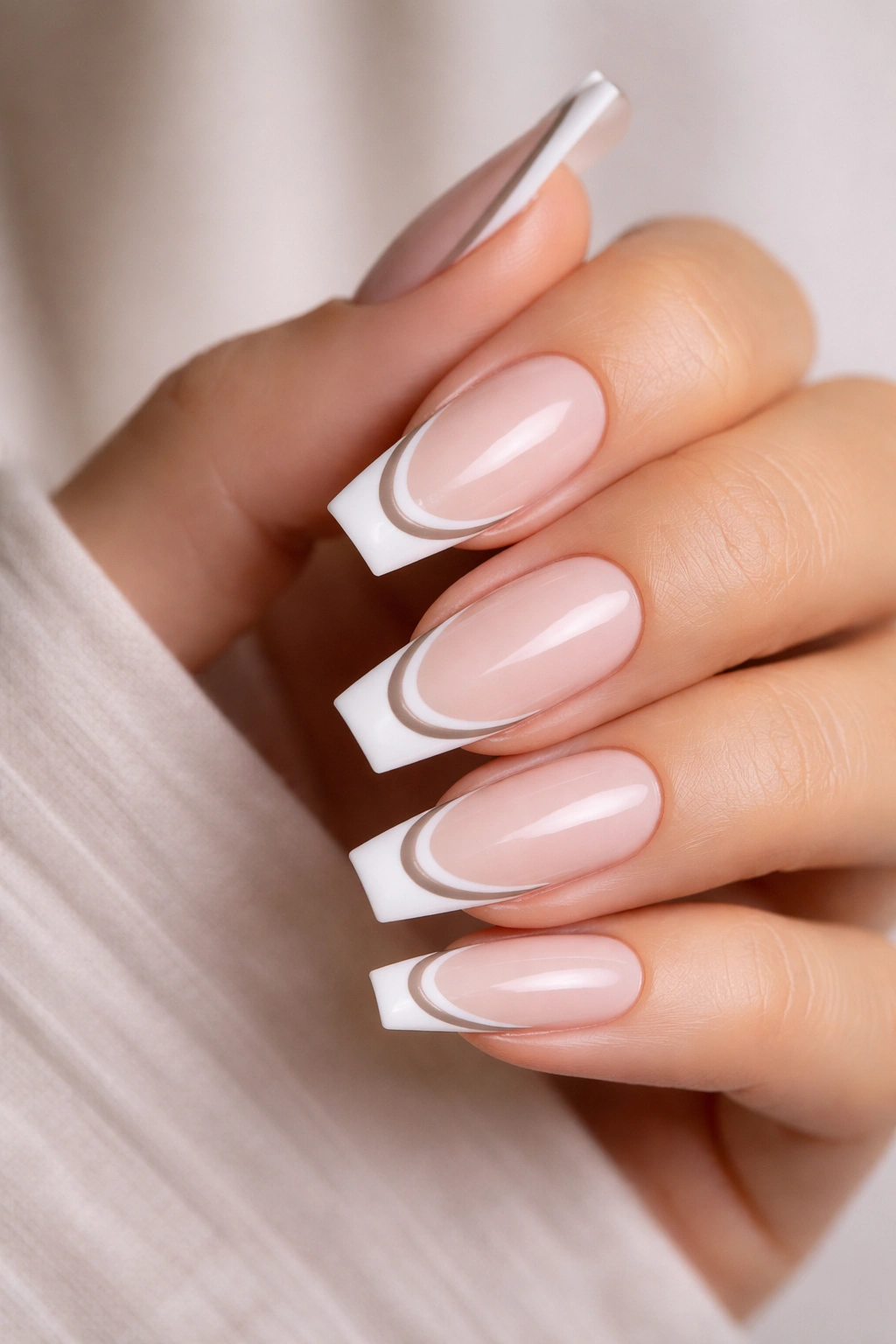
I like this design on people who wear neutrals all week and still want their nails to feel considered. A single white tip can read a little plain on a longer coffin shape. Add a second floating line in taupe, mushroom, or caramel, and suddenly the set has depth without getting loud.
The layout is simple. One line sits at the free edge like a normal French. Another line—thin, clean, and slightly curved—floats 2 to 3 millimeters below it. That gap of nude space in between is the whole point. It gives the eye somewhere to rest.
A few details make or break it:
- Keep both lines thin. If either line gets chunky, the look turns heavy fast.
- Use one bright and one muted shade. White plus taupe works better than white plus another bright white.
- Match the curve. The lower line should echo the top line, not fight it.
- Choose a milky base. A stark clear base can make the floating line look disconnected.
There’s room to tweak this. White and espresso feels sharper. Soft pink and cream is quieter. Even a gray-beige second line can work if your wardrobe leans cool.
What I would not do is add a third line. Two is smart. Three starts looking like nail art homework.
5. Black French Tips With a Soft Matte Topcoat
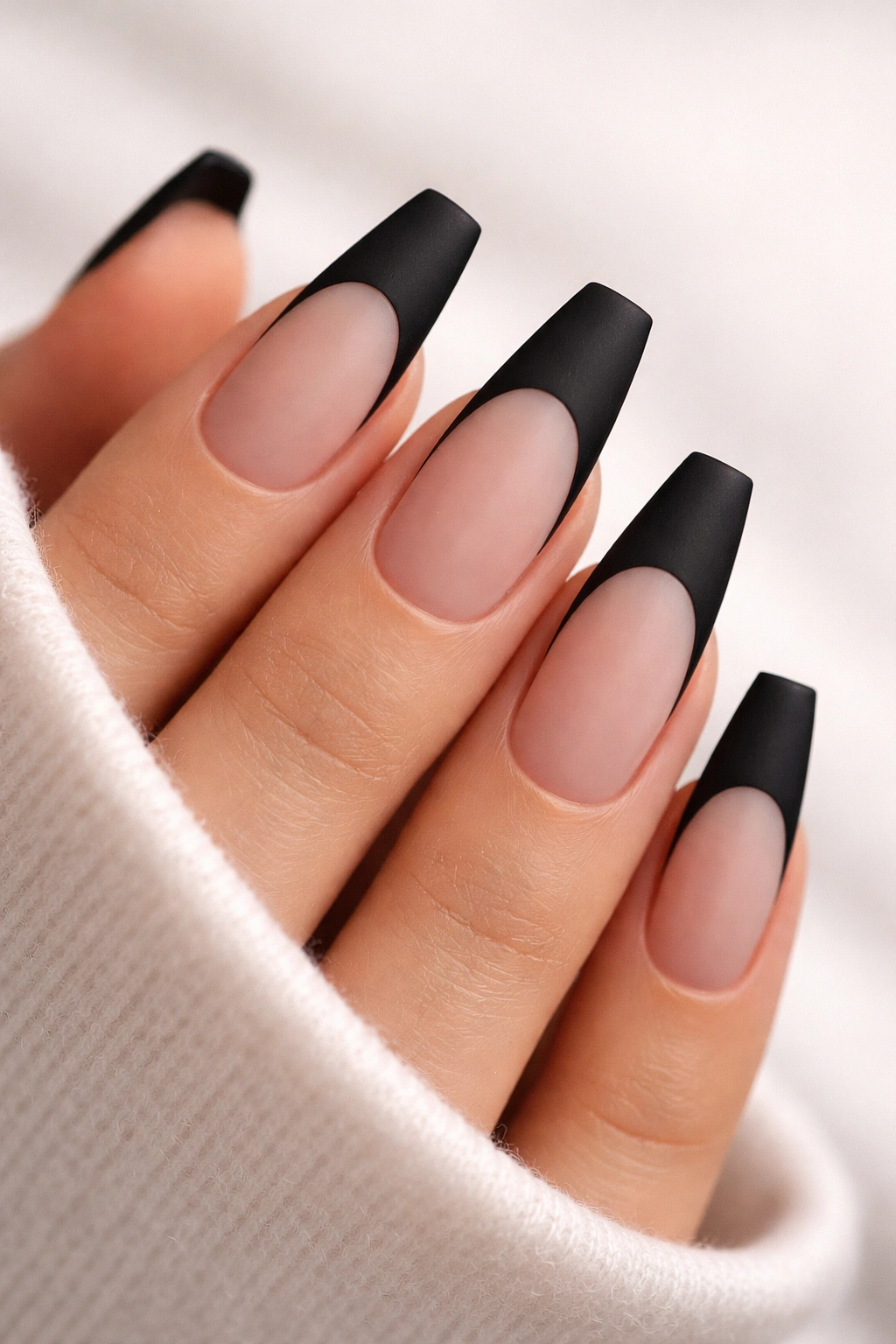
Gloss is not mandatory.
A matte black French tip on a coffin nail has a dry, velvety look that shifts the whole manicure away from bridal or polished-office territory and into something leaner. The shape does half the work already. Matte finish takes away the wet shine and leaves you with silhouette, contrast, and edge.
This design works best when the base stays sheer. If you pair matte black tips with a fully opaque pink base, the result can feel costume-like. A translucent nude keeps the nail bed looking real, which gives the black edge somewhere cleaner to land. That slight see-through quality matters.
Length changes the mood too. On a short-to-medium coffin nail, matte black French tips look sharp and controlled. Push them onto extra-long nails and they can turn theatrical fast. Maybe that is the point for some people. I still think the shorter version is stronger.
Maintenance is the catch. Matte topcoat shows dents, tiny scratches, and hand cream residue more than glossy topcoat does. If you cook a lot, use hair oil, or swipe tinted makeup around your face, the tips can pick up a dull cast. A quick wipe with alcohol helps. So does choosing a matte topcoat with a smoother finish instead of the chalky kind.
I have a soft spot for this one because it breaks the “French has to look sweet” rule. It doesn’t.
6. V-Shaped French Tips With Negative Space
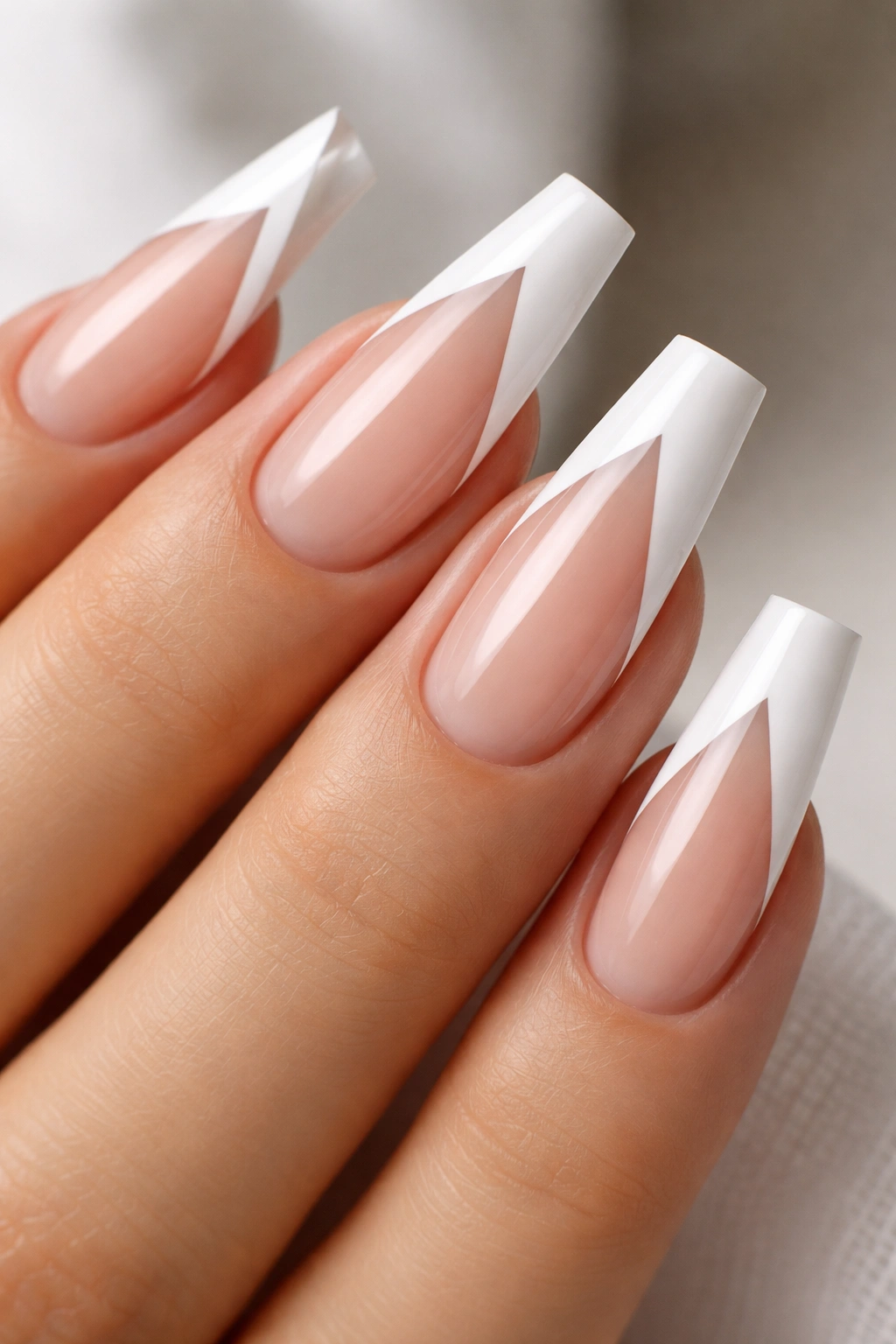
Unlike a rounded smile line, a V-shaped French follows the geometry of a coffin nail. That’s why it looks so right when it’s done well. The point of the V draws the eye down the center of the nail, which can make wider nail beds look slimmer.
The cleanest version leaves negative space through the center and concentrates color along the two upper sides of the V. Think of it as an angular frame rather than a filled-in triangle. If the point drops too far toward the cuticle, the nail starts looking narrow and severe. Keep the V sitting closer to the free edge—usually in the top third of the nail—and it stays crisp.
Who does this suit best? Anyone who wants structure. If rounded French tips feel too soft or too safe on your hands, V-tips give you a stronger line without needing dark colors or extra art. White is classic here, though red, chocolate, navy, and metallic pewter all work.
Here’s the recommendation I give most often: ask for a narrow V with clean side angles instead of a broad chevron. Broad chevrons can look clunky on medium coffin nails. A narrow point keeps the design looking deliberate.
One more note. V-tips need symmetry. If one side is even half a millimeter thicker, you’ll see it every time you type.
7. Pearl Glazed Tips Over a Jelly Nude Base
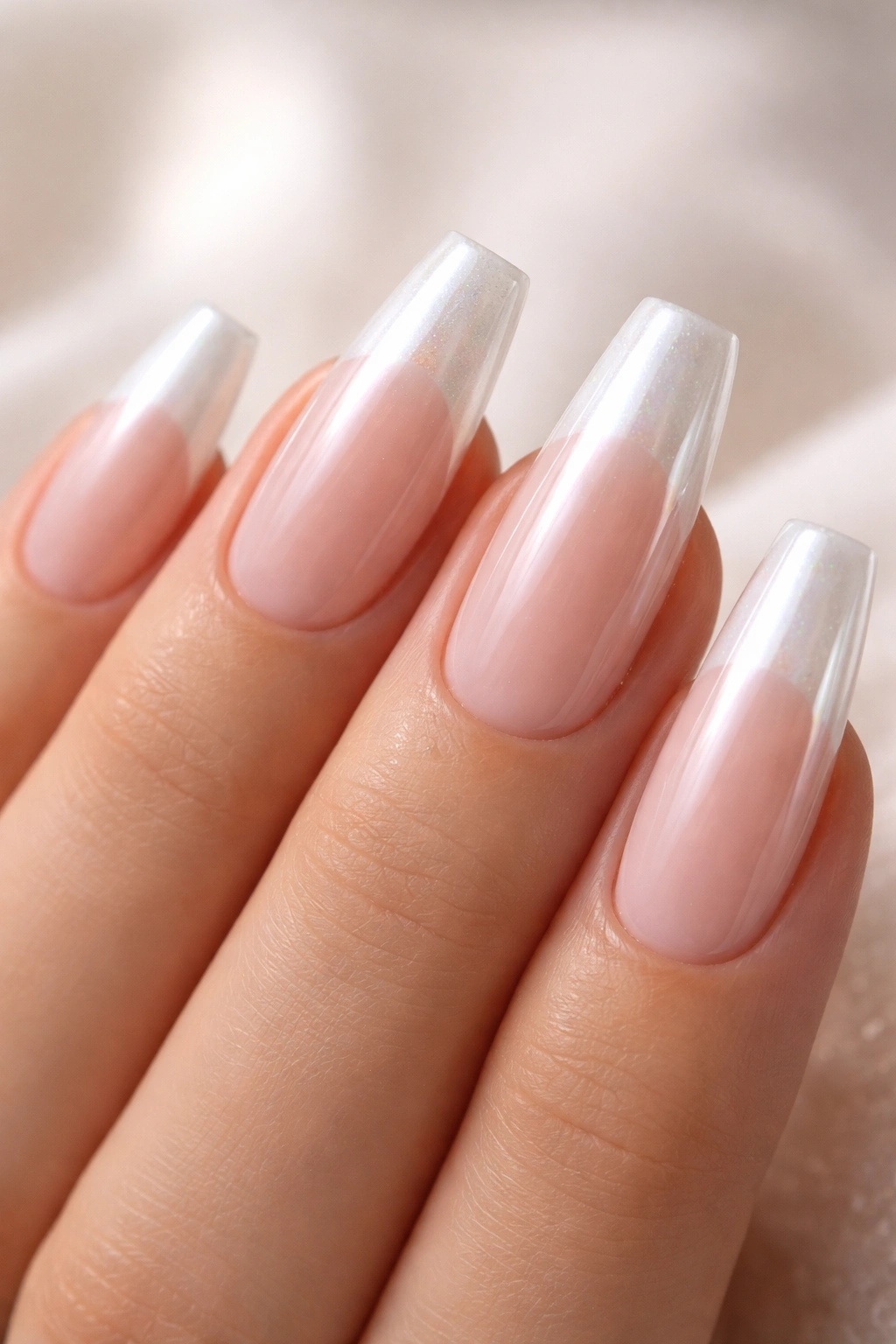
This one has a softer face. Pearl glazed tips have a slippery, almost shell-like sheen that sits between plain white and chrome. You still get light at the tip, though it feels diffused rather than reflective.
The base should stay translucent. A jelly nude—peachy beige, pink-beige, or soft tan depending on your skin tone—lets the nail look juicy instead of painted flat. Then the pearl effect sits on the tip only, often over a pale ivory or milky white base layer. The result has depth. You can see the line, but it doesn’t hit as hard as a bright salon white.
What gives it that glazed edge
A fine pearl powder or aurora pigment pressed over cured gel creates that slick finish. The particles are smaller than chunky shimmer, so the tip flashes softly instead of looking glittery. That’s an important difference. Glitter breaks the clean French idea. Pearl keeps it intact.
Good ways to wear it
- On medium coffin nails with a sheer nude base
- With a soft almond-beige or rosy jelly tone underneath
- As a full tip glaze or a thin glazed outline
- With a glossy top coat only, since matte kills the pearl effect
This style grows out more gracefully than people expect. Because the base is translucent, the regrowth line stays less obvious. That makes it a solid pick if you hate looking at your nails on day ten and feeling instantly annoyed.
8. Reverse French Cuticle Arcs With Slim White Ends
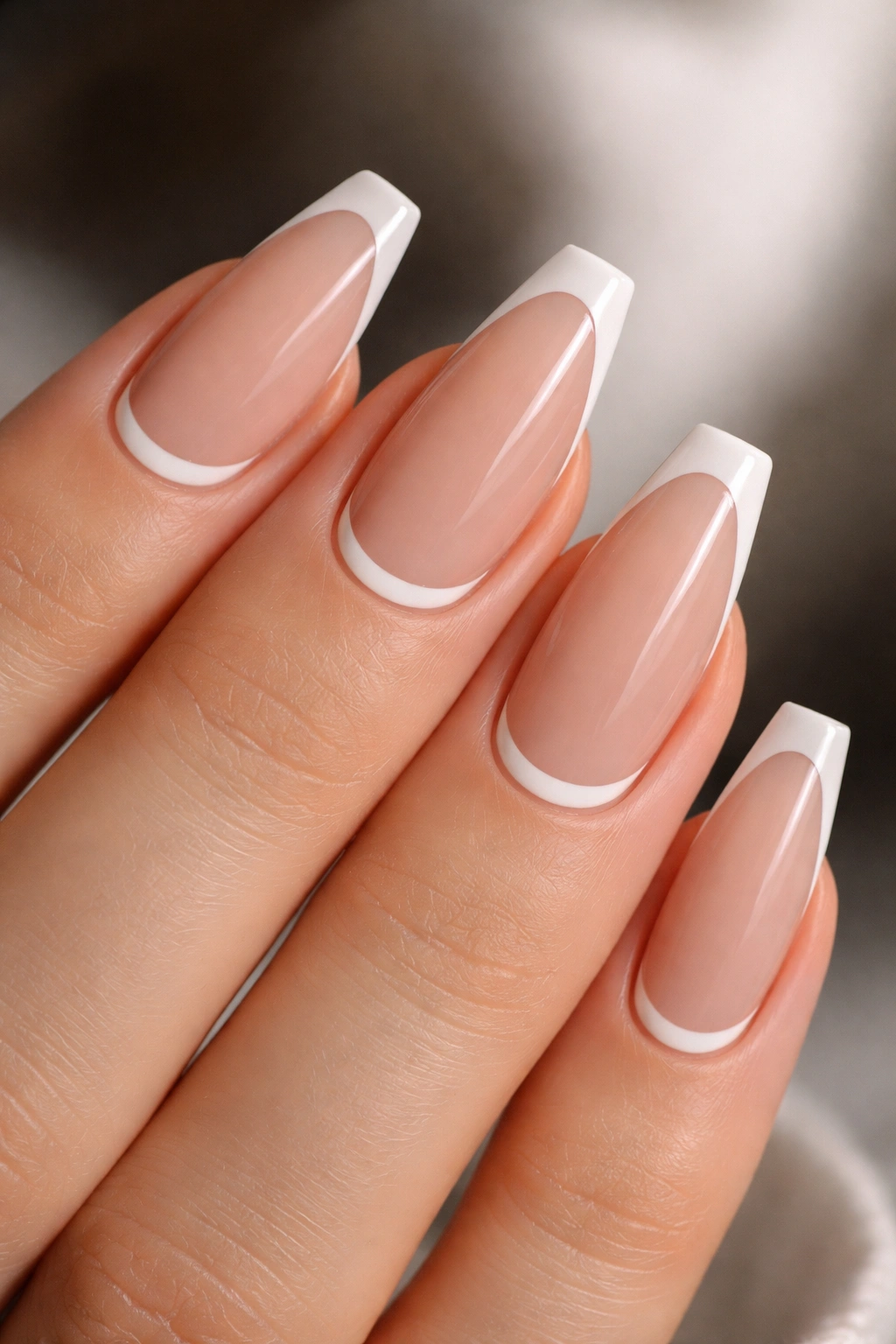
A standard French puts all the attention at the tip. A reverse French adds a second focal point near the cuticle, and on coffin nails that can look unexpectedly polished—almost architectural—when the lines are slim.
The version I like most keeps a tiny white or metallic crescent tracing the cuticle area, then repeats a narrow French line at the edge. Two echoes. Same color. Plenty of bare or sheer nude space between them. That spacing is what keeps it elegant instead of busy.
Cuticle work has to be clean for this to land. No way around it. A ragged skin line ruins the arc, and once you notice that unevenness, it is all you see. This is one of those designs where dry prep, sharp detail brushes, and patience matter more than the polish shade itself.
It also helps to use gel paint rather than bottle polish for the cuticle crescent. Bottle brushes are wider, and most of them push too much product at once. With a liner brush, your nail tech can sketch the arc in one slow sweep, cure it, then refine the thickness before top coat.
I’d save this style for medium lengths and up. On a short coffin nail, the space between the cuticle arc and the tip can get cramped. On a longer nail, the repetition looks cleaner.
Subtle? Yes. Forgettable? Not even close.
9. Tortoiseshell French Tips on Medium Coffin Nails
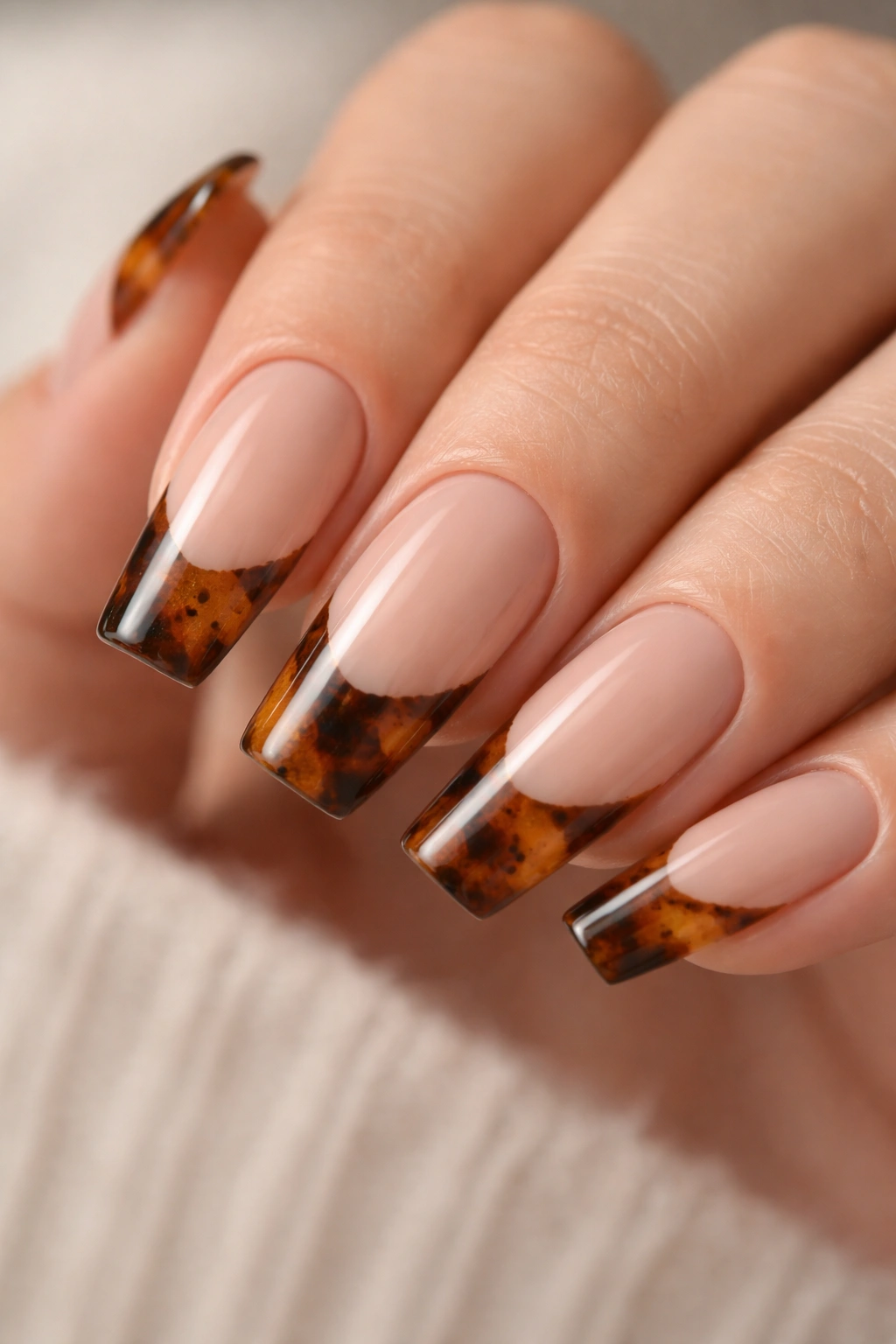
The first time you see a well-done tortoiseshell French tip up close, the detail is what grabs you. Not the color alone—the layering. Little pools of amber, tea brown, dark espresso, and softened black floating inside the tip so it looks deep instead of flat.
This design suits medium coffin nails better than extra-long ones. Medium length gives enough room for the pattern to show, though the tips still look wearable. Go too long and the tortoiseshell can start feeling costume-y, especially if the base is also tinted dark.
A clean tortoiseshell French usually needs at least three passes:
- A translucent amber or honey base on the tip
- Irregular brown patches cured in layers
- Selective black accents kept sparse so the pattern doesn’t go muddy
- A warm glossy top coat to bring back the glassy depth
The base of the nail should stay sheer nude or soft beige. That contrast is what keeps the whole set from looking too dense. I also like the French line slightly blurred here rather than razor-sharp. Tortoiseshell has some natural movement to it, so a hard graphic edge can feel off.
This set has more personality than a plain neutral French, though it still sits comfortably with black coats, tan knits, denim, leather bags—the sort of things people already wear all the time. It feels grown, not girlish.
10. Outline Tips With Barely-There Nude Centers
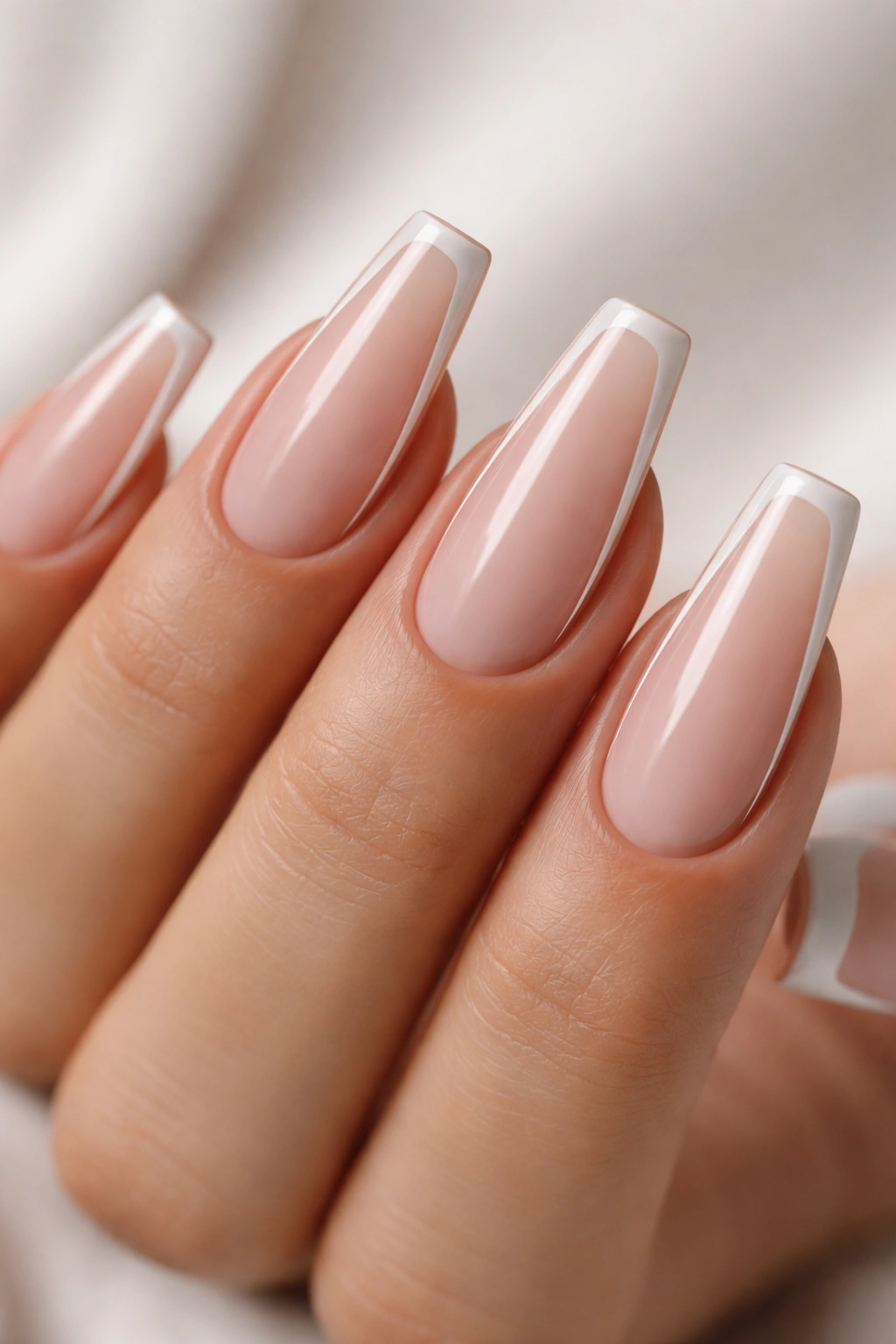
Less polish. More edge.
An outline French tip traces the free edge and sidewalls while leaving the center of the nail largely bare or covered only with a sheer nude wash. On a coffin shape, that framing effect looks crisp because the nail already has those straight side lines built in. You’re tracing the architecture instead of covering it.
This design also wears better than it looks like it should. Since the center stays transparent or milky sheer, tiny chips are easier to hide and regrowth does not hit as hard. The eye stays focused on the perimeter. That’s handy if you stretch fills a little longer than your nail tech would prefer.
Color changes the feel fast. White keeps it airy. Black outline tips look more graphic. Metallic silver or espresso brown can look sharper than either, depending on your skin tone and the base shade. I like the outline line no thicker than 0.5 to 1 millimeter. Once it gets wider, the effect shifts from frame to block.
This style is also one of the easiest to customize with shape. A slightly deeper outline at the corners can exaggerate the coffin silhouette. A flatter line across the end can make the free edge look cleaner. Tiny changes. Big difference on the hand.
You do need a steady painter for this one. Wobbly sidewall lines ruin the illusion fast.
11. Colored Micro Tips in Mismatched Neutrals
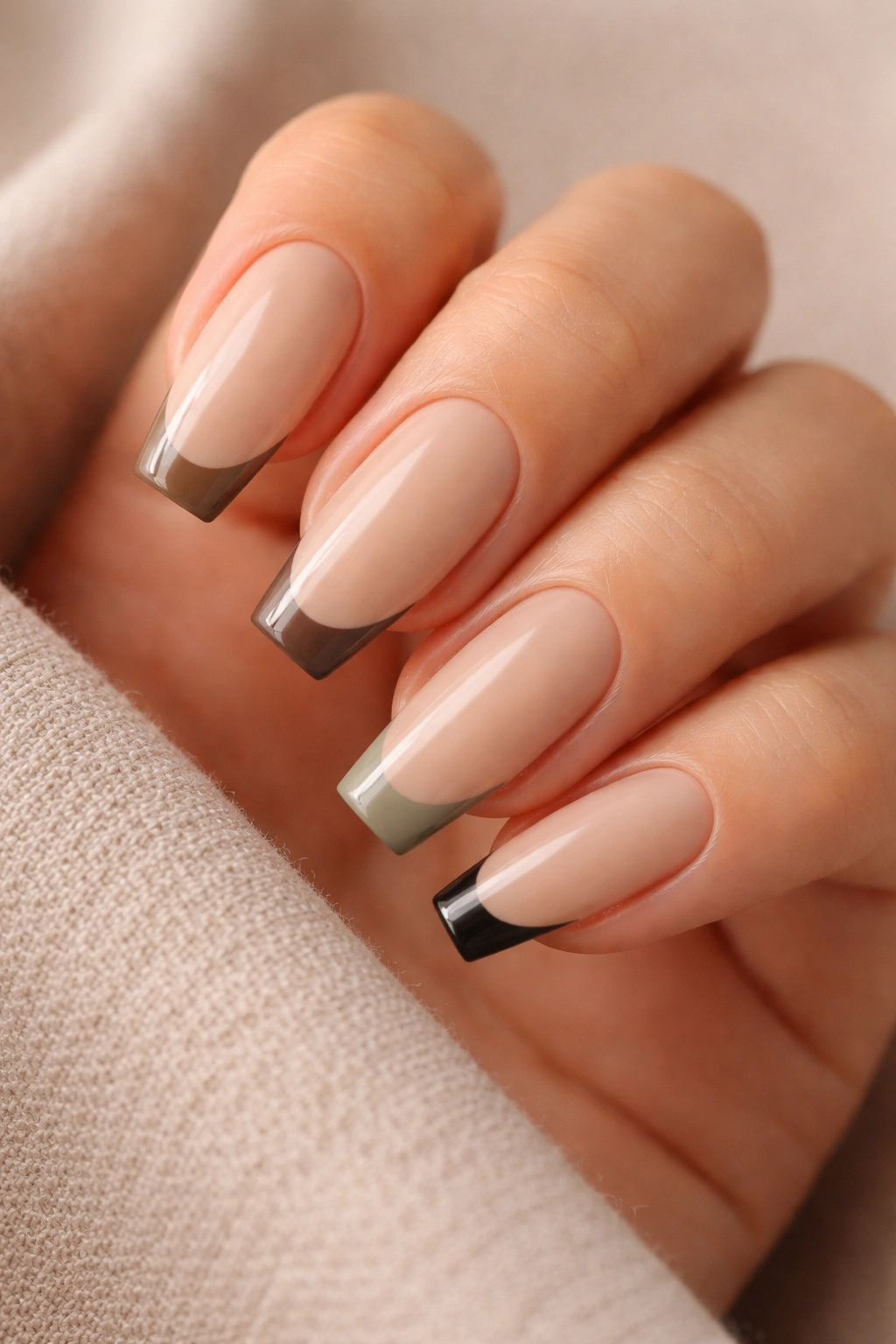
Why limit yourself to one French tip color when mismatched neutrals can make the same idea look more edited and personal? I’m not talking rainbow candy shades. I mean oat, clay, espresso, olive-gray, dusty mauve, soft black, camel—tones that sit in the same family without matching exactly.
This works because the French tip is so small. On a full-color manicure, five different neutral shades can feel fussy. On a micro tip, the color shows as a whisper at the edge. You notice the shift finger to finger, though it still reads as one set.
How to keep it from looking messy
Stick to a tight palette rule:
- Use one undertone family—warm, cool, or muted.
- Keep the base color the same on every nail.
- Make each tip the same thickness.
- Limit the palette to five shades max, one per finger.
The easiest mix is white, taupe, mushroom, mocha, and charcoal. If you want more softness, swap charcoal for dusty rose-brown. If you want more edge, use espresso and olive-gray together. The point is control. Once one color gets brighter or more saturated than the rest, your eye goes there first and the set loses cohesion.
This style is also good if you get bored easily but still want something polished enough for daily wear. It looks thoughtful without demanding constant attention.
12. Crystal-Accented French Corners for Event Nails
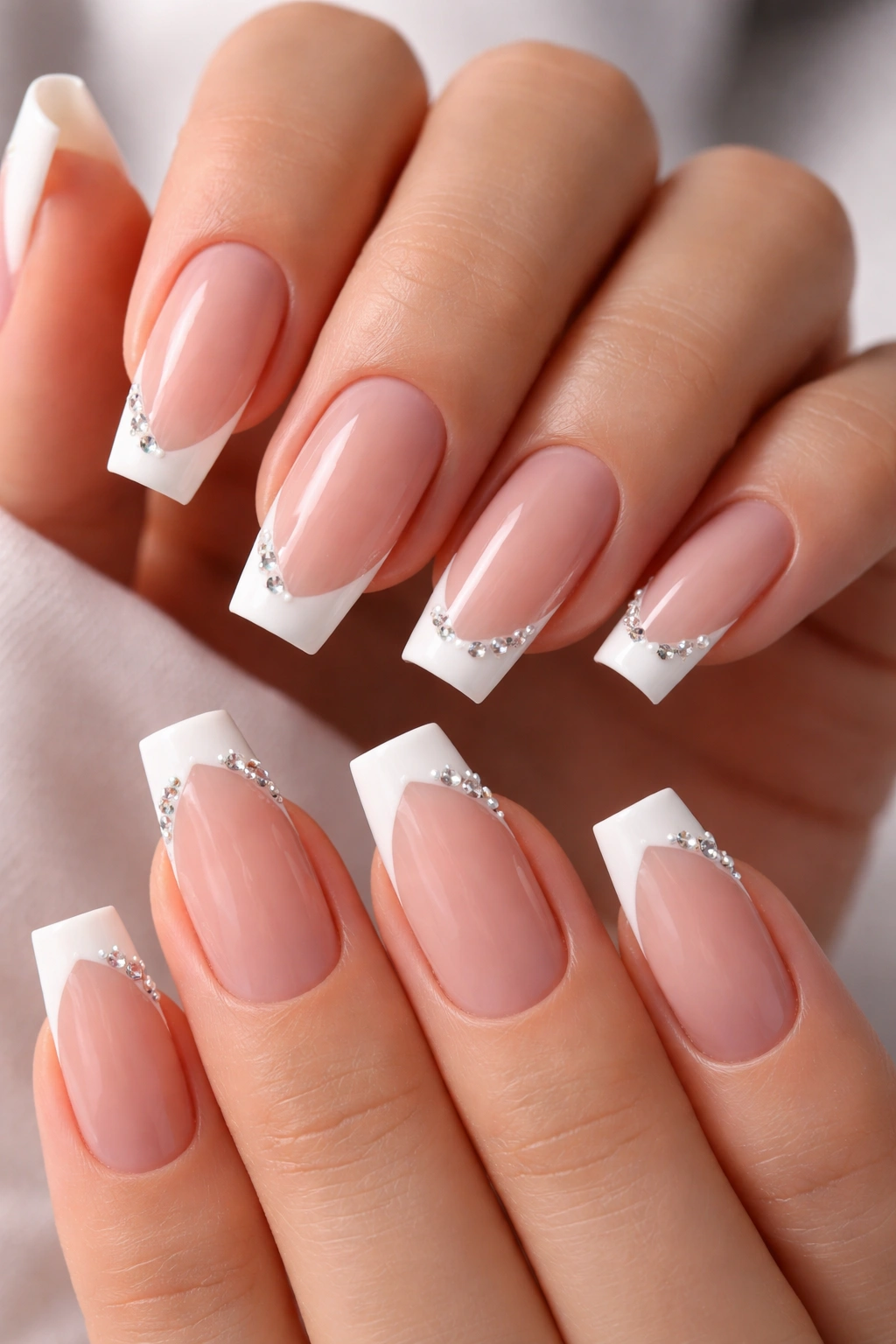
If you want stones on a French manicure, keep them small and off to the side. Full crystal cuticle bands can look heavy on coffin nails, and they tend to snag more than anyone admits. Corner accents are smarter.
The cleanest version places 2 to 4 tiny crystals—usually ss3 or ss5 size—where the French line meets one sidewall or where a diagonal tip ends. That placement makes the stones feel tied to the design instead of stuck on after the fact. You still get sparkle, though the nail keeps its shape and line.
Here’s why I prefer this to a full gem nail: the French tip still stays visible. That matters. Once the stones become the first thing you notice, the manicure stops being about the tip design at all.
A few placement notes help:
- Use flat-back crystals only, sealed around the base with builder gel or gem gel
- Keep stones on one side, not mirrored on both corners
- Skip oversized charms on coffin tips unless you want extra weight
- Pair them with one accent nail or all ten nails, though use the same placement each time
This is one of the few modern French tip coffin nails that leans dressy on purpose. Weddings, parties, photos, dinners where you know your hands will be seen—fine. I still wouldn’t overload it. One tiny flash at the edge often looks stronger than a full crystal story.
What to Ask Your Nail Tech for Before the First Brushstroke
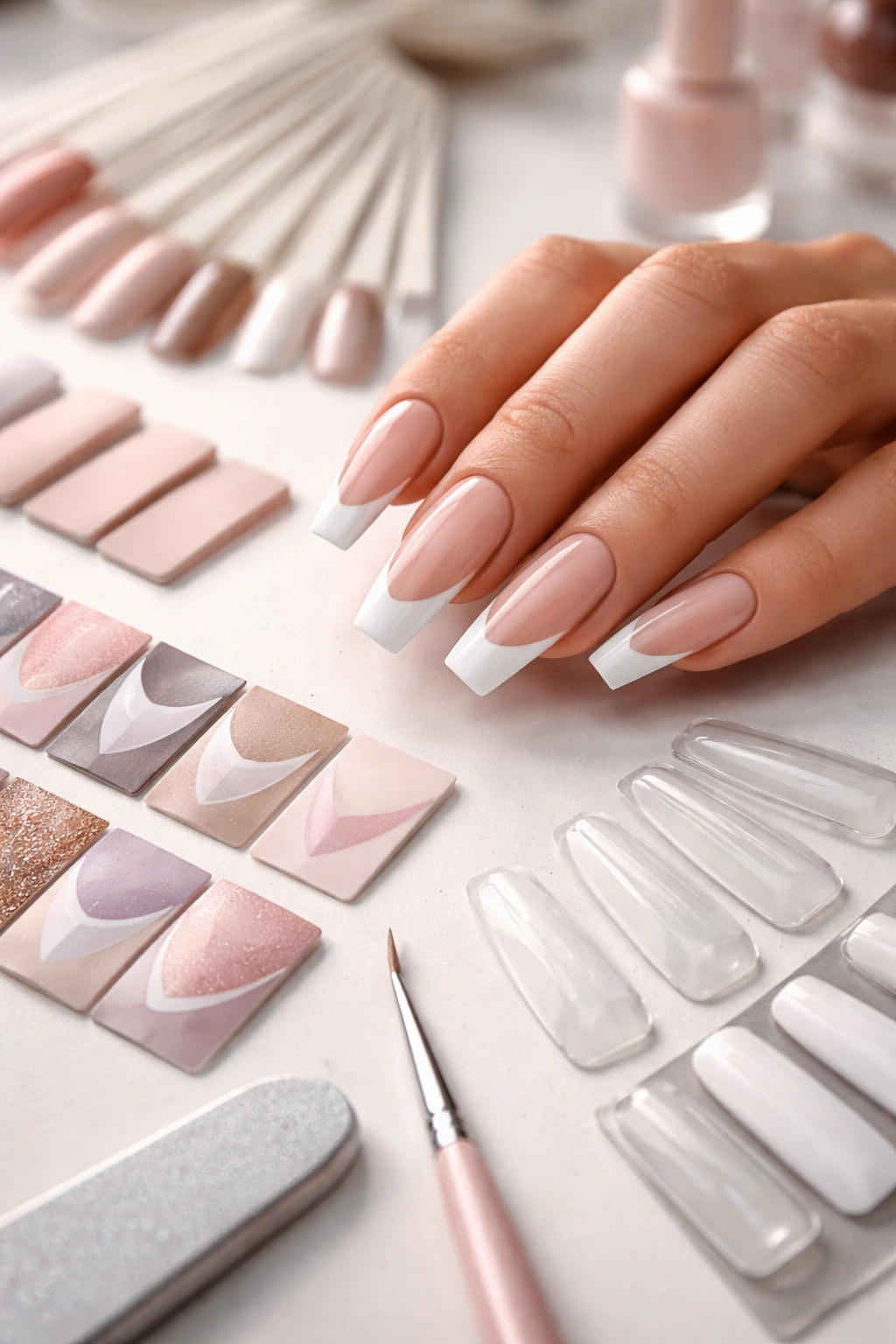
A reference photo helps, though specific words help more. If you sit down and say “modern French on coffin nails,” you might get anything from chunky white squares to glazed pearl tips with charms. Nail language gets fuzzy fast.
Start with length and shape first. Tell them if you want short, medium, or long coffin, and be honest about how you use your hands. If you type hard, work with boxes, lift weights, or wear contact lenses daily, medium length is often the sweet spot. Then get into line details: micro tip, side French, V-tip, outline tip, reverse French. Those terms narrow the design right away.
Shade matters more than most clients think. Ask for:
- A milky nude base, if you want softness and easier grow-out
- A jelly nude base, if you want translucence and depth
- A bright white, ivory, taupe, black, chrome, or pearl finish, depending on the tip style
- Structured gel or builder gel overlay, if your nails bend easily
Also say whether you want the lines sharp or softly diffused. That one detail changes the whole set. Tortoiseshell tips can handle a blurred edge. Micro white tips cannot.
And speak up about the sidewalls. If they flare, the French line widens. If the corners are too square, the coffin shape loses that elegant taper. A good tech knows this already, though clear direction still saves time.
How to Keep Modern French Tip Coffin Nails From Looking Tired
A French manicure shows wear fast because the eye goes straight to the edge. Tiny chips that would hide on a nude full-color set can stand out on a French tip after one rough afternoon.
Cuticle oil helps more than another layer of top coat. Use it twice a day, especially around the sidewalls. Dry skin makes even fresh nails look neglected, and modern French designs depend on clean lines and clean framing. If your cuticles look ragged, the manicure loses half its polish.
A few habits stretch the life of the set:
- Wear gloves for cleaning, especially with bleach or hot water
- Do not pry open cans, scrape labels, or use your nails as tools
- File snags early with a fine-grit file, always in one direction
- Book fills before the apex drifts too low, usually around the two- to three-week mark
One more thing.
If the underside of the nail picks up makeup, self-tanner, hair dye, or cooking stains, wipe it with alcohol on a lint-free pad. Coffin nails expose that underside more than rounded shapes do. You notice it when you hold your hand up.
Modern French tips do not need constant babying. They do need a little respect.
Final Thoughts
The French manicure never needed rescuing. It needed editing.
On coffin nails, the strongest sets usually come down to line placement, tip thickness, and finish. That’s it. A micro white edge on a milky base can look sharper than a nail covered in charms. A side French or outline tip can change the whole silhouette with one brushstroke.
If you’re torn between designs, start with the safest three: micro-line white tips, diagonal side French, or outline tips. They give you the modern feel without asking you to commit to anything too loud. Once you know what line weight and base color you like on your own hands, branching into chrome borders, tortoiseshell tips, or crystal corners gets much easier.
Screenshot the details, not the pose. Your nail tech needs to see the line, the base, and the finish—not the coffee cup.