

Orange coffin nails can look polished or plastic, and the gap between those two outcomes is smaller than most people think. Pick the wrong orange and the set can read flat, chalky, or costume-ish. Pick the right one—paired with the sharp taper and flat tip of a coffin shape—and the color snaps into place.
Shade family matters more here than it does with beige or red. Tangerine throws more yellow, blood orange leans deeper, terracotta softens the mood, and neon needs a clean base or it will show every streak. The coffin silhouette helps because it gives bold color a frame; even a loud orange looks more deliberate when the sidewalls are filed clean and the tip stays crisp.
I also think people underrate finish. A glossy orange feels juicy. The same pigment in matte can look dry, earthy, almost like suede. Add chrome, foil, jelly layers, or a skinny French edge and you are no longer wearing “orange nails” in the basic sense. You are wearing a design with intent.
Length changes the whole read too. Some orange sets need a longer extension so the color has room to breathe. Others hit harder at a medium length, where the shape stays sharp but your nails still feel like they belong in your actual life.
1. Glossy Tangerine Orange Coffin Nails
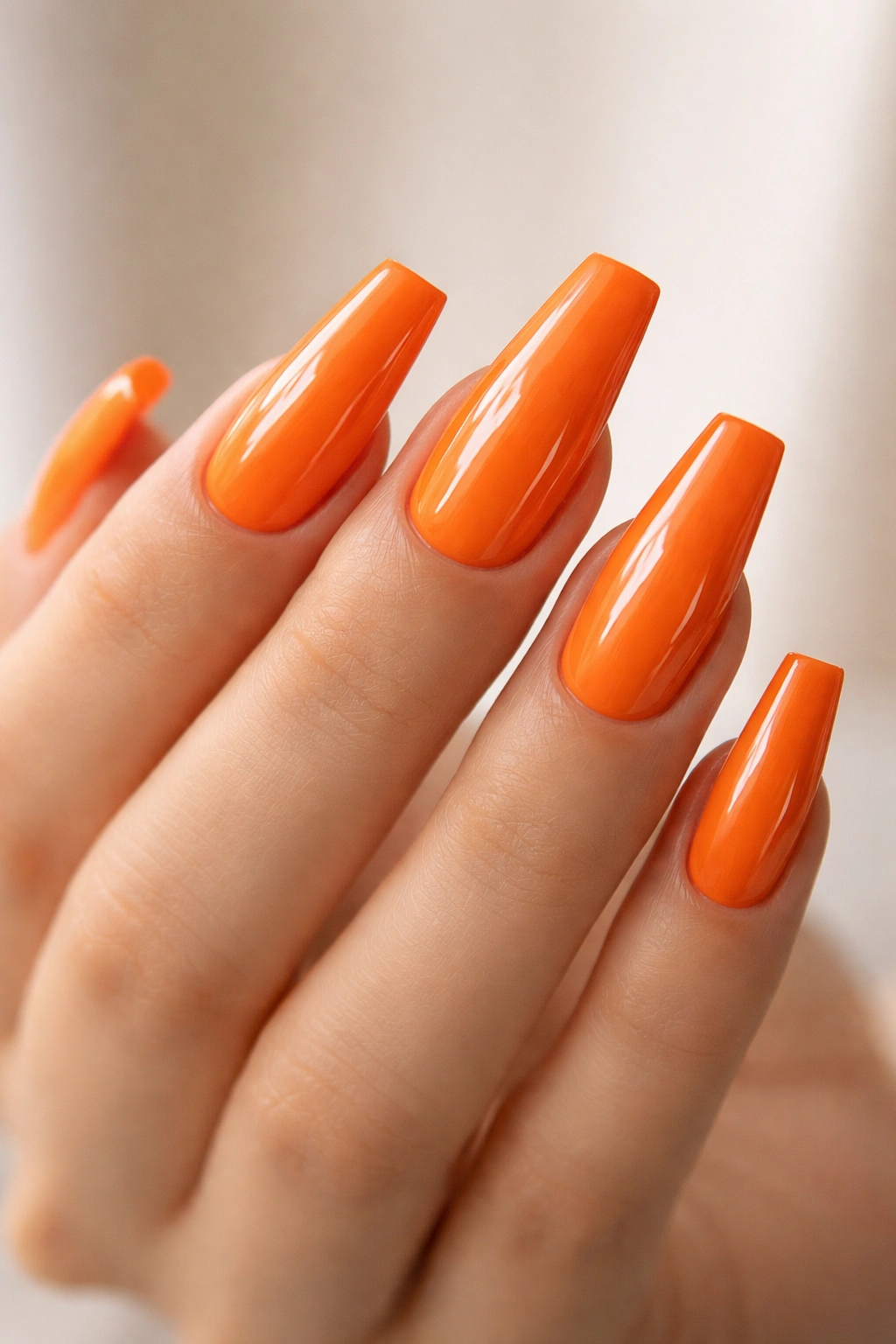
If you want one orange set that almost never misses, start here. A glossy tangerine manicure has enough warmth to feel bright without drifting into traffic-cone territory, and that balance matters on coffin nails because the shape already carries some attitude on its own.
The biggest mistake with this look is going too sheer. Orange pigment can get patchy near the sidewalls, especially with regular polish, so a creamy gel formula or builder-gel color overlay gives a smoother result. On a medium coffin length—about 4 to 6 millimeters past your fingertip—tangerine looks clean and punchy rather than bulky.
Why the shine does the heavy lifting
Gloss pulls the eye across the nail from cuticle to tip. That matters with orange, because matte or satin finishes can make lighter shades look dusty if the color isn’t rich enough. A high-shine top coat also makes tiny application flaws less visible, which is handy with saturated colors.
Dry skin around the nail stands out more next to orange. No way around it.
What to ask for in the salon chair
- Medium coffin length with straight sidewalls and a flat, not overly wide tip
- A pale peach or sheer nude base layer if your orange polish tends to streak
- Two or three thin coats of tangerine gel, with the free edge capped each time
- A glassy top coat refreshed every 5 to 7 days if you want the shine to stay crisp
Best move: keep the color full-coverage on all ten nails and skip extra art. This shade earns its keep by being bold and simple.
2. Matte Burnt Orange Coffin Nails
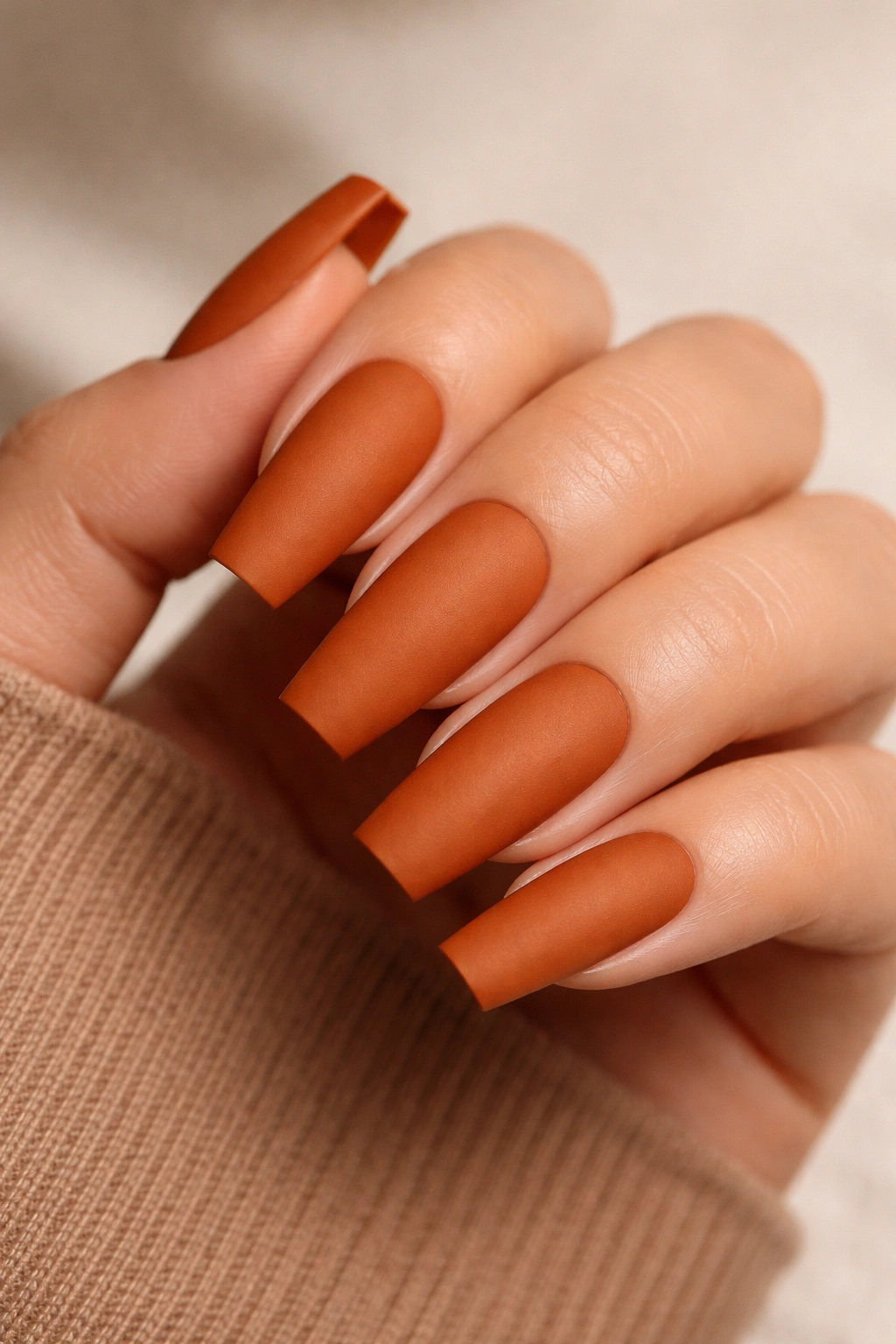
Matte burnt orange changes the mood fast. The moment you remove the shine, orange stops feeling juicy and starts leaning into clay, spice, brick, and worn leather. On coffin nails, that dry finish looks sharper than you might expect.
Buff the surface smooth first.
Matte top coat grabs onto every ridge, dent, and lumpy builder-gel patch under it, so this is not the set for rushed prep. A burnt orange with a little brown mixed in also hides growth better than neon shades do, which means your manicure still looks tidy after the first week instead of shouting at you from across the room.
This color has a grounded feel that works well on medium and long coffin shapes. Short coffin nails can wear it too, though the tip needs to stay slim. If the free edge gets too wide, matte burnt orange can start to look heavy—more block than blade.
One more practical note: matte top coats pick up makeup, self-tanner, pen marks, and kitchen stains faster than glossy ones. A quick wipe with rubbing alcohol helps, but if you are rough on your hands, ask for one accent matte nail and the rest glossy burnt orange. You still get that soft, powdery look without needing to baby the whole set.
3. Orange French Tips With a Sheer Nude Base
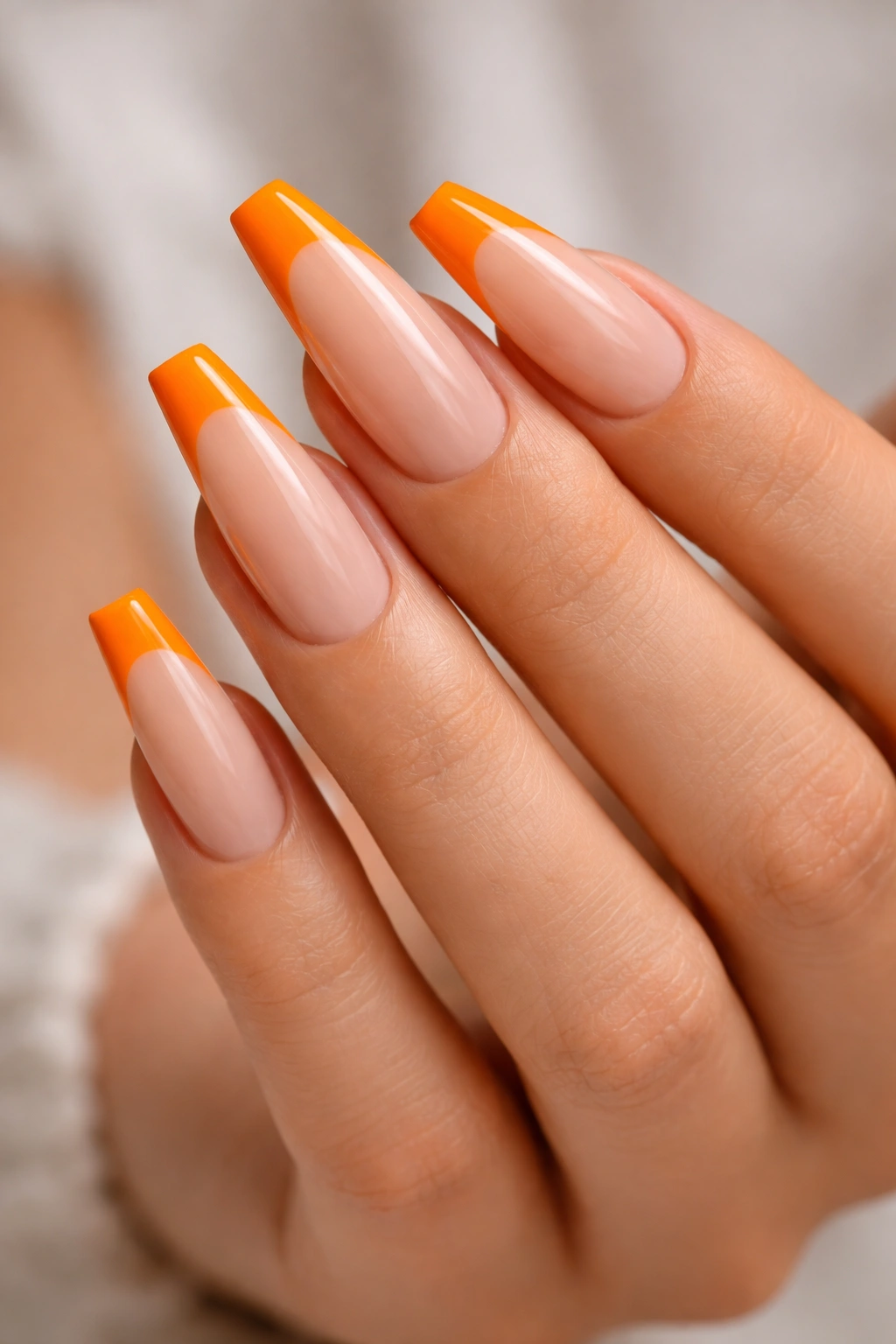
Why do orange French tips work so well on coffin nails? Because the shape already gives you a clean, straight edge to play against, and that means the color can stay focused at the tip instead of taking over the whole hand.
A full orange set is fun. A nude base with orange tips feels more precise.
The best version of this look uses a milky beige, pink-beige, or soft peach base—not a stark, chalky nude—and a tip line that is thick enough to read from a few feet away. On a medium coffin nail, the sweet spot is usually about one-fifth to one-quarter of the nail length. Go too thin and the orange disappears. Go too deep and you lose the French effect.
Keep the smile line slightly lifted
A dead-straight tip can make coffin nails look boxy. Ask for a smile line that curves upward at the sides, even if only by a millimeter or two. That tiny lift makes the nail look longer and keeps the orange from feeling chopped off.
This design also gives you room to play with shade. Bright orange tips feel sporty. Coral-orange tips soften the look. Burnt orange tips over a rosy nude base feel richer and more grown-up. If you like orange but do not want a full-color set, this is usually the safest first step.
4. Sunset Ombré Orange Coffin Nails
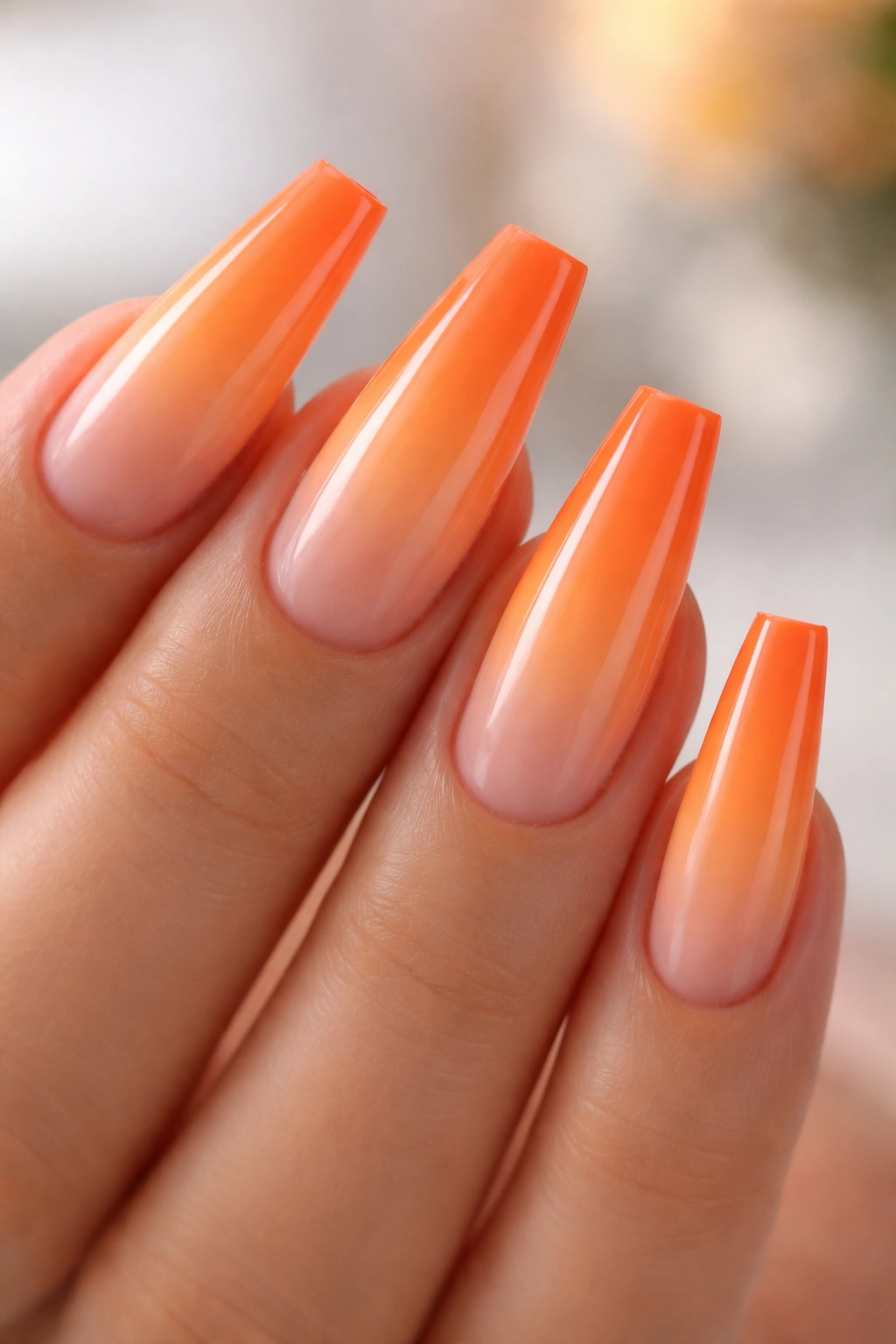
Set an apricot shade next to a deeper orange and you can almost see the fade before the sponge touches the nail. Sunset ombré orange coffin nails make sense on this shape because the taper naturally guides the eye from the softer cuticle area to the stronger color near the tip.
The smoothest version starts pale at the base and deepens as it moves outward. Think soft peach, then clementine, then a richer tangerine or amber at the end. That direction matters. Dark color near the cuticle can shrink the nail bed and make the set feel shorter.
Airbrushing gives the cleanest blend, though a dense makeup sponge still works if your nail tech has patience and a light hand. You want blur, not stripes.
Nail artist notes that make the gradient look expensive
- Use 2 or 3 related orange tones, not five. Too many shades muddies the fade.
- Keep the darkest color on the outer third of the nail so the shape still looks long.
- Finish with a high-gloss top coat; ombré nearly always reads smoother with shine.
- Skip chunky glitter over the blend unless you want the fade to become background texture.
This is one of those sets that looks better on medium-long or long coffin nails than on short ones. The extra length gives the color room to melt into itself.
5. Pumpkin Orange With Scattered Gold Foil
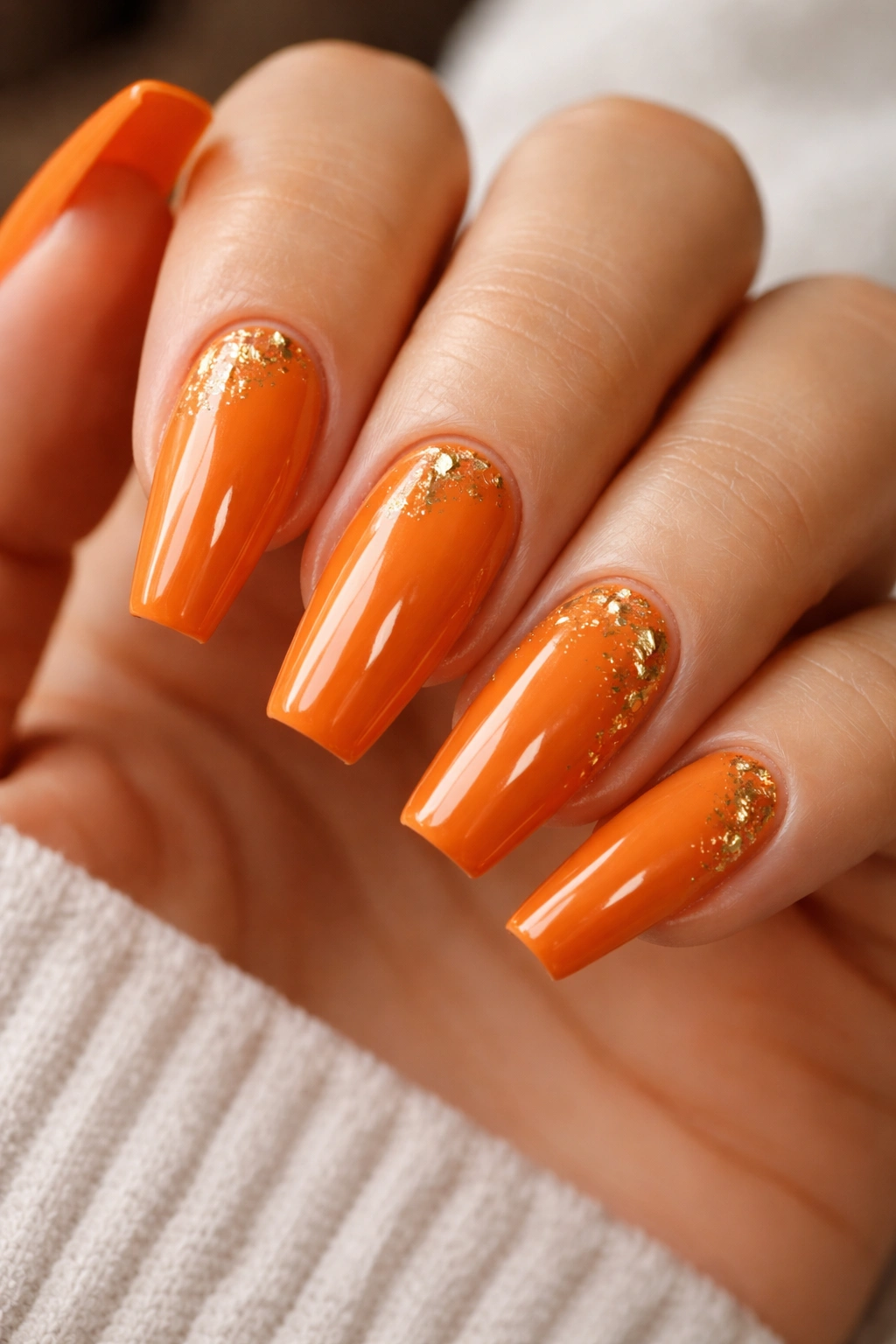
Gold foil can ruin orange nails fast if it is slapped on like confetti. Used with restraint, though, it adds texture and warmth that flat glitter never quite matches. I like this look most with a pumpkin or baked-orange base, something rich enough to hold its own under metal.
Placement decides everything. A few torn flakes pressed near the cuticle or drifting along one sidewall look intentional. Covering half the nail with foil starts to feel gift-wrap-adjacent, and that is rarely the goal with coffin nails, which already have a bold outline.
Longer nails give you more room to place the foil in irregular pieces. Medium lengths still work, but the foil should be finer—tiny shards rather than big leaf chunks. Seal it under builder gel or a thick top coat if you want a glassy surface. If the edges of the foil stay raised, you will feel them every time you run your fingers through your hair.
I keep coming back to this detail because it matters: orange and gold need contrast. A flat mustard orange beside bright gold can look muddy. A deeper pumpkin, paprika, or burnt marmalade gives the metal something sharper to bounce off.
One accent nail per hand is enough. Two is the ceiling.
6. Neon Orange and White Swirl Coffin Nails
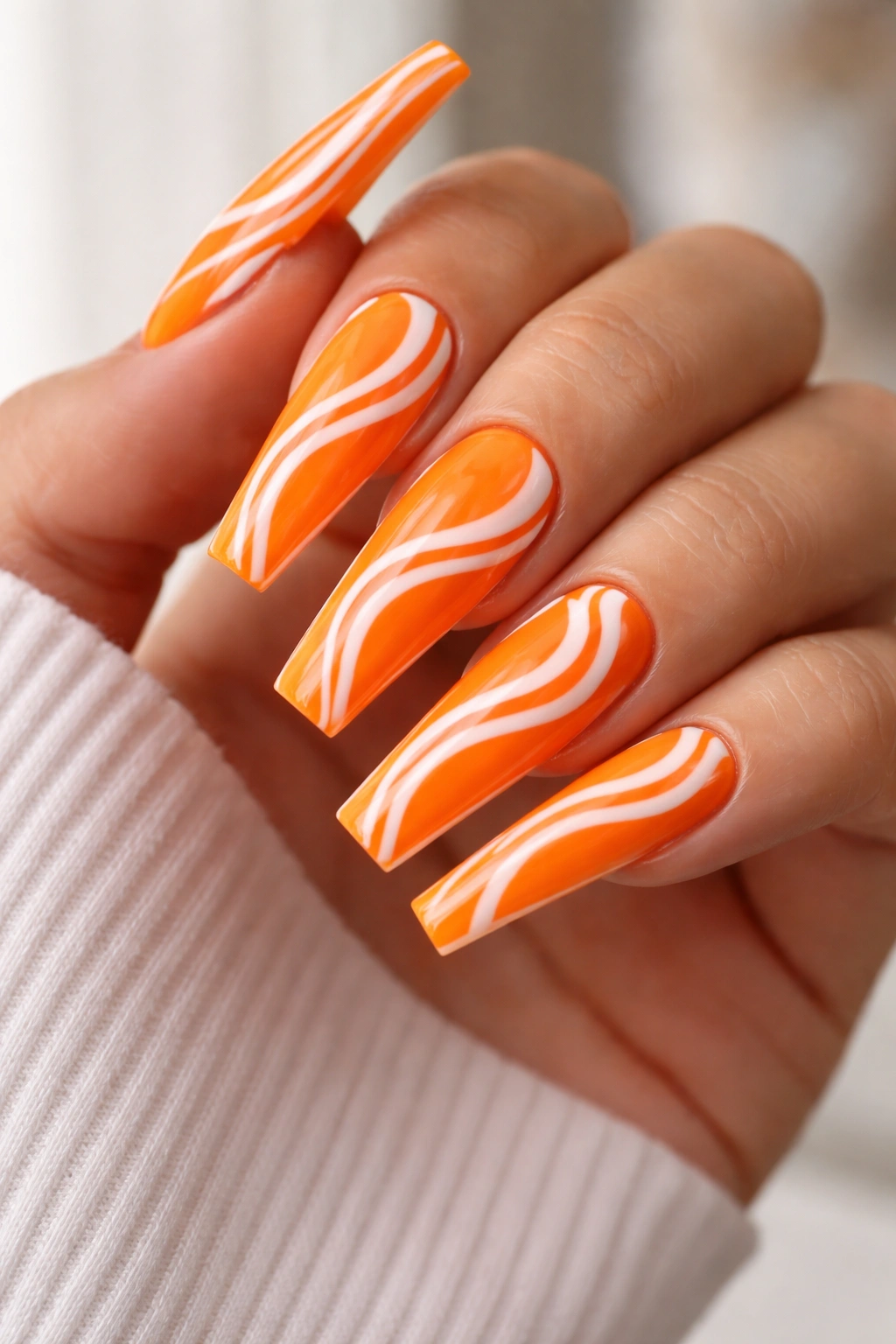
Unlike a solid neon set, which can feel blunt, neon orange with white swirls has motion. The white breaks up the intensity, the orange still leads, and the whole manicure feels lighter even though the color is louder.
This design needs length. Not absurd length, but enough space for the lines to travel. A short coffin nail can hold one or two curves. A longer coffin nail gives the swirls room to sweep from cuticle to tip without turning into scribble.
The cleanest version uses a bright neon orange base on some nails, then a sheer nude or pale milky base on others with orange and white swirl lines layered on top. That split keeps the set from becoming a wall of brightness. I would not do ten full neon-and-white swirled nails unless you love maximal nail art and do not mind the look taking over every outfit.
Who suits this one? Anyone who likes statement nails and does not want something precious. The white lines should stay fine—around 1 to 2 millimeters wide—and a glossy top coat helps them look sealed into the nail rather than sitting on top like correction fluid. Keep the swirl count low. One strong curve is better than six nervous little loops.
7. Peach-Orange Jelly Coffin Nails
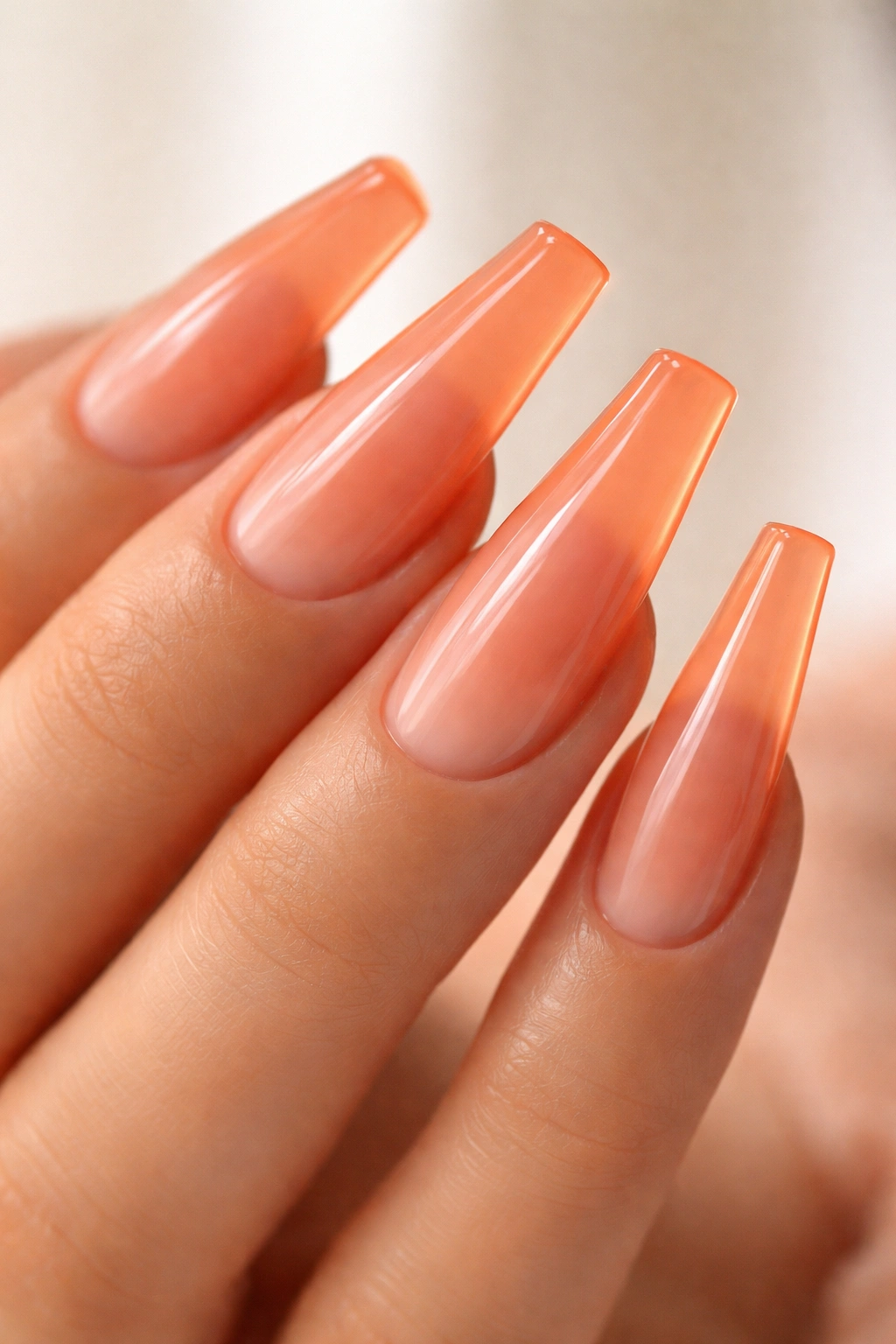
Jelly nails have that translucent, candy-window look that regular cream polish cannot fake. With a peach-orange shade on a coffin shape, the effect lands somewhere between stained glass and hard candy, especially when light comes through the tip.
Transparency is the point. If the color turns fully opaque, you have lost the whole charm of the design.
Layer count matters more than color name
Most jelly oranges look best in 2 thin coats over a clear or sheer nude base. One coat can read unfinished. Three or four coats often kill the see-through effect. Ask for a syrup gel or a jelly-specific formula; trying to thin down a standard cream polish almost always gives a streaky result.
Long extensions show this finish best because you can actually see the glow through the free edge. On a natural nail with only a small bit of growth past the fingertip, the effect is softer, though still pretty—sorry, better-looking—than people expect.
Small details that help this set stay clean
- Keep the nail art minimal or skip it altogether; jelly polish already has visual texture
- File the underside of the extension neatly, since it shows more through translucent color
- Use clear top coat only; a milky top can cloud the whole effect
- Choose a peach-orange or apricot jelly if bright carrot shades feel too harsh on your skin tone
Best move: pair jelly orange with a slightly longer, slimmer coffin than you would choose for an opaque cream polish. The transparency makes length feel lighter.
8. Terracotta Orange With Thin Black Line Art
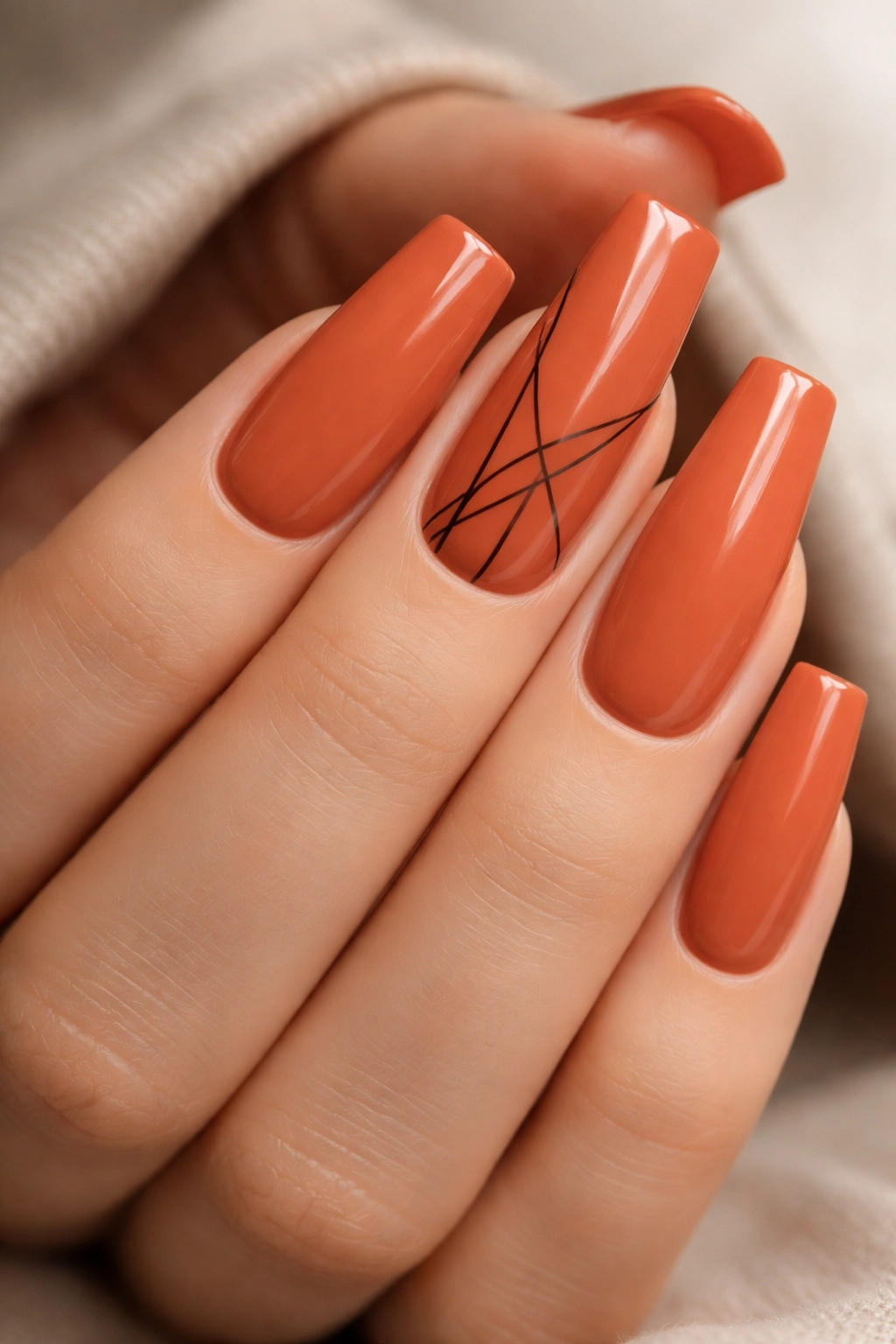
Terracotta is the grown-up branch of orange, and a thin black line can make it feel almost architectural. Not artsy in a messy way. Precise. Intentional. A little severe, which I mean as a compliment.
This design works because terracotta has enough brown in it to settle down, while black line art brings edge without needing rhinestones, chrome, or glitter. You can do a single diagonal line, a cuticle half-moon, an abstract face outline on one accent nail, or a split design where black traces the border between nude and color.
Line weight matters more than people think. Once those black strokes get thicker than about half a millimeter, they start eating the shape. Coffin nails already narrow toward the tip, so heavy lines can make the whole set look cramped.
Gloss and matte both work here, though they tell different stories. Glossy terracotta with black lines feels crisp and sleek. Matte terracotta pushes the set into something softer and moodier. If you want the art to stay sharp for two weeks or more, seal the lines under top coat rather than leaving them raised on the surface. Raised detail chips first.
This is one of my favorite orange nail ideas when you want color without noise.
9. Orange Chrome Mirror Coffin Nails
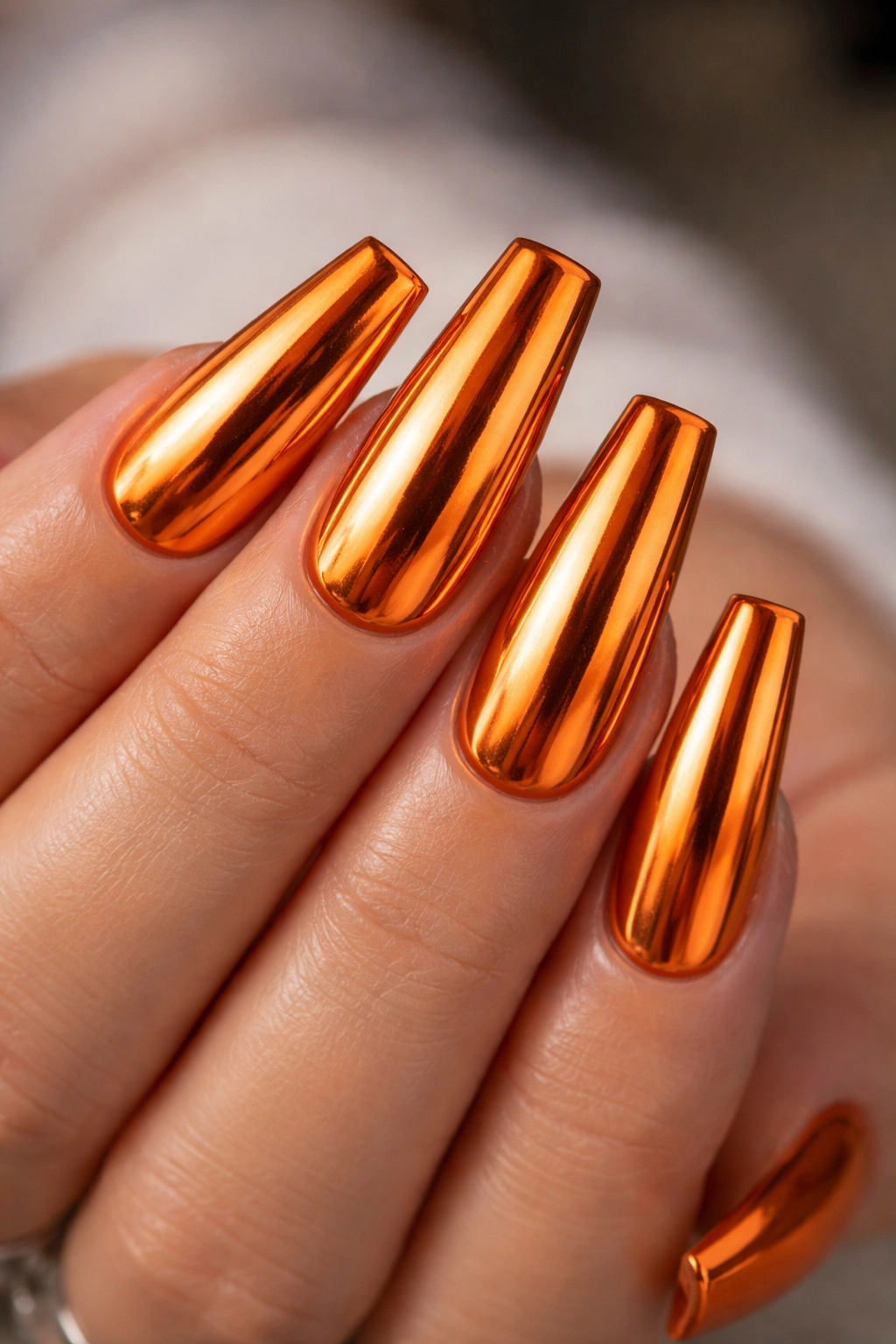
Can orange chrome look polished instead of loud? Yes—but only if the base underneath is nearly flawless. Chrome does not hide bumps. It puts a spotlight on them.
A smooth surface starts with prep: clean apex, even sidewalls, no visible lumps near the cuticle, and a top coat cured to the point where chrome powder will grip but not clump. Nail techs usually rub chrome onto a no-wipe gel top coat, then seal it with another layer. Skip any part of that sequence and the mirror finish gets patchy.
Prep matters more than pigment
Bright pumpkin chrome can veer flashy fast. A copper-orange chrome, burnt amber chrome, or orange shot with gold tends to look richer and easier to wear. On coffin nails, that reflective finish sharpens the flat tip and makes the whole silhouette look cleaner.
This set also wears better on structured gel or acrylic than on bendy natural nails. A mirror surface shows dents and pressure marks faster than a standard cream polish does. If you type hard, tap your nails on counters, or use your thumbnail as a tool, chrome will tell on you.
Short version: if you love a slick, reflective manicure and you are willing to do the prep properly, orange chrome is worth it. If you want a low-maintenance set, pick gloss instead.
10. Orange Aura Coffin Nails
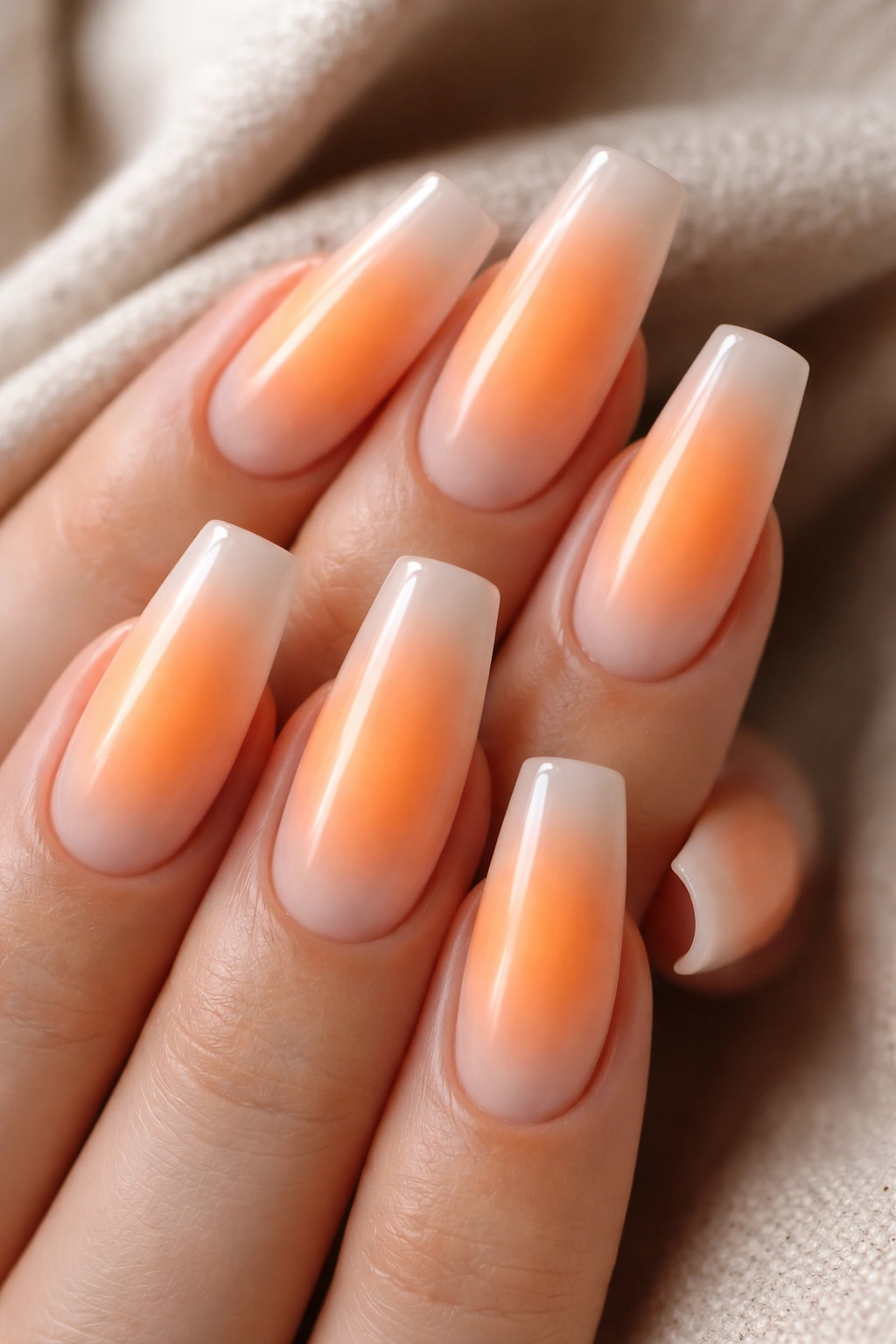
A soft orange glow in the center of a milky nail has a strange floating effect—as if the color is sitting under glass instead of on top of it. That is the charm of orange aura coffin nails. They feel softer than solid color but still give you that warm citrus hit.
I like this design most on a semi-sheer nude, pale peach, or soft pink-beige base. Airbrush orange into the center, deepen the middle with a touch of amber or coral if you want more depth, then blur the edges until the color diffuses. Hard circles kill the mood. Aura nails need haze, not targets.
Some techs sponge this look on. It can work, though airbrushing usually gives a finer fade.
What makes the aura placement look balanced
- Keep the glow centered slightly above the middle of the nail, not too close to the cuticle
- Use a small halo of deeper orange only if the base color is light enough to show contrast
- Finish glossy; matte aura tends to lose that lit-from-within look
- Leave at least 20 to 30 percent of the nail base visible around the edges
This is a smart choice if full orange feels like too much but a tiny French tip feels too quiet. You still get color, though it comes through as a glow instead of a wall.
11. Coral-Orange Nails With Tiny Floral Accents
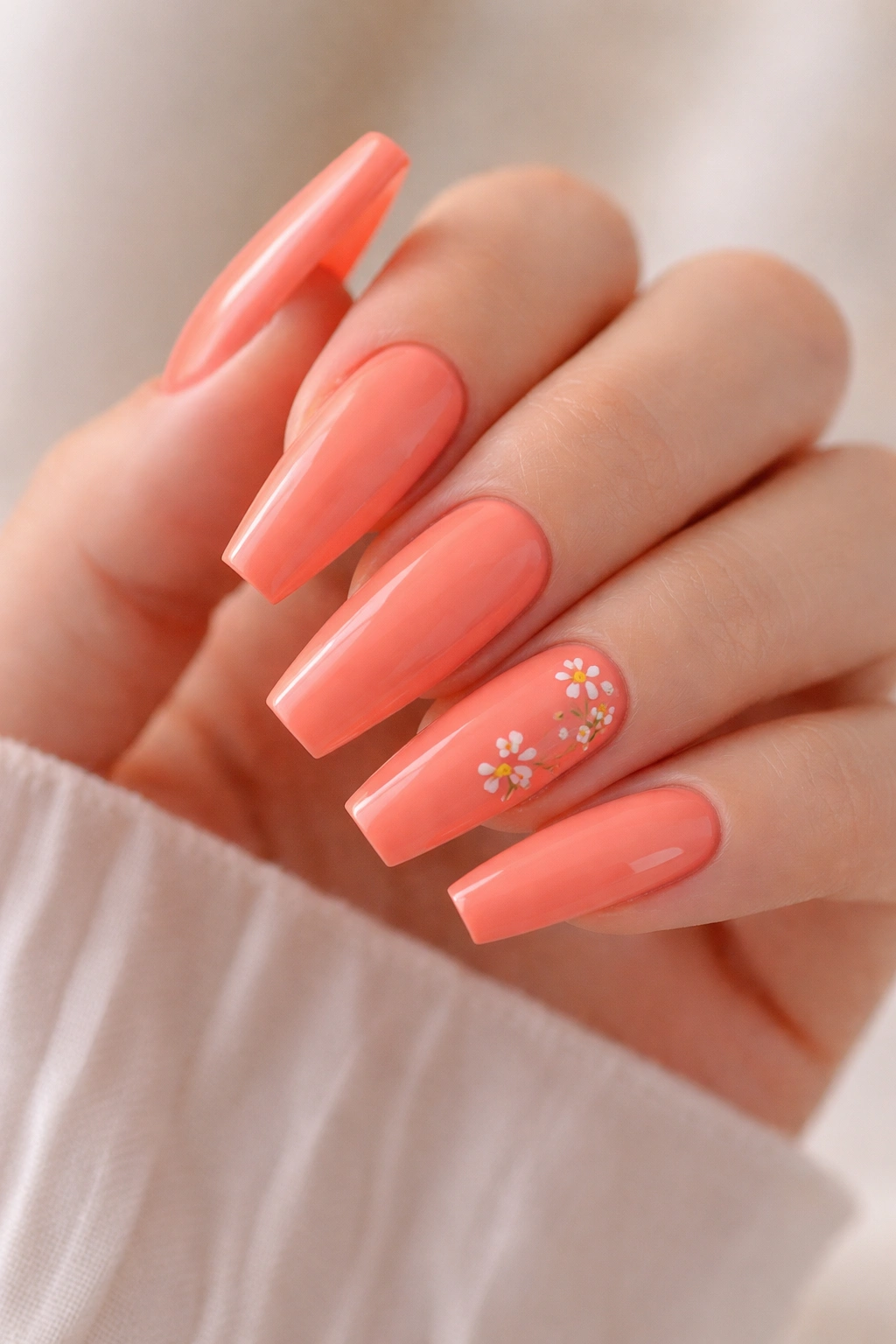
Tiny floral accents over a coral-orange base can go sweet or sharp depending on how disciplined you are. A couple of small blossoms on one or two nails feel fresh. Flowers on every nail, all the way to the tip, start crowding the shape and make the manicure look busy.
Skip all ten nails.
The nicest version uses coral-orange on most nails, then a milky nude or sheer peach accent nail for the floral detail. A dotting tool and a fine liner brush are enough for small daisies, five-petal blooms, or scattered petals. Keep each flower under 5 millimeters wide so the art reads delicate rather than chunky.
Color choice matters here too. White petals with tiny orange or yellow centers keep the set light. Cream petals soften the contrast. Black flower outlines make the whole manicure feel punchier and less cute. That can be a good thing if you love floral nail art but hate anything that looks juvenile.
A medium coffin length is the sweet spot. On extra-long nails, floral accents can drift into theme territory. On medium nails, they feel edited. And that is what you want: one clear idea, not six competing ones.
12. Blood Orange With Tortoiseshell Accent Nails
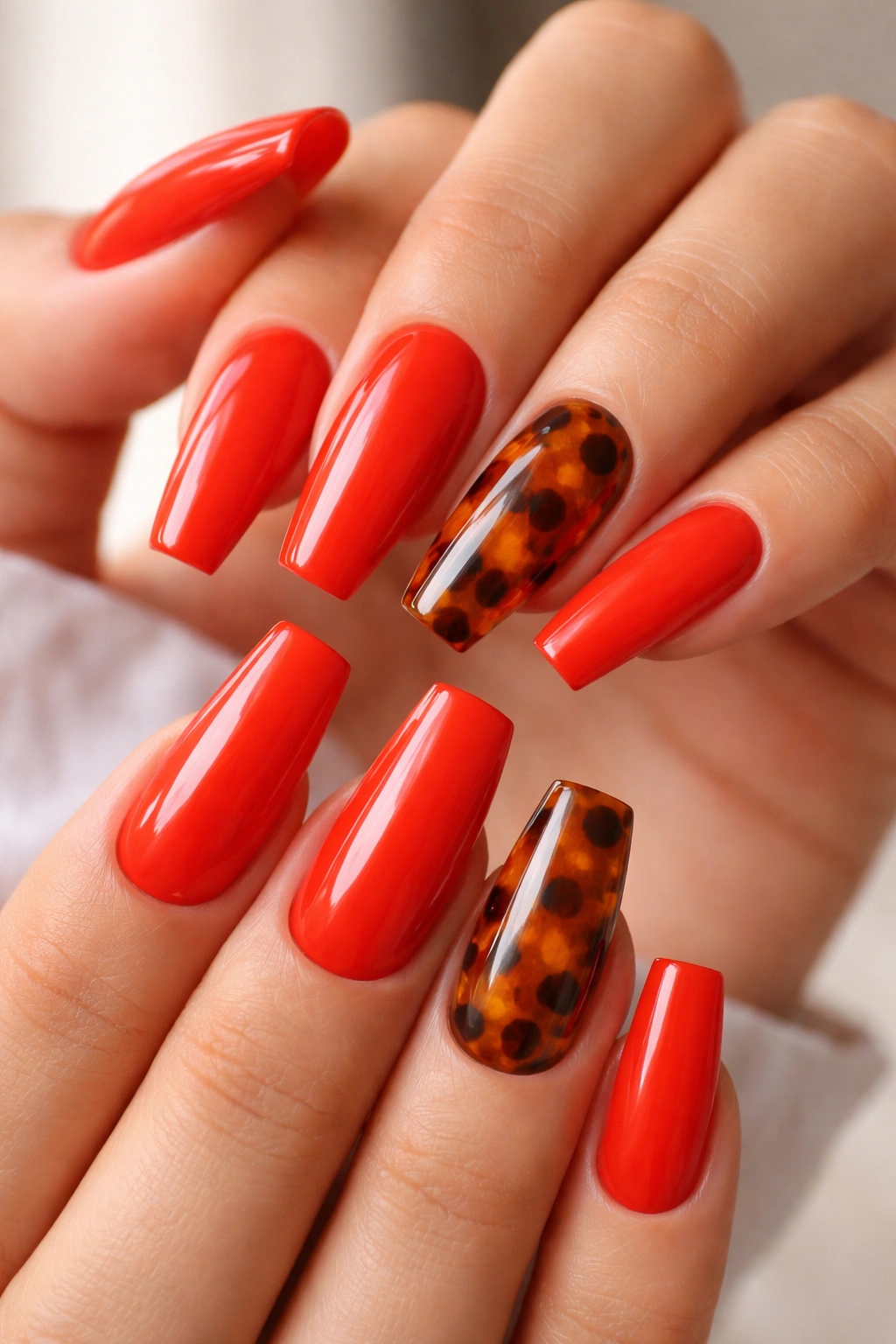
Unlike bright citrus shades, blood orange carries some depth. It sits closer to red-brown, burnt coral, and oxblood-adjacent tones than people expect, which is why it pairs so well with tortoiseshell. Both have warmth, both have dimension, and neither one needs glitter to feel rich.
A smart version of this set keeps the tortoiseshell to one nail per hand—maybe the ring finger, maybe the middle finger—while the rest stay solid blood orange. That contrast gives the accent room to matter. Two tortoise nails on each hand can still work, though the set starts leaning harder into pattern.
Tortoiseshell itself needs layering. First a translucent amber or honey base, then irregular spots of medium brown and black, then another sheer amber layer to blur everything together. Done well, it looks deep and slightly smoky. Done badly, it looks like random blobs trapped in gel.
This combo is strong on medium or long coffin nails, especially in glossy finish. Matte blood orange can look good on its own, though once you pair it with glossy tortoiseshell the mismatch can feel accidental. Keep both finishes aligned. Same mood, same top coat, sharper result.
13. Orange Glitter Fade Coffin Nails
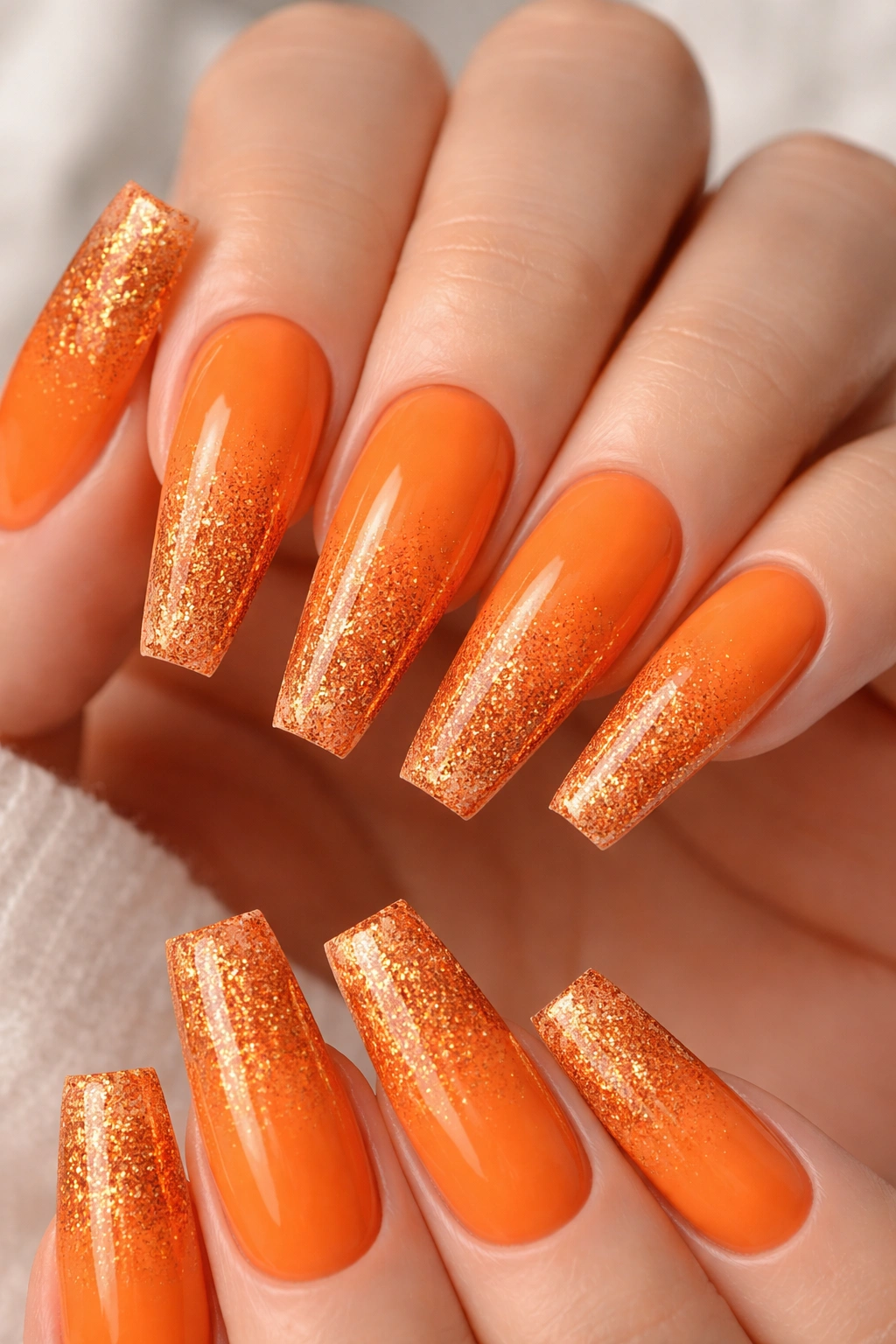
Glitter works best with orange when it behaves like light, not confetti. That is why an orange glitter fade beats an all-over chunky glitter nail almost every time. You get shine and texture, but the base color still leads.
The fade can start at the tip or the cuticle. Tip fades feel cleaner on coffin nails because the sparkle follows the flat edge and makes the shape look crisp. Cuticle fades feel softer and can help disguise grow-out a little better.
Pick the glitter size with care
Fine glitter suspended in gel gives a smooth, sugar-like shimmer. Medium hex glitter brings more flash but can make the surface lumpy if the top coat is thin. I almost always lean toward fine copper, gold, or orange-reflective glitter for this style because it melts into the base instead of fighting it.
A few details that keep the fade sharp
- Concentrate glitter on the outer quarter to third of the nail, then feather upward
- Use one accent glitter fade on each hand if you want the set to stay sleek
- Add two layers of top coat if the glitter pieces are textured or uneven
- Pair the fade with a solid cream orange rather than another textured finish
Best move: choose a slightly deeper orange base—papaya, pumpkin, amber—so the sparkle has contrast and does not disappear under the light.
14. Creamsicle Orange and Pink Color-Block Coffin Nails
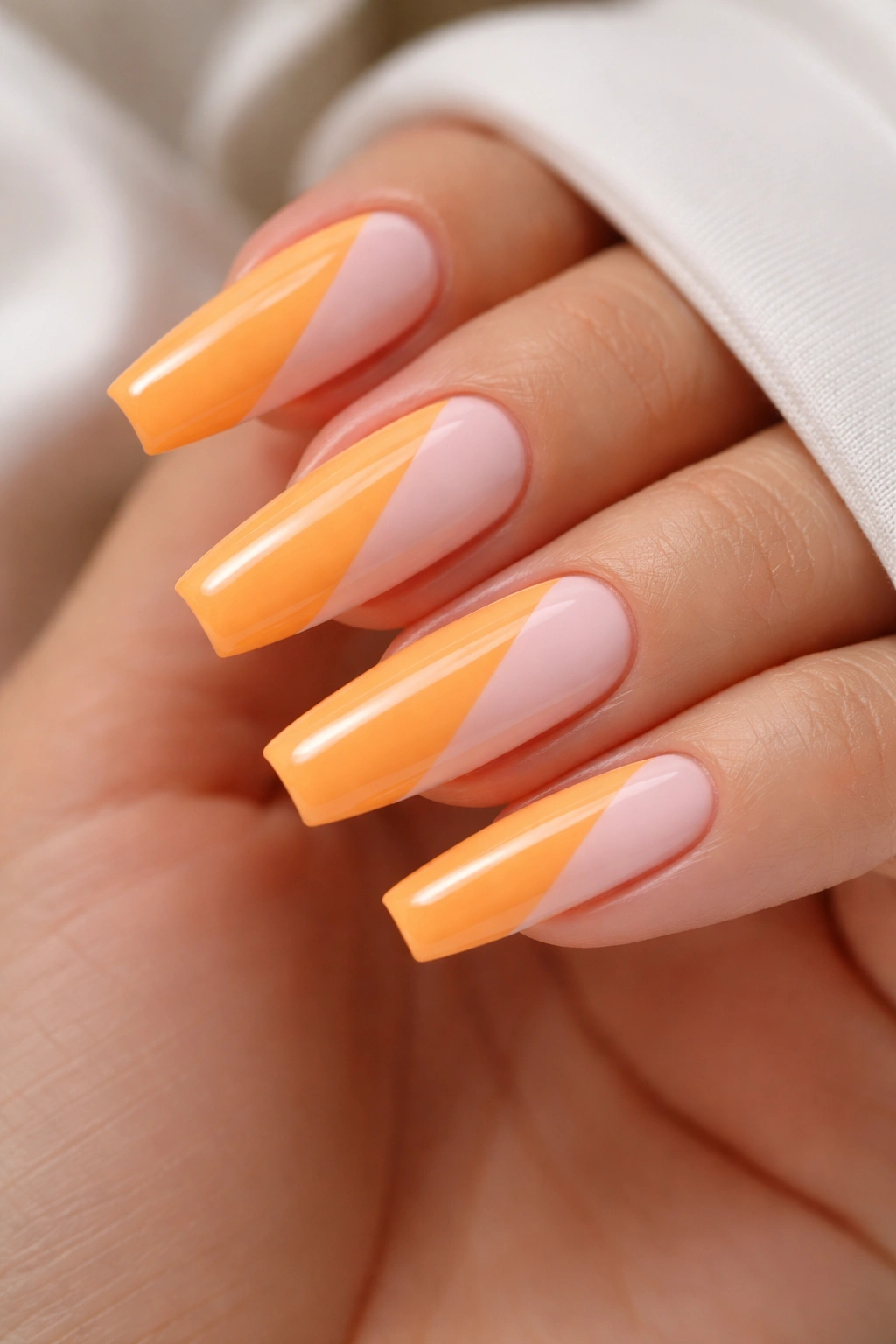
Picture a creamy orange panel crossing a soft pink base at a diagonal, with one clean border and no extra fuss. That is the version of color-block nails I keep liking on coffin shapes. It has a retro streak, but the sharp tip keeps it from feeling costume-y.
This design lives or dies by palette. Use a creamy sherbet orange instead of a neon, and pair it with a pale pink, blush nude, or milky rose. Hot pink plus orange can work, though the mood changes fast and the manicure starts reading louder, younger, more graphic. Maybe that is what you want. If not, soften one side of the pairing.
Crisp borders matter. Striping tape, a fine liner brush, or gel paint with a stiff edge brush gives the cleanest block. A wobbly divide line looks sloppy because the whole point of color blocking is contrast and control. Diagonal placement usually flatters coffin nails more than horizontal bands do; the angle follows the taper and keeps the nail looking long.
I like this set when you want orange nails that still feel playful but not sugary. One blocked accent nail per hand is enough for a quiet take. Four or five blocked nails push it into statement territory.
15. Burnt Orange Coffin Nails With Tiny Cuticle Crystals
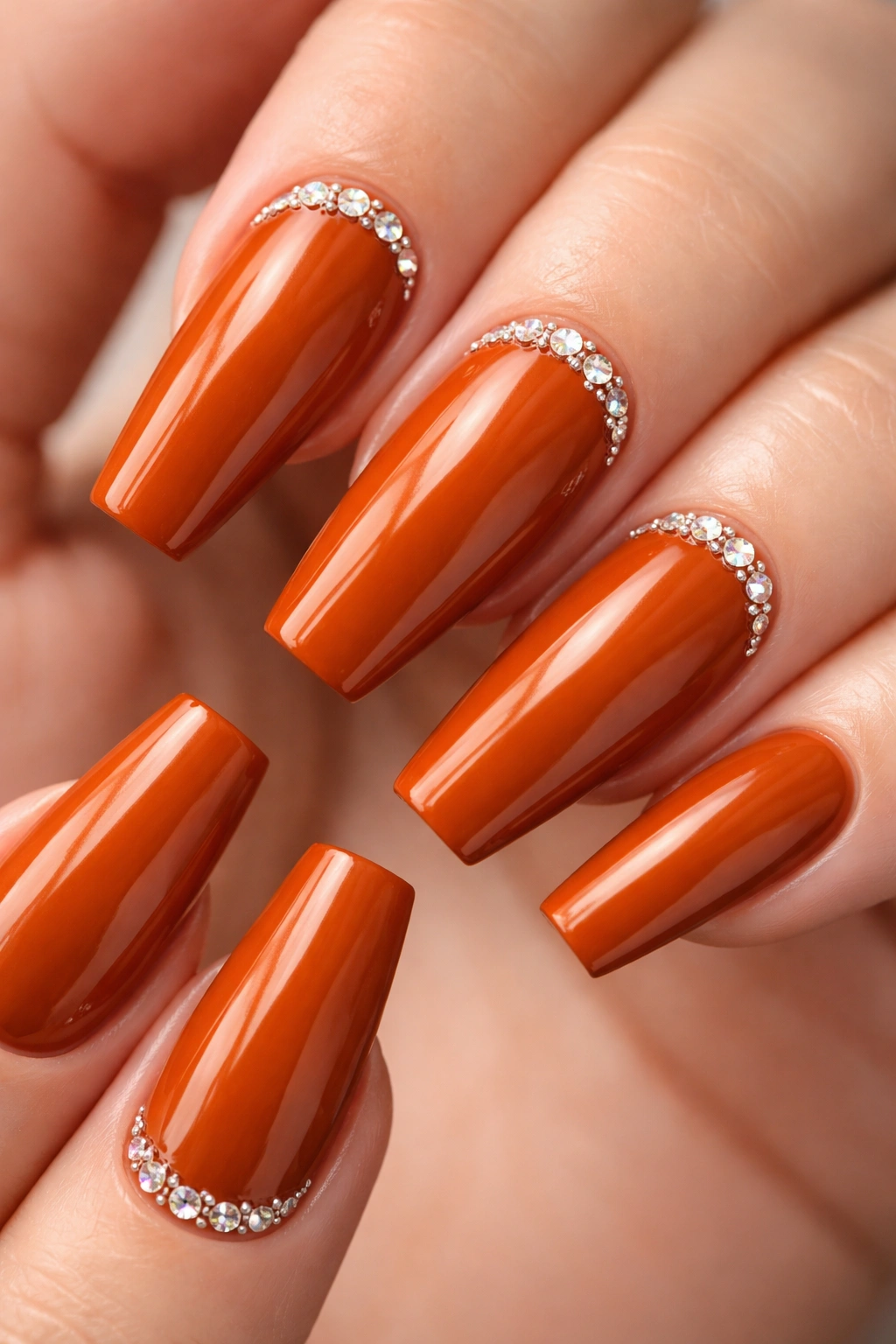
Do rhinestones and orange nails always look overdone? No. They look overdone when the stones are too big, the placement climbs halfway down the nail, or the base color is already screaming. Burnt orange with tiny cuticle crystals avoids that problem by keeping the sparkle low and tight.
Placement keeps the set sharp
The cleanest version uses ss3 to ss5 crystals—small stones, not chunky gems—placed in a soft arc near the cuticle on one or two nails. You can also do a single stone on each nail if you want only a flicker of shine. Once you start stacking multiple sizes into a full cluster, the design gets heavier and the orange stops being the main event.
A deeper burnt orange, rust, or cinnamon-orange handles crystal accents better than bright tangerine does. The darker base gives the stones contrast and lets them read as a detail rather than party decor. Glossy top coat helps here too; matte plus crystals can feel disconnected unless the rest of the set is built around texture.
Secure the stones with builder gel or rhinestone gel, not top coat alone. Top coat is fine for sealing edges, though it is rarely enough to hold stones through everyday wear. If you wash dishes barehanded, jam your hands into jean pockets, or sleep with your nails pressed under the pillow, even tiny crystals can lift. Placement near the cuticle lowers the snag risk.
Final Thoughts
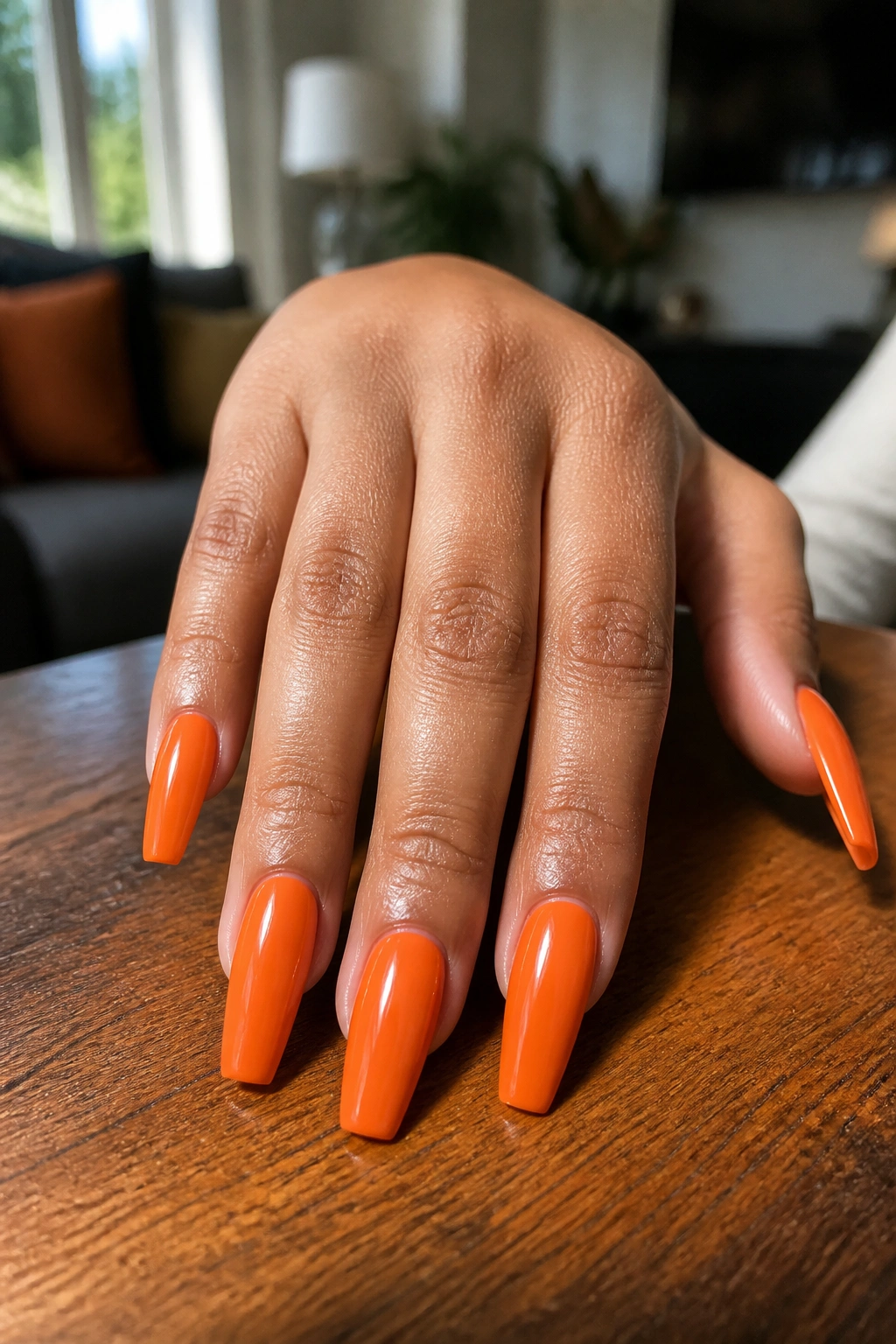
Orange is not one mood. That is the part worth remembering. A juicy tangerine gloss, a smoky terracotta matte, a blood-orange tortoiseshell mix, and a peach jelly set all sit under the same color family, yet they do not read the same on the hand at all.
Finish matters almost as much as shade, and the coffin shape gives every orange manicure a little backbone. That flat tip can make a simple cream polish look sharper, while the taper keeps bigger ideas—chrome, aura, foil, glitter fade—from turning clunky.
If you are choosing between two orange nail ideas, hold the swatches near your skin in daylight and indoor light before you commit. Orange shifts more than people expect. Get the undertone right, keep the shape clean, and the color stops feeling risky fast.