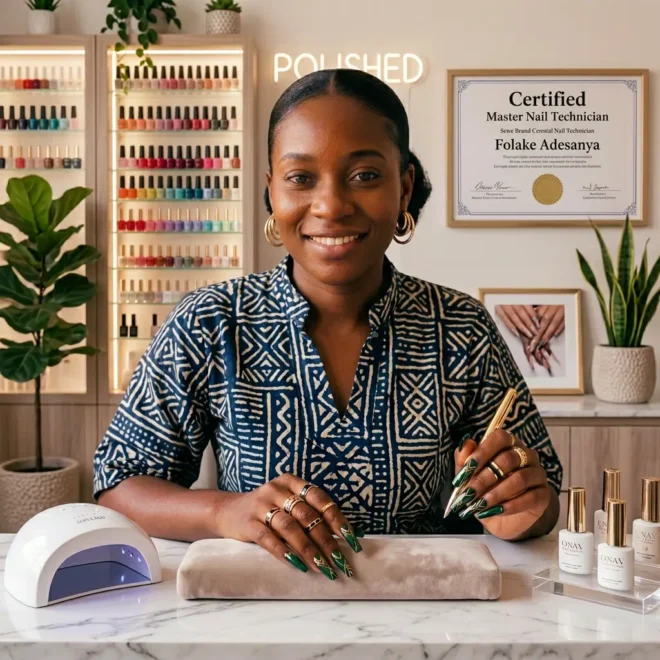


Under salon lights, half the burgundy polishes on the wall look like twins. Step outside, though, and they split fast—one reads like black cherry, one leans plum, another turns brown at the edges, and one suddenly looks rich enough to pass for a glass of red wine. That’s why burgundy coffin nails can look either sharp and expensive or a little flat if the shade and finish miss the mark.
The coffin shape changes the whole mood of a dark manicure. Because the sides taper and the tip stays squared off, deep colors look cleaner, longer, and more deliberate than they often do on round or squoval nails. You also see every little detail more clearly: streaks in sheer polish, uneven sidewalls, lumpy acrylic, top coat drag. Dark shades don’t hide much.
I’ve always liked burgundy because it lands in that useful middle ground. It has more edge than a classic cherry red, more warmth than a flat black, and more range than people give it credit for. A blue-based wine shade feels crisp; an oxblood reads heavier and moodier; a jelly burgundy can look almost lit from underneath when the light hits the nail from the side.
Length matters too. A medium coffin with 10 to 14 mm of free edge can carry details that look cramped on short nails and stretched out on extra-long tips. So before you pick a design, it helps to know which version of burgundy you’re actually after.
Deep Wine, Berry, and Oxblood: Picking the Right Burgundy Base
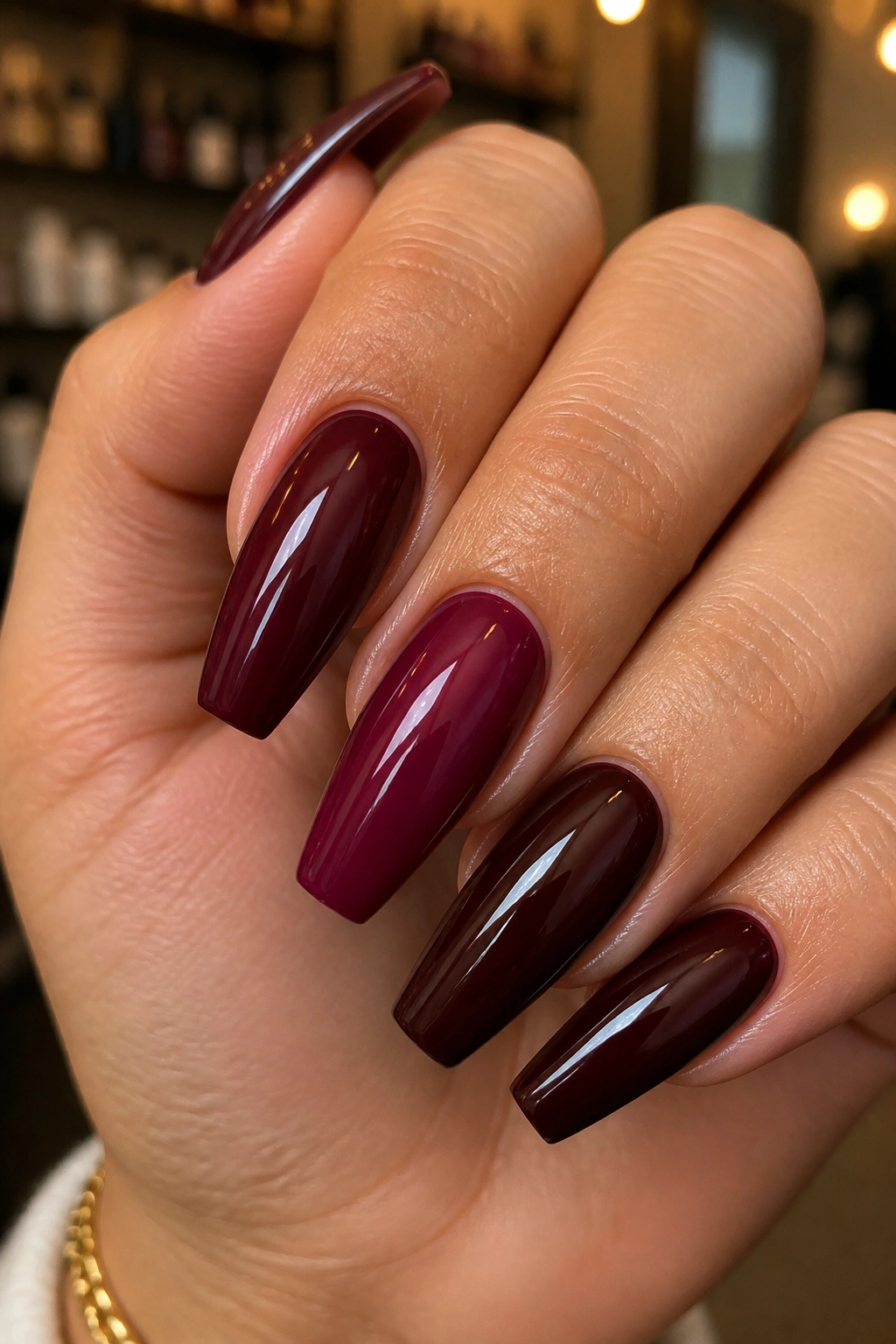
Not all burgundy shades behave the same once they hit the nail. Some pull red, some lean purple, and some carry enough brown or black pigment that they read almost gothic from a few feet away. On a polish swatch wheel, those differences can seem minor. On coffin nails, they show up fast.
A few quick color cues help:
- Blue-based burgundy looks cooler and often sharper in photos, especially against silver jewelry.
- Berry burgundy has a hint of plum and tends to soften the look of a long coffin shape.
- Brown-red burgundy feels warmer and richer, especially with gold accents or tortoiseshell details.
- Blackened wine shades give the strongest contrast and make the taper of coffin nails stand out more.
Skin tone plays a part, but not in the rigid way some manicure advice makes it sound. If your skin has pink or neutral tones, cooler burgundy shades usually look crisp and clean. If your skin has golden or olive tones, brown-red and oxblood shades often sit more naturally against the hand. And yes, you can ignore that rule if you want a stronger contrast—that can be the whole point.
Lighting lies a little.
A shade that looks soft under warm indoor bulbs may turn almost black outdoors. If you’re choosing at a salon, hold the bottle near a window or check a cured sample nail under white light. That tiny step saves a surprising amount of regret.
Why the Coffin Shape Makes Dark Nails Look Sharper
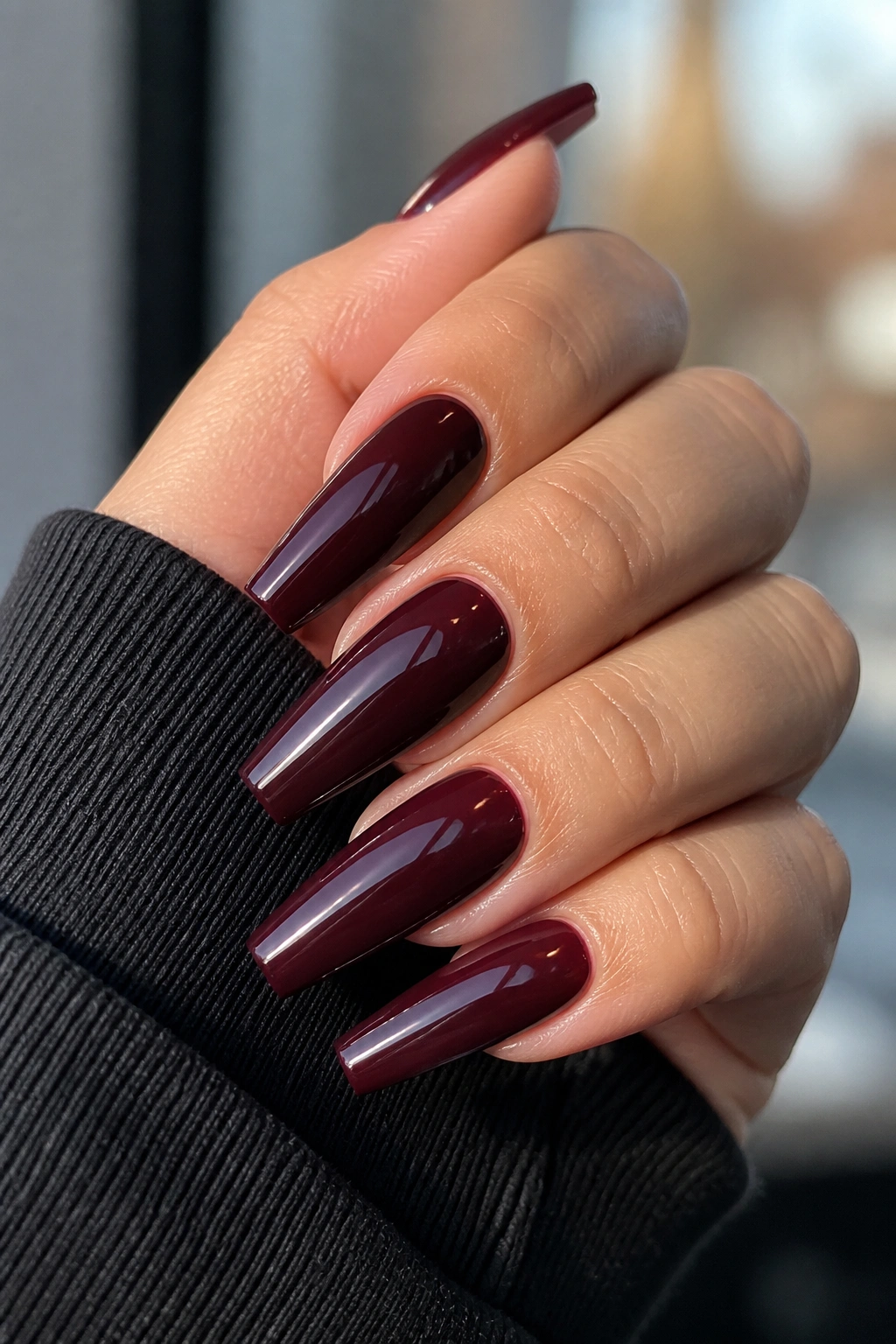
Coffin nails do one thing dark shades love: they create direction. The narrow sidewalls guide the eye toward the flat tip, so deep colors look more graphic and intentional than they do on a softer shape.
That’s part of why burgundy works so well here. A deep red-black polish already has visual weight, and the coffin silhouette gives that weight somewhere to go. The result feels sleek rather than heavy—assuming the nail is balanced correctly through the apex and side edges.
Short coffin nails can still carry burgundy well, but the effect changes. On a shorter set, dark wine shades look neat and compact. On medium and long coffins, they start to feel dramatic, especially if you add chrome, velvet cat-eye, or a high-gloss top coat that reflects a clear line of light down the center.
One caution: crooked shaping shows more on dark coffin nails than on pale shades. If one side is filed straighter than the other, burgundy polish will announce it. Ask your nail tech to check symmetry with both hands held palm-down at eye level before color goes on. It takes 20 seconds. It matters.
Salon Details That Keep a Burgundy Set Looking Clean
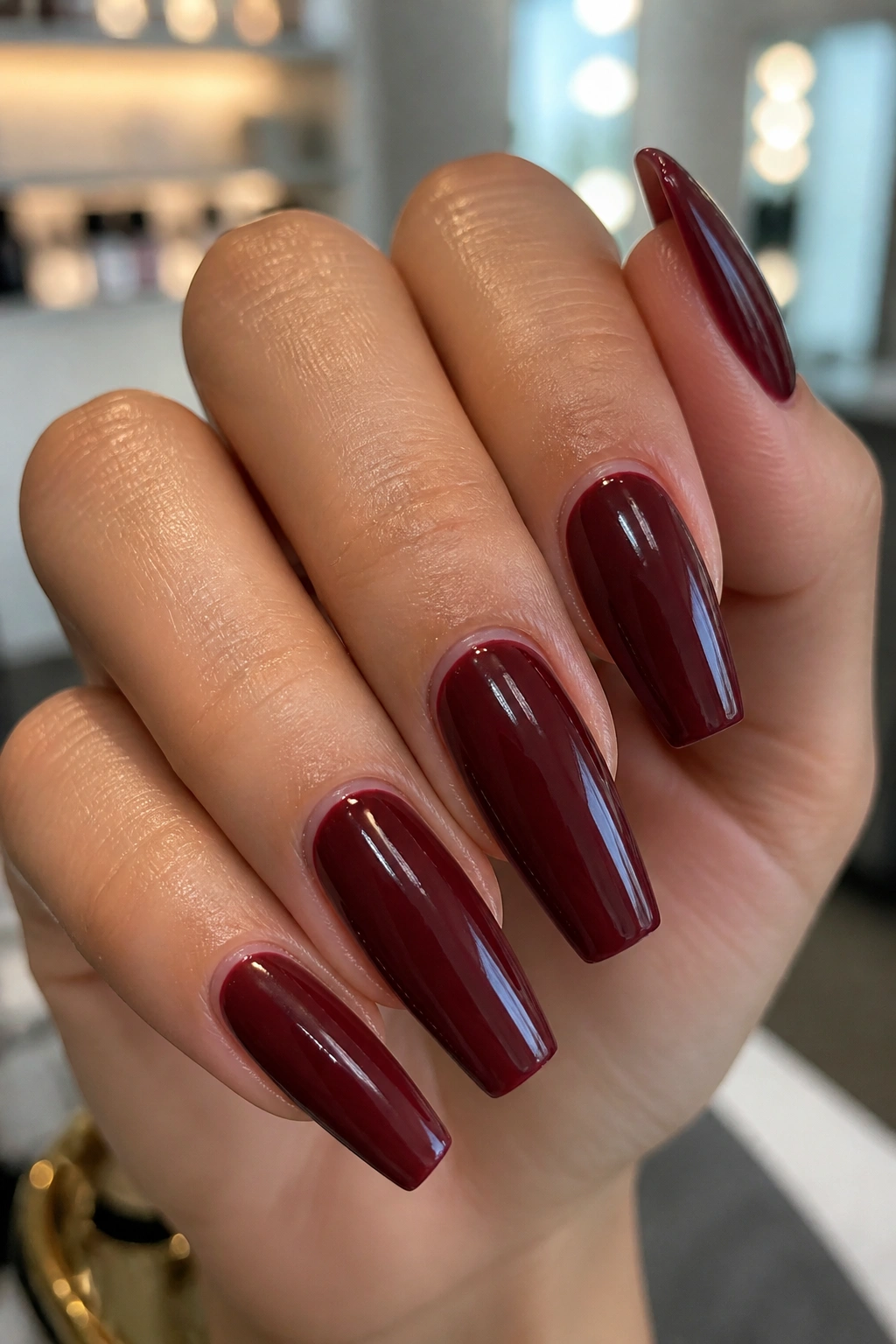
A dark manicure can look rich for three weeks—or look worn after four days. Application decides a lot of that. Burgundy shades are unforgiving around the cuticle line, and any flood, gap, or streak tends to be more obvious than it would be with sheer pink.
When you sit down for the service, these are the details worth asking for:
- A thin, tight cuticle line with no pooling into the sidewalls
- Capped free edges so the color doesn’t wear white at the tip too early
- An even apex if you’re getting acrylic or hard gel on medium or long coffin nails
- Two thin color coats instead of one thick coat, especially with jelly, magnetic, or chrome bases
- A high-gloss top coat or a true matte top coat—not a half-satin finish that can make burgundy look dusty
If you wear your hands hard—typing, opening cans, cleaning without gloves, the usual—ask for a slightly shorter coffin. Around 12 mm of free edge is often the sweet spot: long enough to show shape, short enough to stay practical.
Cuticle oil helps, yes, but not because it’s magic. It keeps the skin around a dark manicure from going dry and chalky, which makes the whole set look fresher. A drop morning and night does more than most people expect.
1. Glossy Deep Wine Burgundy Coffin Nails
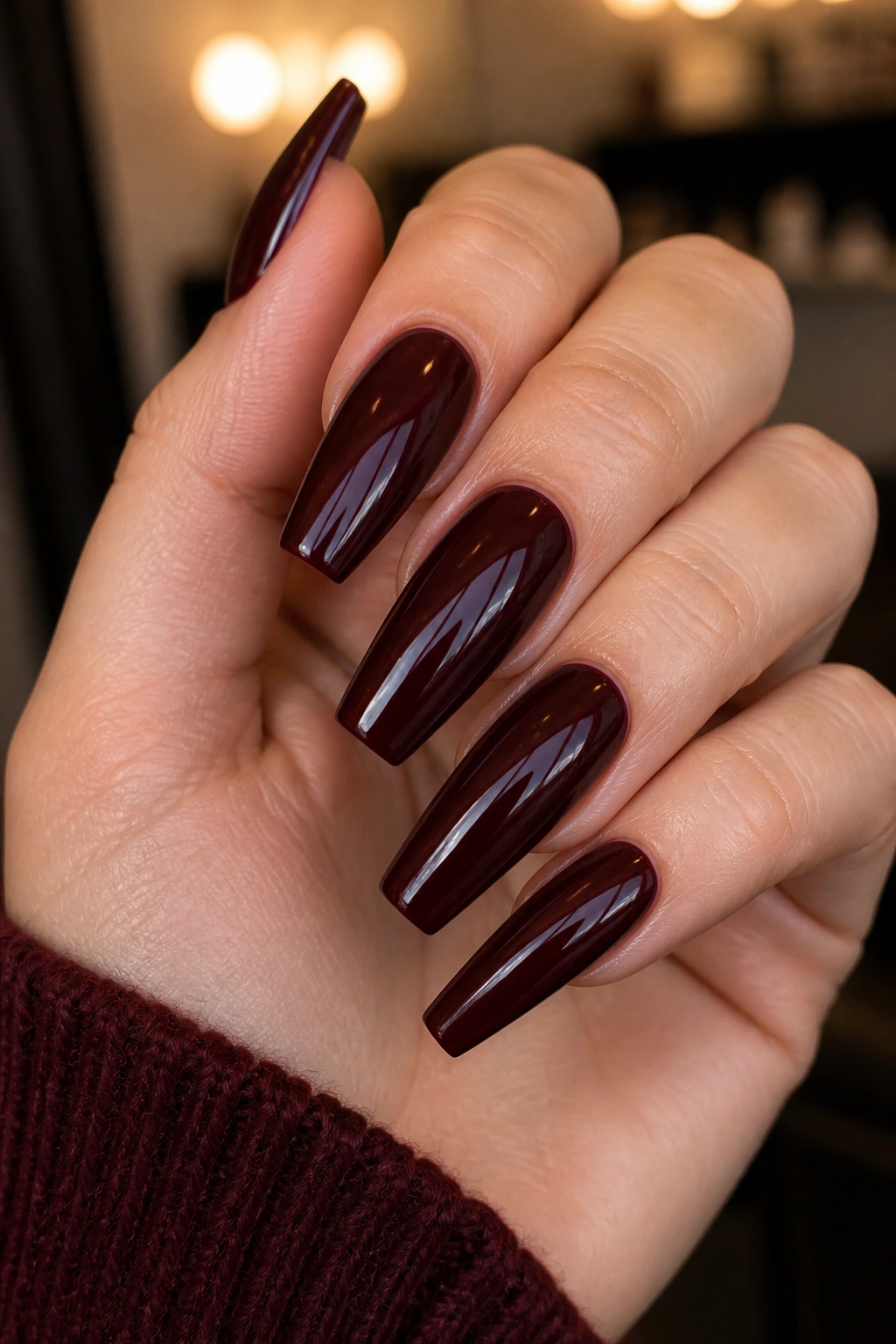
If you want the version of burgundy coffin nails that almost never misses, start here. A deep wine creme with a glassy top coat shows off the coffin shape without adding extra design work, which is part of why it looks so polished.
Why this one keeps working
The strength of this set is the surface. A smooth, high-gloss finish creates one long reflection line from cuticle to tip, and on a coffin shape that line makes the nails look straighter and cleaner. Medium length—about 12 to 15 mm past the fingertip—is where this style tends to hit hardest.
What to ask for at the salon
- A blue-red wine shade, not a brown maroon, if you want a crisper look
- Full opacity in two thin coats
- A top coat with strong shine, cured long enough to avoid dull patches
- Clean sidewalls with no bulk near the tip
I like this set most when the nails are kept plain and the shape does the talking. No foil, no stones, no accent nail. The shine is the design.
2. Matte Oxblood Coffin Nails
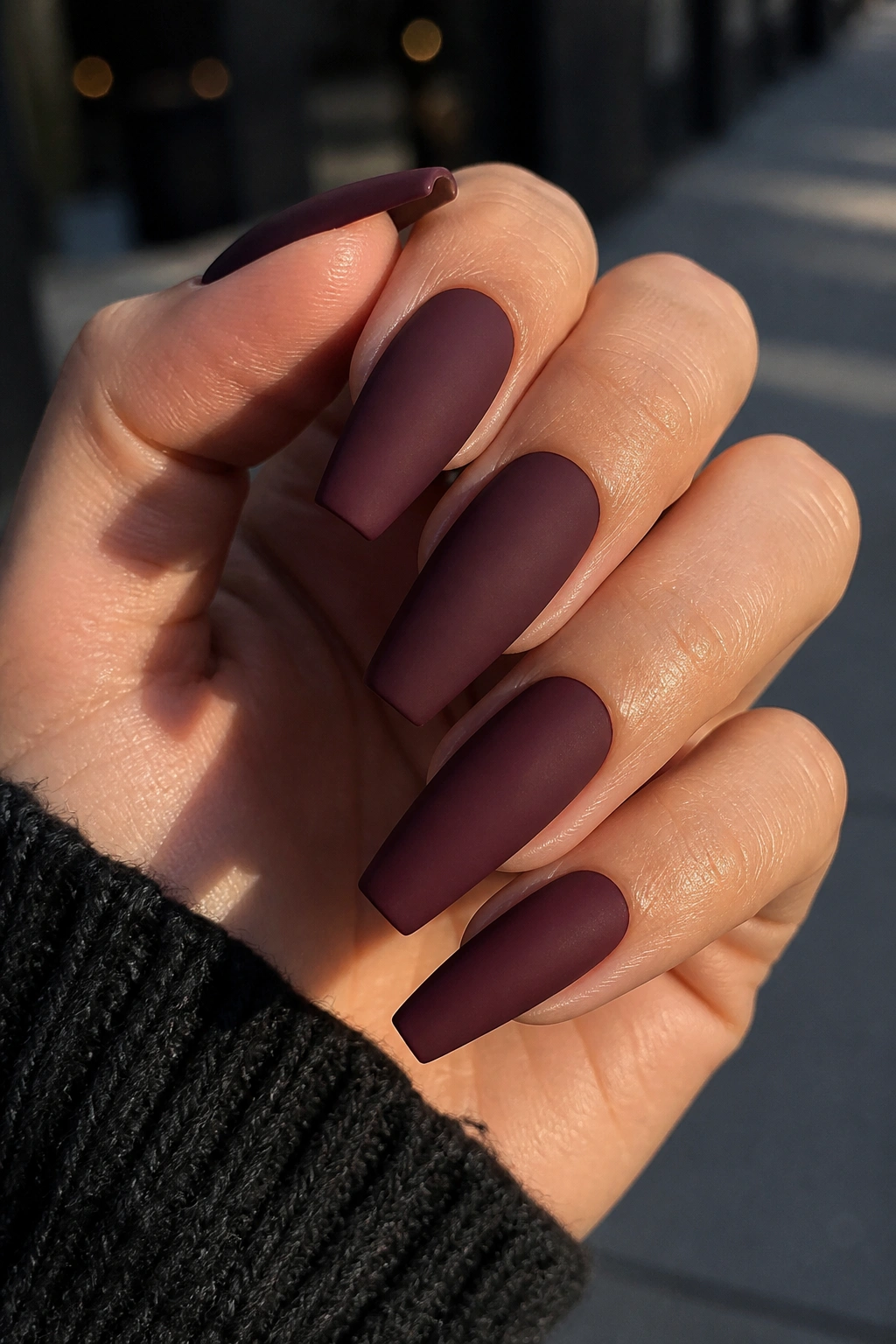
Matte oxblood has a heavier mood. It feels denser, flatter, and a little more fashion-forward than glossy wine, especially on longer coffin nails where the tapered sides give the color a blade-like edge.
There’s a catch, though. Matte top coat shows texture and dents faster than gloss, so the underlying nail needs to be smooth before that final layer goes on. Buff marks, tiny ridges, uneven acrylic near the apex—matte will not forgive them.
The color matters as much as the finish. An oxblood with brown-black depth looks richer than a flat red under matte top coat. You want the shade to still read as burgundy, not chalky brick. If the salon sample looks dusty before the top coat even cures, skip it.
A thin gold ring stack or a leather jacket makes this manicure feel sharper, but it doesn’t need styling props to work. It already has enough presence. For maintenance, ask your tech whether the matte top coat can be refreshed with one more layer after 10 to 14 days, because hand cream and natural oils can make the surface look patchy.
3. Burgundy French Tip Coffin Nails with a Milky Nude Base
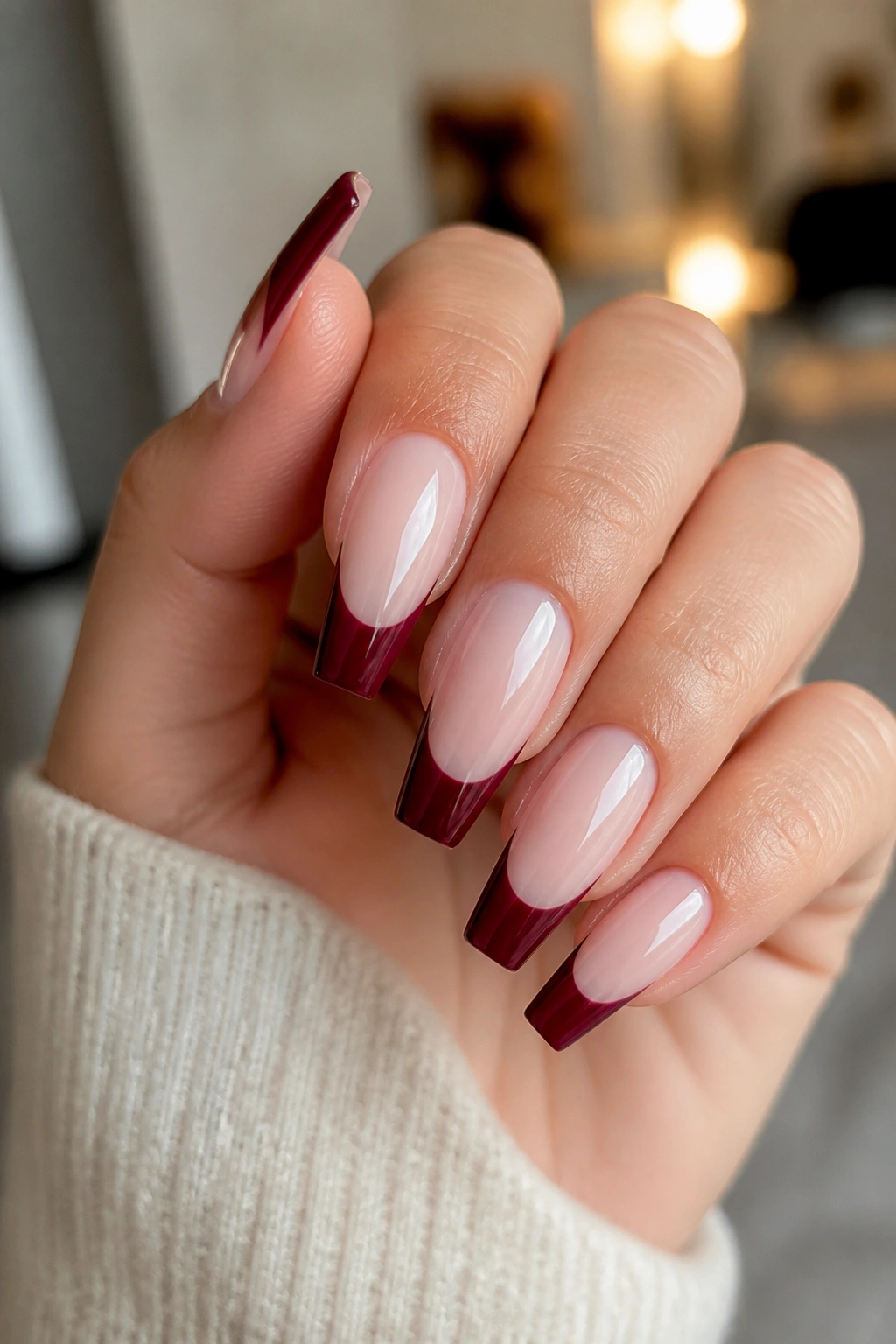
Why does this combo look so clean? Because the contrast does the heavy lifting. A sheer pink-nude base keeps the nail bed light, while the burgundy tip draws a crisp line across the squared end of the coffin shape.
This is one of the easiest ways to wear a dark manicure without feeling fully committed to dark polish on every millimeter of nail. It also grows out more gracefully than a full-color set, since the base stays close to your natural nail tone.
The line matters more than the color
A French tip on coffin nails needs width control. Too thin, and the dark tip looks accidental. Too thick, and it can crowd the nail bed. A tip depth of 3 to 5 mm usually reads clean on medium coffin nails, though longer sets can carry more.
Ask for these details
- A milky nude or sheer beige base with enough coverage to blur the smile line
- A burgundy tip painted straight across the free edge, then softened at the corners
- A fine liner brush for sharp side edges
- Extra top coat over the tip line so you do not feel a ridge
If you like dark nails but still want your hands to look a touch softer, this is one of the smartest picks on the list.
4. Burgundy Ombre Coffin Nails Fading into Black Cherry
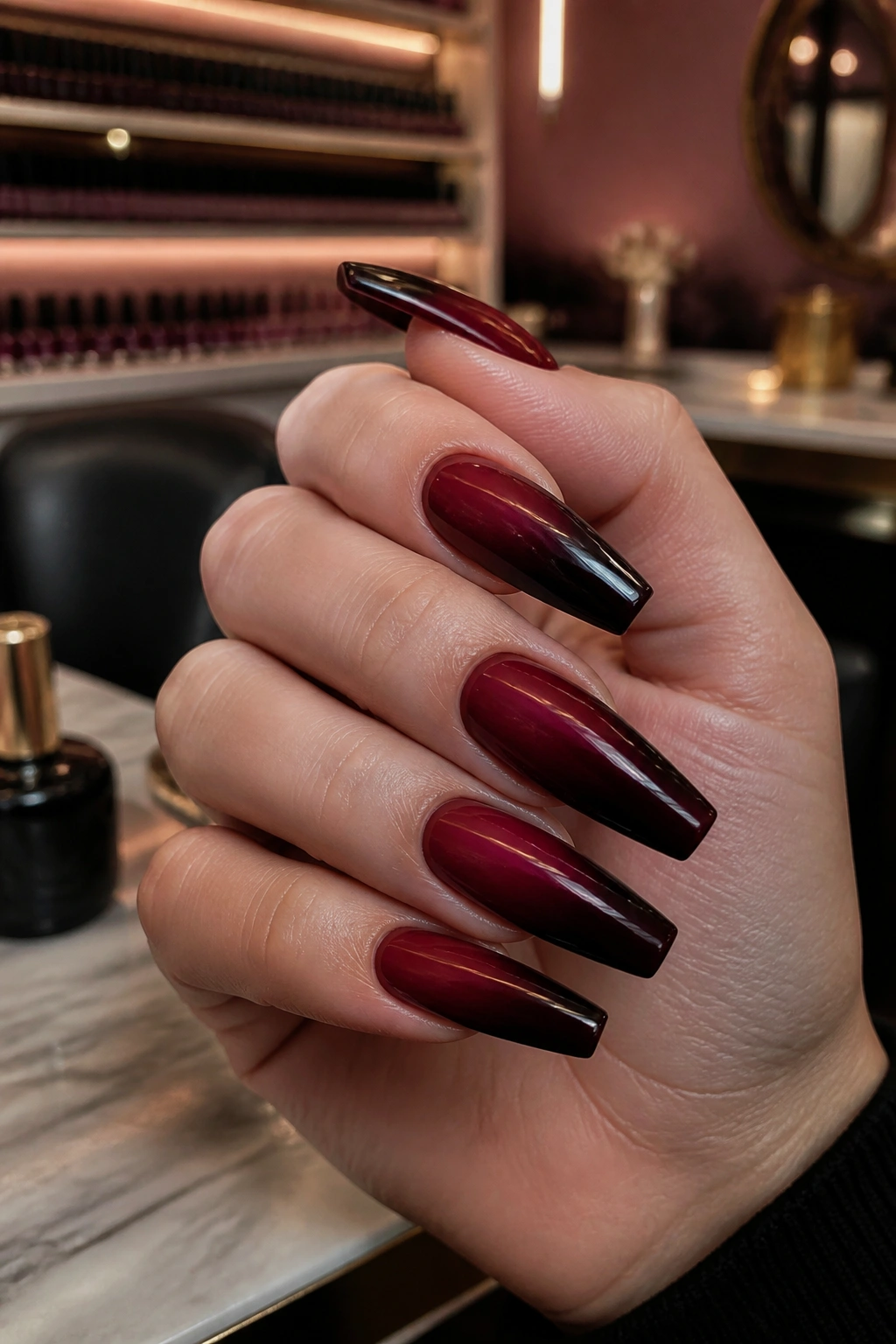
A good burgundy-to-black ombre looks smoky, not striped. You should see the color sink from wine red near the cuticle into black cherry or soft black toward the tip, with no hard band through the middle.
I’ve seen this set look muddy when the two colors are too similar in depth. The fix is simple: keep the burgundy red enough to show a shift, and use black sparingly. You want a gradient, not a blunt two-tone nail.
Where it earns its keep
This design shines on medium-long to long coffin nails, where there’s enough surface area to blend the transition over 8 to 12 mm. On short nails, the fade can look cramped unless your tech is especially good with an airbrush or sponge blend.
A few details make a difference:
- Start the darker tone at the tip, where natural wear is less noticeable
- Add gloss unless you want the fade to look flatter
- Keep any accent nails minimal; this design already has depth
- Ask the tech to turn the finger side to side under the lamp to check for patchiness
The finished look has a smoky, late-night feel—less red than a classic burgundy set, more shadow. If plain wine nails feel a little too safe for your taste, this is an easy step deeper.
5. Gold Foil Burgundy Coffin Nails
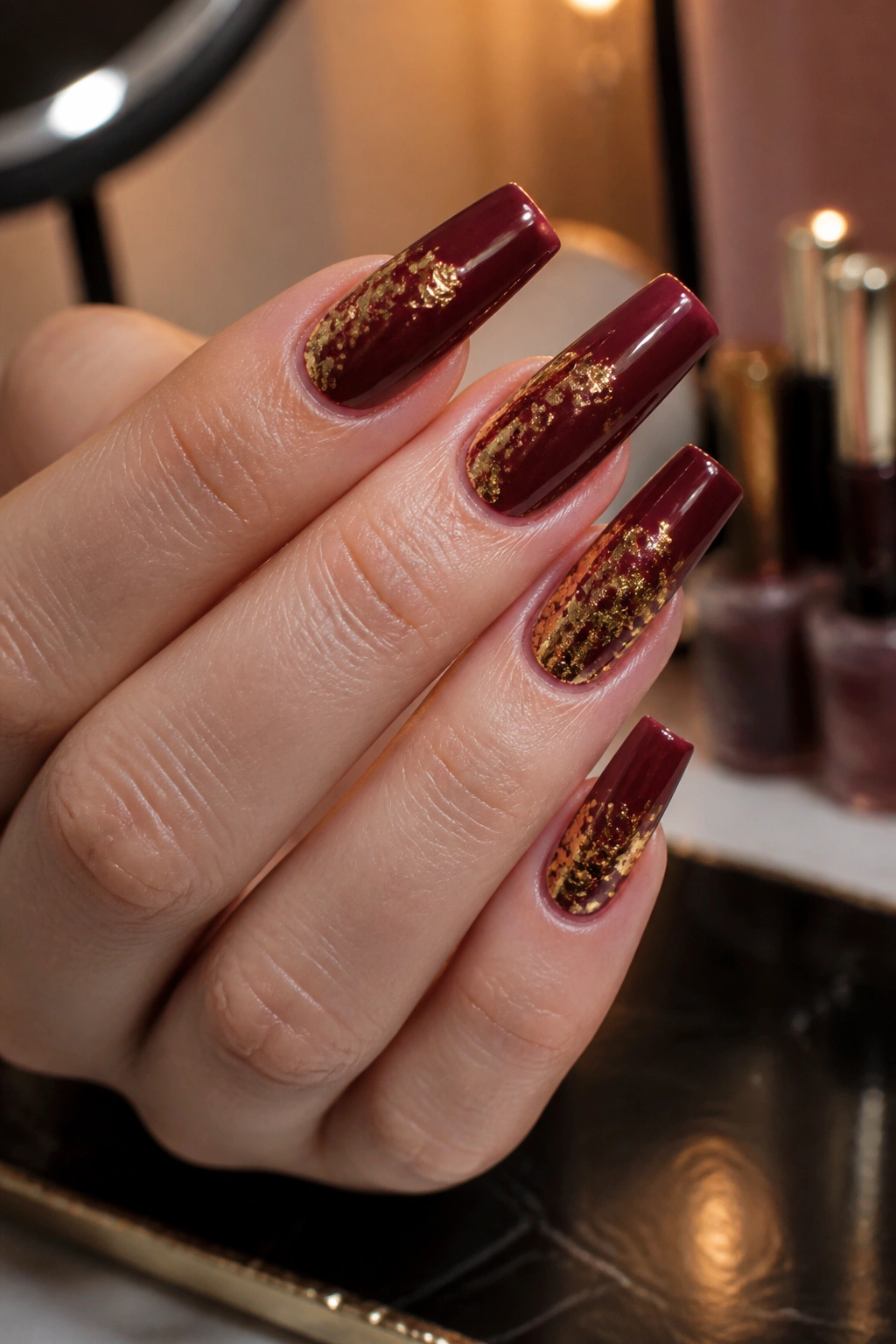
Gold foil on burgundy can go one of two ways. Done with restraint, it looks like tiny flashes of metal caught in dark glass. Done with a heavy hand, it starts to look busy fast.
That’s why placement matters more than the foil itself. I prefer foil kept to one-third of the nail area or less, usually clustered near the cuticle, dragged diagonally across the center, or pressed lightly into one side of an accent nail. Scattered all over every finger tends to kill the shape.
The base shade should lean warm for this one. Brown-red burgundy, merlot, and oxblood usually pair better with gold than cooler berry tones do. You want the metal to look at home in the color, not pasted on top of it.
Gloss is the way to finish this set. A thick enough top coat smooths the foil edges and gives the nail a sealed, almost lacquered surface. If you can still feel foil texture after curing, it needs another coat. Raised foil catches hair, sweaters, and annoyance.
6. Jelly Burgundy Coffin Nails with Glass-Like Depth
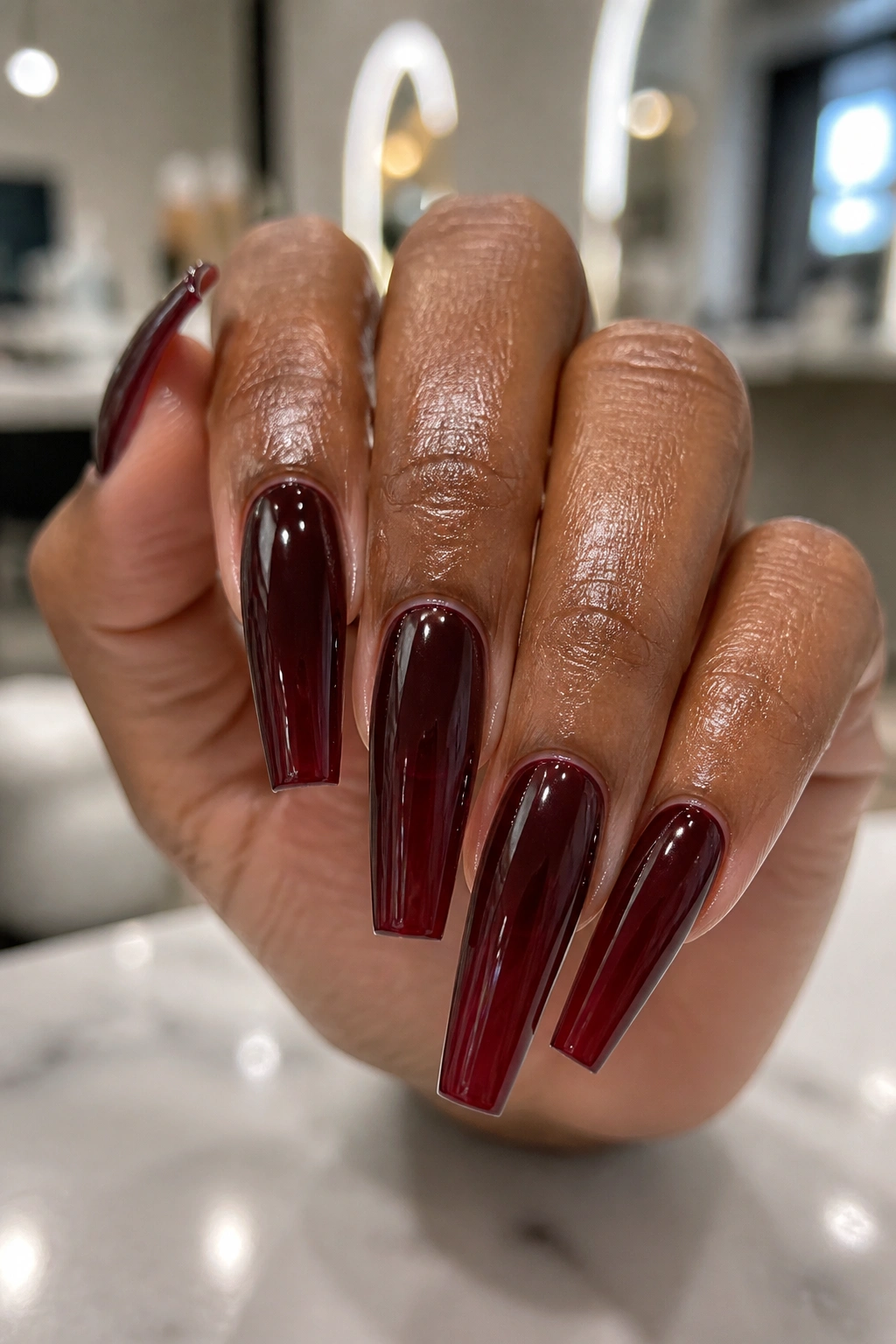
Unlike a full-coverage creme, a jelly burgundy lets light travel through the color before it bounces back. That’s why it looks deeper, almost syrupy, especially at the apex and free edge where the product layers slightly thicker.
This style works best when the structure underneath is clean. If the extension line, builder layer, or natural nail edge is messy, a jelly finish may show it. On a clear tip with a smooth overlay, though, the effect is rich and almost candy-like without turning juvenile.
Who does this suit? Anyone who likes dark nails but wants movement in the color instead of a flat block of pigment. It’s also a smart option if you think opaque burgundy can feel too heavy on your hands.
Wear notes
A jelly set often looks better in three sheer coats than in two thick ones. That slower buildup keeps the color translucent and prevents wrinkling near the sidewalls. Ask for a high-gloss top coat, because jelly polish without shine loses half its charm.
One more thing: phone cameras often flatten jelly finishes. In person, they usually look better than they photograph.
7. Velvet Cat-Eye Burgundy Coffin Nails
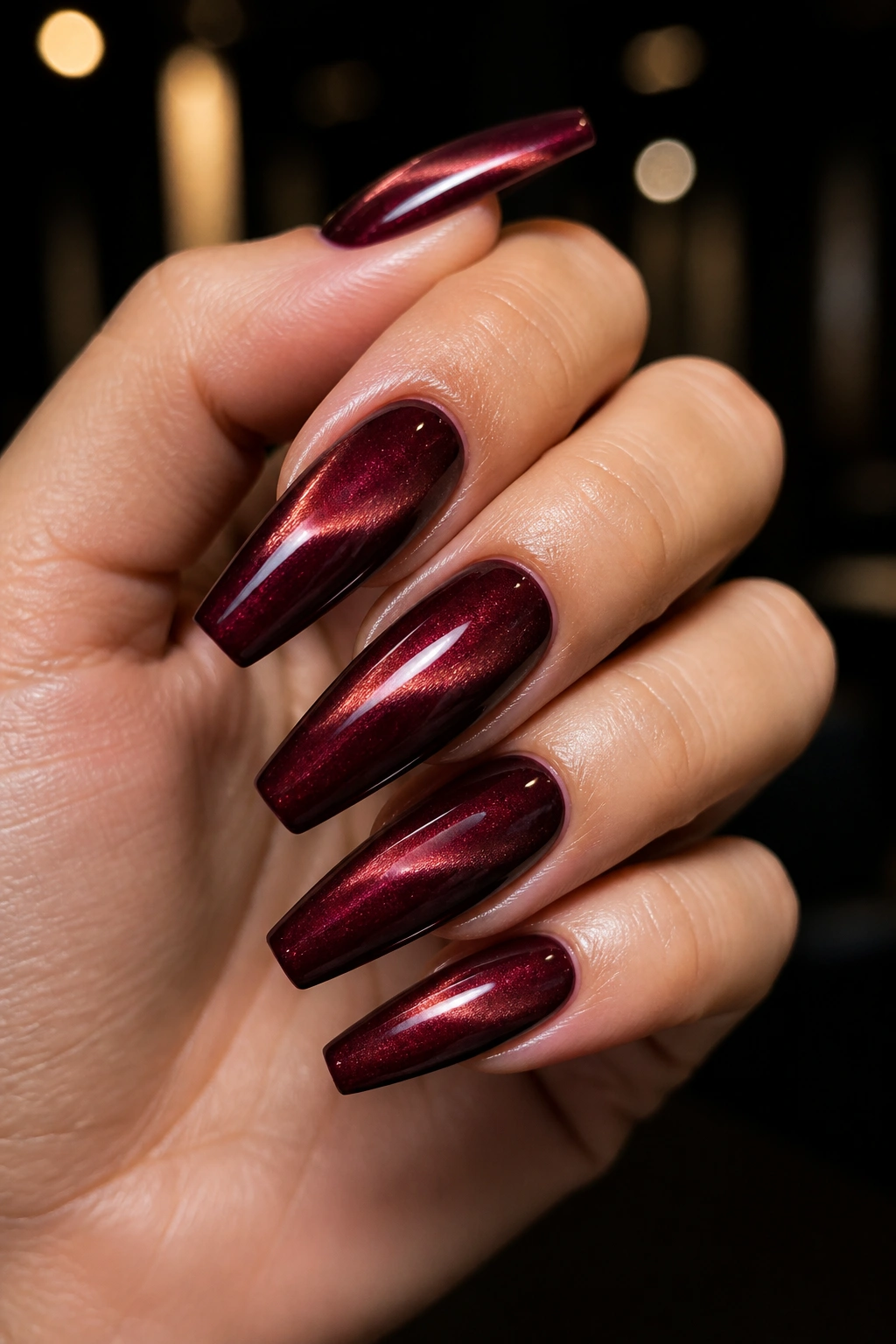
Magnetic gel has a way of making burgundy look lit from the inside. When the magnet pulls the shimmer into a soft stripe or diffused halo, the nail shifts as your hand moves, and the coffin shape gives that effect a long, clean canvas.
Why the shimmer placement changes everything
A tight cat-eye line down the center can make nails look narrower and longer. A more diffused velvet effect softens the shape and makes the whole nail glow. On burgundy, I lean toward the velvet style because the base color already has enough drama; the shimmer should move, not shout.
A few salon specifics worth mentioning
- Ask to see the magnetic polish over a black or deep burgundy base, because the underlayer changes the depth
- Longer nails show the shift more clearly than short ones
- Fine shimmer reads smoother than chunky magnetic particles
- Top coat thickness can blur the line if it’s applied too heavily
This is one of those sets that makes you keep turning your hand under the light, which is half the fun. It feels more alive than flat polish.
8. Black Cherry Chrome Burgundy Coffin Nails
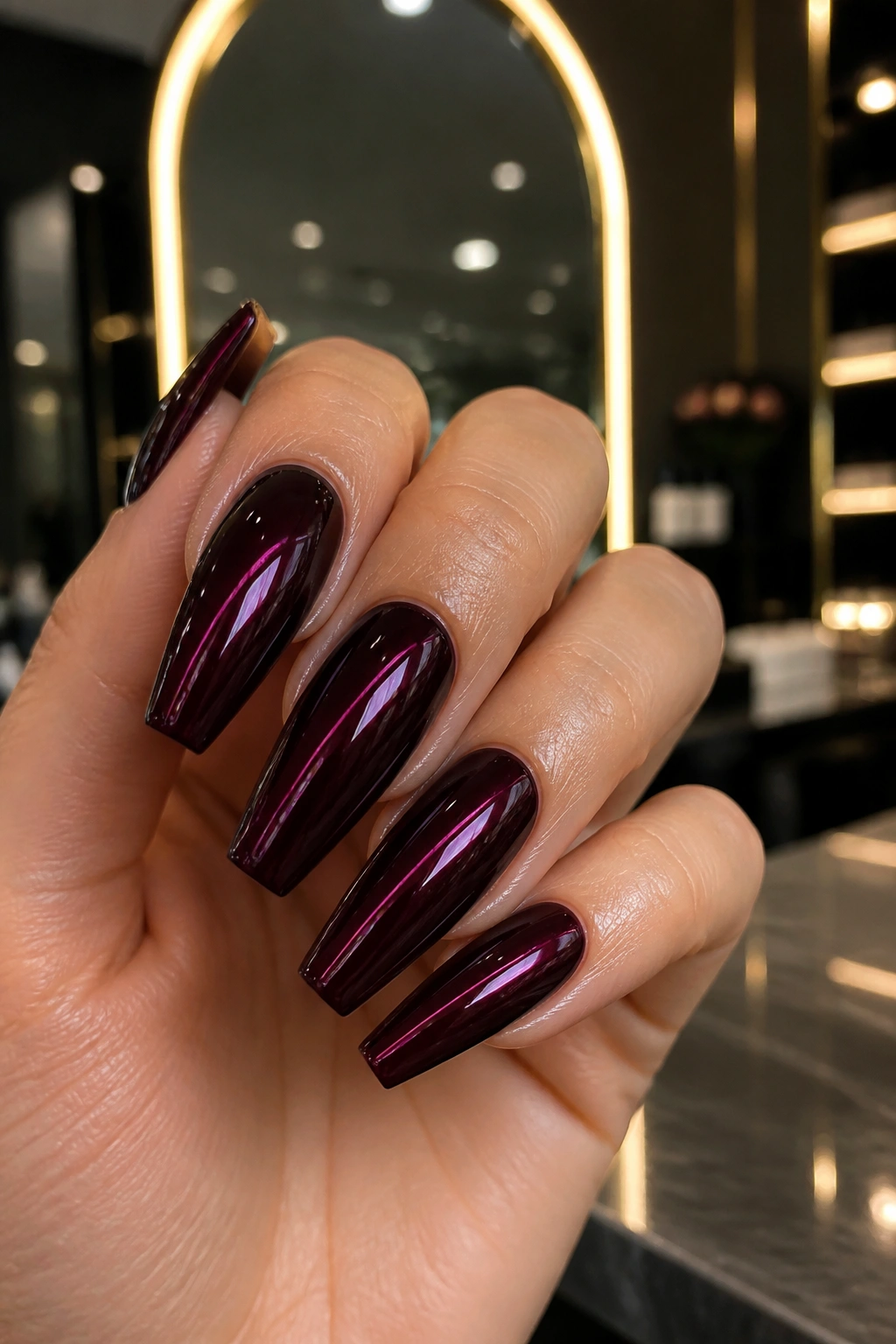
Chrome over burgundy is moodier than the mirror-silver version people think of first. The effect is less about looking metallic and more about adding a slick, glazed finish that deepens the color and sharpens the surface.
A black cherry chrome works best over a near-black burgundy base. If the red underneath is too bright, the chrome can turn candy-like in a way that fights the coffin shape. Darker is better here—wine, cherry cola, almost-black plum.
You also need a nail tech who’s neat with powder application. Chrome tells on every smudge around the cuticle line and every bit of leftover pigment near the sidewalls. That’s not a design flaw; it’s a skill test.
I wouldn’t pile crystals, foil, and decals onto this look. The reflective finish already gives the set enough energy. Keep the shape long, the surface smooth, and the top coat sealed well at the tip so the chrome doesn’t start wearing dull at the edge. When this one is done right, it looks sleek and a little dangerous.
9. Burgundy Swirl Coffin Nails on a Sheer Base
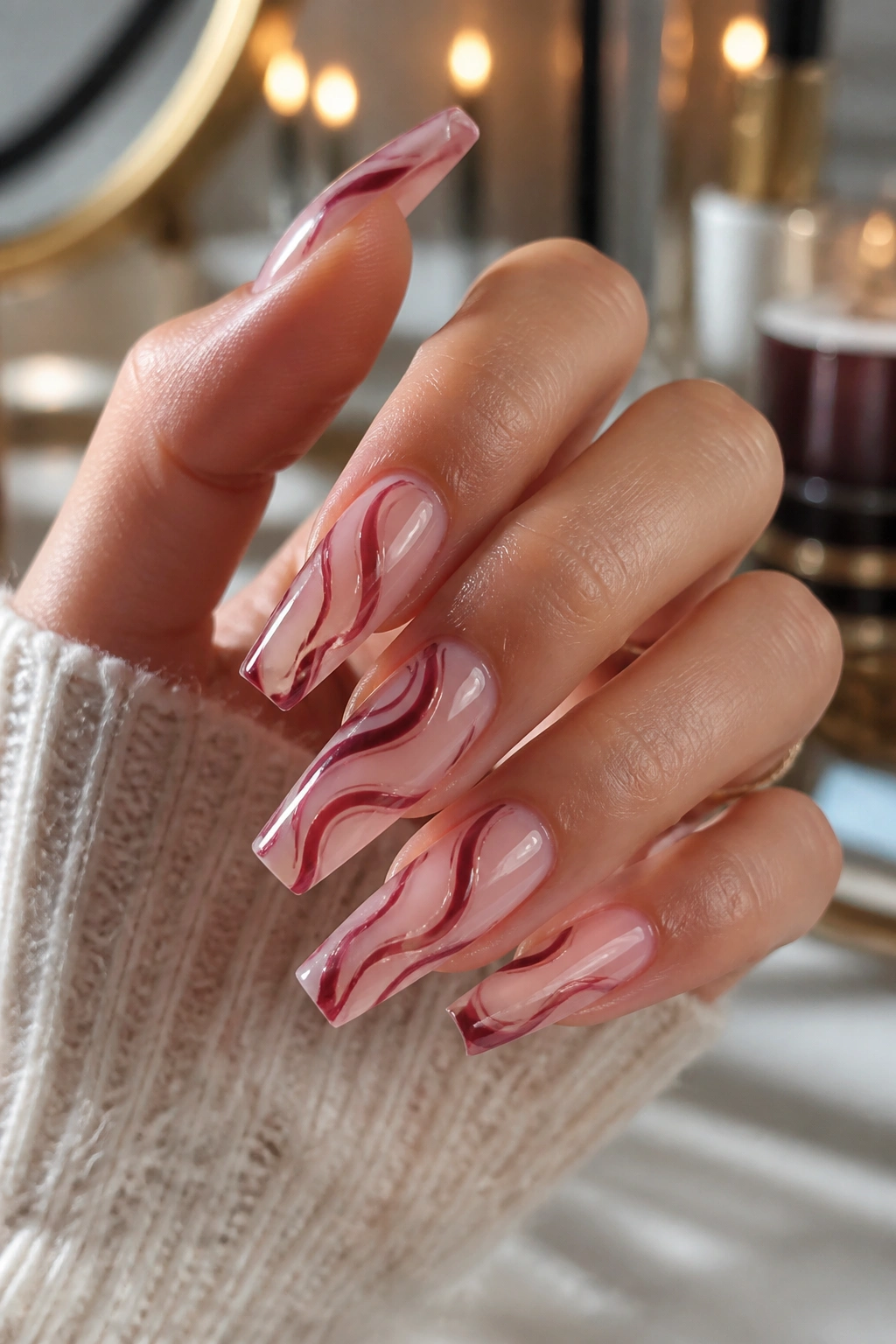
A sheer base with burgundy swirls gives you negative space, movement, and dark color without coating the whole nail. It’s lighter on the eye than a full deep-red set, which makes it useful if you want something artful but still easy to wear across two or three weeks.
The linework matters more than people expect. Thick, random swirls can look messy on coffin nails because the shape already has strong geometry. Thinner flowing lines—some curved, some stretched diagonally, one maybe crossing the center—look cleaner and make the nail feel longer.
You can take this in two directions. A single burgundy tone keeps it minimal. Adding a second shade, like blush nude or soft black cherry, gives the design more depth. I’d stop at two colors, though. Three starts to fight for attention.
No accent nail needed.
If you like a ring stack or wear a watch often, this manicure plays well with jewelry because the open space keeps your hands from looking overloaded. Ask for a milky sheer base, not a fully clear one, so the swirls have a softer backdrop and your natural nail line doesn’t distract from the design.
10. Burgundy and Blush Color-Block Coffin Nails
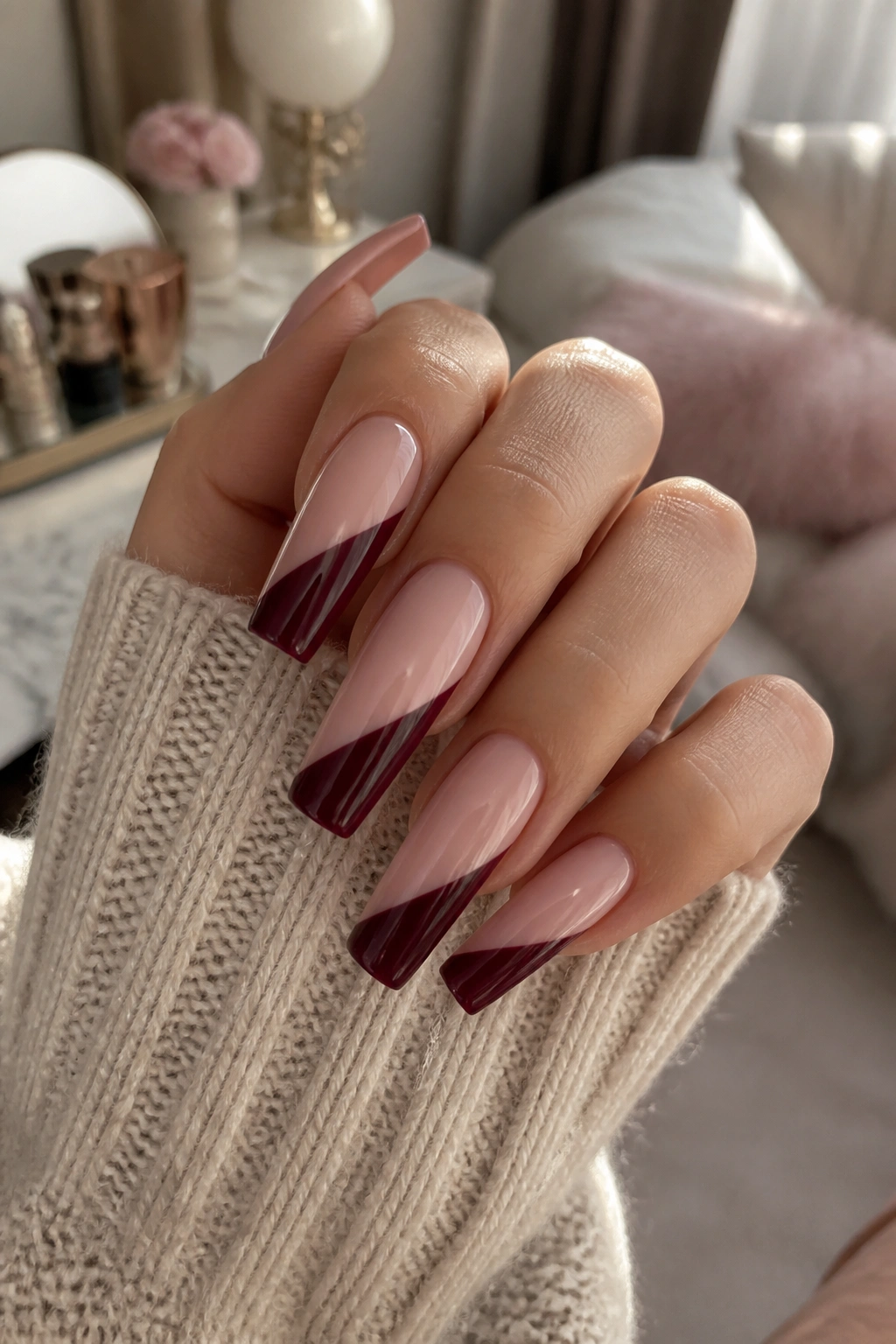
This design has more structure than swirls and more softness than a full dark manicure. Picture a blush or beige-pink base sliced with burgundy panels—diagonal corners, half-moons, side blocks, or a sharply angled tip.
Why the contrast feels fresh
The blush tone gives the eye a place to rest, while the burgundy block brings depth and shape. On coffin nails, diagonal blocking usually works better than horizontal bands because it follows the taper of the nail and keeps the hand looking long.
Good ways to map it out
- A diagonal burgundy corner from one sidewall to the tip
- A reverse half-moon in blush with burgundy on the upper two-thirds
- Two slim burgundy side panels framing a nude center
- A slanted split down the nail with negative space on one side
Tape or a liner brush is the difference between sharp and sloppy here. If the lines wobble, the whole design loses its edge. This set tends to look strongest on medium-length coffins where there’s room for the blocks to read clearly without feeling stretched.
11. Tortoiseshell Accent Burgundy Coffin Nails
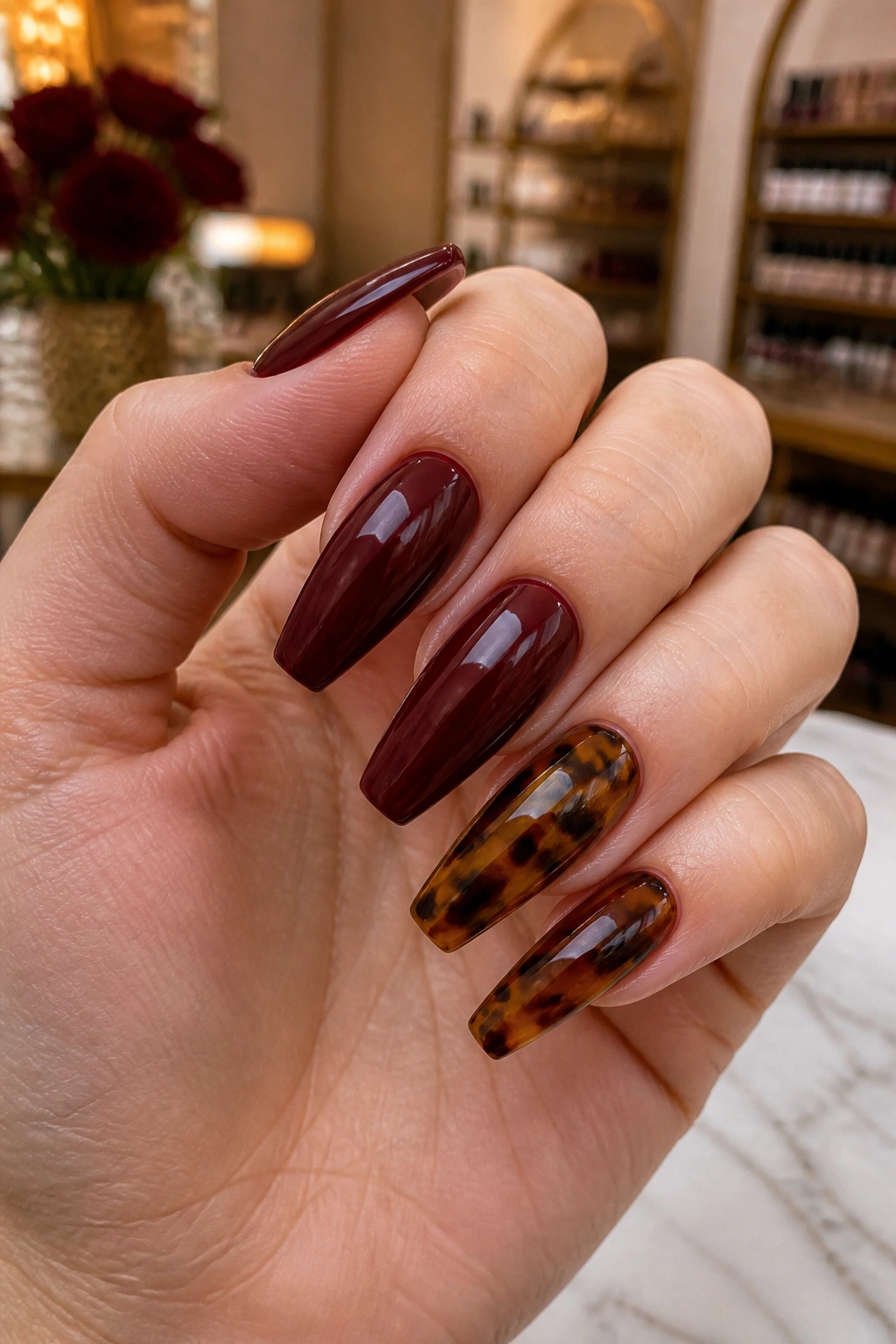
A full tortoiseshell set can be a lot. One or two tortoiseshell accent nails paired with burgundy, though, has just enough warmth and pattern to make the manicure feel layered without turning it into costume.
The trick is keeping the colors in the same family. A warm merlot or brown-red burgundy sits naturally beside amber, caramel, and dark espresso spots. A cool berry burgundy can still work, but it won’t look as connected.
I’d place tortoiseshell on the ring finger and maybe the thumb, then keep the rest of the nails solid. That spacing gives the pattern room to stand out. Put it on every other finger and the eye gets tired.
Tiny details that make tortoiseshell look believable
- Use a jelly amber base, not opaque mustard
- Float darker spots in uneven sizes so the pattern looks organic
- Seal with enough top coat to create depth over the patches
- Keep the burgundy nails glossy so the finishes match
This pairing has a rich, dressed-up feel without needing rhinestones or chrome. It also looks better in person than it often does in quick salon photos, where the amber depth can get lost.
12. Burgundy Coffin Nails with Tiny Crystal Cuticles
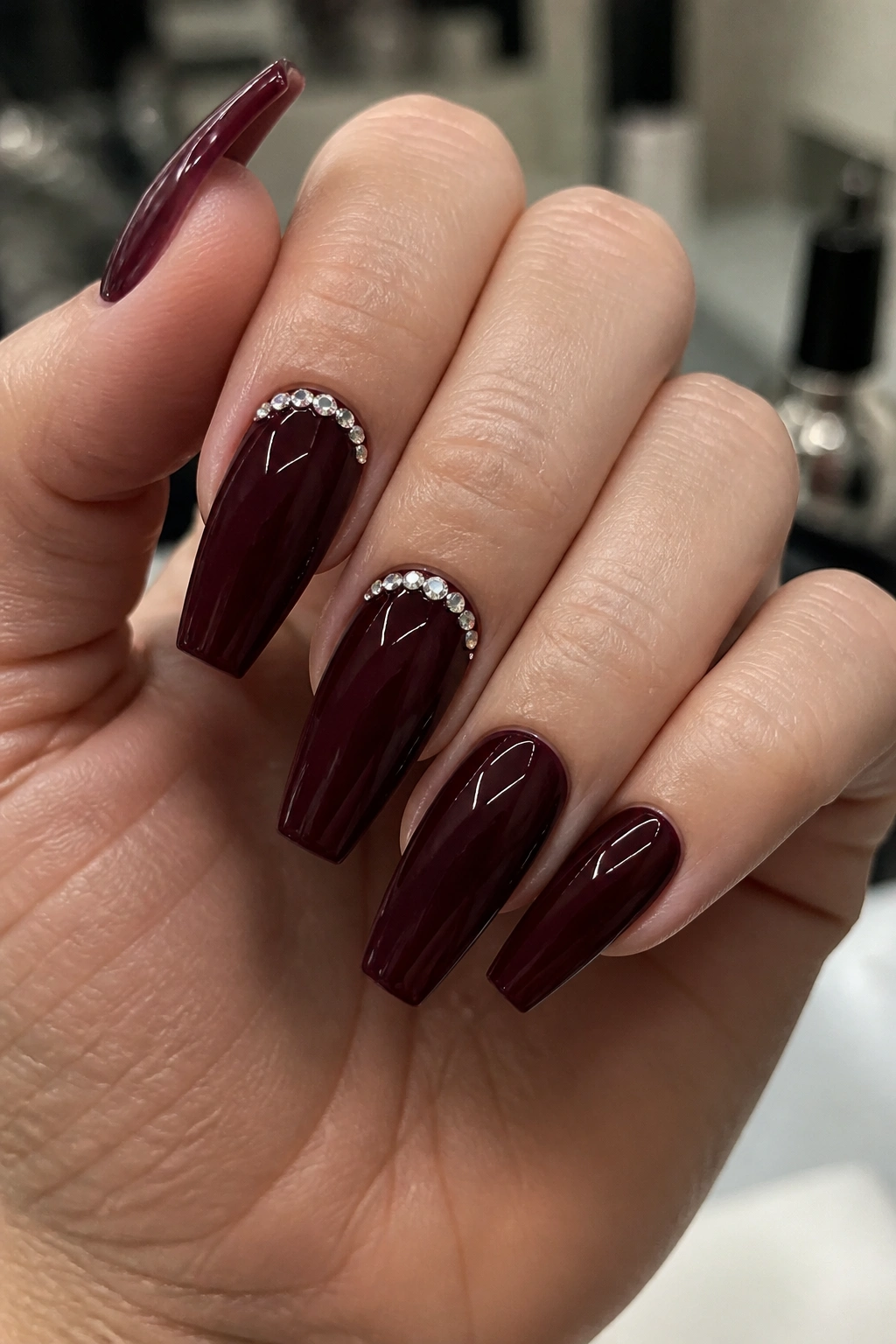
If you want sparkle without committing to full bling nails, a fine row of crystals near the cuticle is a smart move. It keeps the burgundy front and center while adding one narrow flash of light where your nail bed starts.
Placement is everything. I’m talking ss3 to ss5 crystals—small, neat, and close to the cuticle arc, not giant stones marching halfway down the nail. On coffin shapes, oversized crystals can make the nail look top-heavy and throw off the clean taper.
This style works best on one or two fingers per hand. More than that, and the manicure can start to feel formal in a way you may not want for everyday wear. If you know you’re rough with your hands, ask for stones to be fully nestled into gel, not perched on top where they can snag.
A small crystal cluster can also hide the grow-out line a little longer, which is a practical bonus. Tiny sparkle is easier to live with than you’d think.
13. Plum-Burgundy Marble Coffin Nails
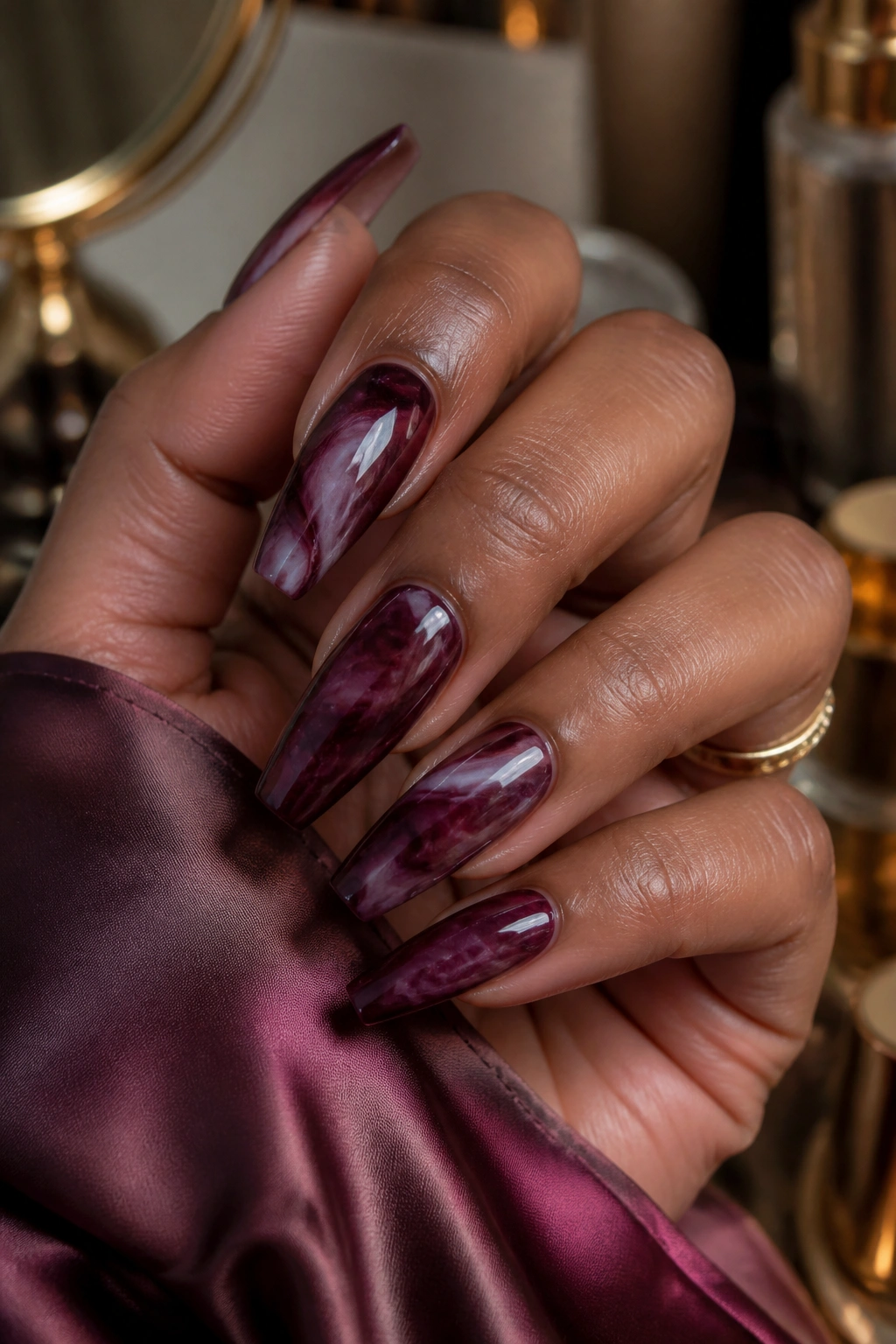
Marble sounds soft. On coffin nails, it can look sharp if the colors are dark enough. A plum-burgundy marble gives you movement and texture while staying within the same moody palette, which keeps the set from feeling busy.
The color mix matters
The best version usually blends burgundy, plum, a touch of white or cream, and a whisper of black. Too much white makes the design jump out in a harsh way. Too much black makes the marble muddy. You want veining, not soup.
Where to use it
I like marble as:
- Two accent nails in a full burgundy set
- A full set on long coffins with all other details stripped away
- A base for thin gold veining if you want one extra layer of detail
Water marble can work, though gel blooming and liner-brush marbling are easier to control on salon clients. Ask your tech to keep the pattern elongated instead of round so it follows the shape of the nail. A marble that runs lengthwise flatters coffin nails more than one that spreads in cloudy circles.
14. Burgundy Plaid Coffin Nails for Colder Months
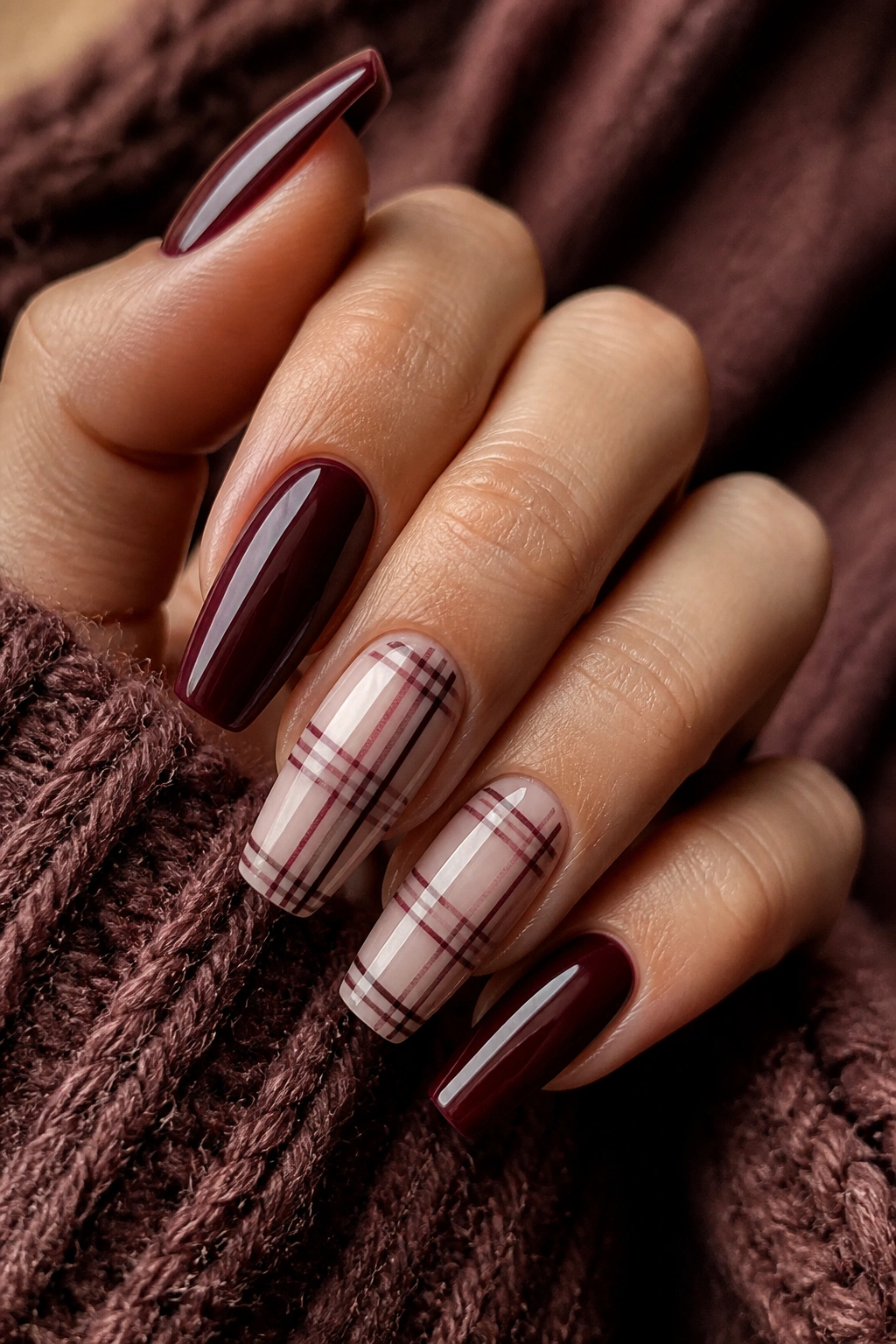
Some plaid nail art looks crafty in the wrong way. The version that works with burgundy coffin nails keeps the grid fine, the colors grounded, and the placement selective.
You don’t need plaid on every finger. One or two accent nails with thin burgundy, black, cream, or muted gold lines over a sheer or beige base usually does the job. The rest can stay solid burgundy so the set still feels cohesive.
The line thickness should stay narrow—think hairline striping, not chunky tartan blocks. Coffin nails already have strong geometry, and a heavy plaid can make the hand look crowded. Fine lines keep the design crisp.
Matte top coat can suit plaid if the colors underneath are strong enough, but I still prefer gloss here because it sharpens the linework and makes the burgundy tie back to the solid nails. If you wear knitwear, wool coats, or deeper neutrals during colder weather, this manicure sits right in that mood without looking costume-y or overdone.
15. Deep Burgundy Coffin Nails with a Thin Silver Outline
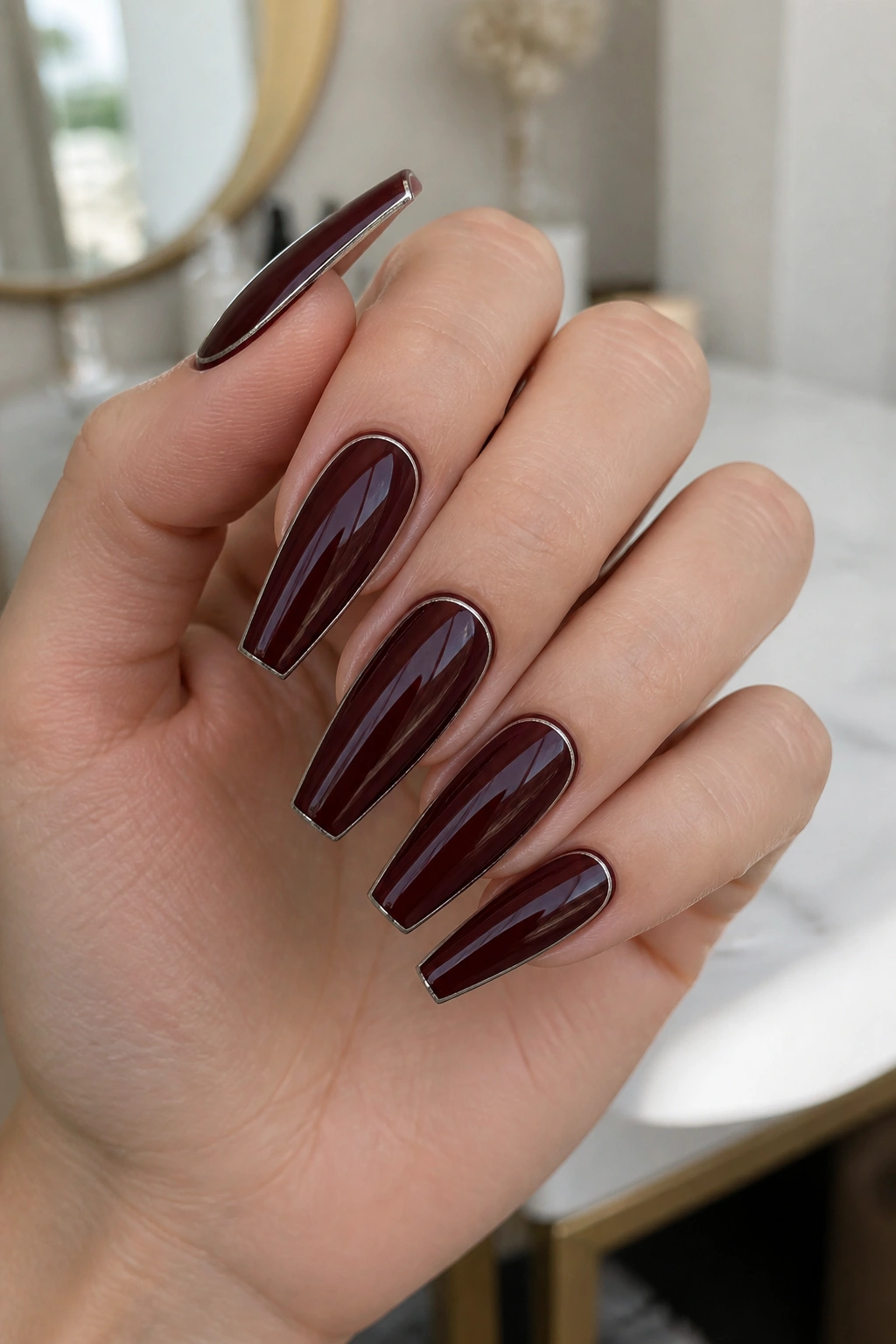
This one is cleaner than it sounds. Start with a full deep burgundy nail, then trace one edge, the cuticle curve, or the entire perimeter with a fine silver line. The result is graphic, polished, and a little unexpected.
Unlike gold foil, which feels organic and irregular, silver outlining is all about precision. It works best with cooler burgundy shades—wine, berry-black, black cherry—because the metal picks up the cool undertone and makes the color read sharper.
Who should try this? Anyone who likes minimal nail art but still wants a design that looks intentional from up close. It’s especially good on medium coffin nails, where a 1 mm metallic line can be seen clearly without taking over the nail.
A full perimeter outline is the boldest version, though I also like a single side outline that runs from cuticle to tip. It adds structure without boxing in the whole nail. Ask for a liner brush and gel paint rather than striping tape if you want the cleanest finish and fewer lifting issues.
Final Thoughts
Burgundy is one of those rare nail colors that can handle mood, polish, and edge all at once. On a coffin shape, it looks even better because the taper gives dark color a cleaner frame. That’s the part many manicure idea roundups miss: shape and shade are doing equal work.
If you want the easiest win, go with glossy deep wine or a burgundy French tip. If you want more texture, cat-eye velvet, jelly finishes, chrome, and marble give the color extra movement without losing that rich red depth.
Pick the version that suits how you actually wear your nails—not the one that looks best on a tiny swatch or a filtered salon photo. Burgundy has range, and coffin nails give it room to show off.