


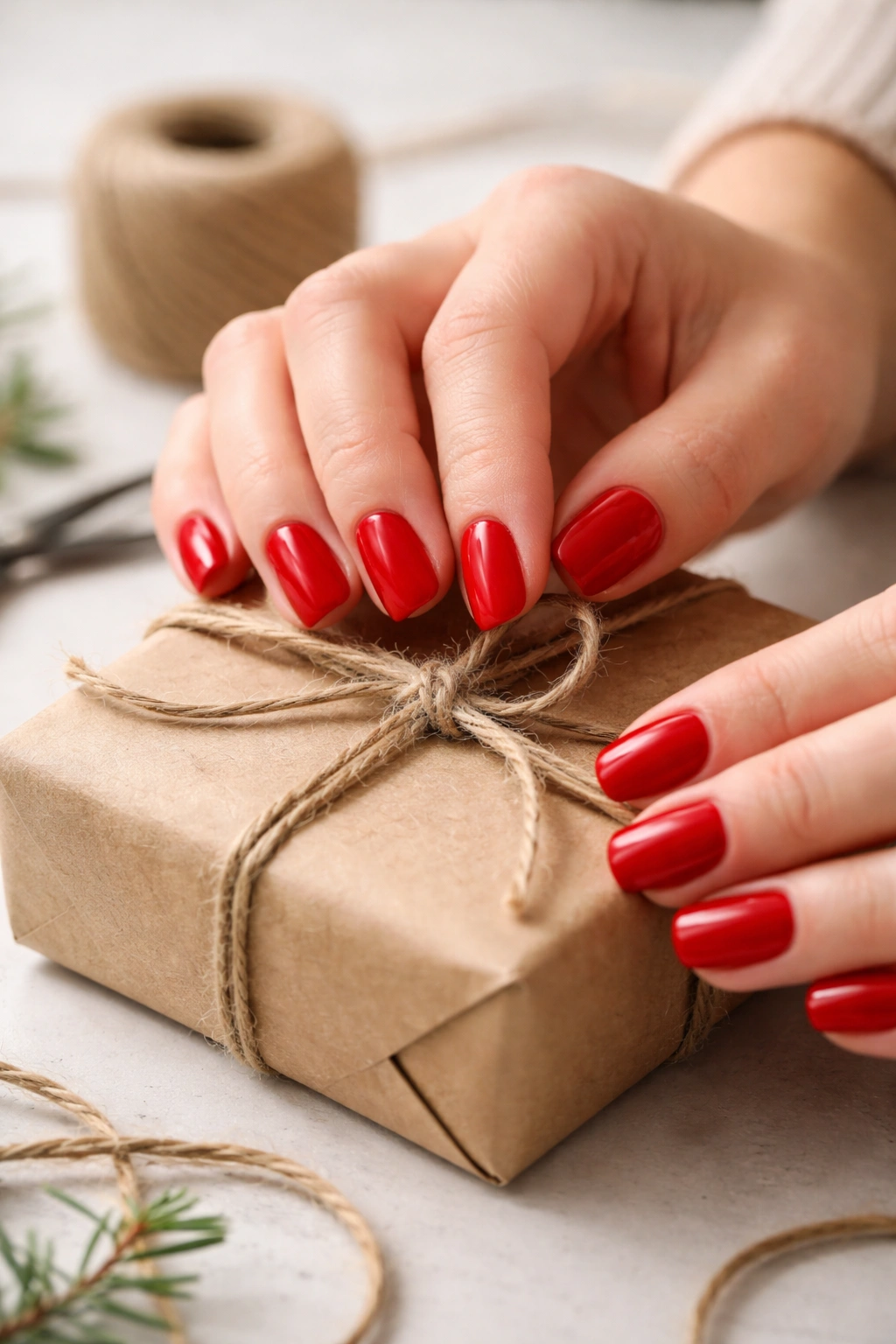
Red and short squoval nails are a combination that shouldn’t work but absolutely does. The squoval shape—that modern blend of a square and an oval—is flattering on most hand shapes and works especially well when you keep it short enough for daily life. Add red into the mix, and suddenly you’ve got something that reads polished, intentional, and way more interesting than a basic manicure. Red can feel either too formal or too dramatic on longer nails, but keep them short and squoval, and the whole vibe shifts. You get the confidence boost of a bold color without the commitment or maintenance headache.
The beauty of this combination is its versatility. Short red squoval nails work whether you’re heading to a business meeting, out for dinner, or just running errands on a Saturday afternoon. Red has this unique power—it catches light, it draws attention, and it makes your hands look intentional. Unlike pastels or nude shades that blend into the background, red demands to be seen. When you pair that boldness with the practicality of short nails and the modern geometry of the squoval shape, you end up with something that feels both effortless and elevated.
What makes red such a permanent fixture in nail design is that it never gets tired. It’s not trendy because trends fade, but red is always in. The catch is knowing which version of red actually works for your specific skin tone, lifestyle, and the occasion you’re dressing for. That’s where the real complexity comes in—because while all red looks like red from far away, the differences between a blue-based red, an orange-based red, a cream red, and a jelly red are genuinely significant. Add in different finishes like matte, glossy, chrome, glitter, or foil, and you’ve got a whole universe of red nail possibilities.
Here are twelve versions of red short squoval nails that actually have presence, along with exactly what makes each one worth trying and who should reach for it.
1. Classic Bright Red Cream
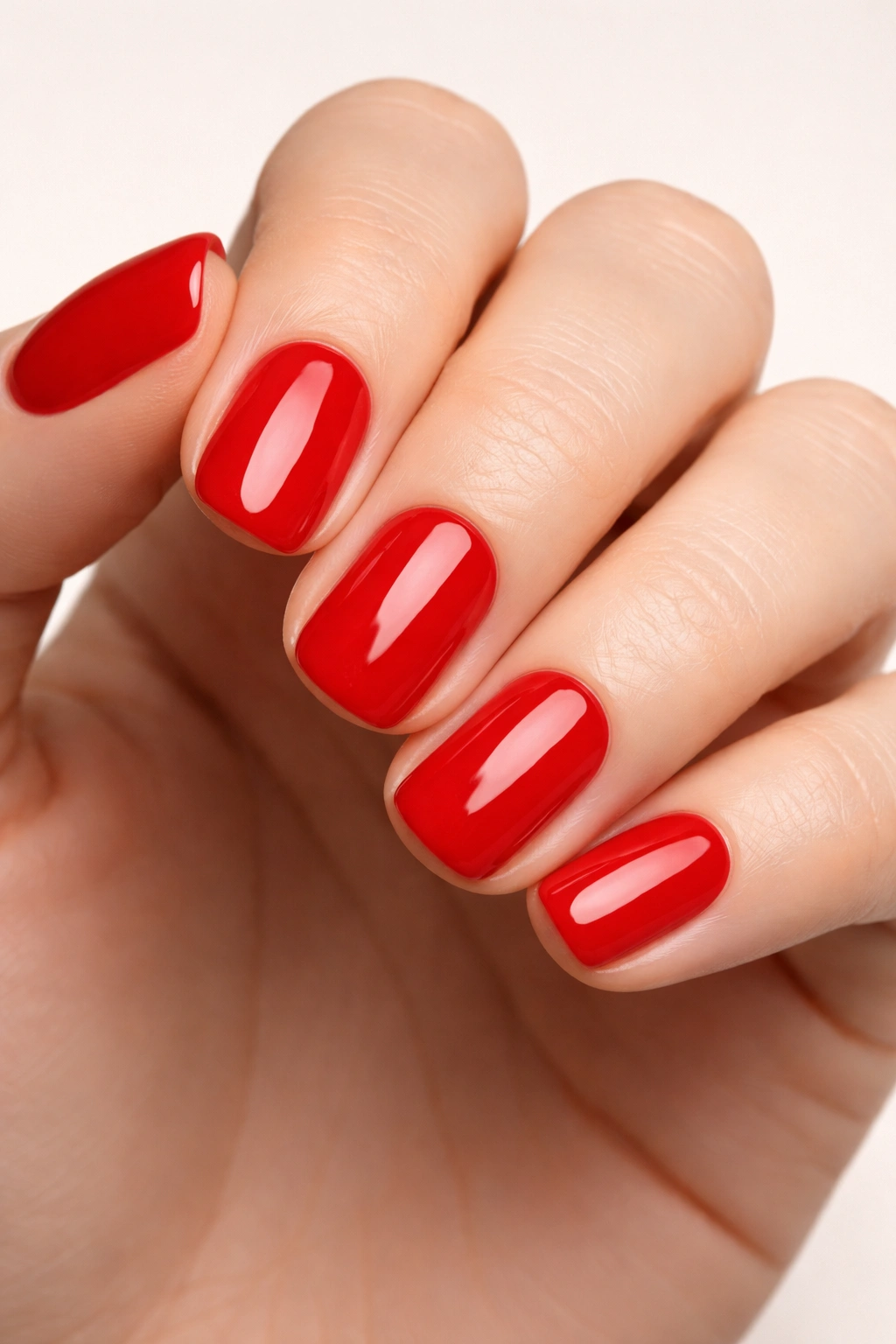
This is the red that started the whole tradition—a true, pure red with zero undertones, applied in a smooth, opaque cream formula. No shimmer, no texture, just a confident solid block of color. Bright red cream sits perfectly in the middle of blue-toned and orange-toned reds, which is why it’s considered the universal classic. When you see a red nail in old Hollywood films or in nail design history, this is the one. The finish is glossy and smooth, reflecting light evenly across the nail surface.
Why It’s the Foundation for a Reason
This shade works on virtually every skin tone because it has no warm or cool bias to clash with your complexion. It’s readable from across a room—you can see those red nails from ten feet away. The simplicity of the color means the squoval shape becomes the design element itself; your nail silhouette is the star here, not a complicated pattern. The cream finish means it chips visibly when it starts to wear, which sounds bad but actually signals when it’s time for a fresh manicure rather than lingering in that murky in-between phase.
Key Details to Know
- Choose a formula with excellent opacity—you should never need more than two coats
- Pair with a red-tinted base coat to prevent staining on pale or medium skin tones
- High-quality red creams often have subtle blue undertones to keep them from looking orange
- The glossy finish shows every dust particle and fingerprint, so polish frequently
- This shade pairs beautifully with minimal nail art—a single gold stripe or tiny nail charm is enough
Pro tip: Bright red cream looks even more striking when paired with a sheer, glossy top coat that adds depth without changing the color. The slight magnification of the top coat makes the red appear richer.
2. Tomato Red with Gold Leaf
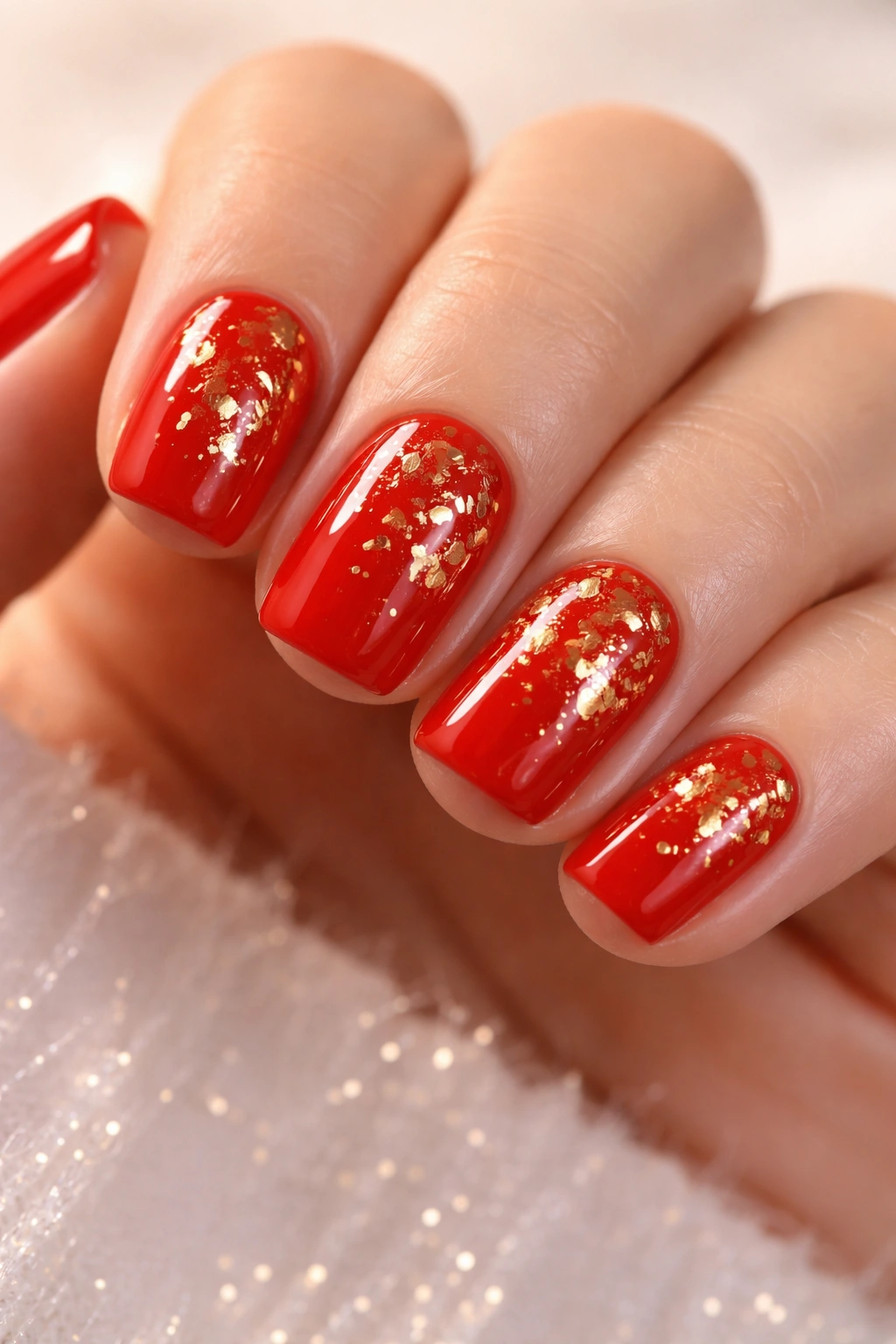
Swap the pure bright red for something slightly warmer and more orange-leaning, then add a hit of actual gold leaf inlaid into the polish. This is red with personality. The gold leaf catches light differently than the base color, creating dimension and a subtle luxury feel. Some applications feature the gold leaf scattered across the entire nail, while others concentrate it near the cuticle or the free edge. The gold becomes like hidden flecks of jewelry on your fingertips.
Why Depth Matters in a Bold Color
Tomato red sits between a true primary red and an orange, which means it photographs differently in different lighting. Indoors it reads warm and almost clay-like; in daylight it becomes brighter and more energized. The gold leaf interrupts the solid plane of color just enough to feel intentional rather than accidental. On short squoval nails, the gold doesn’t overwhelm because the nail surface is compact; each fleck of gold is positioned just right to catch your eye without crowding the design.
Application and Longevity
- Gold leaf can be inlaid during the polish-curing process or pressed into uncured gel
- Encapsulation under a clear top coat protects the gold from snagging or lifting
- The tomato base is warm enough to make most skin tones glow
- This style reads more special-occasion than everyday, but it’s still practical for short nails
- Maintenance is slightly higher because any chipping reveals the layer beneath
Insider note: If you choose this design, expect compliments. Gold leaf on nails catches everyone’s attention immediately.
3. Deep Burgundy Matte
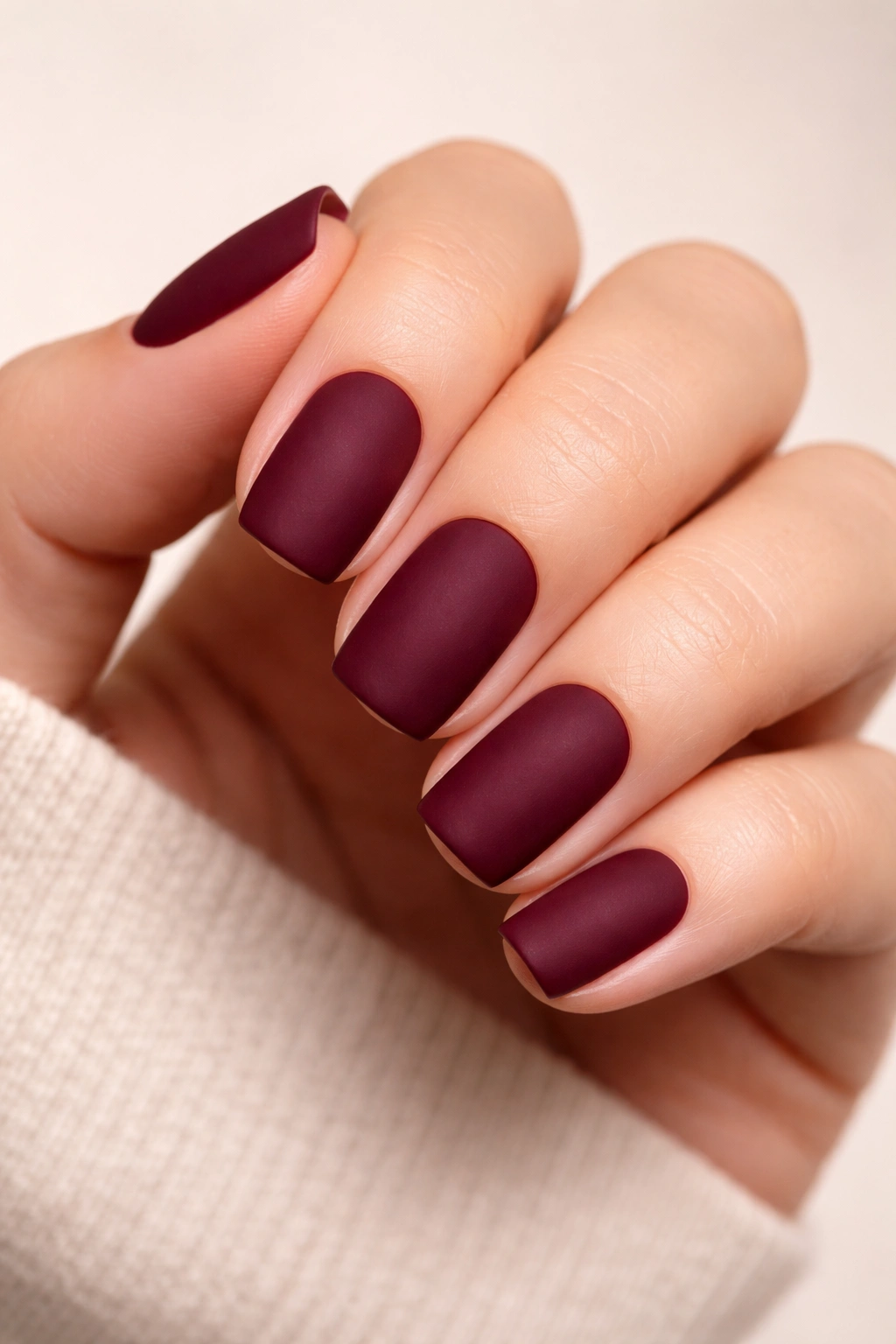
Go darker and cooler—a burgundy that’s so deep it almost reads as brown in dim light, but reveals itself as a rich wine red under bright conditions. Apply it matte (no shine, no reflection) and suddenly the whole effect becomes sophisticated and subtly dramatic. Matte red nails have a velvety, almost fabric-like texture that feels expensive and intentional. The squoval shape provides clean lines that show off the matte finish without any competing visual elements.
The Psychology of Going Matte
Matte finishes feel less corporate and more artistic. They’re quieter than glossy finishes—they don’t shout, they whisper. Deep burgundy matte reads as someone who knows exactly what they like and isn’t following a formula. The depth of the color means it suits all skin tones, but it’s especially stunning on deeper skin tones where it creates a striking contrast. On pale skin, it reads almost gothic. On medium tones, it becomes classic and timeless.
Care and Maintenance Notes
- Matte finishes show oils and dust more readily than glossy, requiring more frequent polishing
- Use a matte top coat instead of shine to maintain the texture
- Some people add tiny dots of holographic glitter while the matte polish is uncured, creating hidden sparkle
- Avoid glossy products on matte nails—they’ll create spotty shine
- This shade pairs beautifully with warm-toned jewelry like copper or bronze
Worth knowing: If you’re worried matte red will feel too heavy, start with the burgundy version instead of pure bright red. The darkness of the shade somehow feels lighter than a true red, which is counterintuitive but true.
4. Red with Black Accent Nail
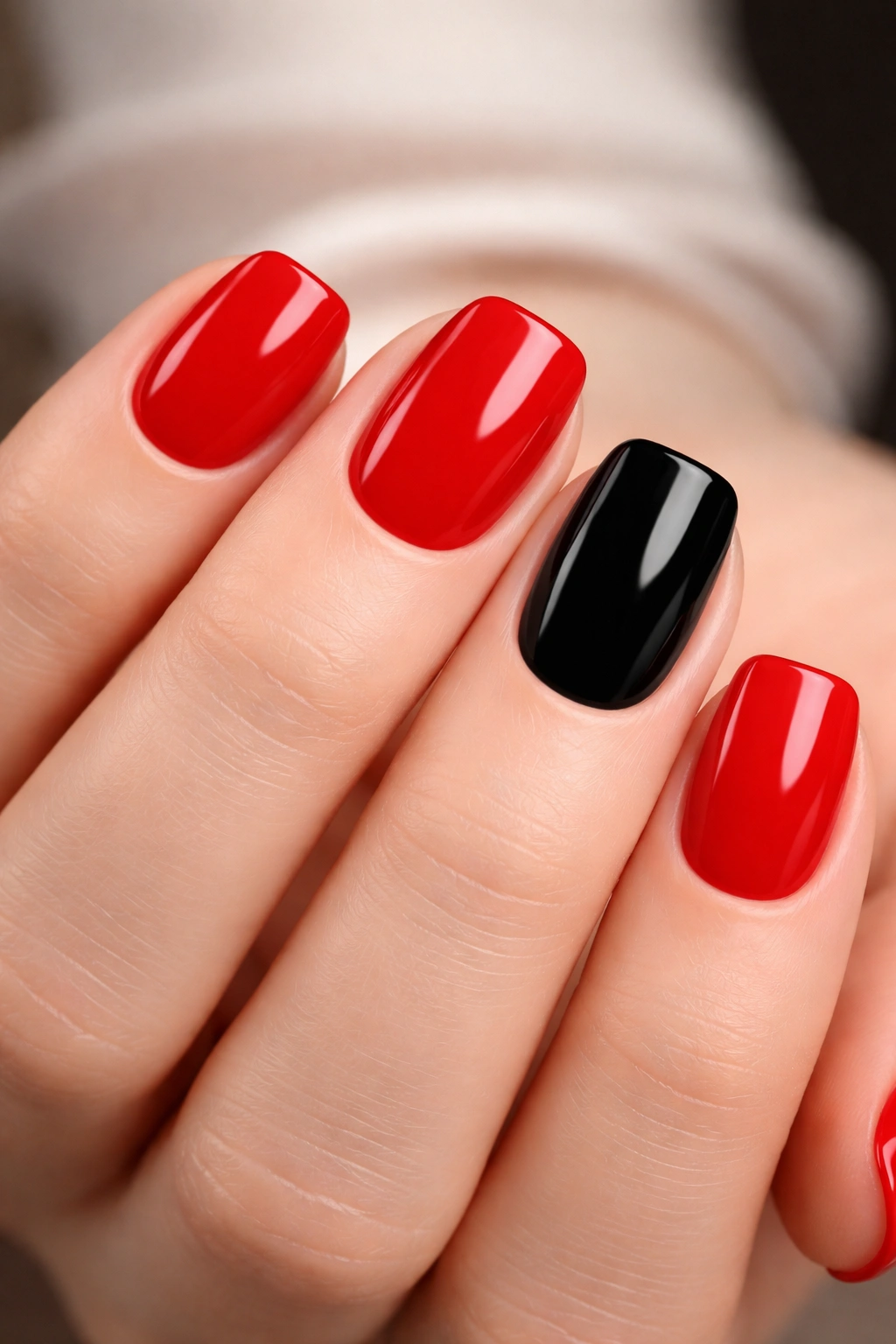
Keep eleven nails a clean, classic bright red, and make one accent nail (usually the ring finger or thumb) a pure black. This is a color blocking approach that adds visual interest and a touch of edge without veering into full nail art. The black and red combination reads sophisticated and slightly rebellious at the same time. On short squoval nails, the contrast between the two colors is sharp and clean. You get the boldness of red with the intrigue of black in a single mani.
Contrast and Clarity
Black against red creates maximum contrast, which means even from a distance people can see that you’ve made a deliberate design choice. It’s not complicated—there’s no intricate design work required—but it absolutely reads as intentional. The black accent nail often becomes a moment of rest for the eye; it’s like punctuation in a sentence of red. On short nails, this approach is perfectly manageable; longer nails might make the black block feel too heavy, but short squoval keeps everything in proportion.
Design Variations Worth Trying
- Reverse it: one red accent nail with all black
- Make the black nail feature a gradient that blends black to red
- Add a thin gold or silver line between the red and black sections
- Use the black nail as a canvas for tiny gold geometric lines
- Try negative space on the black nail—paint thin red lines on the black surface
Pro tip: If you’re not ready for true black, try a deep charcoal gray or navy instead. It gives you the contrast without feeling quite as bold.
5. Crimson Red with Rhinestone Detail
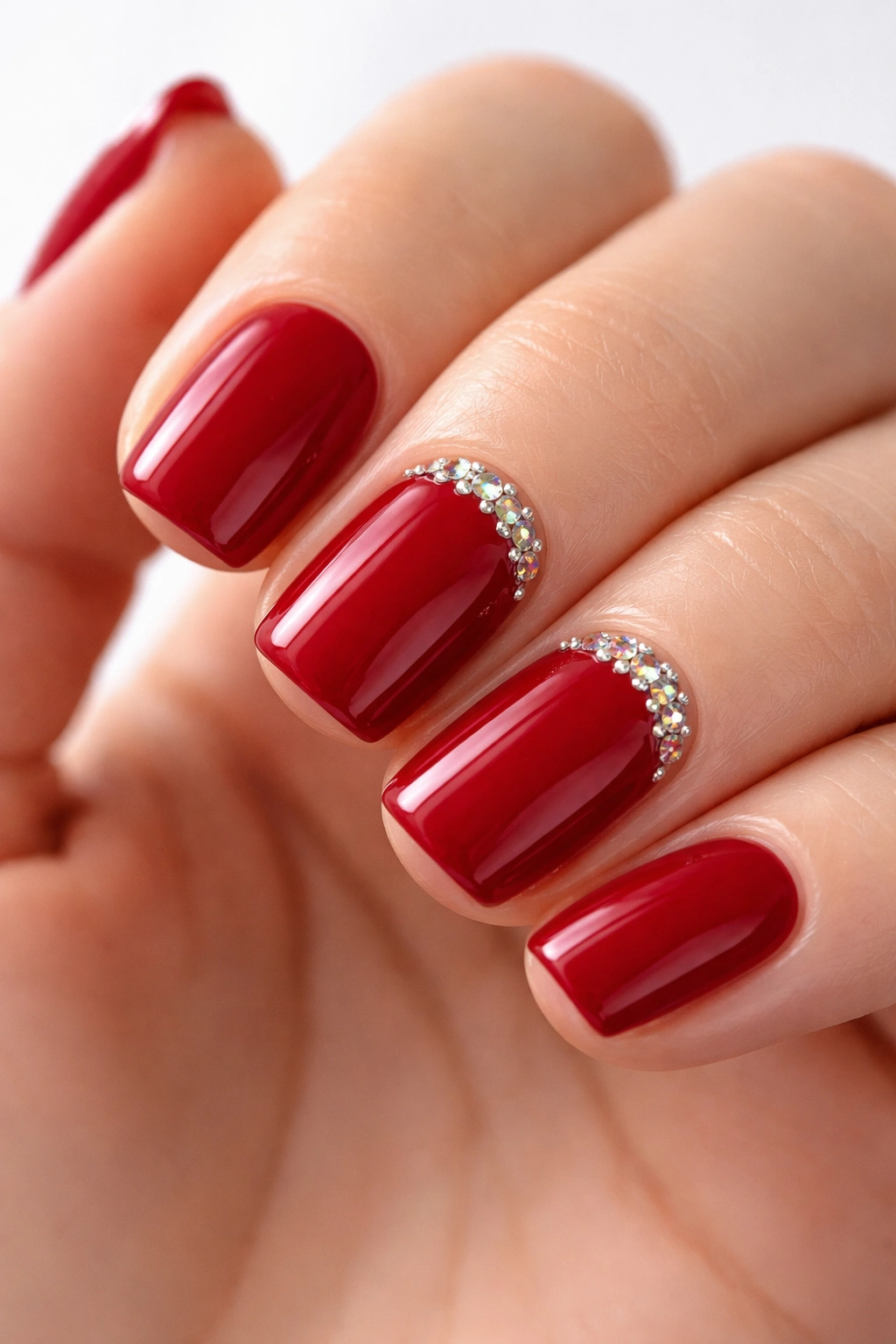
Crimson—a red that leans slightly orange and sits between true red and scarlet—paired with strategically placed rhinestones or crystal accents. The stones catch light and create sparkle that’s different from shimmer or glitter. Actual rhinestones are faceted, so they throw light in multiple directions rather than creating a smooth shimmer. On short squoval nails, you can usually fit three to five stones per nail without overcrowding. Concentrate them near the cuticle for elegance or scatter them for playfulness.
When Sparkle Elevates Rather Than Dominates
Rhinestones feel special in a way that glitter doesn’t. There’s something tangible about them, something you can almost feel through the screen when you’re looking at a photo. Crimson red provides a rich backdrop that makes stones pop without competing with them. The color is warm enough to create harmony with gold-toned stones and cool enough to work with silver-toned ones. The short squoval shape means the stones stay contained—they don’t spill all over the sides of longer nails.
Placement Strategy
- Cuticle placement: subtle and elegant, works in professional settings
- Scattered across the nail bed: more playful and party-appropriate
- Concentrated on the tip of the squoval: draws attention to the nail shape
- Single focal stone on each nail: minimalist and striking
- Stone gradient (more stones at the cuticle fading to fewer at the tip): sophisticated
Real talk: Rhinestones will snag if you’re rough on your nails, and they can pop off if you’re touching things constantly. This is a design for someone willing to be slightly careful or willing to go back to the salon for touch-ups.
6. Fire Engine Red Jelly
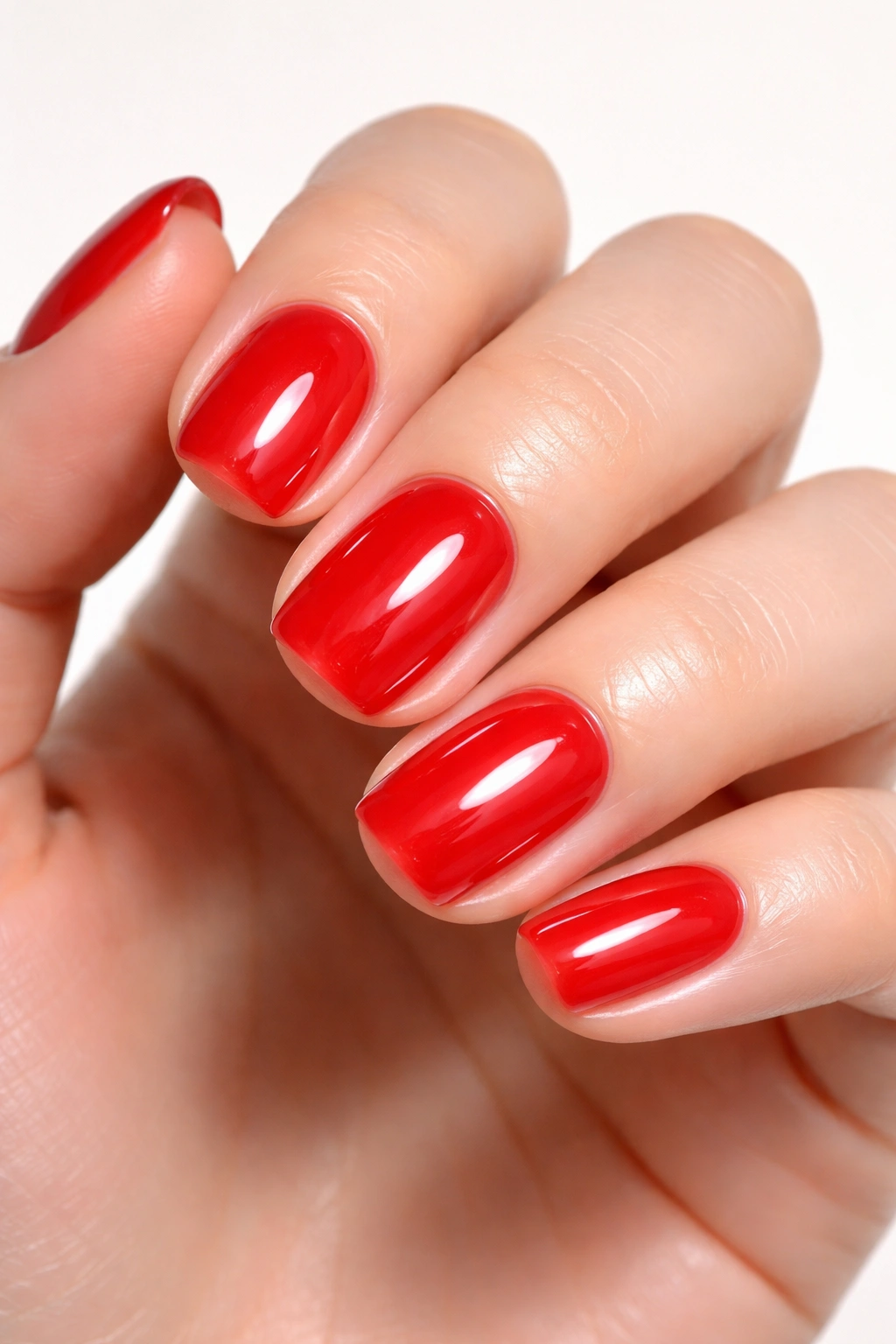
A jelly red is translucent rather than opaque—you can see a hint of skin tone through it, which creates this glowing quality that feels alive and energetic. Fire engine red jelly is bright and urgent, with that transparent quality giving it lightness despite the intensity of the color. Because it’s see-through, it requires more coats than a cream red (usually three to four), but the result is this dimensional quality that solid reds can’t achieve. On short squoval nails, the jelly finish catches light in specific ways that make the nails look dimensional and almost liquid.
The Unique Appeal of Jelly
Jelly finishes feel less formal than opaque creams but bolder than pastels. There’s something playful about a jelly red—it reads younger and more modern than a traditional cream. The transparency means the red interacts with your specific skin tone, so the color is slightly different on everyone. Two people with the same jelly red polish will have two subtly different colors because of skin tone variation. This personalization is actually a strength; it means the color is customized to your complexion naturally.
Making Jelly Work
- Apply thin, even coats—thick gloopy layers will look muddy
- A strong base color is important; translucent red needs solid foundation
- Use a glossy top coat that enhances the jelly effect
- This finish shows bubbles and imperfections more readily, so careful application matters
- Jelly reds photograph beautifully in natural light
- Best with shorter nails where the translucency doesn’t extend too far past the nail bed
Worth knowing: Jelly reds were everywhere a few years back, but they’re becoming popular again among people who prefer dimensional finishes over flat color.
7. Brick Red with Minimalist Line Art
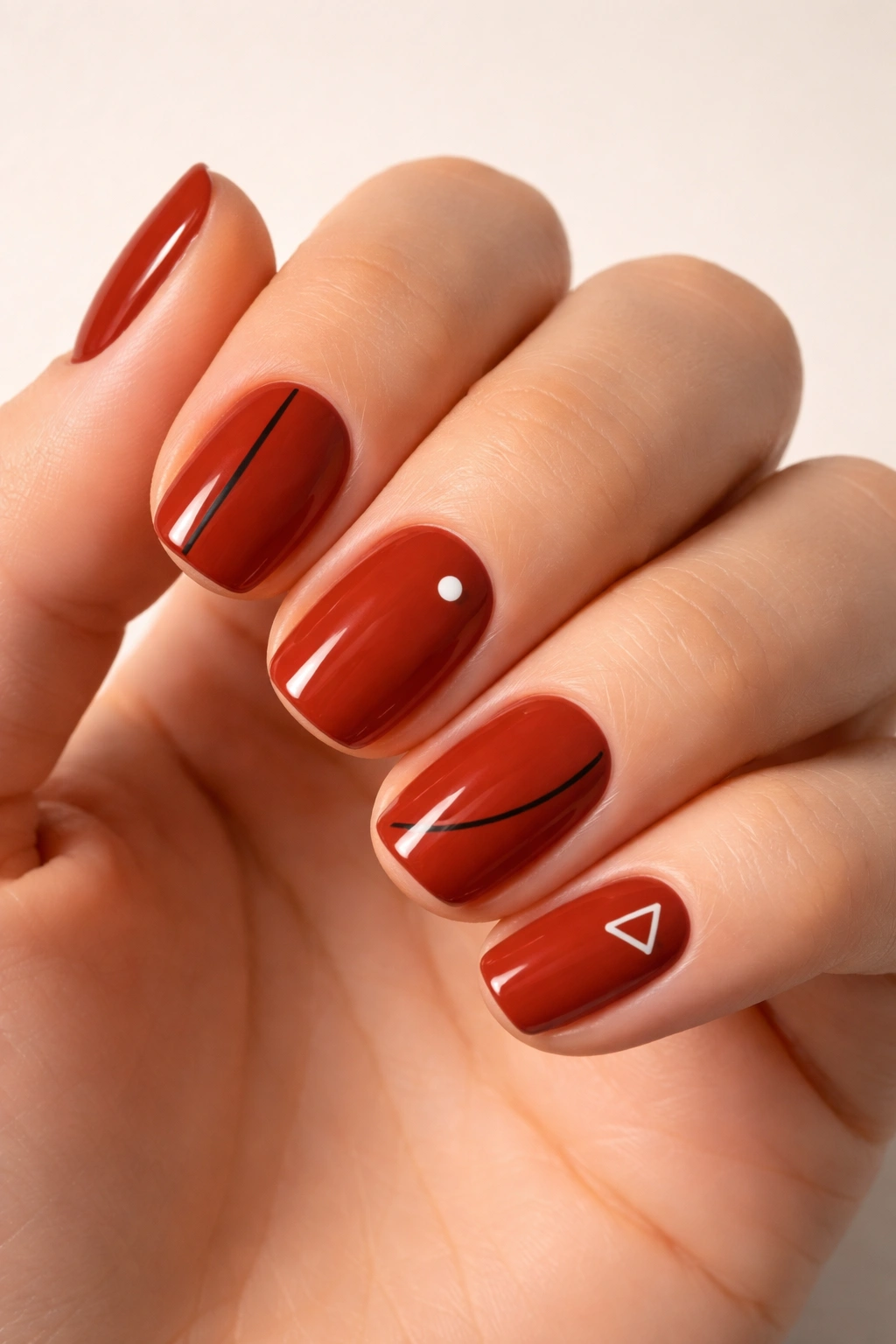
Brick red is more muted and earthy than traditional reds—it has brown undertones that make it feel warm and grounded. Then add minimalist line art: thin black or white lines creating abstract geometric shapes, single-line drawings of leaves, or tiny connecting dots. The minimalism is key here; intricate detailed designs overwhelm short nails, but simple line art feels sophisticated and intentional. One thin line per nail or a few connecting lines across a few nails, nothing more.
When Red Becomes a Canvas
Brick red’s earthiness makes it a perfect base for black line art. The contrast is clean without being as dramatic as bright red with black. Adding line art gives you visual interest while keeping the overall aesthetic intentional and modern. Short squoval nails are actually the ideal size for line art; longer nails either require more intricate designs or look sparse. The compact surface area of short nails means even simple lines create impact.
Line Art Ideas That Work
- Single thin vertical or horizontal line on each nail
- Tiny dots connected by hairline strokes (constellation style)
- Geometric shapes: triangles, squares, or irregular polygons
- Organic shapes: abstract leaves, tiny mountains, simple waves
- Negative space line work that creates the illusion of letters or symbols
Insider note: If you’re doing this at home, use a toothpick or a nail art pen rather than trying to paint with a regular brush. The precision matters.
8. Cherry Red Metallic
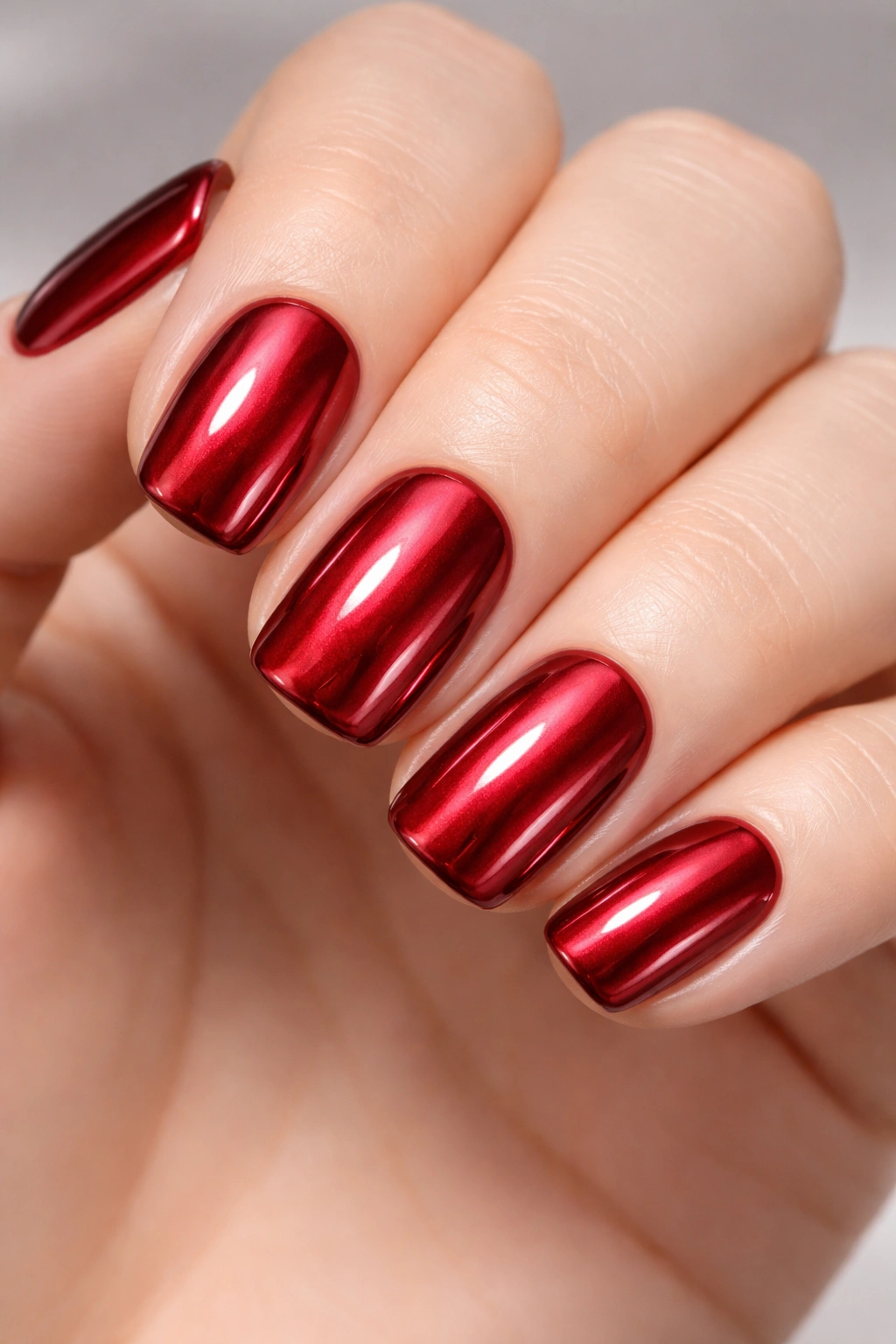
Cherry red is a true red with slightly cool undertones, and when you apply a metallic finish—whether that’s a chrome-like shimmer or flecks of actual metallic pigment—you get something that feels more futuristic while staying grounded in the warmth of red. The metallic quality gives it movement and depth. In one light it’s pure cherry red; in another it’s gleaming and almost liquid-looking. Short squoval nails show off metallic finishes beautifully because the compact surface means the effect is concentrated and intense.
Metallic Finish Techniques
Metallic reds can be achieved several ways: metallic shimmer mixed into the polish, metallic powder dusted onto uncured gel, or actual chrome foil applied to the surface. Each method creates a slightly different effect. Shimmer versions are more subtle; they look like the red is internally glowing. Chrome and foil versions are bolder; they look almost mirrored. On short nails, even the boldest metallic looks wearable because there’s just less real estate.
Best Practices for Metallic Red
- Metallic finishes require very smooth application; any bumps or ridges show
- Use a hard gel base for metallic powder—regular polish won’t hold it properly
- Matte top coats will dull metallic finishes, so use high-shine sealers
- These nails photograph extraordinarily well; expect excellent camera results
- The metallic effect hides minor nail imperfections better than cream finishes
Pro tip: Metallic finishes can look overly trendy, but on short squoval nails they feel modern without feeling temporary.
9. Red Ombre: Deep to Bright
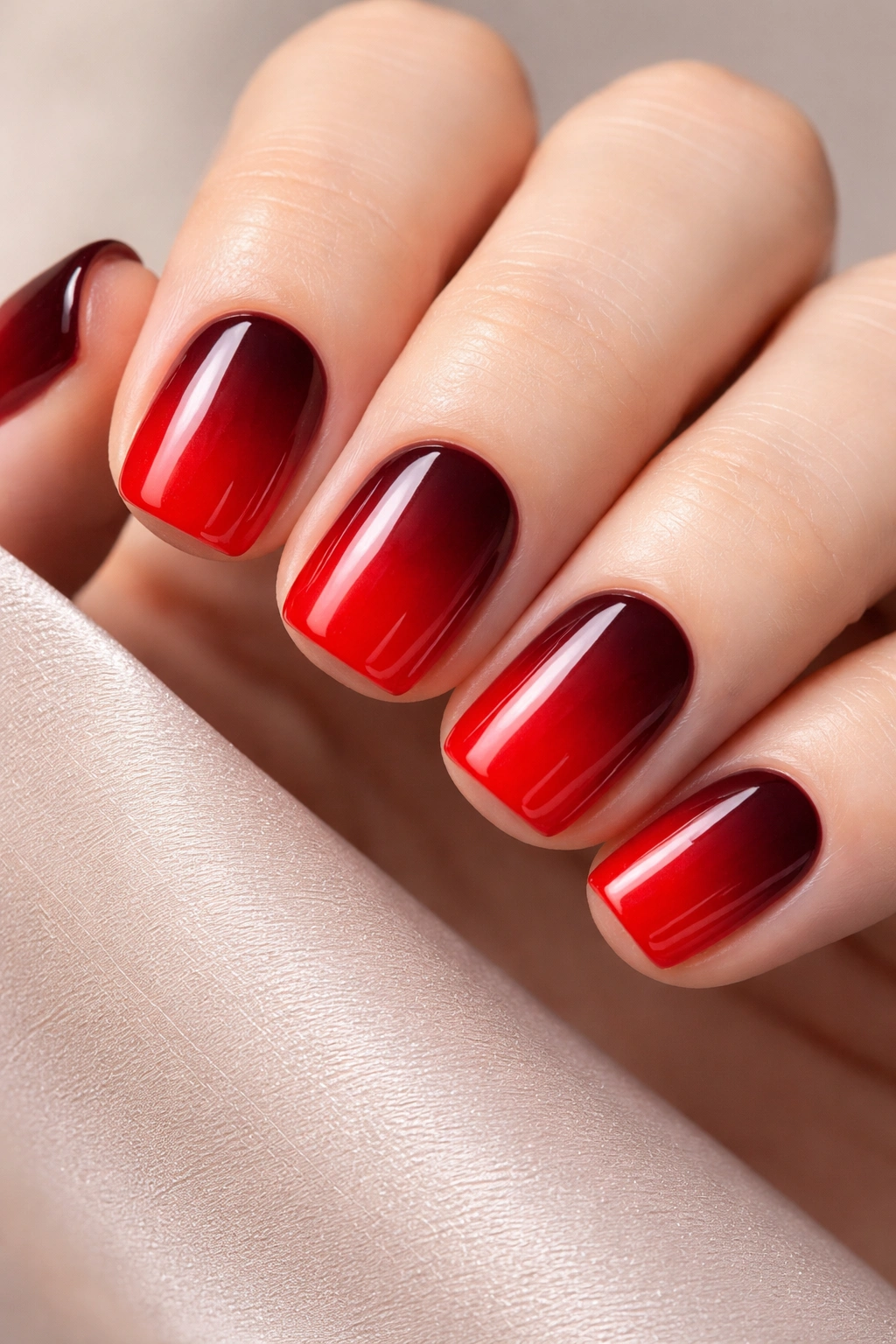
Create a gradient that starts as deep burgundy or crimson at the cuticle and transitions to bright fire engine red at the free edge. The ombre effect creates dimension and movement; the eye is drawn from the darker root to the lighter tip. This is a design that requires blending skill, but the effect is stunning. On short squoval nails, the ombre gradient is compact and concentrated, which makes the color transition feel intentional rather than accidental.
Ombre as a Design Element
Ombre feels modern and fashion-forward compared to solid color. It shows that someone has thought about their nails as a design project, not just painted them a single color. The gradient from dark to light adds dimension without adding complexity; it’s still technically one color family, just in different values. The squoval shape shows off the gradient beautifully—the widest part of the nail (the center) displays the color transition perfectly.
How Ombre Works on Short Nails
- Shorter nails mean a shorter gradient range, which is actually easier to blend
- Use a sponge technique or brush blending, depending on your skill level
- Consider a three-color ombre (very dark at cuticle, medium in middle, bright at tip) for more dimension
- The transition should be gradual enough that you can’t see where one color ends and another begins
- Glossy top coat enhances ombre by making it look seamless
Worth knowing: Ombre can hide imperfections in the gradient application on longer nails, but on short nails you need cleaner blending since there’s less distance to hide mistakes.
10. Scarlet Red with Foil Accents
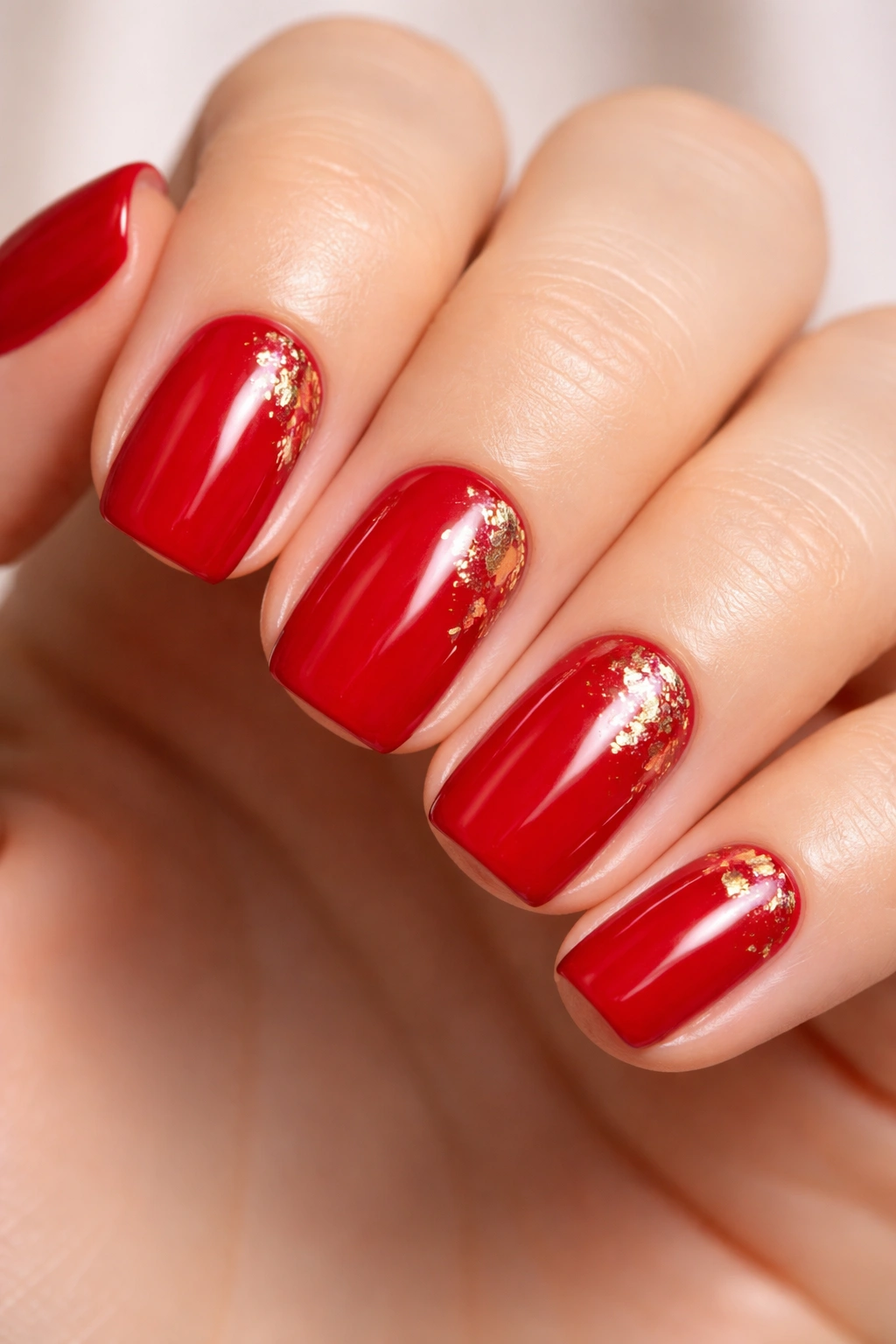
Scarlet red is a bright, pure red that sits between crimson and true primary red—it has a slight orange bias that makes it feel warm and confident. Layer actual metallic foil (gold, silver, or rose gold) into the design, either as thin lines or as small patches on select nails. Foil adheres to gel polish during the curing process, creating a permanent metallic element that won’t chip off the way stamped metallic designs might. The foil catches light like jewelry embedded in your nails.
Foil as a Luxury Element
Foil finishes feel expensive and intentional. They’re permanent, which means they won’t peel or fade like some metallic effects. Scarlet red provides a vibrant base that makes foil elements pop. The contrast between the matte or semi-glossy foil and the glossy red creates texture and visual interest. On short squoval nails, you have just enough space to incorporate foil in a way that feels balanced—not too much to feel costume-y, but enough to read as special.
Foil Application Strategies
- Thin foil lines: geometric, minimalist, elegant
- Foil patches: concentrated on one or two nails for accent
- Foil gradient: foil density increases from cuticle to tip
- Half-nail foil: entire half of the nail covered in foil, creating a bold statement
- Scattered foil shards for an abstract, artistic effect
Real talk: Foil work is easiest at a salon because it requires timing precision during the gel curing process. Home attempts often result in foil peeling or applying unevenly.
11. Red Glitter Gradient
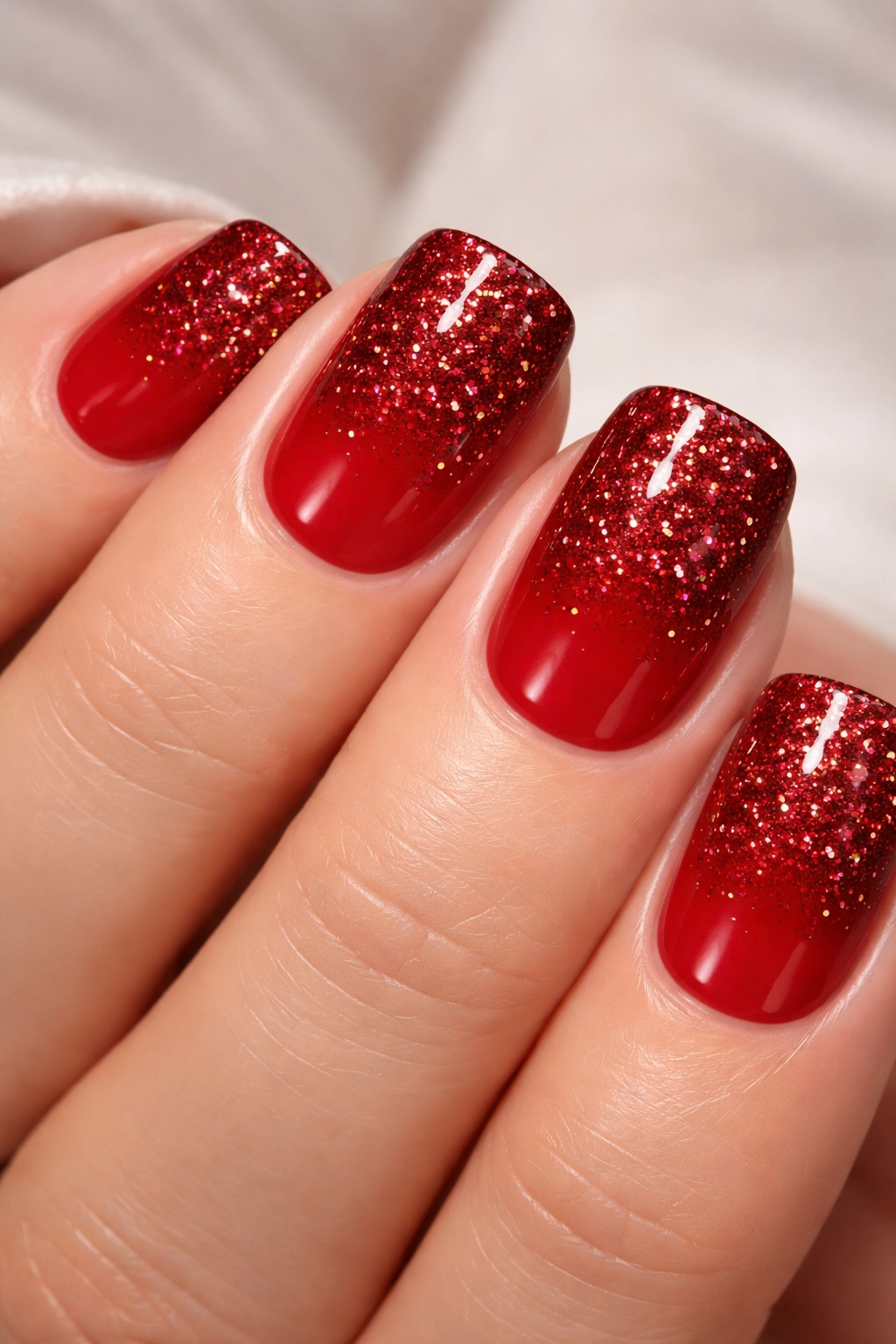
Start with a deep burgundy or bright red base and gradually increase the density of red glitter as you move toward the free edge, ending with a heavy glitter concentration at the tip. Glitter creates sparkle and movement that reads festive and celebratory. The gradient approach keeps it wearable—solid glitter from cuticle to tip can feel costume-y, but a gradual buildup feels modern and intentional. Short squoval nails contain the glitter effect; it doesn’t extend too far past the fingertip.
Glitter Density and Wearability
The beauty of a gradient is that you get the sophistication of solid red near the skin and the sparkle and fun of glitter at the tips. This combination reads appropriate for almost any occasion—it’s glittery enough to feel special but grounded enough to look intentional rather than costume-y. Using a glitter in the same color family as the base (red glitter on a red base) creates a monochromatic sparkle that’s less visually jarring than contrasting glitter colors.
Glitter Types That Work Best
- Fine micro glitter: subtle shimmer, professional-appropriate
- Chunky hex glitter: bolder, more playful and celebratory
- Mix of sizes: creates dimension and catches light differently
- Translucent glitter: allows the base color to show through while adding sparkle
- Holographic glitter: shifts color with light, creating an almost chameleon effect
Pro tip: Use a clear or slightly tinted base coat under glitter so it sits on a stable foundation rather than directly on the nail, which can stain.
12. Coral-Red with Stamped Pattern
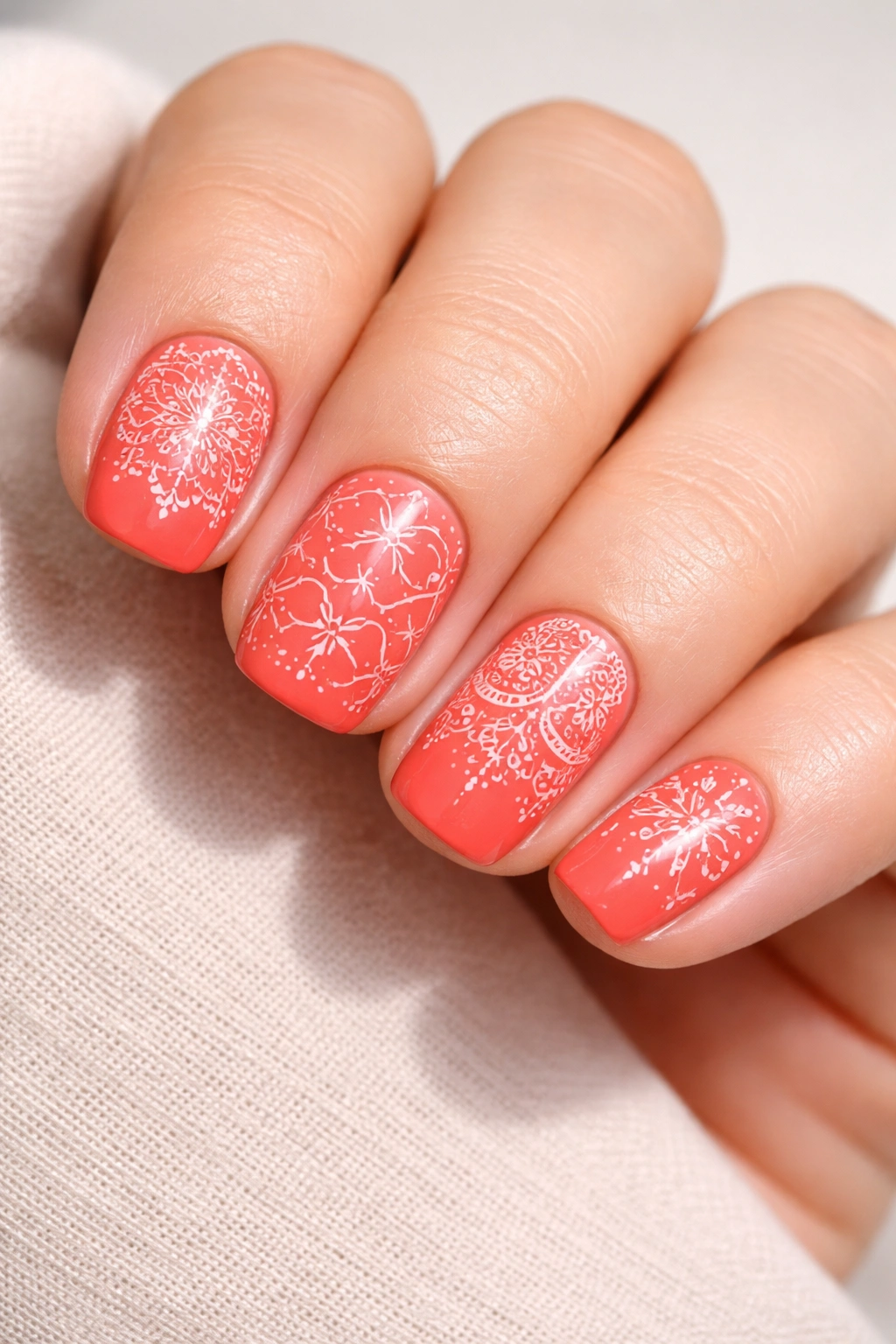
Coral-red is a red that skews orange—it’s warmer and less formal than true red, and it reads more summery and playful. Add a stamped pattern (repeated geometric shapes, tiny florals, or abstract designs) in white, black, or a complementary color. Stamping uses a special plate and stamper to transfer pre-designed patterns onto the nail; it’s faster and more consistent than hand-painting. On short squoval nails, stamped patterns don’t have room to sprawl, which actually keeps them looking balanced and intentional.
Stamping as Accessible Nail Art
Stamping is the gateway to nail art for people who can’t hand-paint. The patterns are pre-designed, so you don’t need artistic ability—just steadiness when applying. Coral-red is warm enough to work with almost any stamped pattern color. The short squoval shape means stamped designs look complete and contained; they’re not fighting with excessive nail surface.
Stamping Design Ideas
- All-over repeating pattern: consistent design across all nails
- Single pattern on accent nails: pattern on maybe two or three nails, solid red on the rest
- White geometric lines: minimalist and modern
- Tiny black florals: delicate and feminine
- Abstract swirls or waves: artistic without being intricate
Worth knowing: Stamping plates come in endless designs, and new patterns are released constantly. You can find literally anything you’re looking for, which means customization possibilities are genuinely endless.
Wrapping Up
Red short squoval nails work because they hit a sweet spot between boldness and practicality. The color commands attention while the shape and length keep everything grounded and wearable. Whether you go for a classic cream, a creative ombre, or a stamped design, the foundation is strong—red is the most reliable bold color in the nail universe.
The real key is knowing which version of red actually speaks to you. Bright red cream reads different than burgundy matte, which reads different than coral-red with stamping. Your skin tone matters, your lifestyle matters, and how much maintenance you’re willing to do matters. But here’s the thing: red suits everyone when you choose the right undertone and finish. Spend time thinking about whether you want cool-toned or warm-toned reds, whether you want matte or glossy, and whether you want added detail or simple elegance. That intentionality is what makes these nails really pop—it’s not just the color itself, but the fact that you’ve made a deliberate choice about exactly which red and exactly which execution.
Short squoval nails have become increasingly popular over the past few years because they’re the sweet spot shape—not too short to feel boring, not too long to be impractical. Add red into the mix and suddenly you’ve got something that works morning to night, casual to formal, everyday to special occasion. You’re not locked into one look either; red is versatile enough that you can switch between these twelve approaches depending on your mood, the season, or what you’re doing. That’s the real power here—not that one of these is objectively better than the others, but that red on short squoval nails gives you options that actually feel distinct and intentional, not like color variations of the same basic thing.