




The quickest way to make a soft blue manicure look expensive is chrome. Put that finish on a coffin shape, and light blue chrome coffin nails stop looking sweet and start looking sharp—icy at one angle, liquid metal at the next. A flat pastel can disappear on the hand. Chrome never does.
That shine is also less forgiving than people think. Every bump in the builder gel, every crooked sidewall, every dry patch around the cuticle shows up once the powder goes on. I’ve seen nail sets that looked dreamy in the bottle and almost foil-like on the hand because the base wasn’t smooth enough or the blue was picked half a shade too gray.
Coffin nails help because the shape gives the reflection room to stretch. A medium to long coffin tip, filed with straight sidewalls and a narrow squared-off end, makes chrome look cleaner than it does on a short rounded nail. You can still wear the look at a shorter length—I’ll get to that—but the shape matters more here than it does with cream polish.
And blue matters too. Pale sky blue, milky baby blue, icy blue with a silver cast, a jelly blue over sheer pink—each one gives a different mood. Some read crisp and glassy. Some look like pearl. Some lean cool enough to feel almost metallic. The twelve sets below are the ones I’d pull from the inspiration pile first.
1. Classic Mirror Light Blue Chrome Coffin Nails
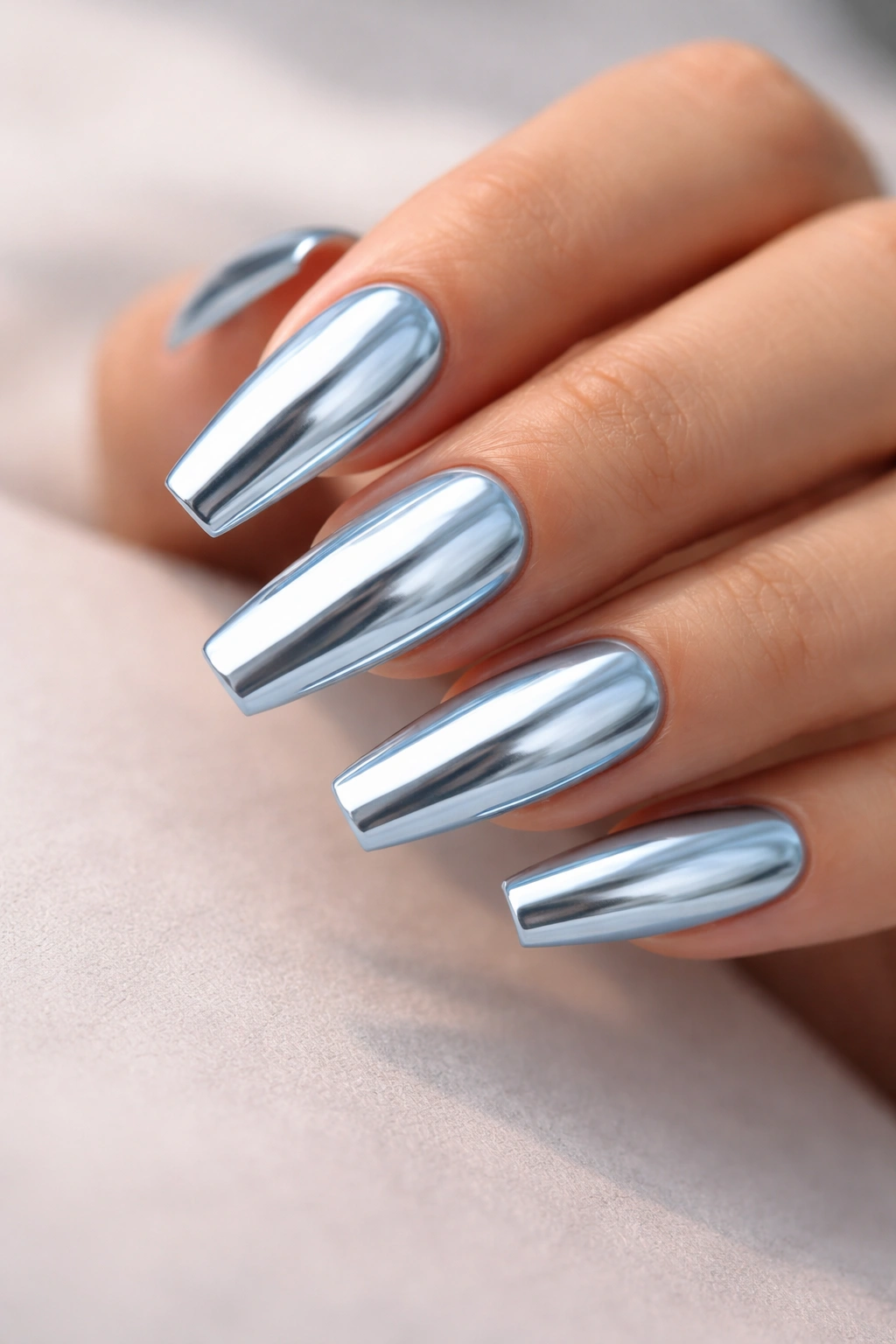
Start with the one that does not need extra art to make its point. A full mirror baby-blue chrome set on medium-long coffin nails is the manicure version of polished metal: clean surface, sharp reflection, no distraction.
The finish works best when the blue base sits in that narrow zone between pastel and ice. Too pale, and the chrome can turn silver-white. Too saturated, and you lose that airy look that makes light blue feel fresh on a coffin shape. A single coat of pale blue gel over a leveled builder base usually lands in the right place, especially if the chrome powder has a pearl-silver cast instead of a harsh gunmetal tone.
Why the plain version hits harder than people expect
A lot of nail art looks stronger in close-up than it does from arm’s length. This one is the opposite. The clean mirror surface throws light from across the room, and the coffin shape keeps the whole thing from reading flat. You get a crisp taper through the sidewalls, then that squared tip catches the chrome like a tiny panel of glass.
Because there is no art covering mistakes, prep has to be tight. Ask for a smooth apex, clean cuticle work, and sidewalls that match on all ten fingers. The American Academy of Dermatology has long warned against aggressive cuticle cutting, and that matters here; torn skin next to chrome polish stands out fast.
What to ask for at the salon
- Length: 8 to 12 mm past the fingertip gives the reflection room to stretch without making daily wear annoying.
- Base: A pale cool blue gel, not a chalky pastel polish that dries unevenly.
- Chrome layer: Fine pearl chrome rubbed over a no-wipe top coat for 20 to 30 seconds per nail.
- Top coat: Thin and glossy. A thick final coat can blur the mirror effect.
Best move: leave at least one hand free of stones, decals, or charms. The plain version is the one that usually lasts in your rotation.
2. Milky Ice-Blue Chrome with a Glazed Finish
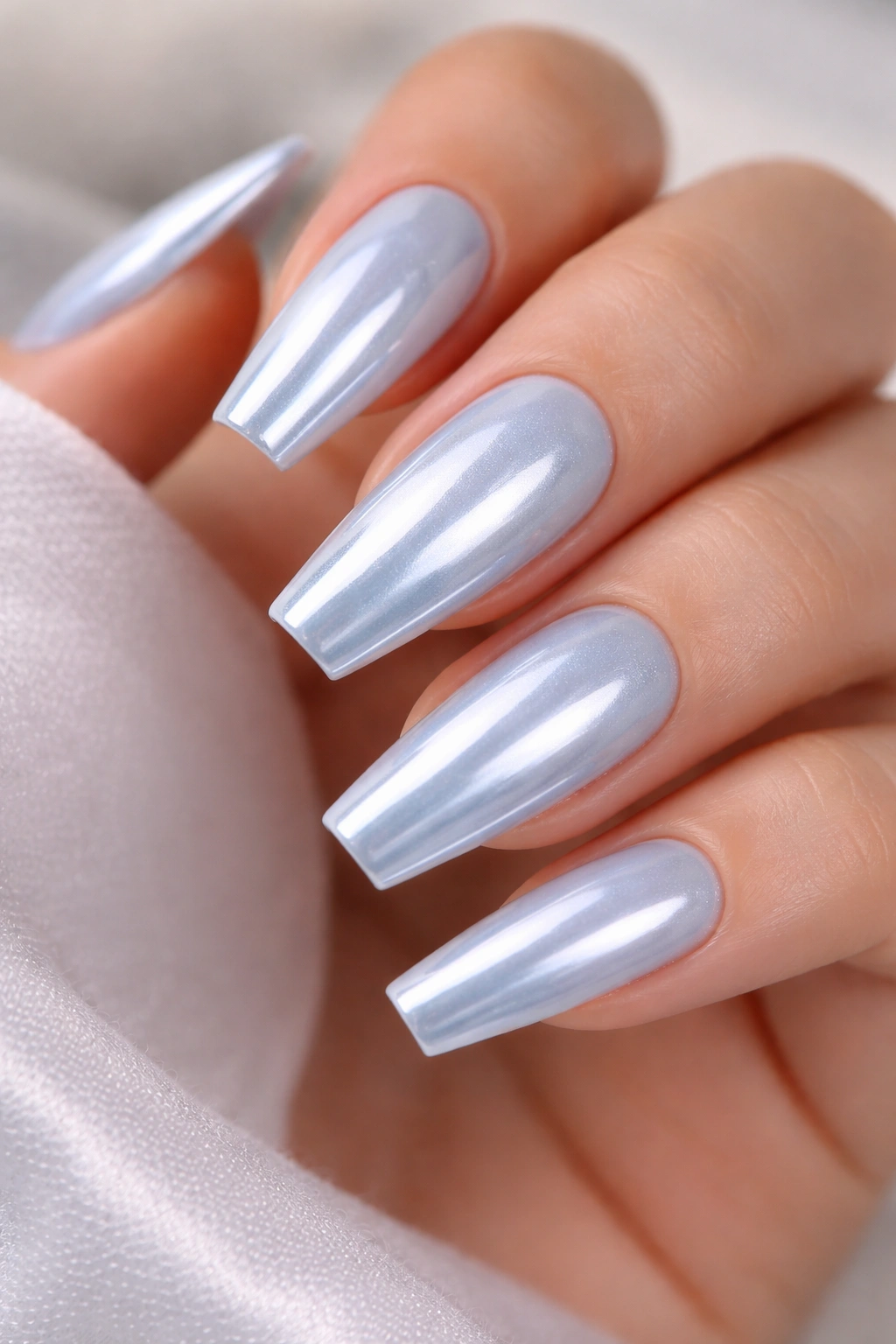
If full mirror chrome feels a bit loud, the milky glazed version is where I’d go first. It still shines, but it shines through a soft veil instead of hitting like polished steel.
This look starts with a sheer, cloudy base—think cool-toned milk with one drop of blue stirred in. Then a pearl chrome is buffed over the top, not enough to create a hard mirror, more like the sheen you get on the inside of a shell. On coffin nails, that haze softens the length without making the shape feel blunt.
The reason this one works on more skin tones is the translucency. Opaque baby blue can clash if it pulls too gray against warm or olive skin. A milky wash lets some of the natural nail bed show through, which keeps the whole set from looking pasted on. If your nail tech uses builder gel, ask for a semi-sheer neutral base under the blue layer so the nail still has depth.
This is also one of the safer choices if you are new to chrome powder. Tiny flaws in the surface do not scream the way they do under a hard mirror finish. You still need a smooth top coat, no question, but the pearly haze gives the eye somewhere else to go.
I’d wear this on a medium coffin length, around 7 to 10 mm of free edge, with no accent nails at all. Let the finish do the work.
3. Baby Blue Chrome French Tips on Long Coffin Nails
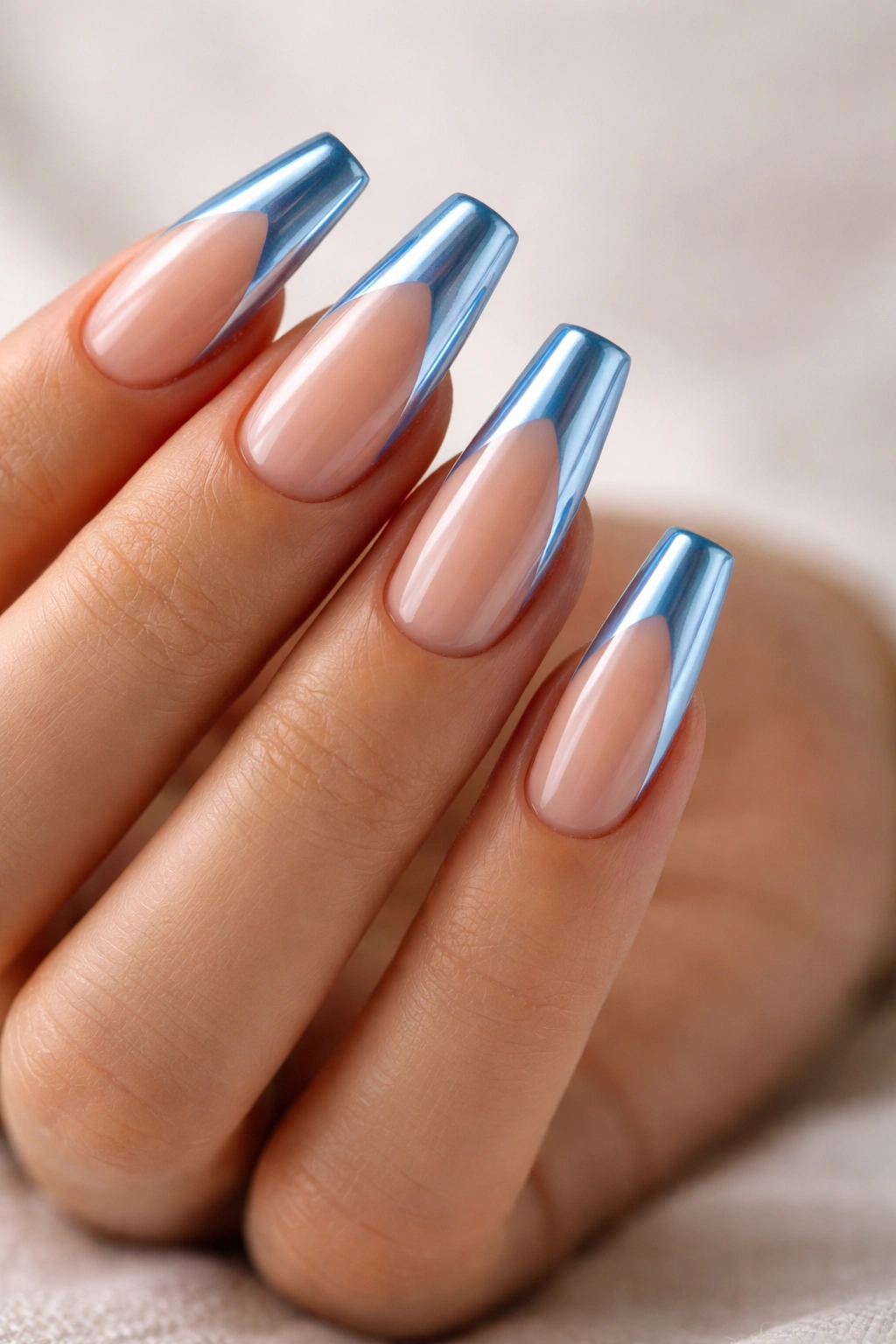
Why does a French tip suddenly look sharper when the tip is chrome? Because the contrast is doing two jobs at once: it shows the coffin shape and it lets the shine stay focused where the eye already lands.
A nude or sheer pink base keeps the manicure grounded. Then the free edge gets sculpted into a light blue chrome band, usually 5 to 7 mm deep on a long coffin nail. That width matters. Too thin, and the tip looks stingy. Too deep, and you lose the clean French effect.
The best versions have a crisp smile line, not a flat stripe. On a coffin shape, I like the smile line slightly higher at the center and pulled lower at the sidewalls because it lengthens the nail bed. That little curve changes the whole hand.
How to ask for this look without getting a chunky tip
Tell your nail tech you want a structured nude base with chrome only on the tip, not chrome powder over the whole nail and then a nude painted back in. The cleaner method is:
- build and file the full coffin shape first
- apply the sheer base color
- paint the tip in pale blue gel
- top with no-wipe top coat on the tip area
- rub chrome powder onto the cured tip only
- seal the whole nail
That order keeps the line sharper.
One warning, though. If the coffin tip is short—under 4 mm of free edge—the chrome French can start to look cramped. This design needs space.
4. Nude-to-Blue Chrome Ombre with a Soft Cuticle Fade
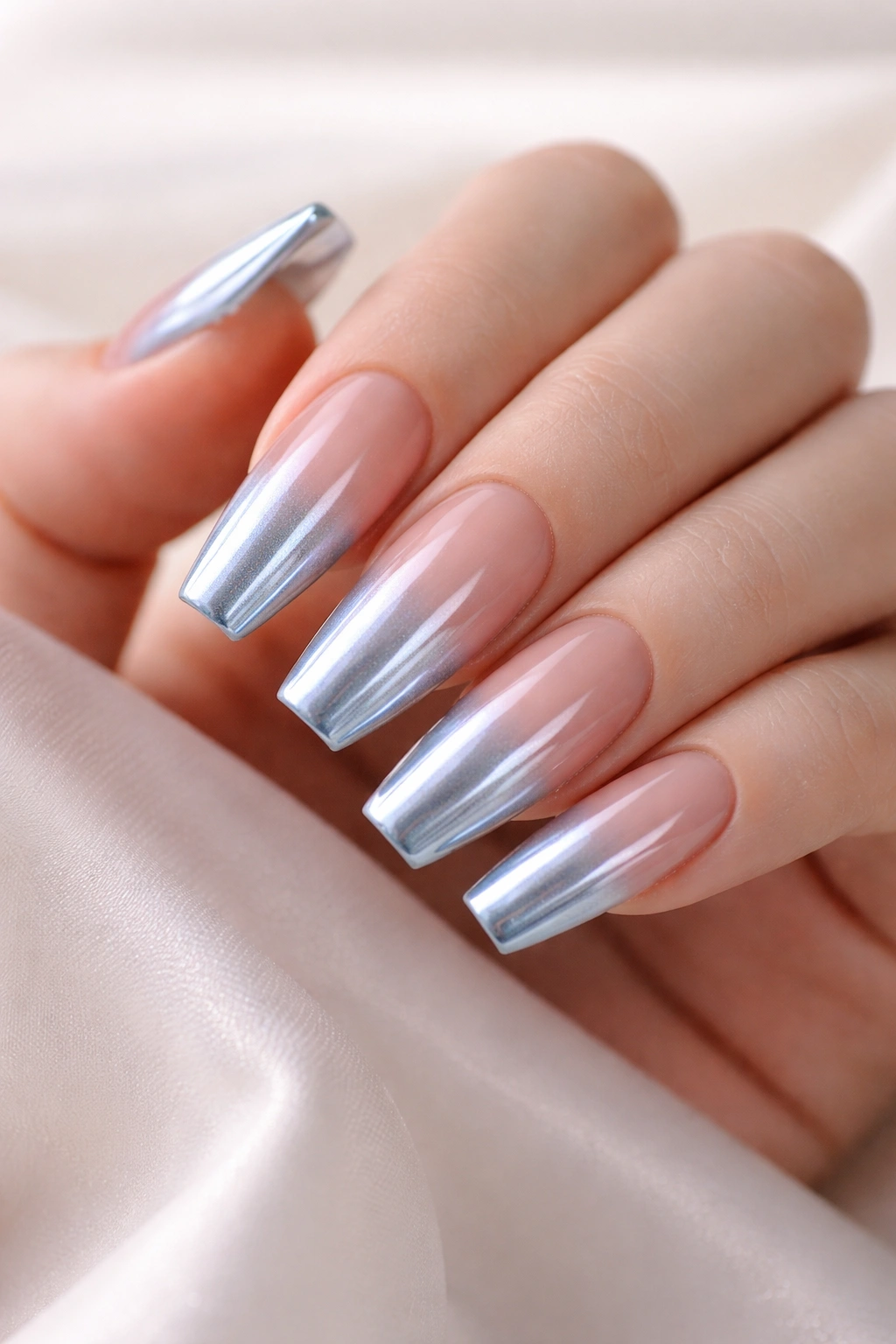
Picture a bare-looking cuticle area that melts into icy blue by the time your eye reaches the tip. Then imagine chrome laid over that gradient so the fade still shows underneath. That’s one of the smartest ways to wear blue chrome if you want regrowth to look less harsh.
The fade matters for practical reasons, not only style. When color starts farther from the cuticle, the fill line is less obvious after 10 to 14 days. On a solid chrome manicure, new growth can show fast because the finish is so reflective. A blended root buys you time.
Nail artists usually get this effect with an airbrush, a sponge blend, or a soft ombré brush. Airbrushing gives the smoothest transition, but a patient hand with gel polish can still pull it off. The trick is building the blue in light passes instead of trying to push one thick coat from tip to center.
Quick details that make this set look clean:
- Base near the cuticle: soft pink nude, sheer beige, or a milky neutral
- Blue placement: strongest at the last third of the nail
- Chrome type: pearl or ice-silver, not rainbow chrome
- Best length: medium-long to long, since the gradient needs room
I like this one on people who want a statement manicure but hate a blunt outgrowth line. It’s still flashy. It’s just smarter about it.
5. Silver-Outlined Light Blue Chrome Coffin Nails
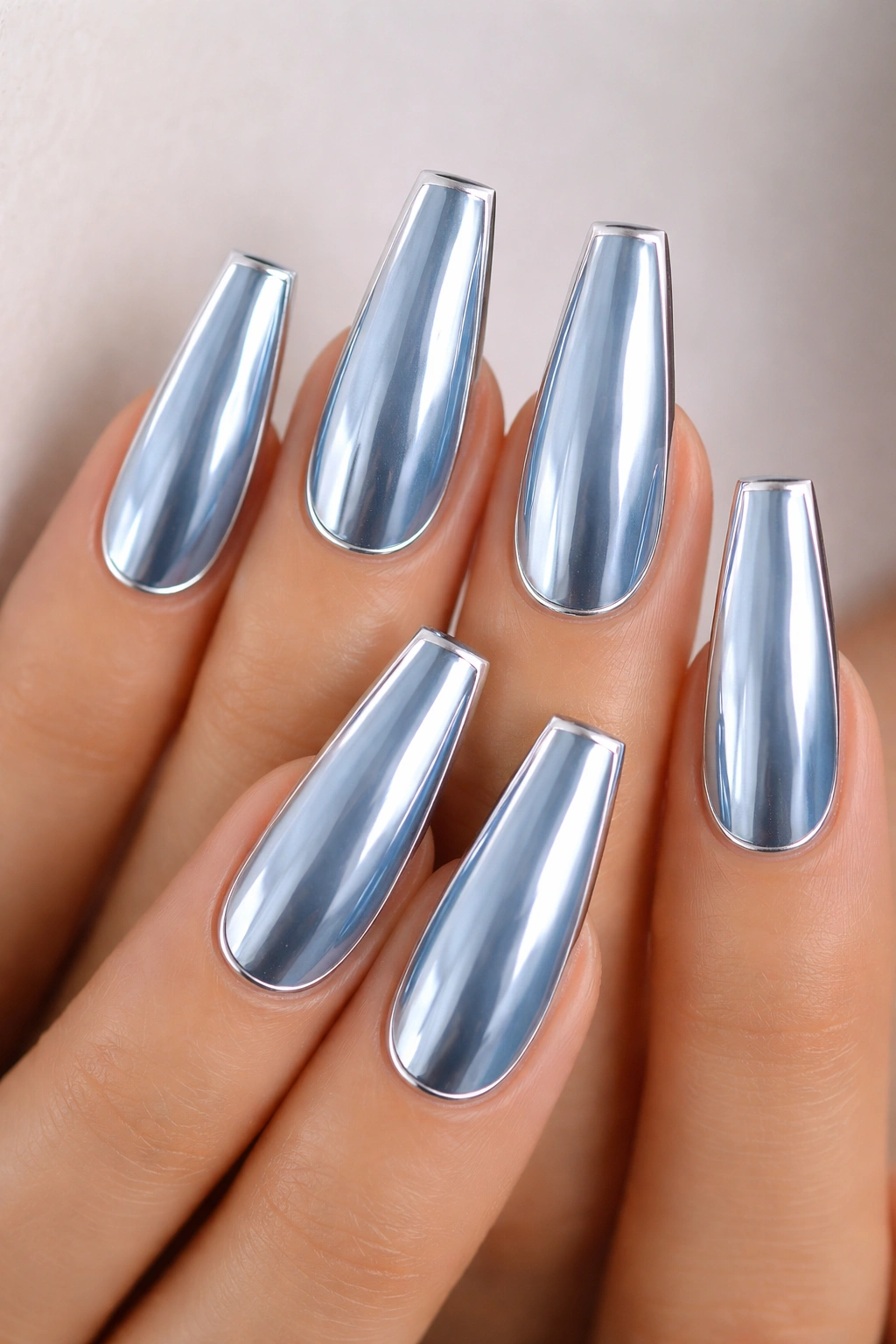
Some nail sets try too hard. A silver outline around a blue chrome center does the opposite: it adds structure with one narrow line and lets the shape carry the design.
This look is strongest when the outline is thin—about 1 mm, maybe a hair less—and placed with a liner brush after the chrome has been sealed. Too thick, and the edge starts to eat the nail. A slim silver border makes the center look brighter, almost like the blue is lit from inside the frame.
There’s also a neat little optical trick here. Coffin nails can look wide if the tech leaves the sidewalls too straight without enough taper. A drawn outline lets you fake a tighter silhouette by bringing the silver line slightly inward along the sides and keeping the tip crisp. You are not changing the structure, not exactly, but the eye reads it as narrower.
I’d skip extra rhinestones on this set. The frame is already a graphic element, and more hardware can push it into busy territory fast. If you want a touch more detail, add a tiny metallic stud at the cuticle on one ring finger and leave the rest alone.
The result looks controlled. That’s the word I keep coming back to. Not plain, not overloaded—controlled.
6. Pearly Light Blue Chrome with White Swirl Art
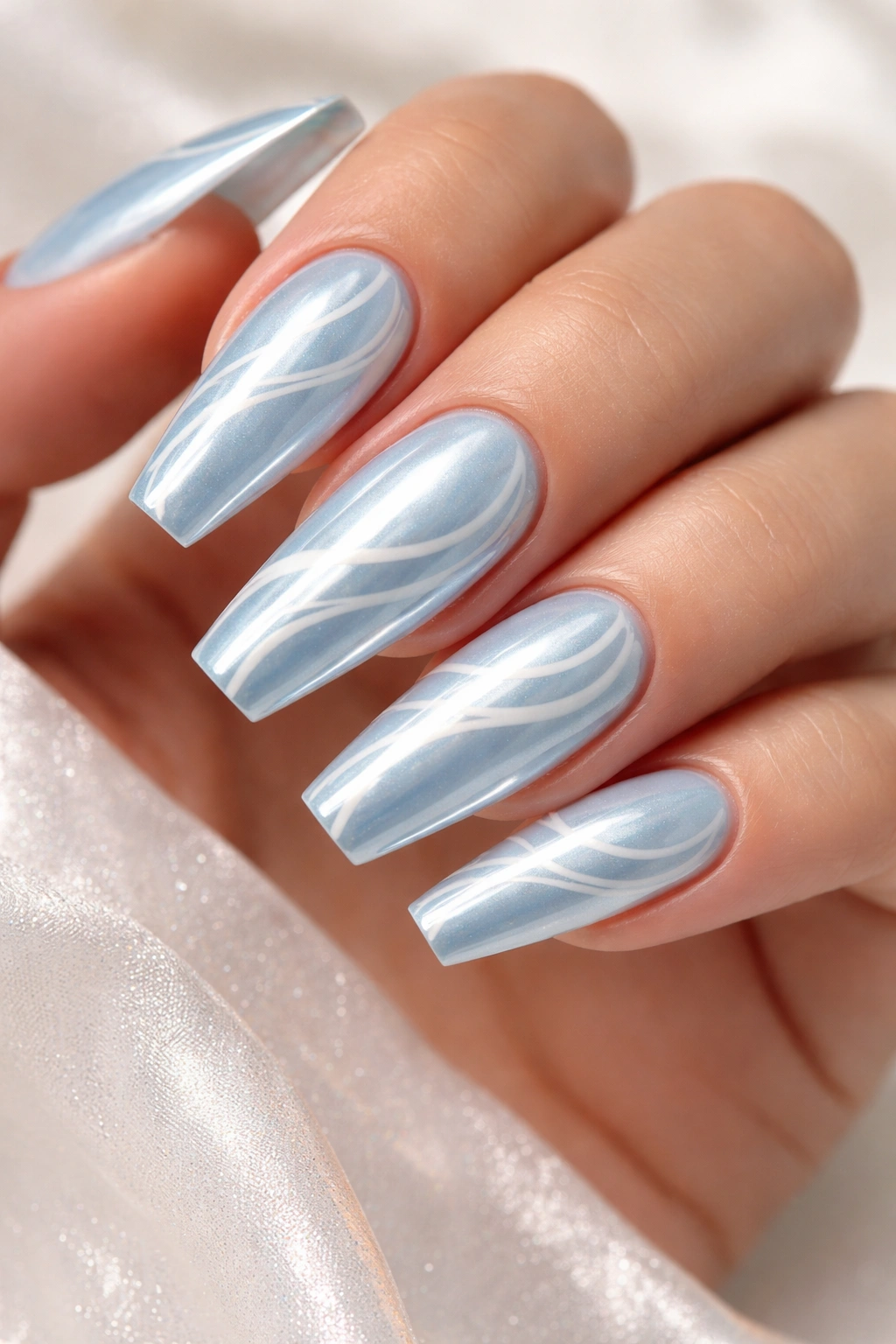
Unlike a hard mirror manicure, pearly chrome can carry line work without the surface turning messy. That makes it the right base for soft white swirls that snake across the nail like smoke or marble ink.
The order of application matters. Chrome goes down first over the blue base, then gets sealed. The white swirls are painted on top with gel paint and finished with another glossy top coat. If you try to draw the swirls under the chrome, they blur. If you draw them on an unsealed powder layer, they drag.
Who is this best on? Someone who wants movement in the design but does not want stones, charms, or 3D gel. White line work keeps the set light. It also gives the eye a break from pure shine, which can feel like a lot on ten full chrome nails.
I prefer 2 or 3 swirl-heavy nails per hand, not all ten. Middle and ring fingers usually carry the art best, while the thumb and pinky can stay plain chrome. That balance feels cleaner and wears better because the busiest nails get less impact than the pointer finger.
Ask for a bright white gel paint, not an off-white cream. Crisp white gives the coolest contrast against icy blue. Creamy ivory muddies it.
7. Cat-Eye Light Blue Chrome with a Diagonal Flash
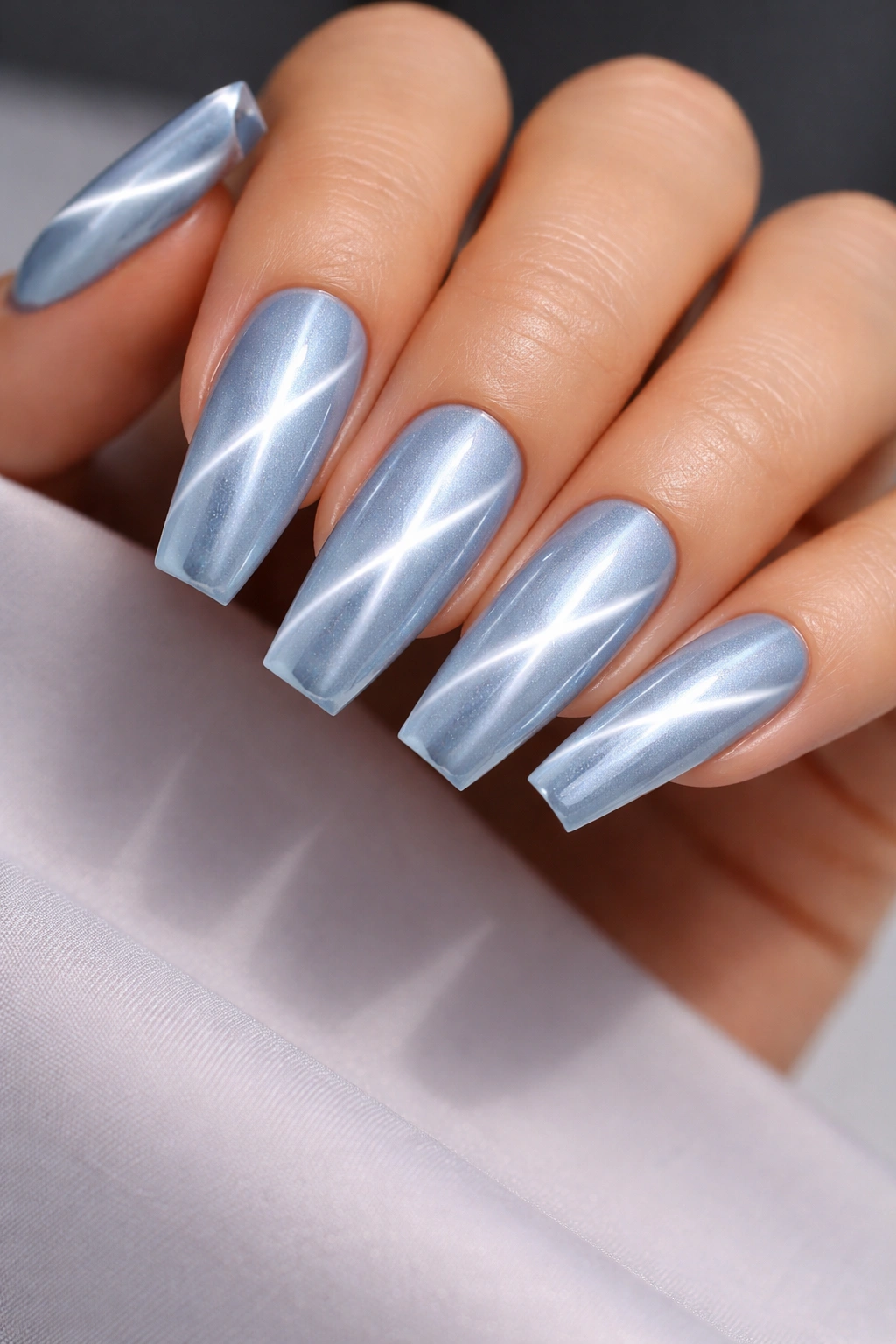
A diagonal flash changes everything. You still get chrome, but there’s a second layer of movement running through it—a narrow band of light that shifts when the hand turns.
This style starts with magnetic gel under the chrome. The tech places the magnet at an angle for 5 to 10 seconds before curing, which pulls the metallic particles into a slash across the nail. Then a pale chrome powder goes on top. The final effect is deeper than standard chrome, almost like you’re looking into blue glass instead of at a flat reflective surface.
Why the layered shine works so well on coffin shapes
Cat-eye polish can look crowded on short rounded nails because the light band has nowhere to travel. Coffin nails give it a path. The straight sidewalls hold the line, and the squared tip stops the flash from looking warped at the end.
What makes this different from plain chrome
- The shine moves in two ways: broad chrome reflection plus a focused cat-eye streak.
- It looks darker at some angles, even with a pale blue base.
- Photos catch only part of it. In motion, it has more depth than a still image shows.
My preference: keep the diagonal direction consistent on every nail. Mixed angles can look chaotic fast.
8. Light Blue Chrome Coffin Nails with Tiny Crystal Cuticles
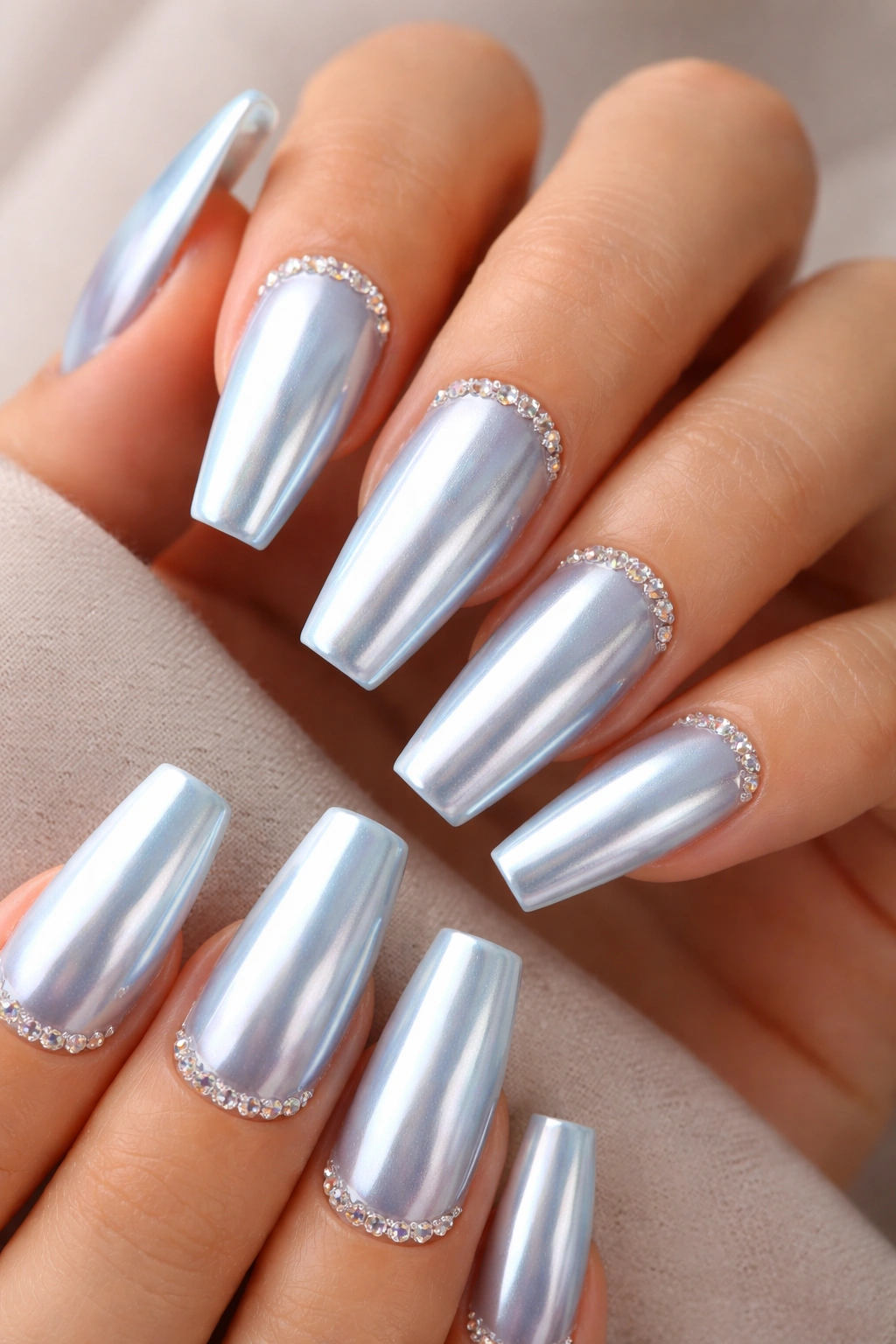
Tiny crystals can make chrome look cleaner, not busier, if you stop at tiny. That limit matters more than people admit.
The best version uses small stones—SS3 or SS5 size—placed in a half-moon near the cuticle or in a short vertical row at the base. Once stones get too large, they start fighting with the chrome reflection and catching lint, hair, sweater fibers, all the annoying little things you notice on day three. Small crystals give a pinprick of sparkle and leave the blue shine in charge.
Placement does most of the work here. A cuticle crescent softens the hard gleam of chrome and pulls attention back toward the nail bed, which helps on long coffin shapes. A single stone on each nail can also work, though I think the half-moon on one or two accent nails has more impact.
There is a practical side too. Stones hold better when they sit on a flat area with enough gel adhesive under them and a bead of top coat or builder gel around the base, not over the top. Covering the top of a crystal dulls it. A good tech knows that, but it never hurts to ask.
If you use your hands hard—typing all day, opening boxes, lifting weights—save the stones for one finger per hand. Chrome alone survives longer than chrome plus hardware.
9. Cloud Accent Nails over a Blue Chrome Base
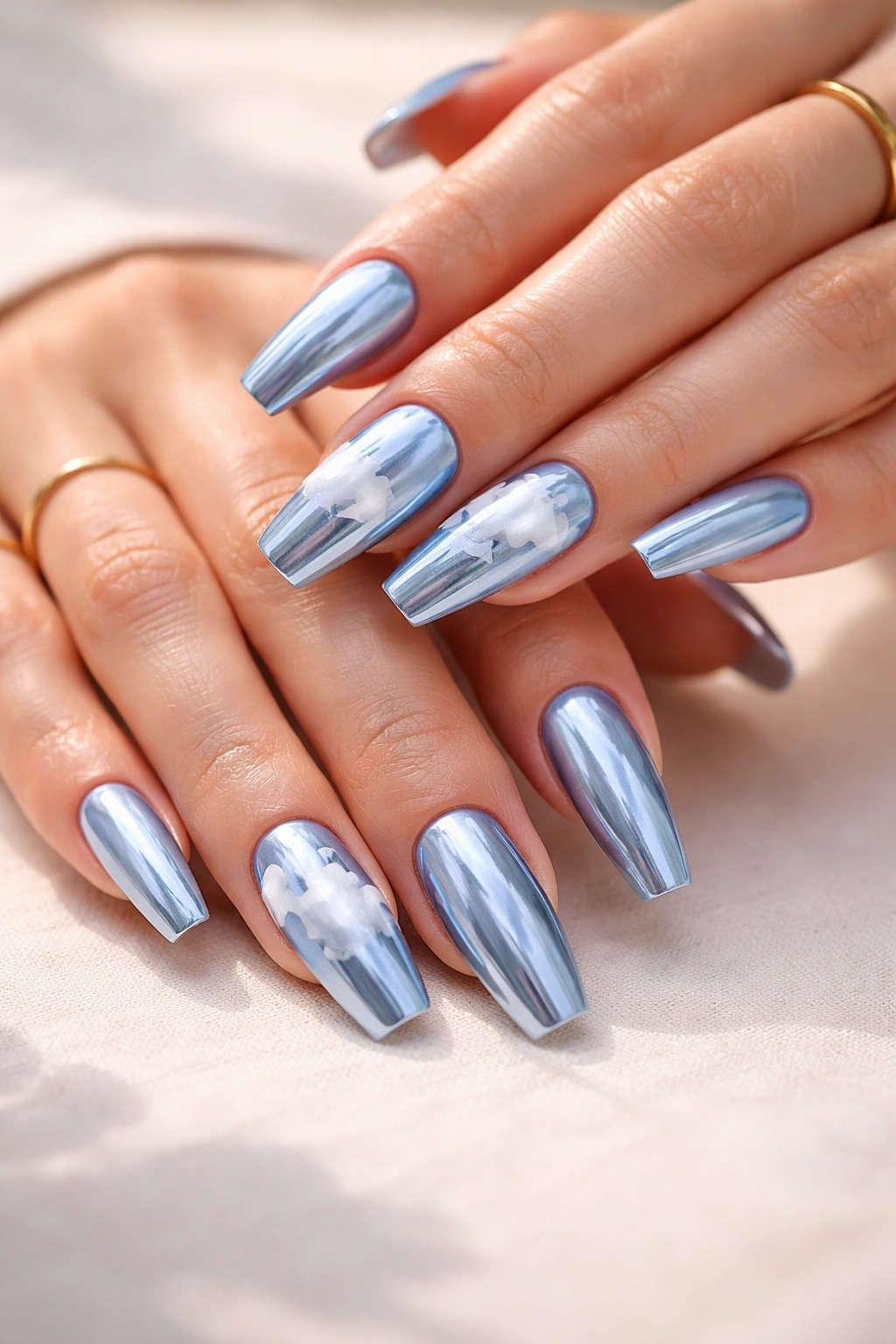
What happens when you put soft white cloud art over a reflective blue coffin nail? You get a manicure that reads playful from up close and sharp from far away, which is a harder balance to strike than it sounds.
Cloud nails go wrong when every finger gets a cartoon puff. Then the set starts to look themed. The stronger move is to choose one or two statement nails per hand, usually the ring finger and thumb, and keep the rest in plain light blue chrome or a milky variation. That way the art feels intentional instead of scattered.
Cloud placement should stay light. Small, layered white curves with a hint of pale blue shading at the lower edge look better than big opaque blobs. Some techs add a tiny touch of chrome powder or pearl pigment at the top of the cloud to tie it back to the rest of the set. That works—if the cloud stays soft and does not turn into a silver patch.
How to keep this design from looking childish
Use a cooler blue base, skip smiley faces or stars, and keep the coffin shape crisp. The contrast between a structured nail shape and soft cloud art is what makes the look work.
I’d pair this with a medium length, around 8 mm of free edge. Long enough to show the design. Short enough that it still feels wearable when you grab keys, type, or button a coat.
10. Marble Ice Chrome with Fine White Veins
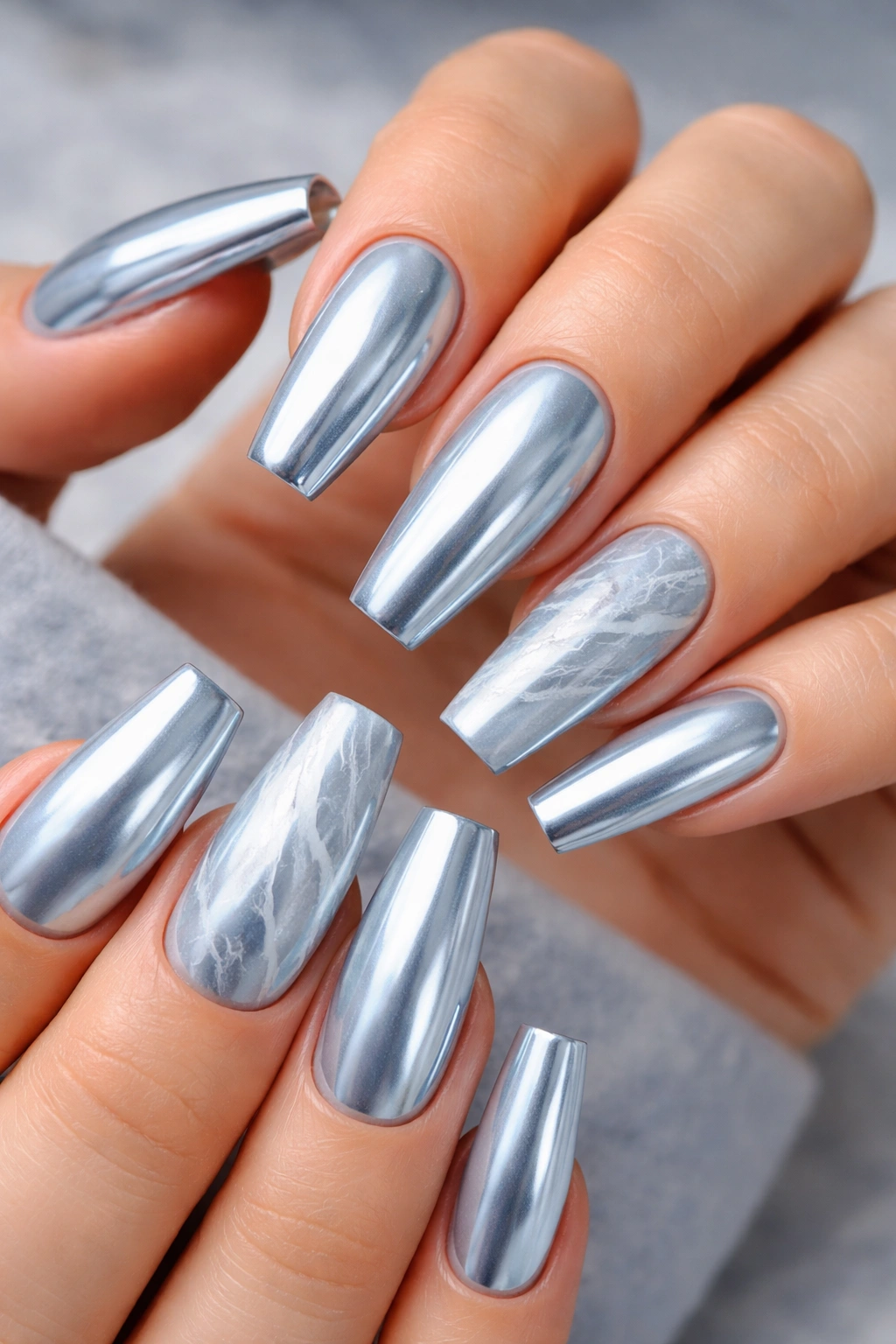
I keep coming back to this set because it has texture without actual texture. White marble veining over icy chrome gives the nail surface a stone-like pattern while the top coat stays glass-smooth.
The key is restraint. You want 2 or 3 thin veins per accent nail, not a web. Nail artists usually pull this off with blooming gel or a fine liner brush, dragging narrow white lines through a pale blue base before sealing and adding chrome in selective areas—or, in another method, adding the chrome first and painting the veins over a sealed surface. Both can work. I prefer chrome under the veins when the goal is a cleaner, colder look.
A good marble line is uneven. One stretch should be hair-thin, another slightly blurred, maybe one branch breaking off toward the side. Natural stone is irregular, and neat parallel lines kill the effect right away.
Helpful details to request:
- Accent count: 2 to 4 marble nails in a set of 10
- Vein thickness: less than 1 mm in most places
- Blue tone: icy or milky, not bright turquoise
- Top coat: high gloss, because matte cancels the chrome payoff
This one suits longer coffin lengths, where the veining can travel across the nail instead of bunching near the center.
11. Shorter Light Blue Chrome Coffin Nails with a Soft Edge
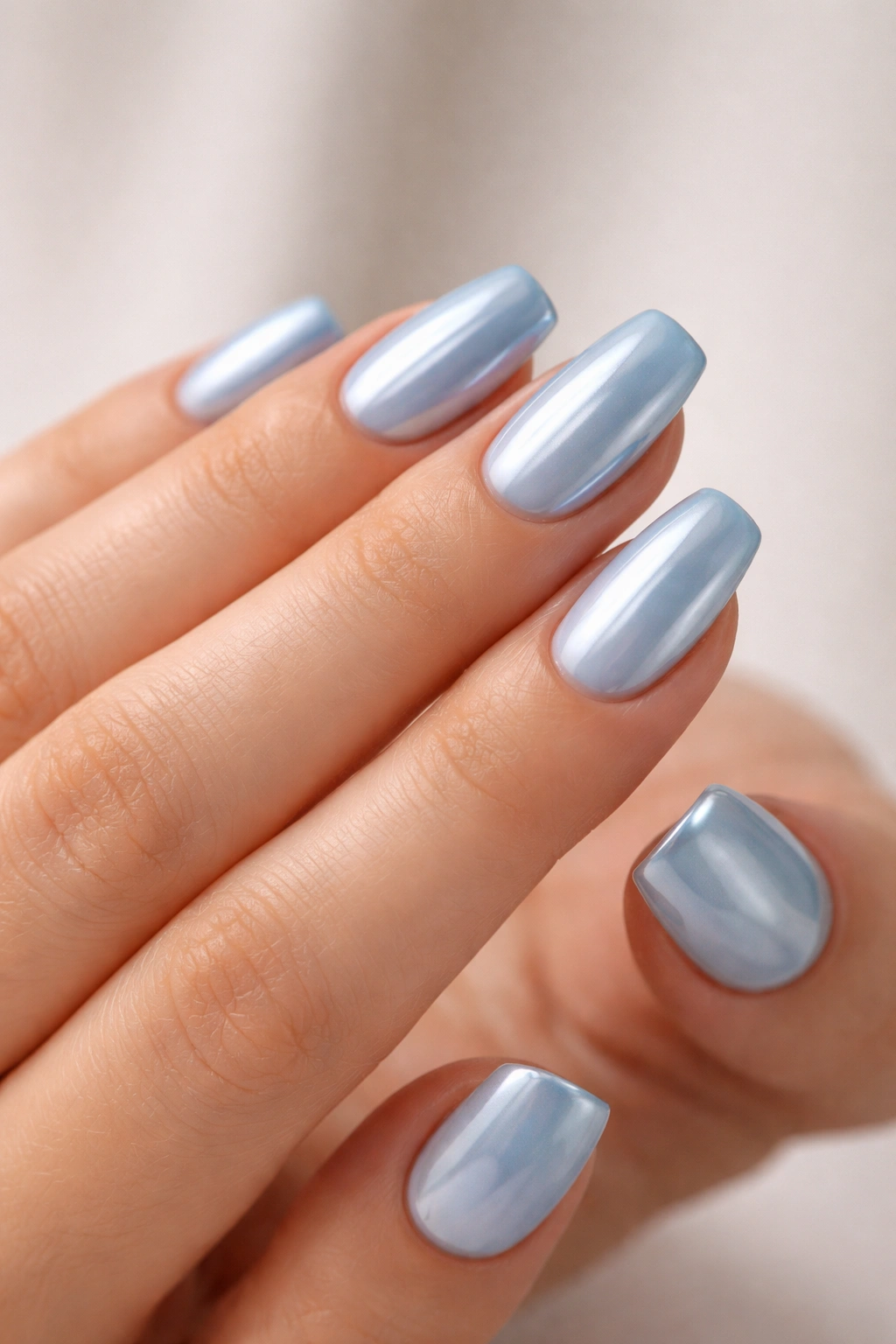
Not everyone wants long tips clicking against every hard surface in the house. A shorter coffin—more “soft coffin” than sharp tapered box—can still carry chrome if the proportions are right.
The danger with short coffin nails is width. Take too little from the sidewalls and the shape reads square. Take too much and the nail looks squeezed. I like to see 4 to 6 mm of free edge past the fingertip, a gentle taper through the sides, and a tip that keeps a small flat edge instead of collapsing into almond. That tiny flat end is what keeps the shape in the coffin family.
Chrome actually helps here because it lengthens the nail visually. Reflection draws the eye from cuticle to tip, which makes a shorter shape feel sleeker than a cream pastel would. Milky or glazed chrome often works better than a hard mirror on this length, though. The softer finish keeps the hand from looking stubby.
This is the design I recommend to people who wash dishes barehanded, type nonstop, or can’t stand snagging their nails on denim pockets. You still get the cool blue shine. You just get to open soda cans without a strategy session first.
Short does not mean dull. It means you planned for real life.
12. 3D Water-Drop Light Blue Chrome Nails
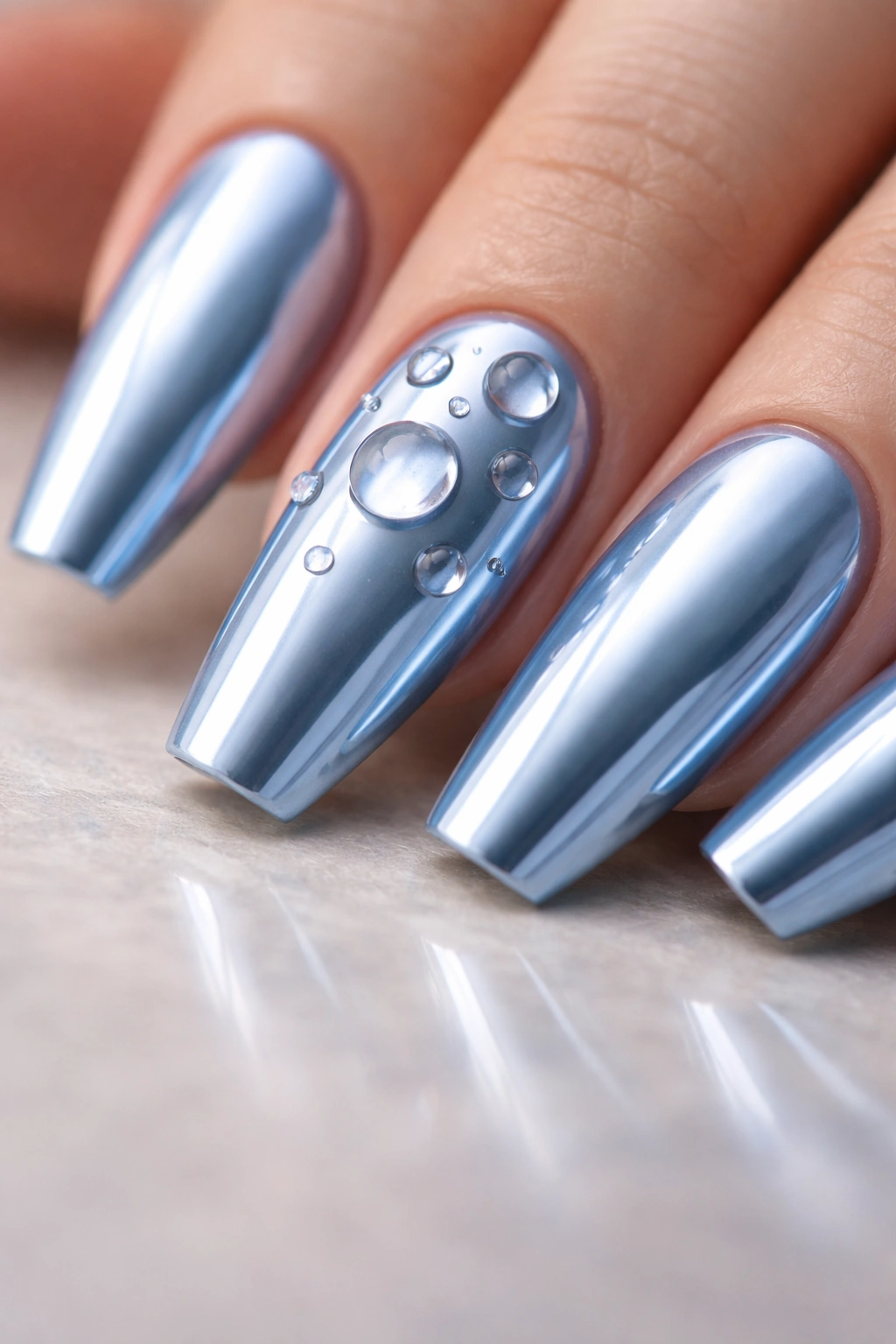
Unlike shine from top coat alone, 3D water drops throw light in tiny raised points across the nail, which makes a blue chrome base look almost wet. When it’s done well, the effect is sharp and a little strange—in a good way.
The drops are usually made with thick builder gel or clear sculpting gel placed in small domes and cured for 30 to 60 seconds. Size matters. A mix of tiny and medium droplets looks natural. Identical dots lined in rows look like craft beads. I’d keep the domes off the free edge, where they chip sooner, and place them toward the center or upper half of the nail.
This is one of those designs that needs editing. Put droplets on every nail, and the hand can start to look cluttered. Put them on 2 accent nails per hand over a clean chrome set, and the contrast lands. Thumb, middle, or ring finger usually takes the texture best.
A note on wear: raised gel catches more friction than flat art. If you tuck sheets, dig in a bag, or wear tight gloves often, expect a little more wear around the droplet edges. Not damage, usually—just dulling.
Still, for pure visual payoff, this one earns its place. It looks like chrome after rain.
Final Thoughts
If you want the easiest entry point, go with the milky glazed version or the chrome French tip. Both give you the light blue chrome effect without demanding full mirror perfection on every nail surface. They also grow out with less drama, which matters if you stretch fills past two weeks.
If your goal is impact, the full mirror set, the cat-eye layer, and the 3D water-drop design have the strongest flash. Ask for a smooth structured base, a fine chrome powder, and coffin sidewalls that match from nail to nail. Those details decide whether the manicure looks crisp or off.
One last opinion—because I do have one. Blue chrome looks best when you resist the urge to stack every trend on top of it. Pick one extra idea: stones, swirls, marble, clouds, maybe droplets. Let the shine handle the rest.
