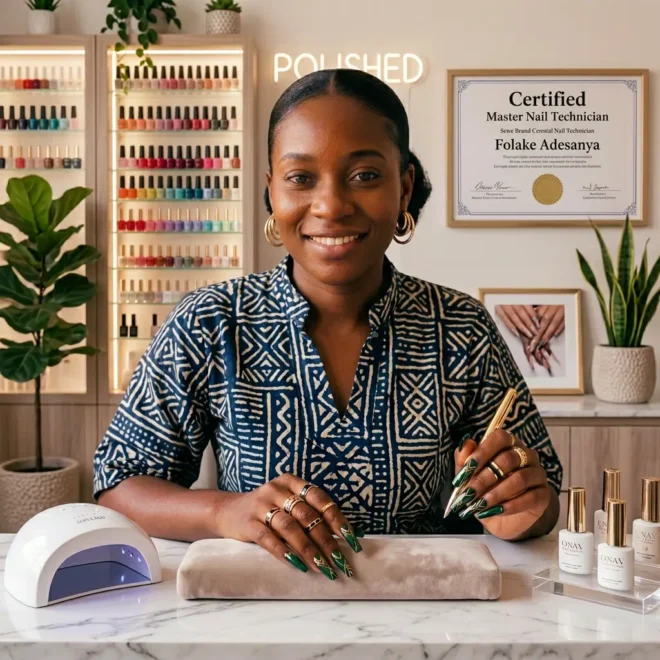


The worst moment in a nail appointment hits about 30 seconds after your tech asks, “What shape and what design are we doing?” You wanted ballerina nail ideas, not a pop quiz. And once you’re in the chair, staring at a wall of swatches, every plan you had on the drive over can vanish.
Ballerina nails look easy from the outside. They’re sleek, tapered, and a little dressier than a plain square shape. But the shape changes how color sits on the nail, how line work reads from a distance, and whether details like chrome, flowers, or gems look crisp or crowded. A micro French tip on a medium ballerina set can look clean and sharp. Make that line 2 millimeters thicker, and the whole manicure shifts mood.
That’s why screenshots matter, but specific screenshots matter more. Your nail tech doesn’t only need the color. They need the finish, the length, the thickness of the French line, whether the nude base is sheer or milky, and whether you want the sidewalls soft or sharply tapered. Tiny choices. Big difference.
A good ballerina set has structure first and art second. Get that part right, and nearly any design below can look polished, deliberate, and worth the time in the chair.
What Makes Ballerina Nails Different From Almond and Square
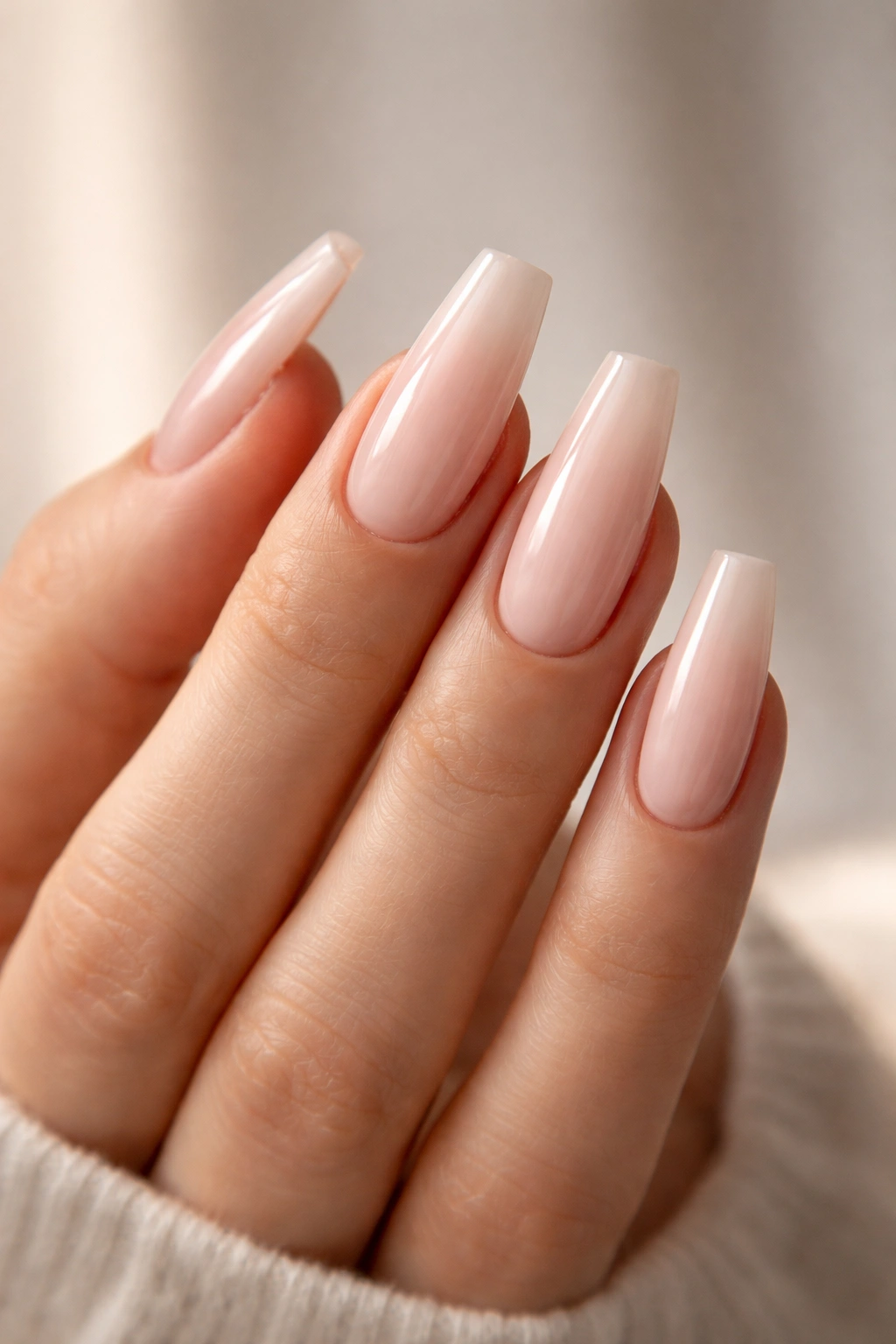
Ballerina nails sit in that sweet spot between soft and sharp. The sidewalls taper inward, like an almond nail, but the tip is filed flat. That flat edge changes everything. It gives French tips a cleaner landing zone, makes ombré fades look more stretched out, and gives swirls, chrome, and negative space room to breathe.
Clients often use coffin nails and ballerina nails as the same term. Most salons will know what you mean either way. Some techs use ballerina for a slightly softer taper and coffin for a more dramatic one, though plenty of artists don’t make a hard distinction.
Length matters more than people expect.
On a short ballerina shape, you need enough free edge to file that flat tip without the nail looking stubby. On a medium set, the shape starts to show its full personality. Long ballerina nails give the most space for art, but they also put more stress on the sidewalls, so structure and apex placement matter more if you type, lift boxes, or use your hands all day.
Three choices decide whether the set feels right:
- Length: short, medium, or long
- Taper: subtle, moderate, or sharp
- Finish: glossy, matte, chrome, velvet, jelly, or mixed textures
If you only choose the art and skip those three, your reference photo still leaves room for guesswork.
What to Bring to Your Nail Appointment
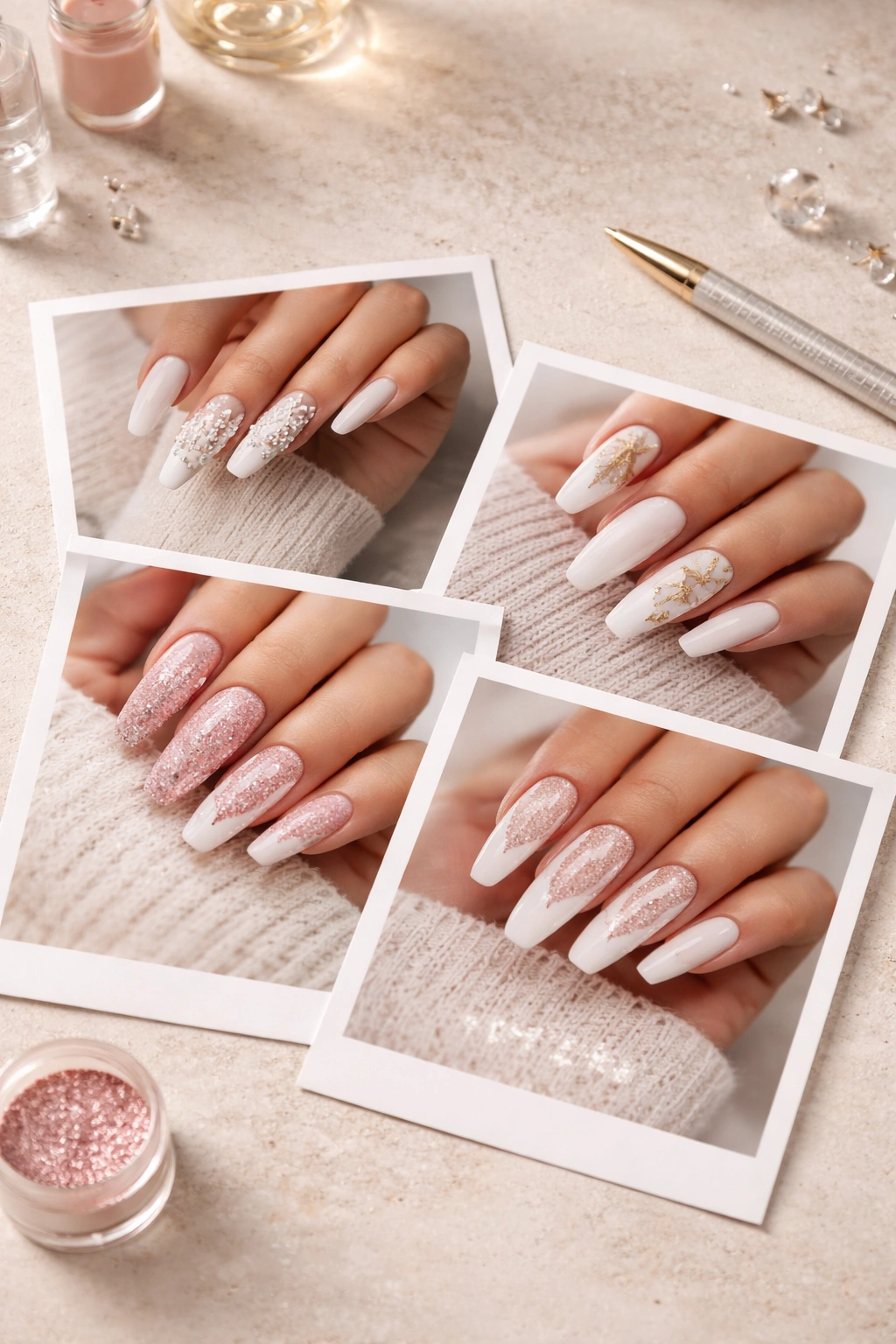
Bring 2 or 3 photos, not 18. More than that usually muddies the message. One image for shape, one for color, one for detail placement. That gives your nail tech enough to work from without forcing them to decode a collage of conflicting ideas.
Save photos that show the manicure from the front and from a slight side angle. The side view tells your tech how tapered the nail is, how thick the enhancement looks, and whether the apex is high, low, or softly built through the center.
A few details are worth saying out loud, even if you think the photo shows them:
- “I want this length, but with a softer taper.”
- “I like the base color here, but I want the finish glossy instead of matte.”
- “Keep the accent nails to two fingers per hand.”
- “Make the French line thin—about 1 millimeter.”
- “I want the nude base more sheer than opaque.”
Material matters too. Gel polish over natural nails gives you a different result than acrylic or hard gel extensions. If you want long ballerina nails with detailed art, extensions usually hold the shape better. If you want a shorter, cleaner set with minimal design, structured gel on your natural nails may be enough.
And please—this one saves time—tell your tech if you need the set to survive keyboard work, childcare, gym machines, or frequent hand washing. Pretty nails that don’t fit your day fall apart fast.
1. Milky Nude Ballerina Nails With Micro French Tips
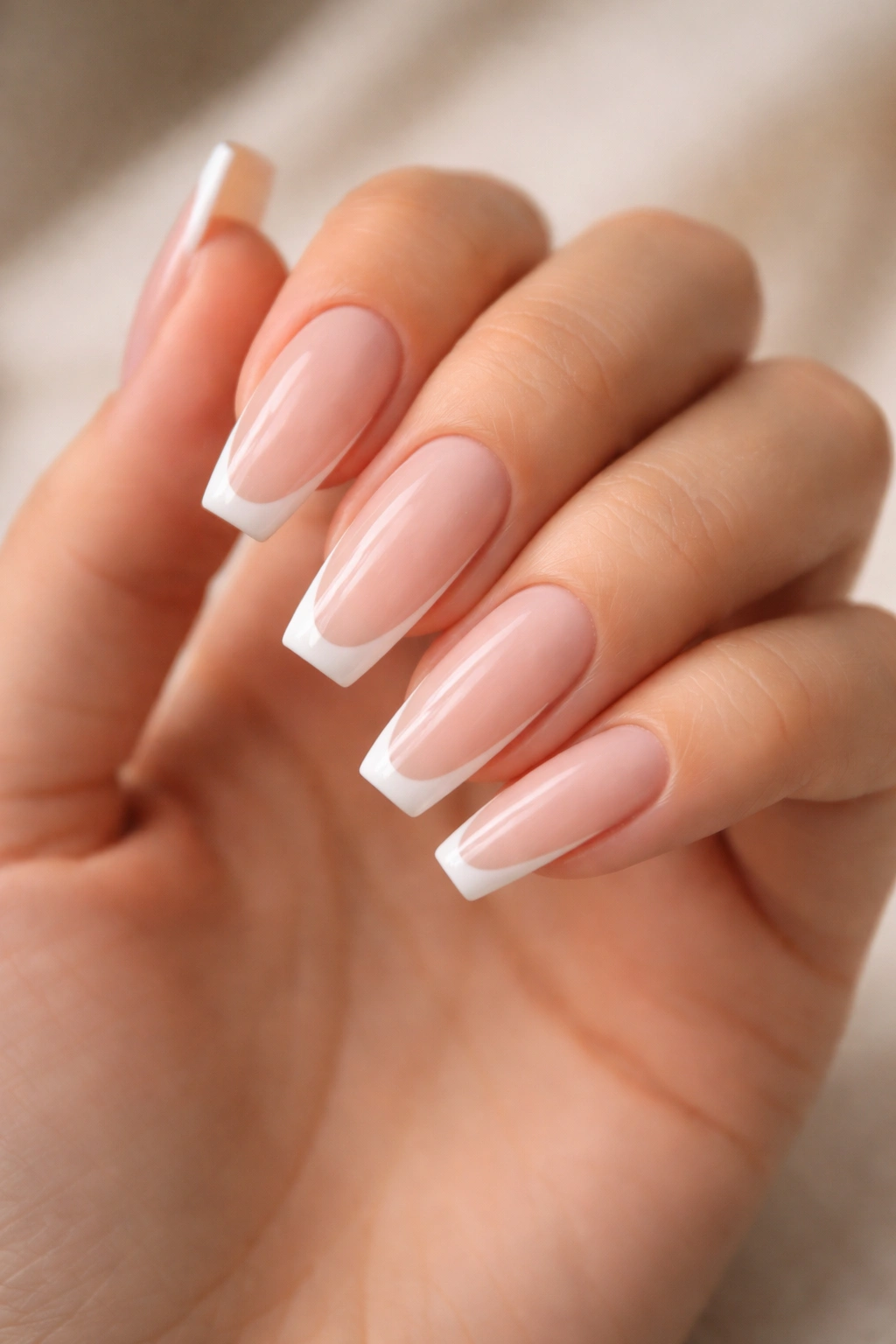
There’s a reason this design never feels tired: it fixes the biggest problem with classic French manicures, which is that thick white tips can swallow the whole nail. On a ballerina shape, a micro French line gives you edge definition while keeping the nude base front and center.
The base color matters more than the tip here. Ask for a milky nude or soft pink-beige builder base that smooths the nail plate but still lets a touch of natural tone show through. You want that “clean nail, only better” look rather than a fully painted-out beige.
Why the tiny tip works on this shape
A ballerina tip already gives the eye a straight edge to follow. That means your white line can stay thin—about 1 millimeter, sometimes less—and still read as a French manicure from arm’s length. On almond nails, the same line can disappear. On ballerina nails, it lands sharply.
Quick details to request
- Ask for a bright white gel paint rather than a sheer white polish if you want a crisp line.
- Keep the nude base one or two shades warmer than your skin tone, not an exact match, or the manicure can look flat.
- Medium length shows this design best, with 8 to 12 millimeters of free edge after shaping.
- A glossy top coat gives the cleanest finish.
Best note to tell your tech: keep the sidewalls straight and the French line thin enough that the white reads like a frame, not a block.
2. Baby Pink Ombre Fade
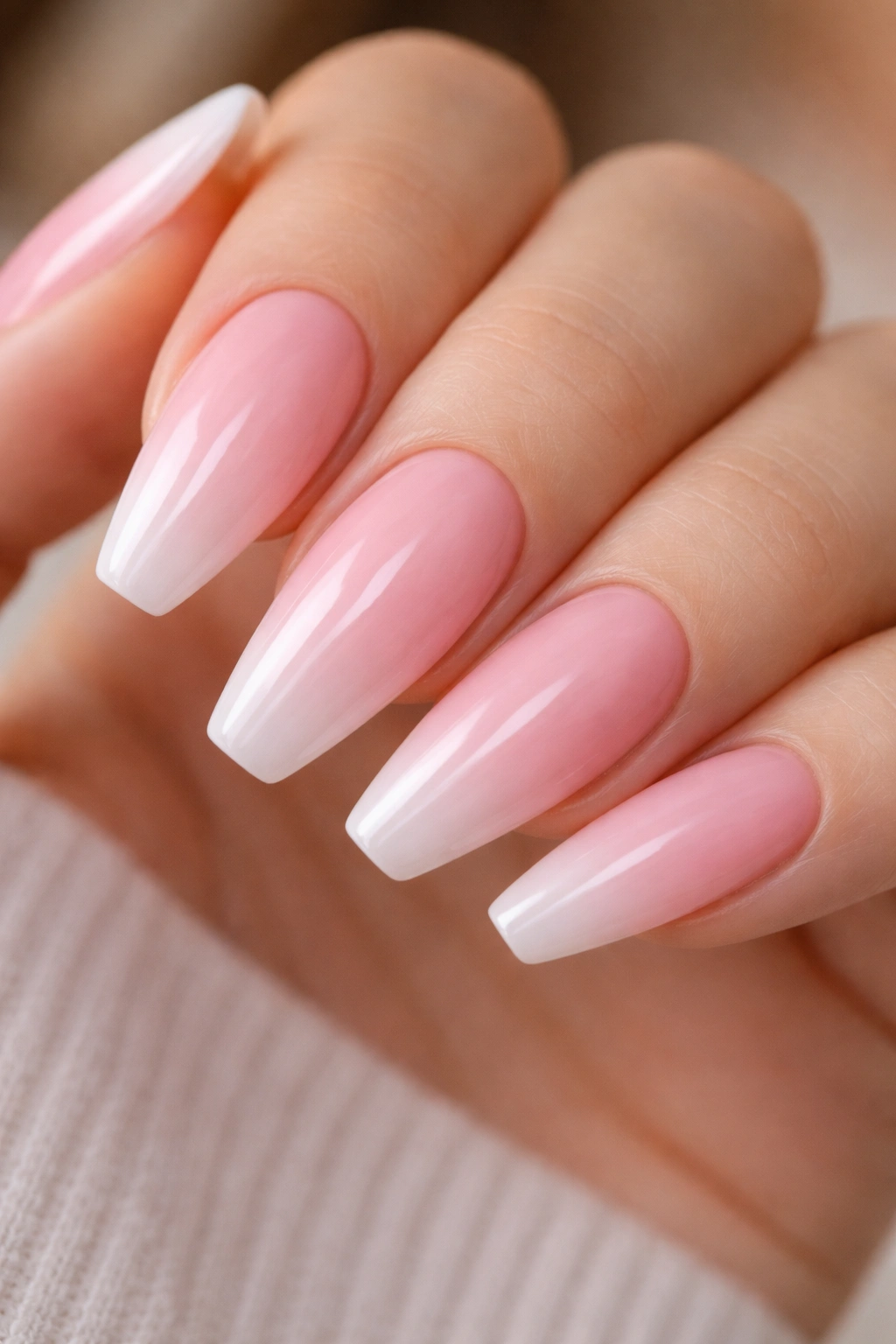
If you want something soft but not plain, this is the set I’d pull up first. A baby pink ombré on ballerina nails has more body than a nude set and more polish than a solid color manicure. It gives the nail a diffused look, almost airbrushed, with the strongest color near the tip and a sheer blend through the body of the nail.
The trick is restraint. You do not want a harsh two-tone blend where pink stops and nude starts. Ask for a sponge or airbrush fade that begins around the middle of the nail and deepens toward the flat tip. On medium or long ballerina nails, that gradient looks stretched and elegant in the best way.
Gloss makes this one sing. Matte can flatten the fade and make the pink look chalky, especially if the color has a cool undertone. A high-shine top coat keeps the color looking creamy instead of powdery.
One more thing. Pick a pink with a little warmth if your skin leans golden or olive. Cooler baby pink can still work, but it reads more candy-like. Warm pinks look smoother and more grown-up on this shape.
3. Matte Taupe With Glossy Black Swirls
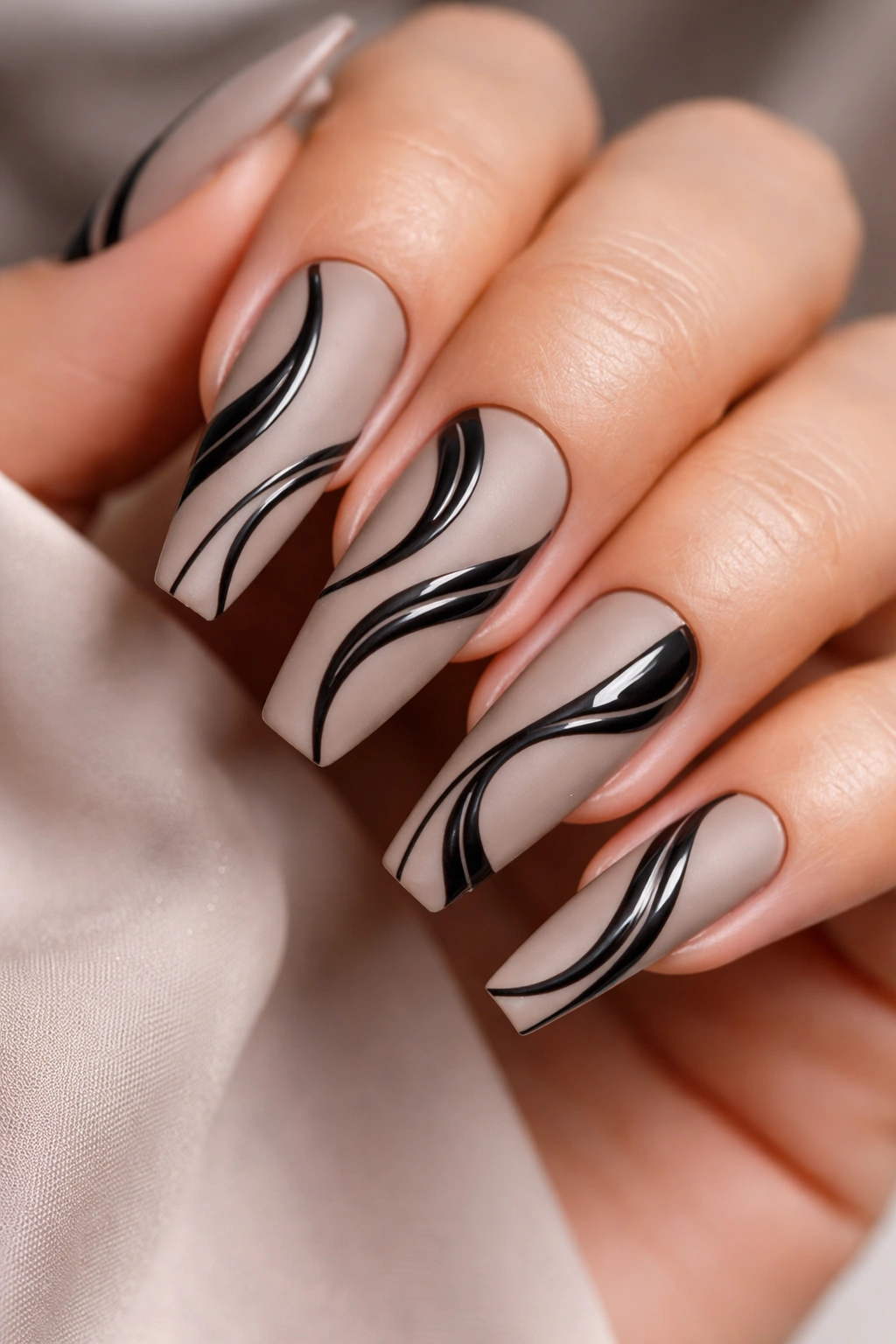
Why does this combo look so expensive on the hand? Because it plays with contrast in two different ways at once: color contrast and finish contrast. Taupe gives the nail a quiet, neutral base. Glossy black line work on top catches the eye because the shine shifts under light while the background stays velvety.
Matte surfaces can show dents, lint, and cuticle oil marks if the prep is sloppy, so the base has to be smooth. No bumps. No bulk. This is one of those sets where structure shows.
Swirls suit ballerina nails because the taper narrows the canvas as the lines move upward. A good artist will start the curve lower on one sidewall, let it travel diagonally, then pull it thin near the tip. That shape keeps the design from feeling heavy.
How to keep it sharp
Ask for two or three swirls per nail, not a dense web of lines. The taupe should still read as the main color when you glance at your hand. If every inch is covered in black, the matte base stops mattering.
This design also handles grow-out well. A rubber base or builder base close to your natural nail color keeps the gap near the cuticle from looking harsh during the second and third week.
4. Deep Burgundy With a Thin Gold Cuticle Line
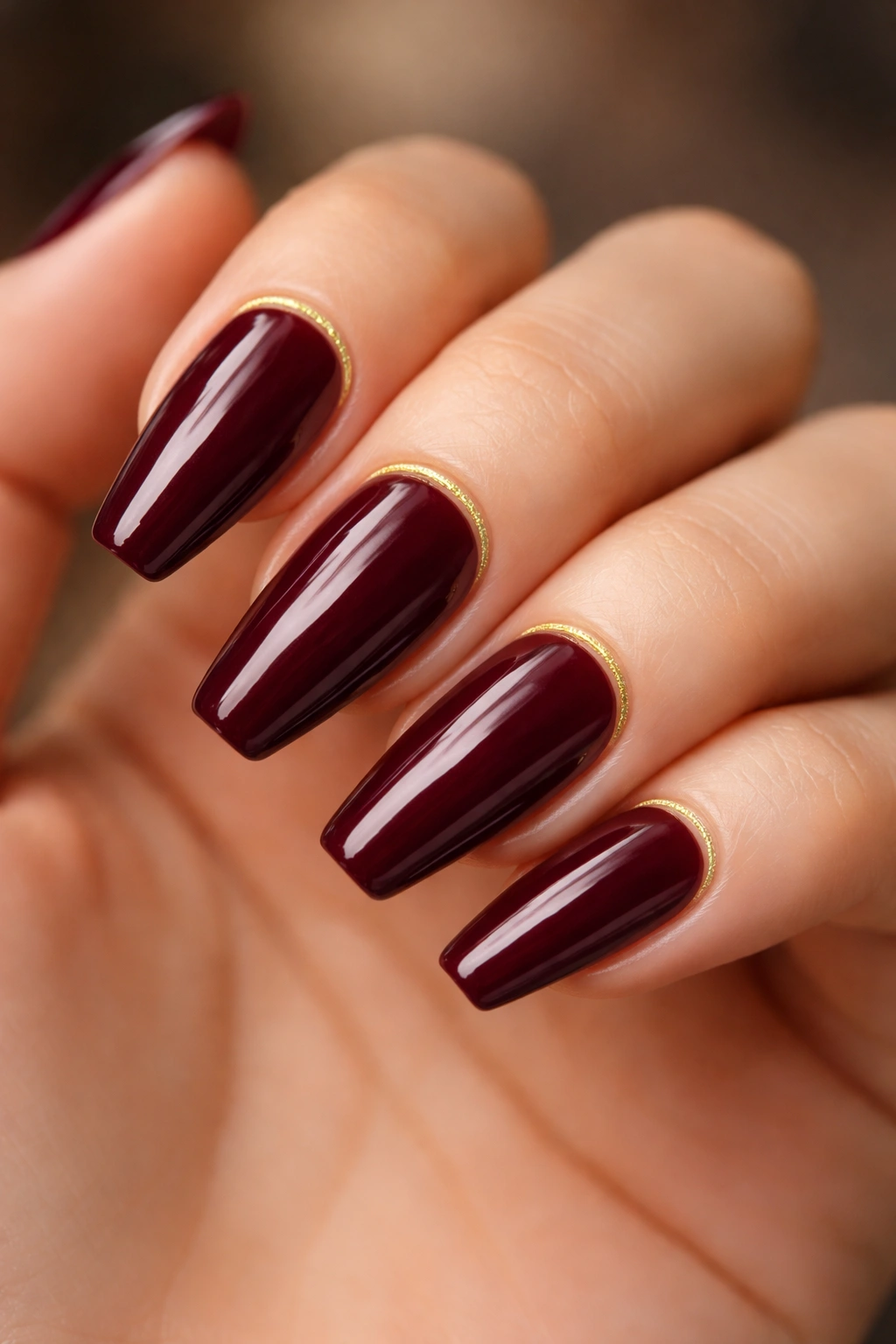
Picture a glass of red wine, a slim gold ring, and low light hitting the top of your hand. That’s the mood here. Deep burgundy ballerina nails already carry weight because the color is rich and dense. A thin gold line tracing the cuticle turns that solid manicure into something more deliberate.
The gold should stay fine. Think striping gel or metallic liner, not chunky foil packed around the entire cuticle. A line that’s roughly 0.5 to 1 millimeter wide is enough. Wider than that, and the base color starts fighting the accent.
A few details make this set work:
- Use a blue-red burgundy if you want a cooler, dressier look.
- Use a brown-red wine shade if you want something warmer and softer.
- Keep the gold accent on all nails for a formal look, or on ring fingers and thumbs only if you want less fuss.
- Gloss is the move here. Matte kills the depth of the burgundy.
And no, the gold line does not need rhinestones next to it. Leave it clean. The appeal is in the precision.
5. Sheer Nude With Soft White Chrome
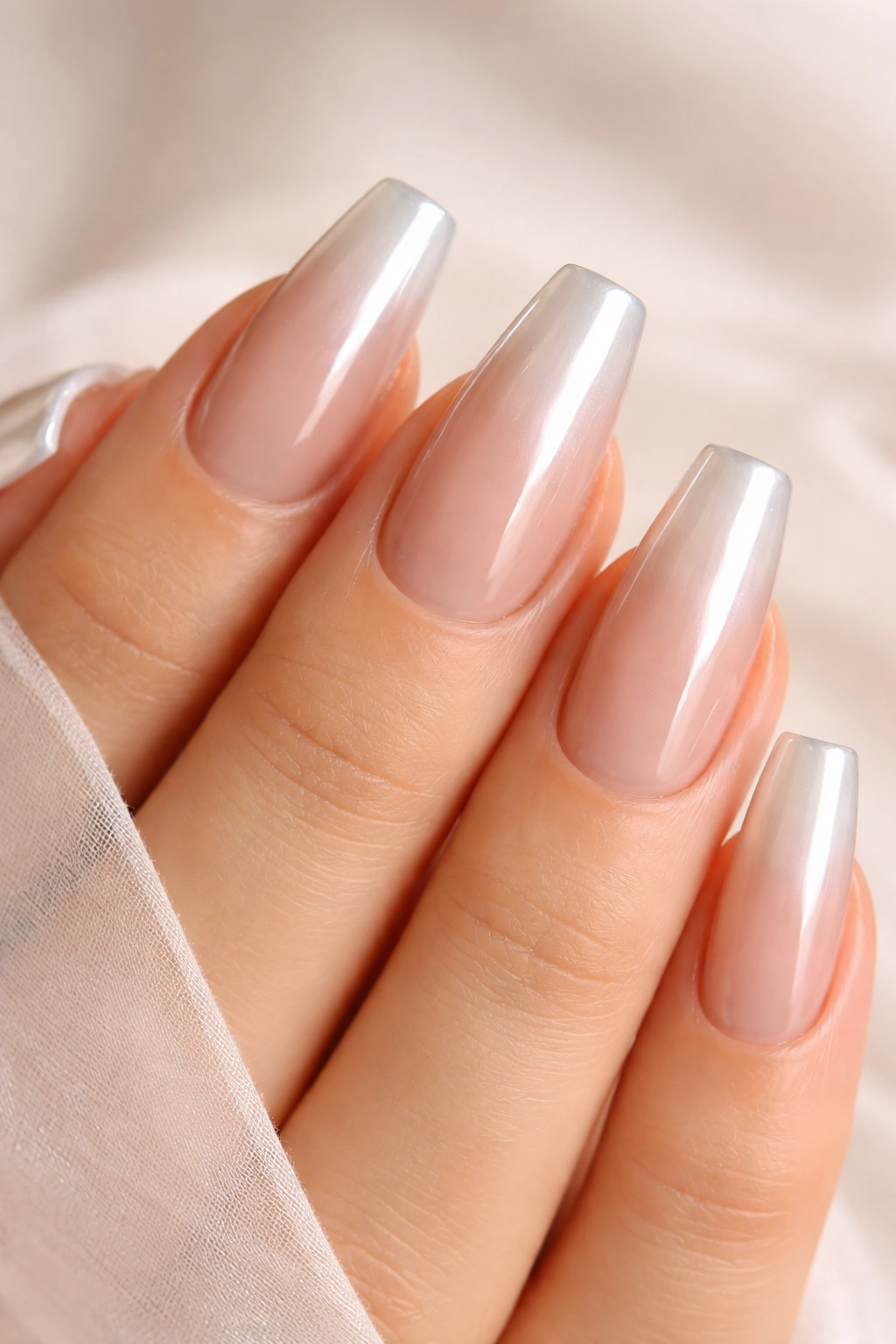
Chrome can go wrong fast. Too much powder, too bright a base, or the wrong top coat, and the nails start looking mirror-like in a way that overpowers the shape. Soft white chrome over a sheer nude base avoids that problem. You get a pearly, glazed surface that shifts from cream to silver depending on the light.
This set suits ballerina nails because the flat tip gives the chrome a broad plane to reflect from. On a tapered point, pearl chrome can look icy. On a ballerina shape, it reads smoother.
Ask for a translucent pink-nude or milky beige base, then a fine pearl chrome rubbed over a no-wipe top coat. Nail techs often have several chrome powders; the one you want is the soft white or opal one, not the bright silver metal finish. If they swipe a sample stick and it looks like polished steel, wrong powder.
Shorter lengths can wear this well, which is useful if you like a clean manicure but still want some effect. The shine does most of the work. No extra gems needed. No line art required. The nail itself becomes the detail, and on days when you want your hands to look polished with almost no visible art, that’s hard to beat.
6. Espresso Tortoiseshell Accent Set
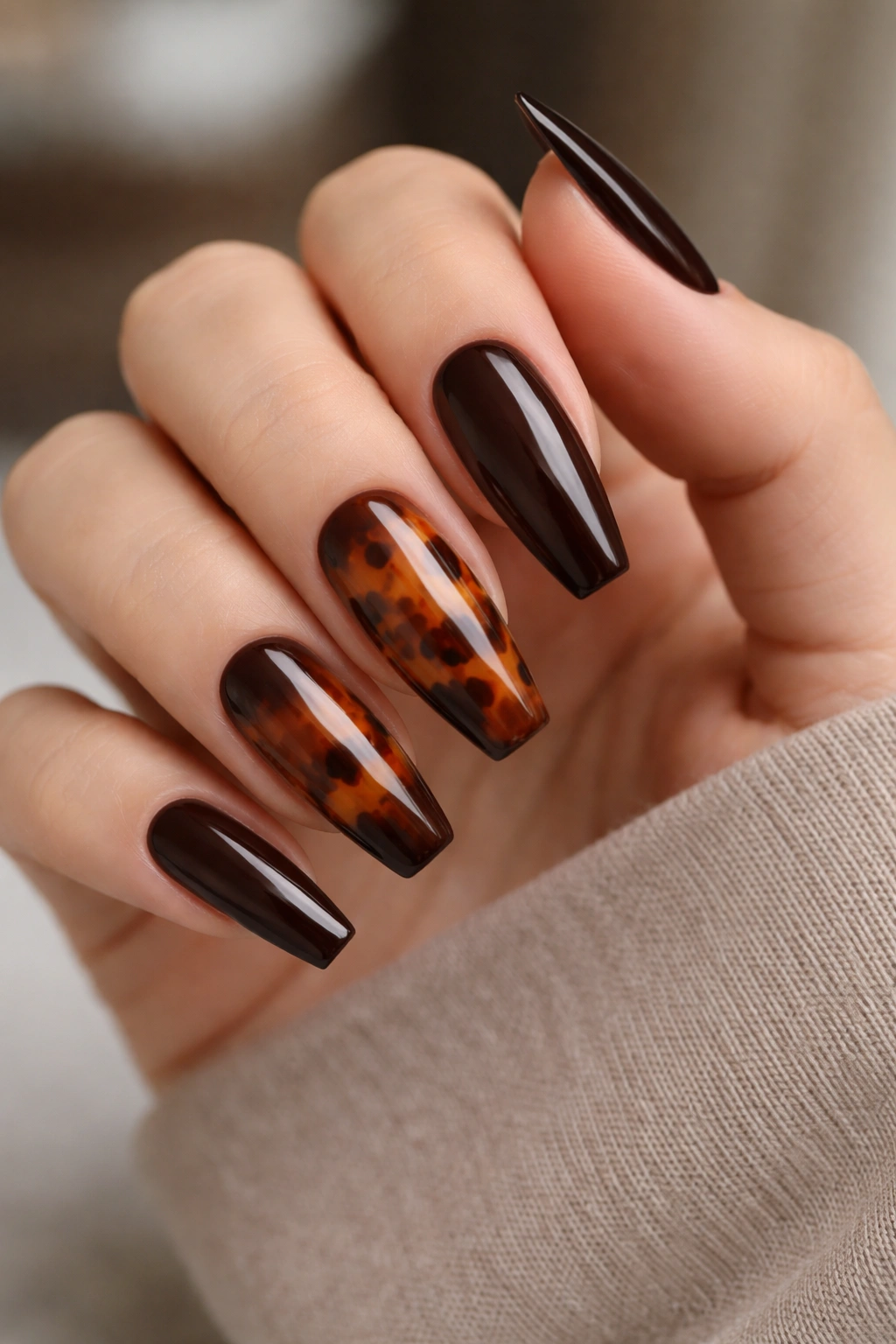
Unlike a full leopard or zebra manicure, tortoiseshell has depth. It looks layered because it usually is layered: amber jelly, brown patches, a touch of black, then top coat to seal the whole thing. On ballerina nails, that layered look sits well on accent nails while solid espresso shades anchor the rest of the set.
This is a strong pick if you like dark nails but don’t want one flat color on all ten fingers. Tortoiseshell gives movement. Espresso keeps the whole manicure grounded.
Who should ask for it? Anyone who wears gold jewelry often, leans toward brown, caramel, camel, black, or cream clothing, and wants nail art that still feels grown-up. It also hides tiny wear marks better than a solid black manicure, which is a practical bonus.
A smart layout looks like this:
- Index and pinky: solid espresso
- Middle and ring: tortoiseshell
- Thumb: either tortoiseshell or solid, depending on how much pattern you want
Medium length is enough. Longer nails can handle bigger tortoiseshell spots, but the design still reads well on a moderate set if the color layering is done right.
7. Clear Tips With Encapsulated Dried Flowers
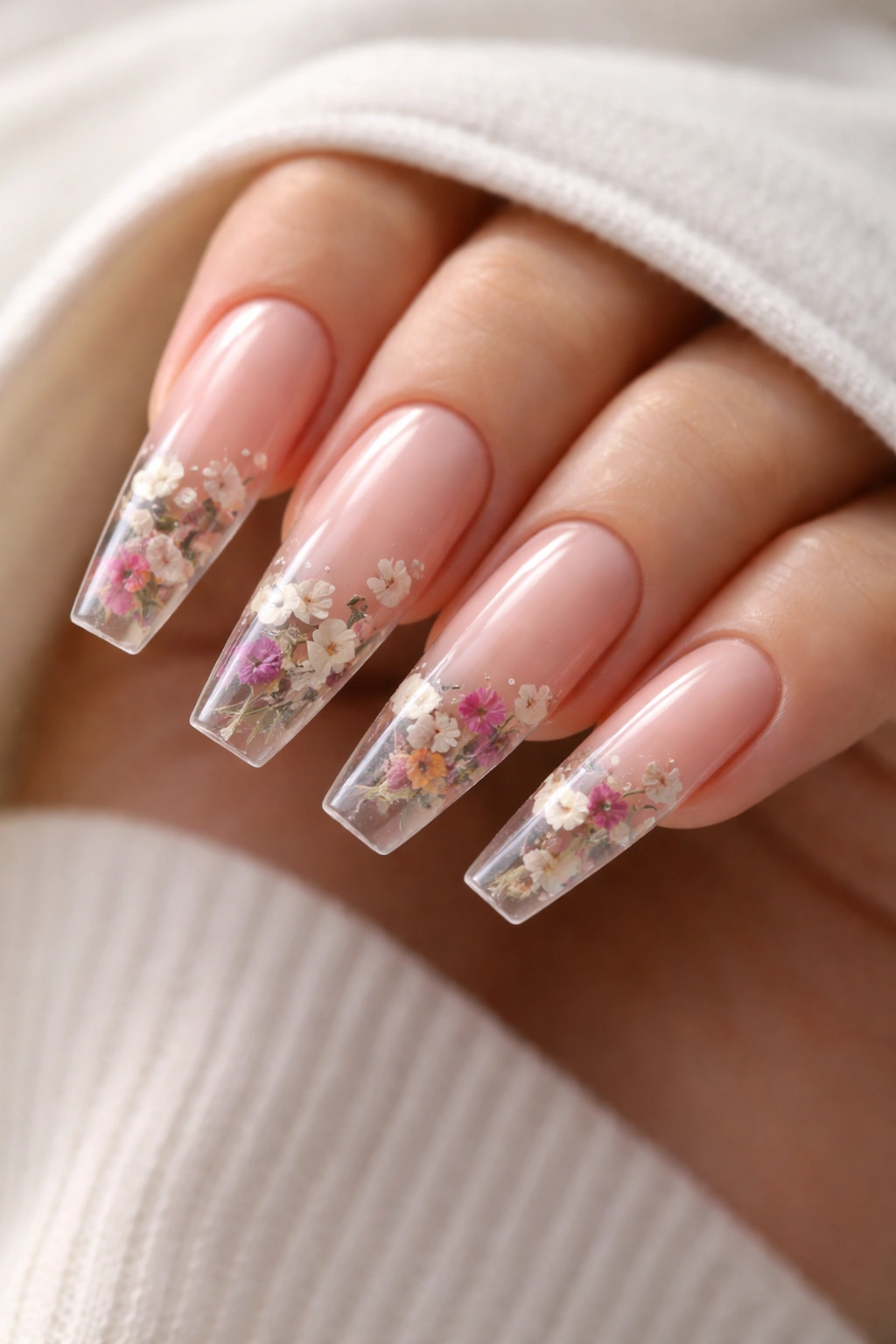
This one takes more skill than it looks like it should. Encapsulated flower nails need clean placement, thin layers, and flowers small enough to sit flat under the gel or acrylic. Done well, they look like the petals are floating inside the nail rather than stuck on top.
Ballerina nails give dried flowers a neat frame. The flat tip keeps the design from drifting into a fairy-costume vibe, which can happen on extra-long stilettos. The shape keeps it structured.
What makes the set look polished
Choose one flower family and one accent color. Tiny white daisies with yellow centers. Soft pink petals with a clear base. Blue forget-me-not style flowers with a sheer nude bed. Mixing five flower types on one set can get messy.
Details worth deciding before the appointment
- Clear full tips create the crispest glassy look.
- Short petals sit flatter than full pressed blooms.
- A jelly nude or sheer pink base on 4 nails keeps the flower nails from taking over the set.
- Gloss top coat is non-negotiable here.
Tell your tech this: you want the flowers sealed smoothly, with no raised edges you can feel when you run a fingertip over the nail.
8. Short Ballerina Nails With Peachy Side French
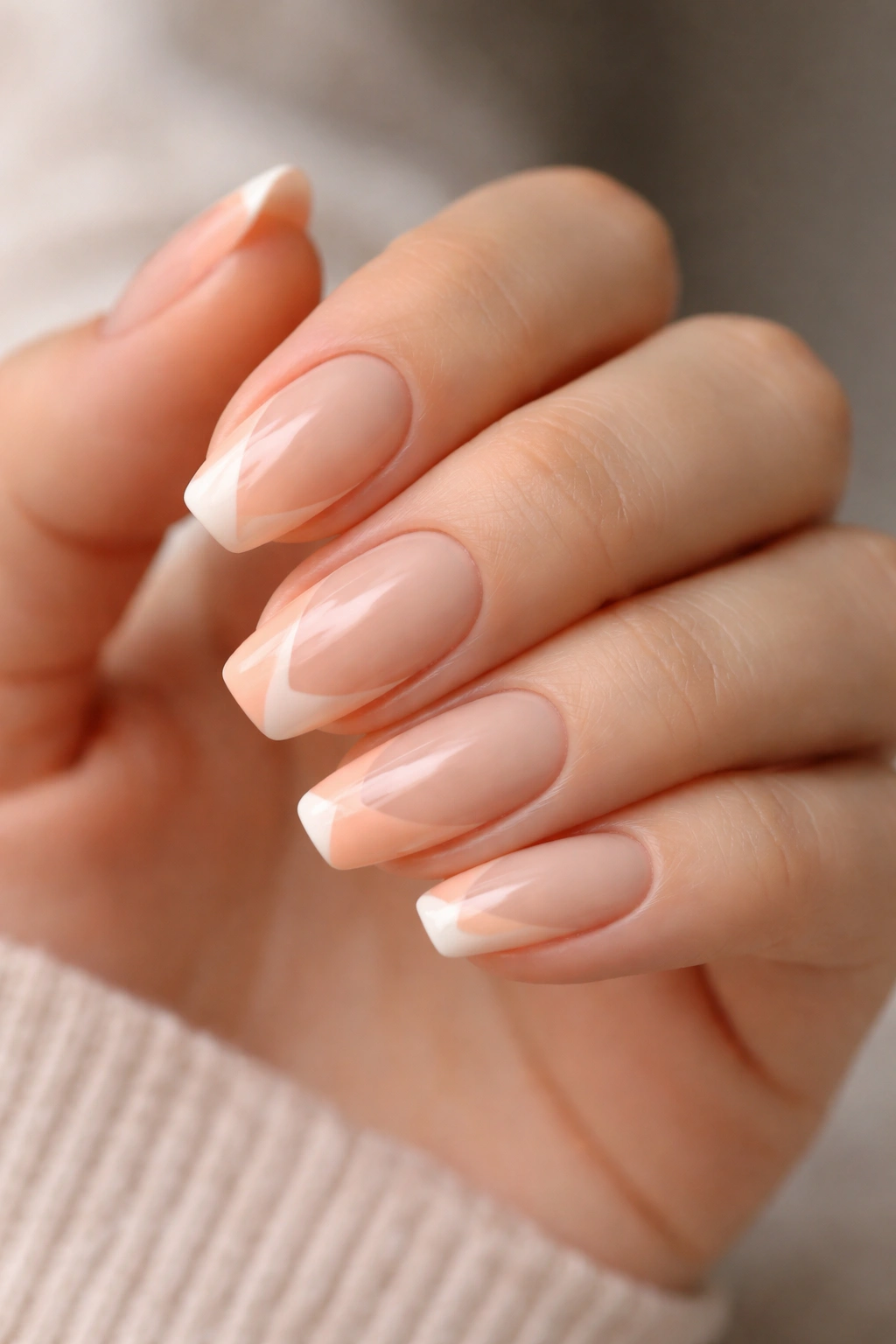
Short ballerina nails are harder to pull off than medium ones. File too much at the sides and the nail looks pinched. Leave them too wide, and they read square. That’s why a side French design works so well on a shorter shape: it pulls the eye diagonally and makes the nail look longer.
Instead of painting a curved tip straight across the free edge, your tech creates an angled French from one sidewall toward the center or opposite corner. Peachy nude is a smart base here because it warms the hand and keeps the design soft.
You can take this in two directions. Use a white side French for a clean, crisp look. Use a deeper caramel or tan line for a tonal manicure that feels subtler. Both look good. White is sharper. Tonal is easier to wear day after day if you don’t like high contrast.
Keep the length modest—3 to 6 millimeters past the fingertip is enough. On a short set, the clever part is the line placement, not extra nail length. That’s the whole point.
9. Jet Black With a Single Crystal Moon Accent
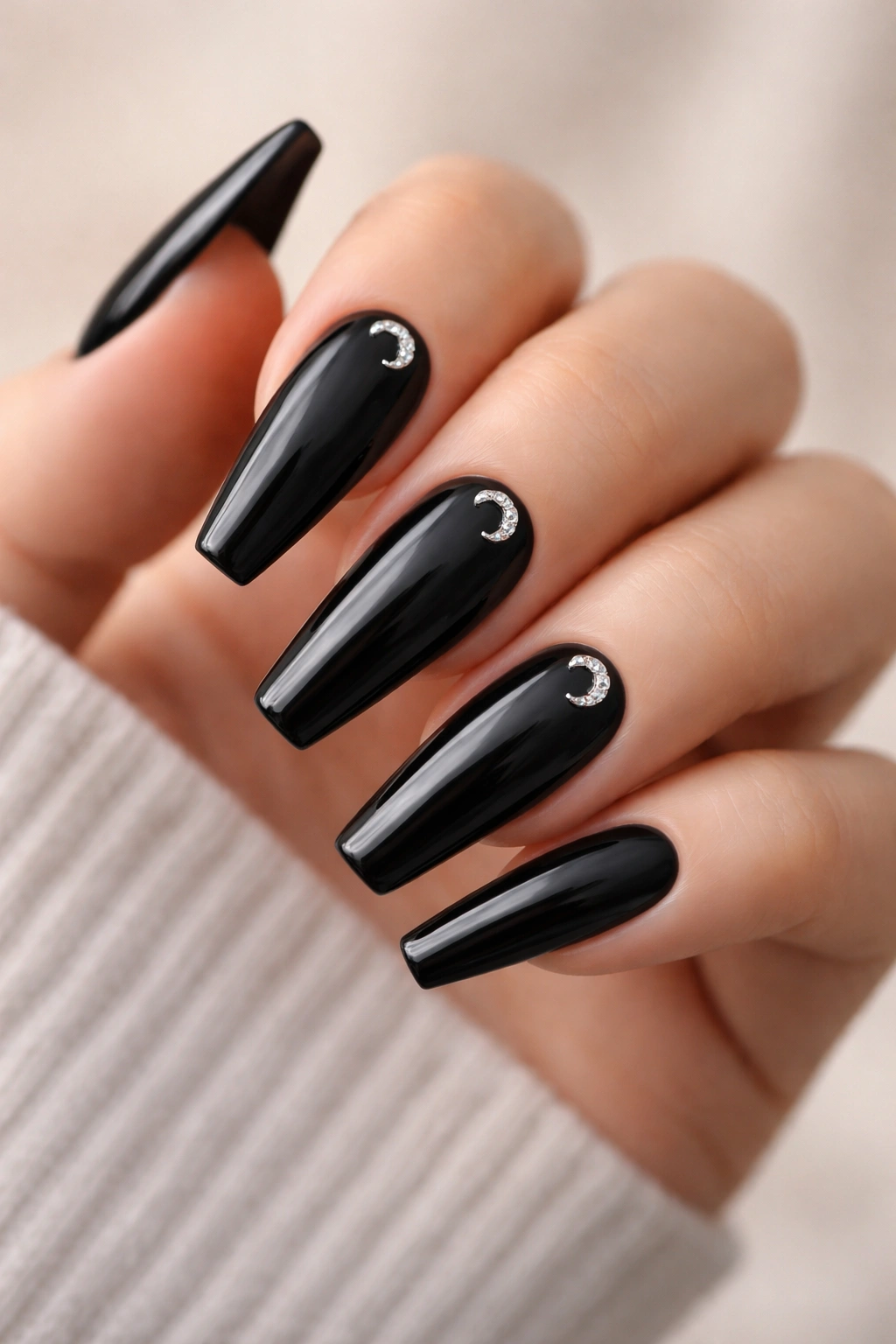
Black nails don’t need much help. They already bring drama, structure, and edge. A single crystal moon detail near the cuticle gives that dark base one point of light, which is all it needs.
Could you add crystals to every nail? You could. I wouldn’t. Black ballerina nails look strongest when the surface stays sleek and uninterrupted across most of the hand. One crescent on each ring finger—or ring fingers and thumbs if you want symmetry—keeps the design controlled.
Why the restraint matters
A ballerina shape has straight visual lines. Scatter rhinestones across it, and the clean geometry starts to break up. Keep the crystals close to the cuticle in a half-moon arc, and the shape still reads first.
How to ask for it
Request small SS3 or SS5 crystals rather than large stones. Tiny stones hug the curve of the cuticle better and snag less. Pair them with a deep black gel, not a washed-out charcoal, and ask for extra top-coat smoothing around the edges if the stones are framed rather than fully encapsulated.
This is one of the few sets that can look dressy and a little severe at the same time. That tension is why it works.
10. Sage Green With Hand-Painted White Daisies
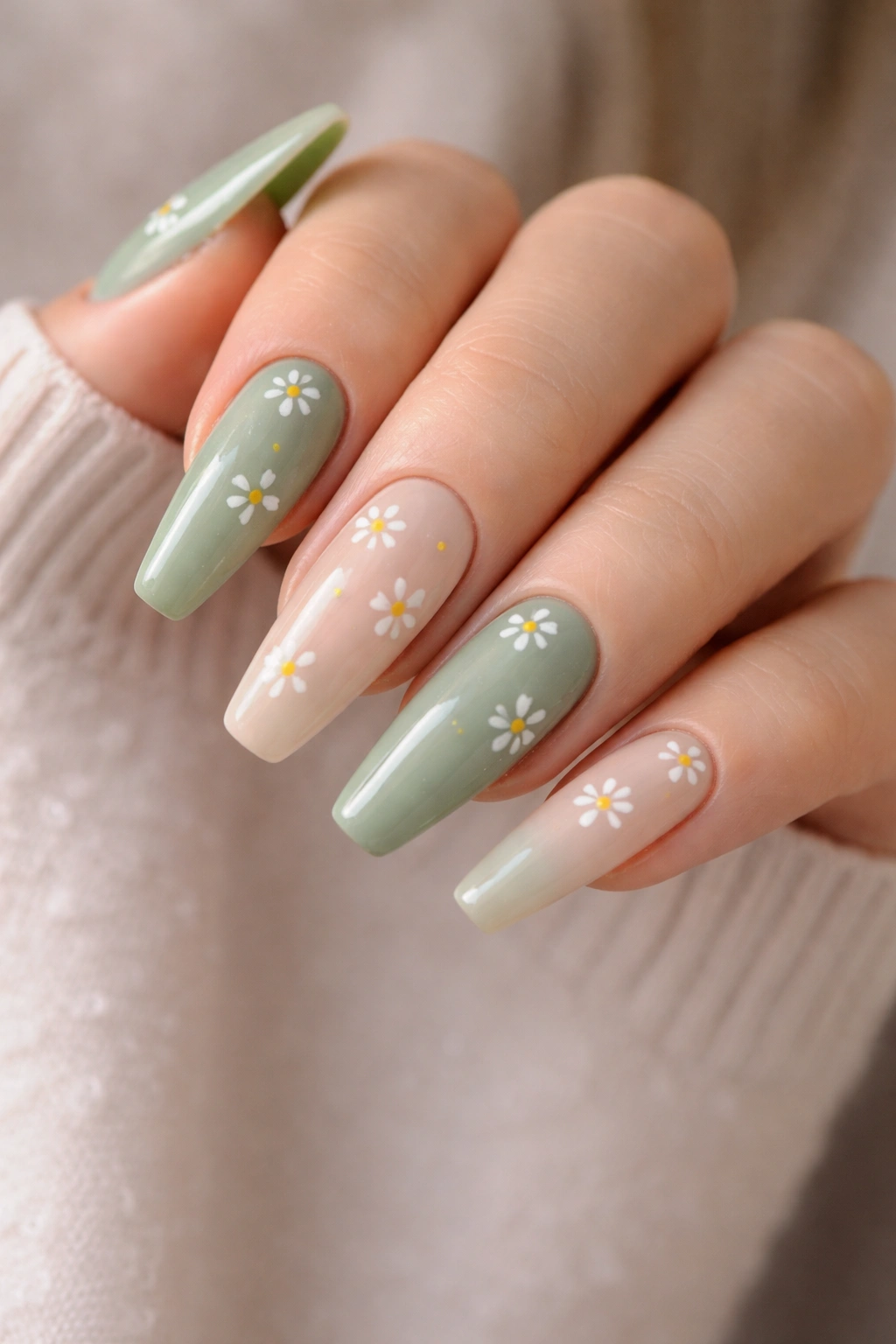
I like this set most when it avoids the cartoon route. Sage green already has a muted, earthy tone, so the daisies should stay small, spaced out, and hand-painted with a steady brush. Big chunky petals on every nail can make the whole thing feel juvenile fast.
A good version uses sage on most nails, then switches one or two to a sheer nude or milky base for the floral art. That lets the daisies pop and keeps the green from feeling too dense across the hand.
Key details that keep it clean:
- Use five-petal daisies no wider than the nail bed on short or medium lengths.
- Tiny yellow centers read better than oversized dots.
- A fine liner brush makes crisper petals than dotting-tool blobs.
- Place flowers off-center on some nails. Uniform placement can look stiff.
This design loves spring colors, sure, but it doesn’t need to be tied to a calendar. Sage works year-round because it behaves more like a neutral than a loud pastel. And if you wear gold jewelry, that muted green has a habit of making rings look richer.
11. Jelly Pink Aura Nails
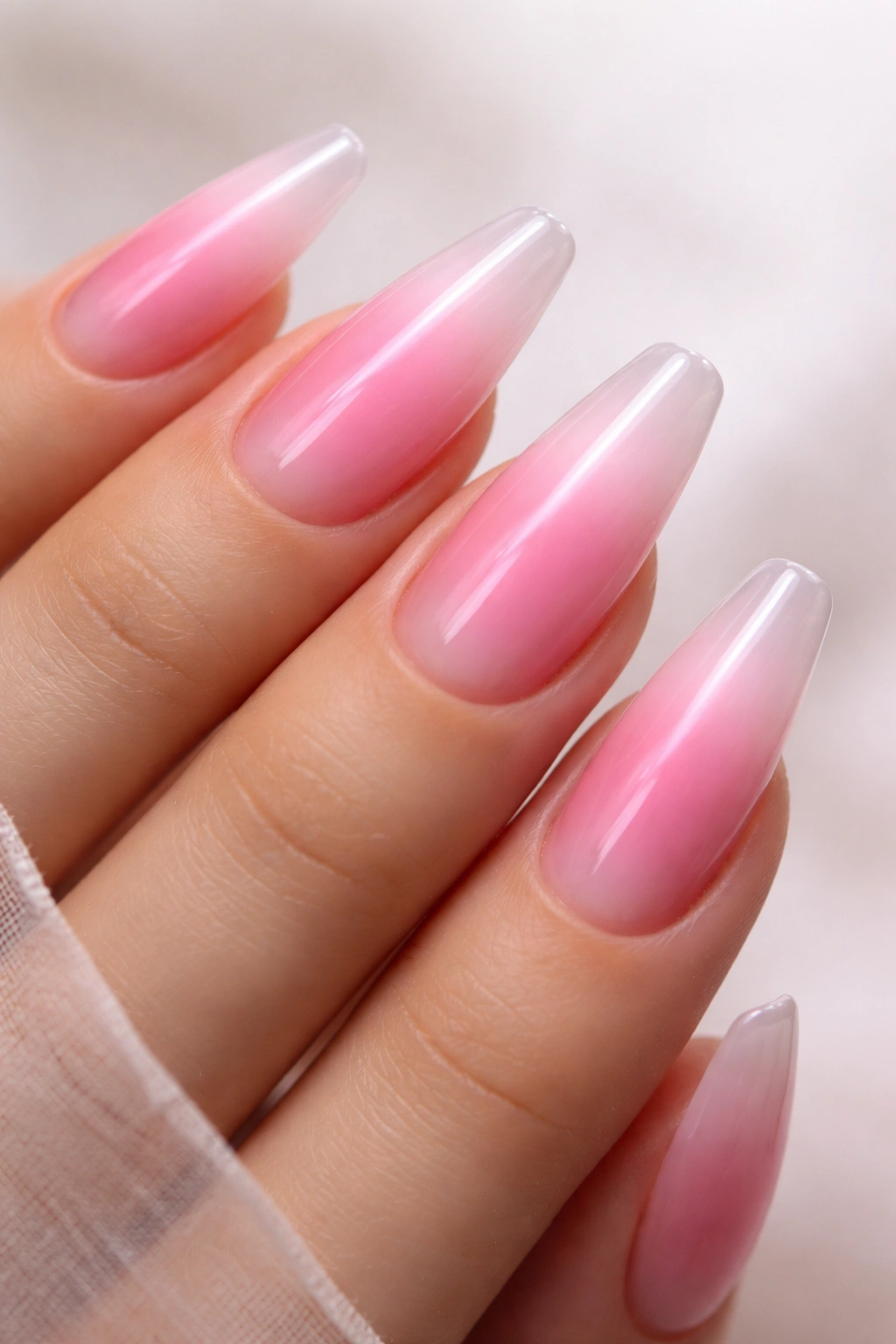
Aura nails can look muddy when the color blend is too harsh or the center blush is placed too low. On a ballerina shape, the strongest version puts the soft pink glow in the middle third of the nail, then fades it outward into a sheer jelly base. That placement keeps the nail looking airy rather than bruised.
The finish matters. Aura designs look best with a glossy top coat because the shine helps blur the transition between the center color and the clear or sheer edge. Matte steals some of that soft-focus effect.
You also need the right pink. Neon center blush on a jelly nude base gives a clubby look. A rose, candy pink, or warm blush center feels cleaner and easier to wear. That choice alone changes the whole manicure.
Longer ballerina nails show the effect best, though medium still works if the artist keeps the airbrushed center small. Ask for the color cloud to stay inside the sidewalls rather than stretching from edge to edge. More negative space around the glow makes the design look lighter—and, honestly, smarter.
12. Mocha Brown With Croc Texture
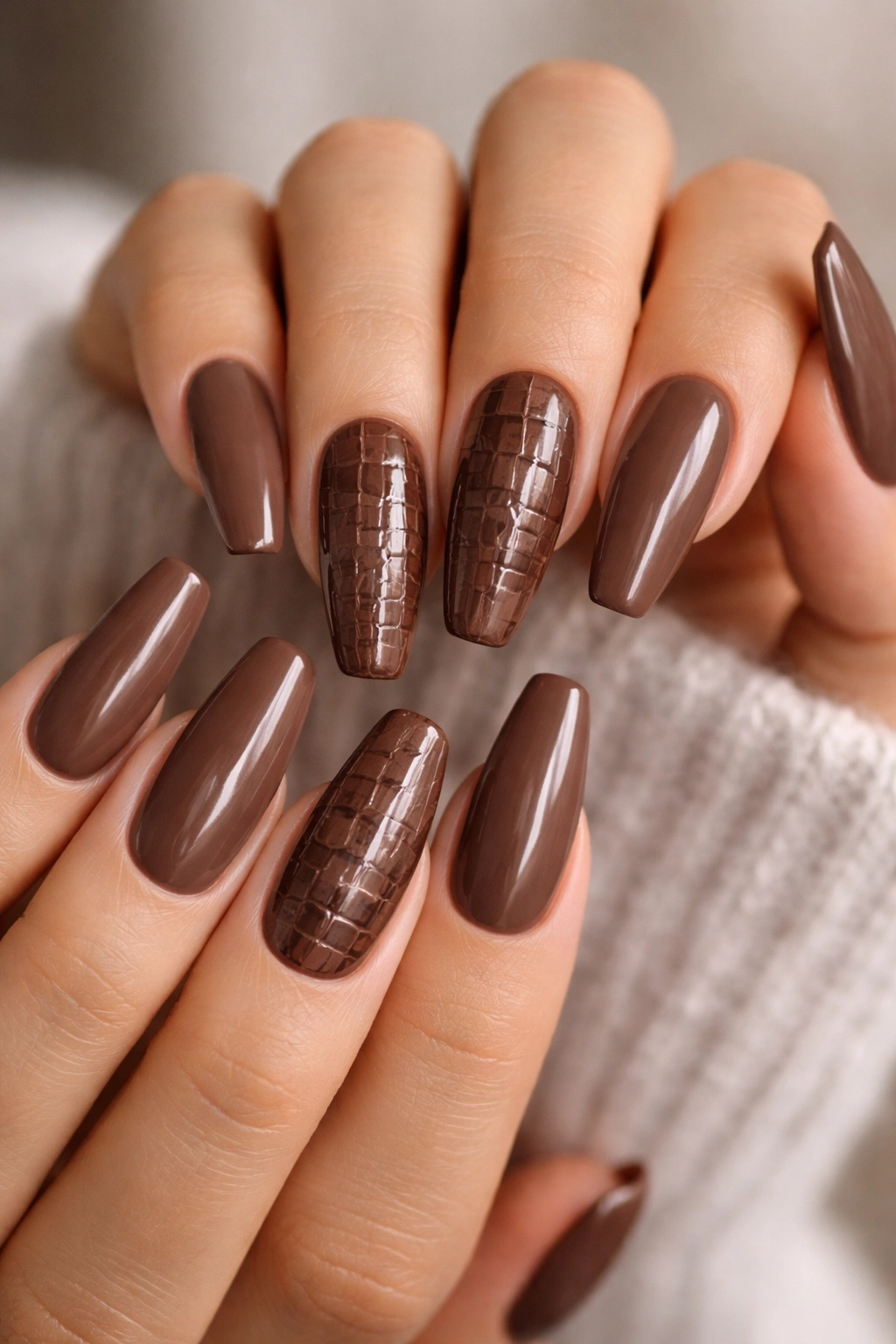
Unlike a flat brown manicure, croc texture gives the surface movement. It turns a simple mocha base into something tactile-looking, almost like leather goods translated onto nails. On ballerina nails, that pattern feels neat because the tapered shape keeps the print elongated.
You want the texture on accent nails, not all ten. One or two croc nails per hand is enough unless you love a heavy-pattern set. Solid mocha on the remaining nails keeps the manicure from tipping into costume territory.
Who is this good for? Anyone who likes neutrals but finds plain taupe or nude a little sleepy. Croc print keeps you in the brown family while adding edge.
A few smart requests make a difference:
- Choose a mid-tone or dark mocha. Pale beige croc texture tends to lose definition.
- Ask for the croc effect in gloss over a matte or creamy base, or all gloss if you want more shine.
- Medium to long ballerina lengths show the pattern best because the cells of the print need room.
And yes, this set looks better with clean shaping than with extra rhinestones. Texture already gives the eye enough to look at.
13. Nude Base With Diagonal Silver Cat-Eye
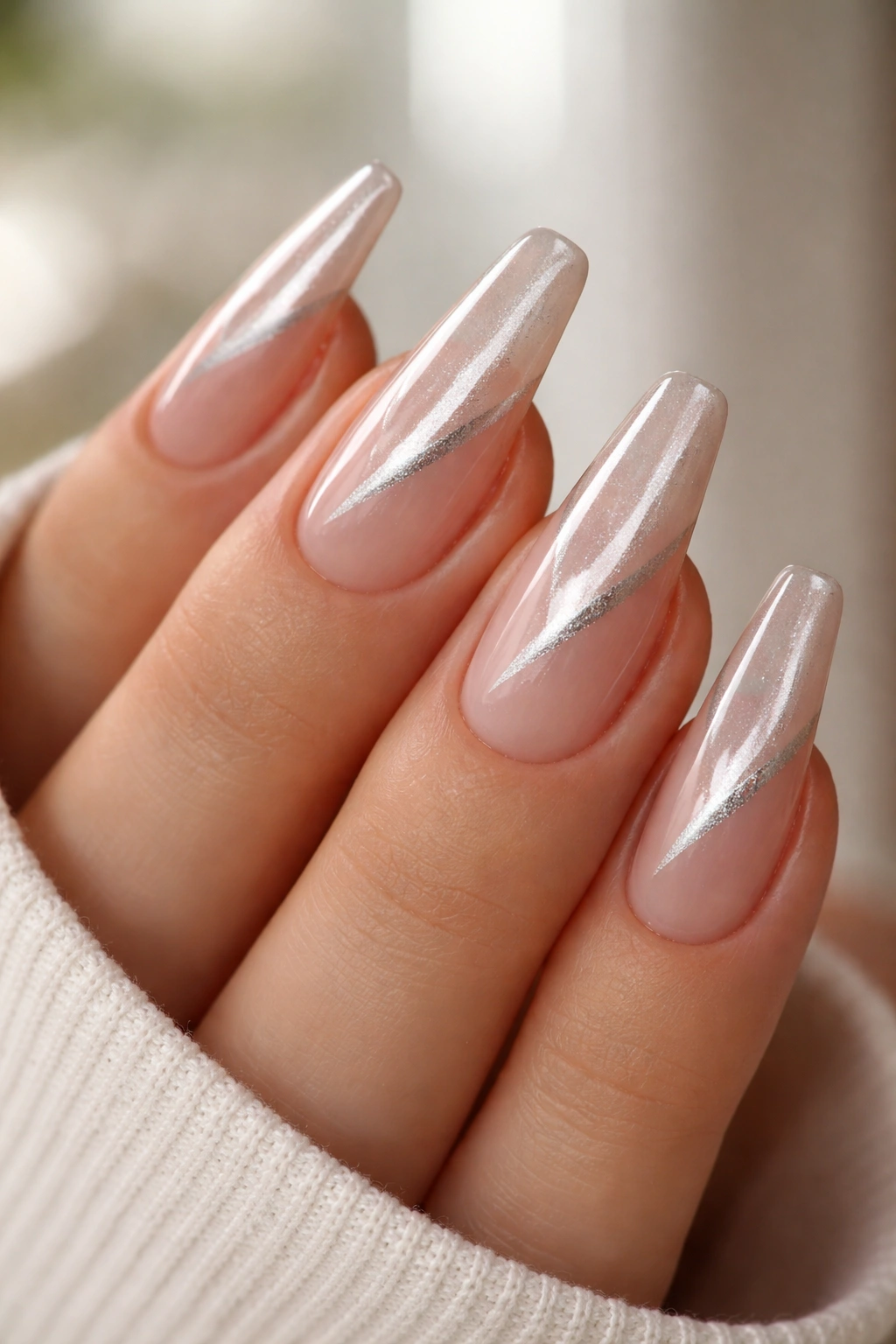
Cat-eye gel has range. It can lean spacey, smoky, or sleek depending on how the magnet pulls the shimmer. A diagonal silver cat-eye stripe over a nude base lands in the sleek camp, which makes it a strong match for ballerina nails.
Instead of coating the whole nail in magnetic polish, your tech can paint a diagonal band—usually from one lower sidewall toward the opposite upper corner—then use the magnet to pull the shimmer into a bright, narrow lane. The nude around it keeps the design airy.
Why this version looks sharper than full cat-eye polish
A full cat-eye nail can swallow shorter lengths. The diagonal stripe keeps the effect controlled and also makes the nail look longer because your eye follows that angled light line across the taper.
Quick request list
- Ask for a cool silver magnetic gel over a sheer beige or pink nude.
- Keep the stripe off-center, not planted straight down the middle.
- Gloss top coat keeps the magnetic line crisp.
- One accent nail in full cat-eye can work if you want a touch more drama.
Best on: medium ballerina nails with clean sidewalls and a moderate taper.
14. Classic Red With Half-Moon Negative Space
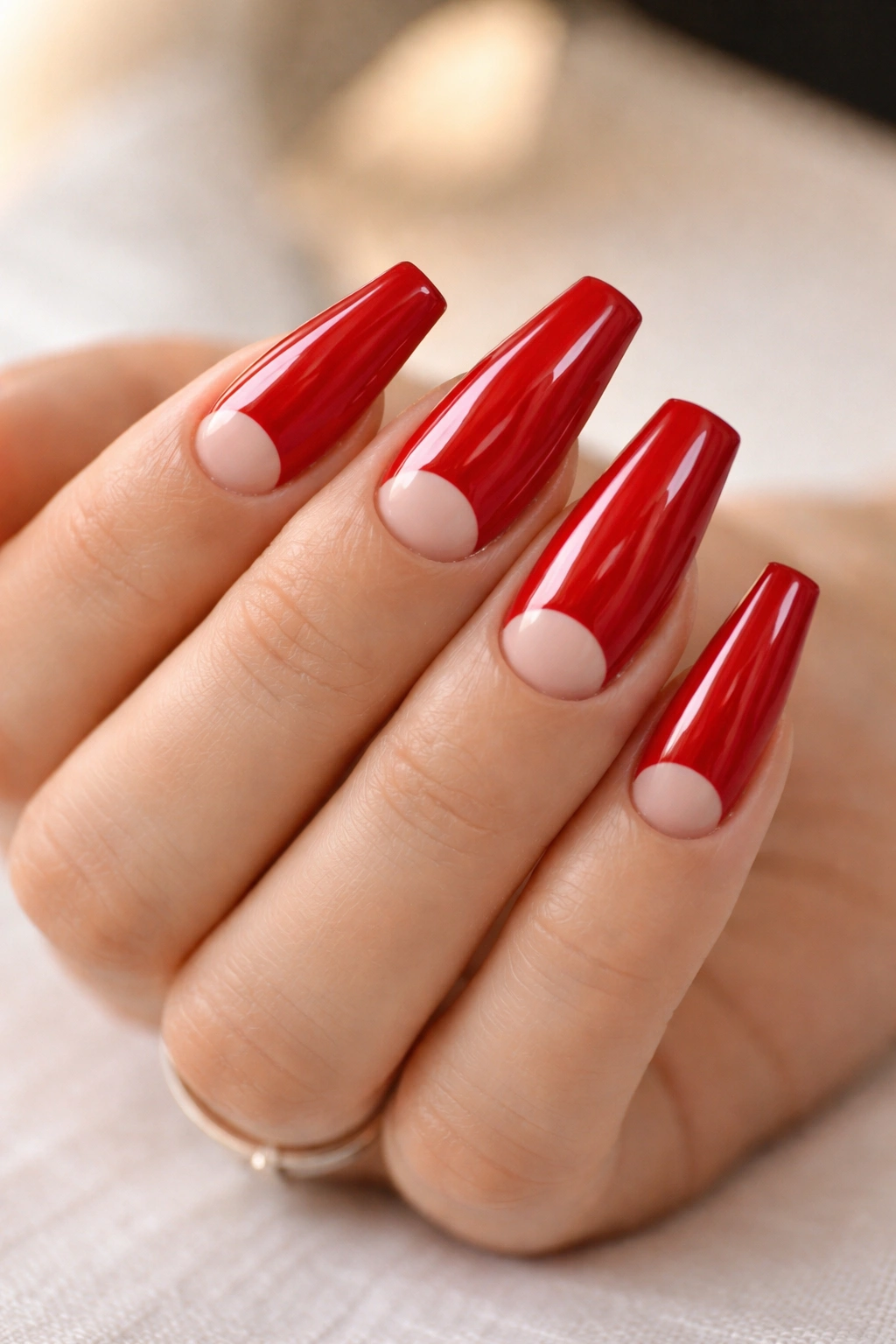
Red manicure fans tend to fall into two camps: full red all over, or red French tips. The half-moon negative space version gives you something smarter than both. Your tech leaves a curved bare or sheer nude half-moon near the cuticle, then paints the rest in a dense red.
That little gap does two useful things. It makes grow-out look less harsh, and it gives the red a tailored feel. Solid red can read bold and timeless, which is great. Red with a half-moon cutout looks more edited.
Keep the red opaque. Jelly red defeats the point here. You want a lacquered, old-school richness against the clean curve at the base. Blue-red shades feel crisp. Tomato reds feel lighter and more casual. Deep cherry sits somewhere in between.
The half-moon needs precision, though. If the curve is wobbly, you’ll notice every time you look at your hands. This is a set for a nail tech with a steady brush or a good stencil habit. When the arcs are clean and the ballerina shape is symmetrical, the manicure feels crisp from every angle.
15. Lilac Pearl Glaze
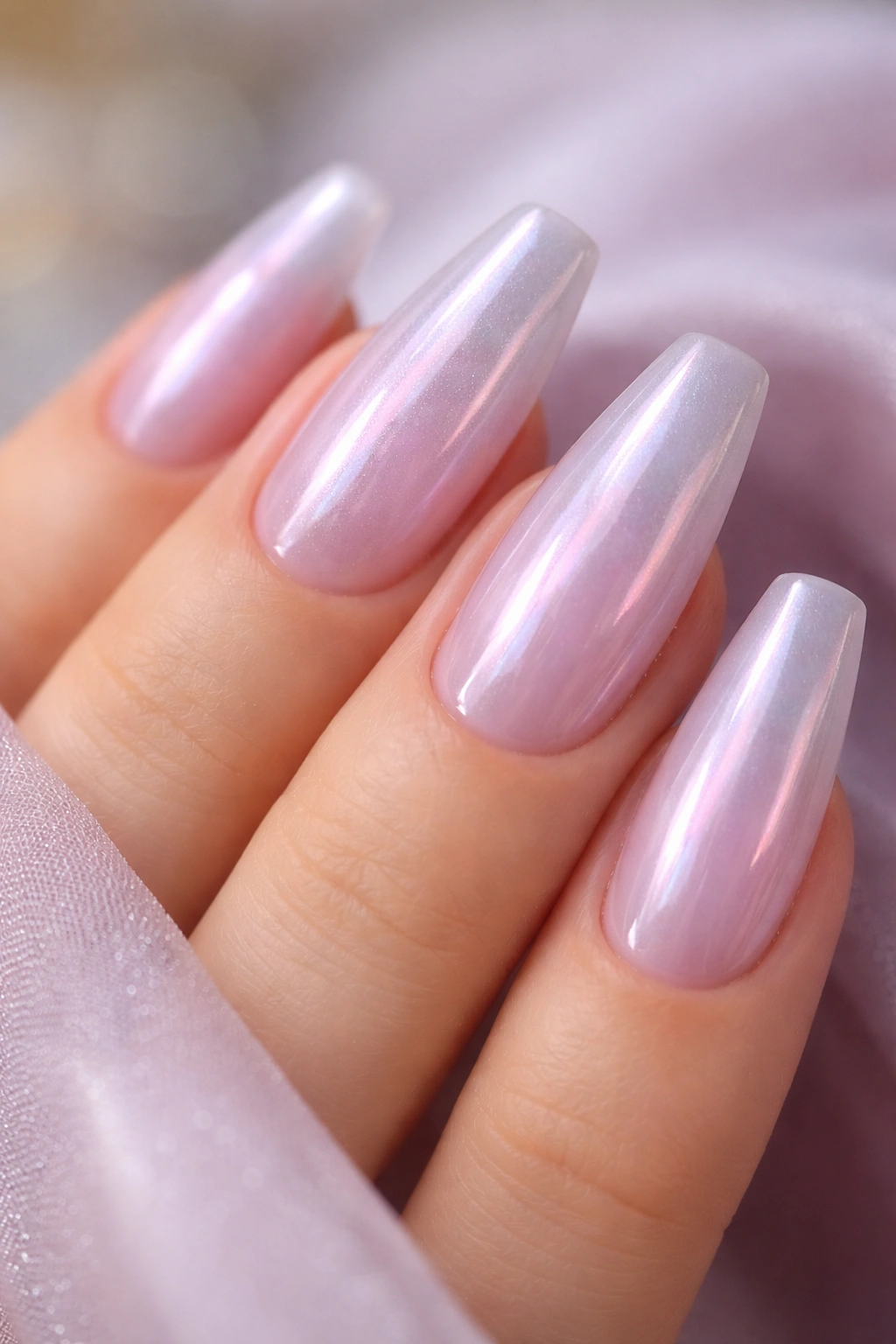
What makes lilac pearl glaze different from white chrome? The base color does more of the talking. Lilac under a pearl top layer gives a soft cool tone that shifts between lavender, silver, and pale pink depending on the light. It’s quieter than purple nail art and more interesting than plain beige.
Does it suit every skin tone? No. And that’s worth saying. On some warmer complexions, a blue-heavy lilac can read chalky. The fix is easy: ask for a pink-lilac or orchid-leaning base instead of an icy lavender. That tiny undertone shift makes the manicure look smoother on the hand.
How to keep it from turning flat
Use a sheer or semi-sheer lilac, not a fully opaque pastel cream. Once the base gets too dense, the pearl glaze sits on top like frost rather than blending in. You want that inside-the-color glow.
Medium length is the sweet spot here. Short ballerina nails can still wear it, though the pearl effect has less room to stretch. I’d skip extra art unless you want one or two tiny pearls near the cuticle. The finish already carries enough mood on its own.
16. Denim Blue Matte Nails With Glossy Tips
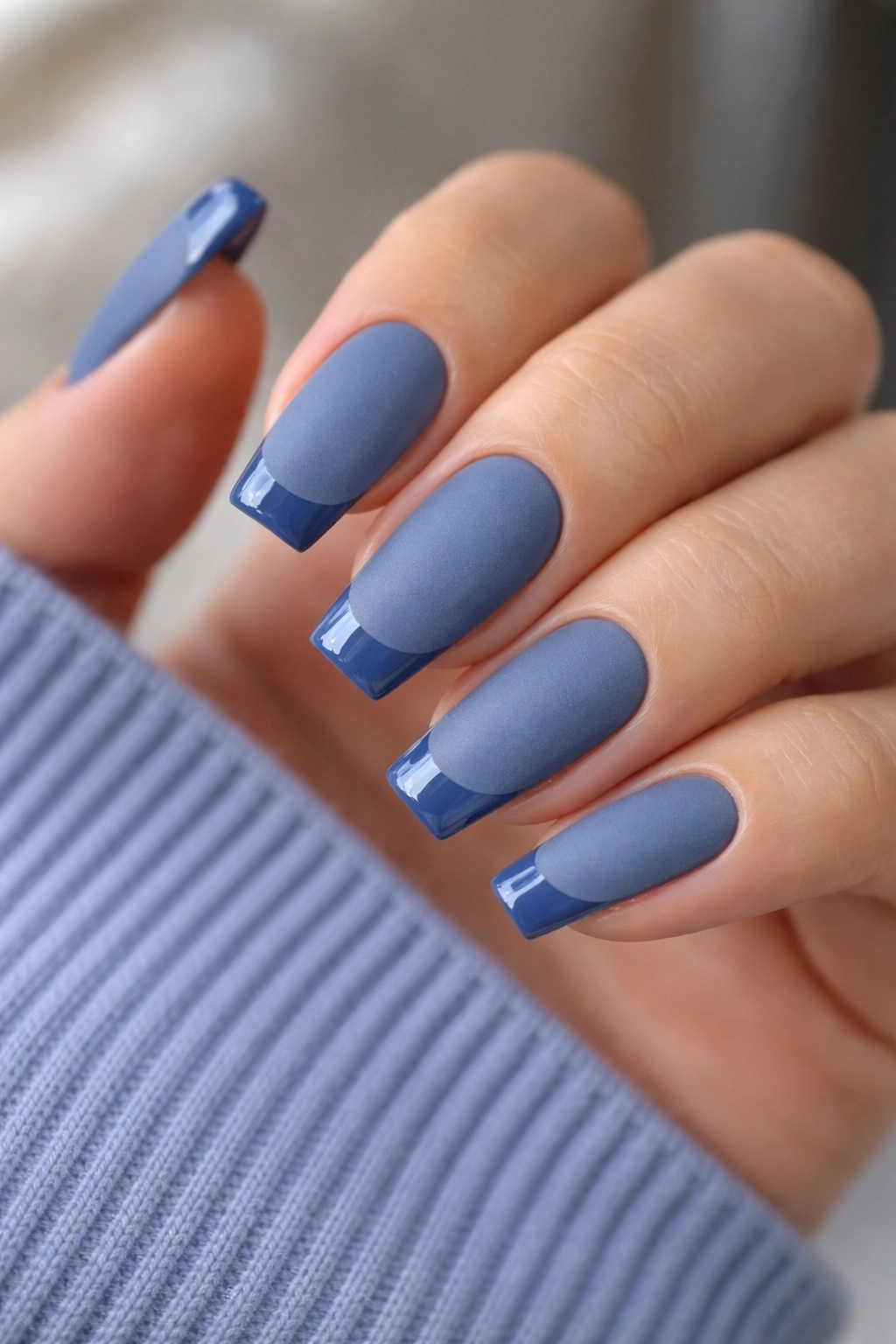
This is one of those designs that sounds odd until you see it on the hand. Denim blue with a matte surface and glossy tips creates a two-texture manicure that still reads clean from a distance. Up close, you catch the contrast. Farther back, it looks like a polished solid color.
The shade matters more than people think. A dusty, slightly gray blue gives the “denim” effect. A bright cobalt does not. Ask for something closer to washed indigo, slate blue, or faded navy.
A smart layout usually means matte on the full nail first, then a glossy French-style tip painted over that cured matte surface. The tip can be thin and sharp or slightly deeper—2 to 3 millimeters works well on medium lengths. Because the finish contrast is the star, the color should stay the same on both parts.
A few notes:
- This design looks best on medium ballerina nails, where the flat tip has room to show the gloss.
- Keep jewelry simple. Texture contrast already gives the manicure punch.
- Matte top coats can wear down at the free edge, so book fills with that in mind.
It’s a smart pick if you want something moodier than nude but still cleaner than black.
17. Smoky Gray Marble
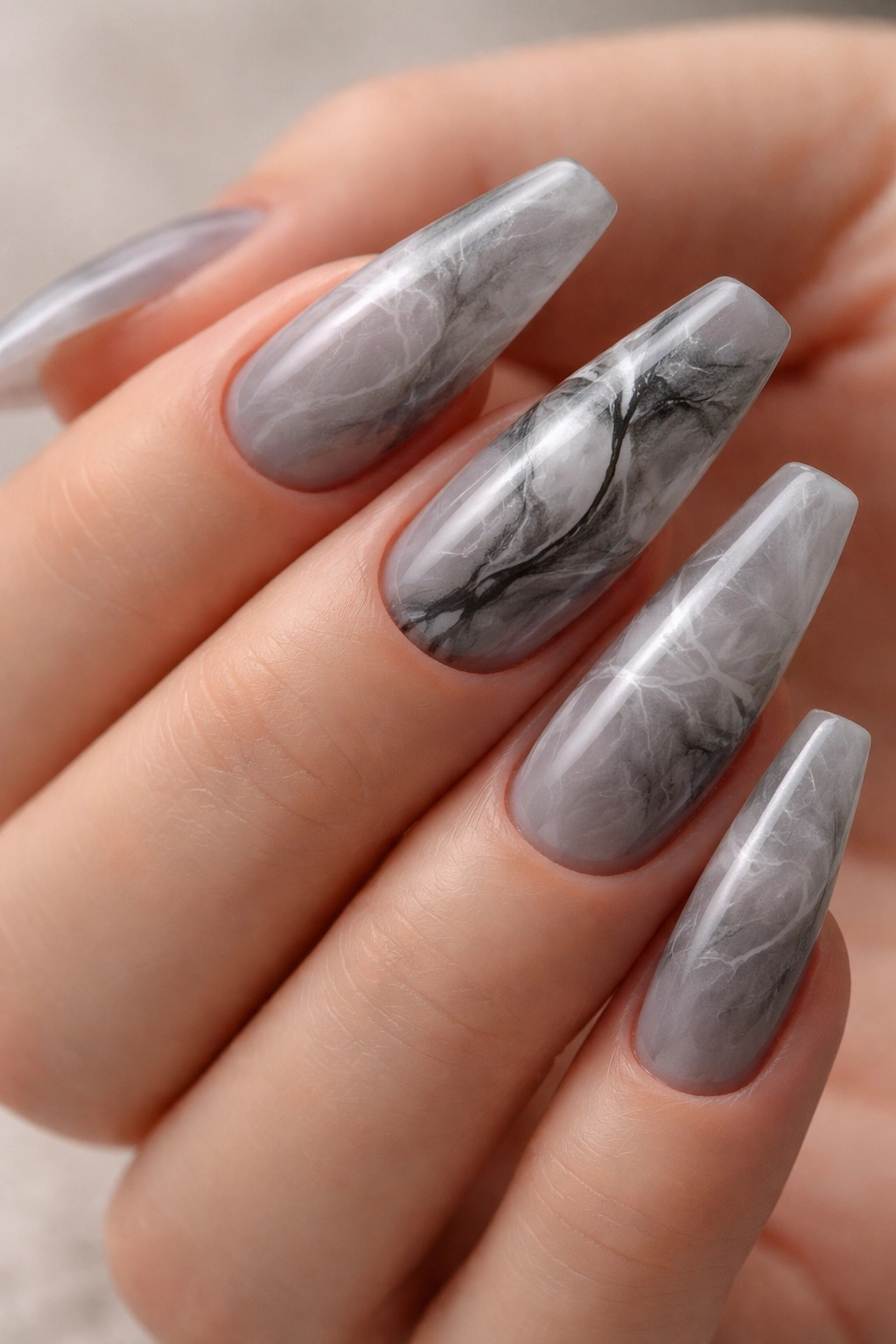
Marble nails go wrong when the veining is too thick, too white, or too evenly placed. Real stone has randomness. Good nail marble needs some of that same imbalance. Smoky gray marble on ballerina nails works because the long, tapered body gives those wispy lines room to travel.
I’d choose a translucent gray base over an opaque cement shade. The little bit of see-through depth makes the white and charcoal veining look suspended rather than pasted on. Add one whisper of silver foil if you want, though even that can be skipped if you like cleaner art.
Placement makes or breaks it. One nail can have heavier veining. Another can stay almost plain with one soft line near the tip. If every nail is marbled the exact same way, the effect turns fake fast.
This is also one of those manicures that likes a cool-toned wardrobe. Black, white, navy, charcoal, silver jewelry—it all fits. Warm camel and orange tones can clash a bit, though that may not bother you if the nails are the statement piece anyway. Either way, keep the veining fine. Thick marble lines look chunky on a shape that wants elegance.
18. Chocolate Ombré With Gold Foil Flecks
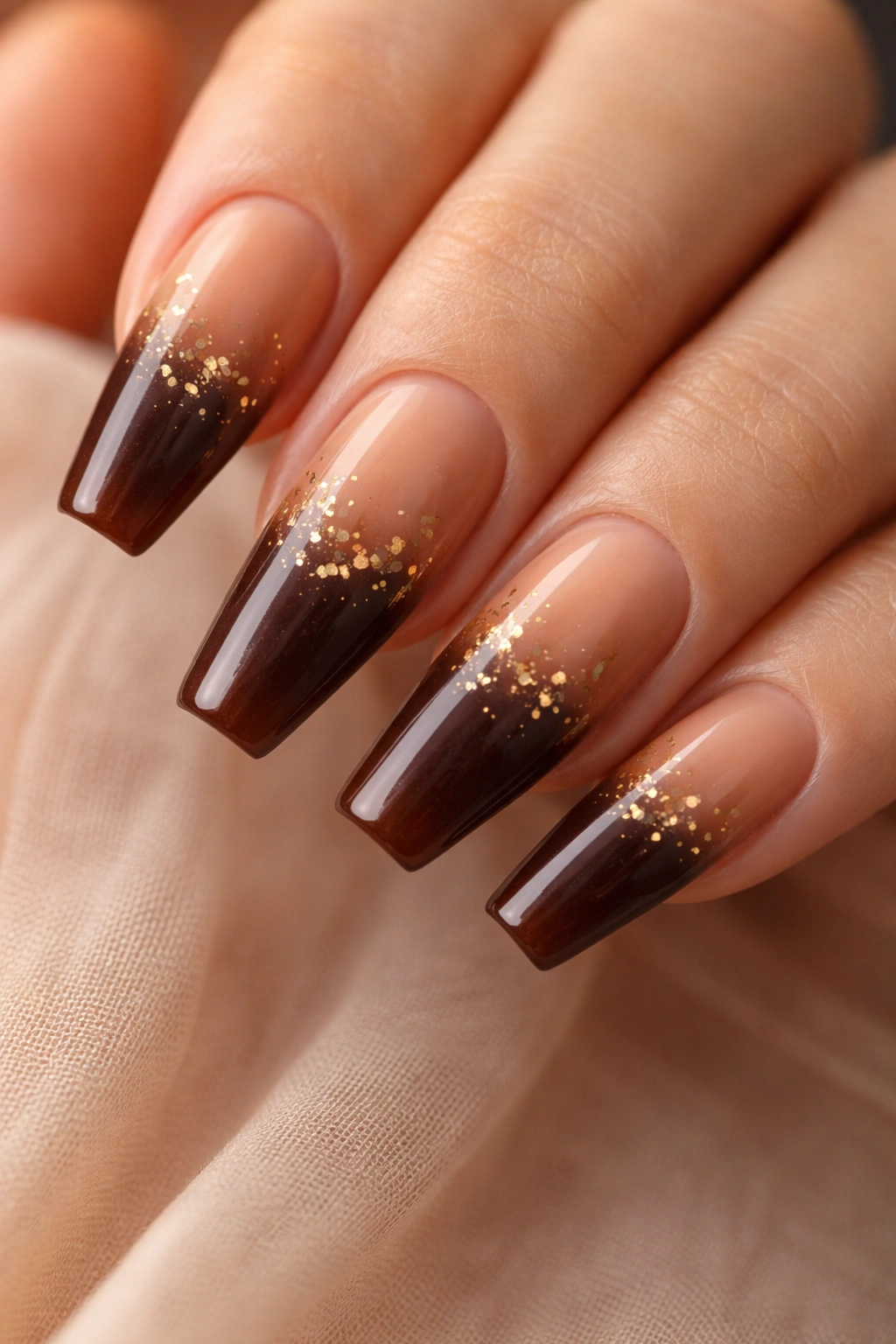
Unlike pink ombré, which leans airy, chocolate ombré feels rich and grounded. The fade can move from a soft caramel or latte nude near the cuticle into deeper cocoa at the tip. Add tiny gold foil flecks—not sheets, not large flakes—and the design picks up warmth without turning flashy.
This set earns its keep on medium to long ballerina nails. The longer taper gives the brown gradient room to unfold, and the flat edge makes the deeper tip look intentional rather than muddy.
Who should wear it? Anyone whose closet is full of brown, cream, black, olive, rust, or gold jewelry. It also suits medium and deep skin tones especially well because the brown family can echo warmth in the hand instead of fighting it.
Keep the foil sparse. That’s the whole secret. Place it near the transition line or lightly through one side of the nail so it looks like a flicker rather than a confetti spill. If every nail gets thick chunks of gold, the ombré fades into the background. And that would be a waste, because the color blend is the best part.
19. Black-to-Clear Fade With Tiny Star Accents
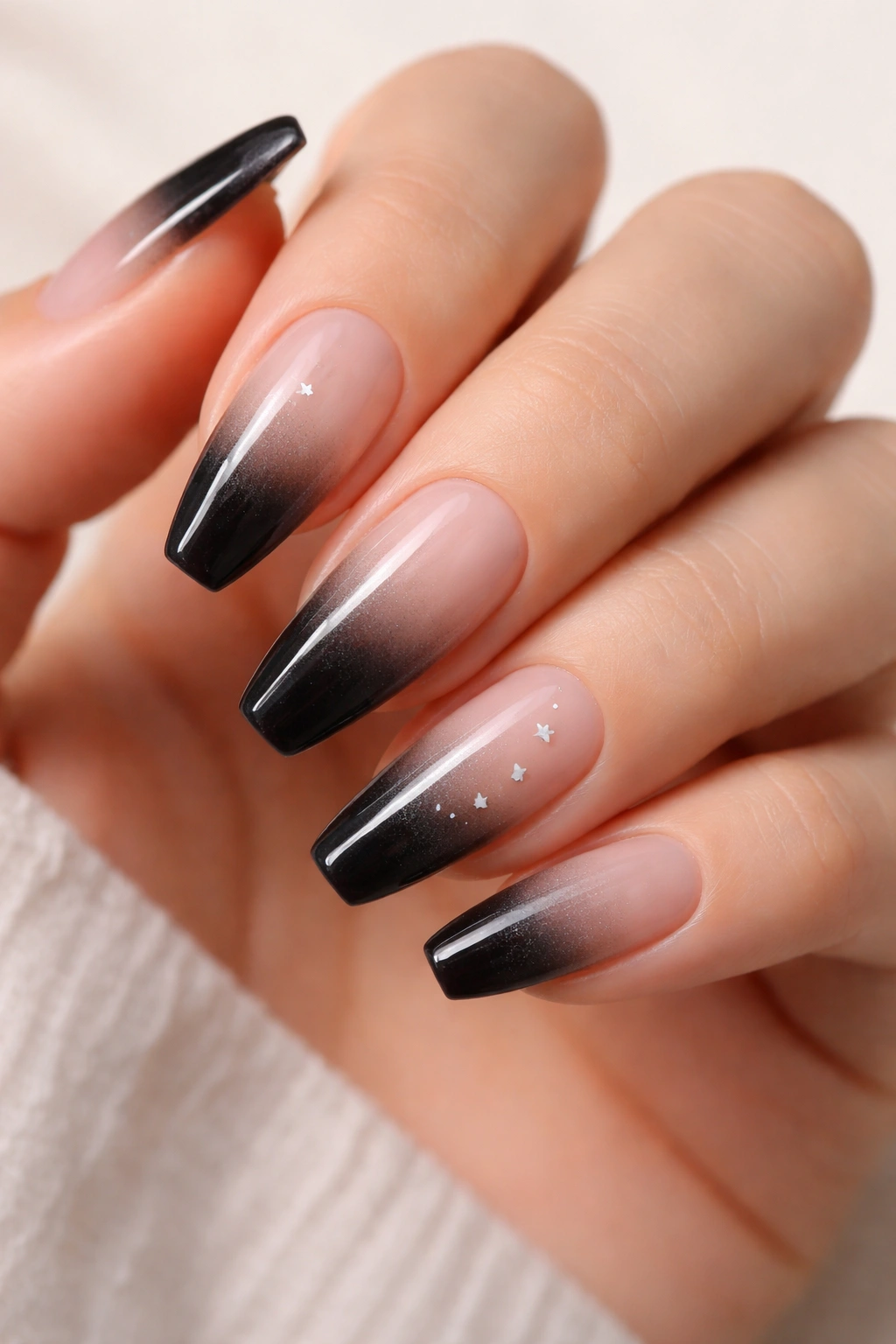
Some nail art tries too hard. This design doesn’t need to. A black-to-clear fade already looks sharp on ballerina nails because the dark color anchors the flat tip while the transparent base lightens the top half of the nail. Add a few tiny stars and you get a celestial nod without turning the whole set into costume nails.
The science of placement—well, the practical version
The black should be most concentrated at the tip, then softly feather upward. If the blend line sits too high, the nails can look heavy. Keep the deepest pigment in the lower third, especially on medium lengths.
What to ask for
- Choose tiny painted stars, silver decals, or miniature foil stars rather than large charms.
- Limit the stars to one or two nails per hand, or scatter one small star on each nail if you want a lighter effect.
- A sheer nude under the clear portion can make the set look more polished than leaving the whole upper nail fully transparent.
- Gloss keeps the fade looking smooth.
Sharp note: this manicure needs tidy cuticles and good fill timing, because the clear area near the base puts growth on display faster than an opaque nude would.
20. Ivory and Blush Lace-Detail Ballerina Nails
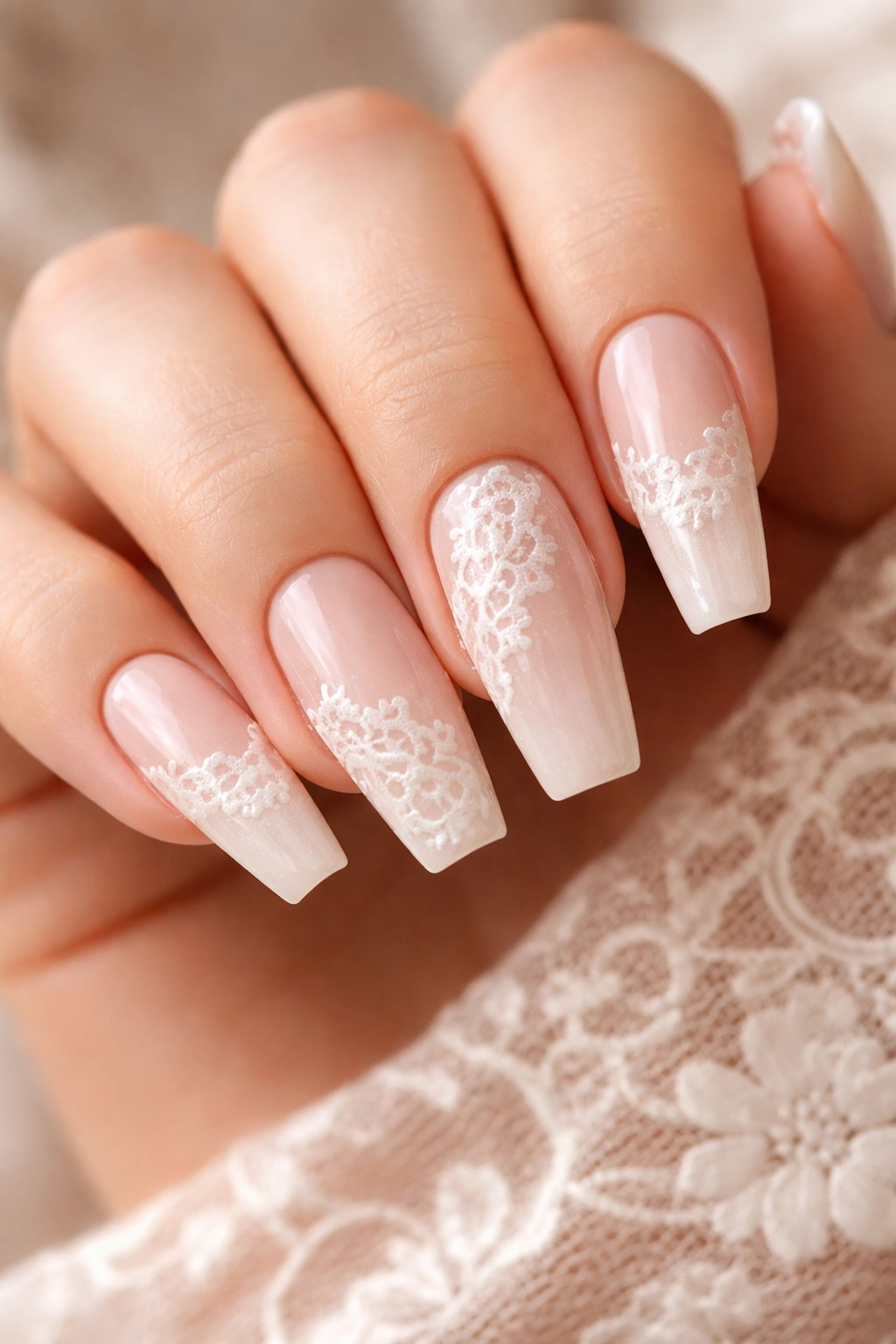
If you want a dressy set that still feels refined, this is the one. Ivory and blush lace-detail ballerina nails give you line work, softness, and structure all in the same manicure. The base usually starts with a blush pink or sheer milky nude, then ivory gel paint creates fine lace motifs, mesh panels, or scalloped edges.
The design needs breathing room. One full lace nail, one partial lace border, a few solid blush nails—that mix is better than covering all ten fingers in dense white pattern. Negative space helps lace art look intentional because it lets the line work stand out.
Raised 3D gel can work here, though I prefer flatter detail for daily wear. Thick lace embossing can catch on fabrics, and on a ballerina shape the cleaner approach often looks more expensive. A tiny pearl at the center of one floral motif is enough if you want one small embellishment.
This set suits bridal appointments, formal events, or anyone who likes a romantic manicure with more edge than a plain pink nude. The ballerina shape keeps the softness from drifting into something sugary. Flat tip, tapered sides, fine ivory lines—done well, it looks composed and deliberate right down to the last finger.
Final Thoughts
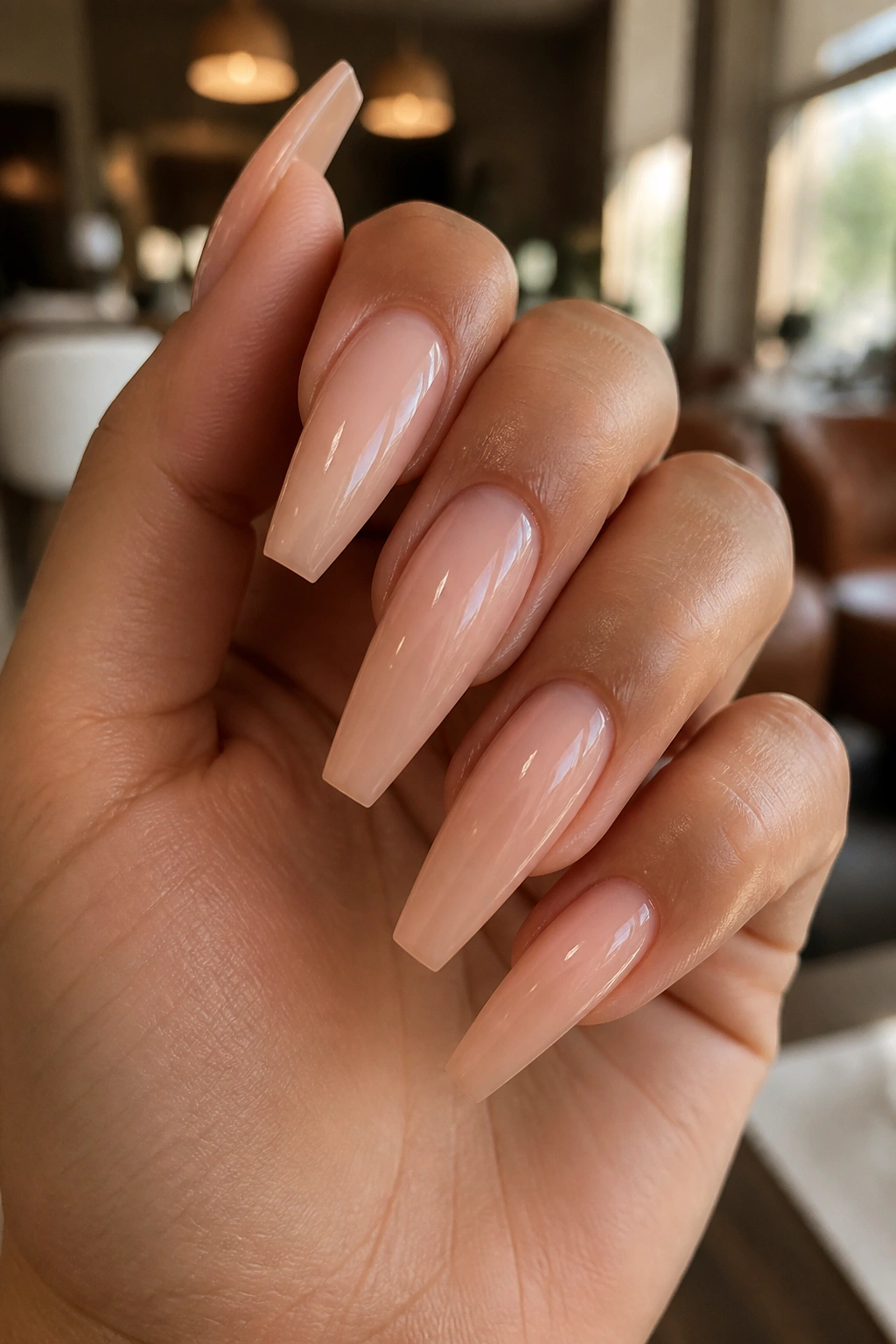
The best ballerina nail ideas usually come down to shape, line placement, and restraint. You can put chrome, flowers, marble, tortoiseshell, or a plain micro French on this silhouette, but the set only lands if the taper is clean and the flat tip is balanced.
Pick the mood first. Clean and minimal. Dark and sharp. Soft and glossy. Textured and graphic. Once you know that, your tech can guide the color and finish in a way that actually suits your hands and your day-to-day routine.
And save the right photo. One clear screenshot with the exact base color, finish, and detail placement will help more than a camera roll full of mixed ideas ever will.