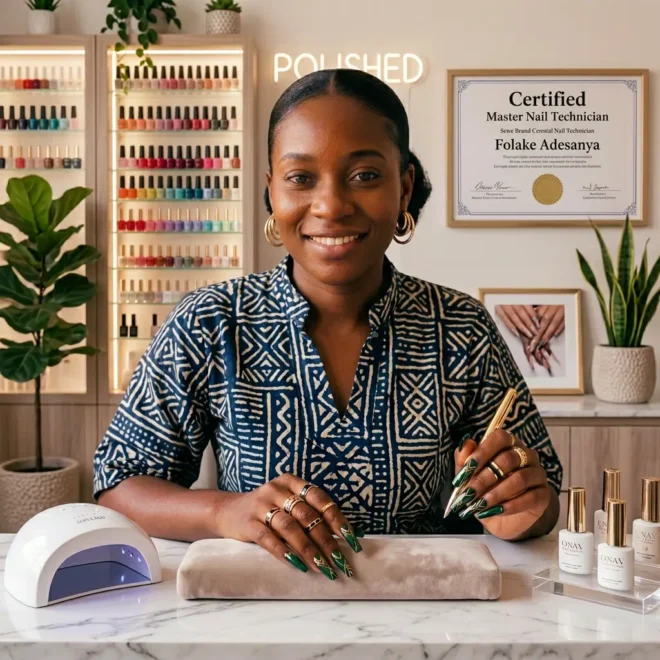


Dark red ballerina nails do not fade into the background. They frame your hands, sharpen every ring you wear, and make even a plain black sweater or white button-down look more put together. That is the pull of this shape-and-color combo: the tapered sides keep the manicure sleek, while the flat tip gives deep red shades a hard, crisp finish that round nails cannot match.
Done well, dark red ballerina nails look rich, intentional, and a little dangerous—in the best way. Done badly, they can look thick, streaky, or oddly wide. Deep red polish shows every shaky cuticle line, and ballerina shaping can go blocky fast if the sidewalls are filed too broad. Those two facts matter more than people think.
I keep coming back to this color family because it has range without losing bite. Oxblood looks almost brown indoors and then flashes wine under warmer light. Black cherry leans moody. Merlot feels plush. A brown-red burgundy can make gold jewelry look warmer, while a blue-red shade pushes the whole set in a cooler, sharper direction. Small shift, big difference.
And once the shape is right, the fun starts.
Why Dark Red Ballerina Nails Look Richer on a Tapered Tip
Shape changes color. The same burgundy gel that looks soft on a short squoval nail can look far stronger on a ballerina tip, because the eye follows the long sidewalls and lands on that blunt edge. You are not only picking a color here. You are picking how that color gets framed.
Ballerina nails—often grouped with coffin nails—need balance. If the taper starts too early, the nail looks pinched and weak. If the taper barely happens, the tip turns boxy, and dark polish makes that width stand out even more. A good rule at the salon: ask for sidewalls to stay fairly straight through most of the nail, then narrow in the last third before finishing with a flat edge.
Length matters too. Dark red tends to look strongest on a medium or long ballerina shape, usually when the free edge extends at least 4 to 8 mm past the fingertip. Shorter than that, you can still wear the shape, but micro details like chrome, marble, or a black outline need more restraint or the nail starts to look crowded.
Undertone is the quiet part that changes everything. Blue-based wine shades look colder and sharper. Brown-red oxblood shades feel heavier and more old-money, if we want to use shorthand. Plum-red sits in the middle and works when you want depth without drifting too brown.
The sidewall trick that keeps the shape clean
Watch the side profile when your nail tech files. The apex—the highest part of the structure—should sit a little back from the center, not at the tip. That gives the nail strength and stops long ballerina nails from dipping downward. Deep colors make weak structure easy to spot, so the architecture has to do its job.
Salon Prep That Keeps Deep Red Polish Crisp at the Cuticle
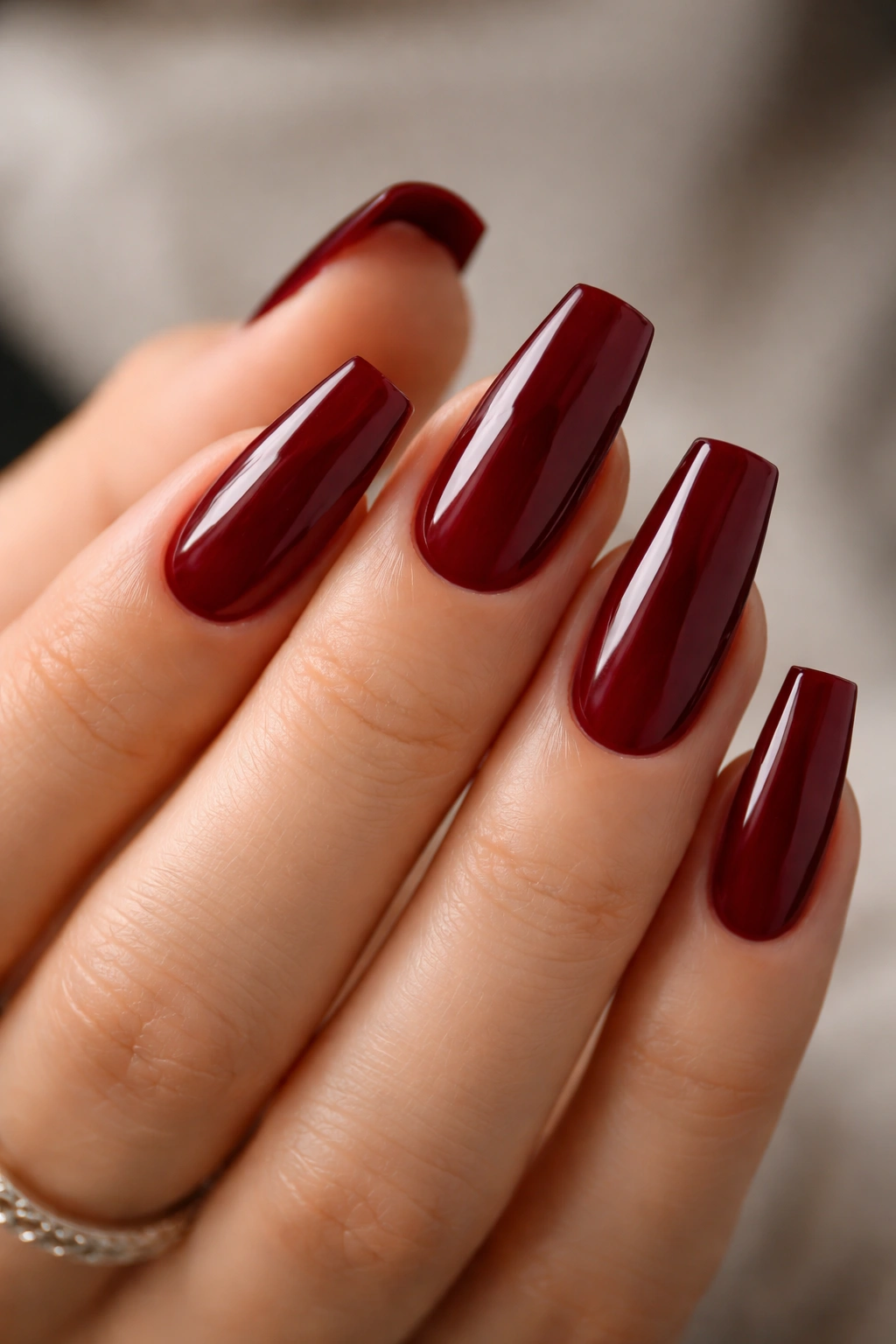
Deep red polish is unforgiving.
A pale beige can hide a messy edge for two or three days. Burgundy cannot. If the cuticle line wobbles, if dead skin is left on the plate, if the polish floods one sidewall, you will see it the second you hold your coffee cup.
Good prep is half the manicure. Maybe more.
If you are at a salon, tell your tech you want thin, even color and a sharply cleaned cuticle line. That short sentence helps more than showing a distant photo with filters all over it. If you are doing your own nails, keep a small angled brush and a dish of acetone nearby so you can erase the line before the gel cures or the lacquer sets.
A few details make dark reds wear better:
- Use a stain-blocking base coat under regular polish, especially if your nails are dry or lightly buffed.
- Cap the free edge with each coat so the flat tip does not chip first.
- Apply two thin coats before reaching for a third. Thick red polish shrinks, wrinkles, and pools.
- Clean dust from the sidewalls after filing. Red over leftover file dust looks grainy.
- Pick one finish on purpose—gloss, matte, velvet, chrome—not three at once.
Bring two photos if you can. One should show the color. The other should show the finish or detail placement. Salons hear “dark red” and can pull six different shades, from brown-wine to blackened cherry, and they are not interchangeable.
1. Glossy Oxblood Dark Red Ballerina Nails
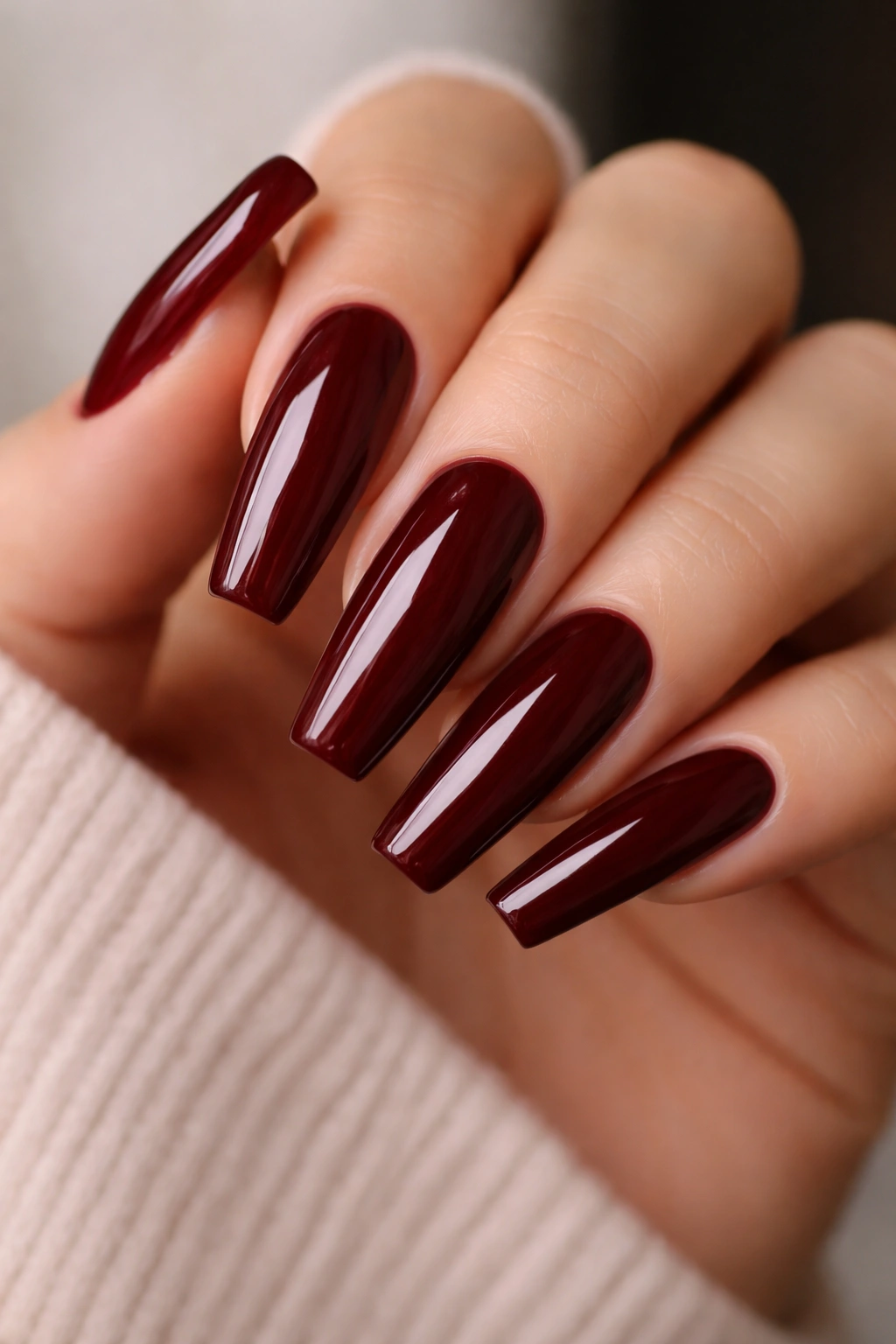
A glossy oxblood set is the one I would hand to anyone who wants a bold manicure without extra design work. The color does the heavy lifting. On a ballerina shape, that dense red-brown tone looks almost lacquered, like polished leather or the surface of a ripe black plum.
The finish has to stay glassy. Skip chunky glitter, skip flakes, skip busy accents on every finger. Oxblood gets its punch from depth, not clutter. When the color is rich enough, a high-shine top coat gives the whole nail a smooth, sealed look that feels expensive rather than loud.
Where oxblood lands on the color scale
Oxblood sits between burgundy and brown-red. It should not lean bright cherry, and it should not look muddy. Indoors, a good oxblood can read close to espresso at first glance. Under warmer light, the red comes forward and the nail suddenly has more life.
Quick details that make this design work
- Best length: medium to long ballerina, with at least 5 mm past the fingertip.
- Best finish: high-gloss gel top coat or a plumping clear top coat for lacquer.
- Best accent: one thin gold ring stack or no accent at all.
- Best color note: ask for a shade with a hint of brown or black in the base, not a true crimson.
Try this: ask your tech to float the second coat instead of pressing the brush hard against the nail. That keeps the surface smoother and gives oxblood more depth.
2. Matte Merlot Ballerina Nails
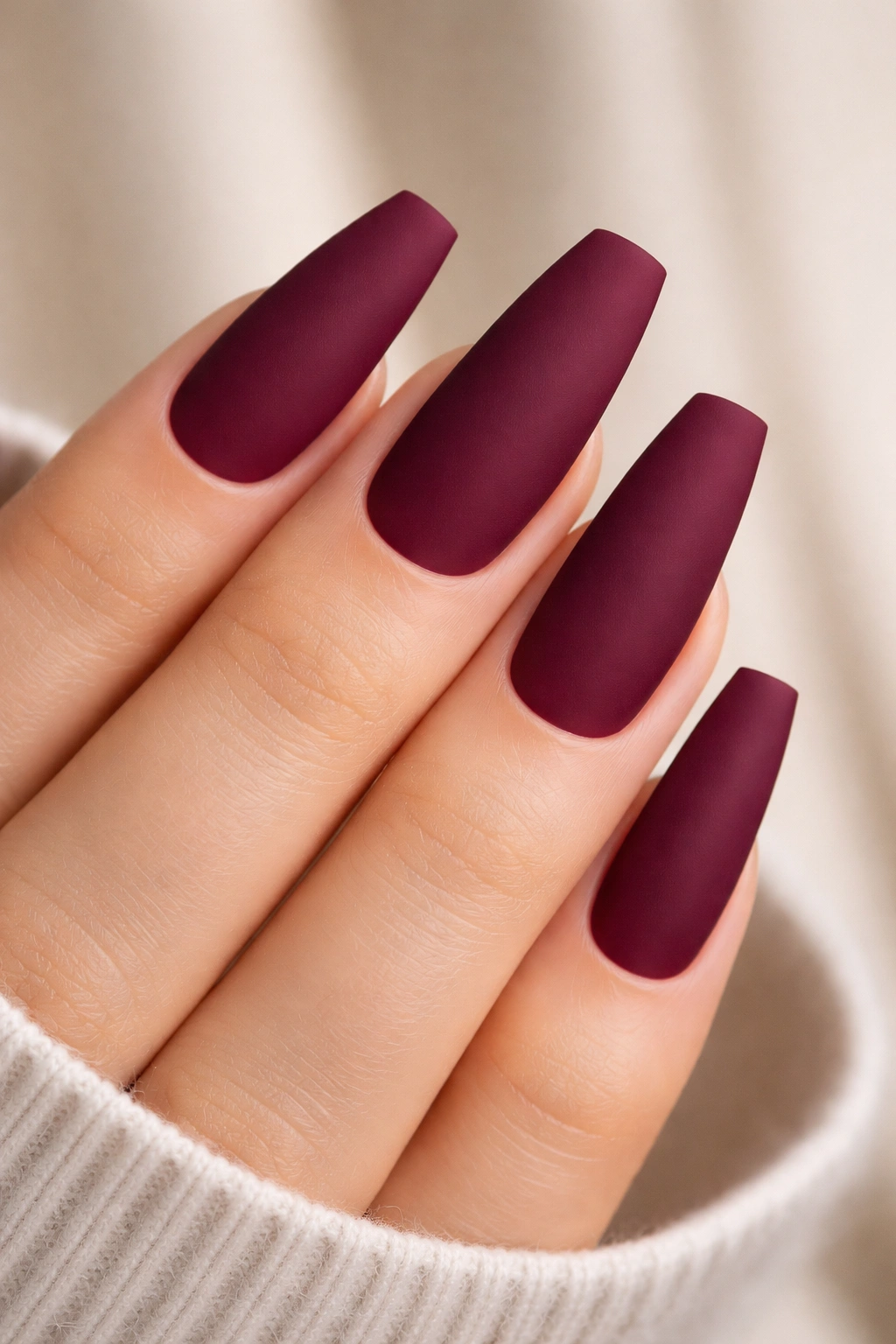
Matte merlot can look more expensive than gloss—if the shade is dark enough. A weak red goes flat under matte top coat. A deep merlot, though, turns soft and velvety, almost like worn suede.
There is a catch. Matte shows surface flaws faster than gloss. Tiny dents, dry cuticles, lint from a towel, rough filing at the sidewalls—none of it hides. If you want this look to stay clean, the base has to be smooth before the top coat goes on. No shortcuts there.
Merlot works best when it carries a little purple or wine undertone. Pure red matte on a ballerina nail can drift costume-fast. Merlot keeps the mood darker and fuller. Medium length is often the sweet spot here. On extra-long nails, matte dark red can start to feel heavy unless the shape is slim and the structure is thin.
Finger oils will polish matte down over time, especially around the tips. Wipe the nails with alcohol after hand cream, and expect the finish to soften after several days if you are wearing regular polish. Gel matte top coat lasts longer, though I still prefer a soft matte over a chalky one. Chalky matte kills depth.
3. Black Cherry Ombré Ballerina Nails
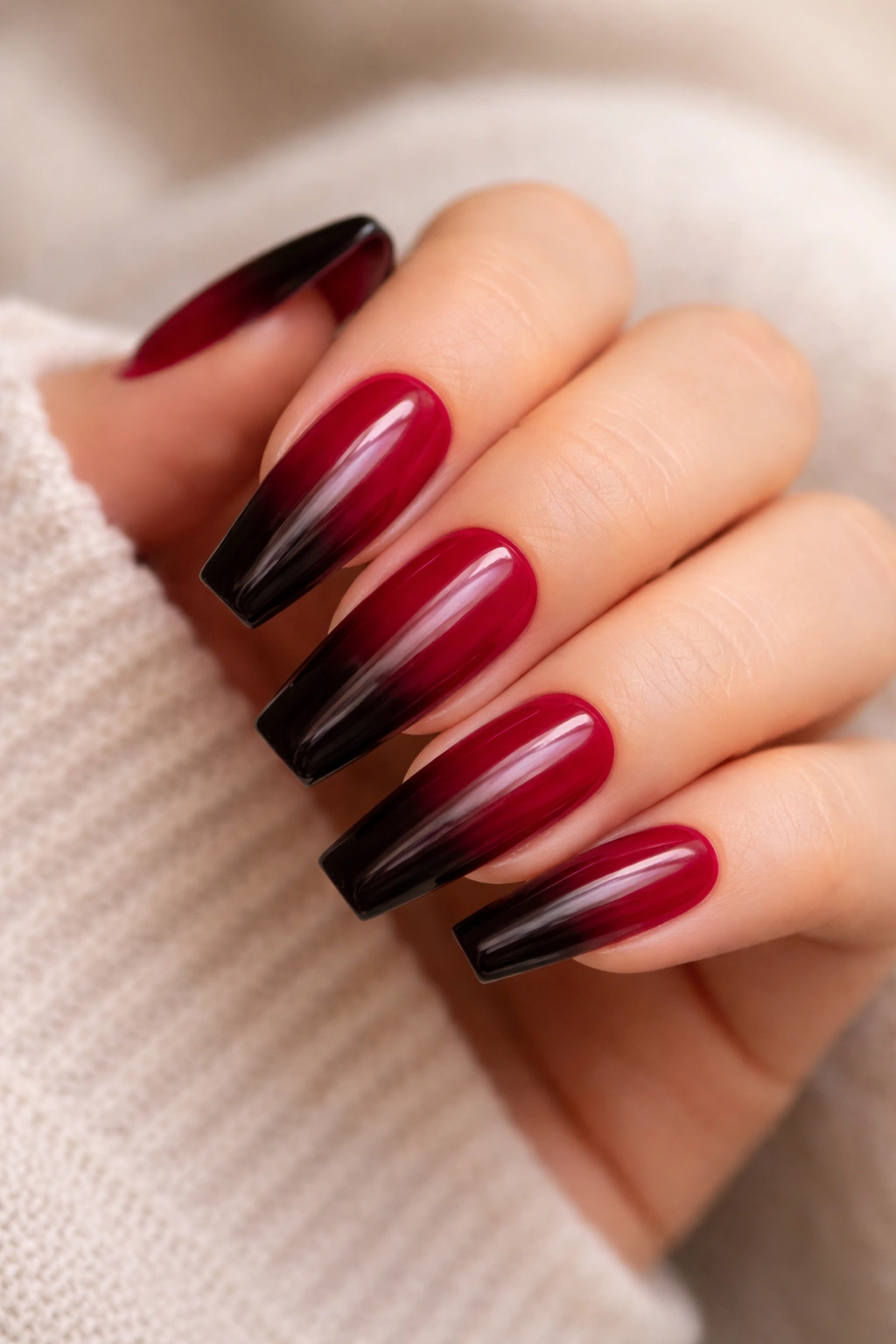
Why does a black cherry fade look stronger than one flat shade? Because the gradient gives the nail movement without breaking up the shape. Your eye sees the darkest tone near the tip, then follows the fade upward, which makes the fingers look longer and the ballerina shape look cleaner.
Black cherry ombré is at its best when the transition stays soft. Think red-wine at the cuticle, then a smoked cherry or near-black burgundy at the free edge. If the contrast jumps too hard, the design stops looking blended and starts looking dipped in two separate polishes.
A sponge fade can work for regular lacquer. Gel usually looks cleaner with a brush blend or airbrushed fade, especially on long coffin or ballerina nails where every patch line shows.
Placement that keeps it sharp
Keep the darkest tone at the last third of the nail. If the blackened red climbs too high, the whole set can look heavy and shorter than it is. A sheer nude or wine-tinted base near the cuticle gives the design breathing room and makes regrowth look softer.
This one also pairs well with a high-gloss top coat. Matte can flatten the fade and hide the detail you paid for.
4. Dark Red Micro French Ballerina Nails
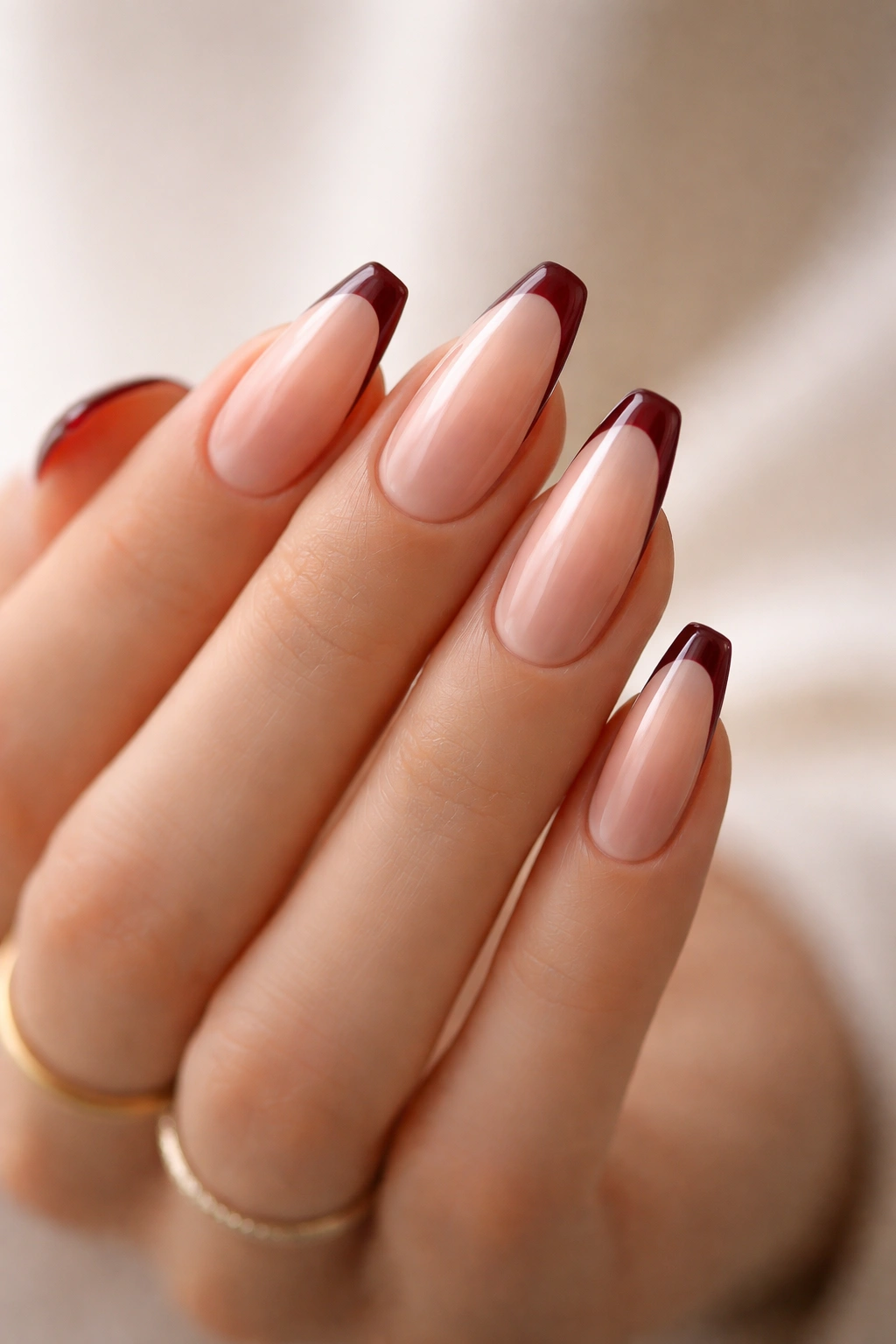
Say you want dark red nails for work, dinners, weekends, everything—but ten full-coverage burgundy nails feel like too much. A micro French is the answer. You keep the ballerina shape, keep the attitude, and lose none of the neatness.
The trick is scale. The red tip should stay narrow, around 1 to 2 mm thick, and the base should be a milky nude, sheer pink-beige, or a neutral builder base that matches your skin tone. Once the tip gets too thick, the look loses its clean edge and starts reading like a color-block manicure.
This design is one of the few dark red looks that wears kindly between fills. Since most of the nail stays sheer, regrowth is softer and less obvious than on a full red set.
- Use a liner brush for the smile line instead of the polish bottle brush.
- Keep the tip straight at the center and slightly angled at the corners to mirror the ballerina shape.
- Pick a wine or oxblood red, not tomato red.
- Limit accent nails unless they are tiny—one gold dot, one slim line, something at that scale.
If you want a manicure that feels sharp without swallowing your whole outfit, this is the one I would book first.
5. Garnet Cat-Eye Ballerina Nails
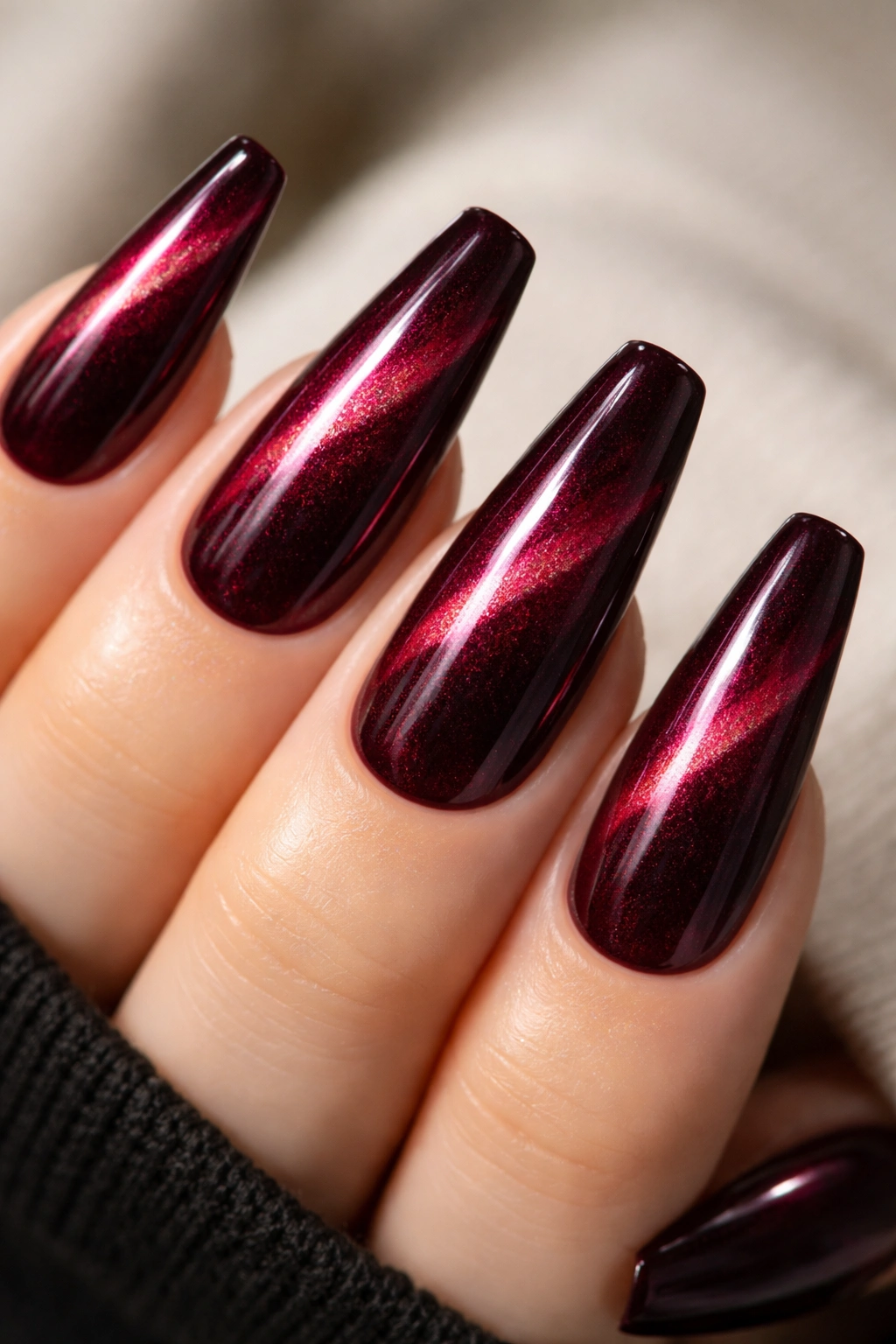
Tilt your hand an inch, and a slim magnetic band slides across the nail like moving silk. That is why garnet cat-eye works so well in dark red. You still get the moody base color, but the surface has a shifting line that makes the manicure feel alive.
Cheap cat-eye polish can look muddy. The better version uses a deep red or wine base loaded with fine magnetic particles, then the tech pulls those particles into a line with a magnet before curing. On ballerina nails, I like the stripe placed diagonally or slightly off-center more than straight down the middle. A dead-center line can make wide nails look wider.
One sentence, because it matters: ask to see the polish swatch before the set starts.
Some red magnetic gels pull silver. Others pull rose, copper, or red-violet. If you want the finished look to stay dark and grown, pick a shade where the magnetic shift stays within the same family instead of jumping to bright pink.
You can wear cat-eye on every nail, and I think this is one design that earns it. Accent-only cat-eye often looks like the salon ran out of time. Full-set cat-eye feels deliberate. Add a short, square gem at the cuticle and the design can tip into costume. Better to leave the surface clean and let the magnetic effect do the talking.
6. Dark Red Chrome Ballerina Nails
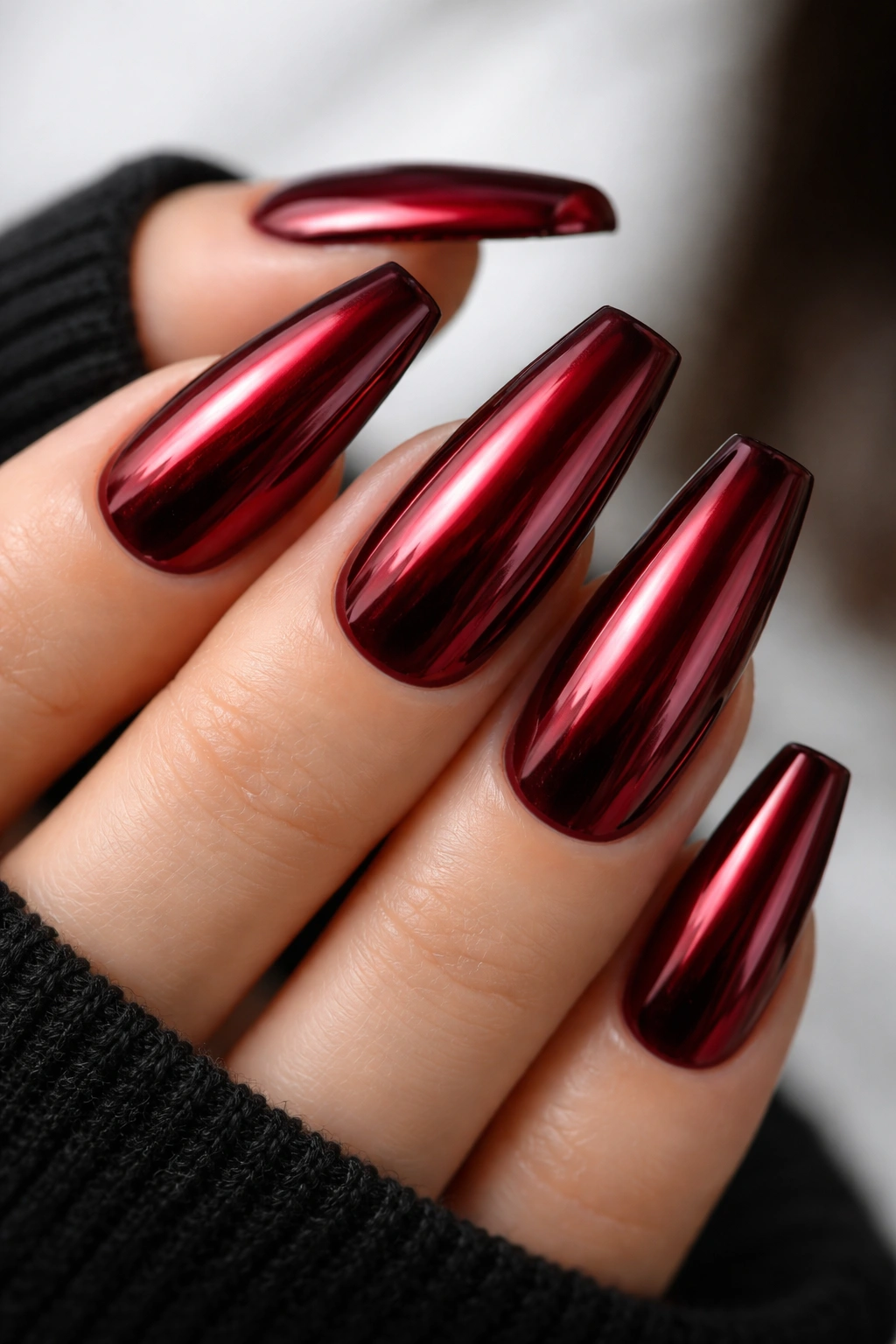
Unlike silver chrome, dark red chrome keeps the body of the shade underneath. You are not turning the nail mirror-metal from edge to edge. You are putting a reflective veil over a black-red or wine base, which gives the set a hard, polished shell.
That distinction matters. A bright silver chrome over long ballerina nails can take over your whole look. Red chrome still feels bold, though it sits closer to a deep lipstick than a piece of armor. Better balance.
Longer nails carry this design best. Chrome exaggerates every curve, so the structure underneath needs to be smooth and even, with no lumps near the apex and no bulky sidewalls. On short ballerina nails, a full chrome coat can make the shape look thick unless the application is tight.
If you want the cleanest version, go with a blackened red base, rub on a translucent crimson chrome powder, and seal it with a no-wipe top coat. Skip rhinestones. Skip foil. Skip matte accent nails. Chrome already has enough bite.
This set looks best when the finish stays uninterrupted from cuticle to tip.
7. Wine Marble Ballerina Nails
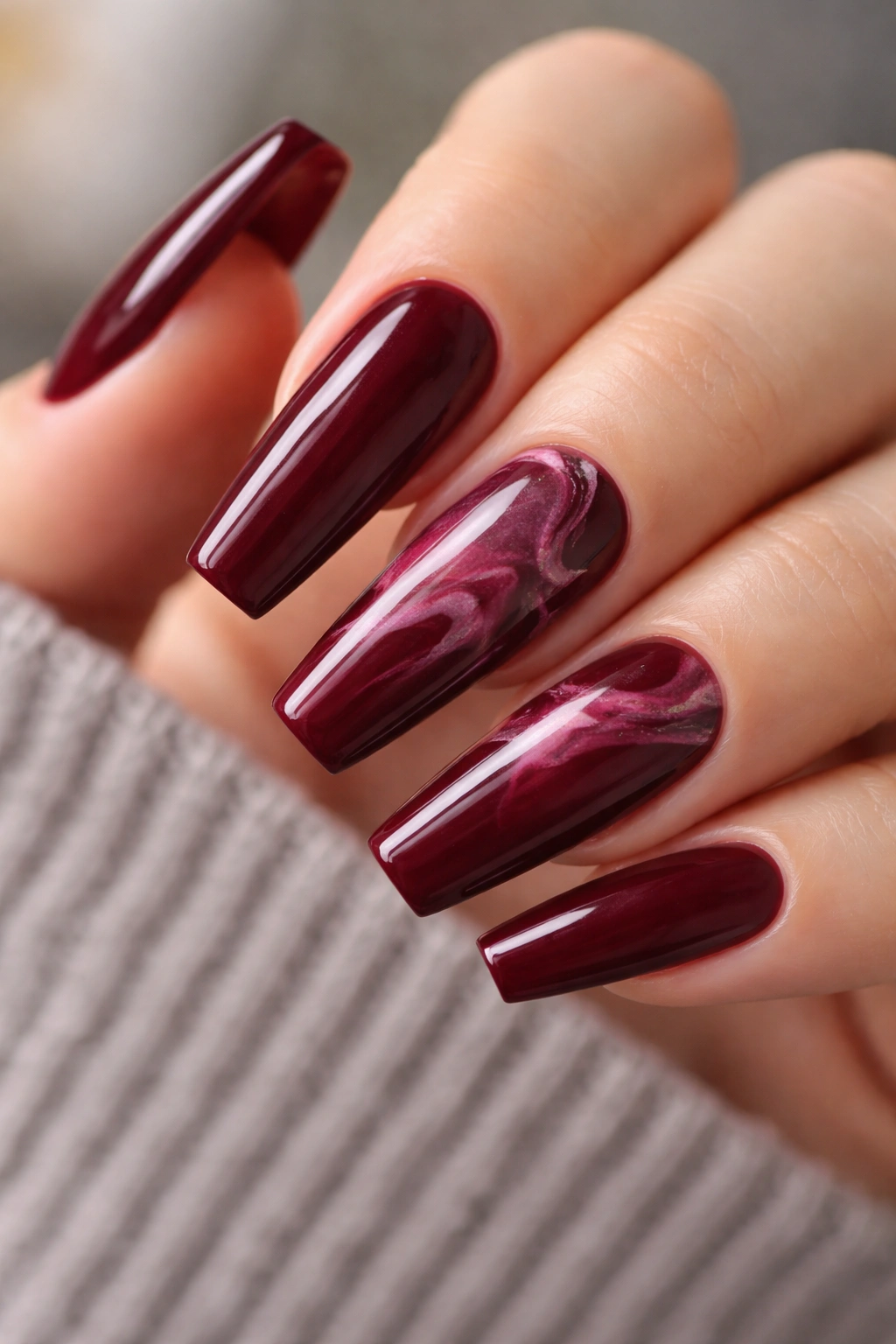
Marble can go wrong fast. On dark red nails, too many swirls make the surface look cloudy, and cloudiness kills the rich depth that makes wine shades worth wearing in the first place.
The fix is restraint. Start with a burgundy, merlot, or black cherry base, then drag in one lighter wine tone and one darker vein color—black, espresso, or a smoked plum. That is enough. Once five colors hit the nail, the design starts to look busy instead of stone-like.
Use two reds, not five
A good wine marble usually needs:
- one deep base shade
- one lighter translucent red or jelly wine
- one vein shade in black or brown-black
White can work, though only in hairline amounts. Thick white marbling against dark red pulls the design away from that moody, polished finish and into something harsher.
Which fingers should wear the design
I prefer marble on two nails per hand at most—ring finger and thumb, or ring finger and middle finger. A full ten-piece marble set can blur together from a distance. Solid dark red on the rest of the nails keeps the whole manicure grounded.
8. Gold-Flecked Dark Red Ballerina Nails
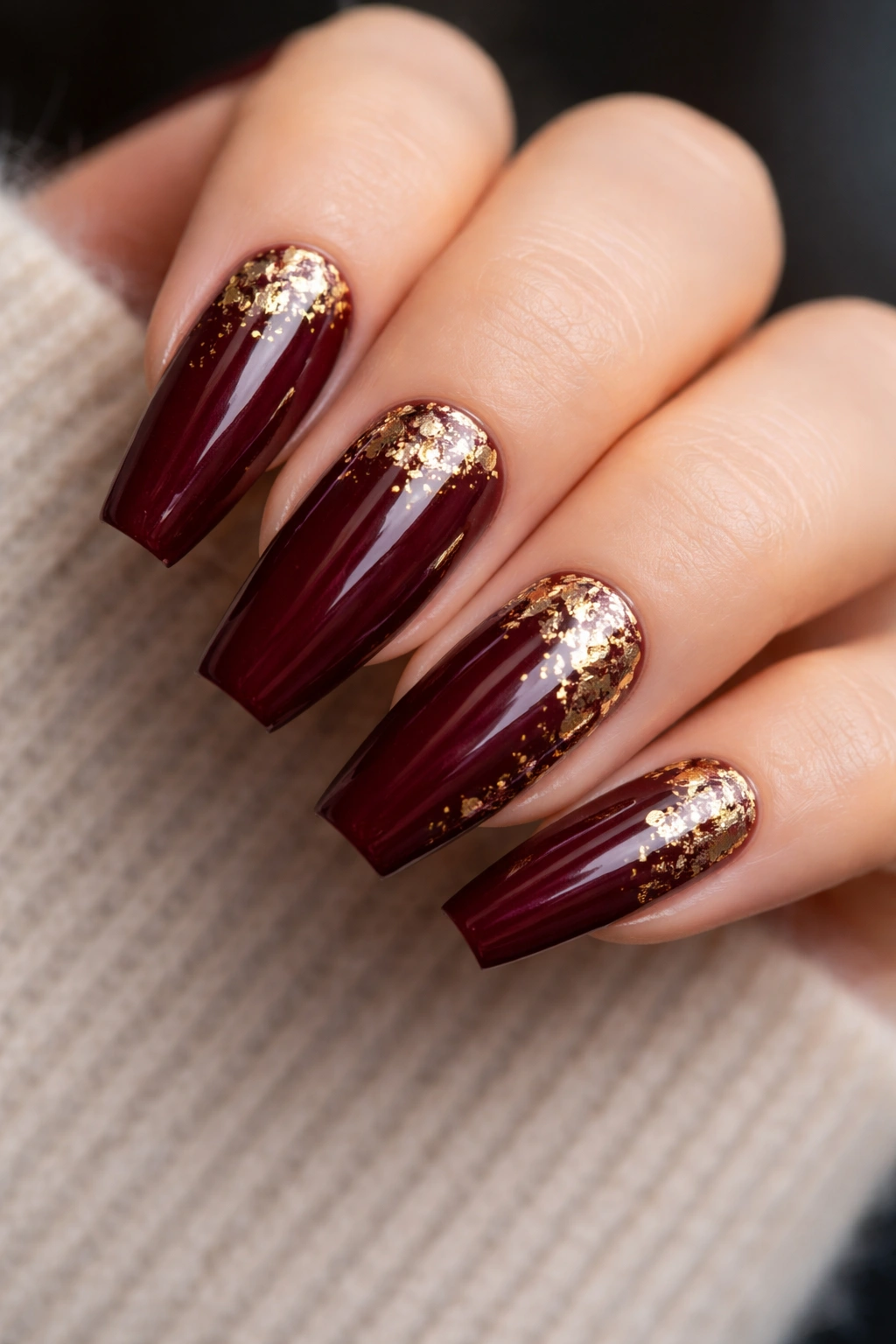
Gold foil is best when it looks a little torn and uneven. Not messy. Broken in a controlled way.
That rough-edged metal against a dark wine base gives the nails contrast without covering the color. Think old jewelry box, not holiday craft project. Placement makes the call here. A few flecks pressed near the cuticle or drifting down one side of the nail look richer than foil pasted across the whole center.
A couple of smart placement ideas:
- Cuticle crescent: tiny foil fragments hugging the lunula on one or two nails.
- Side stripe: a torn vertical line of foil along one sidewall, sealed flat under top coat.
- Floating flecks: scattered pieces on the upper third of the nail, with more empty space than metal.
Warm antique gold pairs best with brown-red oxblood shades. A brighter yellow gold can fight with cooler wine reds, while a muted metallic keeps the palette tighter.
Seal foil carefully. If the edges stick up, dark polish makes that bump easy to spot. I like two thin layers of top coat here rather than one thick one.
9. Velvet Merlot Magnetic Ballerina Nails
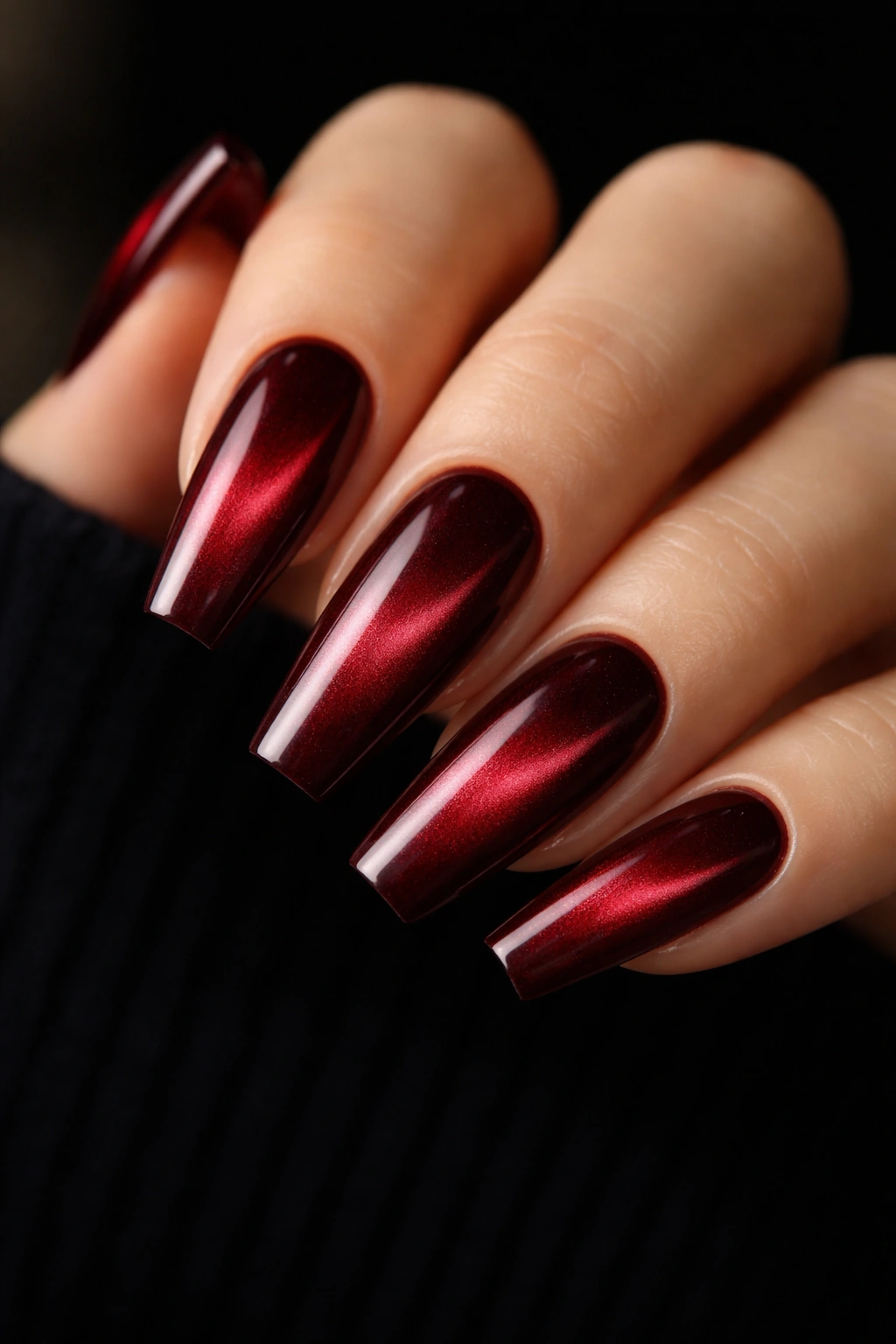
Velvet nails and cat-eye nails get mixed together all the time, though they are not the same look. Cat-eye gives you a line. Velvet gives you a soft, diffused pull across the whole nail, like the color is lit from within rather than sliced by one bright stripe.
That soft-focus effect suits merlot especially well. A deep wine base already has a plush look; magnetic pigment spread with a velvet magnet only pushes it further. Under dim light, the nails can look almost black-red. Move into brighter light, and the inner glow shows up.
Application matters more than people think. A salon that cures the whole hand at once can lose the magnetic placement before the lamp even closes. The cleanest velvet sets are often cured one finger at a time, with the magnet held in place long enough for the particles to shift before the nail goes straight under the lamp.
Length helps, though medium ballerina nails still carry this well if the taper is slim. If you want one of the darkest, moodiest versions of red without using black, this is hard to beat.
10. Dark Red Jelly Layered Ballerina Nails
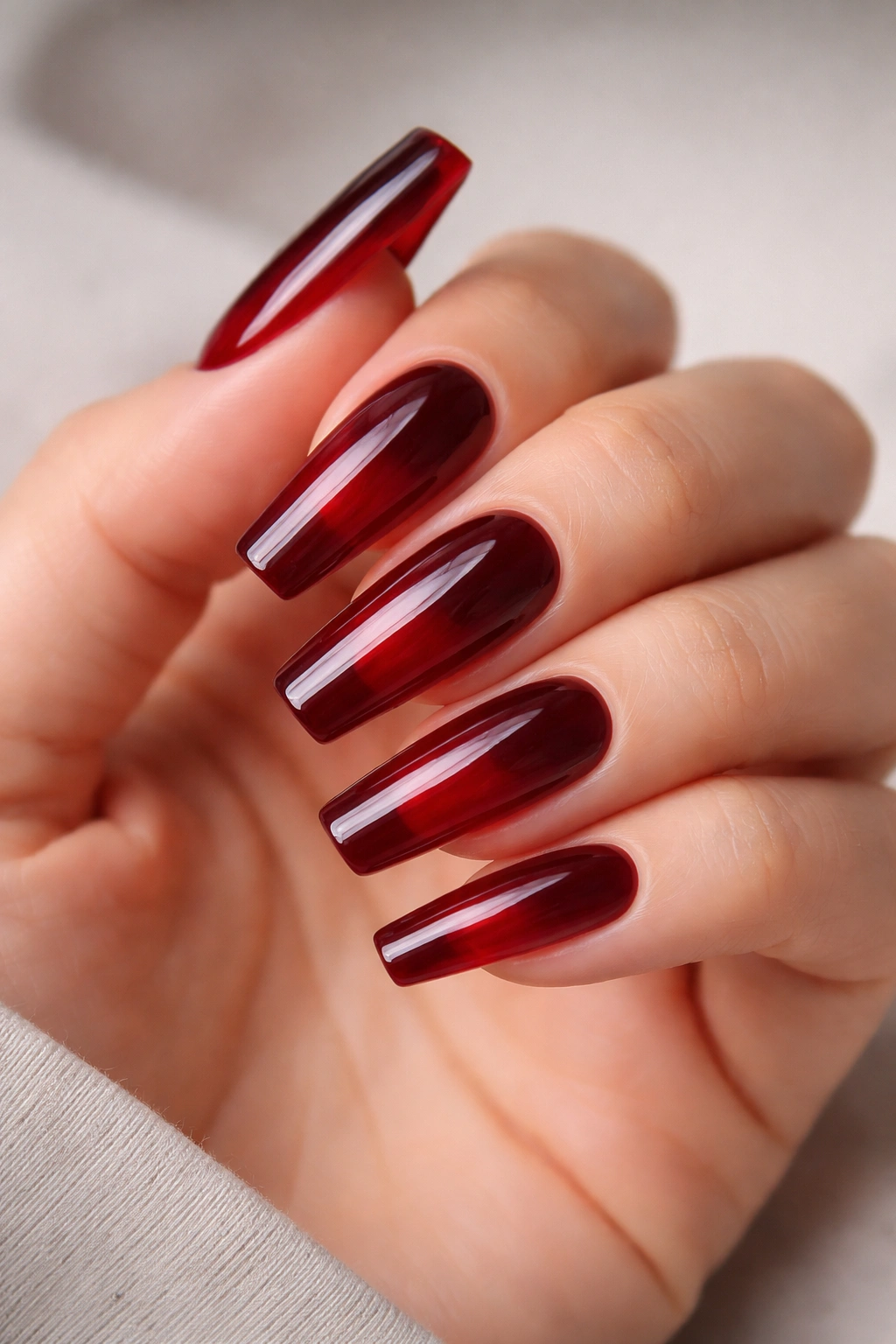
Jelly red on a ballerina nail can look cheap or expensive, and the gap between those two outcomes comes down to layering. One thick coat turns patchy and pink. Three sheer coats over a clean base give you that syrupy depth where the free edge seems to glow through the color.
That translucent effect works well for people who find full-coverage burgundy too hard. You still get the dark red mood, though the finish has more softness and depth at the edges.
Build color in layers, not one pass
Ask for a stained-glass approach:
- a clear or milky base
- one sheer wine-red layer
- a second red layer focused more on the center and tip
- a final balancing layer across the whole nail
Short note, big payoff: jelly looks better on medium length than extra long. Once the nail gets too long, sheer red can drift costume-fast unless the layers are rich and even.
Gloss is the move here. A thick plumping top coat makes the jelly look deeper, almost wet, and that smooth finish is where the set gets its edge.
11. Half-Moon Negative Space Burgundy Ballerina Nails
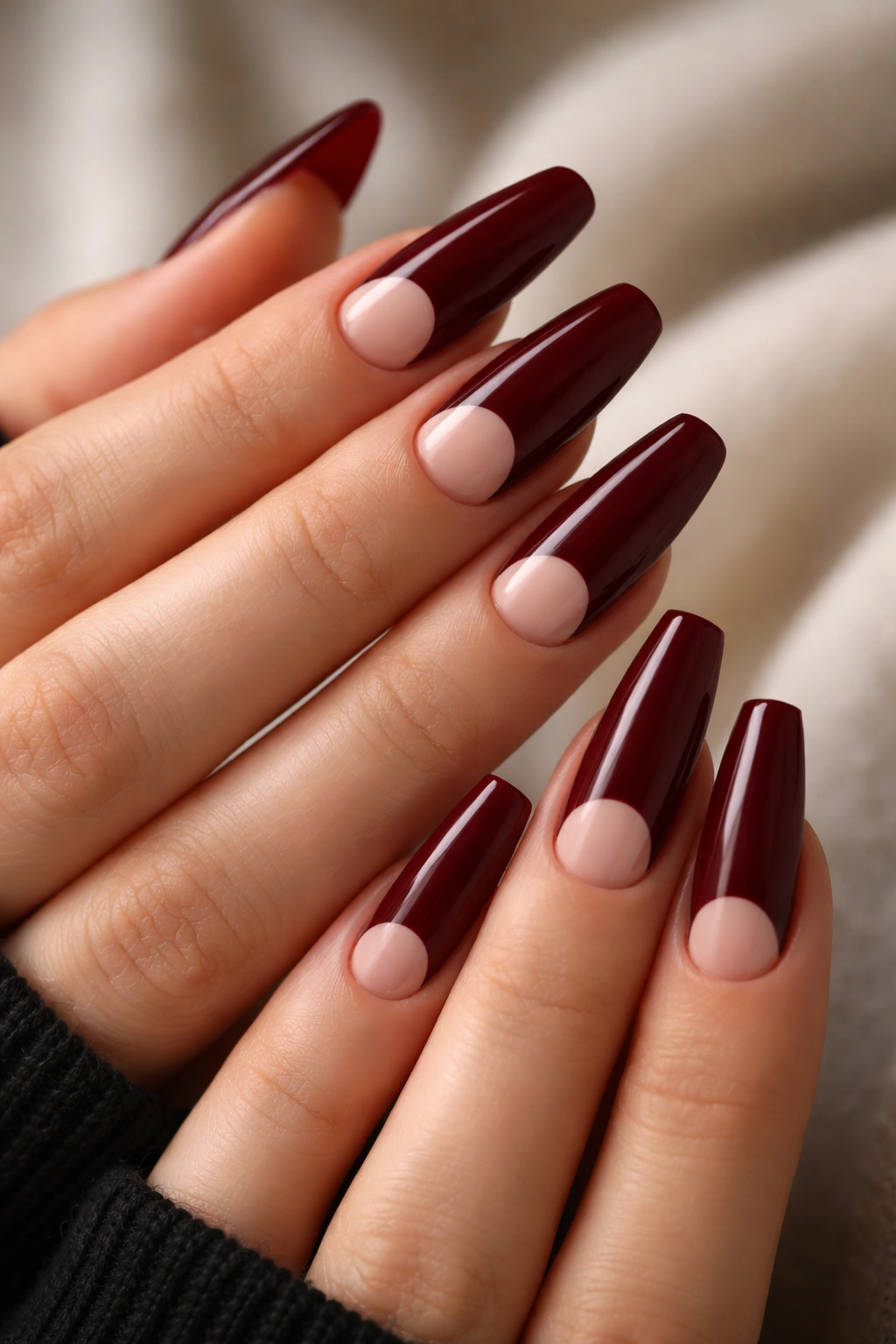
If you hate obvious regrowth, start here.
A half-moon design leaves a slim bare or nude crescent at the cuticle, then fills the rest of the nail with dark burgundy or black cherry. The gap can be tiny—around 2 to 3 mm—or slightly wider if you like a more graphic look. Either way, the line buys you time between fills because the grow-out blends into the design instead of fighting it.
Negative space also helps deep red feel lighter. That matters on long ballerina nails, where full-coverage dark shades can get visually heavy.
A few versions work better than others:
- Bare moon + glossy burgundy body for the cleanest look
- Nude moon + matte wine body if you want softness
- Thin gold outline around the moon on one or two nails only
- Black cherry body with a smoked pink moon for more contrast
Keep the moon shape crisp and even across the hand. A lopsided half-moon is impossible to ignore once you see it.
12. Tortoiseshell and Bordeaux Ballerina Nails
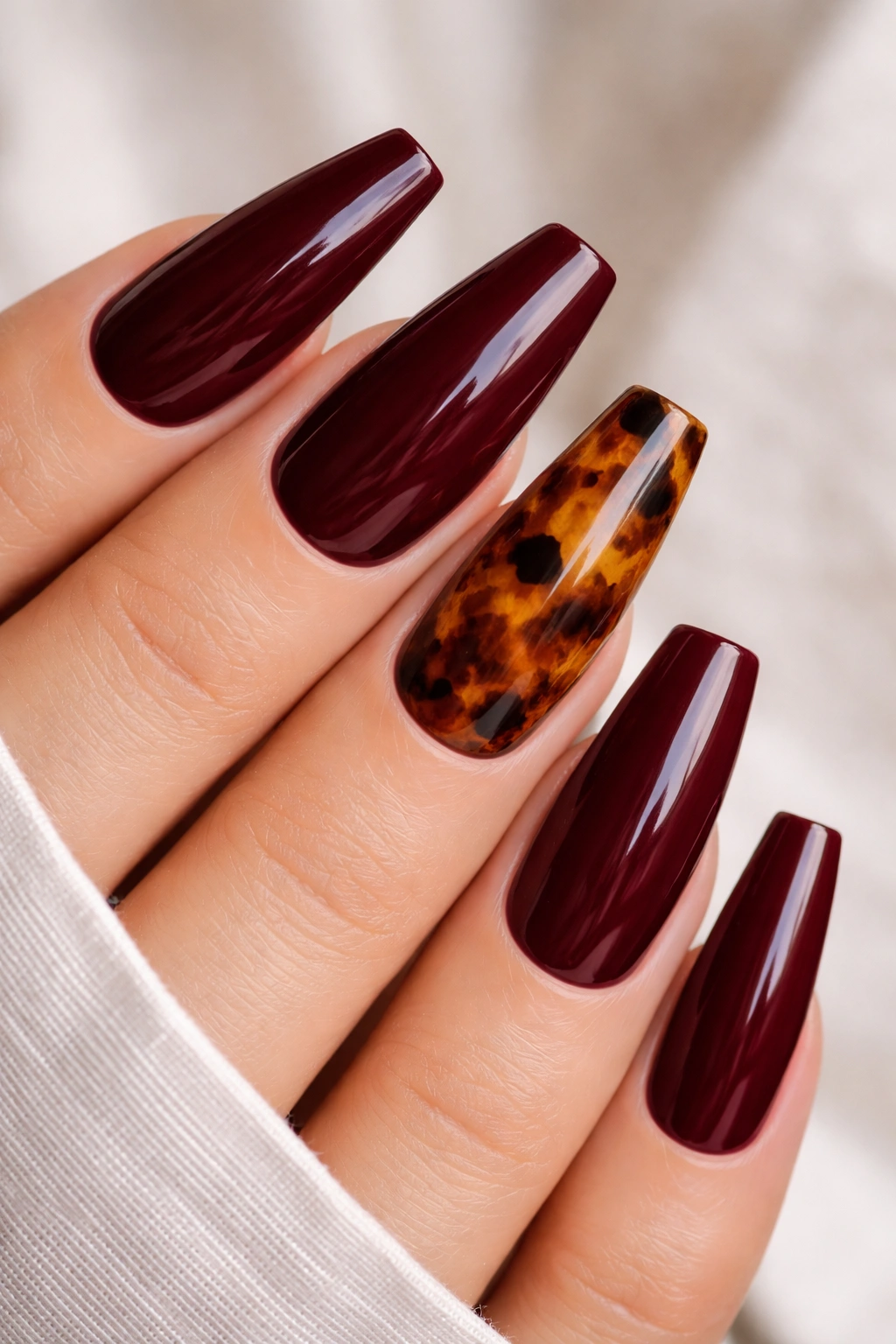
Mixing tortoiseshell with bordeaux can look messy in a hurry. It can also look sharp, warm, and far more thoughtful than another full set of plain burgundy. The difference sits in the ratio.
Do not put tortoiseshell on every nail. Two accent nails per hand is enough, and I usually like them on the ring finger and thumb so the pattern shows when your hands move. The rest of the nails should stay solid bordeaux, oxblood, or a dark cherry cream.
The tones need to share warmth. A cool wine red next to orange-heavy tortoiseshell can clash. Pick a red with brown in it, then let the tortie carry amber, caramel, and black spots. The nails end up feeling tied together rather than random.
This design also looks better with a high-gloss finish than matte. Tortoiseshell needs translucency to sell the effect, and matte kills that depth. You want the pattern to look layered under the surface, not painted flat on top.
It is a small style risk. A good one.
13. Deep Red Crystal Cuticle Ballerina Nails
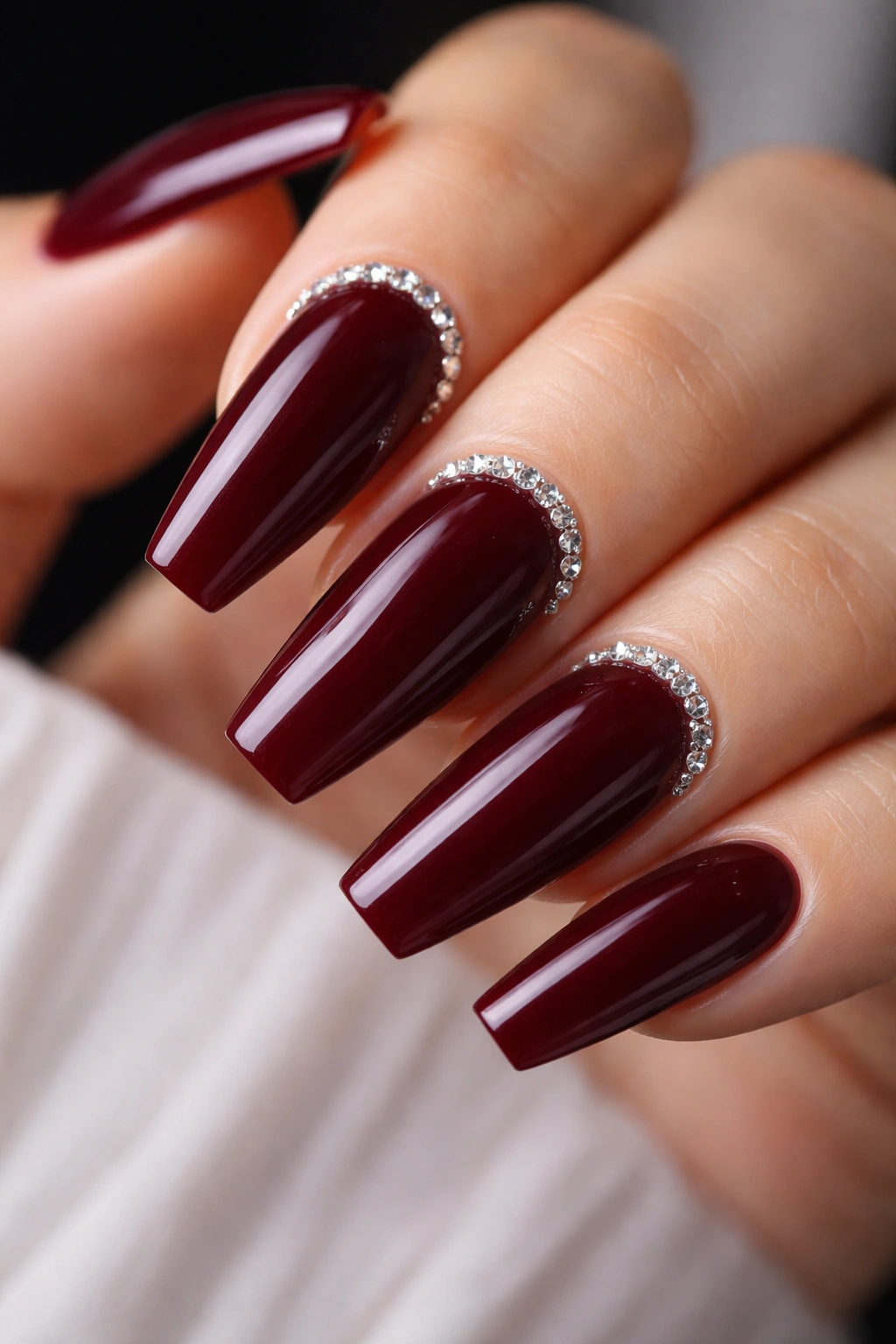
Rhinestones go wrong fast when they spread across the whole nail. One arc of tiny stones at the cuticle, though, can sharpen a dark red set without swallowing it.
The key word is tiny. Think SS3 to SS5 crystals, placed in a slim curve that follows the natural cuticle line on one or two nails. Bigger stones can snag hair, lift sooner, and make the manicure feel heavy. A fine crystal detail looks cleaner and lets the red stay front and center.
I like this most on a deep cream burgundy or blackened cherry base with a high-gloss top coat. Matte plus crystals often fight each other. One wants softness; the other wants sparkle and edge. Gloss gives both a place to sit.
Wear matters here. If you use your hands hard—gym grips, childcare, constant keyboard use, opening cans—ask for the stones to be embedded carefully in builder gel rather than glued on top. Flat-back crystals set low into the surface last longer and feel better.
Two nails with crystal arcs. That is enough.
14. Plum-Red Aura Ballerina Nails
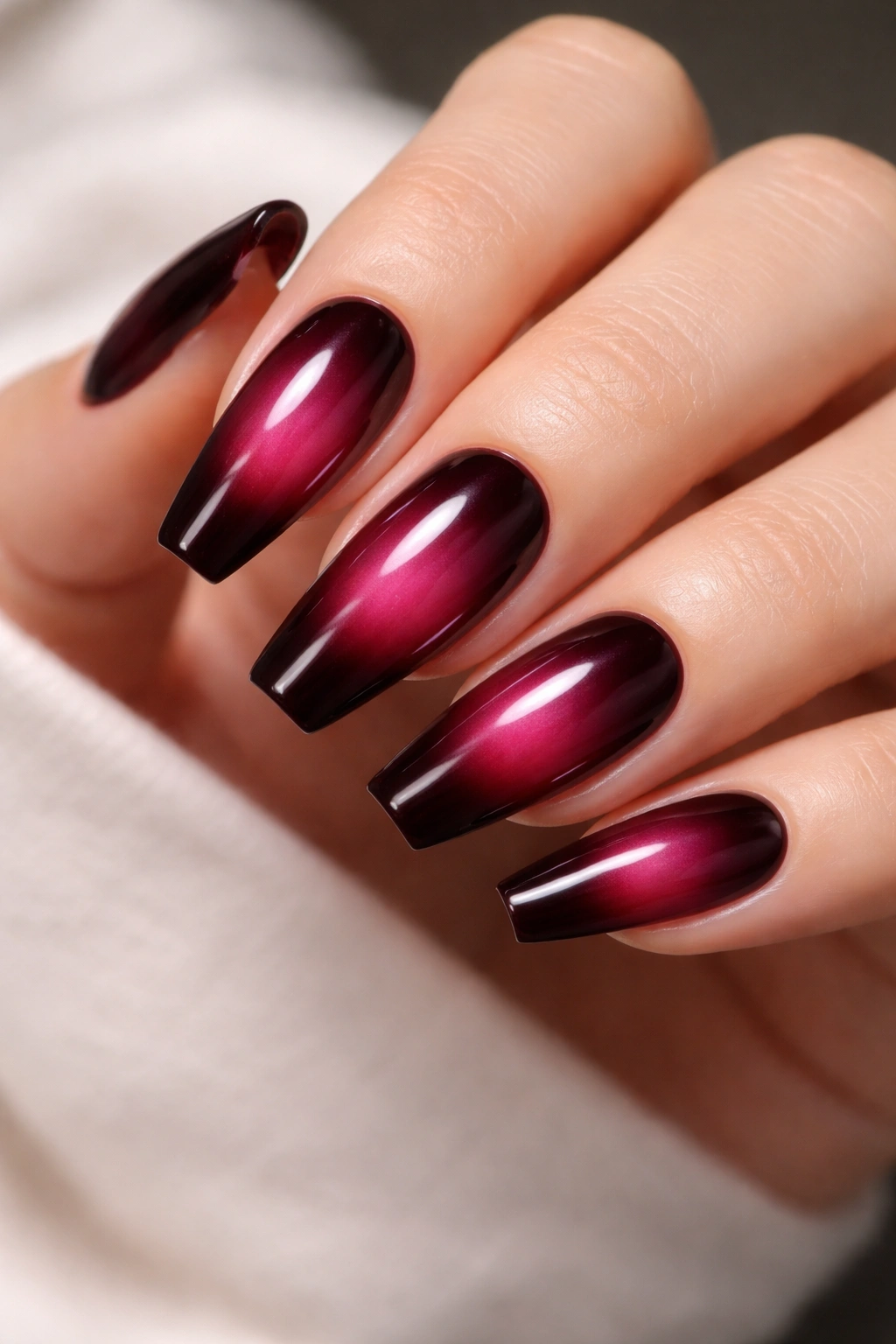
Soft fog in the center, deeper wine around it—the aura look gives dark red more depth without stacking on metal, gems, or heavy line work. On a ballerina shape, that diffused center draws the eye inward, which keeps the nails looking long and slim.
A good aura set needs close shades. If the center is neon pink and the border is dark burgundy, the contrast gets loud in a way that fights the shape. A plum center over a black cherry base, or a wine center over a brown-red border, stays richer and more grown.
Airbrush placement matters
Ask for the glow to stay centered and no wider than a dime on each nail. Bigger than that, and you lose the fade. Smaller than that, and the center reads like a dot instead of a bloom. Airbrush gives the smoothest result, though a sponge blend can work when the colors are near each other.
This is one design that handles a mixed finish well. A glossy top coat makes the center look deeper. A velvet matte finish turns it smokier. I lean gloss here because dark red needs light on the surface to keep its depth.
15. Black-Framed Dark Red Ballerina Nails
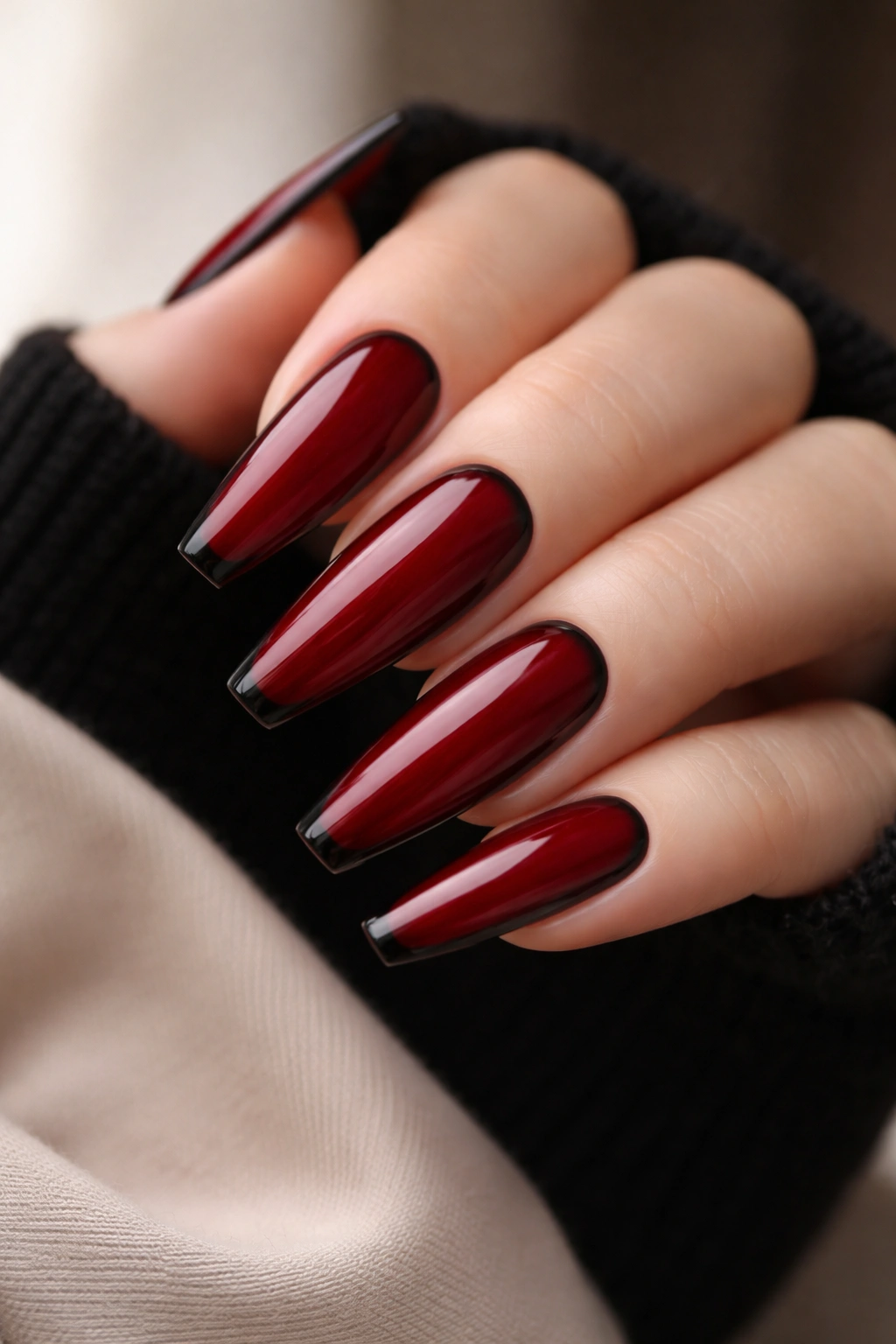
A slim black outline can make a dark red manicure look sharper than chrome.
That border—usually painted around the sidewalls and across the tip with a liner brush—acts like eyeliner for the nail. It defines the ballerina shape, narrows the silhouette, and gives the red center more contrast without changing the base color.
Precision decides whether this looks editorial or messy. The line should stay thin, around 0.5 to 1 mm, and it needs to track the exact edge of the nail. If the frame wobbles, the whole set looks off. I like this most over a burgundy cream or black cherry gloss, not glitter or cat-eye. Too much movement in the base competes with the outline.
Medium to long nails carry the border best. On short ballerina nails, the black line can crowd the shape unless the nail bed is naturally long.
One warning, because this design deserves honesty: pick an experienced tech. Freehand black framing on a deep red base leaves no room for “close enough.”
Final Thoughts
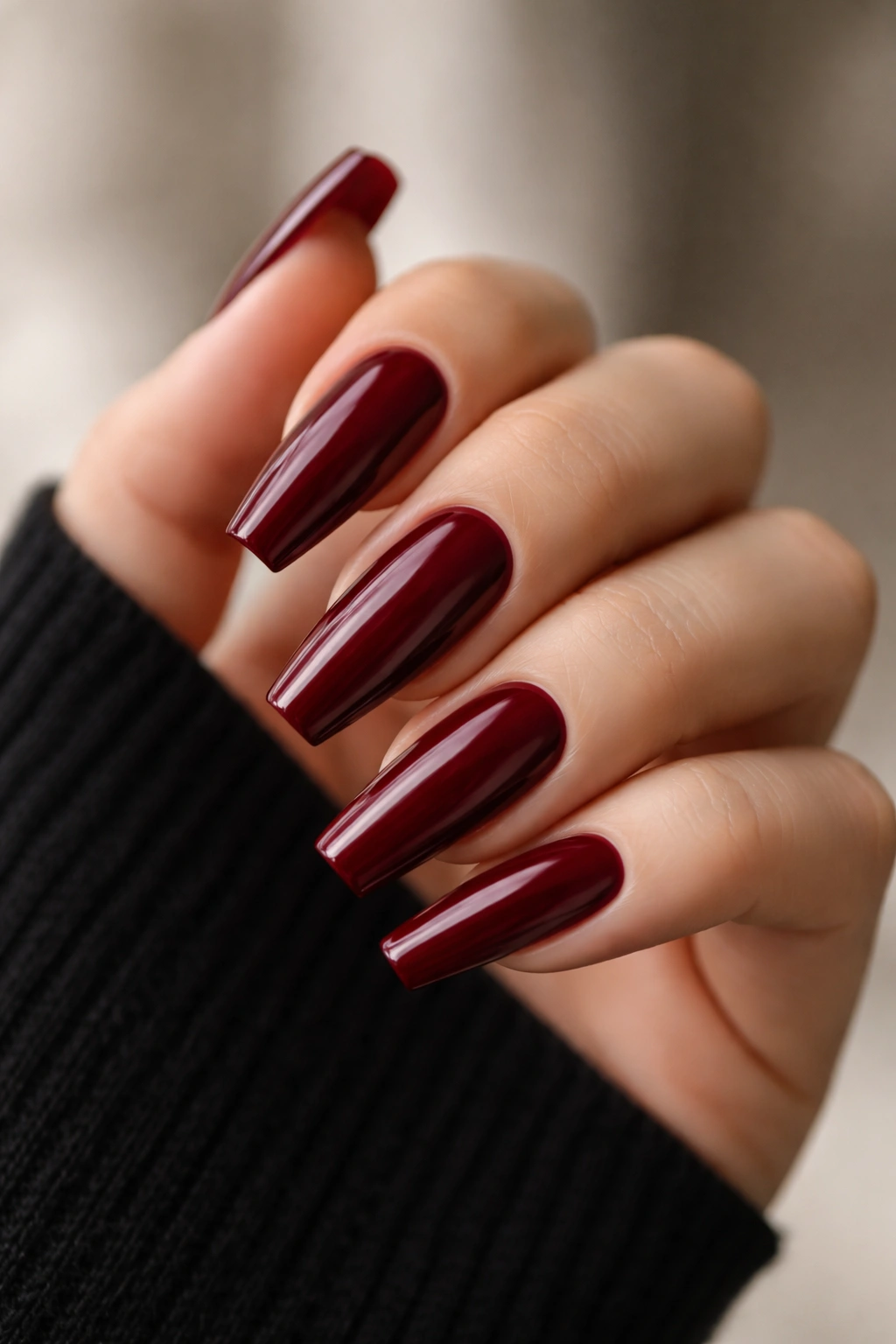
If you want the safest bet, go with glossy oxblood or a dark red micro French. Both carry that bold mood without asking your nail tech to juggle five effects at once. If you want the set people notice across a table, velvet merlot, cat-eye garnet, and a black-framed border bring more bite.
Deep red is one of those shades that rewards precision and punishes laziness. Clean sidewalls, thin coats, a smooth apex, and a cuticle line that looks drawn on with intent—those details matter more here than they do with pale pink or beige.
Bring a color photo and a finish photo. That one move saves so much confusion at the salon, because “dark red” can mean oxblood, burgundy, merlot, black cherry, garnet, or plum-red depending on who is holding the swatch wheel. Pick your red with care, keep the shape slim, and the ballerina silhouette does the rest.