

White had its reign. Then green walked in and made the French tip feel sharper, moodier, cleaner, and a lot less expected.
That shift shows up best on a coffin shape. Green French tip coffin nails have enough edge to feel fashion-forward, but they still keep the tidy structure people like about a French manicure. The tapered sidewalls slim the nail, the squared tip gives color room to show, and the green itself can swing in half a dozen directions—soft sage, murky olive, glossy emerald, acid lime, almost-black forest.
Tiny changes matter here. A smile line that sits 2 millimeters too low can make the nail look shorter. A base color that leans too pink can fight with olive or jade. And the wrong green—usually one that is too bright for the nude under it—can make the whole set feel louder than you meant.
When a green French tip works, though, it works hard. It gives coffin nails shape, contrast, and personality without covering the whole nail in color, which is part of the appeal.
Why green French tip coffin nails flatter the coffin shape
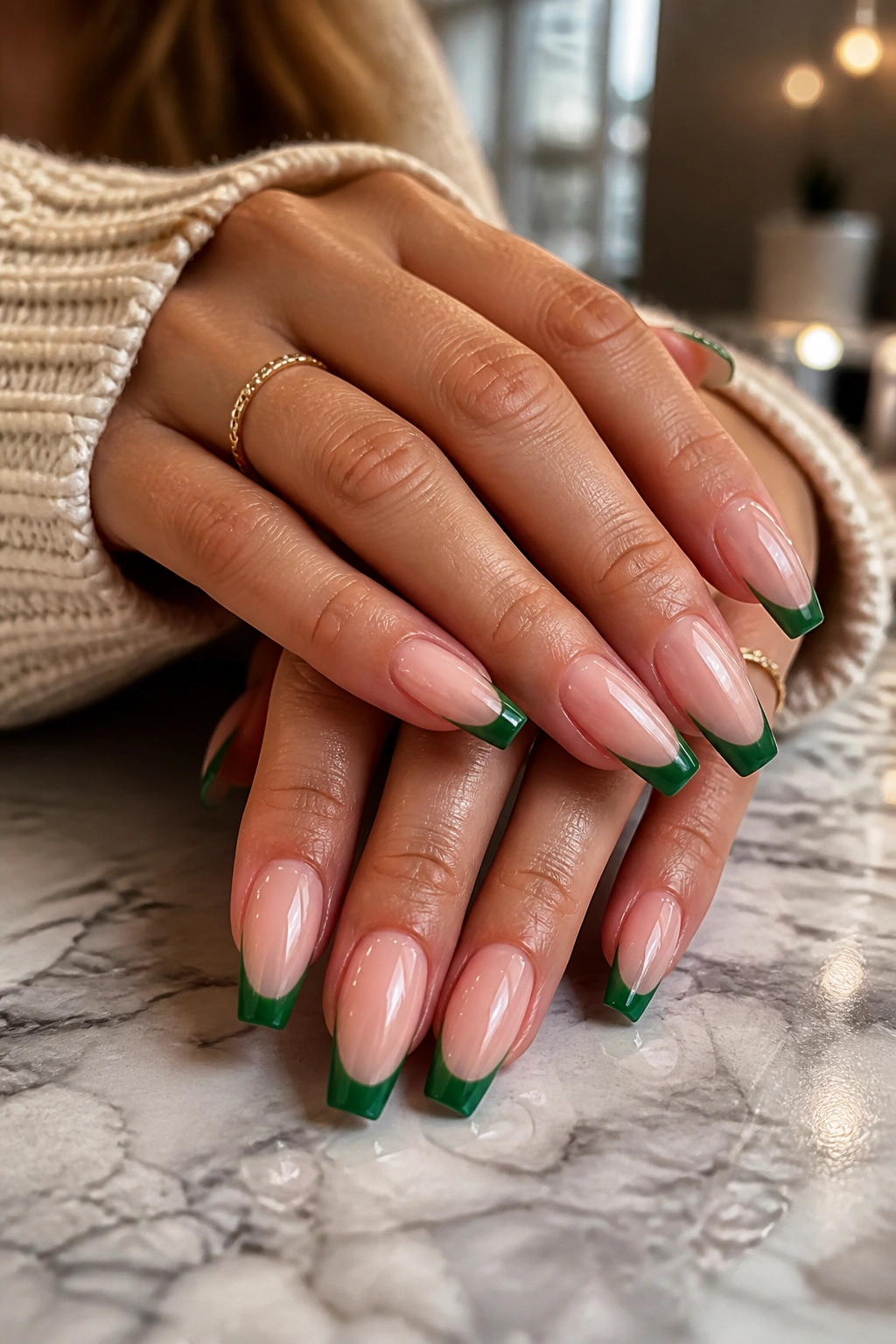
The coffin shape gives green somewhere to land. That is the first thing people miss when they try to copy a set they saw online onto a different nail shape.
A classic French tip depends on clean geometry. Coffin nails already have that built in: long side lines, a flat free edge, and enough width at the tip to hold a visible color band. On a rounded shape, green can blur into the curve. On coffin nails, it stays crisp. You get a clear border between the nude base and the color, and that contrast is what makes the design read from across the room.
Length changes the whole mood. On a short-to-medium coffin, a thin green tip looks neat and controlled. Stretch the nail another 4 to 6 millimeters, and the same color starts feeling bolder because the smile line has more space to arc. That is why a design that feels tasteful on medium acrylics can look dramatic on extra-long extensions without changing the polish shade at all.
The other win is balance. Full green coffin nails can look heavy, mainly with dark shades like hunter or forest. A French tip keeps the center of the nail open, which gives your eye a break. The set still has color—plenty of it—but it does not feel blocked in.
And green has range. White gives you one mood. Green gives you twelve.
Picking the base color, smile line, and green family
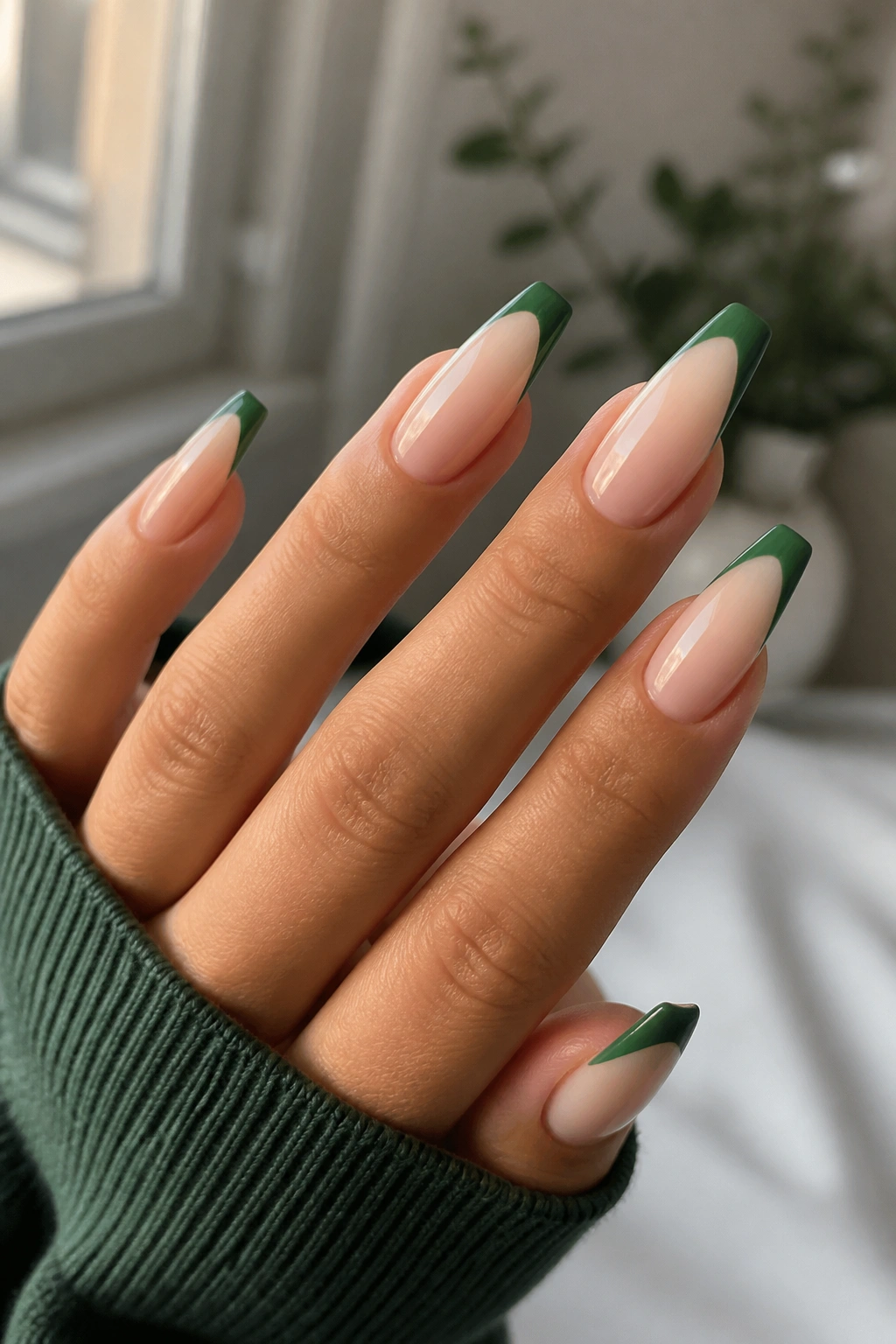
Question first: what kind of green are you after—soft, earthy, jewel-toned, bright, or near-black? If you do not answer that before you sit down, you end up swatching random bottles and hoping one clicks.
Match the nude base to the green
A milky beige or sheer neutral pink works with most green tips, but not every nude works with every green. Sage and pistachio look better over a soft beige-milk base than a rosy one. Emerald and jade can handle a pinker nude because the deeper color holds its own. Olive is picky. Too much pink underneath and the whole manicure can look off by a hair, which is enough to bother you every time your hands catch your eye.
Decide how thick the tip should be
Tip thickness changes the personality more than the color does.
- 1 to 2 millimeters: crisp, minimal, office-friendly
- 2 to 3 millimeters: balanced on medium coffin nails
- 4 millimeters or more: graphic, high-contrast, best on long sets
- Deep smile line with a high sidewall: makes the nail look longer
- Straight-across color band: stronger, more graphic, less delicate
Pick the finish before the polish
Glossy top coat makes green look deeper. Matte pulls out the powdery side of matcha, sage, and olive. Chrome dust shifts the color again—jade turns glassy, lime turns electric, dark green looks almost metallic. Nail techs know this, but it helps to say it out loud when you are booking the set you want.
What to ask for so your salon set matches the photo in your head
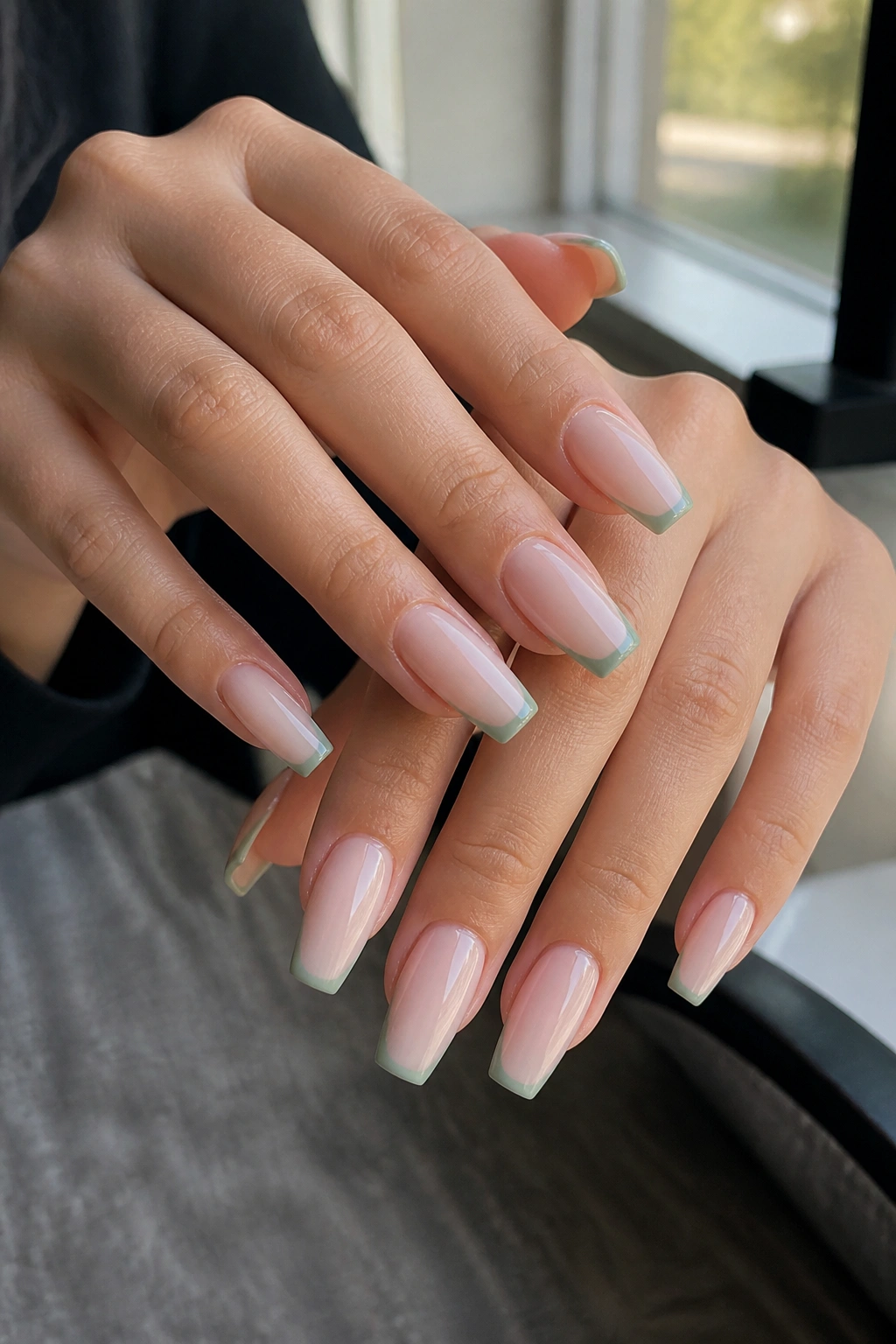
Bring the inspiration photo, sure. But photos leave out the details that decide whether the manicure suits your hands.
Ask for the shape and the design in separate parts. “Medium coffin, slim sidewalls, structured apex, sheer milky nude base, 2-millimeter sage micro tip, glossy finish” tells a nail tech a lot more than “green French tips.” It sounds picky. Good. Nails are visual, and visual things need specifics.
Tell them these six things before the first layer goes on:
- Length: short, medium, long, or extra-long
- Tip style: classic curve, deep smile line, angled tip, V-cut, reverse French
- Green shade: sage, olive, emerald, jade, lime, hunter, pistachio, matcha
- Base opacity: sheer, milky, semi-opaque nude, or nude-pink
- Finish: glossy, matte, chrome, velvet-cat-eye, or textured top
- Accent count: all ten nails the same, two accent nails, one feature nail per hand
Quick side note: if you want marble, chrome, croc texture, or foil, say that early. Those details change the order of service and can add 15 to 30 minutes.
A good set starts before the first brush stroke.
1. Soft sage micro tips on a milky nude base
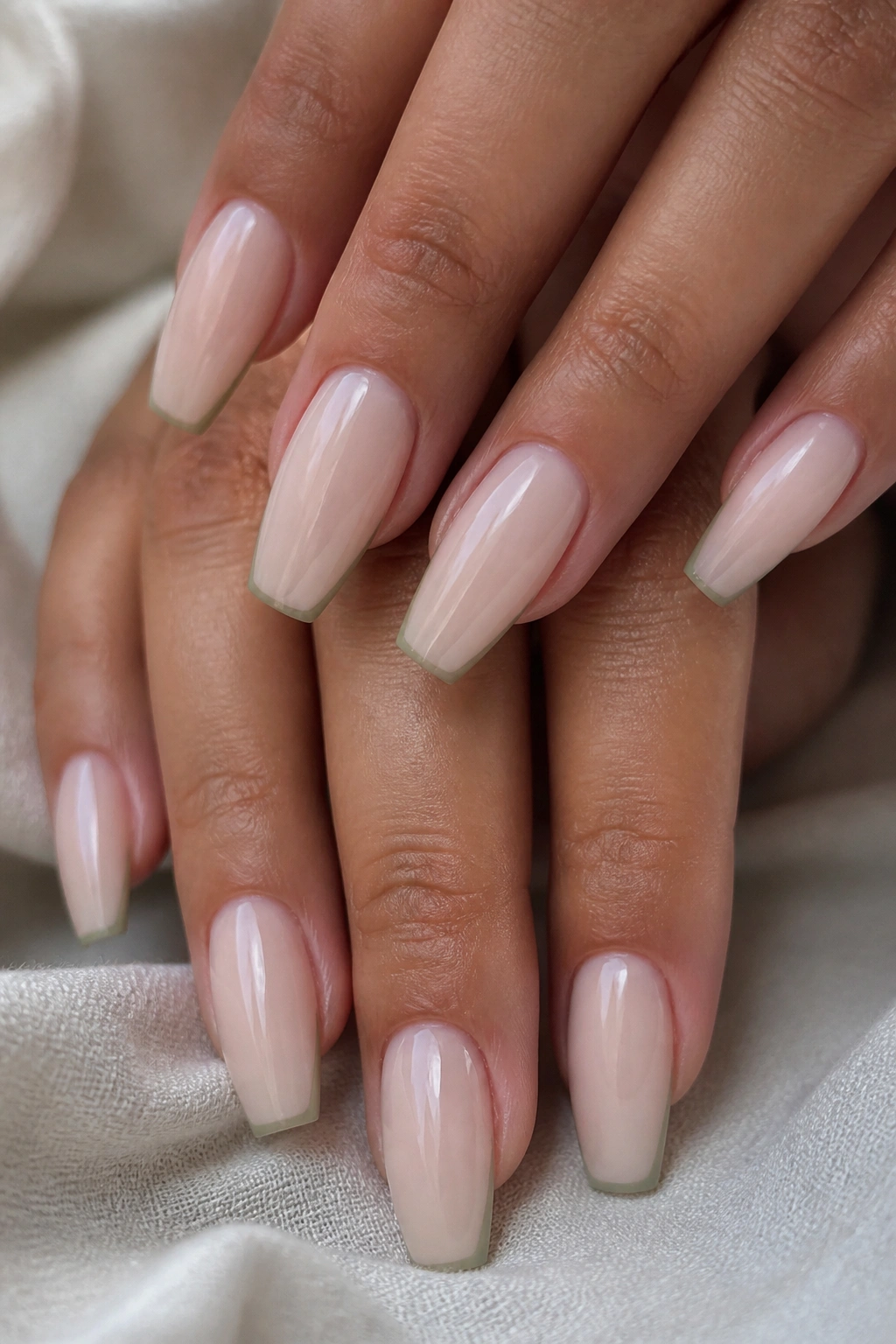
Soft sage is the green I keep coming back to when I want a French tip that feels fresh without turning into the only thing anyone notices. On a coffin shape, a micro tip in the 1 to 1.5 millimeter range sits right on the free edge and gives the nail a thin wash of color instead of a thick block.
Why the thin line works
Sage has a muted, gray-green cast, so it does not shout the way mint or lime does. That makes it ideal for medium coffin nails, mainly if you like a clean manicure but you are tired of white. The slim line keeps the shape looking long. A thicker sage tip can start reading dusty; a thinner one looks deliberate.
Use a milky nude base with low pink content. Too much rose in the base and the green can look muddier. I like this design most on medium length because the micro tip still shows when you gesture, type, or hold a cup, but it never feels heavy.
Best details to request
- Ask for a fine smile line brush instead of the bottle brush for the tip
- Keep the base sheer enough that the free edge is softened, not erased
- Cap the tip with color and top coat so the edge does not wear pale
- Choose glossy top coat if you want the green to look cleaner
Best move: keep all ten nails the same. Sage micro tips lose some charm when too many extra accents compete with that thin line.
2. Glossy emerald deep-curve tips
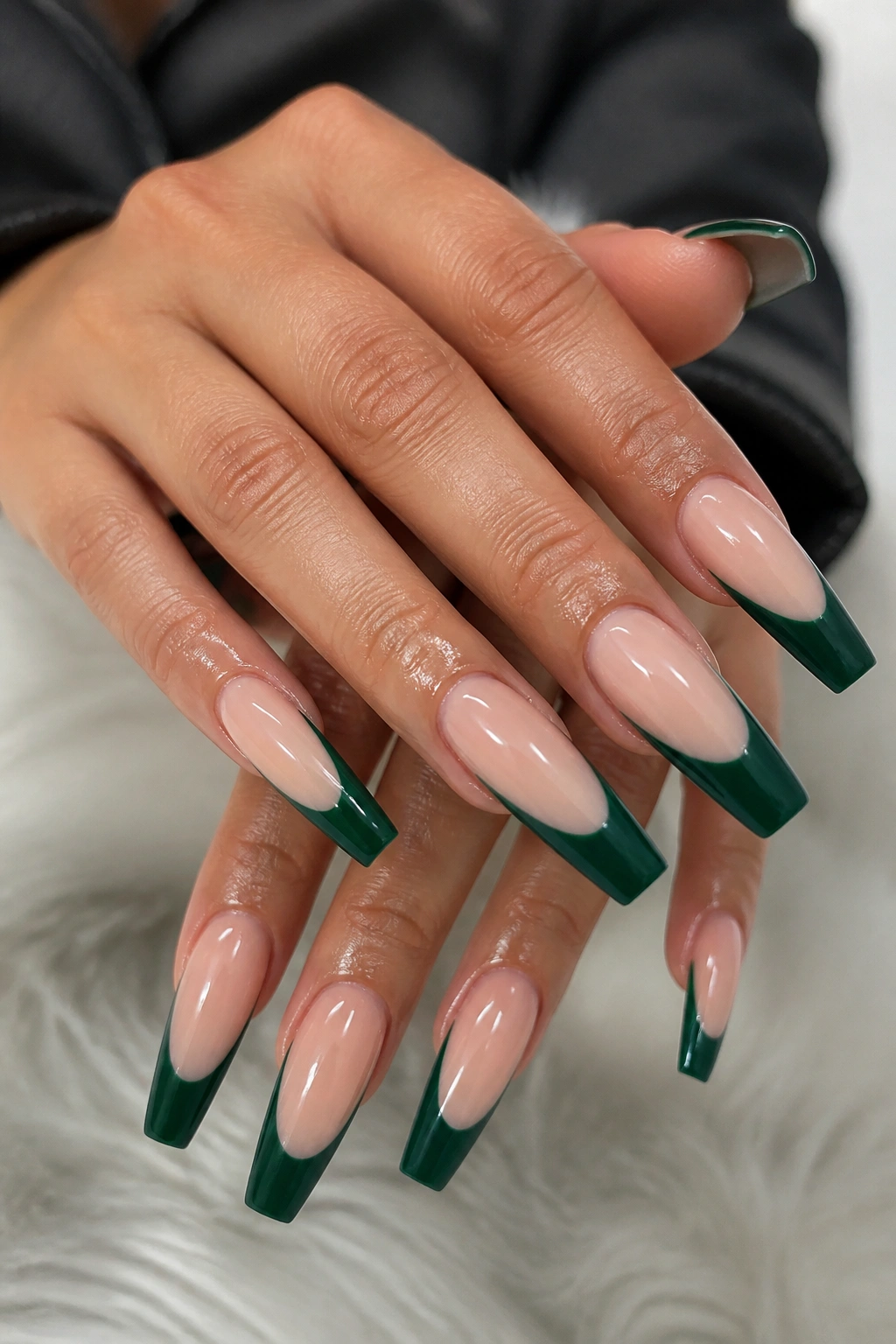
Emerald looks richer when you stop trying to make it subtle. This is not the shade for a shy little line.
A deep-curve emerald French tip uses a dramatic smile line that climbs higher on both sidewalls, which stretches the nail visually and makes the coffin shape look slimmer. On long acrylic or gel-x extensions, that deeper arc frames the nail bed in a way a flat tip cannot. It is cleaner, bolder, and more flattering than a thick straight band of polish slapped across the end.
The finish matters here more than people think. Emerald needs a high-gloss top coat to show that jewel-tone depth. Matte can flatten it and pull it toward a chalkier green-black. Gloss makes it look denser—almost glassy—and that density is part of the point. If your salon has multiple emeralds, ask to see them against the nude base first. One may lean blue, another may lean yellow, and under indoor lighting the difference is easy to miss until the manicure is cured.
I would skip crystals on this one. Emerald already carries weight. A cleaner set lets the color do the work, and on a coffin nail that sharp curved border is enough decoration by itself.
Wear this when you want the French tip to feel dressed up, not delicate.
3. Olive diagonal French tips with sharp side edges
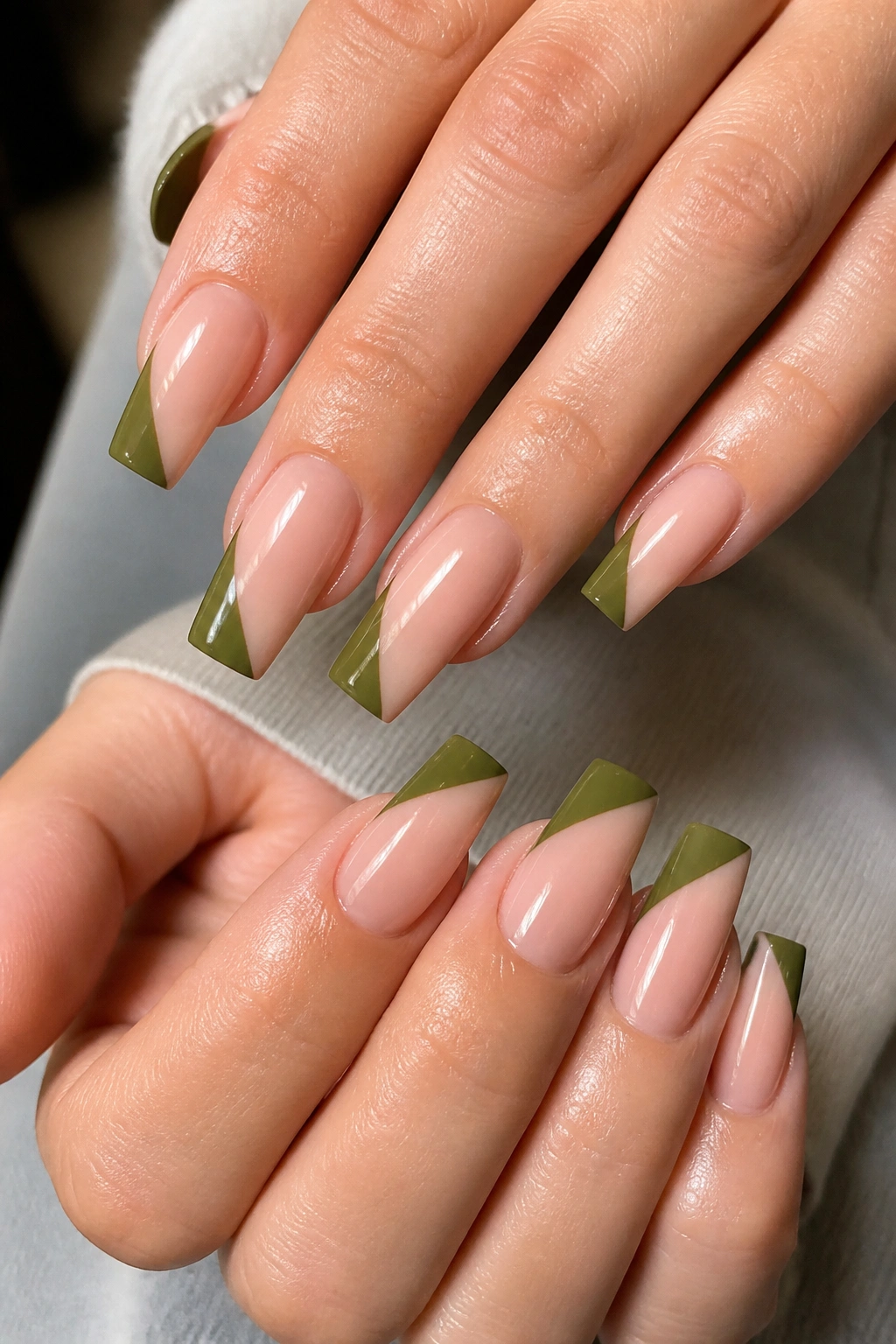
Why do diagonal olive tips look so good on coffin nails? Because the angle echoes the taper of the shape.
A diagonal French does not follow the classic smile line. Instead, the green slices across the tip from one sidewall to the other, usually rising from low on one side to high on the opposite edge. On a coffin nail, that slanted line makes the hand look longer and a little leaner. Olive is a smart choice here because its earthy cast keeps the design grounded. Neon would make the same angle feel harsher.
This set works best when the diagonal is clean and slightly off-center, not dramatic enough to hit the middle of the nail bed. Think controlled slant, not full asymmetry. I like it with a sheer beige base and a sharp glossy top coat. A matte top can work, though it tends to mute the line and soften the geometry.
How to wear it so it still feels polished
Keep the angle consistent across all ten nails, but mirror it hand to hand if you want a more tailored look. Left hand can sweep one direction, right hand the opposite. It is a small move, yet it makes the set look considered.
Olive diagonal French tips also play well with jewelry. Gold rings pull out the warmth in the green, while silver pushes it cooler and moodier. Neither is wrong. They just change the tone.
If you want a design that feels a touch less expected than a standard curved French, this one does the trick without becoming hard to wear.
4. Mint green double-line French tips
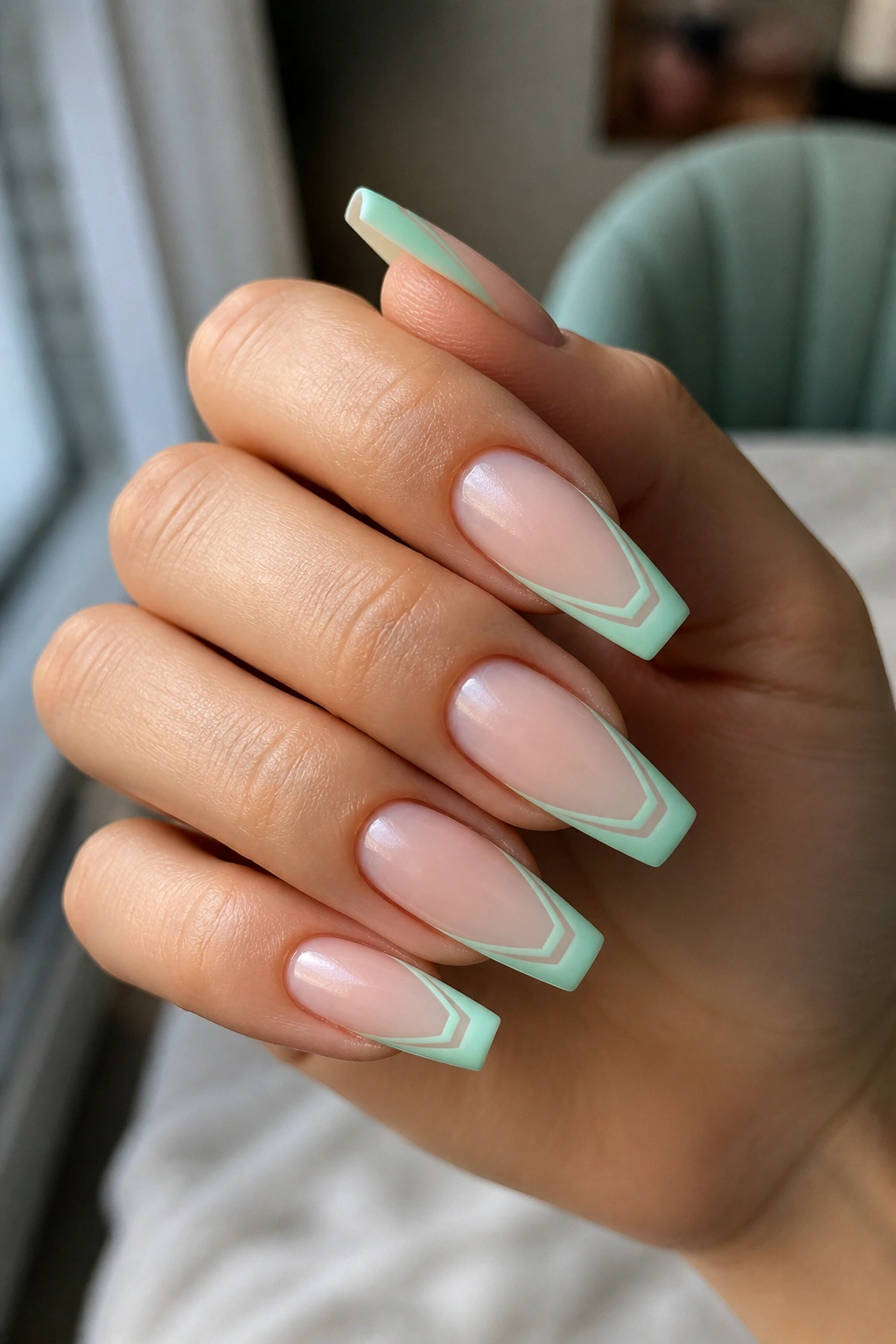
Picture a clear, bright mint line tracing the edge of the nail, then a second finer line sitting a millimeter below it. That gap of nude space between the two lines is what makes this design feel quick on its feet.
Double-line French tips have more movement than a standard French because your eye reads two borders instead of one. Mint gives it energy. On medium coffin nails, the look stays playful. On long coffin nails, it turns graphic.
A few details make or break it:
- Keep the top line 2 millimeters thick or less
- Make the lower line finer than the upper line
- Leave a visible nude gap between them—about 1 millimeter
- Use a cooler nude base so the mint does not look yellowed
- Skip chunky art on the rest of the nail
The reason this design works is spacing. If the two lines are too close, they blur together under top coat. Too far apart, and the set starts looking like two unrelated stripes. Nail techs who do hand-painted line work well usually nail this on the first try. If your tech prefers decals or stamp art, I would steer them toward another style.
Mint can lean candy-sweet fast. The double-line format keeps it cleaner and sharper, which is why I like it on coffin nails more than on rounded shapes.
5. Forest green V-cut tips with negative space
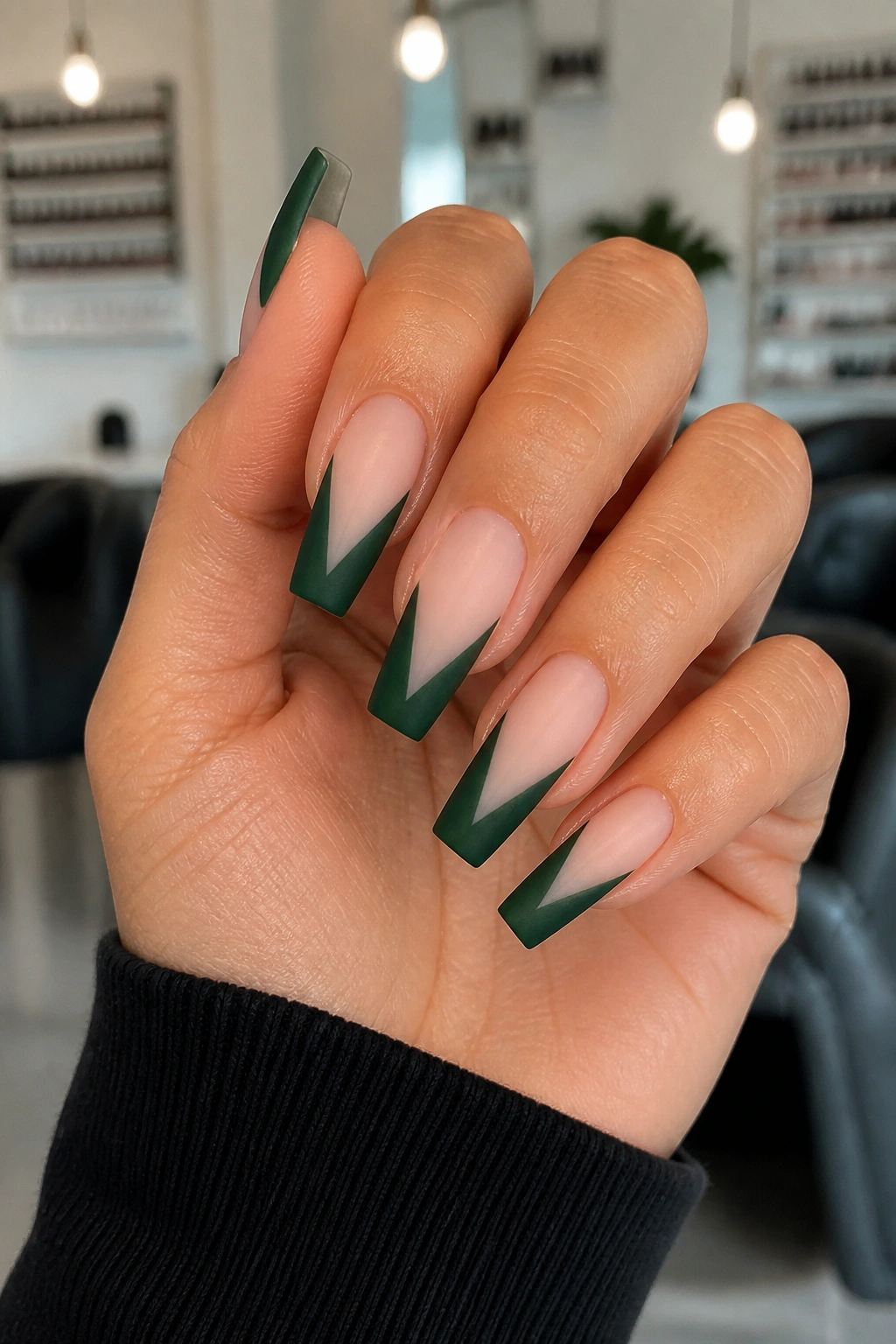
A lot of French tip designs get softer as they get more creative. This one gets sharper.
Forest green V-cut tips replace the curved smile line with a pointed V shape at the center of the nail. On a coffin nail, that point echoes the taper without fighting the square edge, and the result feels architectural in a way standard French tips do not. If you want something with edge but you still need it to look intentional at work, this is a smart middle ground.
Negative space matters here. Leave the center of the nail bed open with a sheer nude or clear pink base so the V shape reads cleanly. Fill too much of the nail with dark green and the design loses its lift. Forest green has enough depth that even a narrow V shows up from a distance. A lighter green would need more width.
This is one of the few green French tip coffin nail ideas that can handle a matte finish without losing impact. Matte makes the forest tone look velvety and slightly darker. Gloss makes it look cleaner and more classic. I lean matte for fall wardrobes and gloss when I want the shape to do less talking than the color.
Keep the V point centered. Off by even a hair, the whole set can look crooked—mainly on the thumbs, where symmetry gets harder. A striping brush and a quick flash-cure between sides help a lot here.
6. Matcha green tips with a soft matte top coat
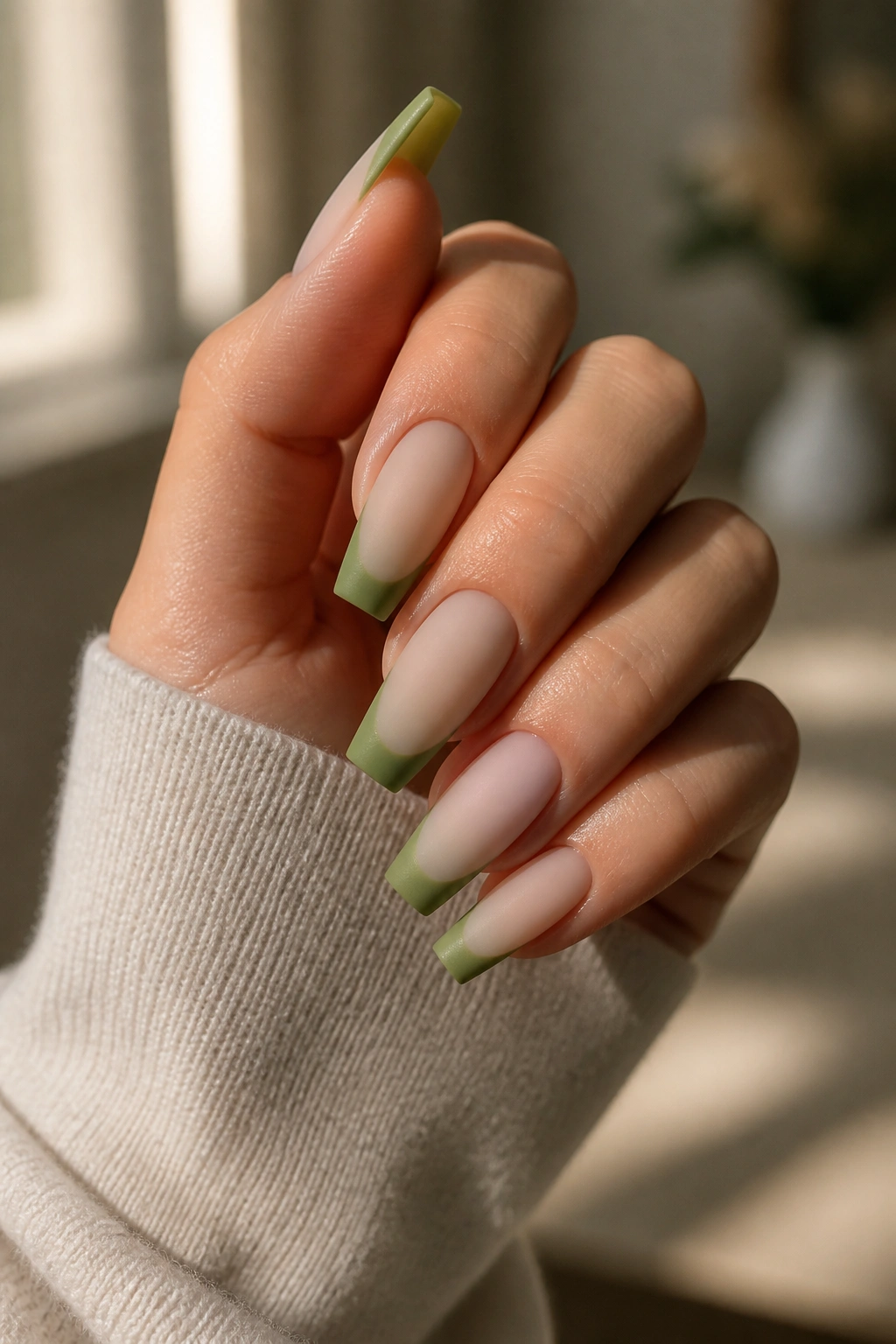
Unlike emerald, matcha needs restraint. It is a muted yellow-green, and too much shine can make it read flat rather than creamy.
That is why a matte top coat works so well on matcha French tips. On coffin nails, the shape still brings structure, but the finish pulls the whole set into a softer lane. You end up with a manicure that feels calm, intentional, and a little fashion-editorial without acting precious about it.
This one suits medium-length coffin nails better than extra-long ones. Long length plus matte matcha can feel heavy, mainly if the tip band is thick. Keep the tip around 2 millimeters, maybe 2.5 if your nails are long-narrow. Use a beige-milk base, not a pink one. Matcha and rosy nude are not natural friends.
Who is this best for? Someone who wants green French tip coffin nails that still sit comfortably beside knitwear, trench coats, simple rings, and neutral makeup. It is not a party nail. It is a taste nail.
One catch: matte top coats show scratches sooner than glossy ones, and green makes that wear easier to see under direct light. If you use your hands hard—opening boxes, typing all day, cleaning without gloves—ask your tech for a matte finish over builder gel so the surface stays smoother longer.
7. Lime green outline French on a clear coffin base
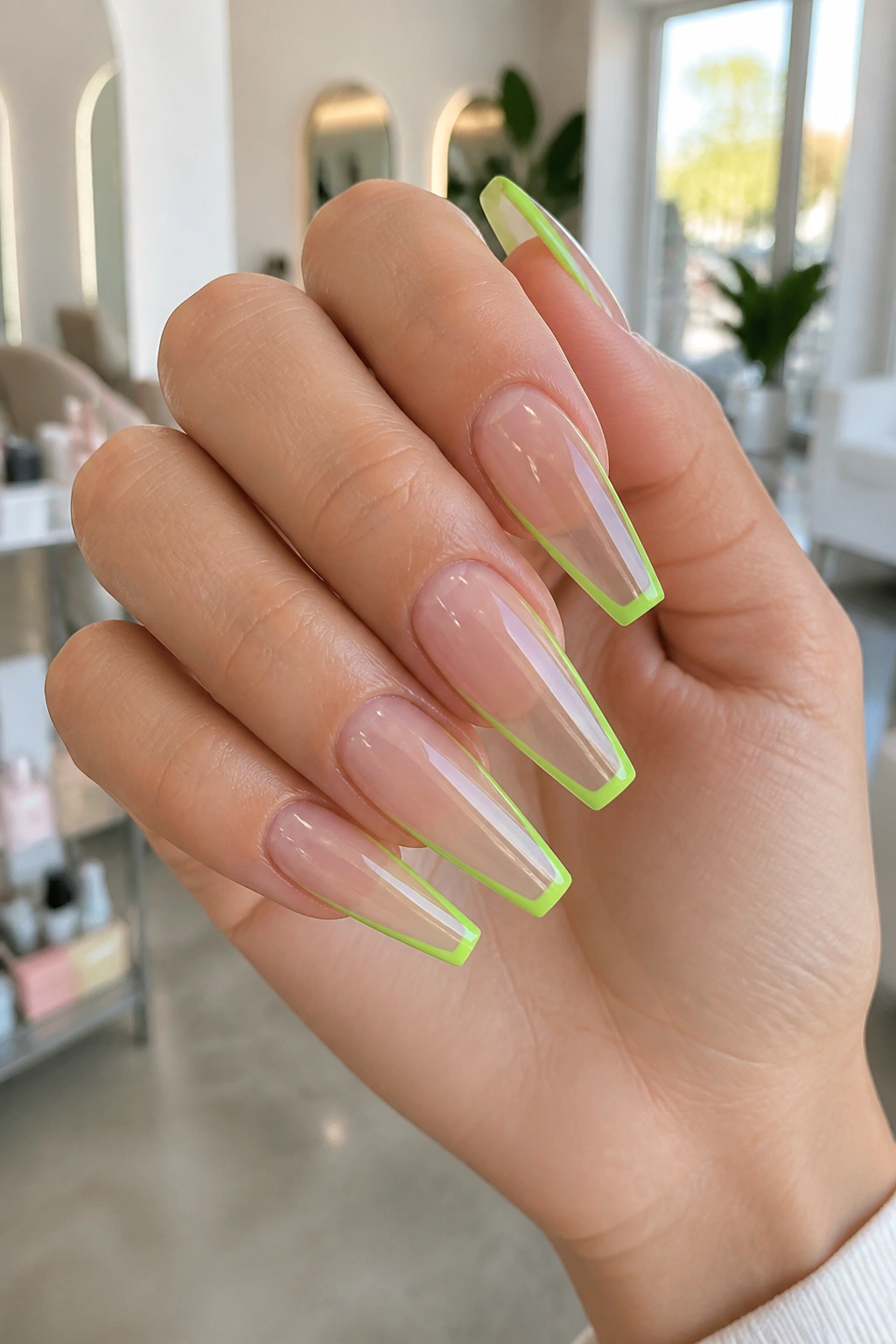
Small shock of color. That is the charm here.
Instead of painting a full tip, this design outlines the edge of the coffin shape in lime green, tracing the free edge and sometimes the sidewalls with a thin line while the main body of the nail stays clear or barely tinted. It is lighter than a full French and more graphic than a micro tip.
What makes it different
The clear base gives the lime room to pop without turning the whole manicure fluorescent. On a regular opaque nude, lime can feel dense and a bit sporty. Floating it on a transparent or jelly base keeps it airy. The coffin outline also makes the shape itself the feature, which is smart if you paid for a crisp sculpted set and actually want people to notice the structure.
Best details for the cleanest version
- Use a jelly nude or clear-pink base, not an opaque builder cover
- Keep the outline line thin—about 1 millimeter
- Trace the corners cleanly so the square tip stays visible
- Use glossy top coat; matte kills the electric edge of lime
Pro tip: ask your nail tech to reinforce the free edge before outlining if you wear long extensions. Thin neon lines show chips fast.
8. Jade marble French tips with scattered gold foil
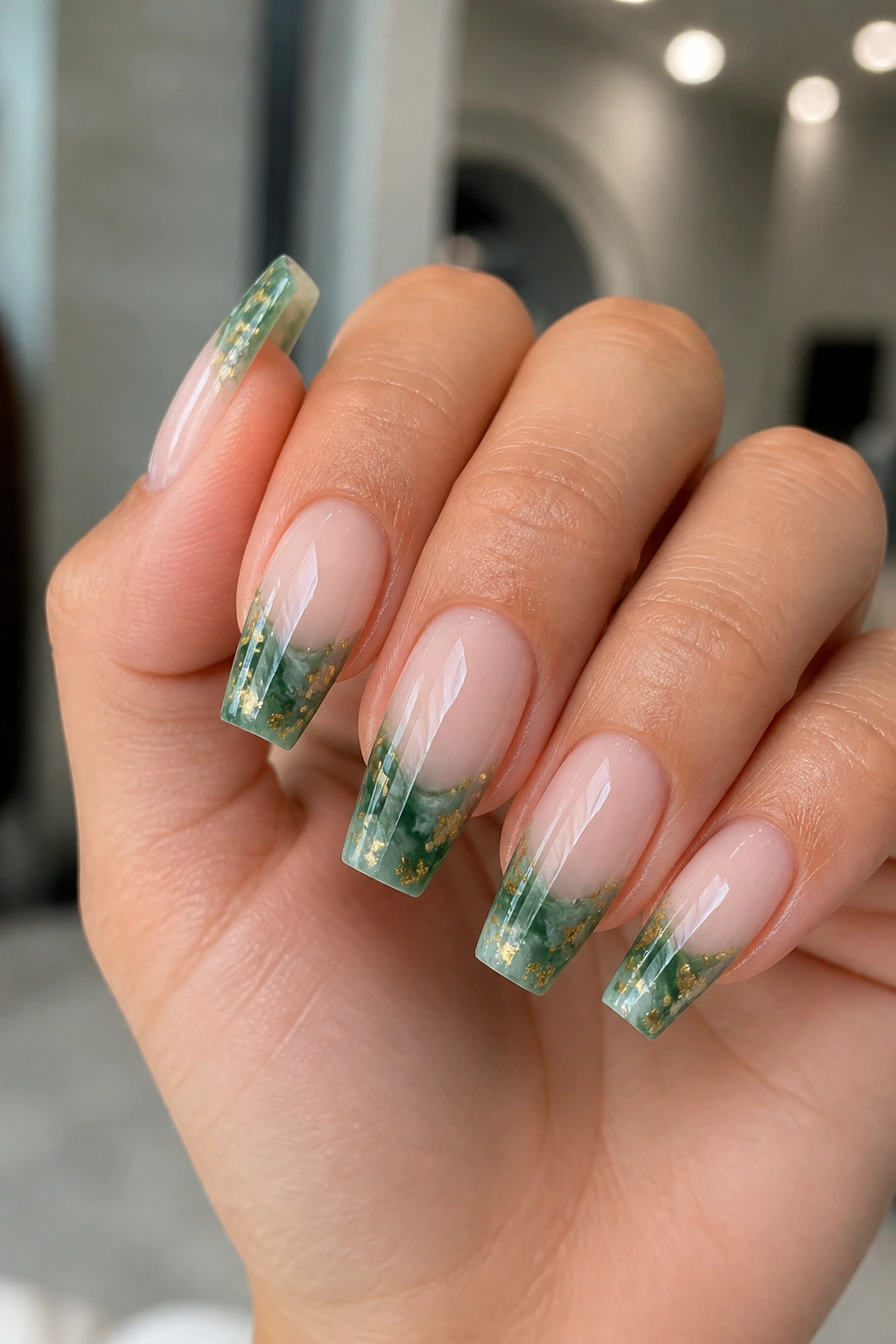
Marble can get messy fast. Jade marble, though, has a built-in advantage: the color family already looks good with soft variation.
On coffin nails, a jade marble French tip gives you the structure of a French manicure with the movement of stone veining. The trick is to keep the marble effect on the tip area only. Let the nail bed stay clean with a milky neutral base, then swirl two jade tones plus a touch of white or translucent gel across the tip before outlining the border. Gold foil works best in tiny broken flecks, not large chunks. Think mineral streaks, not confetti.
I would use marble on two to four nails total, then keep the rest of the set in solid jade French tips. Ten marble tips can look busy, and the coffin shape already brings enough visual line. Accent placement on the ring finger and thumb usually feels balanced because those nails get noticed most in motion.
A small warning here. Cheap foil can oxidize under some top coats and turn dull brassy-green after a stretch of wear. Good salon-grade foil holds color better. If your tech has both leaf foil and transfer foil, ask for the finer one. It sits flatter and feels less bulky under the top coat.
This is a richer set than a plain French, though it still reads tidy because the decoration stays parked at the tip.
9. Hunter green reverse French with a classic tip line
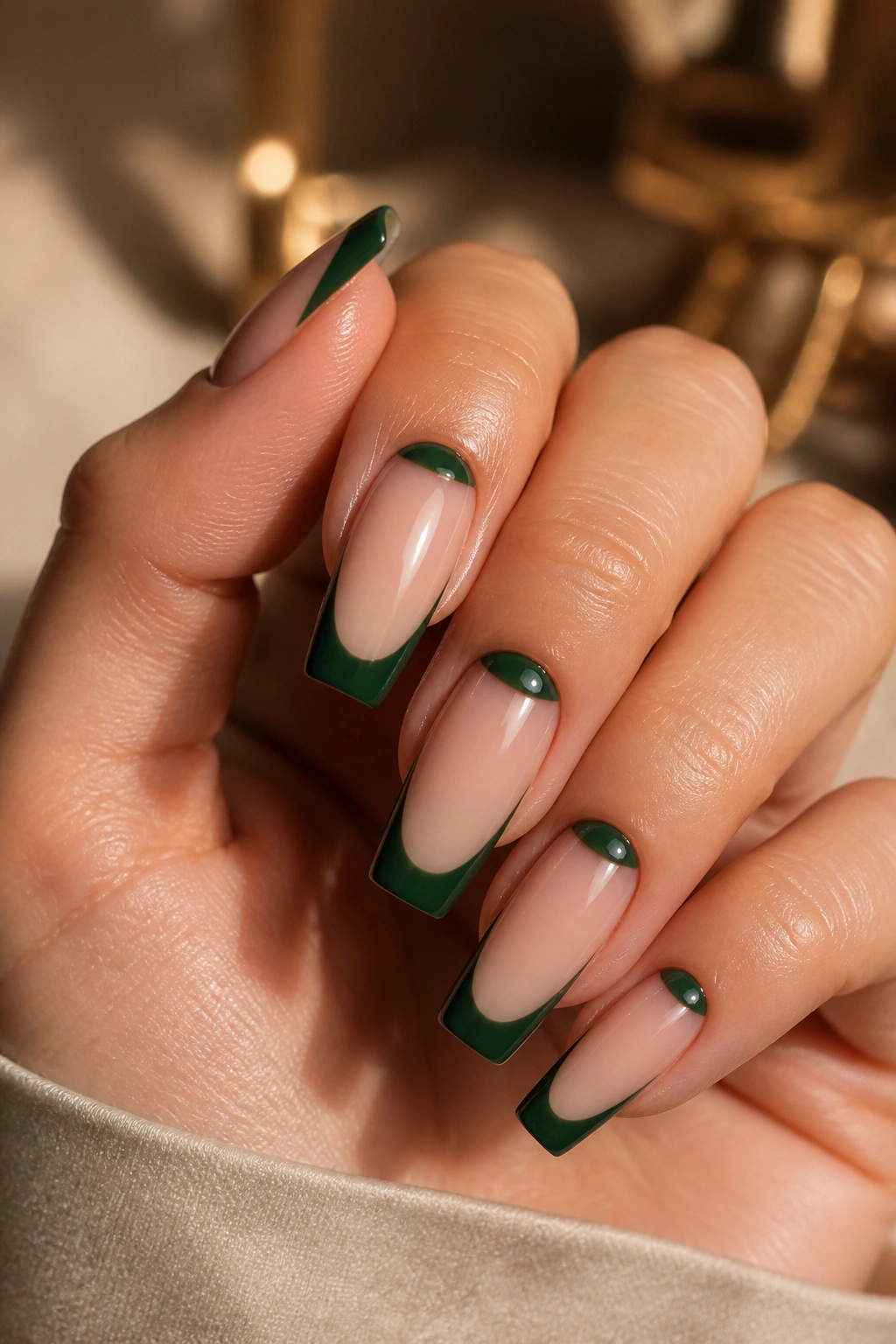
A reverse French can rescue green from looking predictable. That is the whole pitch.
Instead of placing all the color at the free edge, this design uses a slim hunter-green half-moon near the cuticle and then repeats the same green at the tip. The nail bed between those two points stays nude. On coffin nails, that framing effect makes the entire shape look longer and more sculpted. You get symmetry at both ends, which is rare in French manicures and strangely satisfying once you notice it.
Hunter green is the right choice because it has enough depth to frame without looking black. Lighter shades lose impact at the cuticle. Darker shades can turn muddy against some skin tones. The sweet spot is a cool, deep green with a clean finish and no shimmer.
This design asks for precision. The cuticle arc should be fine and tight, usually 1 to 1.5 millimeters, while the tip can go slightly thicker at 2 millimeters. If both bands are equally thick, the set can look boxed in. That little difference keeps the eye moving.
I like this for people who want something dressier than a plain French but who do not want rhinestones, decals, or chrome dust. It feels strict—in a good way.
10. Pistachio angled tips with a tiny crystal accent
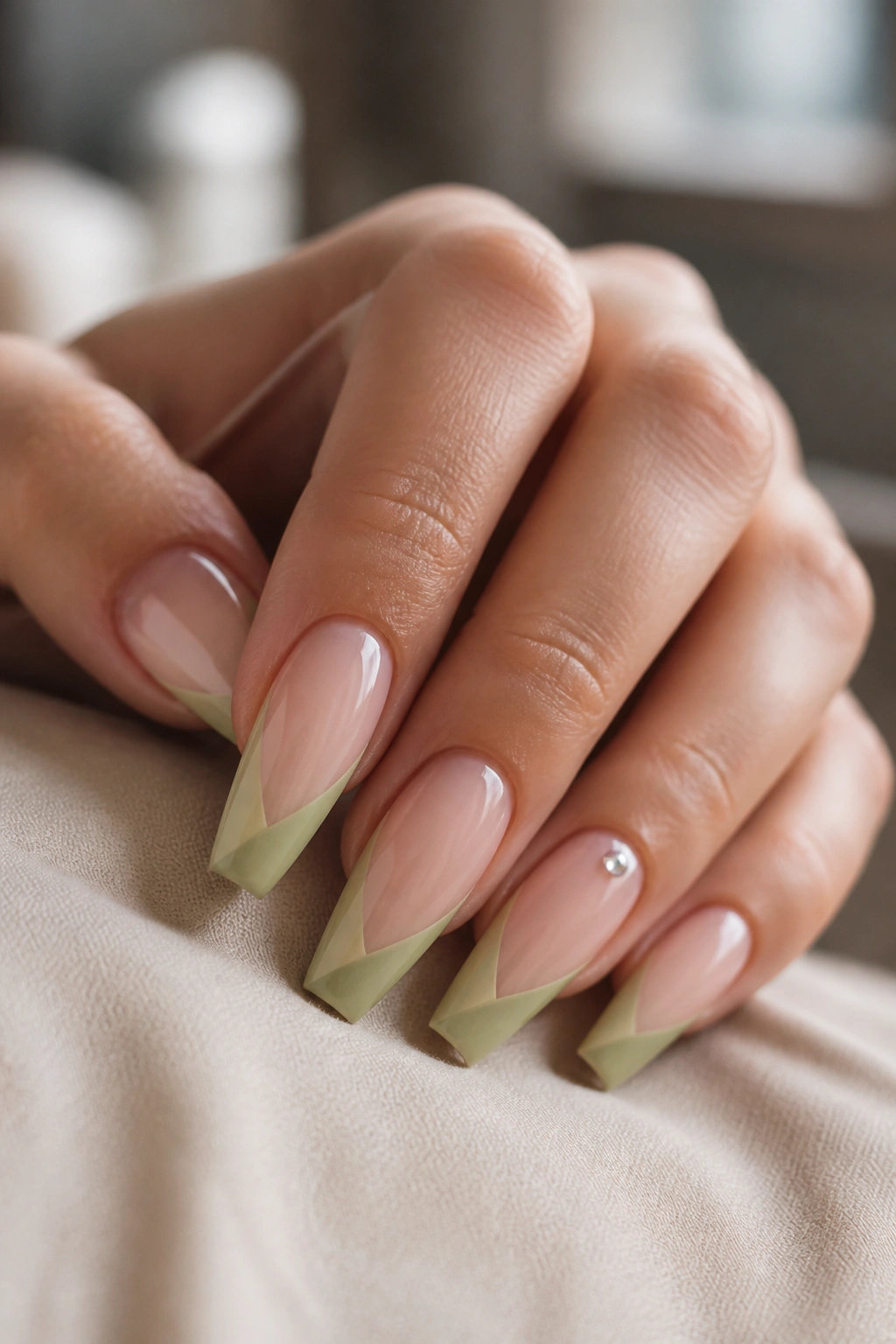
Does every green French tip need art? No. But one tiny crystal in the right place can change the whole feel of a soft shade like pistachio.
Pistachio sits lighter and milkier than sage. It has a creamy pastel tone that can look washed out if the design is too plain, which is why an angled tip helps. The slanted edge gives the color shape, and a single 1.5 to 2 millimeter crystal near the high point of the angle adds a small hit of shine without pushing the set into bridal territory.
How to keep this one from turning sugary
Use a sheer beige base, not baby pink. Keep the crystal placement limited to one or two nails per hand. And make the angle clean enough that the pistachio reads sharp rather than soft-focus. I also like a slightly longer coffin here because the extra length gives the diagonal room to breathe.
Silver crystal settings pull pistachio cooler. Gold settings warm it up. If you wear mostly gold jewelry, that tiny coordination matters more than you might think. Your manicure will feel more cohesive, even if no one can explain why.
This is a good choice when you want green French tip coffin nails that still feel light and a touch dressy, with enough sparkle to catch the eye during movement and nothing more.
11. Neon green ombré French fade on long coffin nails
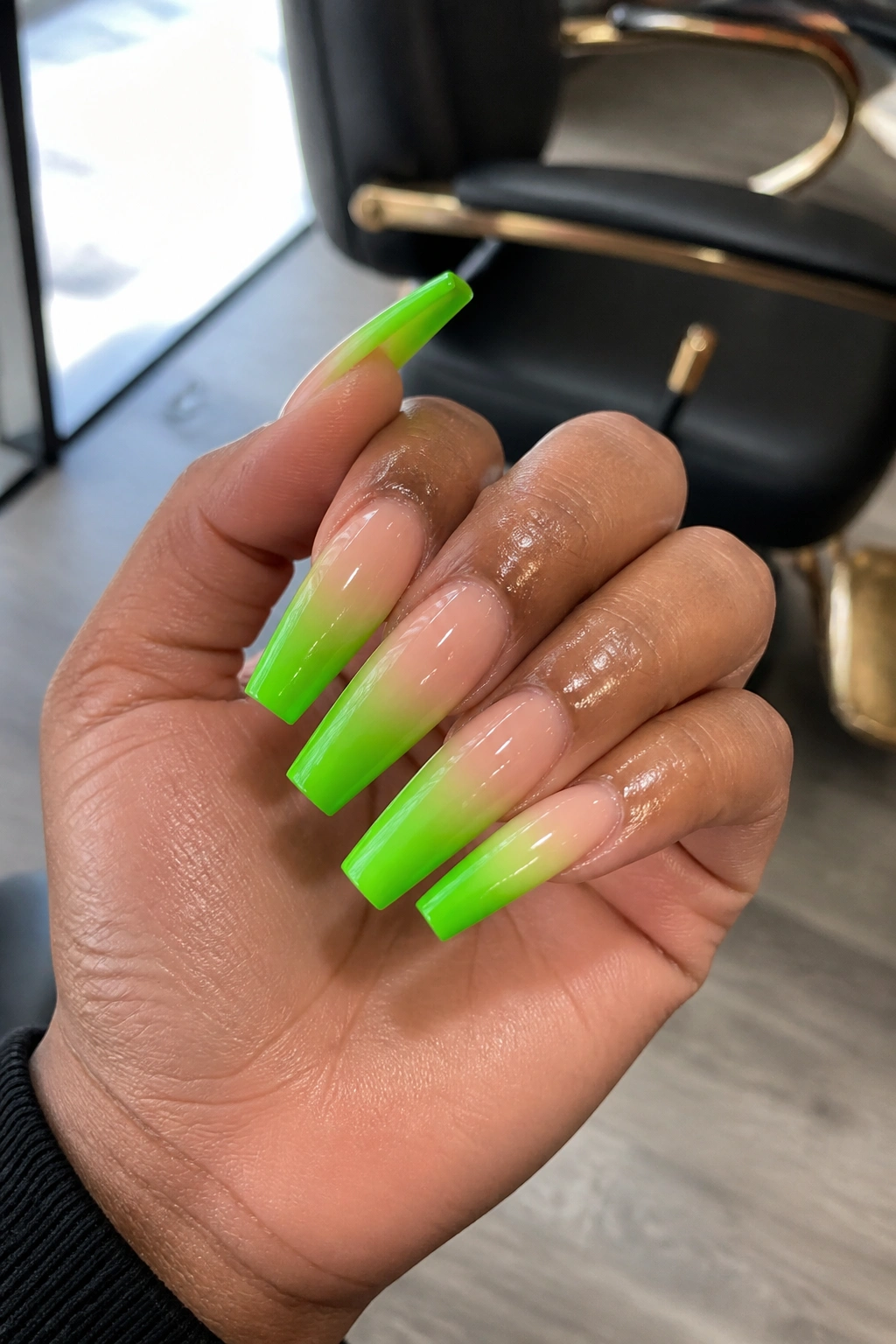
Not every French tip needs a hard line. A fade can hit harder.
A neon green ombré French starts with the color concentrated at the edge of the nail and diffused downward with a sponge, airbrush, or soft gel blending brush. On long coffin nails, that haze of green feels less rigid than a stripe and more like color moving through the tip. The extra length matters here. On short nails, the fade eats too much of the nail bed and the effect gets lost.
This is where I break my usual rule about keeping green controlled. Neon earns its space when it is softened by gradient. The fade takes the raw sharpness out of acid green and turns it into something more wearable. You still see the color first. You just do not get that abrupt stop-start line of a standard French.
Use a transparent milky base so the fade has somewhere to disappear into. If the base is too opaque, the ombré can look chalky. A glossy top coat usually gives the cleanest finish, though chrome powder over the fade can look wild in the best way if you want the manicure to lean clubby rather than polished.
I would not stack extra art on this set. The fade already does enough.
12. Dark green croc-texture French tips
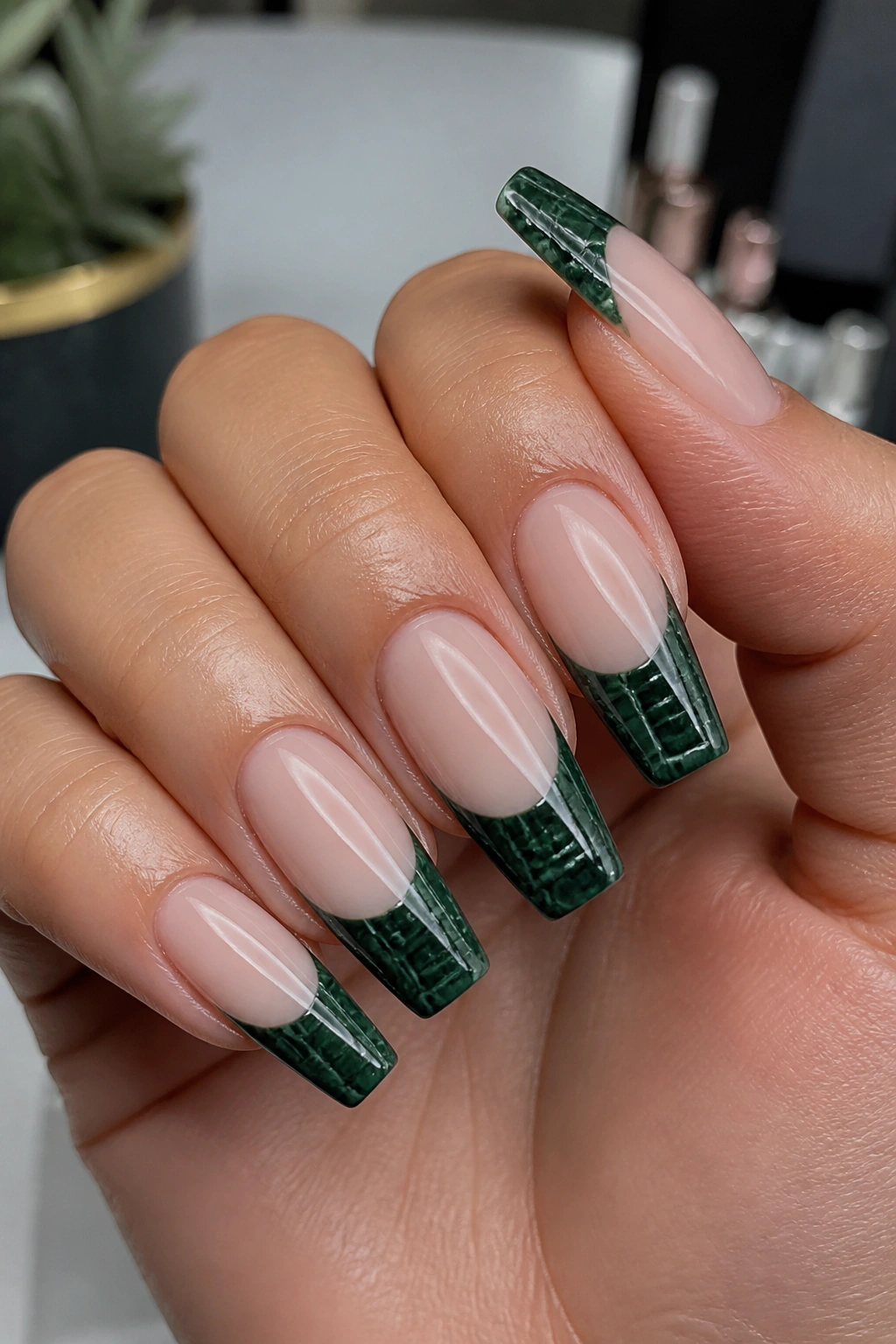
Run your eye across a dark green croc tip and you get depth, shadow, and little pockets of shine where the raised pattern catches the top coat. It is tactile-looking, even when the surface is sealed smooth.
This design uses a croc or reptile-style pattern only on the French tip portion of the nail, usually over a blackened green, deep emerald, or bottle-green base. On coffin nails, the texture works because the tip gives the pattern a boundary. Full croc nails can feel heavy. Croc French tips keep the drama parked where it belongs.
What makes texture work here
You need contrast inside the pattern. A croc effect made with one flat green dies on the nail. Ask for a darker base with a lighter or glossier pattern floating on top, or the reverse. Some techs use blooming gel. Others use a dotting technique and cure in short bursts. Both can work if the scale size stays small enough for the width of your nails.
Details that keep it sharp
- Best on medium-long to long coffin nails
- Works well with a plain nude base and no extra accents
- Looks strongest under high-gloss top coat
- Tip depth should stay controlled—about 3 millimeters
- Dark bottle green often reads cleaner than black-green
My take: if you want green French tip coffin nails that feel fashion-heavy and a little moody, this is the one I would save for.
How to make green French tip coffin nails last longer
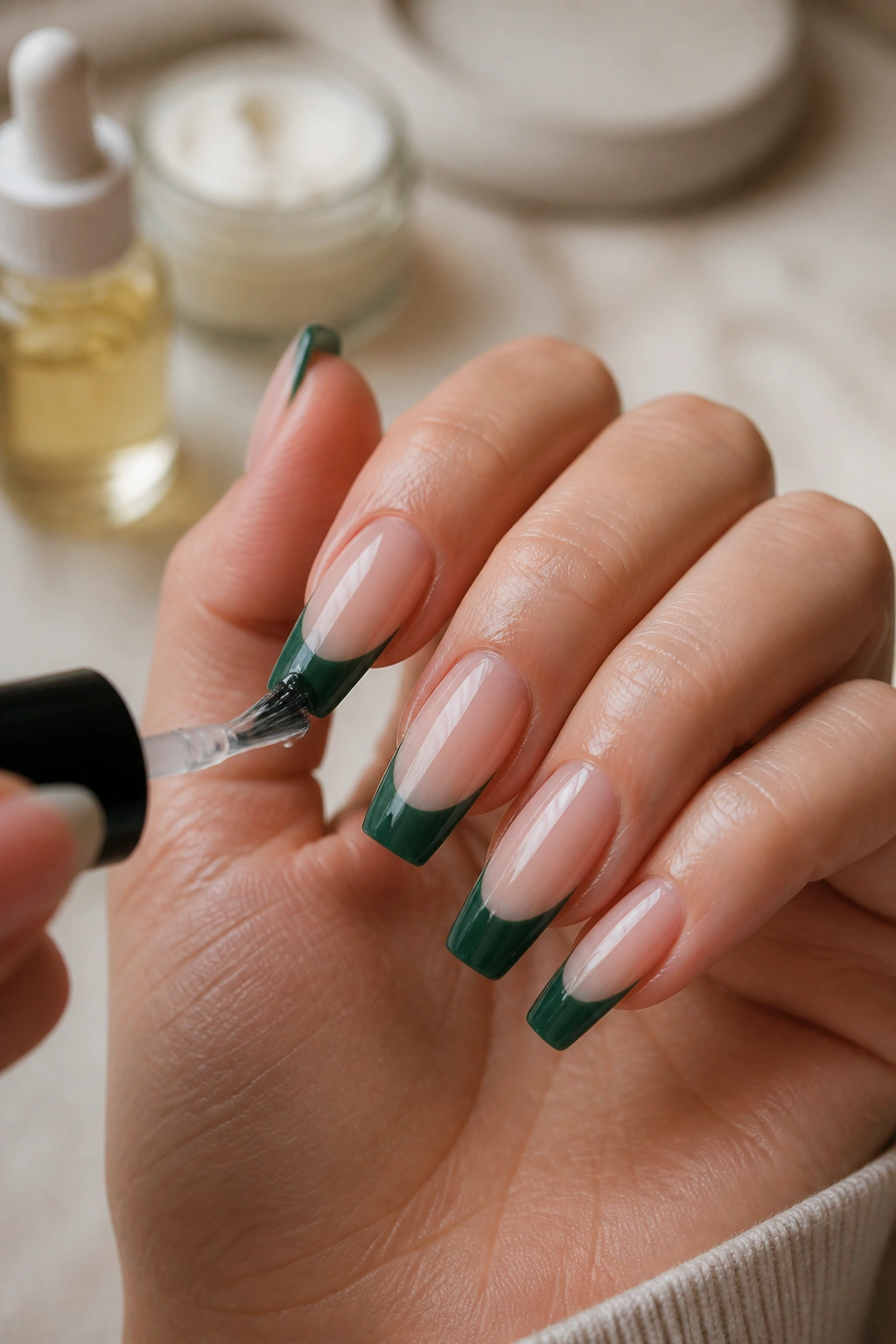
Nail art gets the attention. Prep decides whether it survives week two.
Green tips—mainly dark green, neon, and any design with crisp borders—show wear faster than soft nude sets. When the edge chips, you see it. When the top coat dulls, you notice. Ask your tech to cap the free edge with both color and top coat, and if you wear long coffin nails, builder gel underneath helps keep the tip from flexing.
At home, the boring habits matter most:
- Use cuticle oil once or twice a day
- Wear gloves for dishwashing and long cleaning sessions
- Do not use the nail tips to pry labels, cans, or boxes
- File snags early with a fine-grit file instead of picking
- Add a fresh glossy top coat after 6 to 8 days if you do your own maintenance
Matte sets need more care. Chrome needs gentler care. Crystal accents need the most care of all because hair can catch where placement lifts. If you know you are rough on your hands, pick a glossy solid-line French over marble, foil, or texture. Less to go wrong.
And if the design depends on a crisp thin line, book your refill before the grow-out ruins the proportion. A French tip can still be intact and still look off once the gap at the cuticle gets too wide.
Final Thoughts
Green works on coffin nails because it gives the shape contrast without smothering it. The best sets are not always the loudest ones, either. Sometimes a 1-millimeter sage tip says more than a full set of chrome and stones.
I would choose based on mood, not trend pressure. Soft greens like sage, matcha, and pistachio feel cleaner and easier to wear for weeks. Emerald, hunter, neon, and croc-texture tips make more of a statement and look best when you want the manicure to carry part of the outfit.
If you are stuck between two ideas, pick the one with the better line work. Shade matters. Finish matters. But on a French tip, the line is the whole argument.