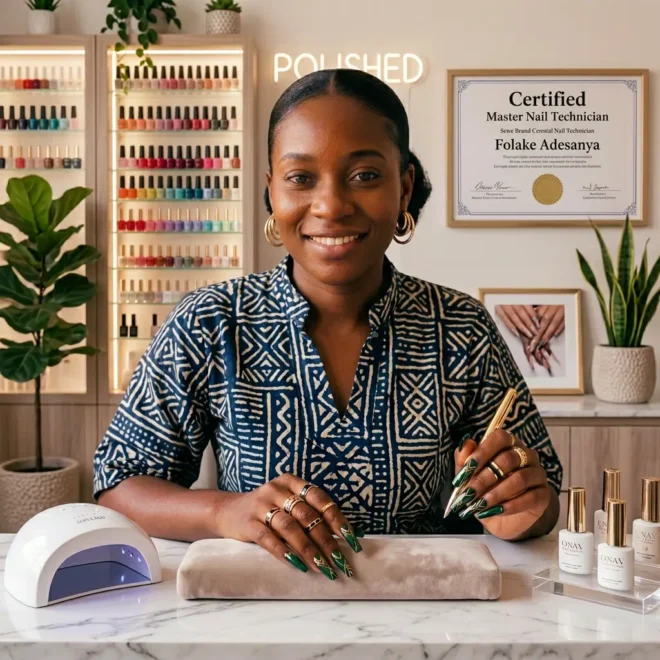


Most colorful French tip coffin nails rise or fall on one small detail: the width of the tip. Go too thick, and a bright color can eat up the nail bed and make the shape look blunt. Keep the line clean and scaled to the length, and even acid green or candy pink starts to look polished instead of chaotic.
That’s why colorful French tip coffin nails keep sticking around in salon chairs, screenshot folders, and press-on sets. The coffin shape gives you that flat, squared edge for color placement, but the tapered sidewalls still slim the hand. You get space to play without losing structure.
Scale is half the battle.
After staring at more nail swatches than I care to admit—and after seeing what actually lasts on hands that type, cook, clean, and open far too many soda cans—I keep coming back to the same conclusion: the strongest colorful French sets are the ones that respect the shape first. A good nail tech knows this already. The smile line, the sidewalls, the opacity of the nude base, even the top coat finish all change the final look more than people expect.
Why Colorful French Tip Coffin Nails Work So Well on a Tapered Square Shape
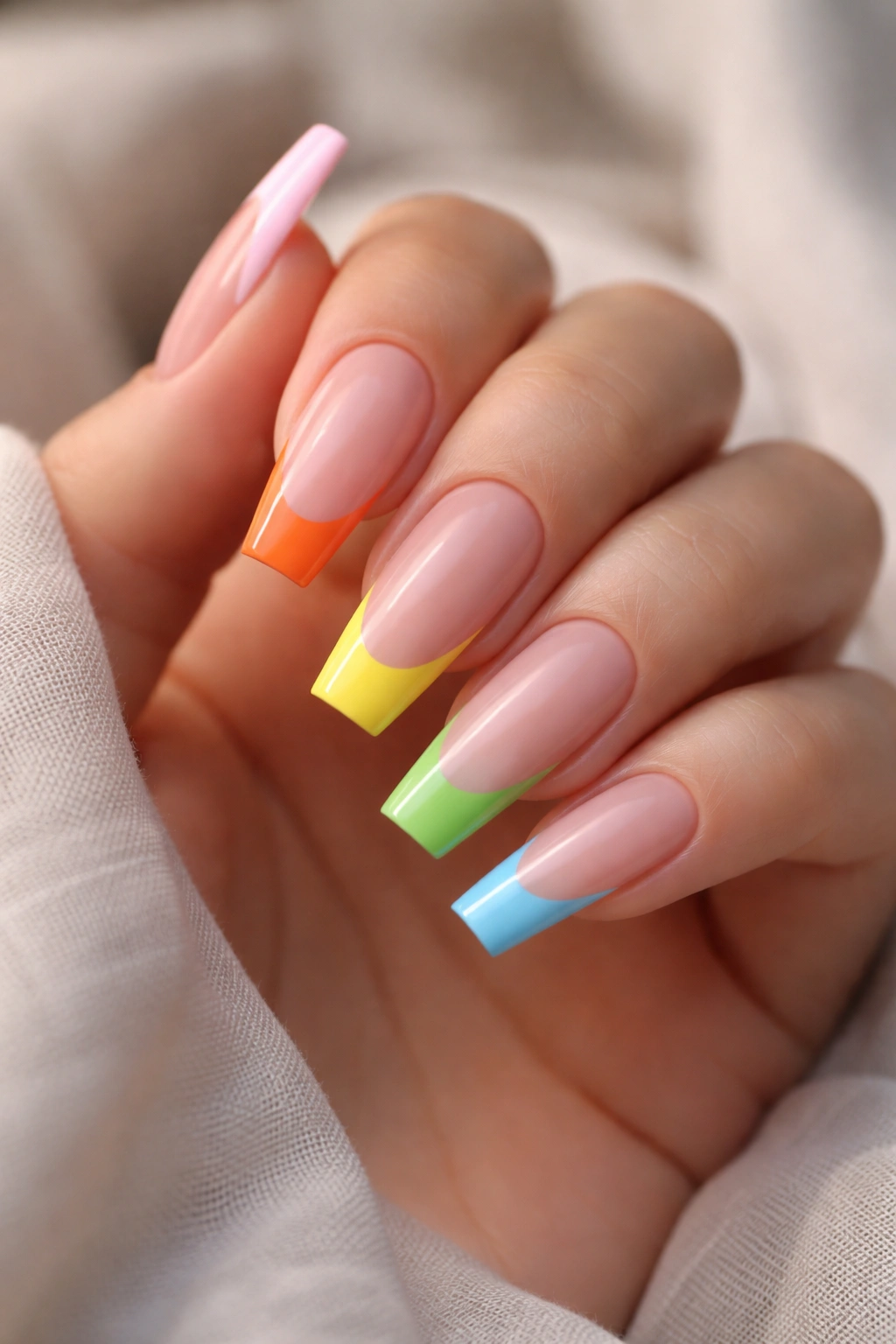
Coffin nails give color room to land. That flat free edge acts like a small canvas, so French tips look cleaner here than they often do on round or short square nails. The sidewalls taper inward, which keeps bright shades from looking too heavy across the whole hand.
Length matters more than people think. On a medium coffin nail, the colored tip usually looks sharp when it covers about 15% to 25% of the nail length. Once the tip creeps lower than that, the set can start to look top-heavy—especially with neon shades, deep cobalt, or full-coverage pastel.
There’s also the matter of the smile line, which is the curved edge where the nude base meets the tip. A deep smile line can elongate the nail bed on a long coffin set. On a shorter set, though, it can crowd the center and make the nails feel squat. That’s why I tend to favor micro French lines, diagonal tips, or side-swept shapes on shorter coffin nails.
A milky nude base helps more than a clear base in most cases. It blurs the natural nail line, softens ridges, and gives bright tip colors something calm to sit against. Clear bases can look good too, though they show every bit of growth and every bit of nail-bed color underneath, which is not always what you want when the tips are loud.
The shape choices that change the final result
If your fingers are short, ask for a narrower taper and a slightly elongated sidewall. If your nail beds run wide, a V-tip or slanted French tends to slim them better than a thick straight-across tip. Thumb nails need their own plan too; on most hands, the thumb tip has to be a touch thinner than the others or it starts shouting.
Small difference. Big payoff.
How to Choose a Color Palette That Flatters Your Hands
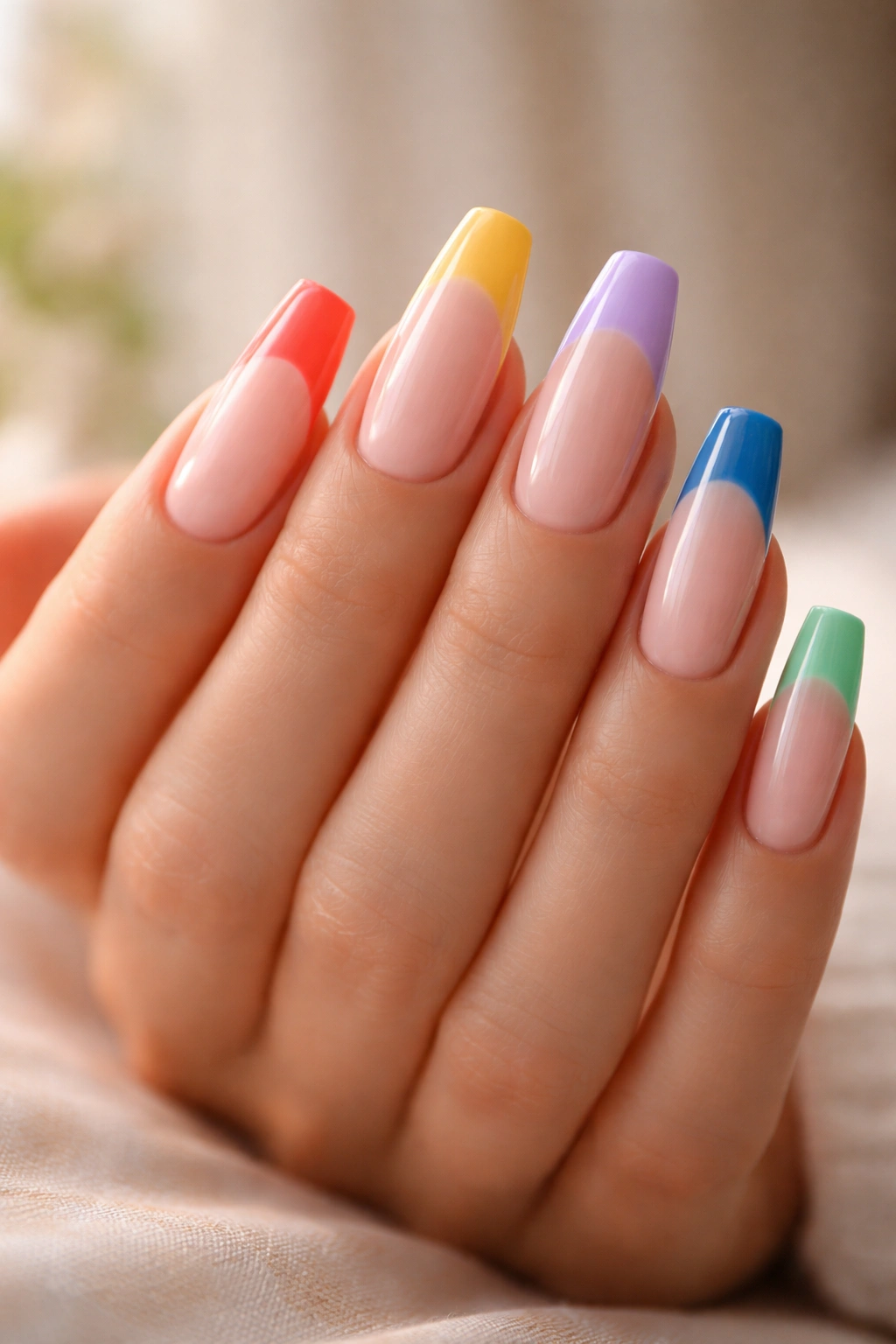
Picking colors for a French manicure sounds easy until you see them on your own skin. A shade that looked punchy on a swatch stick can pull gray, chalky, or oddly harsh once it sits next to your cuticle and knuckles. Undertone matters, and so does contrast.
Warm or golden skin usually handles shades like coral, mango, tangerine, tomato red, butter yellow, and turquoise with no fuss. Cooler skin often looks sharper with lilac, cherry red, cobalt, blue-based pink, mint, and icy lavender. Neutral undertones get the widest lane; you can mix warm and cool shades in one set and it still looks coherent if the saturation level stays close.
The base color deserves equal attention. If your hands run pink, a sheer beige-pink base can settle the whole set down. If your nail beds are olive or a bit shadowed, a milky pink or soft peach nude tends to brighten things up without going pale and flat.
A few color pairings that almost always read well on coffin nails:
- Coral + turquoise for a sharp beachy contrast that still feels crisp.
- Lilac + peach when you want soft color with enough separation to show the tip shape.
- Hot pink + orange for a warm fade that suits long nails.
- Cobalt + silver if you like graphic lines and night-out energy.
- Butter yellow + tangerine for a lighter, cleaner take on neon.
- Mint + white when you want color but still want the manicure to read neat from a distance.
Finish changes the mood. Cream finishes look cleanest for graphic French tips. Jelly finishes soften bright shades and make them look like tinted glass. Chrome powder can be fun, though it also highlights crooked filing and uneven sidewalls in about two seconds flat.
What to Ask Your Nail Tech Before the First Brush Stroke
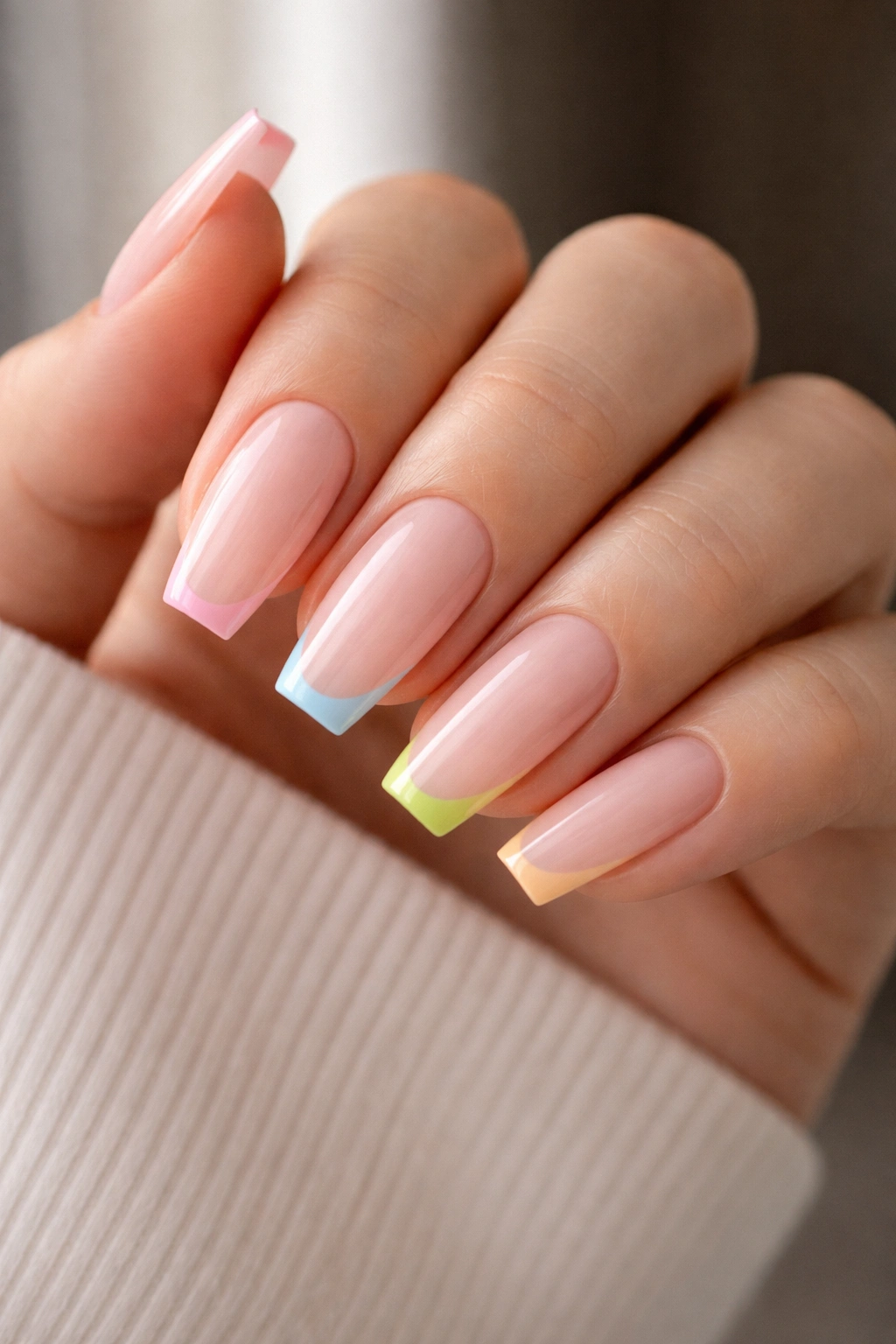
The easiest way to leave the salon with nails you did not ask for? Show one photo and hope the tech reads your mind. Nail art language gets messy fast. One person’s “thin French” is another person’s “half the nail covered.”
Start with the shape and length. Ask for medium coffin, long coffin, or extra-long coffin instead of saying “coffin-ish.” If you know the numbers, even better. A free edge around 6 to 10 millimeters gives enough space for most colorful French tips. Once you get past that, thicker designs and layered outlines start to make more sense.
Then get specific about the tip itself:
- Ask for a micro French, deep French, side-swept French, double French, or V-tip.
- Mention the tip width in millimeters if you care about scale. Saying “keep it around 2 to 3 millimeters” removes guesswork.
- Tell them if you want a milky nude base, a sheer pink base, or a clear base.
- Ask the tech to cap the free edge so the color wraps over the tip and resists chipping.
- If you want more than one shade, say whether you want each nail different, the same pattern on both hands, or alternating colors.
Material matters too. Structured gel works well if you already have decent natural length and want a lighter feel. Acrylic makes sense when you want extra-long coffin nails with strong sidewalls. Press-ons are a good short-term move if you only want the look for a weekend, photos, or an event where you do not feel like booking a fill two weeks later.
Bring two or three reference photos, not twelve. Point to the smile line in one, the colors in another, the length in a third. That usually gets you closer to what you mean than one picture ever does.
1. Electric Blue and Lime Color-Blocked Tips
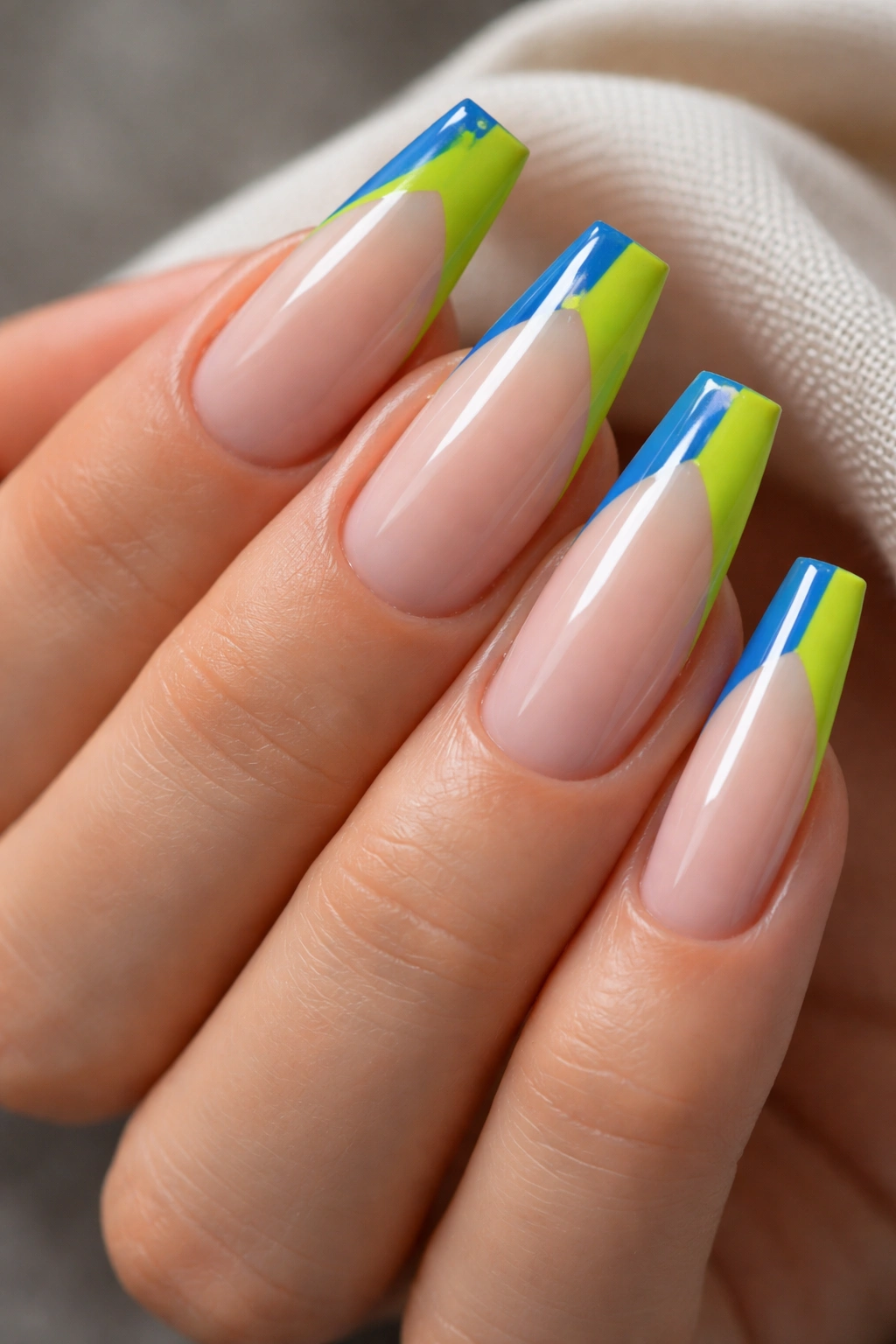
High-contrast color loves a coffin nail. Electric blue and lime green make that plain in seconds, especially when the tip is split into two clean sections instead of painted as one solid band. The flat edge gives the colors a hard stop, which is exactly what keeps the look crisp.
The trick is restraint. Keep the color on the last 3 to 4 millimeters of the nail, and use a soft milky nude across the base. If the nude is too sheer, the contrast can look unfinished. If the tip is too deep, the design starts drifting into full nail art instead of French.
Why the sharp split works
A straight center split can look stiff on some hands. I prefer the divide slightly off-center, with lime on the outer corner and blue on the inner side. That tiny imbalance gives the set movement and makes the taper feel stronger.
Gloss matters here. Matte top coat steals the punch from both colors and can make lime look dusty. A glassy top coat keeps the blue inky and the green bright.
Quick salon notes
- Ask for two fully opaque cream shades, not jelly colors.
- Keep the nude base one tone warmer than your skin if your hands flush pink.
- Medium to long coffin length shows the split line best.
- A thin liner brush makes the center division cleaner than a bottle brush ever will.
Best move: keep all nails the same design and skip extra gems or decals. This color pairing already does enough.
2. Soft Peach and Lilac Diagonal Tips
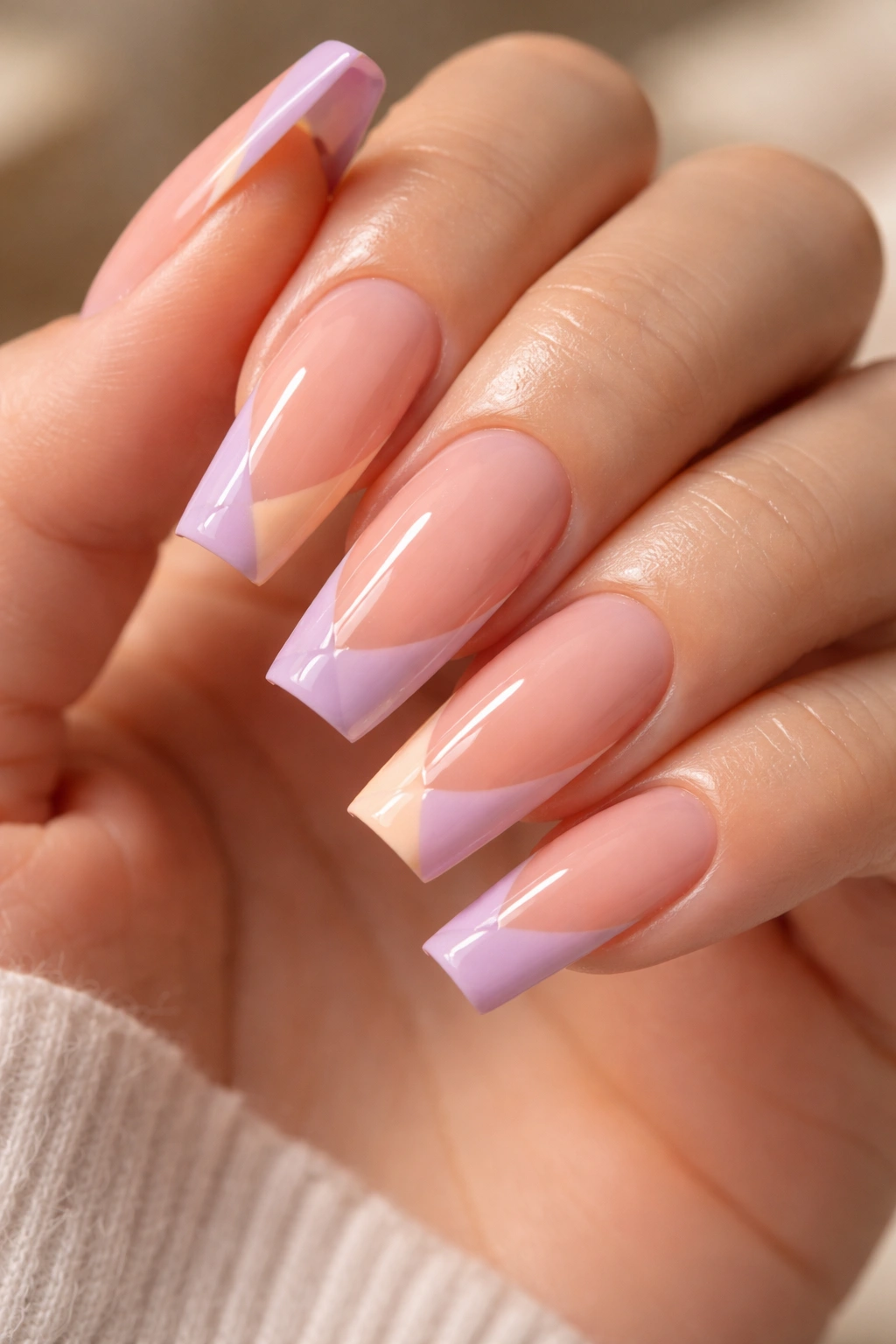
Diagonal French tips hide growth better than straight ones. That is the quiet advantage people miss. When peach and lilac sweep across the tip on an angle, the eye follows the slant rather than staring at the cuticle as the manicure grows out.
The color pairing does a lot for the shape too. Peach warms the hand. Lilac cools it down. Put them together on a diagonal line, and the set feels softer than neon but still far from dull. I like this design on short-to-medium coffin nails, where a horizontal French might shorten the fingers.
You can wear this one in an office, at a wedding, on vacation, wherever. It has color, though it does not scream for attention every time you reach for your phone. That balance is why I keep recommending it to people who want something brighter than nude but are not ready for full rainbow tips.
One warning: do not let the peach go too beige or the lilac go too gray. Once both shades mute down, the whole manicure can start looking chalky. Ask for a warm apricot-leaning peach and a clean pastel lilac, then seal it with a high-shine top coat.
3. Rainbow Micro French Tip Coffin Nails
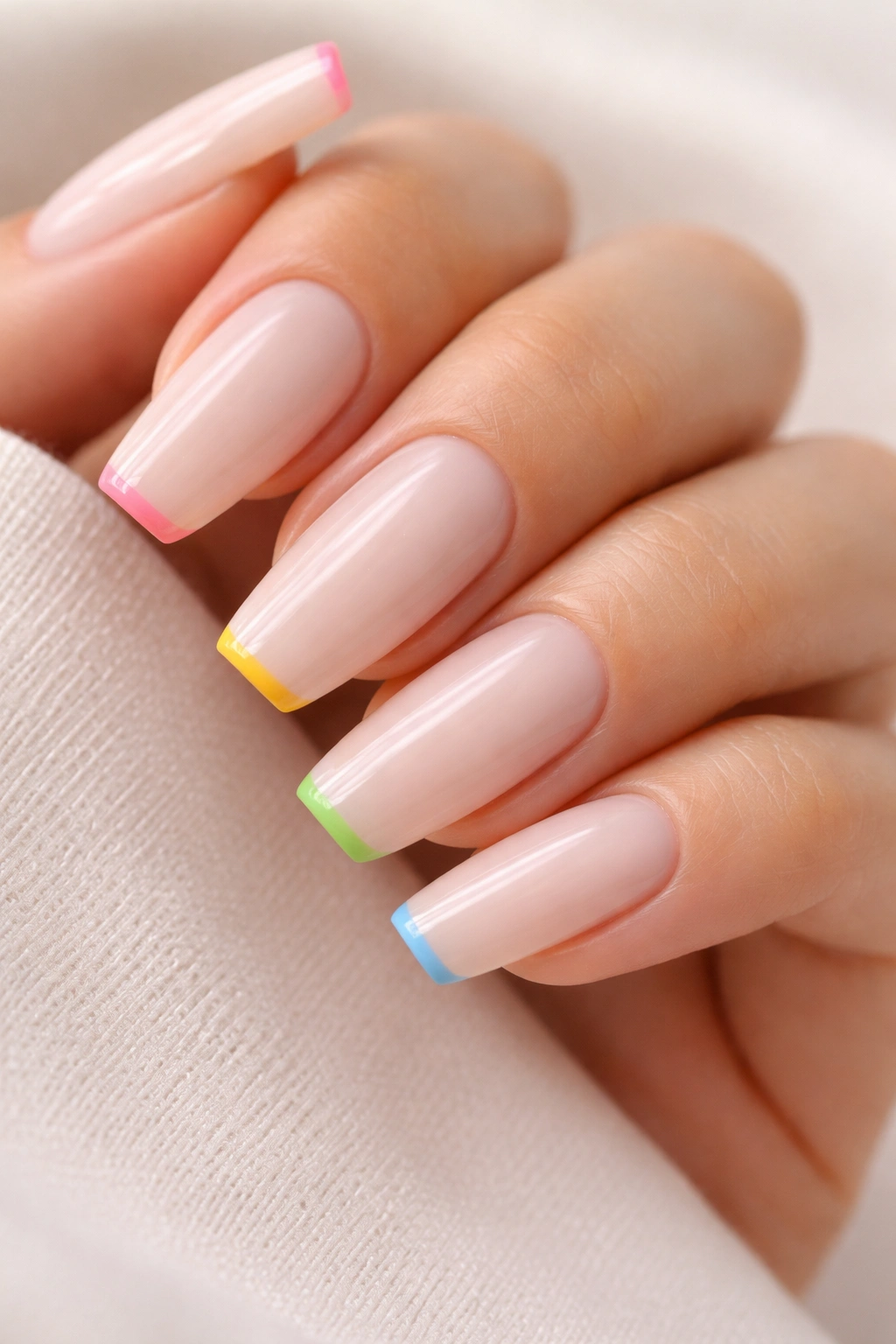
Want color without covering half the nail? Micro French tips are the answer. A razor-thin strip of red, orange, yellow, green, blue, and pink across different nails gives you the fun of a rainbow set while keeping the manicure lean and tidy.
This design works because the coffin edge is straight. On a round nail, a micro French can disappear from some angles. On a coffin shape, the line stays visible—even at a width of 1 to 2 millimeters—which makes the manicure feel intentional instead of accidental.
It also wears well. Thin tips grow out with less drama than thick ones, and chips are less obvious because the color band is so narrow. If you type all day or wash your hands a hundred times, that matters.
How to ask for it
Ask for a sheer pink or sheer beige base, then a different opaque color on each tip. If you want the shades to read bright from a distance, tell your tech to paint a slim white guide layer under pale colors like yellow or mint. Otherwise, those lighter shades can fade into the nude base and look weak next to stronger colors like cobalt or fuchsia.
Keep the line thin on every nail. One thick tip in the set will stand out—and not in a good way.
4. Hot Pink and Orange Sunset Fade Tips
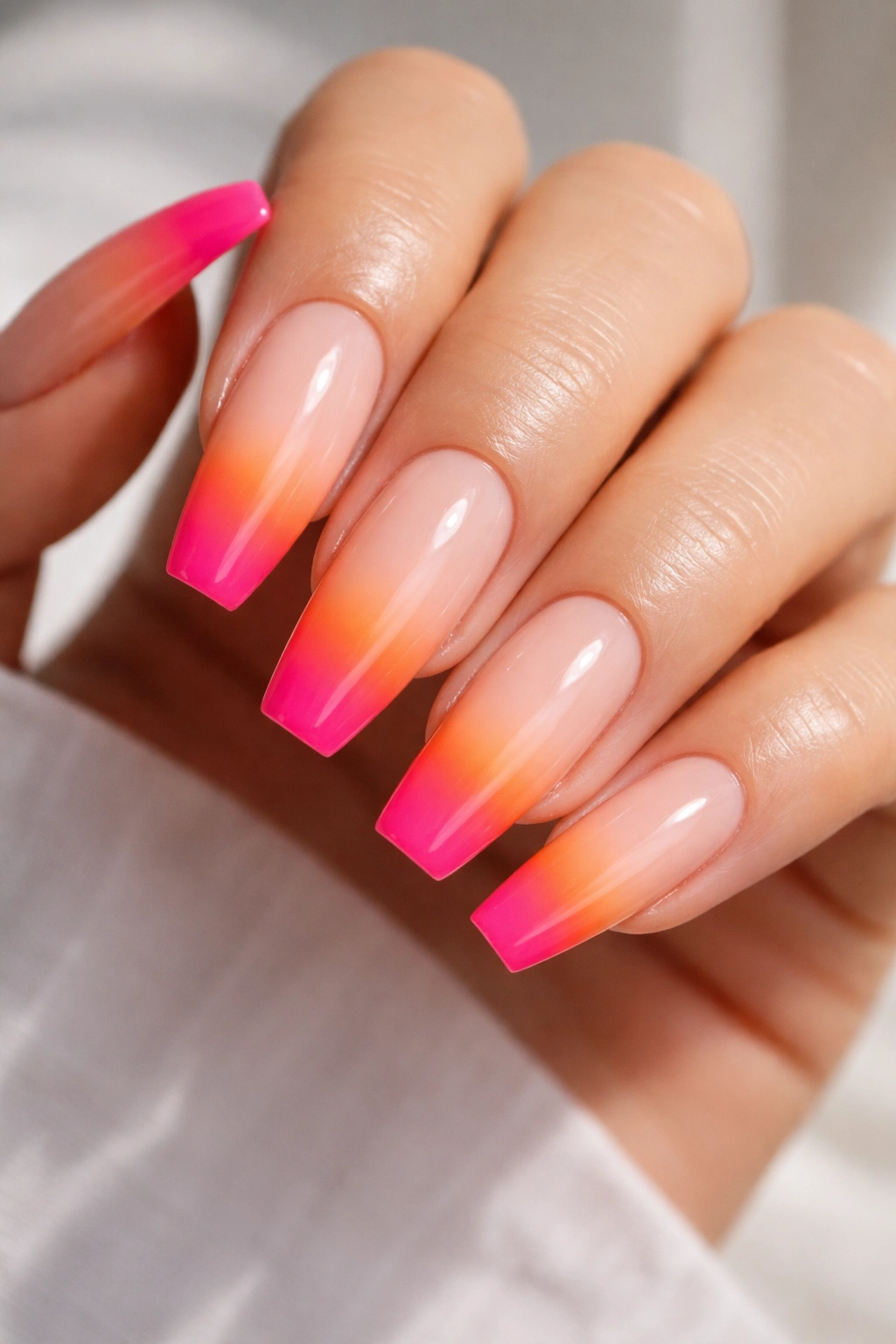
I’ve seen this design in salon photos that looked loud to the point of cartoonish, then watched it come alive on an actual hand once the fade was done with some care. Hot pink melting into orange across the tip can feel warm, juicy, and clean when the blend sits only at the edge of a nude coffin nail.
The secret is the fade itself. If the two shades meet in a muddy middle band, the set falls apart. You want a soft overlap where coral appears in the center for a few millimeters, then disappears. Airbrushing gives the smoothest result, but a sponge blend can work if the tech keeps the layers thin and tops the surface with enough clear gel to level it out.
A longer coffin shape helps this design breathe. Short nails can carry it, though the fade needs to stay tight.
A few details make it better:
- Keep the base milky, not stark nude, so the fade has contrast.
- Ask for the blend to sit horizontally across the tip, not diagonally, unless you want a more dramatic slant.
- Use two coats of color at most. Too many layers can bulk up the free edge.
- Skip heavy glitter over the fade. It muddies the color transition.
This one shines in bright daylight. Under indoor lighting, it still reads warm and saturated, which is half the appeal.
5. Mint and White Double-Line Tips
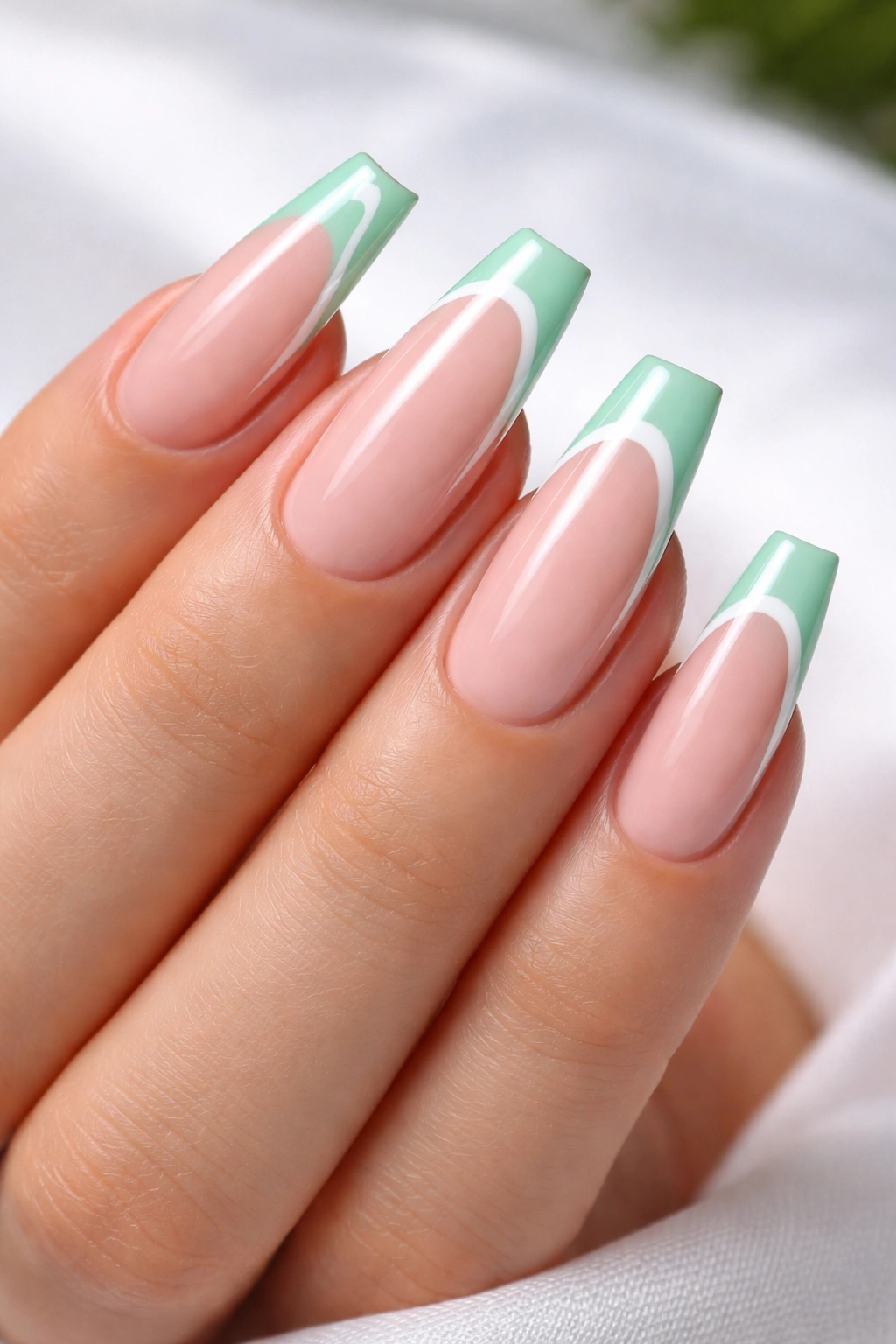
Not every colorful French manicure needs six shades, chrome dust, and three accent nails. A thin white line paired with a mint tip can look sharper than a busier set because the extra stripe gives the edge structure. On coffin nails, that structure matters.
Picture the layout: a white line tracing the smile line, then a sliver of nude space, then a mint band at the free edge. Or flip it—mint first, white above. Both can work, though I lean toward white nearest the base and mint at the edge because it frames the color and keeps the tip looking clean from a distance.
This design punches above its weight on medium lengths. You do not need a huge tip area to make it readable, since the second line creates separation even when the color band is narrow. That makes it a solid pick for someone who wants coffin nails but does not want them extra long.
Mint also plays nicely with skin redness. If your hands flush after washing, cold weather, or too much coffee, this shade can make the whole manicure feel cooler and more balanced. White alone can look stark there. Mint softens it.
One place people go wrong is opacity. If the mint is streaky, the set starts looking unfinished. Ask for two thin coats of opaque mint gel and a liner brush for the white. Bottle-brush white lines tend to wobble.
Small detail. Big difference.
6. Cherry Red and Sky Blue Side-Swept Tips
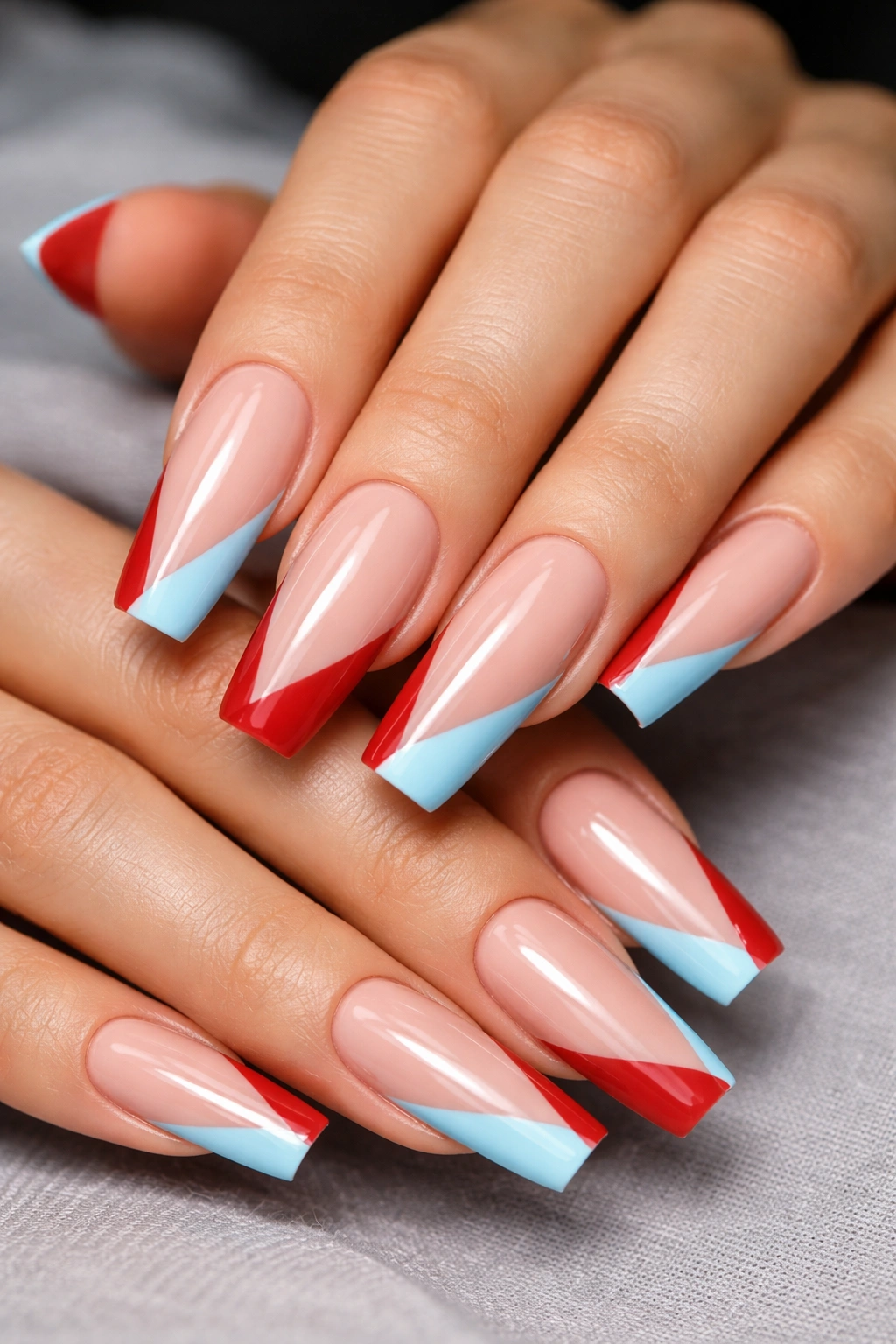
Unlike a centered French, a side-swept tip pulls the eye diagonally across the nail. That makes the fingers look longer and the coffin taper look narrower. Add cherry red and sky blue, and the design lands somewhere between retro and graphic—clean, bright, and a little playful.
I like this one for wider nail beds. A classic straight French can sit flat across the width and make that width feel more obvious. A slanted tip breaks the symmetry and gives the nail more direction. It is not magic, though it comes close.
Color placement matters. Put red on the lower side of the diagonal and blue at the higher outer corner, and the tip looks lifted. Swap them and the design feels heavier. You can alternate that from hand to hand if you want a mirrored effect, though keeping the same placement on all ten nails usually looks neater.
Who should pick this? Anyone who wants color with some edge but does not want a full abstract set. It also suits medium coffin lengths that do not have enough room for checkerboards, fades, or layered outlines. Ask your tech for a sharp diagonal smile line with a fine striping brush and keep the tip depth consistent across each finger. If one slant climbs too high, the whole set starts leaning off.
7. Butter Yellow Floating Tips With a Bare Gap
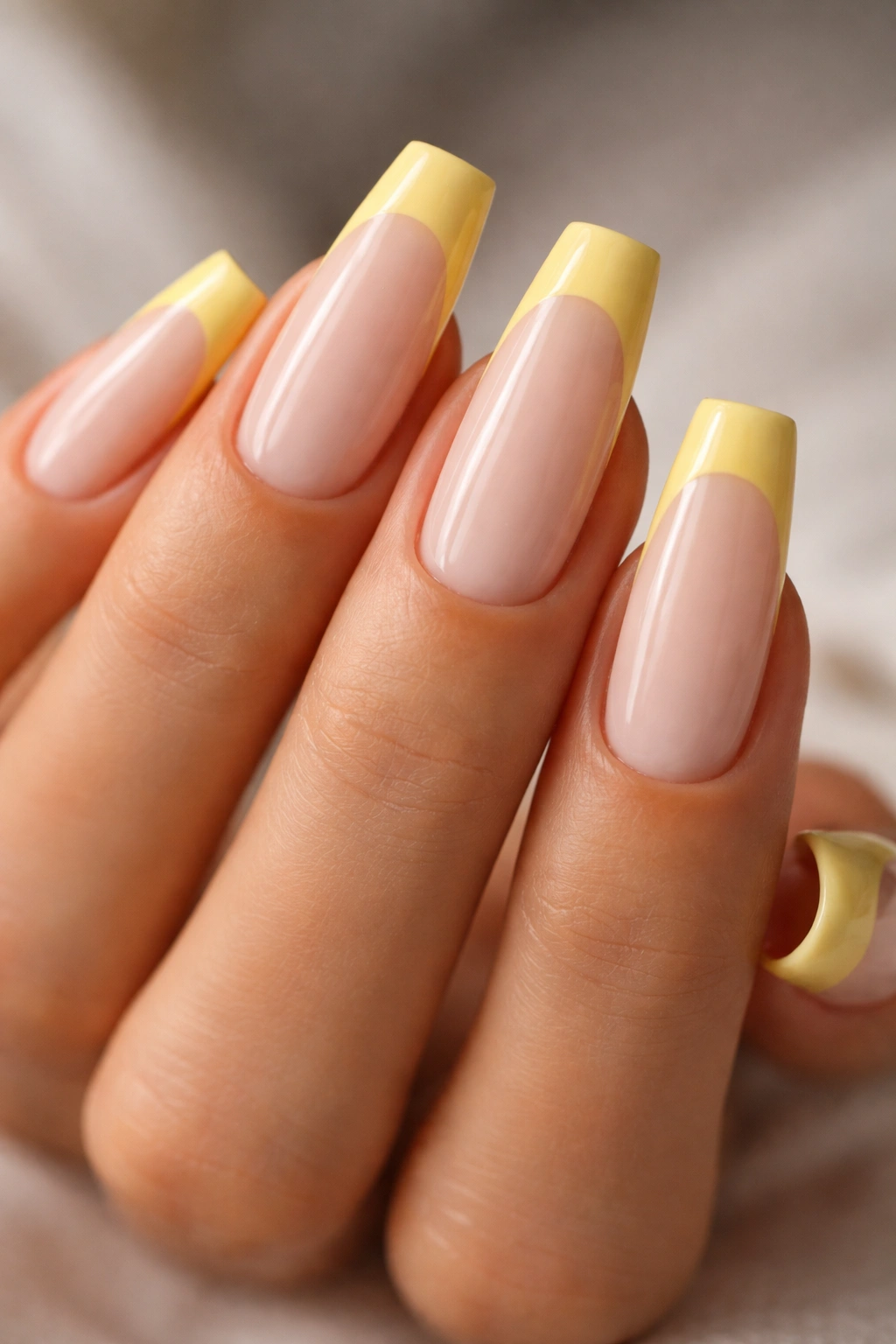
A little negative space changes the mood fast. Floating French tips leave a thin strip of nude between the tip color and the smile line, so the yellow does not start right where a normal French would. On coffin nails, that gap makes the design feel lighter and more graphic at the same time.
Butter yellow is the right shade for this layout. Neon yellow can look hard and highlighter-bright when it sits apart from the nail bed. Butter yellow stays softer. It still reads as color, though it does not fight the nude base.
What to watch for
That bare gap needs to be even. Uneven spacing is the first thing your eye will catch, especially on thumbs and index fingers. I like the gap at 1 to 2 millimeters, with the yellow tip itself sitting another 2 to 3 millimeters above it.
A few practical notes:
- This design looks cleaner on medium or longer coffin nails.
- Ask for a milky base coat so the gap reads intentional.
- Yellow often needs a white underlayer if you want full payoff.
- Crooked shaping shows fast here because the floating line mirrors the free edge.
Best move: keep the yellow glossy. Matte butter yellow can turn powdery in a hurry.
8. Lavender and Pistachio Checkerboard Tips
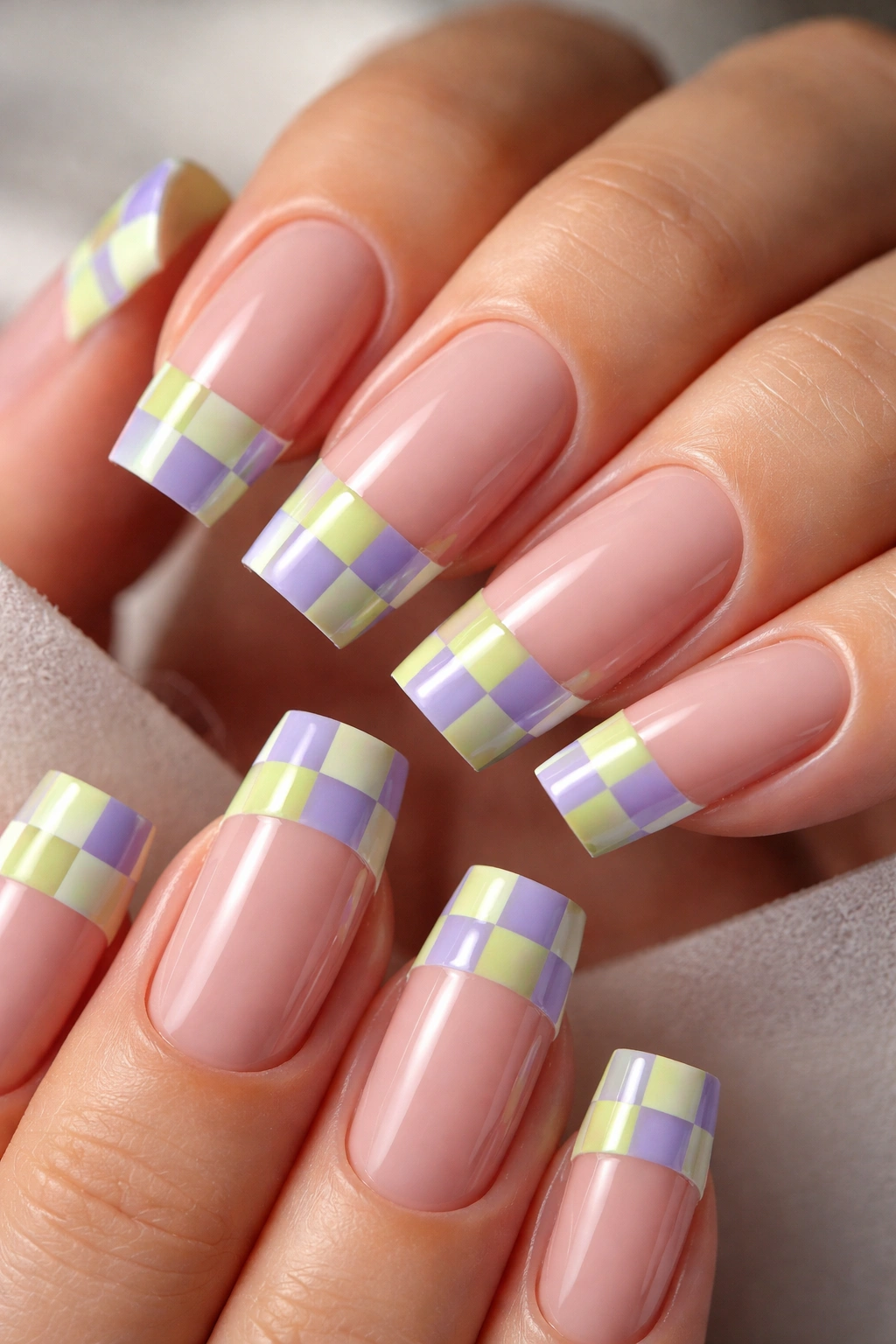
If a plain color-block French feels too quiet, checkerboard tips give you pattern without taking over the entire nail. Keeping the checker only on the free edge is what saves it. Once the pattern drops too low, the manicure can start looking busy in a way that does not flatter the coffin shape.
Lavender and pistachio make sense together because both shades have enough softness to share space. Black-and-white checkerboards can look sharp too, though they pull the whole set in a harder, more graphic direction. Lavender and pistachio feel lighter and less severe.
This one needs clean technique. The tip should be deep enough for two rows of tiny squares on longer nails, or one row of larger squares on medium lengths. Anything in between can get muddy. A good tech will map the tip with striping tape or a fine detail brush before filling in the color. Freehand is possible, though not every artist has the patience for neat little squares after nail number eight.
I would not put checkerboard tips on every nail unless the rest of the set stays stripped down. One good approach is checkerboard on six nails, solid lavender French on two, solid pistachio French on two. Same palette, better rhythm. Your eyes get a place to rest.
9. Jelly Neon Tips Over a Milky Nude Base
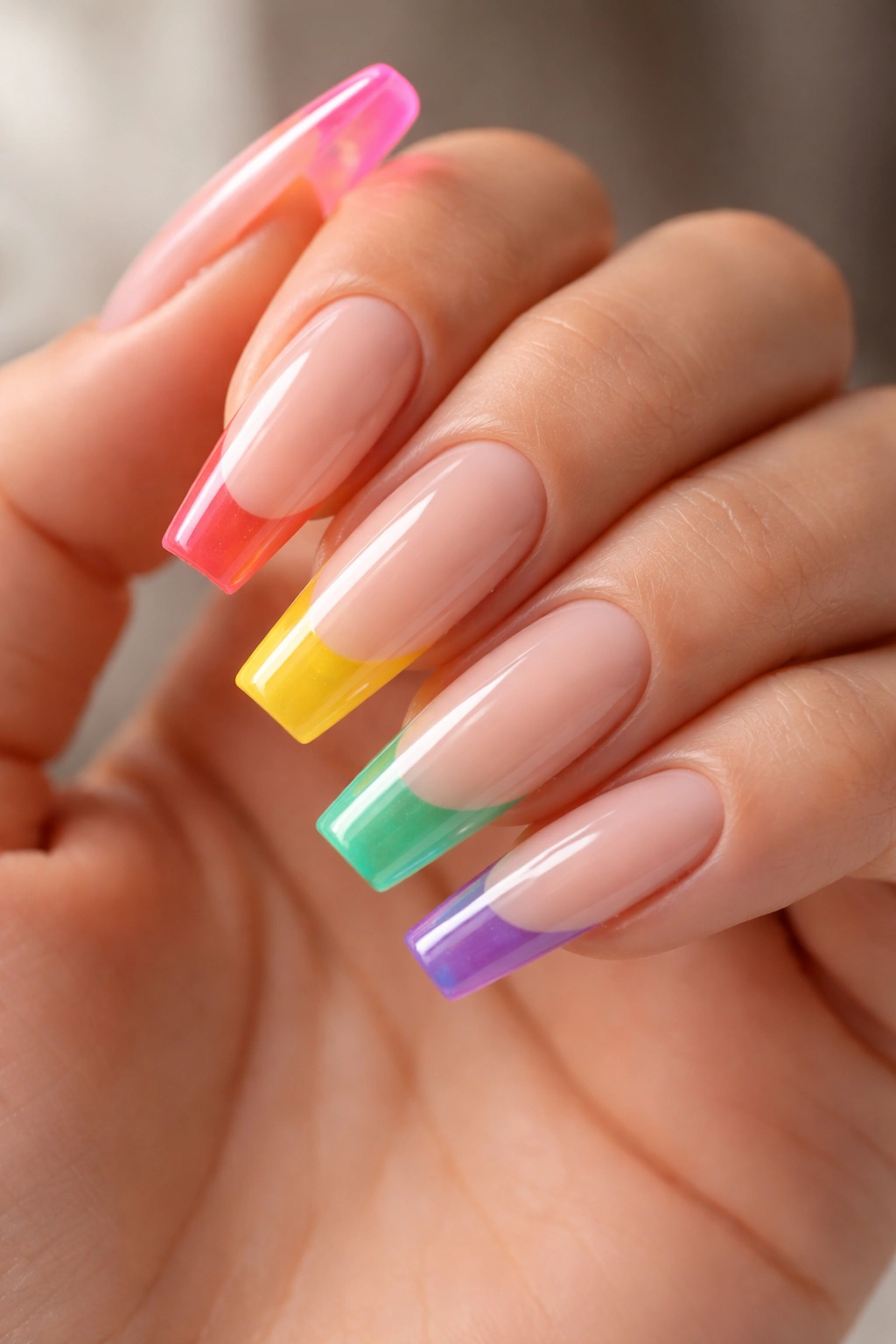
Translucent neon has a candy-glass look that opaque polish cannot copy. That is why jelly French tips hit differently on coffin nails. You still get the bright edge, but light passes through the color a bit, so the set feels fresher and less heavy than a full cream neon.
The base has to do some work here. A milky nude or soft milky pink keeps the jelly tip from blending into the natural nail too much. Clear base plus jelly tip can be fun on press-ons, though on a salon set it often shows too much of the free edge underneath and weakens the contrast.
Jelly colors layer fast. One coat may look watery; three coats can get syrupy and thick. Two thin coats is usually the sweet spot.
How to ask for it
Use the word jelly when you book or when you sit down. Not every salon stocks translucent gel shades in bright colors, and not every tech wants to custom-mix them. Good shades for this look are jelly tangerine, jelly pink, jelly lime, and jelly aqua. Ask for the nude base to stay soft and semi-opaque, then keep the tips glossy. A matte top coat kills the glass effect, which is the whole reason to pick jelly in the first place.
10. Watermelon Pink and Green French Edges
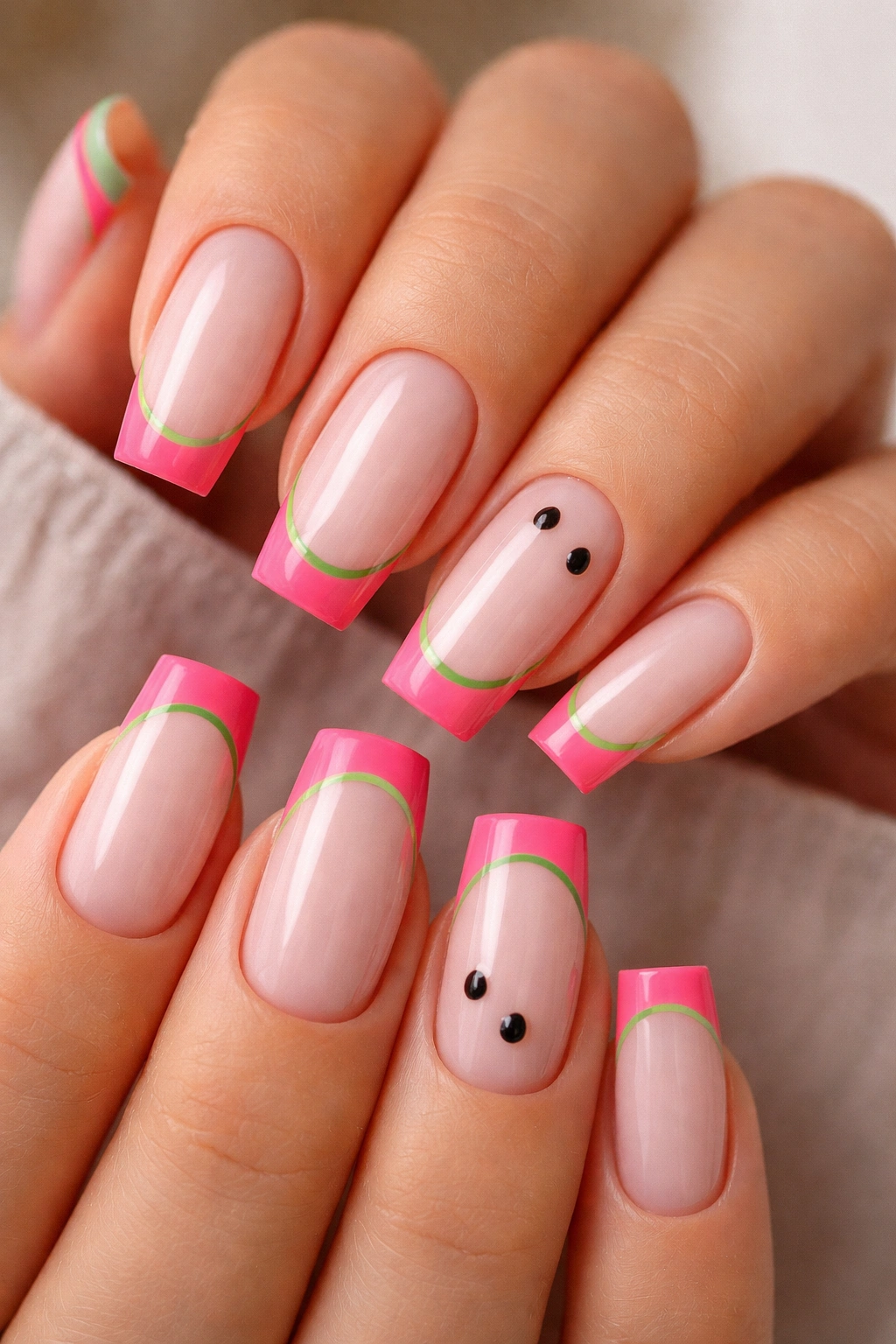
This one can go wrong fast. Lean too hard into the fruit theme and you end up wearing novelty nails. Hold back a little, though, and watermelon pink with a slim green edge turns into one of the smartest colorful French sets around.
I like the pink cool-toned rather than bubblegum. A cooler pink feels juicier and cleaner next to green. The green should stay narrow—think outline, not a giant stripe—so the manicure still reads as French first, fruit second.
Tiny black “seed” dots can work, though use them with restraint. Two accent nails are enough.
Here’s the layout I’d ask for:
- Pink tip covering about 3 millimeters of the free edge
- Green outer stripe around 1 millimeter thick
- Black seed dots on one ring finger and one thumb, not on all ten nails
- Milky sheer base rather than a peachy nude, which can clash with the pink
What I like here is the balance. You get a wink of theme without turning the whole manicure into costume. And yes, this one gets compliments. People notice it when you hold a glass, tap a payment screen, or reach across the table.
11. Cobalt V-Tips With a Thin Silver Stripe
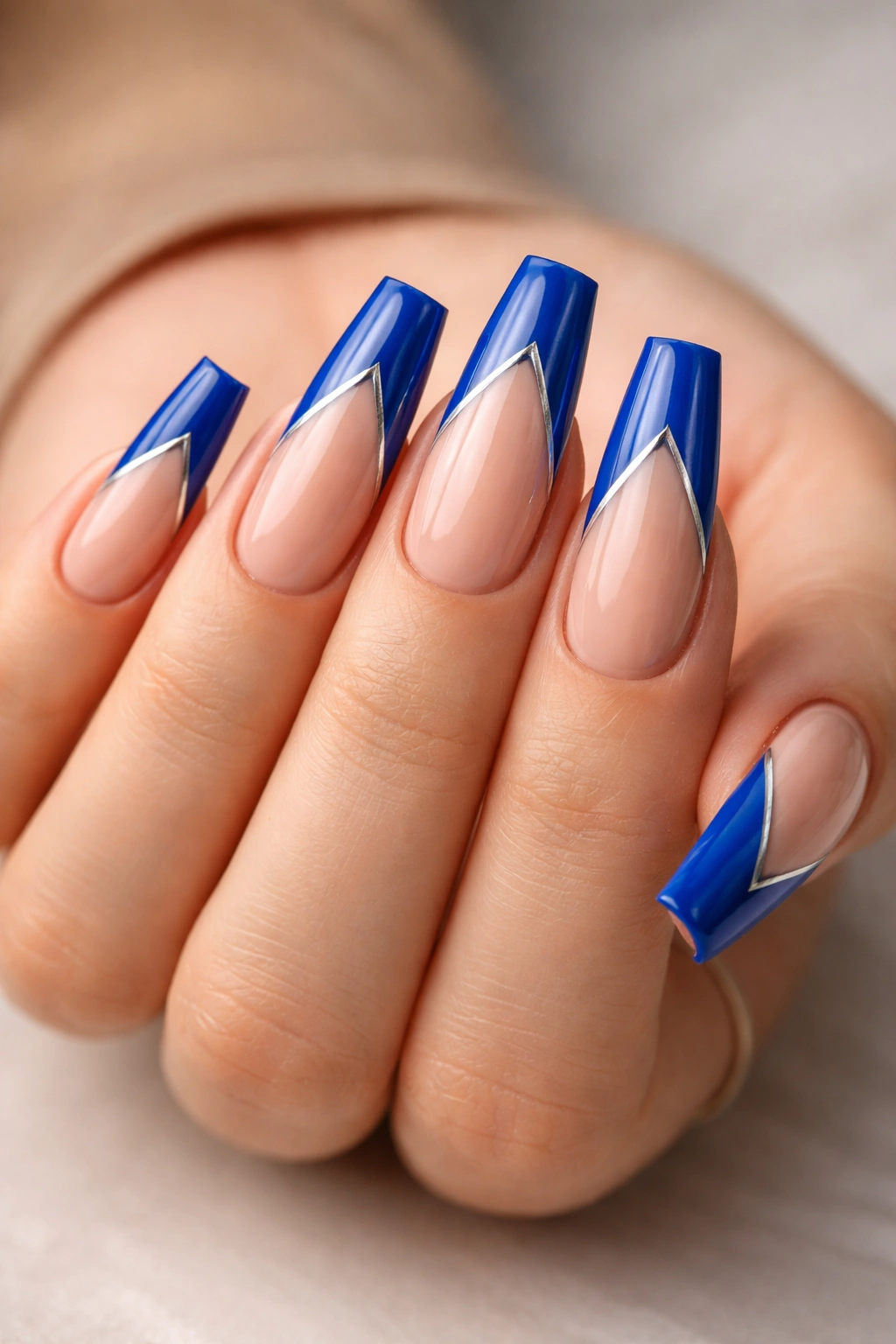
A V-tip changes the whole geometry of a coffin nail. Instead of following the free edge in a soft curve, the color angles toward the center and creates a point. On shorter shapes that can look cramped. On medium and long coffin nails, it can look lean and deliberate in a way a standard French never will.
Cobalt is the right blue for this. Navy can go heavy. Baby blue can look too soft for the shape. Cobalt has enough saturation to hold the V shape from a distance, and that matters because geometry needs visibility. If you have the tech trace a paper-thin silver line where the nude base meets the blue, the edge gets even sharper.
This is one of those designs that feels dressier without needing rhinestones, charms, or textured gel. The silver stripe does the job. I would keep the rest of the manicure quiet: no glitter cuticle, no accent flower, no random chrome swirl on one finger because the artist got bored. The power is in the line work.
There is a catch, though. V-tips demand symmetry. If one side is higher than the other, you will see it from across the room. Ask for the points to hit the same spot on every nail, and make sure the sidewalls are filed crisp before the color goes on. Sloppy prep ruins a graphic set faster than sloppy painting.
12. Mismatched Sorbet Outline Tips on Extra-Long Coffin Nails
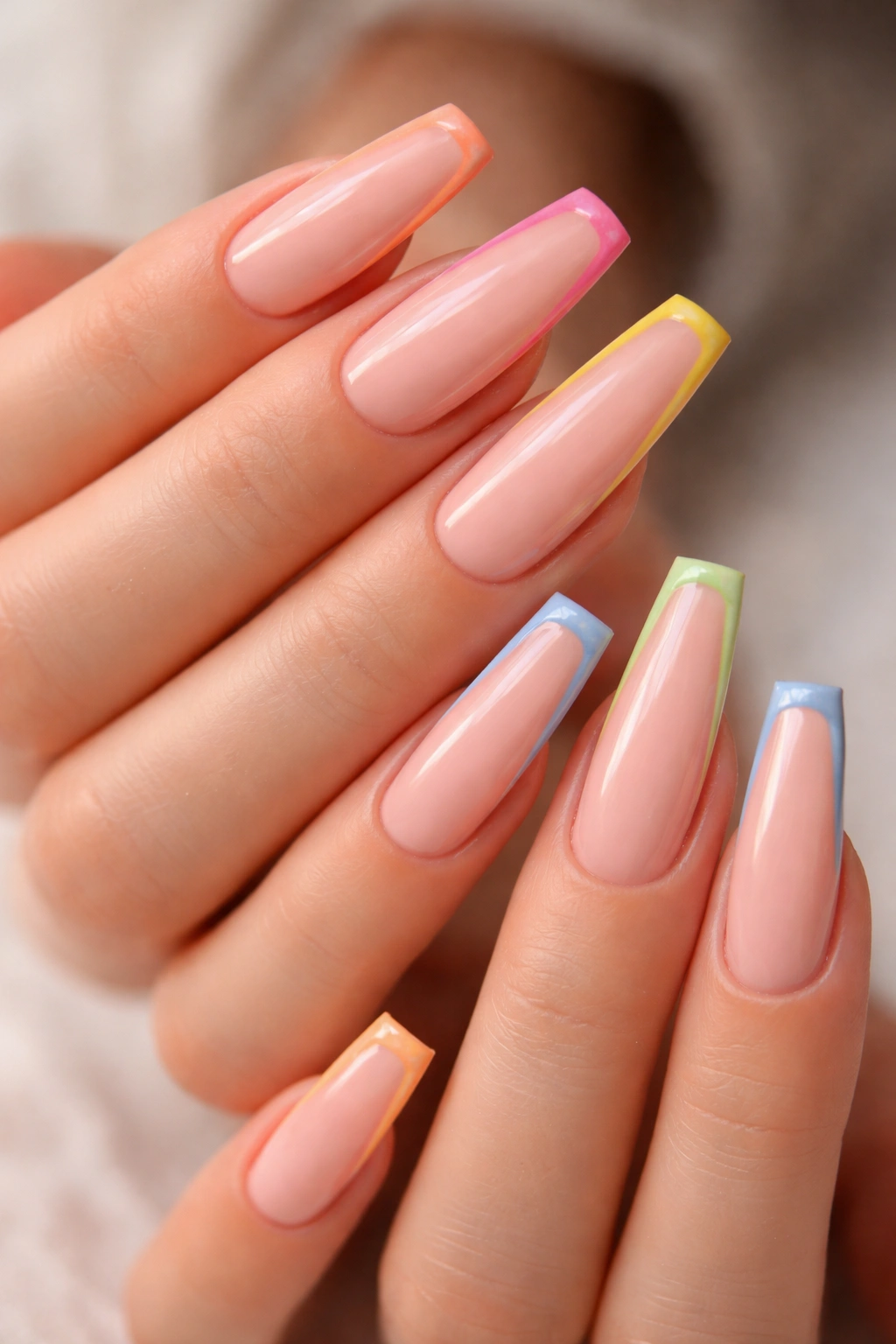
Unlike rainbow micro tips, outline French tips trace the free edge and side corners instead of filling the entire tip with color. That leaves more nude showing, which is why this design works so well on extra-long coffin nails. You get color, shape, and length all at once without the manicure feeling overloaded.
The sorbet palette is the point. Think apricot, raspberry, lemon, kiwi, and blueberry, all with the same soft, creamy intensity. If one shade is neon and the others are pastel, the set loses balance. Matching the saturation level keeps the hand looking cohesive even when every nail is different.
Extra-long length helps. The side outlines need space, and short coffin nails do not give enough of it. Once you have that length, though, the traced edge can make the shape look even sharper because your eye follows the perimeter instead of the center.
Who is this for? Someone who wants color but still likes a lot of nude visible. It is also a smart pick if full rainbow tips feel too heavy on your hands. Ask for the outline to stay thin and even, especially around the side corners. Thick side tracing can make the nails look bulky. Thin lines keep the shape clean and show off the coffin silhouette the way it deserves.
How to Make French Tip Coffin Nails Last Longer Between Appointments
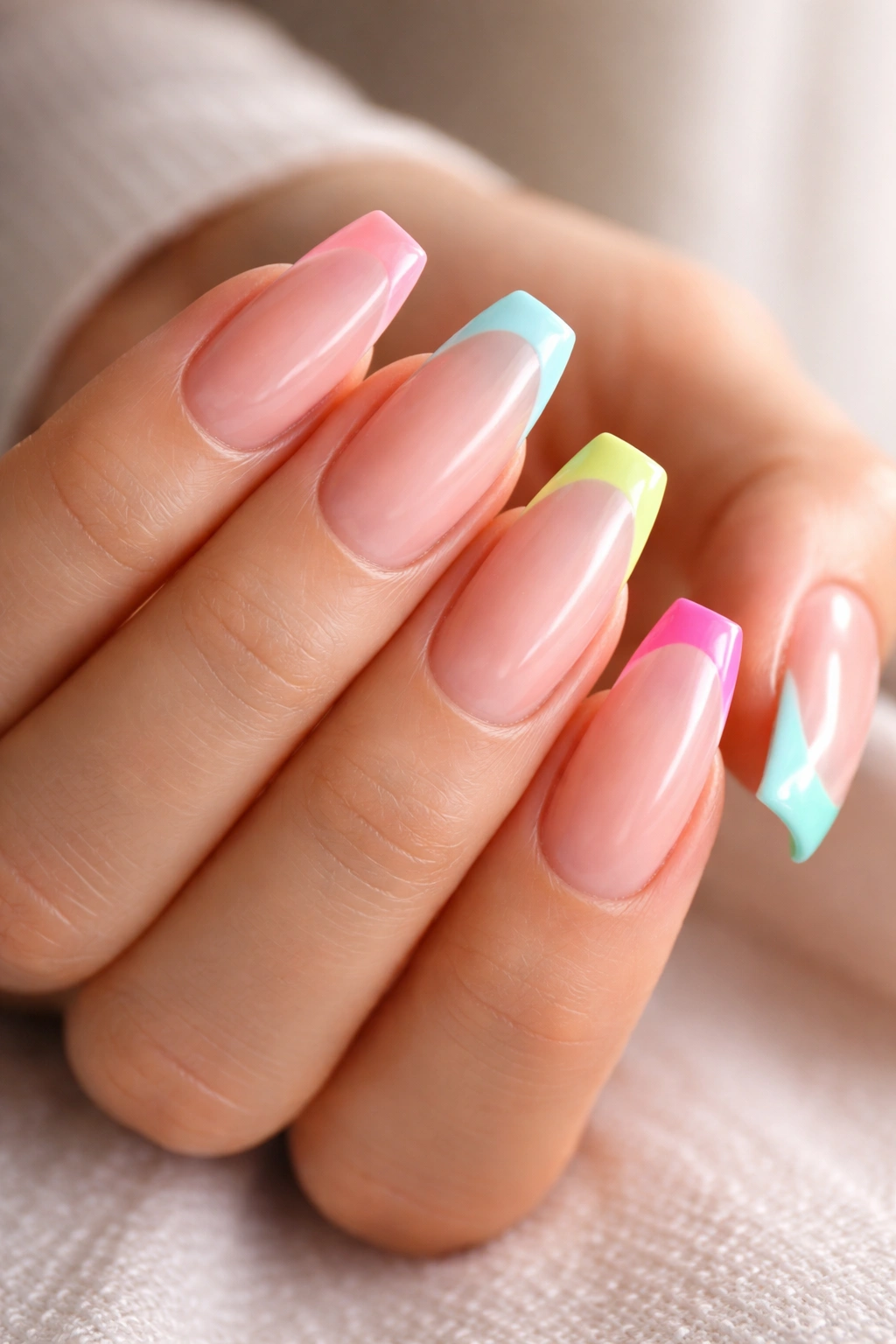
Fresh French tips look crisp because the edges are sealed, the sidewalls are smooth, and the top coat is still hard and glossy. Daily life starts working against all three the minute you leave the salon. Longevity comes down to friction, water, and habit.
The American Academy of Dermatology’s basic nail-care advice still applies here: keep nails dry when you can, wear gloves for wet cleaning jobs, and moisturize the cuticles. Bright French tips do not chip because the color is cursed; they chip because the free edge keeps smashing into keys, cans, counters, and dishware.
A few habits make a bigger difference than people expect:
- Rub in cuticle oil twice a day, especially around the sidewalls.
- Wear rubber gloves for dishwashing, bleach, and long cleaning sessions.
- File tiny snags with a fine-grit nail file instead of clipping at them.
- Do not use the tip of your nail to open cans, peel labels, or pop packages.
- If your top coat dulls after a week, add one thin layer of clear top coat at home.
Peeling gel off is a fast way to wreck the next set. Acetone already dries the nail plate and the skin around it; peeling takes layers of keratin with it. If you need removal, soak properly or let a tech handle it. Your next colorful set will sit flatter and last longer on a smooth surface.
One more thing: book fills before the shape starts drifting. Coffin nails lose their sharpness once the apex grows out and the sidewalls take hits. Past that point, even the best color design starts looking tired.
Final Thoughts
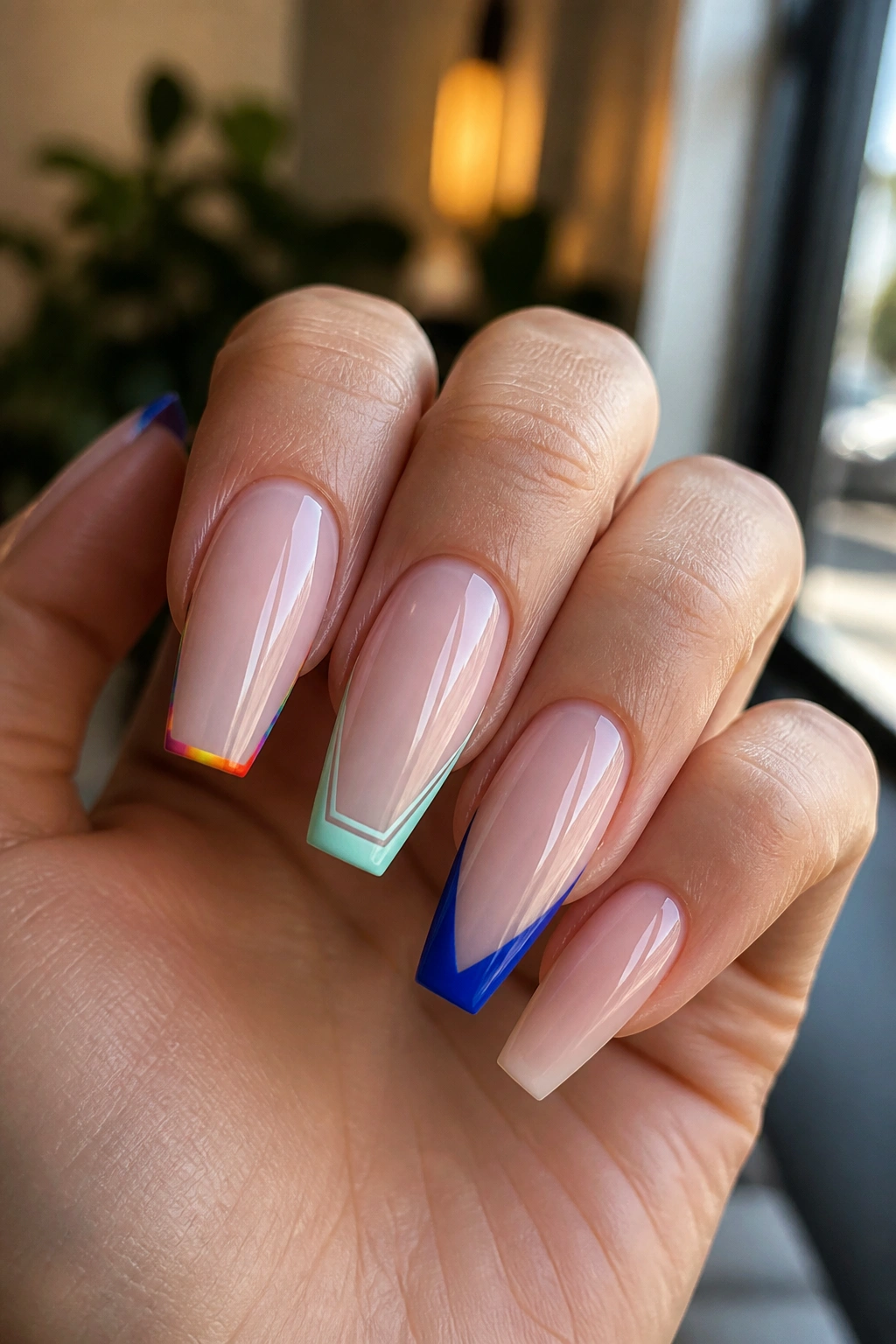
If I had to narrow these down to the three I’d recommend most often, I’d pick rainbow micro tips for low-commitment color, mint double-line tips for a cleaner graphic look, and cobalt V-tips when you want the shape to do half the talking. They suit different moods, though all three respect the coffin shape instead of fighting it.
Colorful French tip coffin nails look strongest when the idea fits the length, the smile line fits the nail bed, and the color palette makes sense on your hands—not only in a saved photo. That sounds fussy. It is. Nail design lives in tiny details.
Get those details right, and even the loudest shades start looking precise.