

Blue can look cheap on coffin nails faster than almost any other color. If the shade is too chalky, the tips start to read plastic. If the smile line is too thick, the whole set loses that sharp, clean French effect and starts looking heavy at the ends.
That is why blue French tip coffin nails are one of those looks that reward precision. The shape gives you a long, straight edge to play with, which is great, but it also leaves nowhere to hide a wobbly line, cloudy top coat, or blue that clashes with your skin tone. You notice every choice.
I keep coming back to blue on coffin nails because it does something white French tips cannot always do: it brings mood. Pale blue feels crisp and airy. Navy feels tailored. Chrome blue catches light in a way that looks almost liquid. Even a tiny shift—from a rounded smile line to an angled one—changes the whole personality of the manicure.
And the twist matters. A plain blue tip can look flat after a week. A blue tip with a side sweep, a chrome edge, a velvet flash, a marble finish, or a floating outline keeps the look alive from every angle, which is the whole point of spending money on a full set in the first place.
Why Blue French Tip Coffin Nails Suit a Coffin Shape
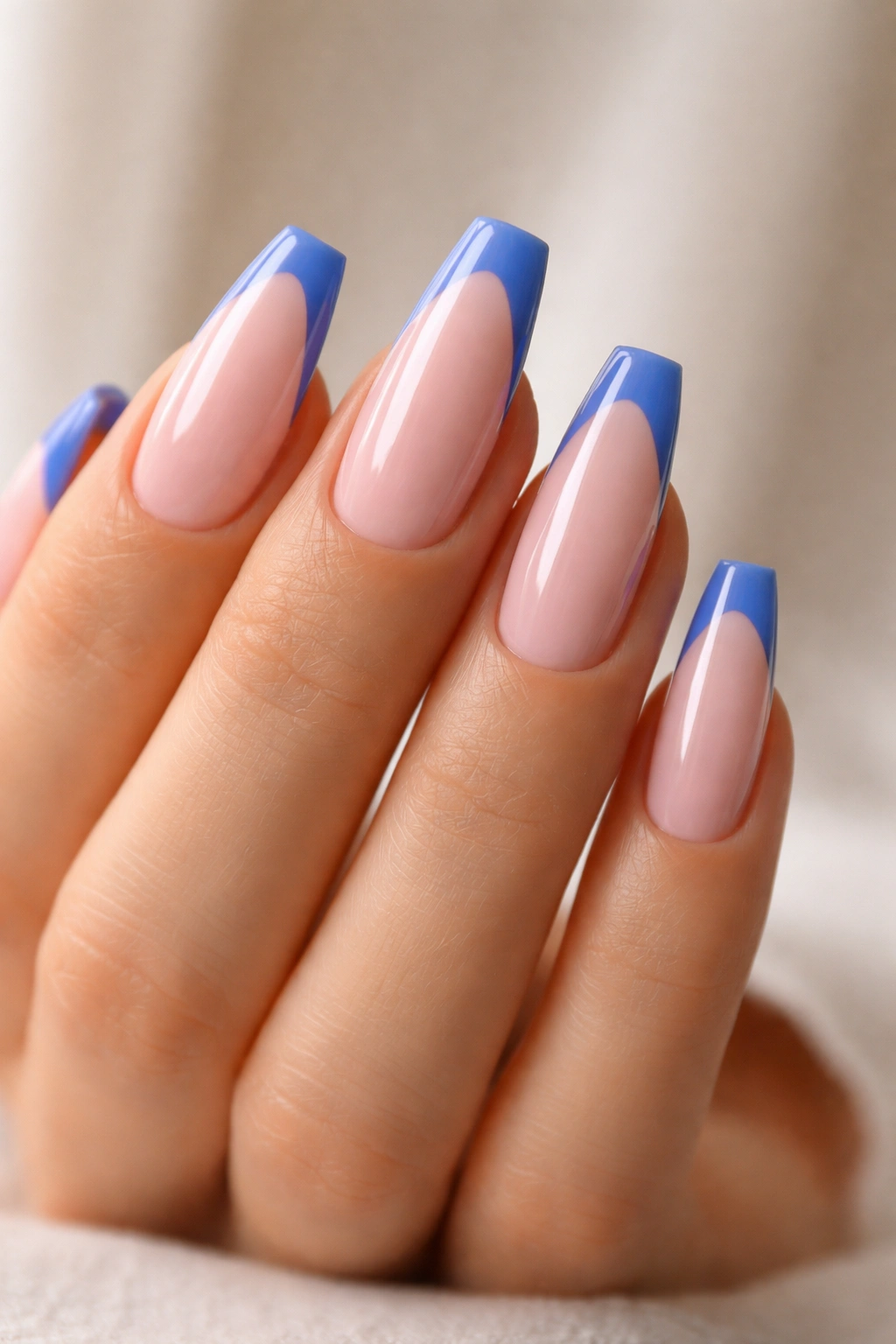
A coffin shape gives blue somewhere to sit.
Those straight sidewalls and flat tip edge make color look crisp, almost graphic, in a way that short round nails do not. With a French design, that matters because the eye reads the tip line first. On coffin nails, the line looks longer, cleaner, and more deliberate.
There is a practical side to this too. A medium or long coffin nail gives your tech enough surface area to draw a proper smile line instead of squeezing a blue stripe onto a tiny free edge. If your nails are short, the tip color can eat up the whole nail bed fast. On a coffin shape, you have more room to keep the nude base visible, which is what makes a French manicure still feel like a French manicure.
Small details change the look more than most people expect. A 2 to 3 millimeter tip feels neat and light. Push that to 4 or 5 millimeters, and the set reads bolder, closer to color blocking. If your nail beds are shorter, ask for a deeper smile line that arches higher into the sidewalls. That little curve can make the fingers look longer.
Blue shows mistakes fast—faster than beige, pink, or soft white.
That is why this shape works so well with a clean base. A sheer pink, milky nude, or translucent beige keeps the design grounded, while the coffin silhouette gives enough structure that the blue never feels random or pasted on.
Choosing the Right Blue Before You Sit in the Chair
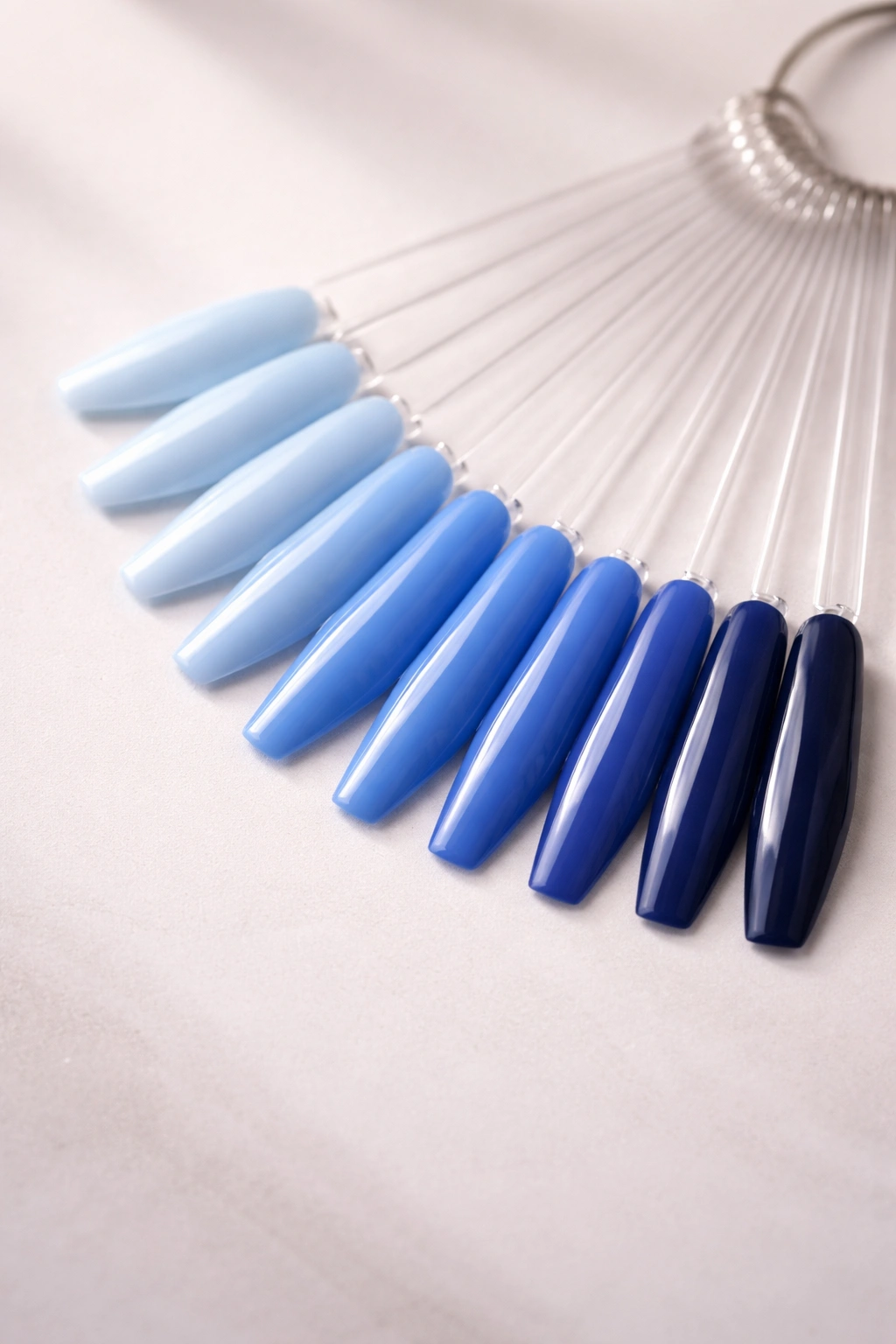
Swatch five blues next to each other and you will see the problem right away: blue is not one color. Baby blue, cornflower, cobalt, navy, teal, sapphire, denim, and icy chrome all create different moods, even when the design is nearly identical.
Skin tone plays a part, though not in the rigid way people sometimes claim. Cooler blues—icy, powder, sky—tend to look crisp against pink or neutral undertones. Richer blues like cobalt, sapphire, and navy stand out beautifully on medium, olive, tan, and deep skin. Turquoise and blue-green shades can work on almost anyone, though they need a nude base that does not pull too yellow.
Finish matters as much as color. A cream blue feels clean and graphic. Chrome gives a mirror edge. Magnetic velvet polish adds depth that shifts as your hand moves. Matte denim blue looks softer from a distance, then the coffin shape sharpens it back up.
If you are choosing from a salon wall, narrow it down with these four questions:
- Do you want the blue to read soft or sharp? Powder blue feels airy; cobalt looks crisp.
- Will the nails be short, medium, or long? Dark navy can swallow a short coffin shape, while micro French baby blue still works.
- Do you want shine, texture, or movement? Chrome, cat-eye, marble, and matte each change the finish more than the shade itself.
- How often will you fill them? Dark, crisp tips show regrowth sooner; softer ombré blues hide the grow-out line better over 2 to 3 weeks.
One more thing. Natural nails grow about 3 millimeters per month, so a clean French line will shift downward sooner than you think. If you stretch appointments, go for a softer fade, a thinner micro tip, or a floating outline design that hides that grow-out line a bit better.
1. Baby Blue Micro French With a Milky Pink Base
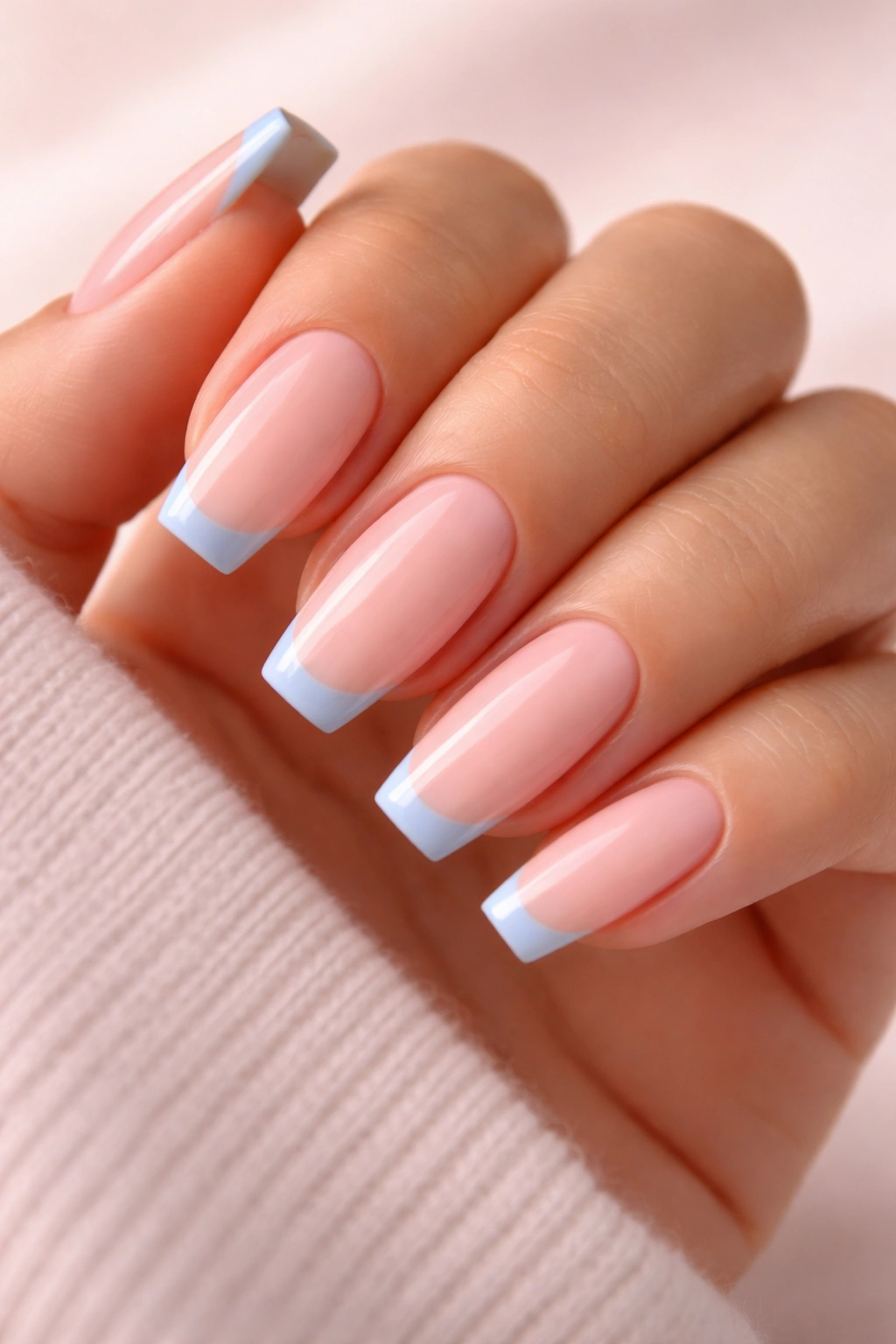
This is the set I would point a first-timer toward without hesitation. A baby blue micro tip keeps the French line thin, clean, and wearable, while the milky pink base softens the whole manicure so the coffin shape does not feel harsh.
The trick is scale. On a medium coffin nail, you want the blue edge to sit at about 2 millimeters wide, maybe a hair thicker on the thumb. Any wider, and the airy look disappears. The milky base should not be opaque either; ask for a sheer pink builder or soft jelly nude so the blue still feels like the star.
Where the balance comes from
Micro French designs work because they respect the shape of the nail bed. You still see the natural length of the finger, and the blue acts like a crisp border rather than a block of color. That makes this version look polished for daily wear, office settings, weddings, or any week when you want color that does not shout.
Quick salon notes
- Ask for a sheer milky pink base, not a flat peach nude.
- Request a fine liner brush for the tip so the smile line stays narrow.
- Stick with a gloss top coat; matte kills the lightness of this look.
- Medium coffin length gives the nicest proportion, though long nails can wear it too.
Best tweak: add a single tiny silver dot near one cuticle if you want a little extra detail without changing the clean feel.
2. Cobalt Side-Swoop French on Long Coffin Nails
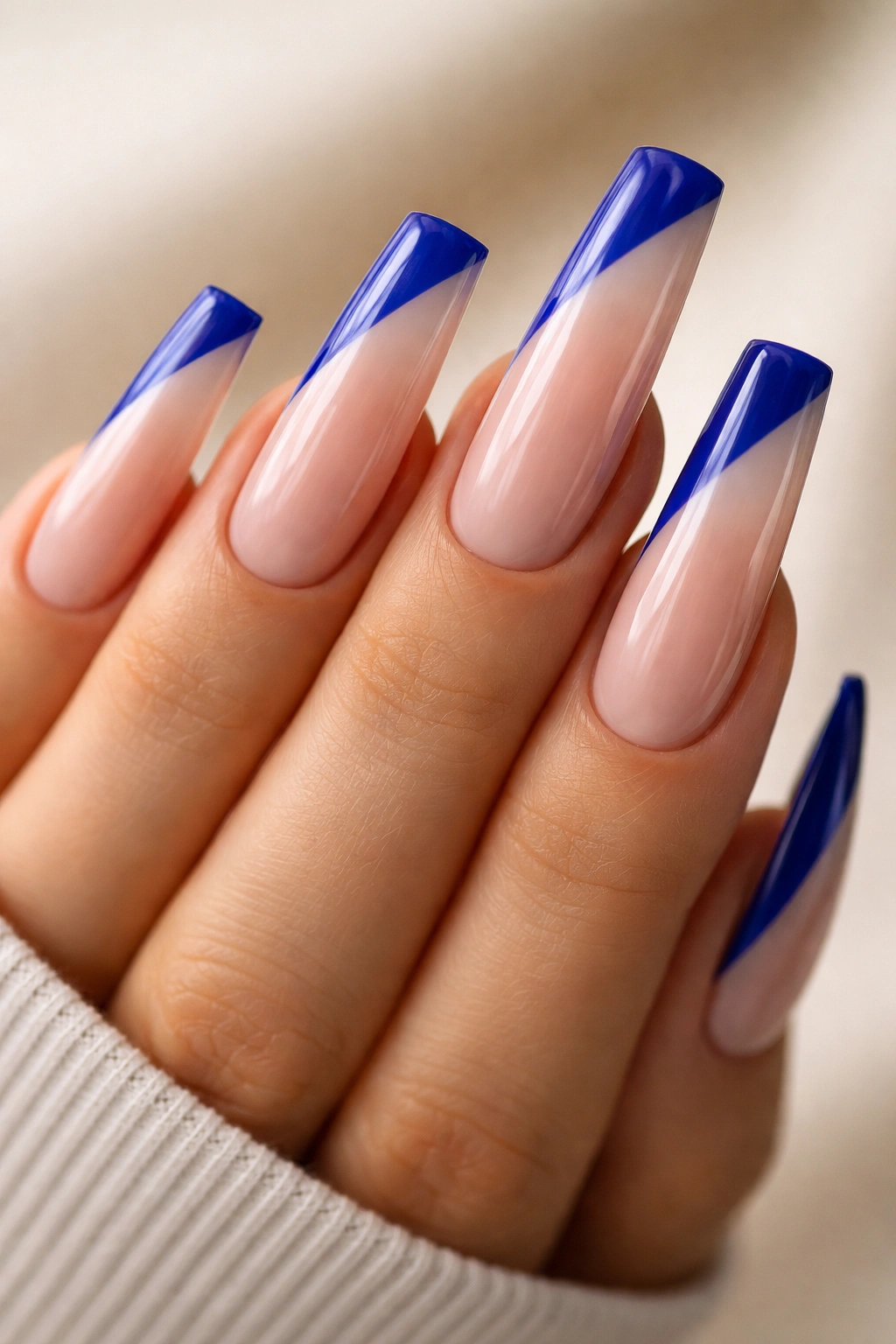
A straight-across French tip can look predictable; a cobalt side-swoop does not.
Instead of following the usual smile line, this design sweeps diagonally from one sidewall toward the center of the tip. That single shift changes the energy of the whole set. It feels faster, sharper, almost tailored. Cobalt is the right blue here because pale shades can disappear when the line goes diagonal.
You need length for this one. On a short coffin nail, the side-swoop can crowd the plate and make the nail look uneven. On a long coffin set, though, that diagonal line pulls the eye along the nail and makes the fingers look slimmer. If your hands run wider, this shape trick earns its keep.
A clean nude base is non-negotiable. Go sheer and glossy. The diagonal tip already carries the drama, so adding glitter, foil, or extra art on top usually muddies the design. I would rather see one sharp cobalt slash than three competing ideas.
The only caution: ask your tech to mirror the angles carefully on both hands. A side-swept French looks chic when the lines match. When they do not, it sticks out fast.
3. Navy Velvet French Tips With Magnetic Flash
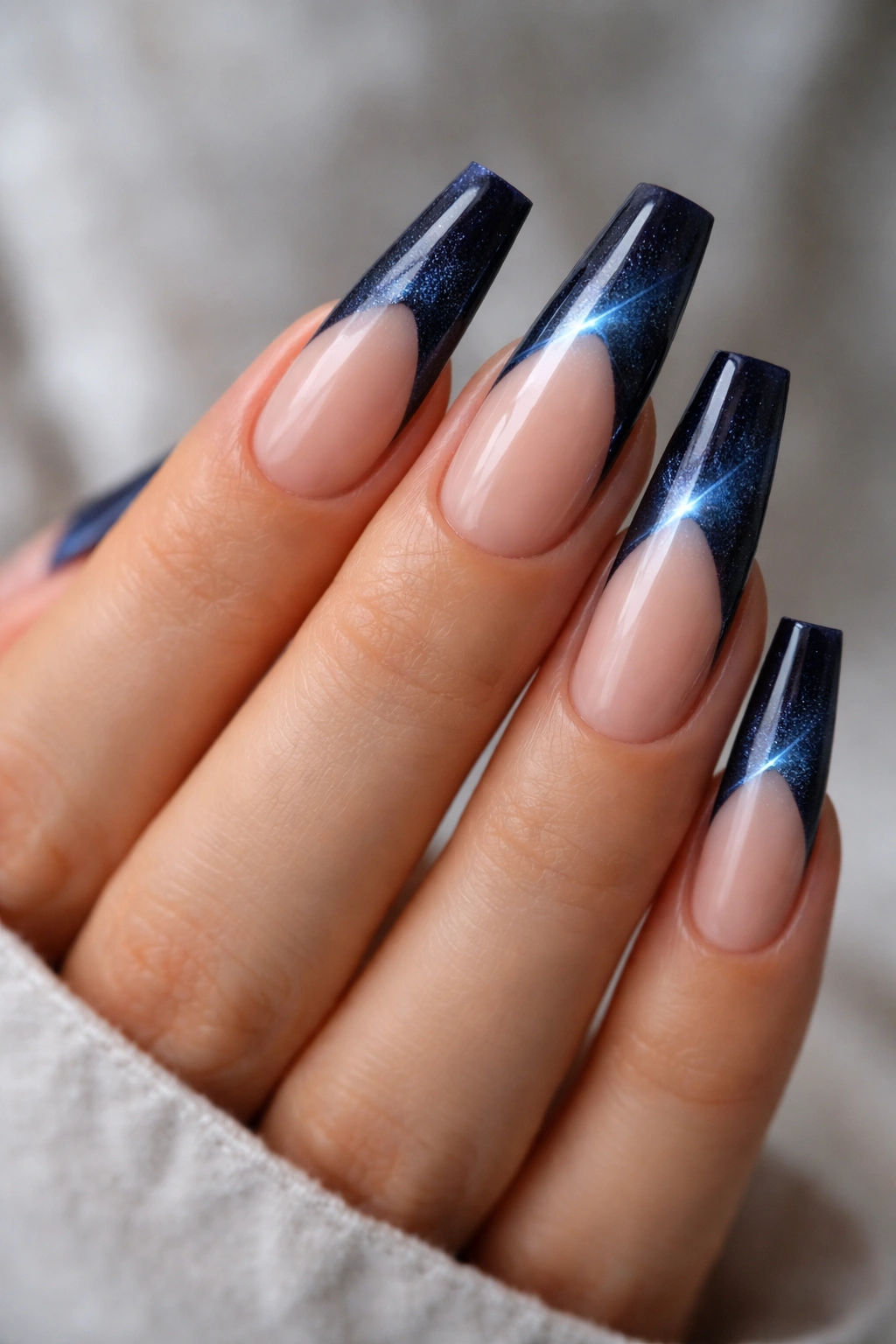
Picture low restaurant lighting, your hand around a glass, and a navy tip that shifts from inky blue to a soft, glowing stripe when you tilt your fingers. That is the appeal of magnetic velvet French tips. They look dark at first glance, then the light rolls across them.
This effect comes from cat-eye gel polish and a magnet used before curing. On a coffin nail, that flash has room to stretch across the tip, so you get movement instead of a tiny glint that disappears. Navy works better than bright blue here because the contrast between dark base pigment and luminous stripe is stronger.
You do not need a full magnetic nail, either. Keeping the effect on the French tip only makes the design feel more controlled. It is moody, but still structured.
- Ask for a deep navy cat-eye gel rather than standard shimmer polish.
- Have the tech hold the magnet at the same angle on each nail so the flash lines line up.
- Pair it with a neutral pink-beige base instead of stark white or peach.
- This one looks strongest on medium-long to long coffin nails.
A plain salon photo will not always sell this design. In motion, though, it has depth that flat cream polish cannot match.
4. Powder Blue Double French With a Silver Divider Line
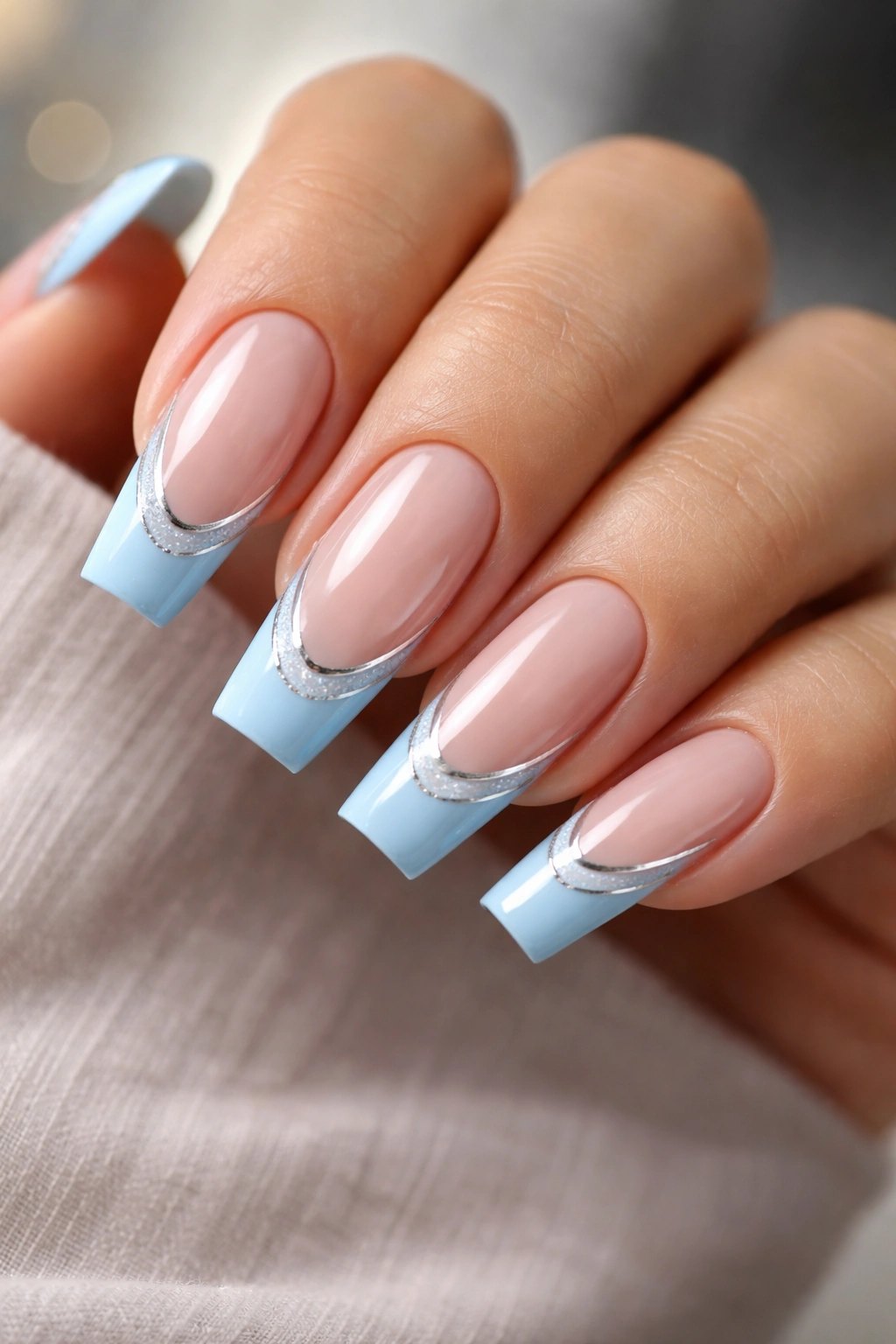
Some nail designs are loud from across the room. This one earns attention at arm’s length.
A double French uses two lines at the tip instead of one. For this version, the first line is powder blue, then a slim silver stripe sits just above or below it, depending on how your tech maps the tip. That little flash of metal changes the design from soft to deliberate. It looks finished, not decorated.
The spacing has to be tight. I like a powder blue band around 3 millimeters wide, with a silver divider no thicker than a striping brush can pull in one pass. Leave a sliver of nude showing between the lines if you want more air. Stack them closer if you want a cleaner, graphic effect.
This design shines on medium coffin nails because the shape gives the lines enough runway. On extra-long nails, there is a risk of the silver stripe looking too small unless the whole design scales up. Your tech needs a steady hand here—uneven spacing ruins the illusion fast.
A silver gel paint line works better than loose glitter. Glitter can look grainy and thick at the edge, while gel paint stays smooth under top coat. Touch the surface afterward. It should feel flat, not ridged. If you can feel every stripe, the set has too much product on the tip, and that bulk tends to chip first.
5. Cloudy Blue Ombre French With a Soft Fade
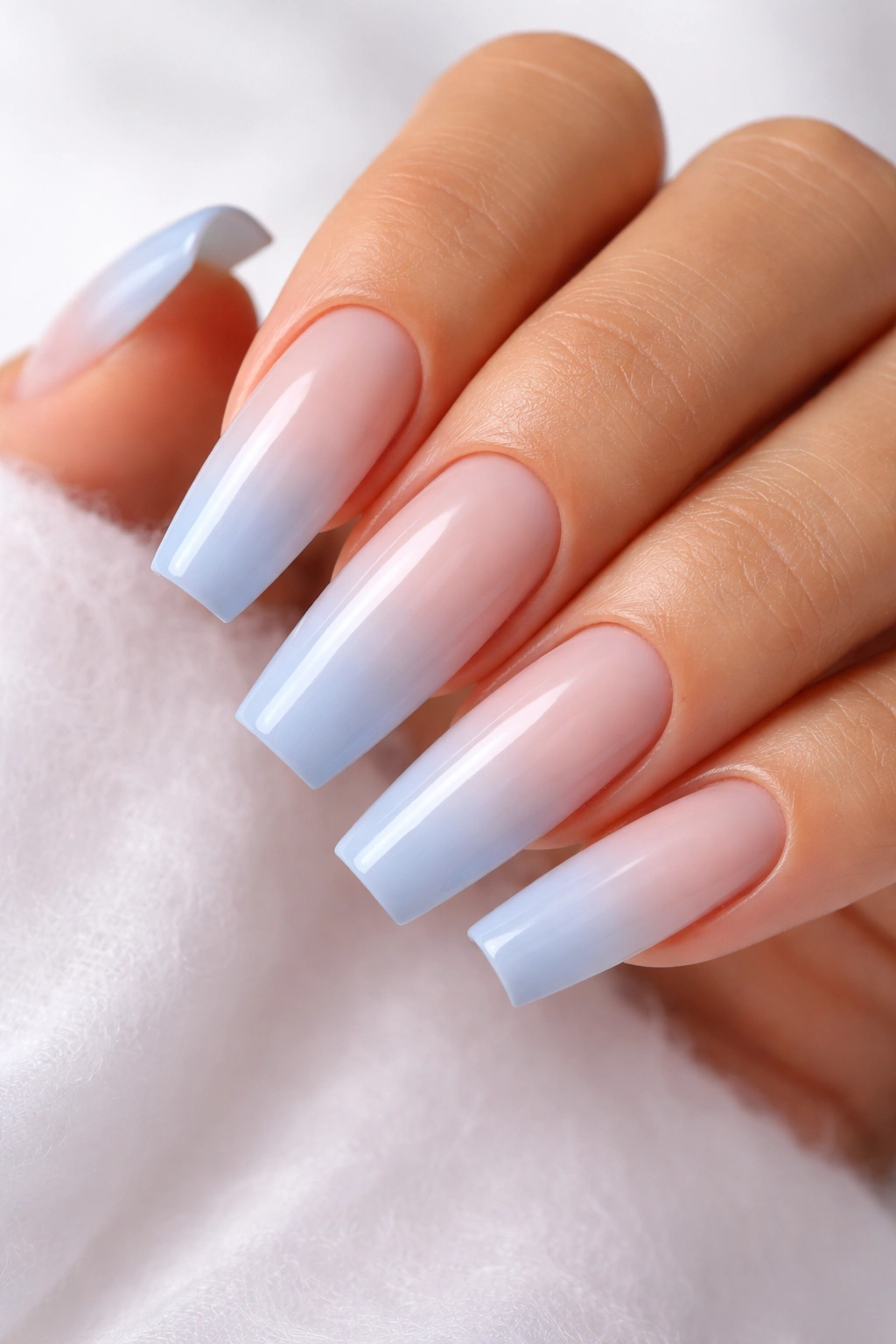
Why do some blue French tips grow out gracefully while others look dated after ten days? The answer is edges. A hard smile line is crisp, sure, though a soft blue ombré French hides wear far better.
This style fades the blue from the free edge upward into the nude base. Think cloud, sea glass, or ink dissolved in water. On a coffin shape, the fade reads clean because the sidewalls keep the design from drifting too far.
The best version uses a milky nude base and a cool, airy blue that thins out before the center of the nail. If the blue reaches too low, the design starts looking like a full ombré nail rather than a French fade. There is a line there, even when you cannot see it sharply, and placement matters.
What to ask for at the salon
Ask for the blue to be dabbed or airbrushed upward in thin layers, then softened with a sponge, brush, or blooming technique depending on the system your tech uses. Builder gel underneath helps because it keeps the nail smooth even after multiple fade layers.
A high-gloss top coat suits this one best. Matte makes the gradient look dusty. And if you wear your sets for three weeks between fills, this design earns extra points because the regrowth line does not scream at you halfway through.
6. Cornflower V-Tips With a Negative Space Cutout
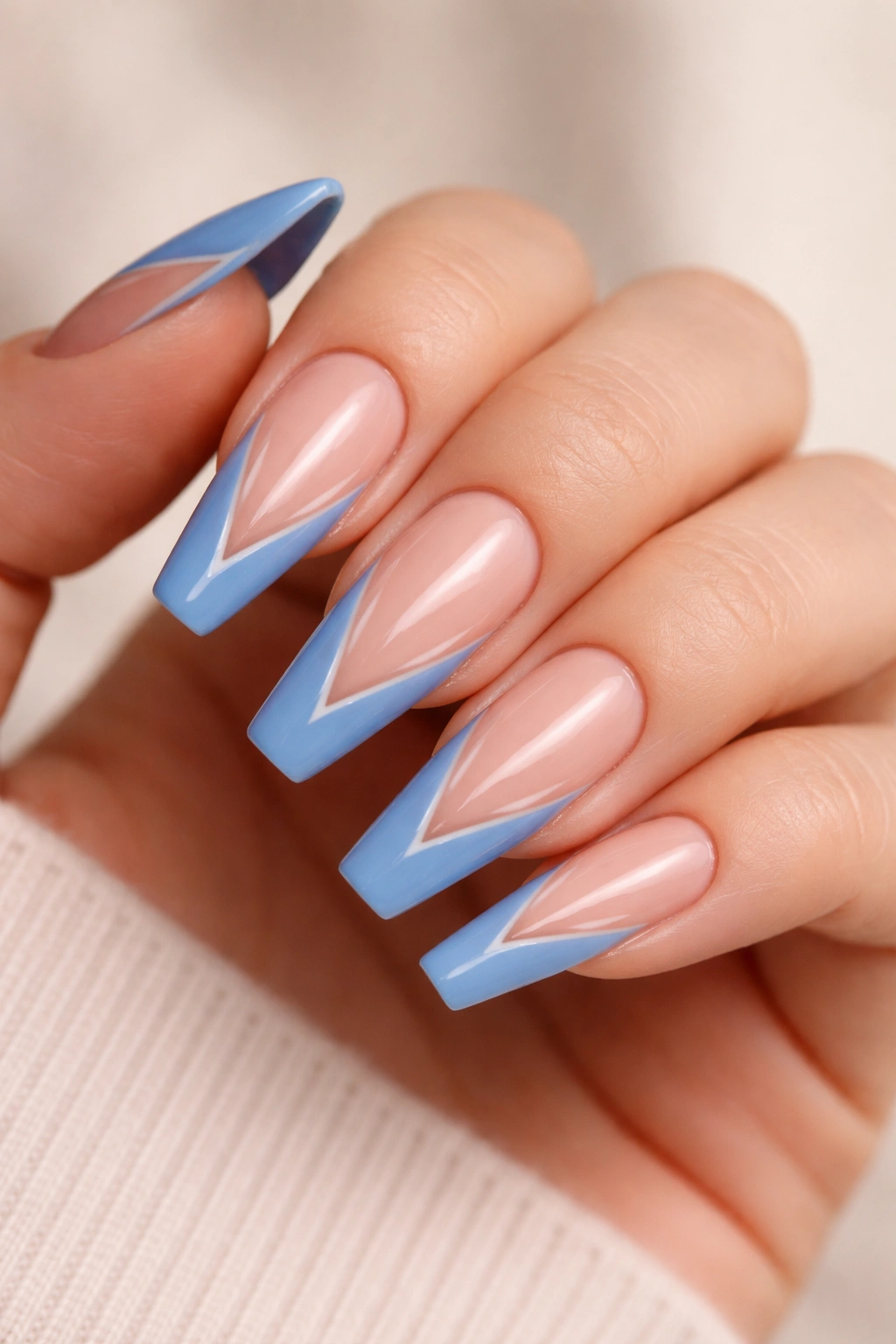
Unlike a rounded French tip, a V-tip design plays into the geometry of coffin nails instead of softening it. That is why cornflower blue works so well here. It has enough brightness to show the shape, though it does not hit as hard as cobalt.
The V should land near the center of the tip, with each side angling up toward the sidewalls. Then comes the twist: leave a slim triangular cutout of nude or clear negative space inside the V. That little open section keeps the design from looking bulky and gives the eye a second line to follow.
This is a smart choice for anyone who likes graphic nails but does not want rhinestones, decals, or foil. The design itself does the work. On medium-length coffin nails, the negative space also keeps the tip from shortening the fingers, which can happen with solid dark French blocks.
I would skip heavy glitter here. The whole charm comes from clean architecture—line, angle, spacing. Ask your tech to map the V with a liner brush before curing so both hands match. If one V is higher than the other, you will spot it every time you look down.
If you wear rings often, this manicure pairs well with silver jewelry. Cornflower blue and silver tend to sharpen each other in a pleasing way.
7. Sapphire Chrome Blue French Tip Coffin Nails With Mirror Edges
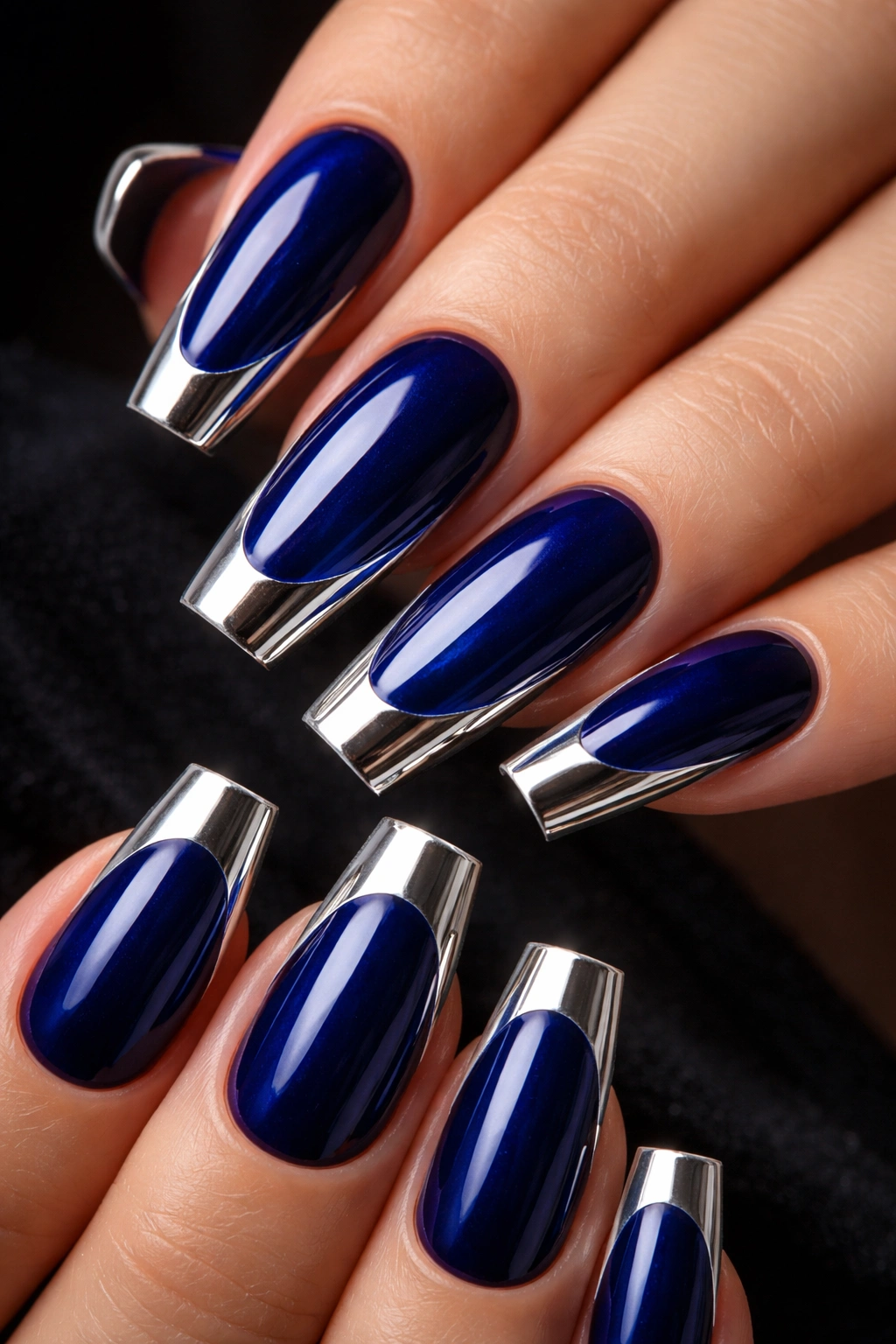
Chrome can go wrong fast. Use the wrong base color and the tip looks foil-like in the worst sense—flat, patchy, a little costume-y. Use sapphire blue over a clean dark gel, though, and you get a mirror edge that looks almost wet.
That is the whole appeal of sapphire chrome blue French tip coffin nails. The coffin shape keeps the mirror finish looking sleek rather than rounded and bubbly. A narrow-to-medium tip width works best because chrome already grabs attention. You do not need a thick band of it.
Where chrome pays off
Chrome adds reflection, which means the color shifts across the tip as your hand moves. On bright days it looks electric. Under indoor light it drops darker, closer to ink or polished stone. That changing surface gives the manicure more life than a flat cream blue.
Application details that matter
- The blue underneath should be deep sapphire or royal blue, not pastel.
- Chrome powder needs a smooth no-wipe gel layer or it will catch in patches.
- Seal the free edge well. Chrome chips first at the tip if the top coat is thin there.
- Keep the base sheer and calm so the tip finish stays the focus.
Salon wording that helps: ask for “a sapphire chrome French on a glossy nude builder base, medium-width tip, coffin shape.” That sentence tells the tech almost everything.
8. Delft Blue Floral French With Two Accent Nails
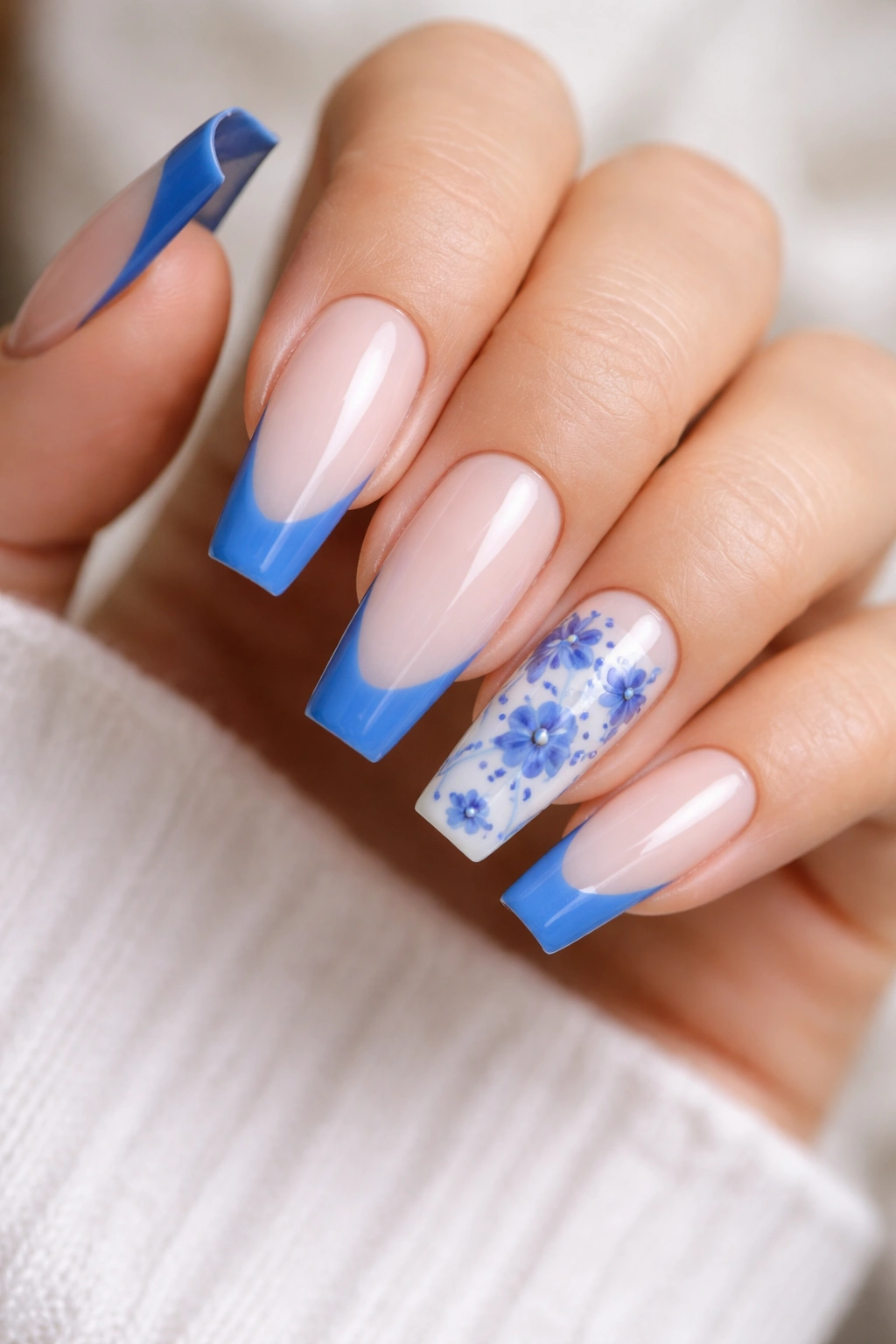
Florals on French tips can look old-fashioned fast, though this version avoids that trap.
The trick is restraint. Instead of covering every nail in petals, keep a classic blue tip on most fingers and place Delft-style blue floral detail on one or two accent nails—usually ring finger and thumb, or ring finger only if you want a cleaner set. White and cobalt details over a sheer nude base keep the pattern crisp.
I like this design when the flowers sit near the tip line rather than scattered across the whole nail. That placement ties the art back to the French shape. Tiny petals, curved leaves, a dot center, maybe a fine vine. No giant rose clusters. No overloaded decals. Small scale is what keeps this from sliding into gift-shop teacup territory.
This set has personality, which is not always true of minimalist nail art. It feels intentional, a little romantic, and far more memorable than another plain white almond manicure. Coffin nails help because the flat edge gives the floral border somewhere to land.
Hand-painted art looks better than stickers here, though decals can work if they are thin and sealed smoothly. If you are booking this at a salon, bring one reference photo that shows the flower scale you want. The words “blue floral French” can mean six different things depending on the tech.
9. Ocean Marble French Tips With Fine White Veins
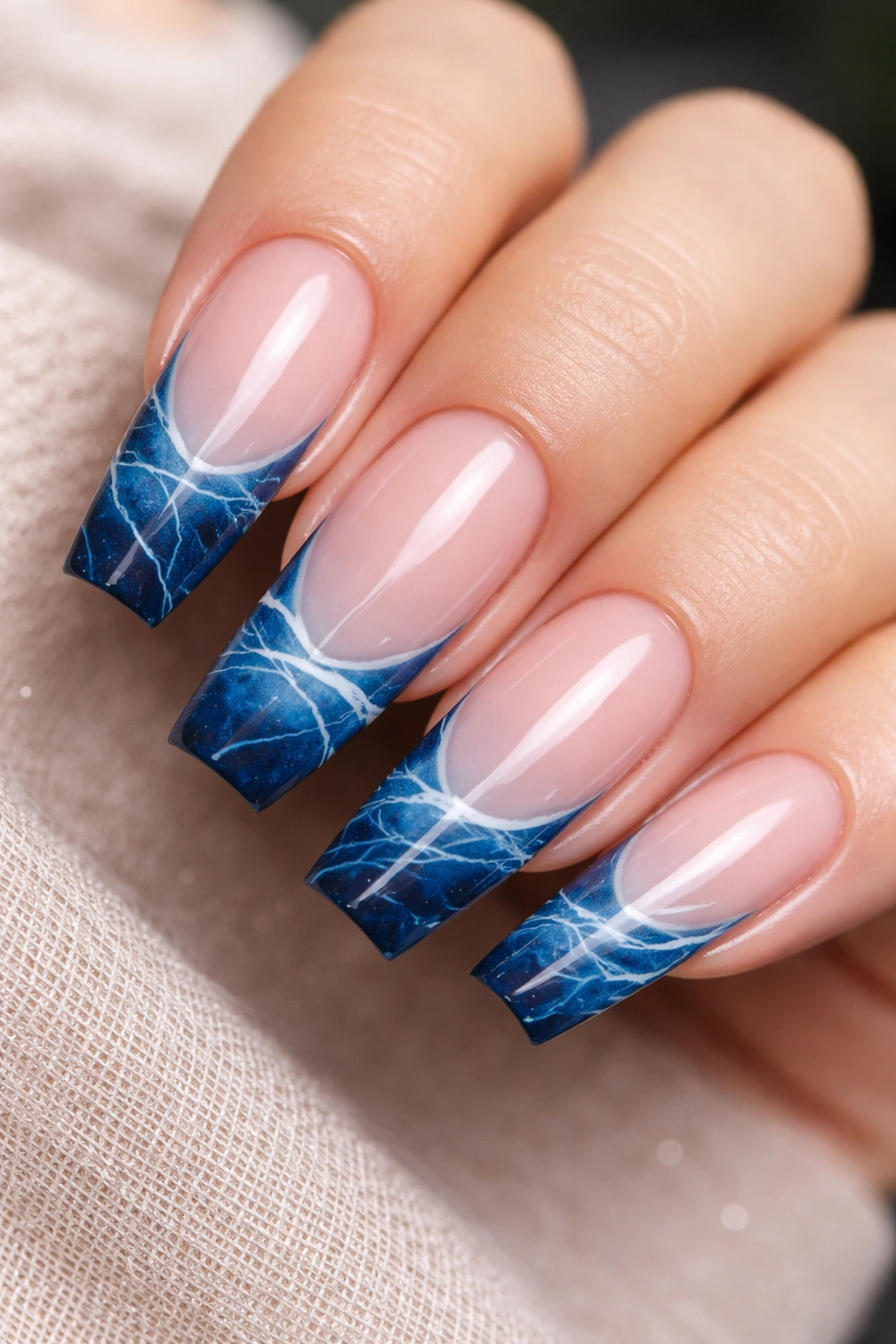
Marble nail art often gets overworked. Too much swirling, too much white, too many shades fighting for space. A blue ocean marble French tip looks strongest when the pattern stays tight and the color story stays narrow.
Start with two blues—one mid-tone ocean blue and one deeper teal-blue or navy. Add whisper-thin white veining through the tip, then cap it with gloss so the surface looks like polished stone. On a coffin nail, the flat tip edge makes the marble pattern feel framed instead of random.
This one suits clients who want texture in the design without adding crystals or chrome. The twist is visual depth, not extra material.
- Use 2 blue tones max plus white. Three or four blues usually muddy the tip.
- Keep the marble on the French section only, not the whole nail.
- Ask for the white lines to stay fine and broken, not thick lightning bolts.
- Gloss top coat is the move; matte drains the watery feel out of the design.
A good marble tip should look layered, almost translucent in spots. If the blue turns solid and opaque across every nail, the design loses the stone effect and starts reading like messy abstract art.
10. Denim Blue Matte French With a Gloss Smile Line
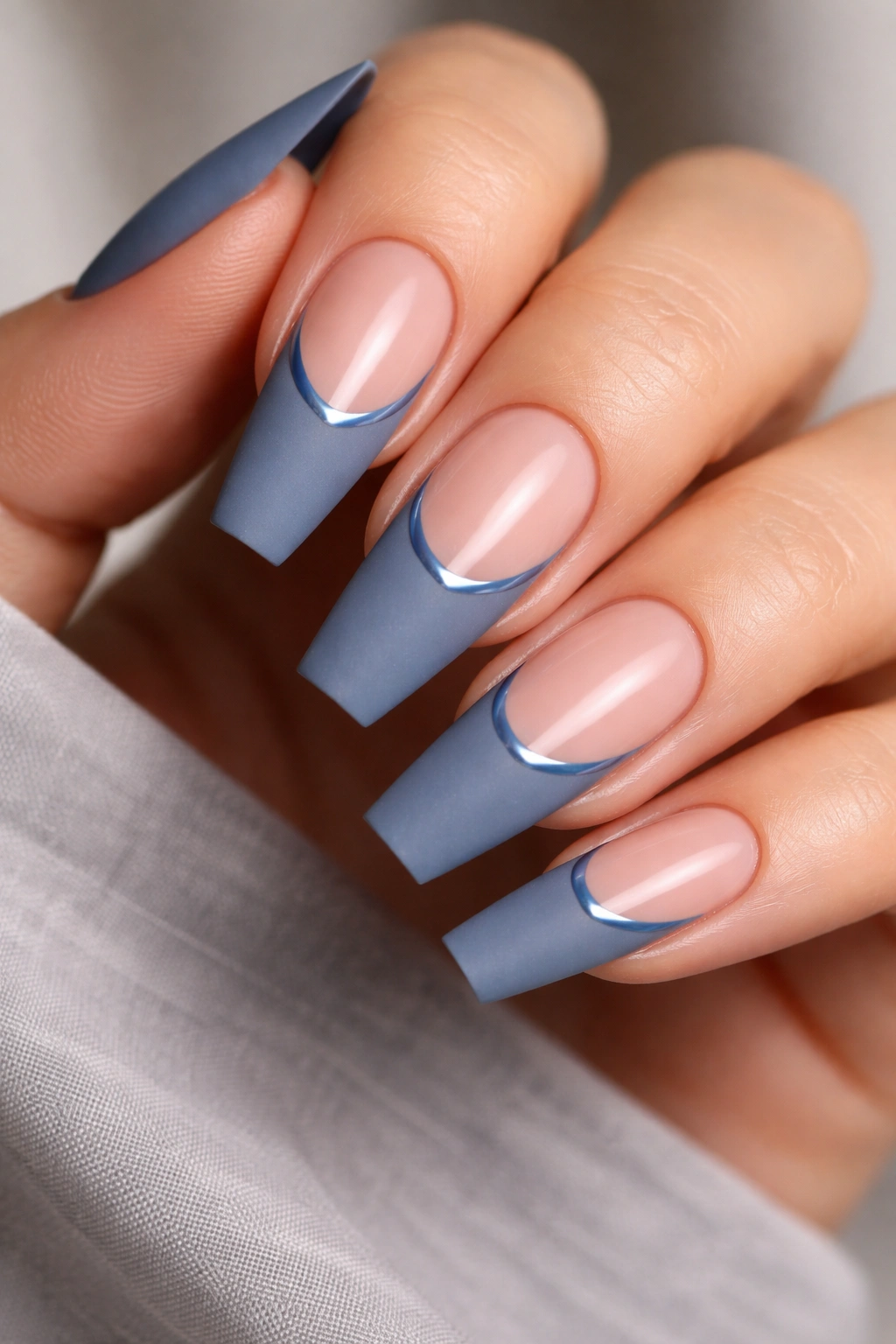
This one is sneaky. From a distance it looks soft and muted, almost casual. Up close, the texture contrast does all the heavy lifting.
Use a denim-toned blue for the French tip, finish the colored part in matte, then trace the smile line or the outer edge in gloss. Because both finishes use the same blue family, the design reads clean rather than busy. You notice the shift in light before you fully register why the tips look interesting.
Matte works best when the surface underneath is smooth. Any lumps, uneven builder gel, or thick sidewalls show more on matte than on gloss. Ask your tech to shape the coffin tip sharply and keep the upper arch tidy. The finish will expose sloppy prep.
I would not pair this with rhinestones. Matte denim blue already has enough character, and a crystal can feel out of place next to that velvety surface. If you want extra detail, a thin glossy border is enough. There is your twist.
People who wear jeans, silver hoops, leather jackets, or neutral wardrobes tend to love this one because it feels grounded. It is still blue French. It just has a little grit to it.
11. Turquoise Outline French With a Floating Edge
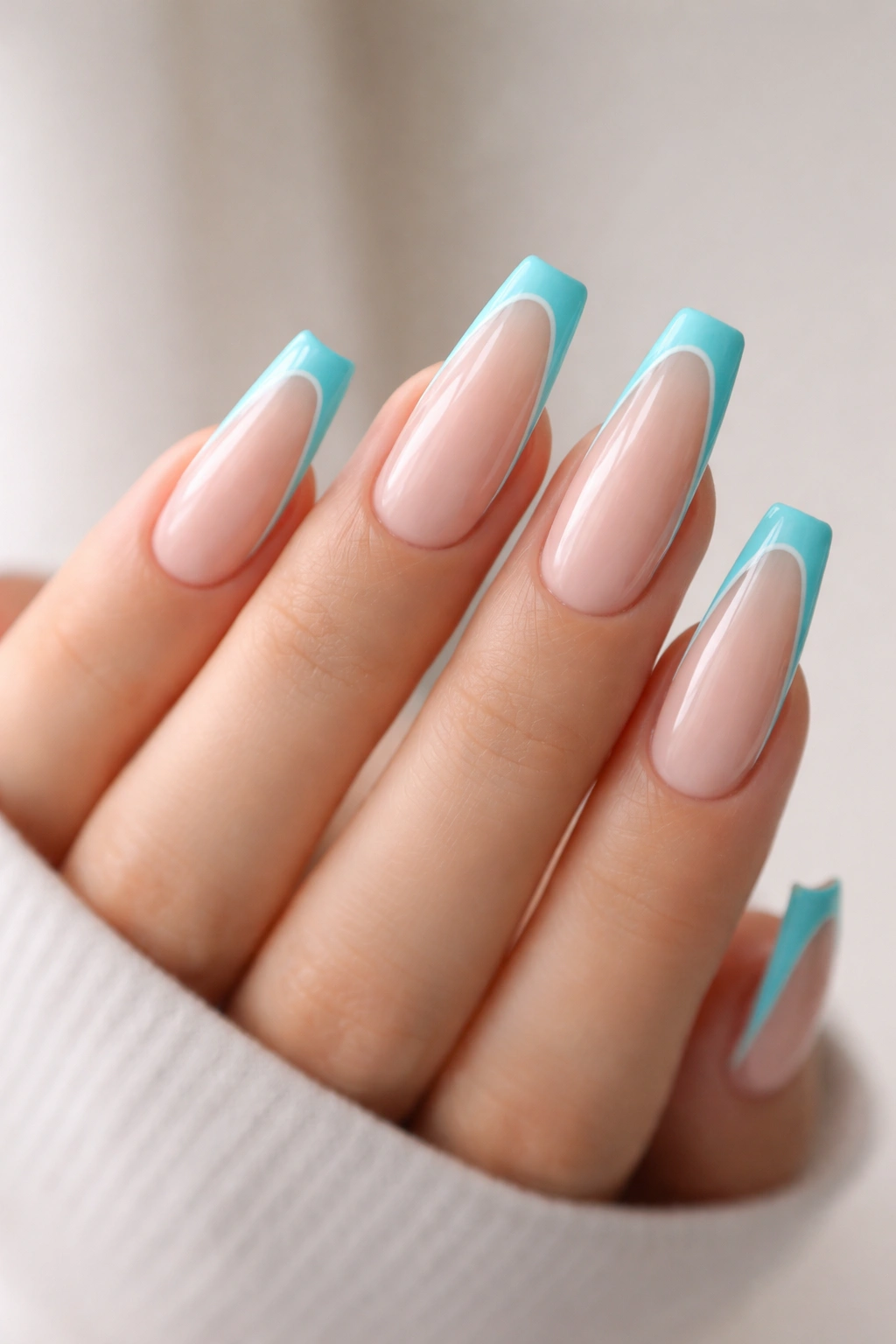
Why paint the whole tip when you can outline it instead? A floating turquoise outline French traces the coffin tip shape while leaving the center of the tip nude or sheer. The result looks airy, sharp, and a little unexpected.
This style uses a liner brush to draw a curved or angled turquoise border along the free edge and sidewalls. Sometimes the line doubles back for a second outline, though I prefer one clean border on most sets. The open center gives the nail more negative space, which makes the design feel lighter than a solid French block.
Who it suits best
If you like bright color but hate the look of chunky tips, this is a strong middle ground. Turquoise has enough punch to show from a distance, though the open center keeps the manicure from feeling heavy. It is especially flattering on medium coffin nails where a full thick tip might shorten the fingers.
How to keep it crisp
The line needs to stay thin and even—around 1 millimeter, maybe less. Ask for a builder base with a high-gloss top coat so the outline looks suspended over a smooth surface. And do not stack too much art around it. A floating French loses its clean tension when decals, glitter, and stones join the party.
This is one of those designs that looks expensive because it uses restraint.
12. Midnight Blue Celestial Tips With Tiny Starburst Details
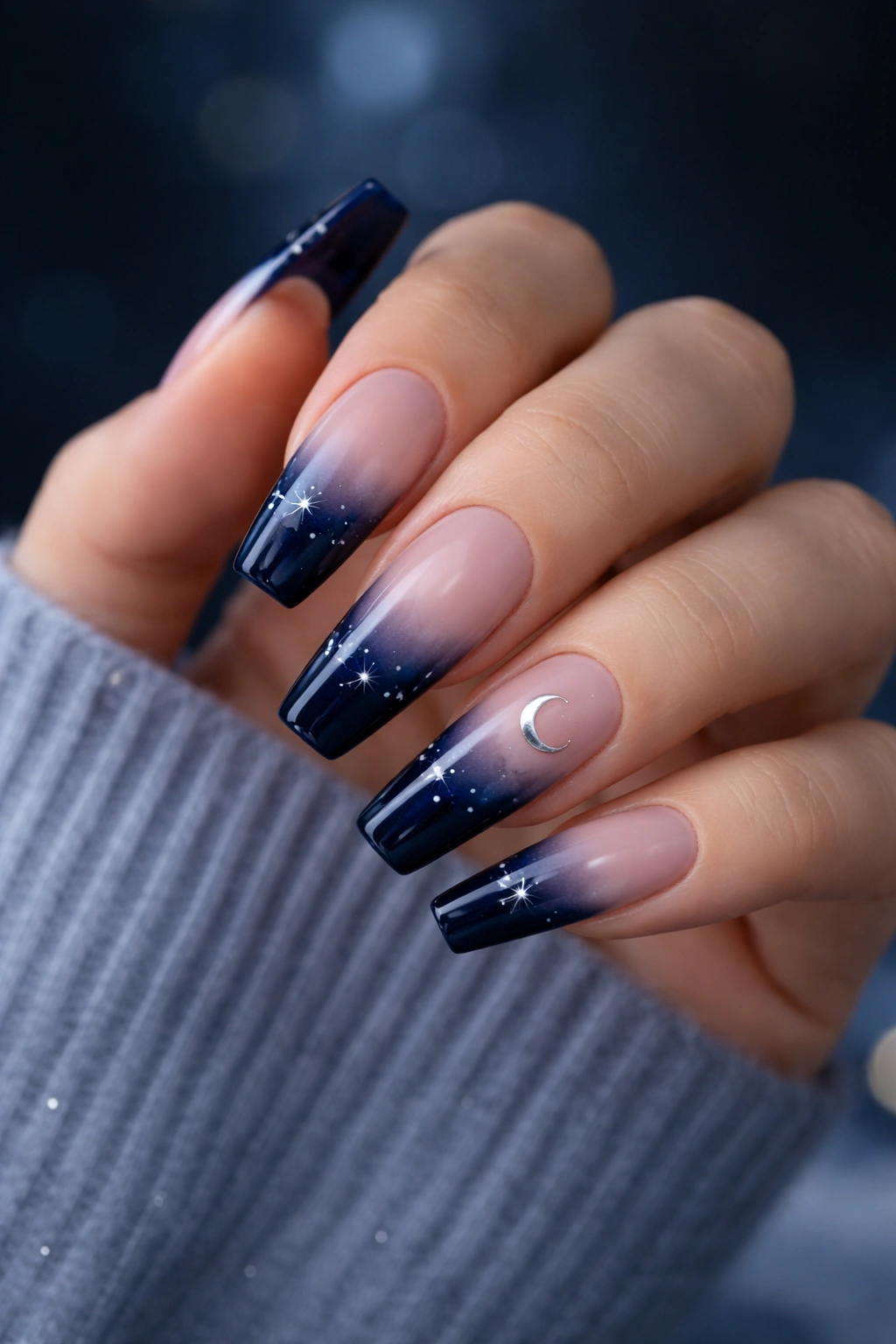
Unlike a full celestial manicure, which can veer costume-like in a hurry, this version keeps the night-sky idea anchored to the French tip. That is what saves it. Midnight blue tips set the mood, while a few tiny silver or white starbursts near the edge add detail without turning every nail into a mural.
The base should stay sheer and glossy. The stars should stay small—think pinprick dots, tiny crosses, maybe one miniature crescent across the whole hand. Once the symbols get large, the set starts competing with itself. I would place one starburst on the pinky, one on the index, maybe a crescent on the ring finger, then leave the rest of the nails clean.
This look shines on longer coffin nails because the deeper blue has enough room to read rich rather than blunt. Midnight blue also flatters a wide range of skin tones and pairs well with silver rings, especially if the star details pick up that same metal tone.
A fine detail brush matters here. So does restraint. The manicure should hint at a night sky, not spell it out. When a celestial French is done well, it feels moody and polished. When it is overpacked, it turns into themed nail art, and that is a different lane.
Bringing a Photo to Your Nail Tech Helps More Than a Long Description
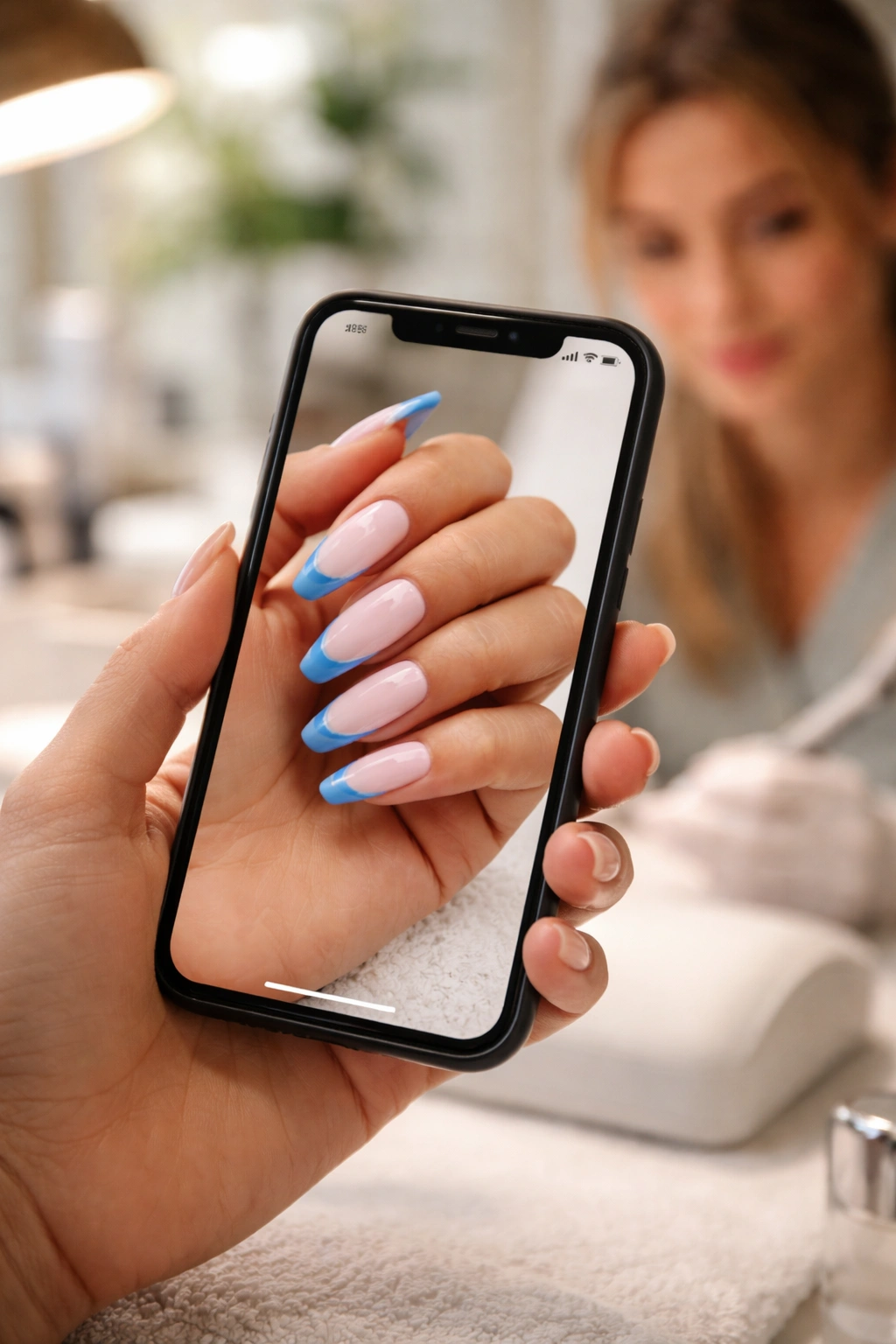
Nail language gets messy fast. “Blue French” might mean baby blue micro tips to one tech and dark square acrylics with chunky glitter to another. A single photo solves half of that confusion in under ten seconds.
Use the photo as a map, not a contract. Tell your tech what you want to keep from it—the blue tone, the tip thickness, the finish, the accent detail—and what you want changed. Maybe you like the chrome edge though want a shorter coffin shape. Maybe you want the marble look but in a softer sky blue. That kind of direction is useful.
If you are booking a set with hand-painted art, chrome, cat-eye, or marble, say that when you book. Those details take extra time, and some salons schedule plain French fills differently from art appointments. Turning up with a reference photo full of detail at the last minute is how rushed nail art happens.
Final Thoughts
If I had to narrow these down to the sets with the strongest staying power, I would put baby blue micro French, sapphire chrome tips, and the cloudy blue ombré fade near the top. They each do something different, though all three still look like French nails first and novelty art second.
The sweet spot with blue French tip coffin nails is usually contrast plus restraint. Pick one twist—chrome, cat-eye, floral accent, marble, floating outline—and let that be the point. Once the design starts stacking three ideas on one tip, the coffin shape loses its clean edge.
Bring one good reference photo, ask for the tip width in millimeters if you can, and do not be shy about discussing shape before color. On a set like this, line placement matters as much as the polish shade. A small tweak there can turn a decent manicure into one you keep staring at all week.