

Warm tones do something cool white polish never can: they make a manicure feel lived-in, flattering, and a little expensive even when the design itself is simple. Put that warmth on French tip almond nails, and you get one of the few nail looks that can read polished on Monday morning, soft at brunch, and quietly dressy at dinner without asking for much. The almond shape helps a lot here. It elongates the fingers, softens the whole hand, and gives the French tip curve more room to breathe than a square edge ever does.
I keep coming back to warm-tone French tip almond nails because they solve a common problem. A classic stark white French can look harsh against some skin tones, especially if your undertones lean golden, olive, peach, or neutral-warm. Swap the bright white for caramel, cinnamon, terracotta, cocoa, honey beige, amber, or soft copper, and the whole manicure settles into your hand in a more natural way. It still looks clean. It just looks better.
There’s another reason these manicures stick around: they’re forgiving. Tiny chips hide better in toasted neutrals than in crisp white. Regrowth is less jarring. And if you like nail art that feels intentional without shouting from across the room, warm French tips hit that sweet spot.
Some looks are minimal. Some lean glossy and rich. A couple flirt with shimmer. All of them work beautifully on almond nails because that tapered tip gives warmth a graceful, curved finish instead of a blunt stripe. That detail matters more than people think.
1. Caramel Micro French on Sheer Nude Base
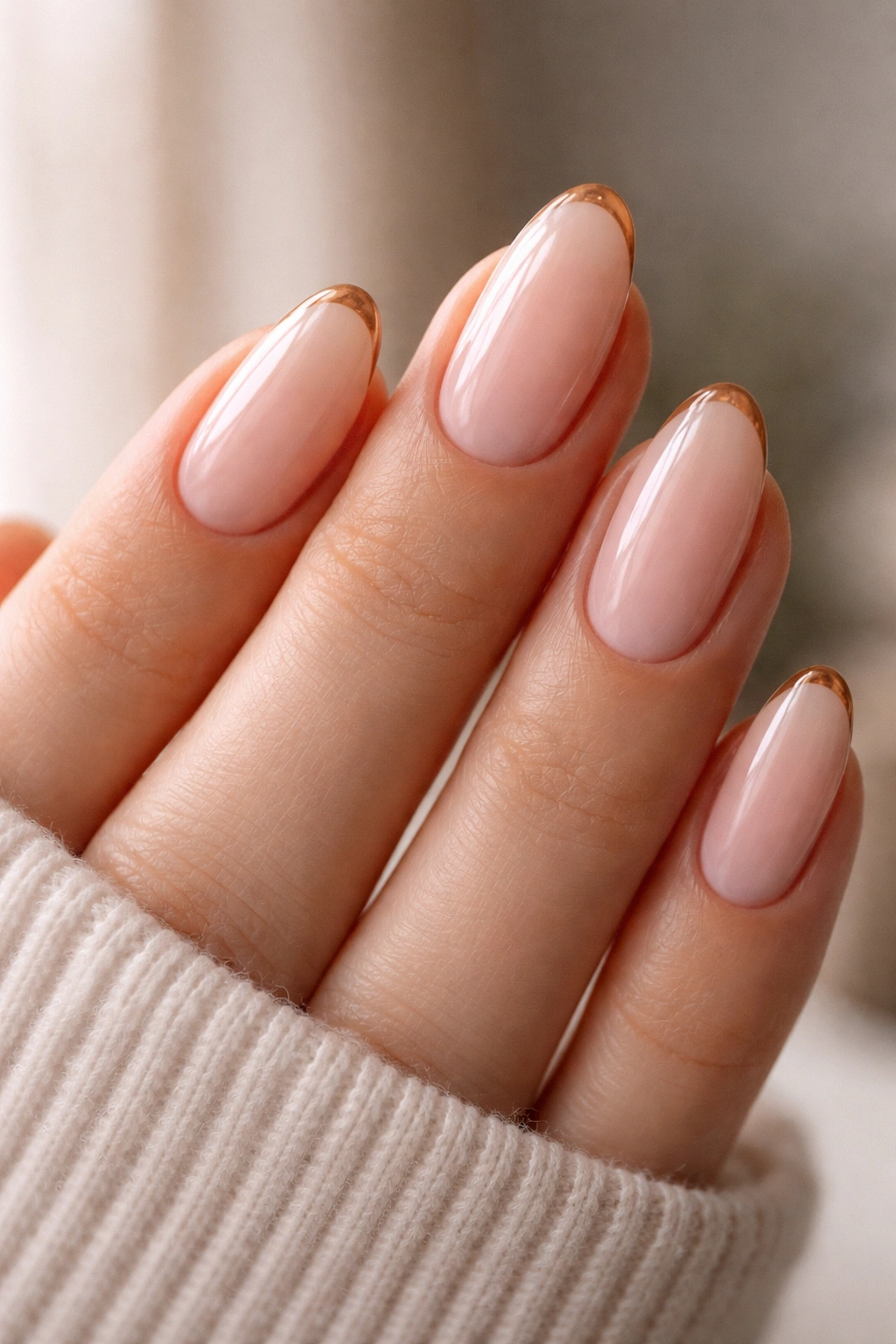
If you want the cleanest possible version of this trend, start here. A caramel micro French tip on a sheer nude base is understated in the best way—thin line, soft contrast, almond shape doing half the work for you.
The beauty of this look is scale. A tip that’s about 1 to 2 millimeters thick feels delicate and modern, especially on medium-length almond nails. Go much thicker and the design starts reading more retro. That can be nice too, but the micro version has a sharper editorial feel.
Why It Works
Caramel sits in that useful middle ground between beige and brown. It adds warmth without looking heavy, and it flatters a wide span of skin tones because it doesn’t pull too yellow or too red. On a sheer pink-nude base, the contrast is gentle rather than stark.
Quick details to ask for
- A semi-sheer nude base that matches your nail bed, not your skin exactly.
- A thin caramel smile line with a soft, even curve.
- Almond length that extends 3 to 6 millimeters past the fingertip for the cleanest balance.
- High-gloss top coat so the micro tip doesn’t disappear.
Best if you want: a low-maintenance French manicure that still looks warmer and softer than classic white.
2. Cinnamon French Tips With Glossy Finish
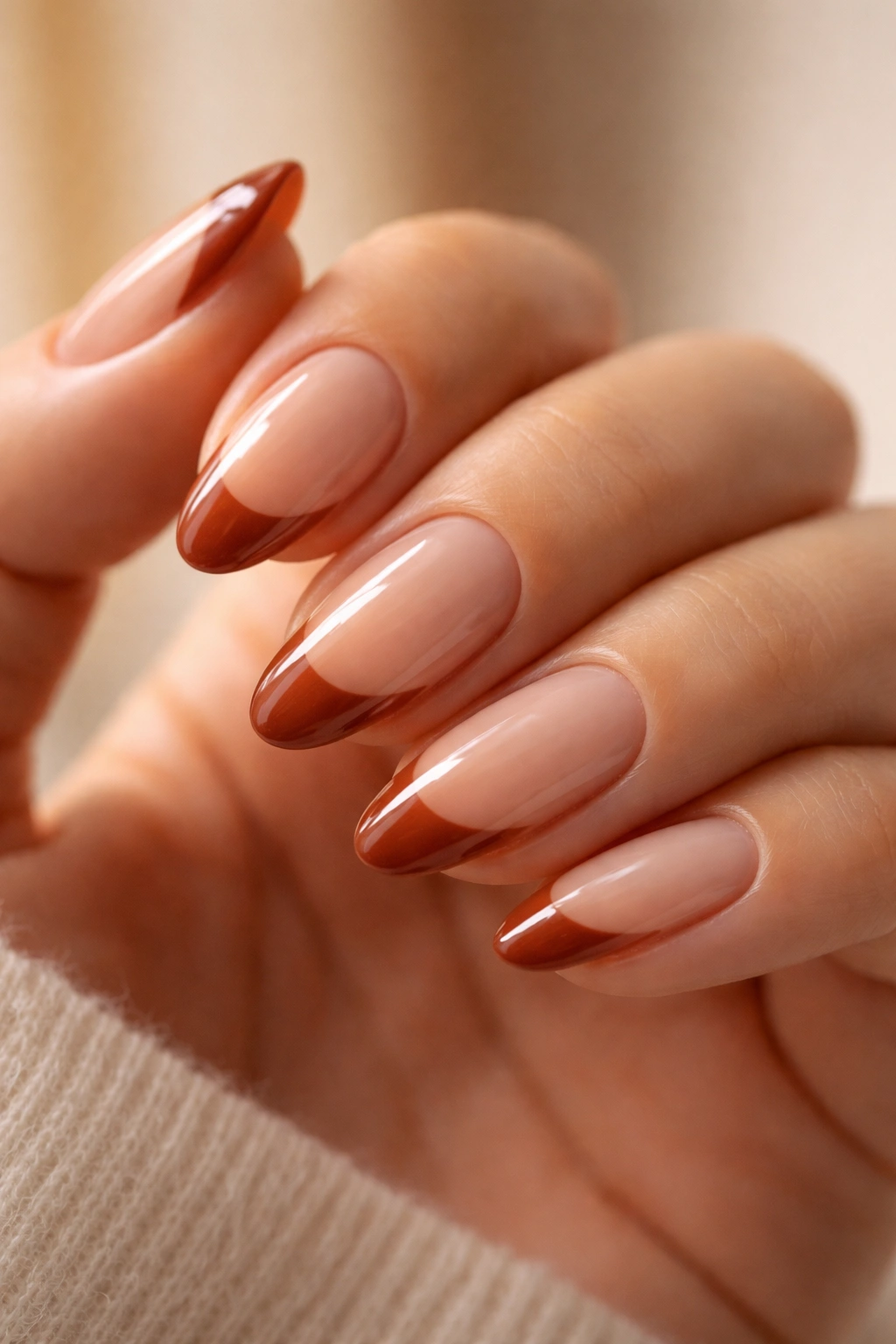
Cinnamon polish has more personality than beige, and that’s the point. It brings a baked, spicy warmth to French tip almond nails without veering into dark chocolate territory.
I like this look most on short-to-medium almond shapes because cinnamon already has presence. You do not need extra length or rhinestones or chrome layered on top. In fact, adding too much can flatten the charm of it. Keep the base soft and translucent, then let the tip carry the color.
A cinnamon shade with a slight red-brown undertone tends to make hands look warmer and a little brighter. That’s especially true if your skin has olive or golden undertones. If your undertones run cooler, ask for a muted cinnamon—more dusty brown than rusty orange.
There is one catch. Some cinnamon polishes can pull muddy under certain salon lights. Check the swatch once it’s painted on a clear tip or a nail wheel, not just in the bottle. Bottles lie.
A glossy top coat matters here. Matte cinnamon French tips can look dry unless the shape is immaculate, while shine makes the color feel creamy and deliberate.
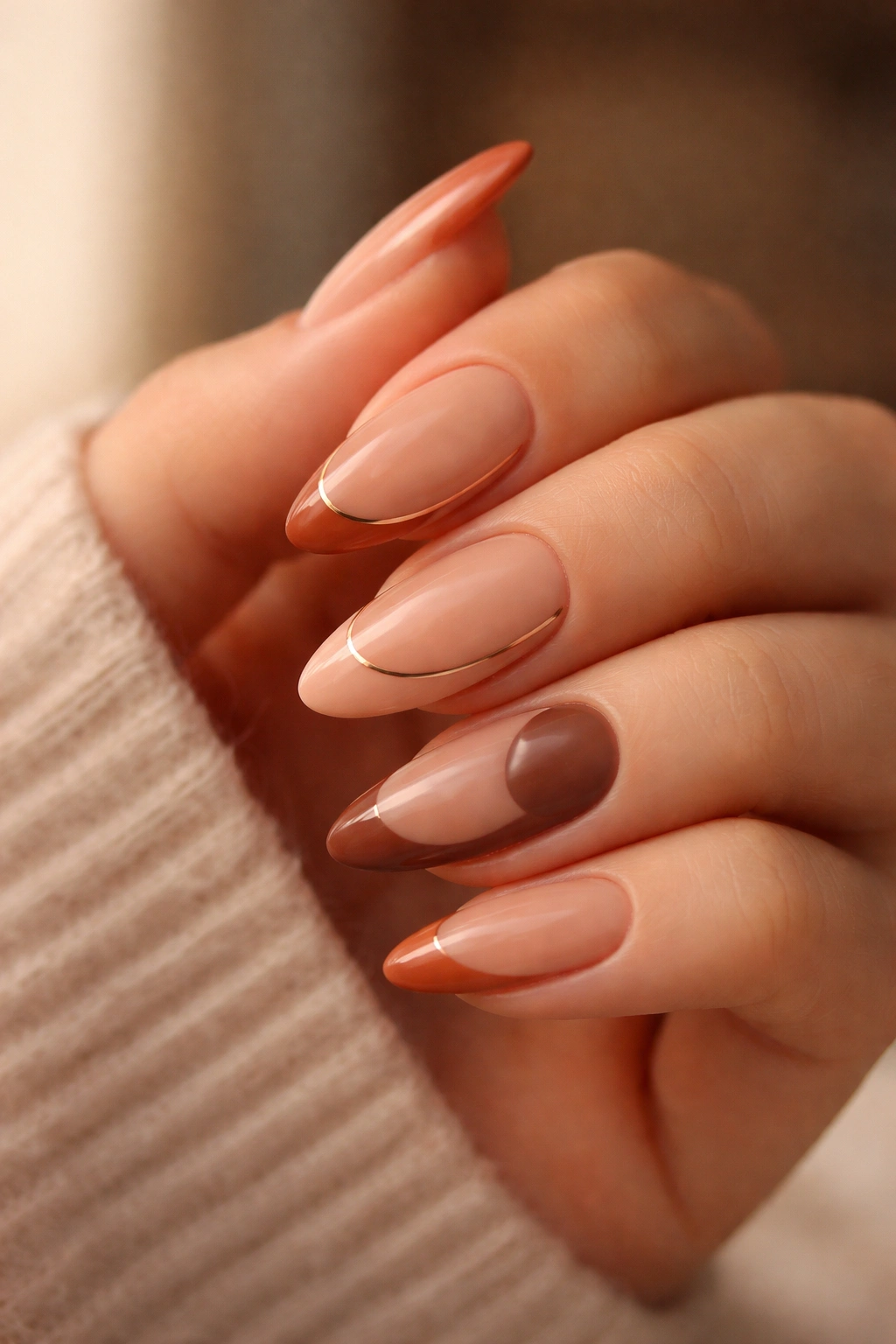
3. Honey Beige Double-Line French Curve
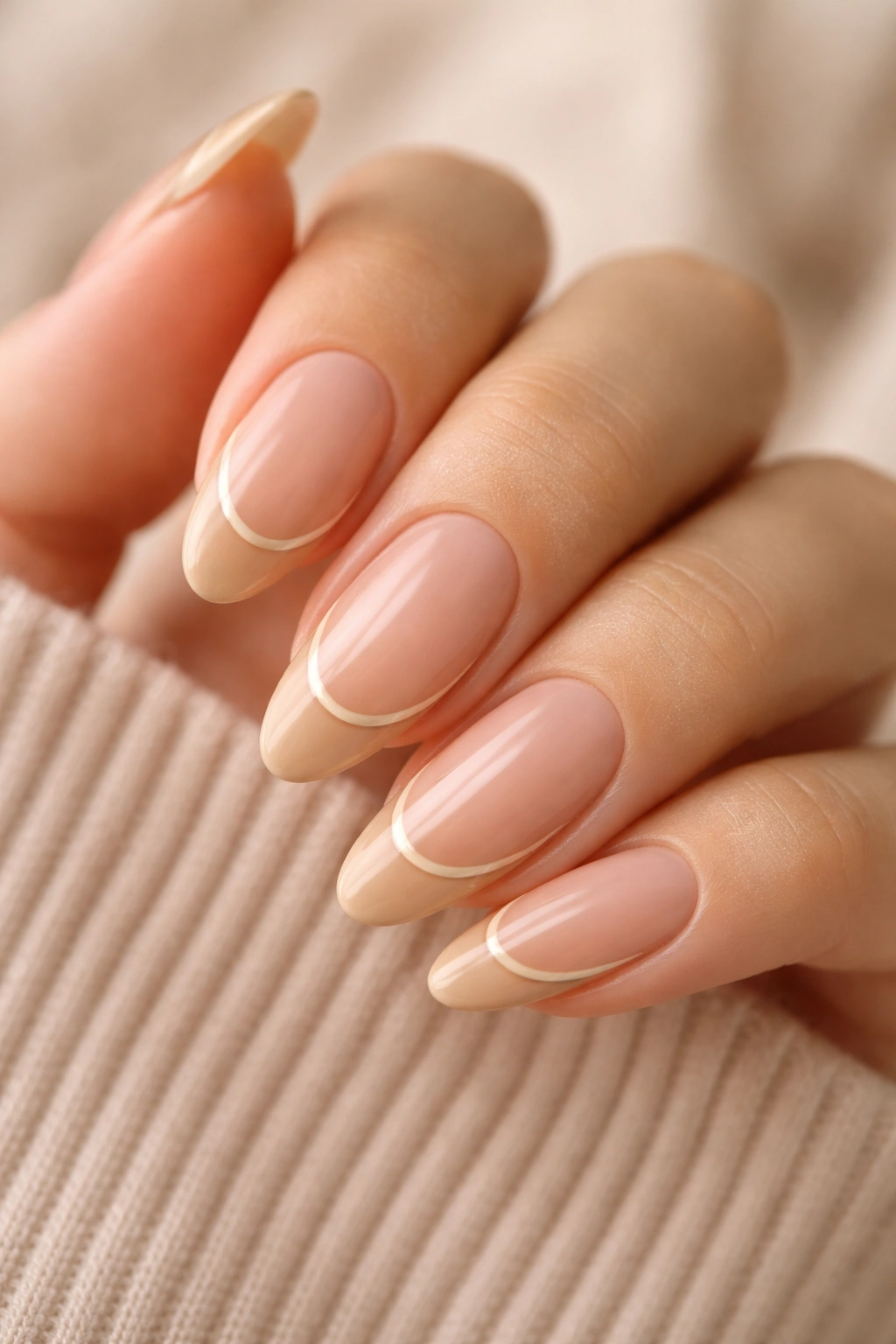
A single French tip is classic. A double-line French curve feels a bit more styled without becoming fussy. Picture a standard honey beige tip, then a second ultra-thin line tracing just above it with a sliver of negative space in between.
That tiny gap changes everything.
The effect on almond nails
Because almond nails already taper, the double curve emphasizes the shape and makes the nail bed look longer. On shorter fingers, that visual lift is noticeable. It is subtle, but it is there.
What to watch for
This design lives or dies on precision. If the gap between the two lines is uneven—say less than 1 millimeter on one side and 2 millimeters on the other—the whole manicure looks off. The lines should follow the natural smile line of the nail, not cut straight across.
Good pairings
- Glossy sheer beige base
- Honey beige main tip
- Thin accent line in a slightly deeper tan or soft gold
- No extra nail art on top
Small detail, big payoff. That’s this manicure in one sentence.
4. Terracotta French Tips With Soft Peach Base
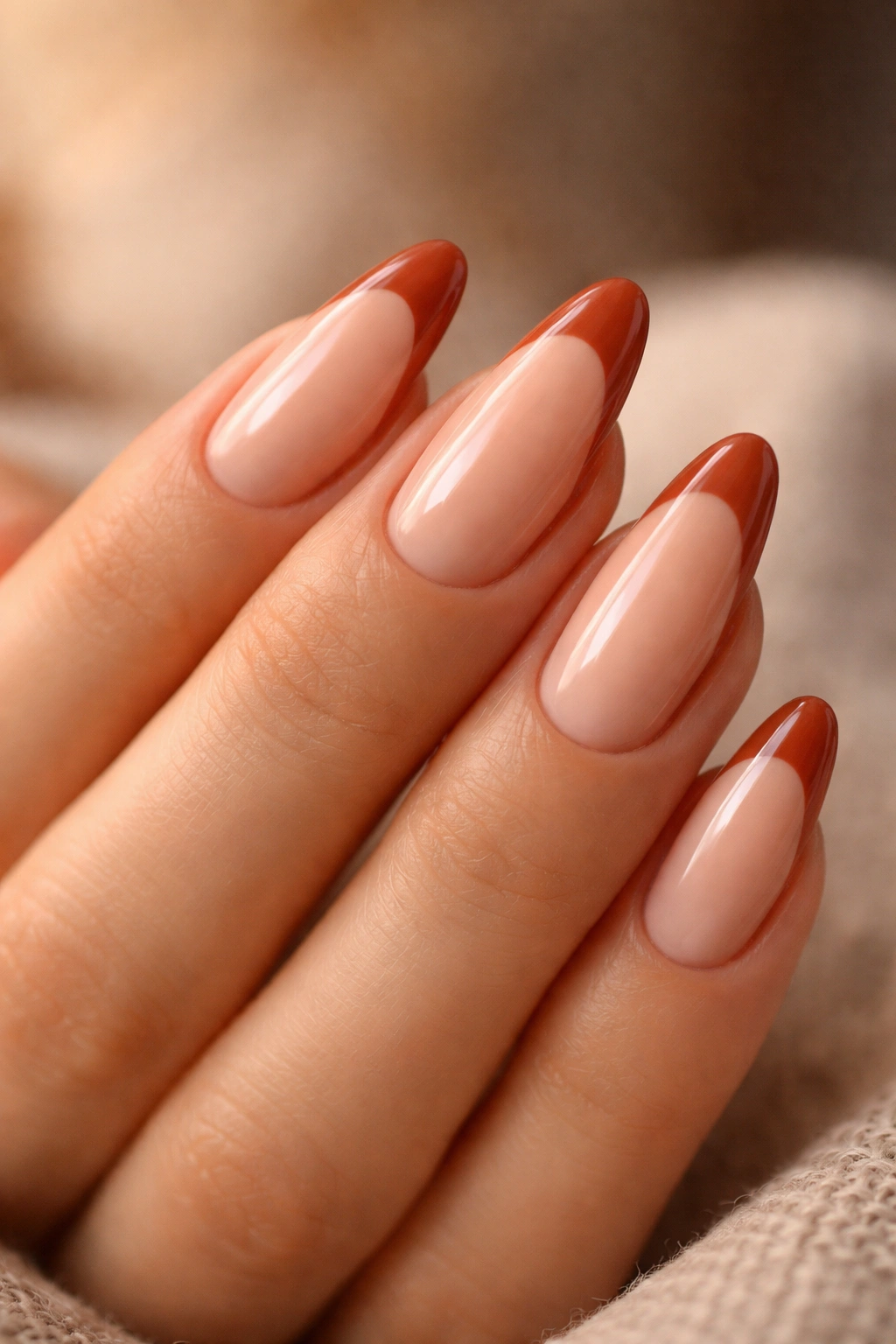
Terracotta is where warm French tip almond nails start to feel cozy in a more obvious way. It has that clay-pot, sun-baked warmth—orange, brown, a little earthy—that instantly makes the manicure feel richer.
This one is better than people expect on a soft peach base. Not pink. Peach. Pink can fight with terracotta and make the tip look too orange. Peach smooths the transition and keeps everything in the same family.
I’d wear this on medium almond nails with a tip thickness closer to 2 to 3 millimeters. Terracotta needs enough space to show its character. Too thin, and it can read like a generic tan line from a distance.
You can also soften terracotta by choosing a muted version with brown undertones instead of a bright burnt orange. That’s usually the smarter move if you want “chic” rather than “festival.”
A lot of people overcomplicate warm nail ideas. This one doesn’t need help. Clean shape. Balanced curve. Glassy finish. Done.
5. Mocha Side French on Almond Shape
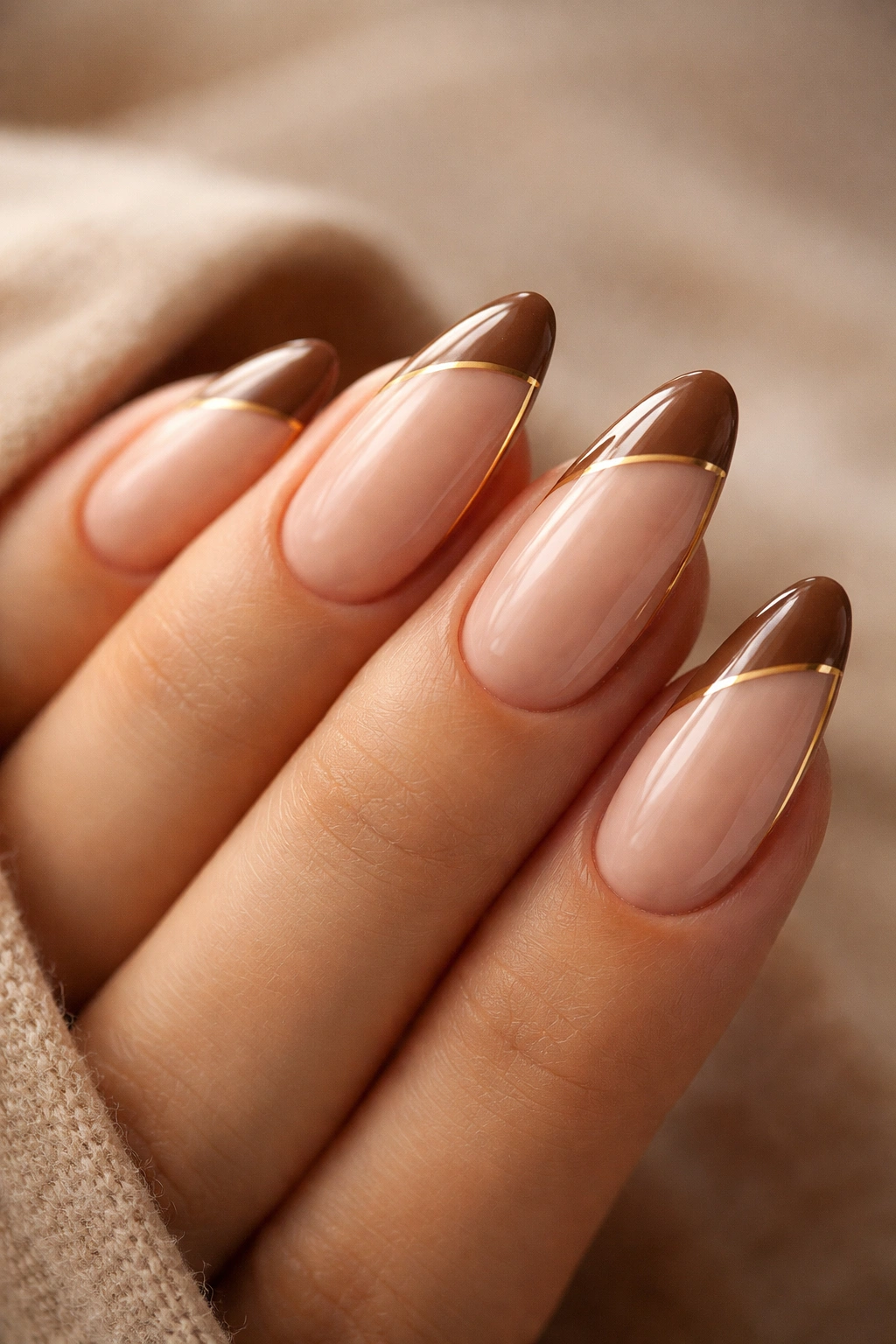
Here’s where the French tip gets playful. A side French sweeps diagonally across the tip instead of following the full smile line, and on almond nails it creates a flattering little slant that makes the shape look even sleeker.
Unlike a standard mocha French, which can feel classic-bordering-safe, the side placement gives the manicure a sharper edge. It’s still wearable. It just has more point of view.
What makes mocha different
Mocha sits between taupe and brown, often with a hint of milk chocolate. It’s softer than espresso and less reddish than chestnut. That makes it one of the easiest warm nail colors to wear if you want depth without too much contrast.
Best version of this design
- Sheer nude or milky beige base
- Diagonal mocha tip starting around one sidewall
- Almond nails kept medium length
- Optional ultra-thin gold outline if you want more definition
Who it suits best: anyone bored with a standard French but not interested in loud nail art.
6. Amber Glazed French Tips With Subtle Shine
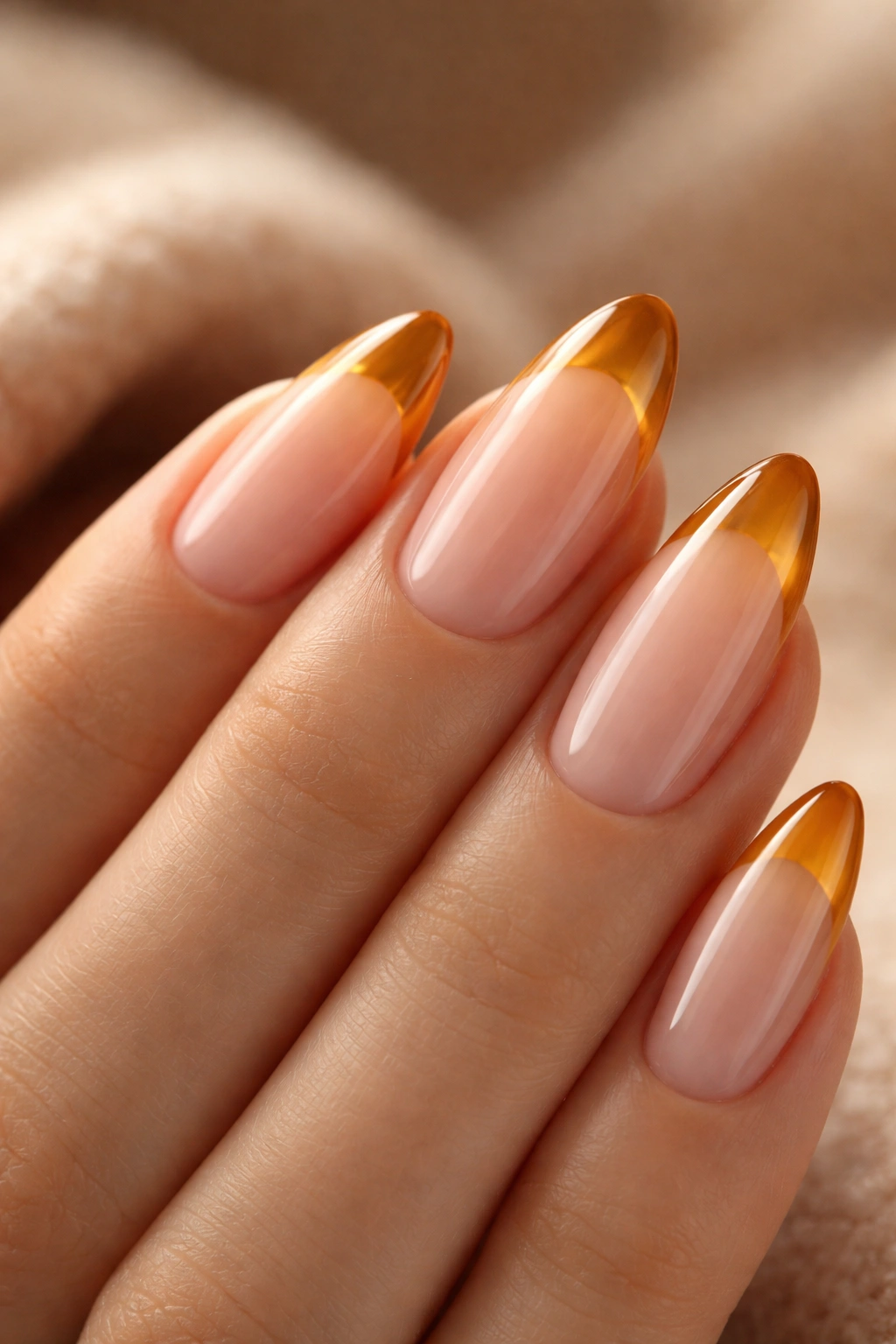
Some warm-tone French tip almond nails look cozy because of color. Others get there through finish. Amber glazed tips do both.
Think of a translucent amber or maple-toned tip with a fine glazed sheen over the top. Not mirror chrome. Not frosty shimmer. More like light passing through hard candy. That’s the effect you want.
Why does this work so well on almond nails? Curves. The almond silhouette gives the glazed reflection a soft arc, so the shine looks fluid instead of flat. On square nails, this finish can feel a bit rigid. On almond, it makes sense.
This is one of those manicures that looks best in motion. You turn your hand, the warm glaze catches the light, and the tip shifts from tea-colored to golden brown. It’s quiet but not boring.
Skip chunky glitter here. It ruins the whole mood. If your nail tech is reaching for obvious sparkle, steer them back toward a pearlescent chrome powder applied lightly over warm translucent polish.
7. Chestnut French Tips With Barely-There Base
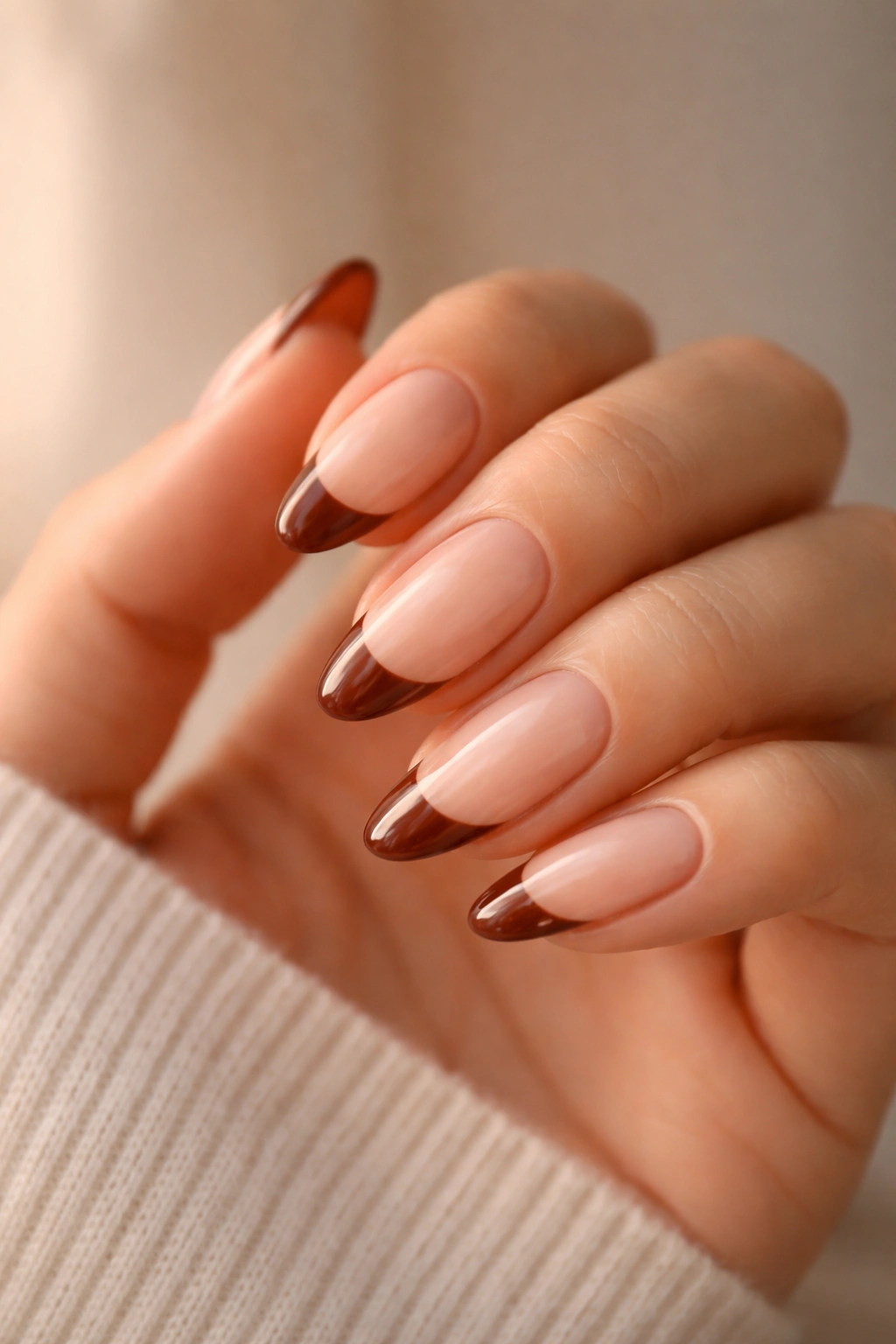
Chestnut gives you depth without the heaviness of dark brown. That’s why it works so well as a French tip color when you want your manicure to feel richer but still soft.
There’s a slight red cast to chestnut that makes it flattering on warmer skin tones, though neutral undertones wear it well too. Paired with a barely-there base—something sheer enough that the natural nail bed still peeks through—it creates a manicure that looks polished from a distance and detailed up close.
I would not overload this one with accent nails. Chestnut already has enough presence. If you need extra detail, ask for one tiny metallic dot at the cuticle on each ring finger and stop there. More than that, and the manicure starts wandering away from the elegant lane it was in.
Length matters too. Chestnut tips can look a bit heavy on long almond nails if the base is too sheer and the tip too thick. Keep the smile line balanced and the free edge proportional. You want slim and tapered, not claw-like.
8. Copper Outline French for a Warmer Metallic Edge
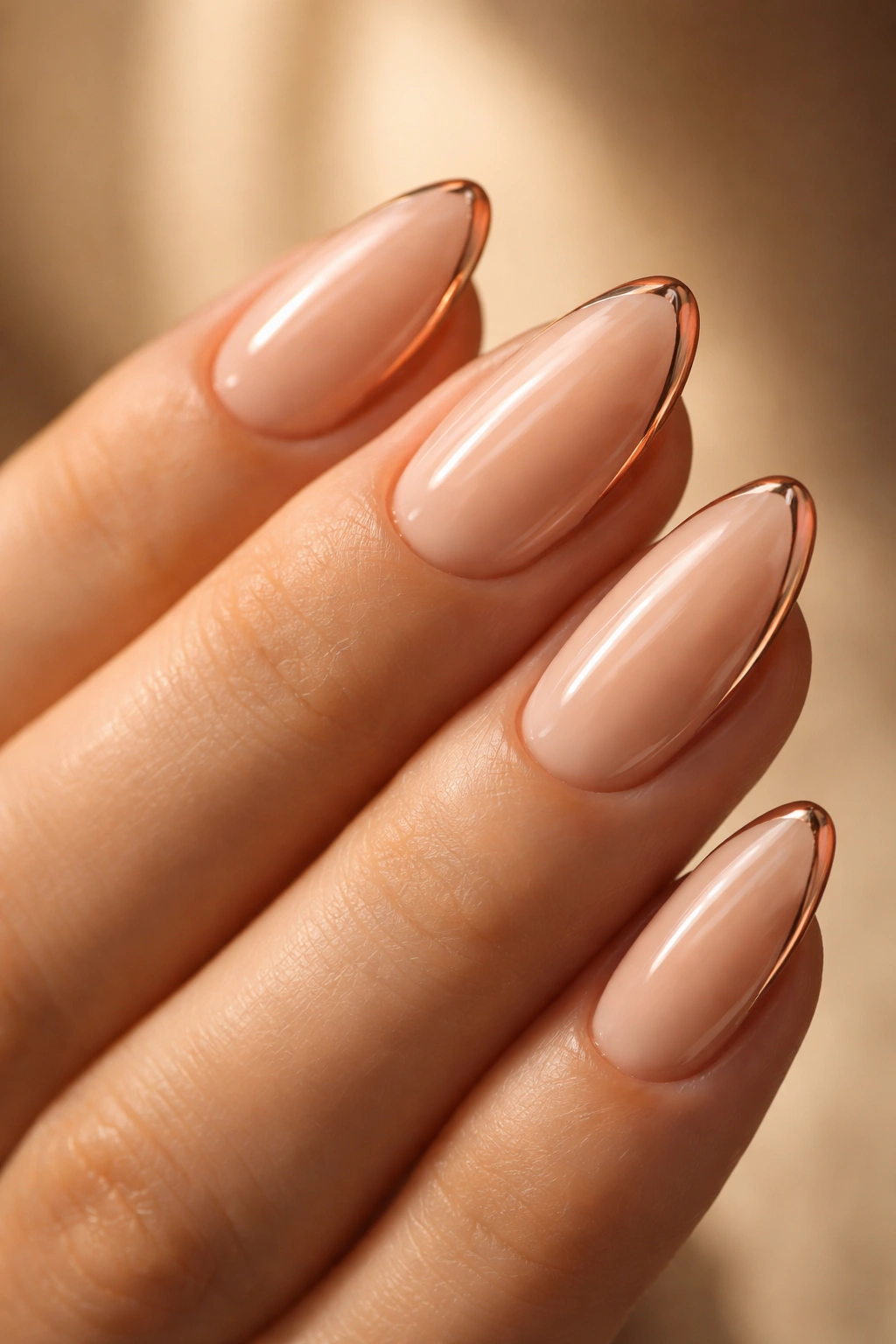
A full metallic French can look dated fast. A copper outline French, though, still feels fresh. Instead of filling the whole tip with metallic polish, you trace the French curve with a thin copper line over a nude or warm beige base.
That thin line has a jewelry-like effect. It reads more like an accessory than nail art.
Why copper works better than silver here
Silver tends to cool the manicure down. Copper keeps the warmth intact, especially against peach, beige, tan, or soft latte bases. It also plays nicely with gold jewelry without matching too perfectly, which I prefer. Too much matching can look stiff.
Ask for these details
- A fine liner brush for a crisp outline
- Copper with a smooth metallic finish, not glitter particles
- Tip line no thicker than 1 millimeter
- Short-to-medium almond shape so the line stays elegant
There’s a restraint to this design that I like. It knows when to stop.
9. Latte French Tips With Milky Neutral Base
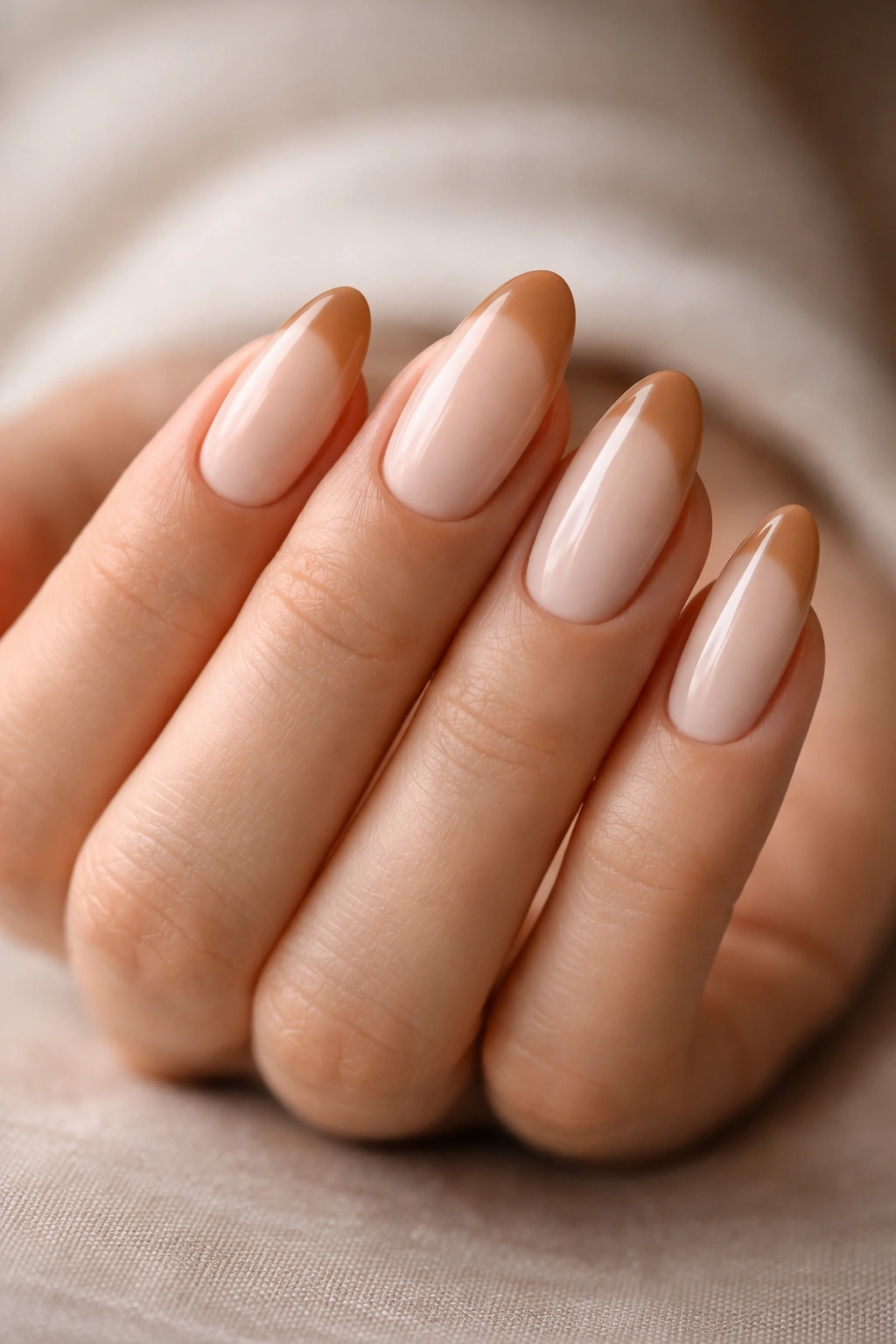
Latte nails have earned their place because they’re easy to wear and hard to mess up. For a French manicure, a latte-toned tip gives you creamy warmth without the stronger orange or red pull of terracotta or cinnamon.
This is the manicure I’d suggest to someone who wants warm-tone French tip almond nails but is nervous about color. Latte is safer. Not boring—just easier. It blends with the hand, looks expensive in photographs, and hides small imperfections better than pale white polish.
The base should stay milky and semi-opaque, not sheer pink. That milky neutral creates a soft contrast with the latte tip and gives the whole set a clean café-au-lait feel. If the base is too transparent, the look can veer patchy unless the natural nail bed is even.
Short paragraph, blunt opinion: this is one of the best office-friendly nail designs out there.
You can sharpen it a little with a deeper latte line on the ring finger only, or keep every tip the same for a cleaner finish. Both work. I usually prefer all ten nails matching on this one because consistency is part of the charm.
10. Toffee French Tips With Delicate Gold Cuticle Accent
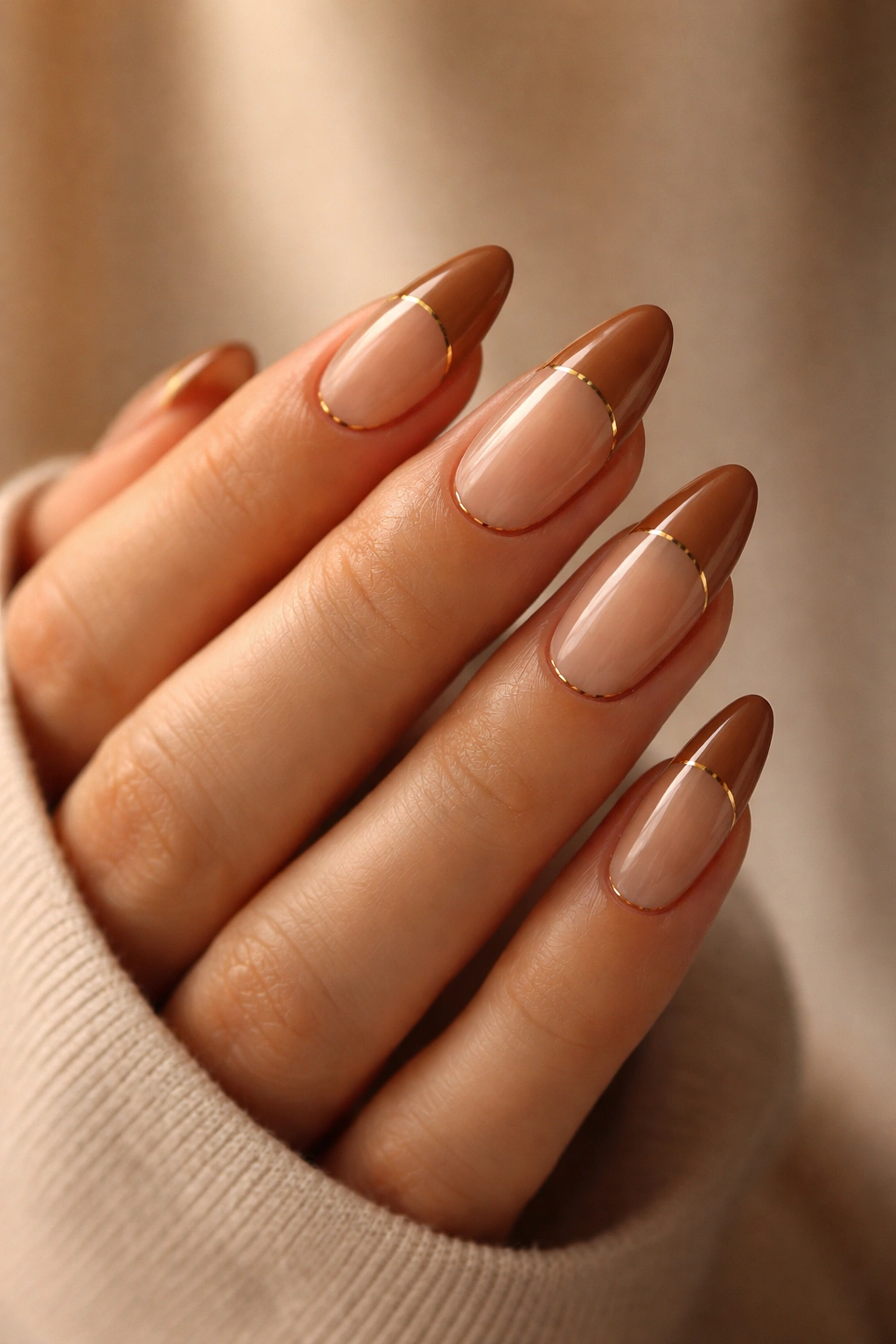
Some manicures earn their keep through one small extra detail. Toffee French tips already bring a soft golden-brown warmth, but add a tiny gold cuticle accent—a dot, half-moon, or slim crescent—and the whole set feels more dressed.
This design can go wrong if the gold is too bright. You want a muted metallic, something closer to brushed gold than foil. And keep it tiny. Think 1 to 2 millimeters of detail, not a chunky reverse French.
Why this pairing works
- Toffee has enough golden warmth to connect naturally with gold accents.
- Almond nails give the cuticle area a graceful oval frame.
- The eye moves from cuticle to tip, which makes the nail look longer.
Placement options
- Single gold dot centered at each cuticle
- Thin reverse arc on accent nails only
- Tiny metallic studs on ring fingers, if you like texture
Less is the whole argument here. Once the gold starts competing with the toffee tip, the manicure loses its calm.
11. Maple Brown French With Soft Ombre Base
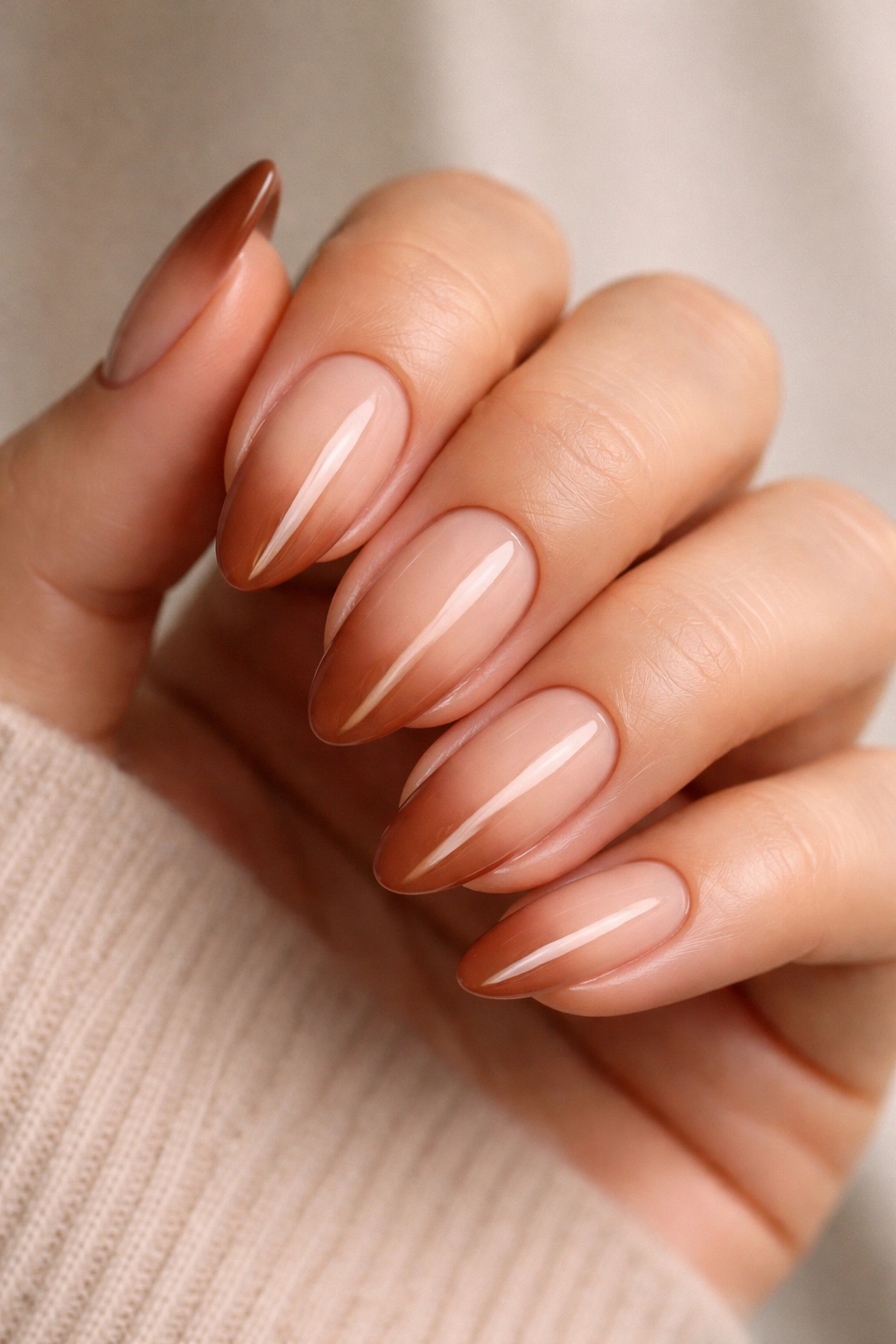
Maple brown has a syrupy depth to it—golden brown, a little amber, a little toasted sugar. Pair that with a soft ombre base, fading from a milky nude at the cuticle to a slightly warmer nude toward the tip, and you get a French manicure with more dimension than a flat base can offer.
This one takes a steadier hand than it looks like it should. The ombre base has to be diffused cleanly before the French line goes on, otherwise the tip edge can look messy against the gradient. If you’re doing this at home, a small makeup sponge helps, though salon gel blending usually gives the smoother finish.
What I enjoy about this look is that it feels cozy without becoming literal. It doesn’t scream autumn leaves or coffee shop candles. It just has warmth built into every layer.
And yes, I know that sounds a little dramatic for nail polish. Still true.
A maple brown French also tends to flatter medium and deeper skin tones beautifully because it echoes warmth already present in the skin instead of fighting it with bright contrast.
12. Cocoa French Tips With Matte Almond Finish
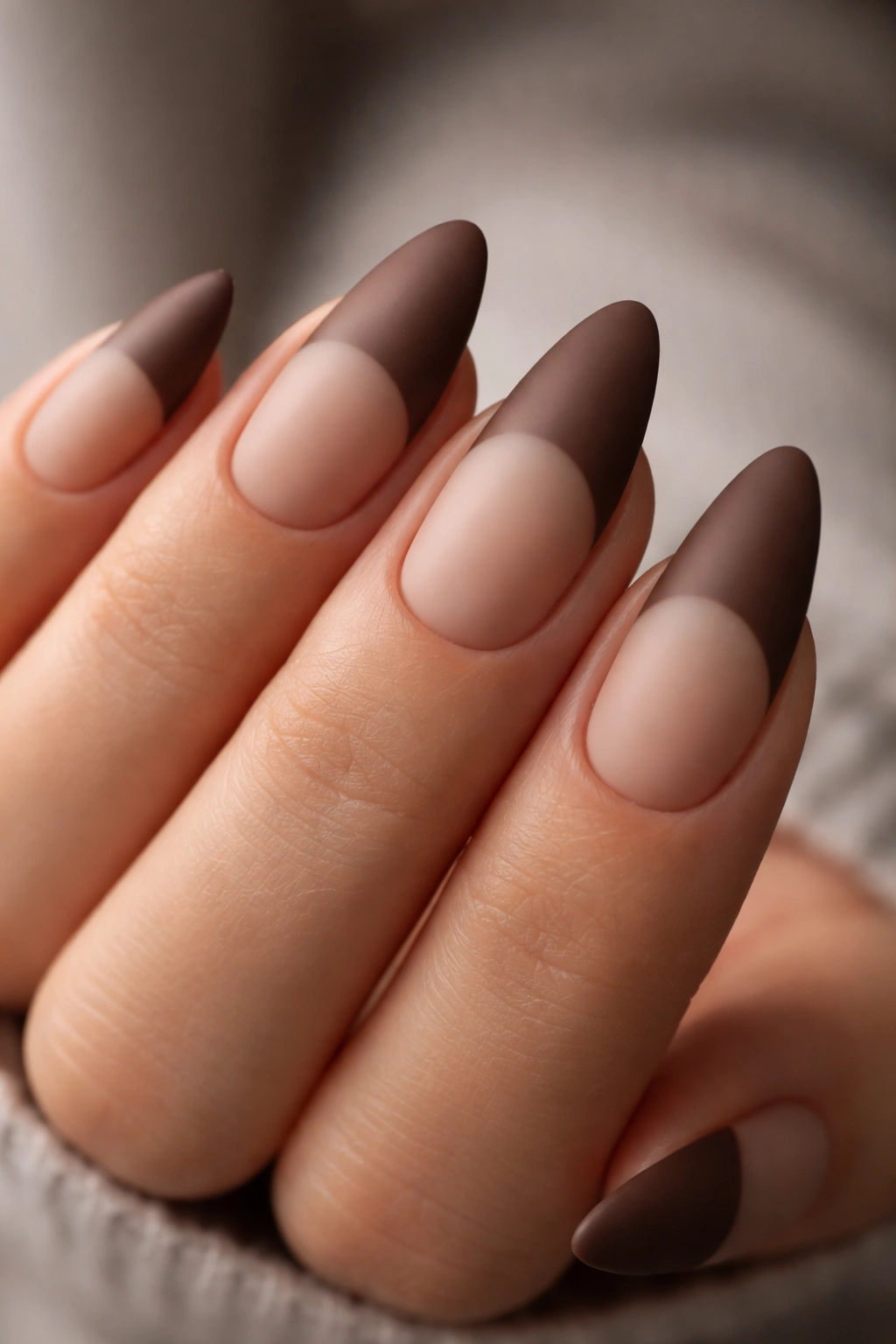
Want something moodier? Go with cocoa French tips and a matte top coat. This is one of the few warm French manicure ideas that shifts from soft to editorial with a single finish change.
Gloss reflects light and softens color. Matte absorbs light and lets shape take over. On almond nails, that means the tapered tip looks more sculpted, and cocoa suddenly feels velvety instead of creamy.
There are a few things to get right here.
The matte version needs cleaner prep
Any bumps, ragged cuticles, or uneven sidewalls show more under matte top coat. Buffing matters. Cuticle work matters. So does dust removal before sealing.
The base color matters more than usual
Pair cocoa with a base that has a touch of beige or warm taupe. A cool pink base under cocoa tips can make the manicure feel disconnected.
Keep the tip thickness moderate
Aim for 2 millimeters on shorter almond nails and up to 3 millimeters on longer ones. Oversized matte cocoa tips can look heavy fast.
Not everyone loves matte. Fair enough. But if you do, this version has a soft suede look that glossy finishes can’t copy.
13. Burnt Sienna French Tips With Tiny Negative Space Gap
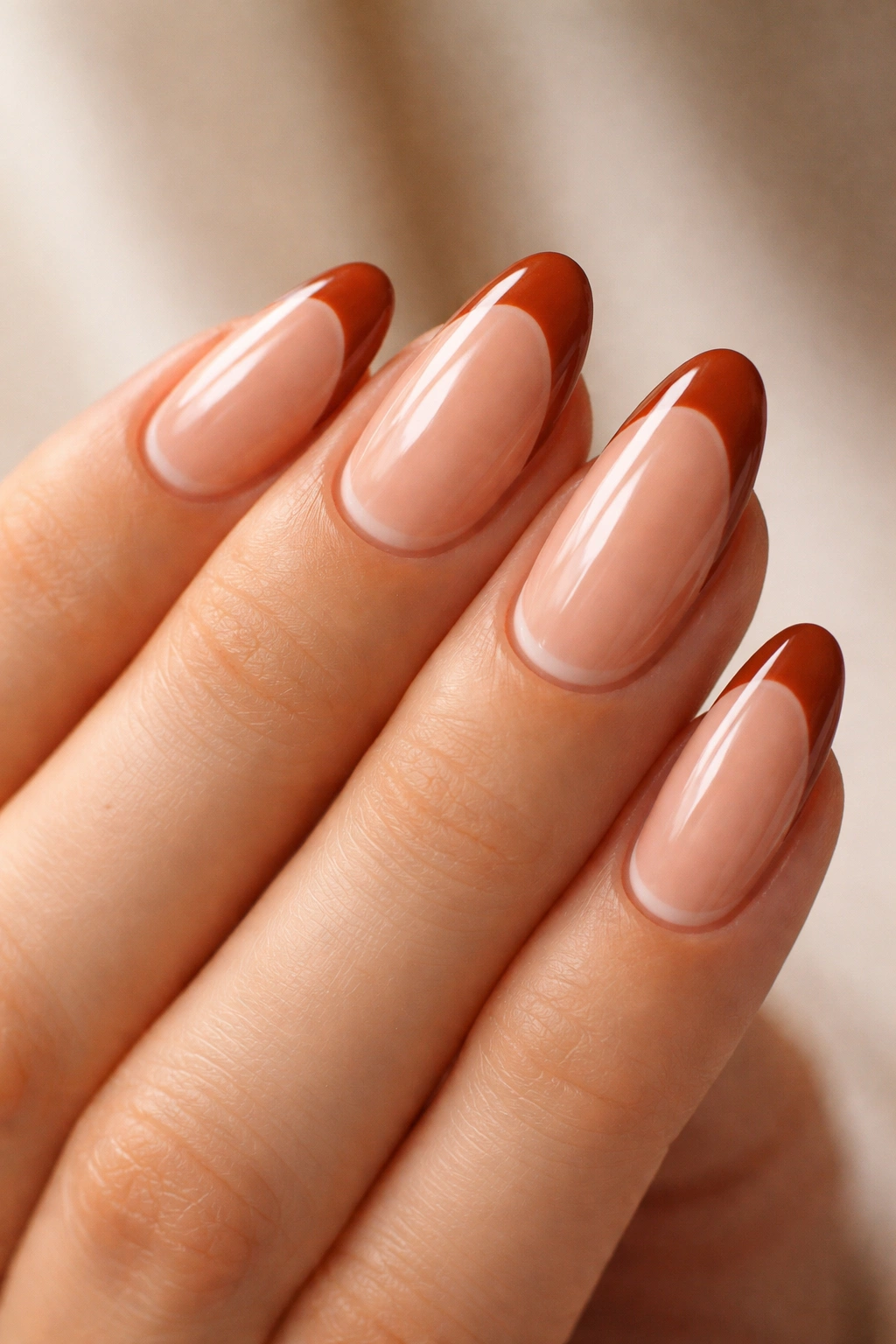
Burnt sienna is bolder than cinnamon and earthier than terracotta. It has more rust in it, more red clay, more attitude. Used as a French tip, especially with a tiny negative space gap separating the color from the base, it feels modern and intentional.
The gap should be slim—about 1 millimeter—so you still read the shape as a French. Too wide, and it starts looking like a floating tip design, which is a different mood altogether.
This manicure suits medium-length almond nails best because the extra visual detail needs room. On short nails, the gap and tip can crowd each other. On long nails, though, burnt sienna has enough body to hold up.
You do not need extra decoration. No foil. No leaves painted on one nail. No marble accent. Burnt sienna already brings enough heat. Let it do its job.
A good nail tech will make the negative space look deliberate, not like the color missed the edge. That distinction matters.
14. Soft Bronze French With Fine Shimmer Veil
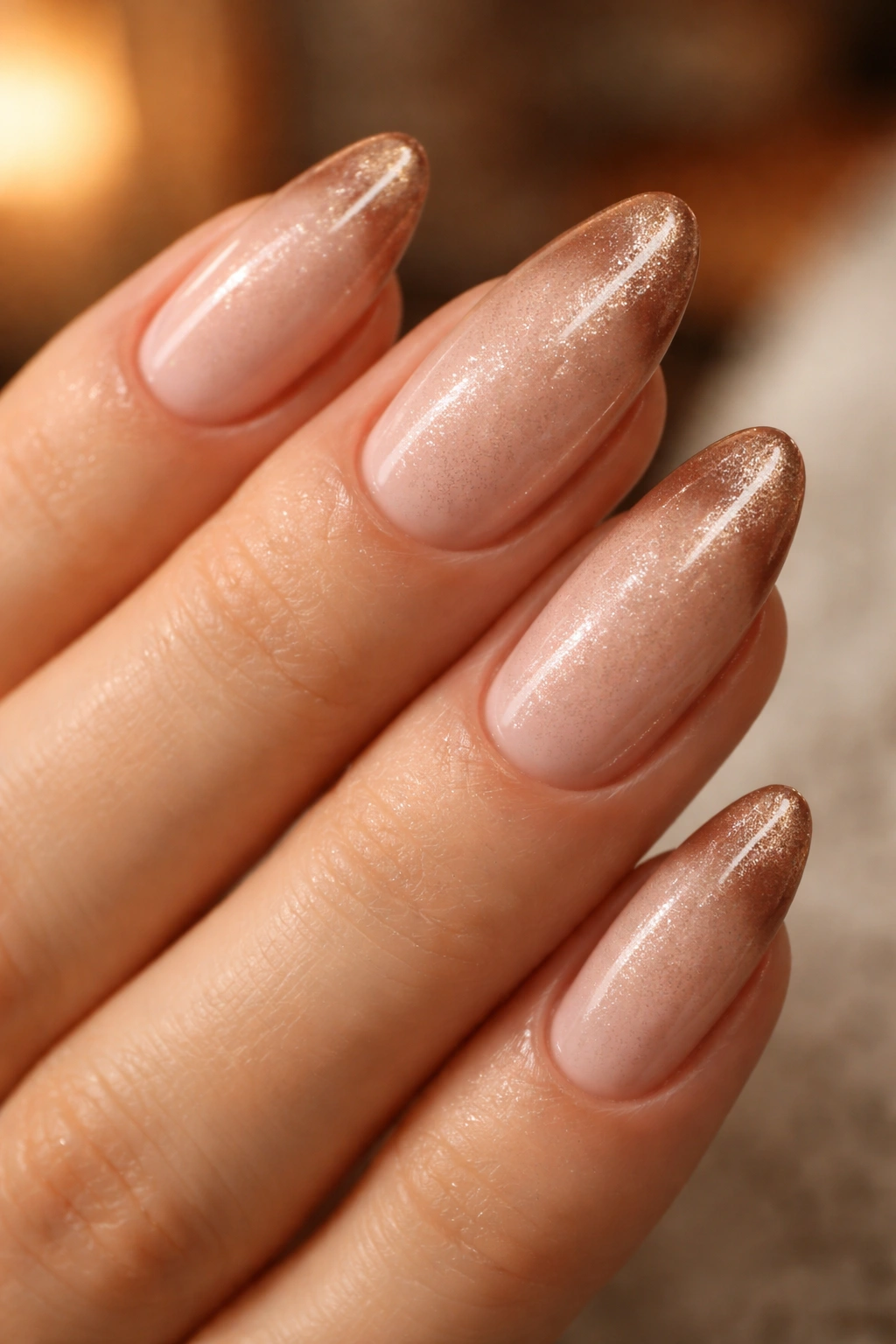
Not glitter. A shimmer veil. There’s a difference, and if you’ve ever seen a manicure cross that line, you know it instantly.
A soft bronze French tip with a fine shimmer veil looks almost creamy indoors, then picks up a warm gleam when light hits it. The particles should be tiny enough that you notice glow first, sparkle second.
What makes this one chic instead of flashy
The bronze needs a muted base—something with brown or taupe undertones—not a bright orange metallic. Then layer sheer shimmer over it, rather than using a gritty metallic polish straight from the bottle. Gel formulas tend to do this best because the shimmer stays suspended evenly.
Good occasions for this look
- Evening events
- Dinner parties
- Weddings where you want polish with some warmth
- Weekends when a plain nude feels too quiet
If you wear gold jewelry often, this manicure tends to make the whole hand look more pulled together. Small thing, but noticeable.
15. Rosy Brown French Tips for a Softer Warm Finish
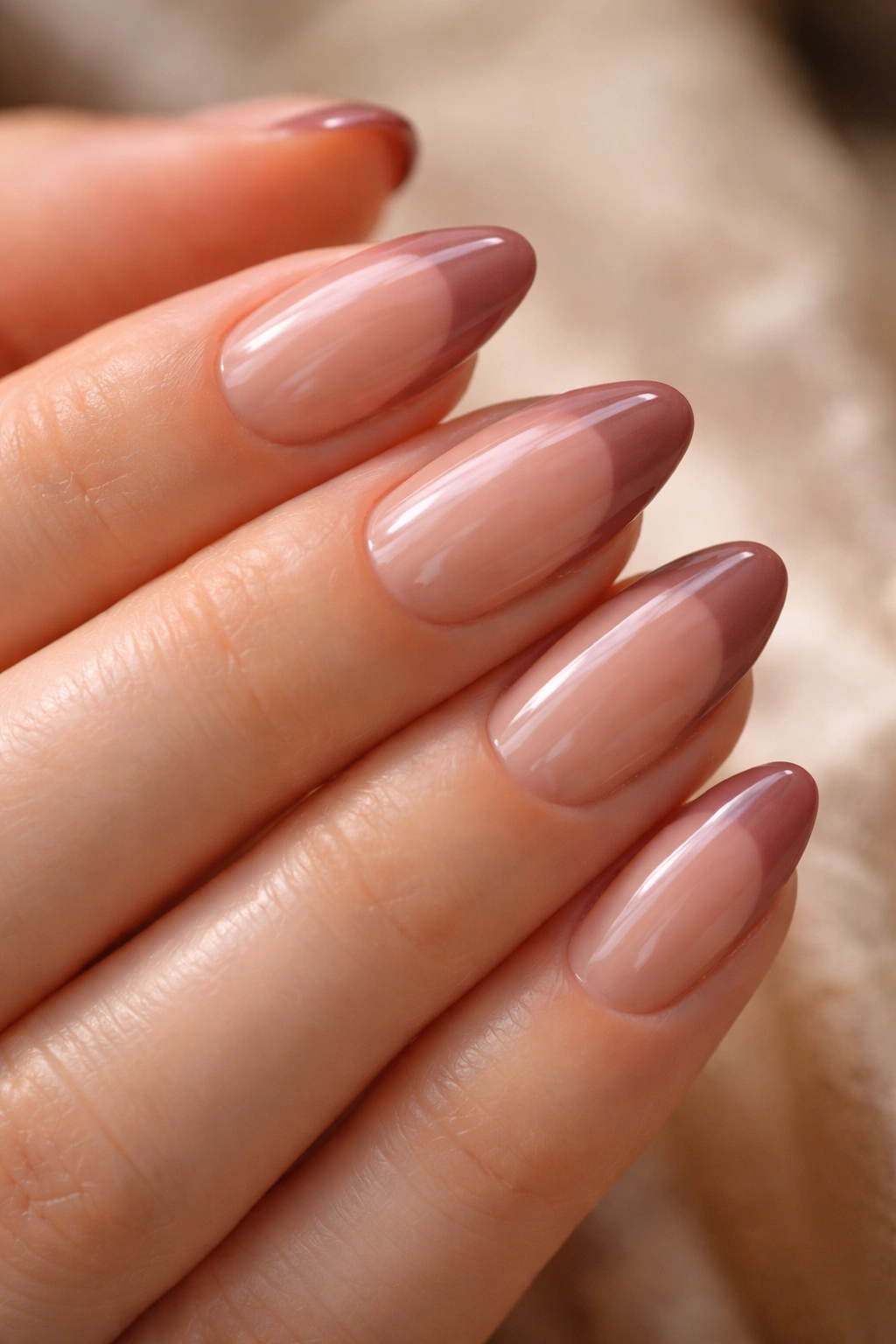
Rosy brown is the answer if you want warmth without obvious brown, orange, or gold tones. It sits in that sweet little pocket between mauve and cocoa, which makes it one of the most flattering French tip shades for people who like soft neutrals but still want a cozy feel.
This color has a gentleness that works especially well on shorter almond nails. Long lengths can make rosy brown look more glamorous, while shorter lengths keep it everyday and easy.
I like this one with a jelly nude base instead of a milky one. The slight translucence keeps the manicure from looking too dense and lets the rosy undertone stay airy. Add a high-gloss top coat and the finish almost looks like tinted glass.
There’s also something forgiving about rosy brown. Chips don’t shout. Regrowth blends more naturally than with white or bright color. If you stretch your salon visits a little too long sometimes—and who doesn’t—this shade won’t punish you for it.
16. Espresso French Tips With Thin Almond Silhouette
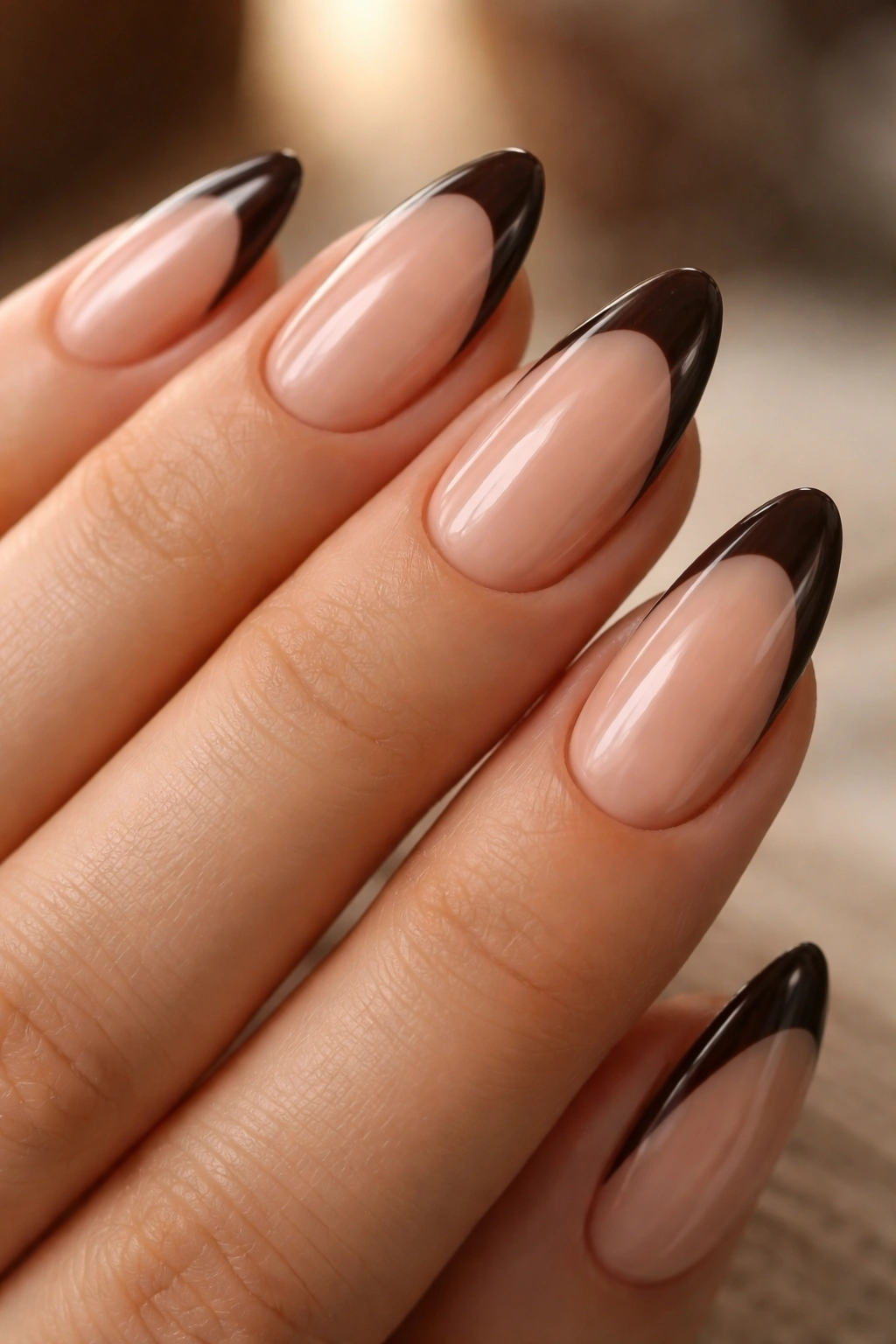
Espresso French tips are the darkest look in the lineup, and when they’re done right, they’re gorgeous. The key phrase there is done right.
Dark tips on almond nails can get dramatic fast. To keep them chic, make the silhouette thin. That means a refined almond shape, not an exaggerated stiletto-almond hybrid, and an espresso line that follows the smile curve with precision rather than taking over half the nail.
Why espresso works
Unlike black French tips, espresso still carries warmth. It’s softer, richer, and easier to wear with beige, camel, rust, cream, and other warm-toned clothes. It feels less graphic and more polished.
Best approach
- Keep the base semi-sheer and warm
- Use a narrow smile line
- File sidewalls neatly so the almond point stays balanced
- Finish glossy for depth, unless you want a velvety matte statement
Espresso is also one of the best choices if you want your warm-tone French tip almond nails to transition from casual to evening with zero effort. It has presence. It doesn’t need explanation.
Choosing the Warm Tone That Actually Flatters Your Skin
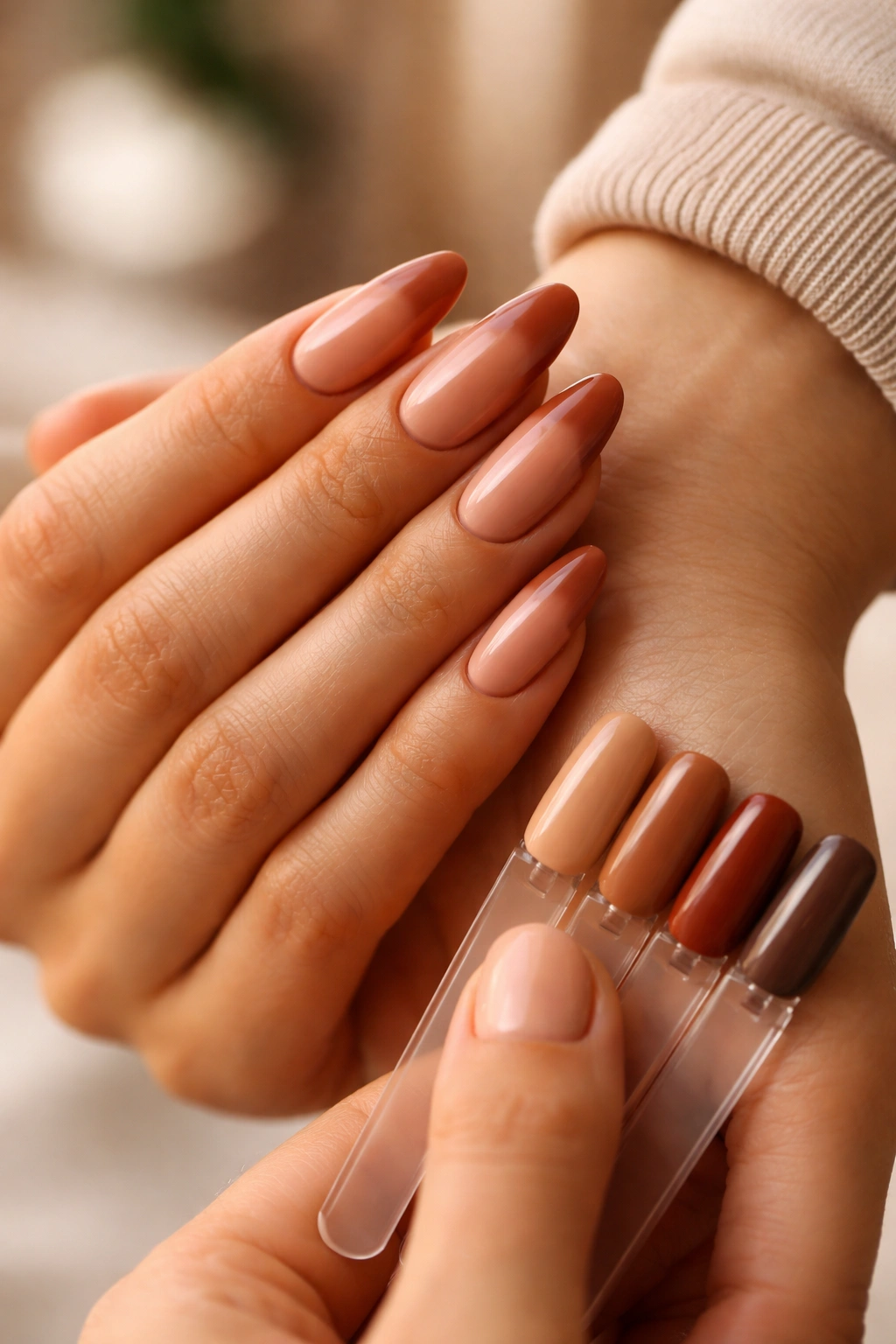
Picking from these designs gets easier once you know which kind of warmth suits you. Not all warm polishes are the same. Some lean yellow, some red, some brown, some copper.
If your skin has golden or olive undertones, shades like terracotta, cinnamon, amber, chestnut, and toffee often look seamless because they echo warmth already in your complexion. If you’re more neutral, mocha, latte, caramel, and rosy brown tend to be safer starting points because they don’t swing too orange.
Peachy skin can wear honey beige and maple beautifully. Deeper skin tones often look especially striking with chestnut, cocoa, espresso, and bronze because those shades create richness rather than washed-out contrast.
A quick salon trick: hold the swatch next to the inside of your wrist and then against the back of your hand. If it looks good in both places, you’re usually safe. If it only flatters one area, the undertone may be off.
Why Almond Nails Make Warm French Tips Look Better
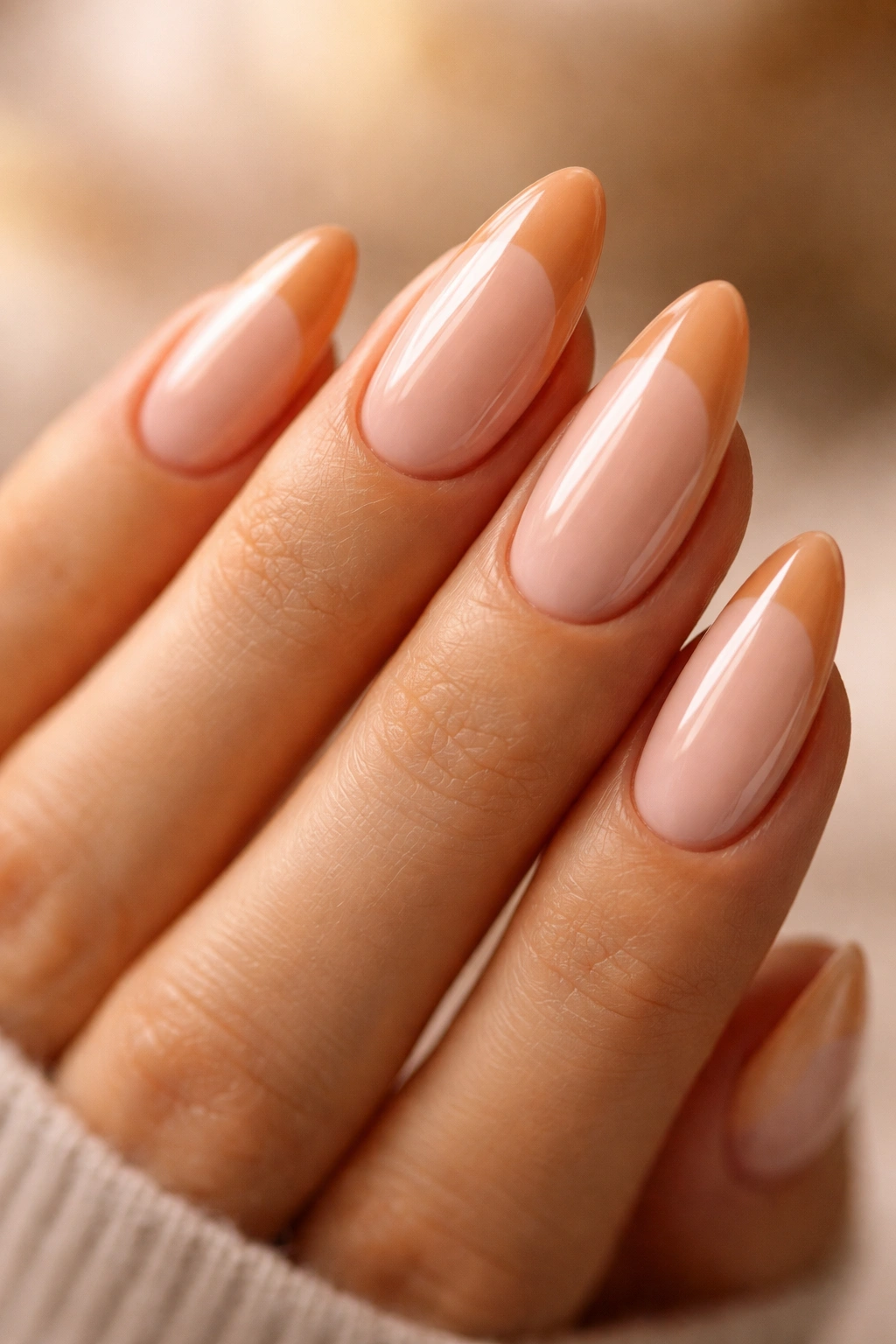
Some designs are flexible across shapes. Warm French tips are a little pickier.
Almond nails help because they soften the transition between natural base and colored tip. That curved taper makes the smile line feel fluid, especially with shades like caramel, terracotta, and mocha that already have a softer visual weight than white. On square nails, the same colors can look more blocky. On coffin nails, they can skew heavier.
Almond shape also helps with:
- Finger-length illusion, especially with slim tips
- Smoother side profile when darker warm colors are used
- Better balance for side French and outline French designs
- A softer, cozier overall look than sharp stiletto shapes
There’s a practical side too. Medium almond nails tend to wear better than long square corners, which catch on everything from jeans to bedsheets to laptop bags. Not glamorous, but useful.
Nail Prep That Makes French Tips Look Expensive
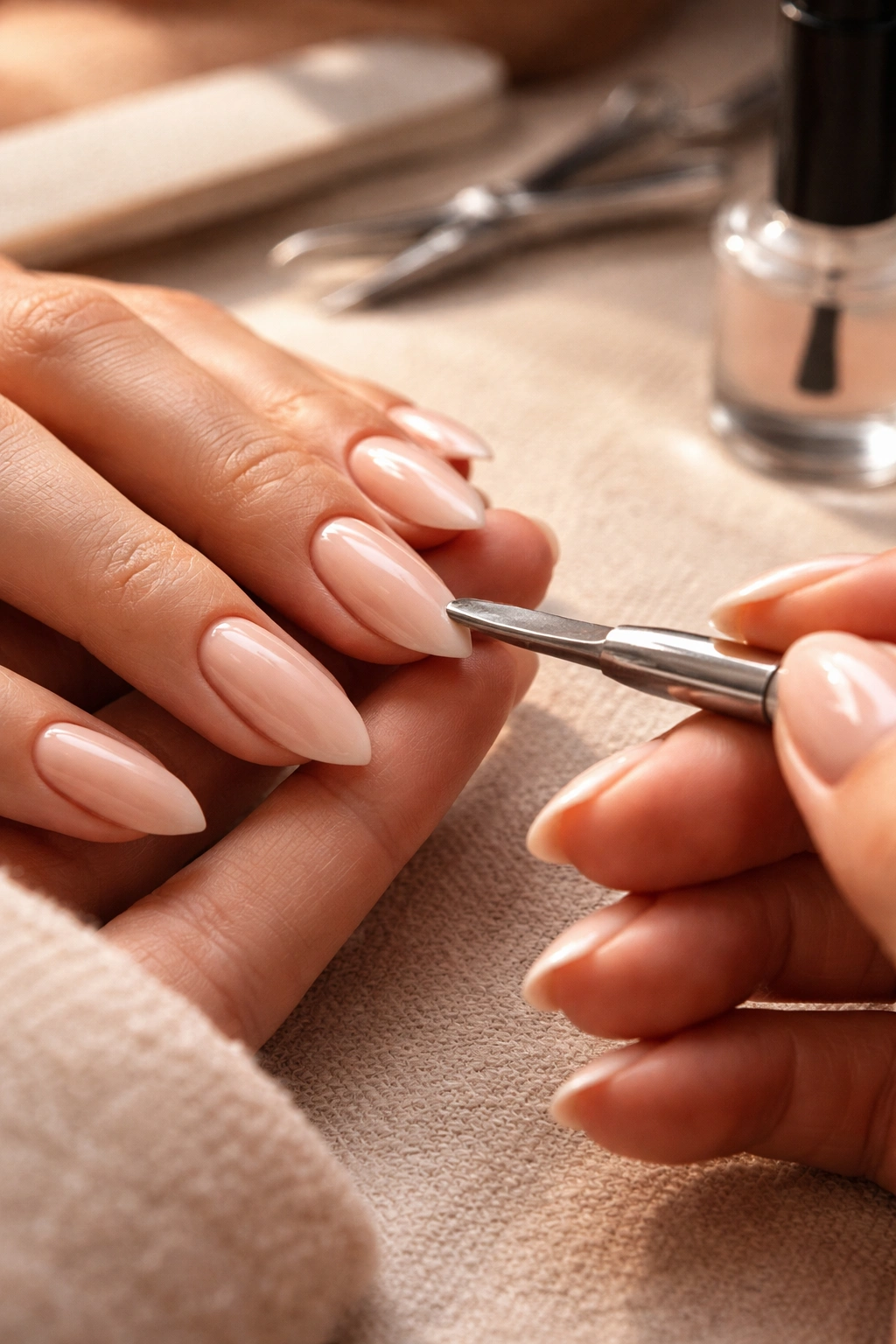
A warm-tone French manicure can have the prettiest color in the room and still look off if the prep is sloppy. Most of the expensive-looking finish comes from the boring stuff underneath.
Push back cuticles properly. Remove dead skin from the nail plate. File each almond tip so both sides mirror each other. Then check the shape head-on, not only from above. A lot of uneven almonds look fine from one angle and crooked from another.
Base color matters too. Your nude should match the depth of your nail bed more than the exact undertone of your skin. If the base is too pale, the French tip can look pasted on. If it’s too dark, the design loses contrast.
And use top coat generously—but not so much that it floods the sidewalls. You want a smooth dome of shine, not a bulky gel hump.
Small Custom Details That Change the Whole Manicure
This is where a simple French becomes yours.
You can alter the same warm French tip almond nails in small ways without changing the core idea:
- Switch glossy top coat to matte
- Add a single metallic outline
- Use a micro tip on one hand and a standard tip on the other if you like asymmetry
- Make ring fingers a touch darker
- Add a negative space gap
- Choose jelly nude instead of milky nude
- Blend the base into a soft ombre
Tiny changes matter more than people think. A copper outline turns cozy into dressy. A matte finish turns creamy cocoa into suede. A double line makes honey beige feel more designed.
That’s why French manicures never really disappear. They’re a framework, not a fixed formula.
Final Thoughts
The best warm-tone French tip almond nails don’t rely on gimmicks. They work because the shape is flattering, the palette is soft, and the contrast is controlled. That combination makes your hands look polished in a way that feels effortless—even though the best versions are anything but accidental.
If you’re stuck between two designs, start with caramel, latte, or rosy brown. They’re the easiest to wear and the hardest to regret. If you want more mood, move into chestnut, cocoa, or espresso.
And if your usual white French has started to feel a little cold, this is probably the switch worth making.