

Dark polish gets a bad reputation for feeling severe, and navy is the shade that proves the opposite. On almond nails, it softens again, which is why navy blue almond nails can look polished, modern, and a little bit sly all at once.
If you’ve ever seen navy go flat, the problem usually isn’t the color. It’s a thick application, a blunt shape, or a finish that fights the light instead of working with it. Almond nails help because the tapered tip gives dark color somewhere to go; the eye follows the curve instead of stopping dead at the edge.
That’s also why navy is so easy to style. Gloss makes it look like lacquer. Matte turns it into something almost suede-like. Add chrome, foil, or a bare negative-space edge, and the whole mood changes without needing a loud design.
I’m partial to navy because it has range. It can look sharp with a white shirt, dressed up with gold jewelry, or relaxed with denim and a plain sweater. Start with the cleanest version first, then move into the more playful ideas once you know how much detail you actually want on your hands.
1. Glossy Navy Almond Nails With a Barely There Cuticle Gap
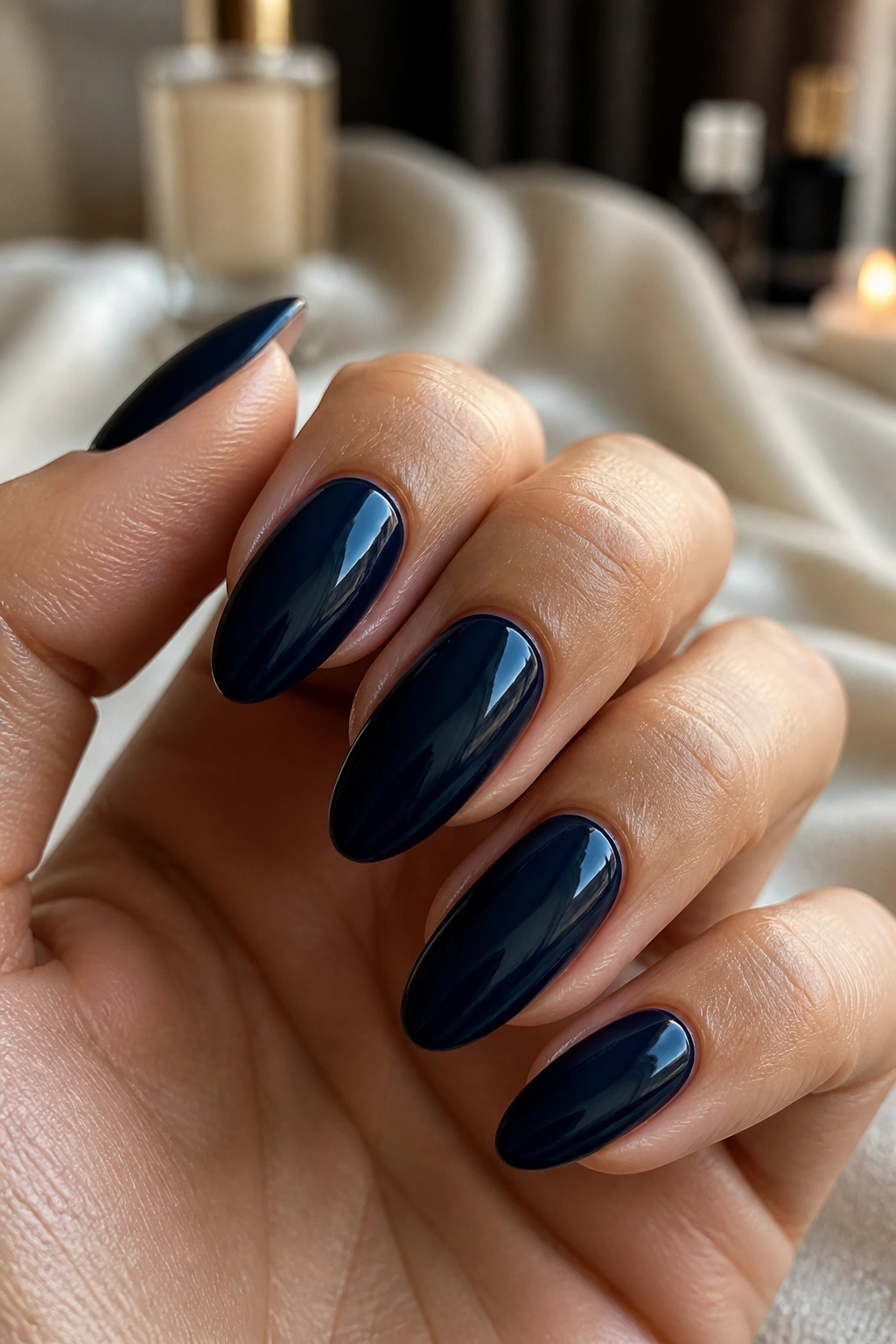
A single-color navy manicure is the one I’d call the anchor. If you want a design that looks expensive without screaming for attention, this is it. On almond nails, a glossy navy shade reads long and smooth as long as the product stays slim at the sides.
The little trick here is the cuticle gap. Ask for a tiny 1 mm gap so the polish doesn’t flood the skin and make the nail bed look shorter. That small bit of breathing room keeps the shape elegant instead of bulky, which matters a lot with dark colors.
Thin coats matter more than people think. Two thin coats of navy, capped at the free edge, almost always look cleaner than one heavy coat that drags and pools near the sidewalls. A high-shine top coat finishes the job, but only if the base layers are even.
Best for: anyone who wants a dark manicure that still feels clean and wearable.
Skip this if: you tend to prefer visible nail art. This one works because it doesn’t try too hard.
2. Navy French Tips on a Sheer Pink Base
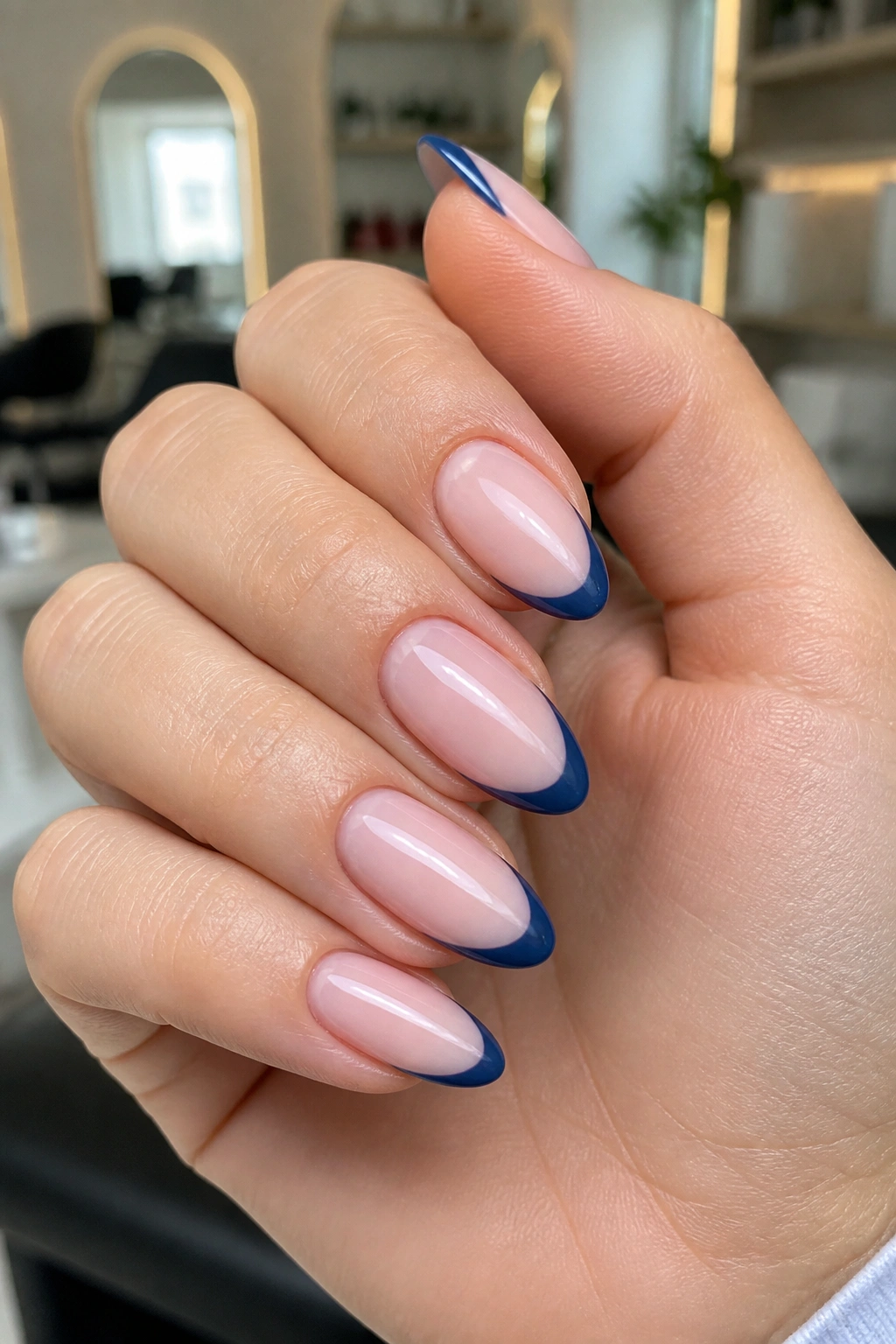
French tips in navy feel sharper than the usual white version, but they don’t lose the neatness people love about a French manicure. On an almond nail, the curve of the tip echoes the natural taper of the shape, so the design looks intentional instead of bolted on.
Why the Smile Line Matters
A navy tip should be slim. A 3 to 4 mm band is usually enough on medium-length almonds; any wider and the nail starts to look chopped off. The sheer pink or milky nude base does the heavy lifting here because it keeps the hand looking light and lets the navy outline do the talking.
I like this version because it gives you two moods in one manicure. From a distance, it looks polished and simple. Up close, the deep blue tip adds a little edge, especially if the finish is glossy and the smile line is crisp.
- Ask for a sheer neutral base, not an opaque pink.
- Keep the tip narrow and even from nail to nail.
- A soft oval smile line looks gentler than a sharp straight band.
- A glossy top coat keeps the dark tip from looking chalky.
One small thing: if your nails are shorter, keep the tip thinner than you think. The almond shape already adds length visually.
3. Matte Navy With One High-Shine Accent Nail
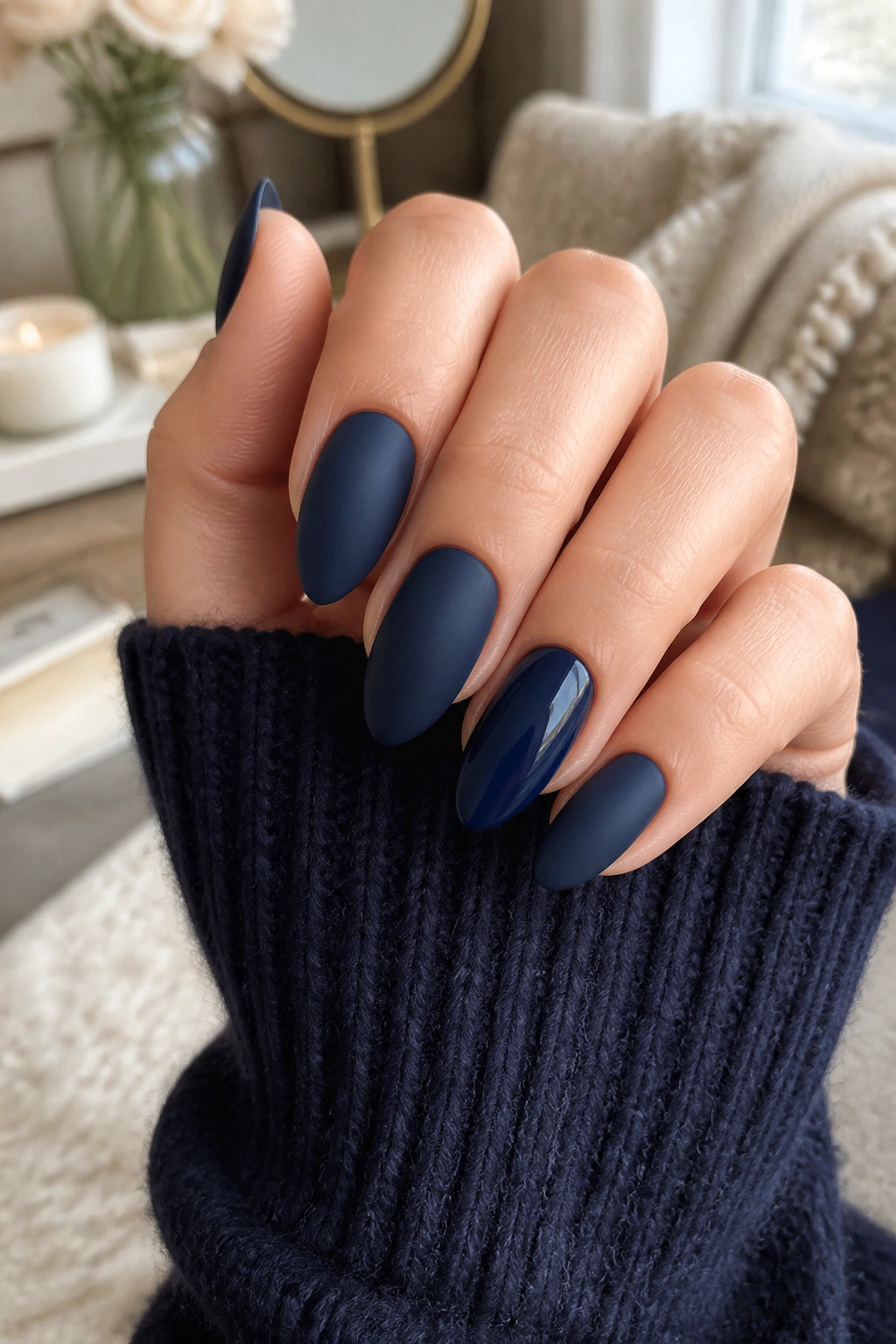
Matte navy can look a little flat if every nail does the exact same thing. One glossy accent nail fixes that fast. It creates a tiny bit of contrast, which is enough to make the manicure feel deliberate rather than sleepy.
The easiest version is one shine-heavy ring finger on each hand. You can keep the color identical and let the finish do the work, or add a slim vertical line of gloss down the center of the accent nail. That little strip reflects light and breaks up the matte surface in a nice, restrained way.
I prefer this to adding glitter everywhere. Glitter can take over quickly, especially on dark blue. A single glossy nail keeps the set wearable for work, dinner, or whatever else is on your calendar. And yes, matte top coat chips a bit faster at the very tips, so this design rewards a quick touch-up.
A good rule: keep the accent subtle. If the glossy nail starts competing with the matte ones, the manicure loses the whole point.
4. Navy Almond Nails With Silver Chrome Crescents

Silver chrome and navy have a clean, cold look that feels almost architectural. It’s not flashy in the usual sense. It’s sharper than that. The best part is that chrome crescents use a small amount of shine without covering the whole nail, so the navy still stays in charge.
Where to Place the Chrome
The crescent can sit at the cuticle, the tip, or both if you want a more graphic result. I like a thin chrome half-moon near the cuticle because it gives the almond shape a lifted look, almost like jewelry sitting at the base of the nail. On longer almonds, a chrome tip crescent can work too, but keep it narrow or the design starts to feel heavy.
Chrome powder needs a smooth base. If the navy underneath is patchy, the silver will show every flaw. That’s why this design usually looks best over a gel color that’s cured evenly and sealed with a no-wipe top coat before the chrome is rubbed in.
- Use silver chrome, not gold, if you want a cool-toned effect.
- Keep the chrome band under 5 mm wide.
- Seal the edges well so the metallic finish doesn’t rub off early.
- Let the navy stay glossy underneath; matte and chrome often fight each other.
My take: this is one of the cleanest ways to make dark blue look expensive without making the nails busy.
5. Thin Gold Foil Over Deep Navy
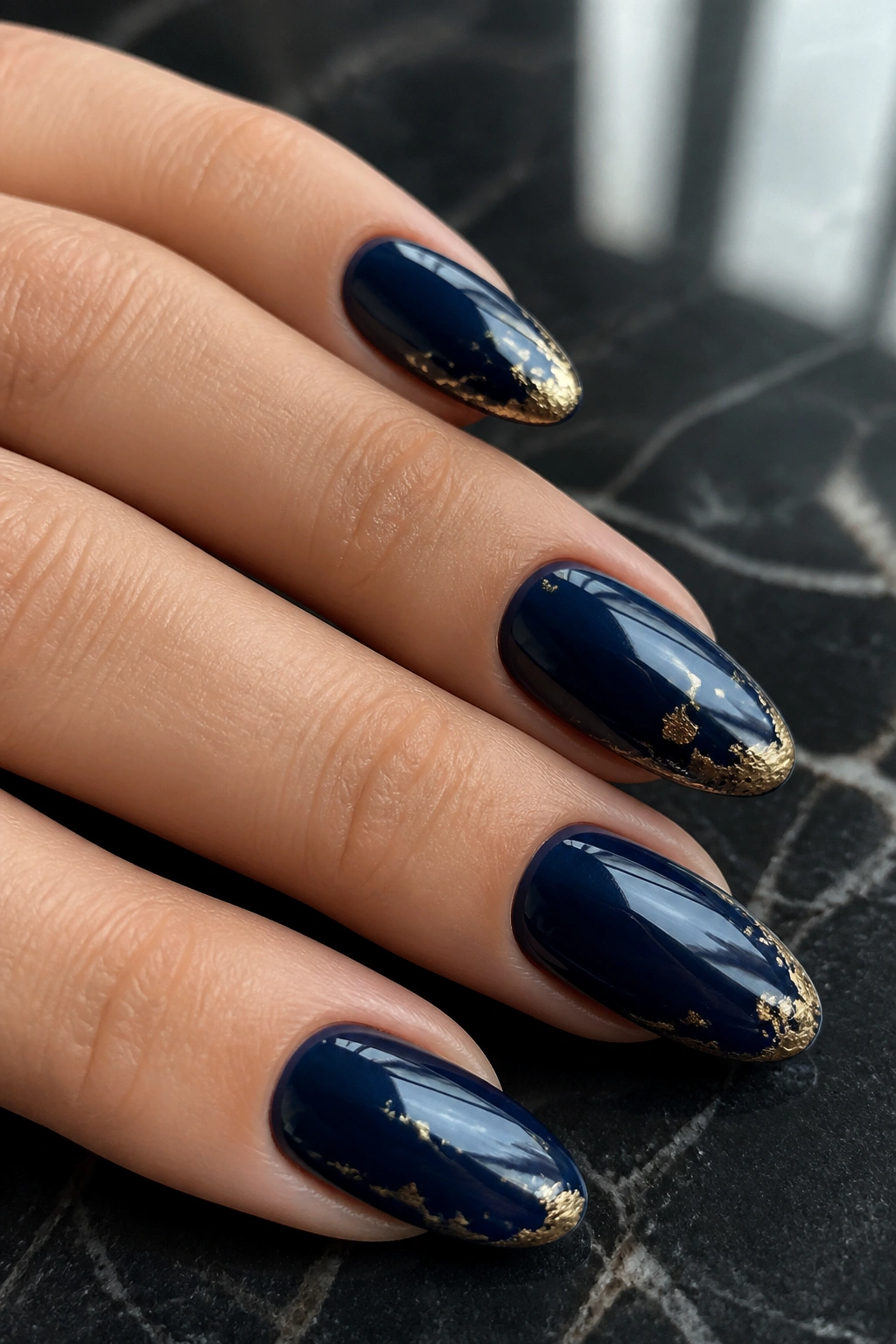
If silver chrome feels too cool, gold foil gives navy a warmer, more dressed-up mood. Tiny torn flakes of gold on a dark blue base look like someone scattered leaf fragments across wet lacquer. It’s a small detail, but it does a lot.
The trick is restraint. A few pieces placed near the center or close to the cuticle are enough. If you cover the whole nail with foil, you lose the depth of the navy underneath, and that depth is half the reason this combo works.
I like this on almond nails because the taper keeps the foil from looking random. The shape gives the eye a path to follow, so even a sparse foil design feels balanced. You can keep all ten nails the same, or use foil only on two accent nails and leave the rest solid.
A glossy top coat is non-negotiable here. Foil edges can lift if they’re not sealed properly, and once that happens, the manicure starts to fray at the corners.
6. Velvet Cat-Eye Navy Nails
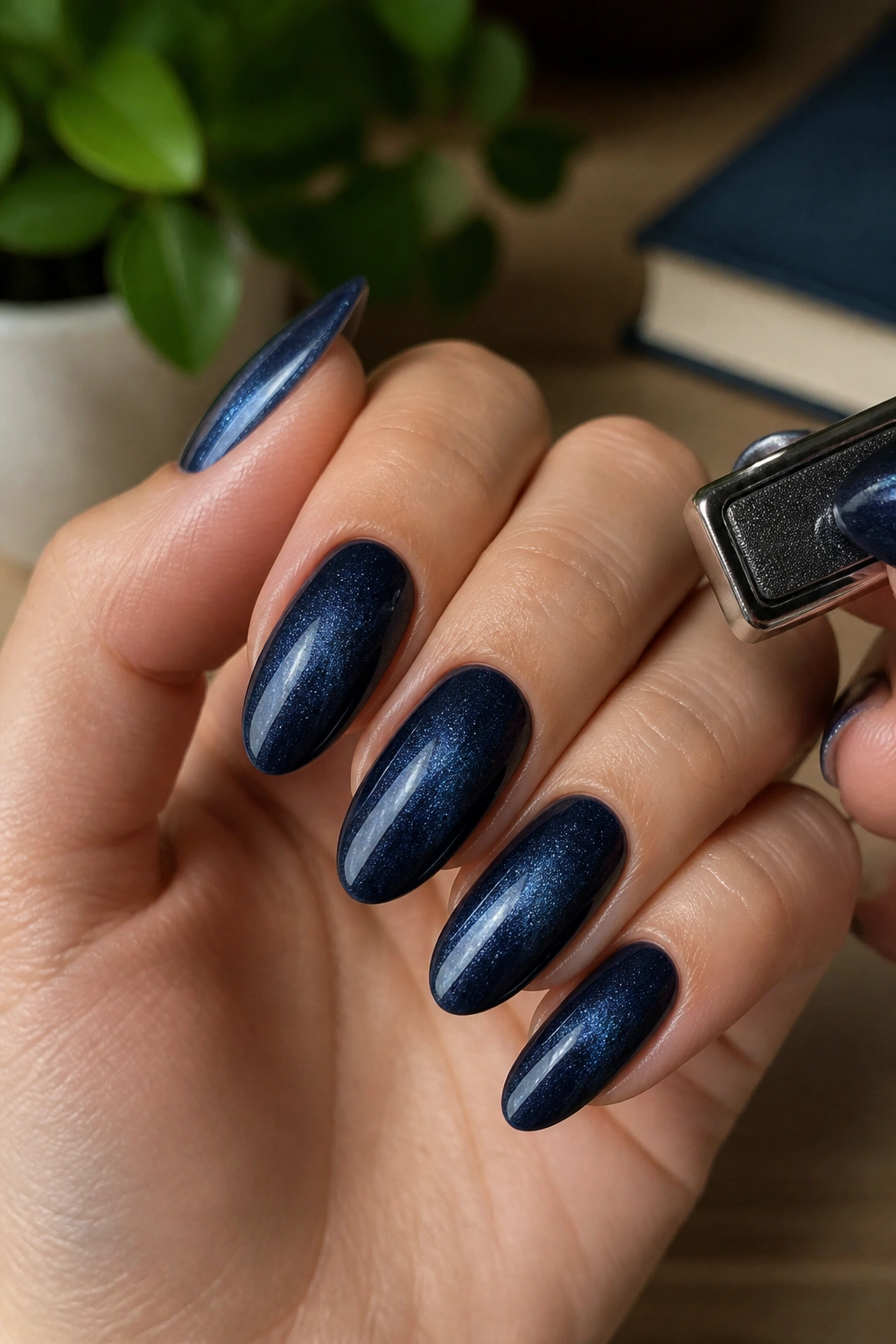
Cat-eye navy is one of those finishes that looks a little different every time you tilt your hand. The magnetic shimmer creates a soft beam through the center of the nail, and on almond shapes that beam follows the taper in a way that feels natural. Almost silky. Almost smoky.
The best cat-eye navy shades lean deep and inky rather than bright cobalt. You want the shimmer to move across the surface, not shout from under it. With the right polish, you can get a band that looks like a narrow ribbon of light running from cuticle to tip.
A magnet matters here. Hold it close to the uncured polish — usually just a few millimeters away — for a few seconds until the shimmer shifts into place. Move too far away and the effect gets weak. Hover too long and the polish can drag. It’s a small timing game, but not a hard one.
This design is strongest on medium-length almonds. Short nails don’t give the shimmer much room to stretch, and the effect can get crowded. Long nails, on the other hand, can show off that moving beam in a really satisfying way.
7. Navy Swirl Art With Milky White Lines
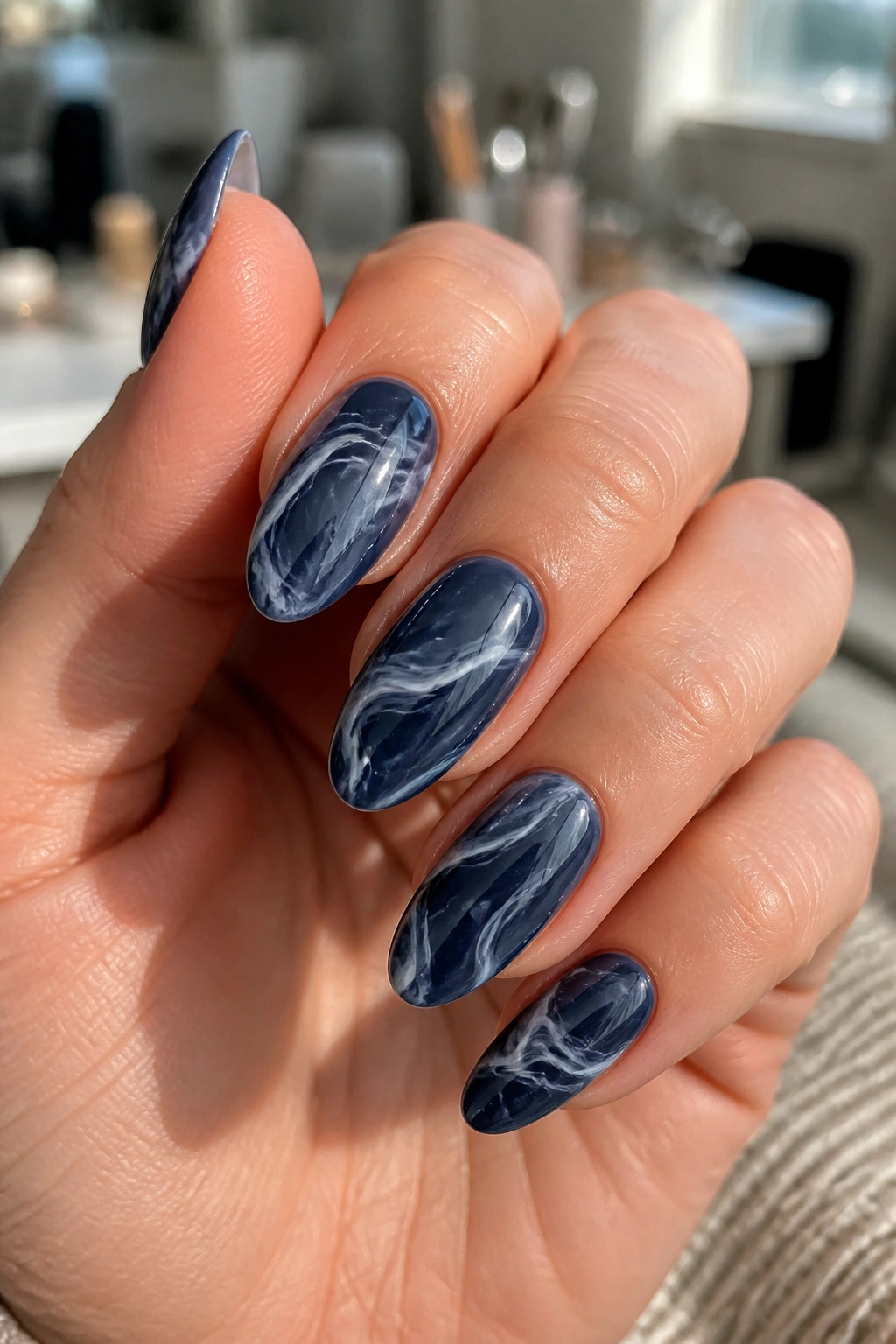
Why do swirls work so well on dark nails? Because they soften all that depth. A navy base can feel serious on its own, but once you run a few milky white lines across it, the manicure starts to breathe.
How to Keep the Swirls Airy
Use a striping brush and keep the white a little translucent. Pure opaque white can look harsh against navy, especially on smaller nail beds. A softened white line, or even a white mixed with a touch of top coat, gives you a more fluid look. The lines should be thin — think 1 to 2 mm, not chunky loops that swallow the nail.
I’d also avoid doing the same swirl on every finger. A few nails with larger curves, a few with tighter S-shapes, and one or two left mostly plain tends to look better. The almond shape already brings motion, so the art should follow that motion instead of flattening it.
- Put the busiest swirl on the middle finger or ring finger.
- Keep the cuticle area open so the nail still looks long.
- Use glossy top coat to keep the lines crisp.
- Leave one nail nearly bare if the set starts feeling crowded.
This one has a bit of a painterly feel. Not fussy. Just lively.
8. Navy Ombre Fading Into Soft Nude
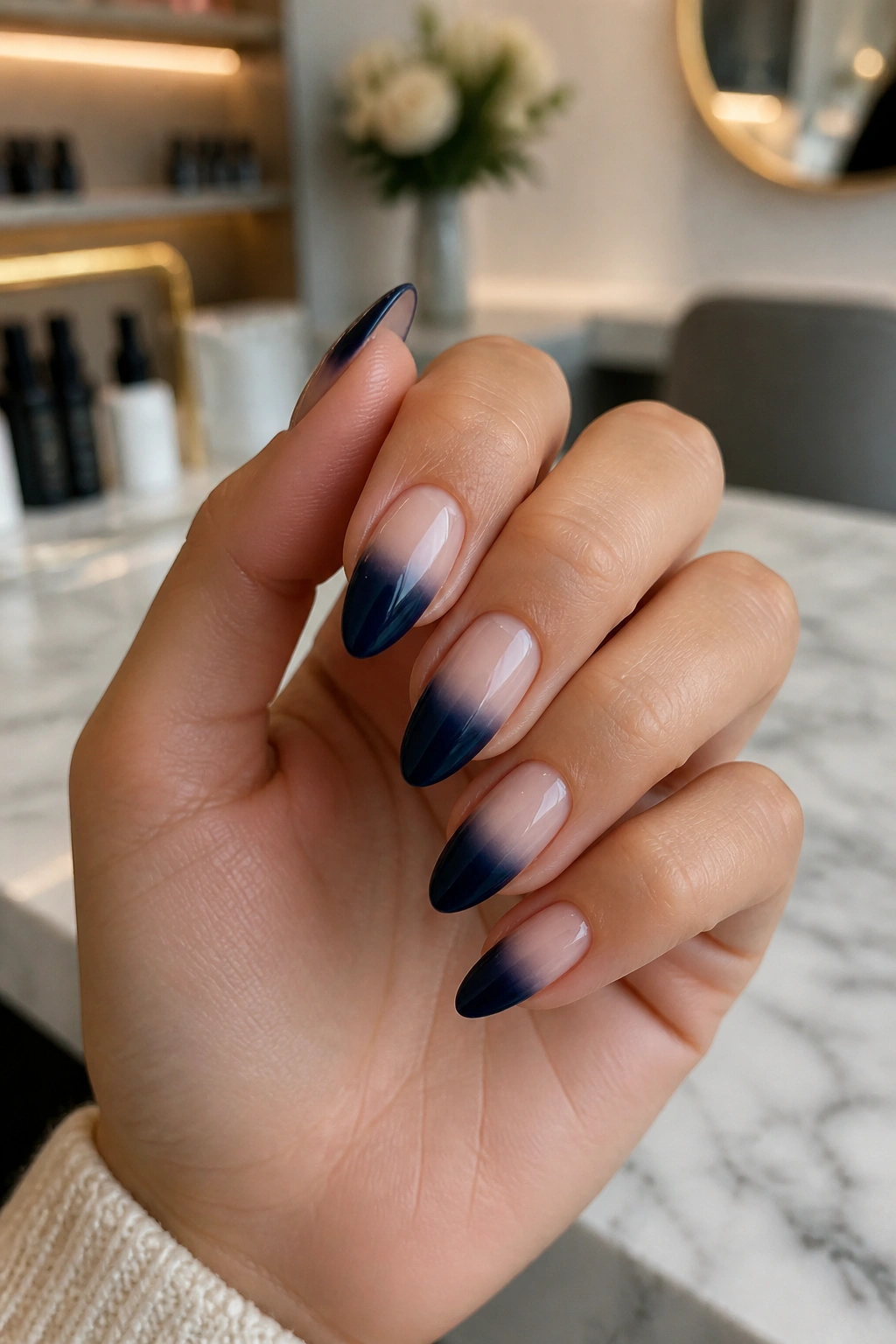
A navy ombre can be a lifesaver if you like dark nails but don’t want a hard color block at the base. The fade from nude to blue makes the manicure feel lighter, which is handy on almond nails because the shape already wants to look elongated.
The most flattering version starts with a soft nude close to the cuticle and deepens toward the tip. That keeps the nail bed bright and prevents the dark color from overwhelming the hand. A sponge blend works fine, though a skilled tech can get a smoother fade with an airbrush or layered gel.
I like this design when the navy is almost black at the tip. It gives the nails that dipped look, like the color was pulled upward instead of laid on in a straight line. If the fade is too obvious, it can feel like a half-finished French. If it’s too subtle, you lose the point.
A medium almond length tends to show the gradient best. Shorter nails can still wear it, but there’s less room for the fade to spread, so the blend has to be tighter.
9. Navy Tortoiseshell Accent Nails
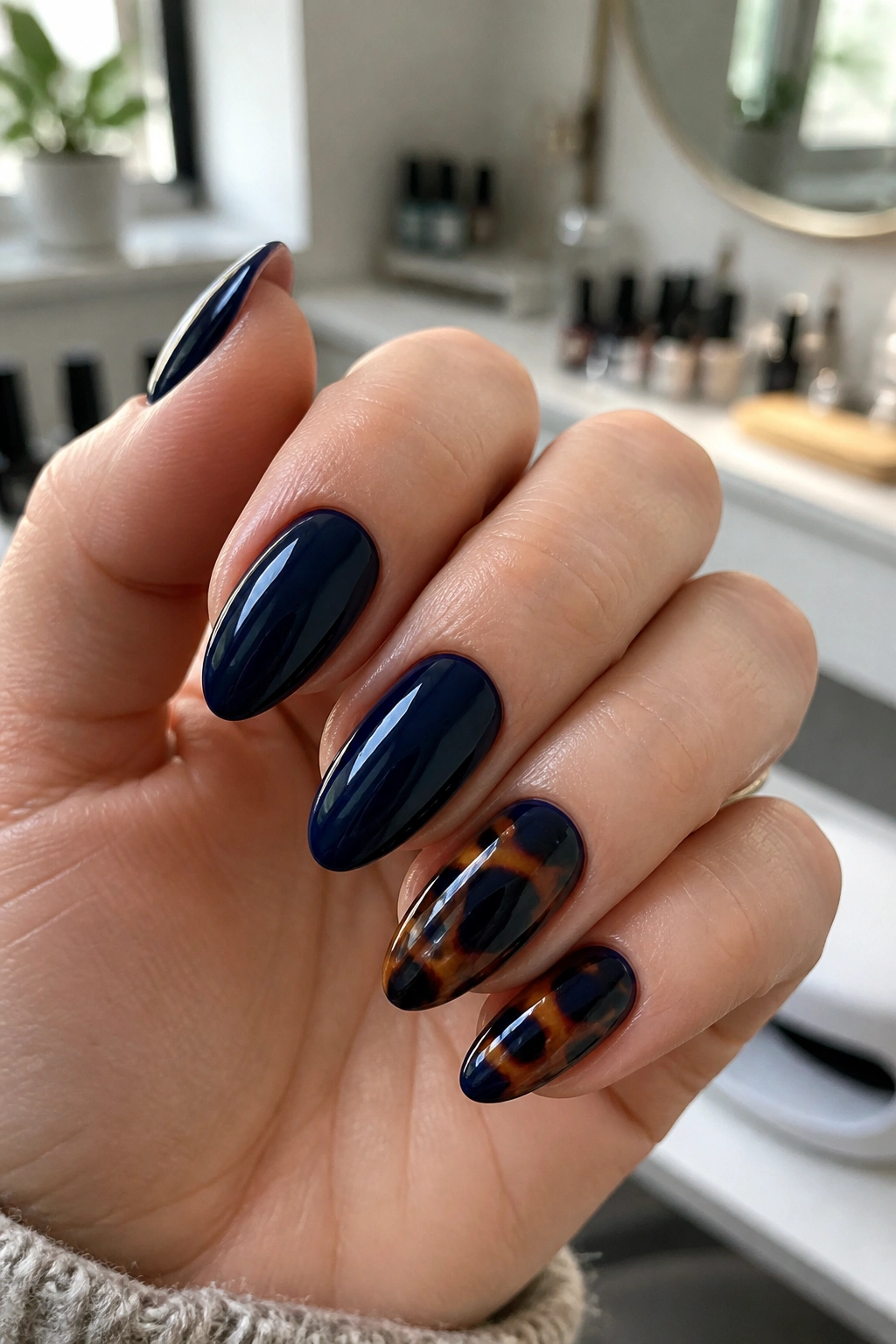
Tortoiseshell and navy are a smart pairing because both colors have depth, but they’re not the same kind of depth. Navy gives you cool darkness. Tortoiseshell brings amber, brown, and a little smoke into the mix. Put them together on almond nails and the manicure gets richer without becoming loud.
I wouldn’t do tortoiseshell on all ten nails unless you want a very patterned look. Two accent nails are usually enough. The rest can stay solid navy, glossy and simple, which makes the tortoiseshell feel like a detail instead of a costume.
The best tortoiseshell accent has translucent layers. You should still see the color underneath, not a flat brown patch. That transparency is what keeps it from looking muddy. A few dark amber spots, a little black-brown depth, and a top coat that gives the surface some shine — that’s the formula.
This one works especially well if you wear gold rings or warm-toned jewelry. The warm flecks in the tortoise pattern pick that up in a way that silver doesn’t quite match.
10. Negative-Space Half-Moon Navy Nails
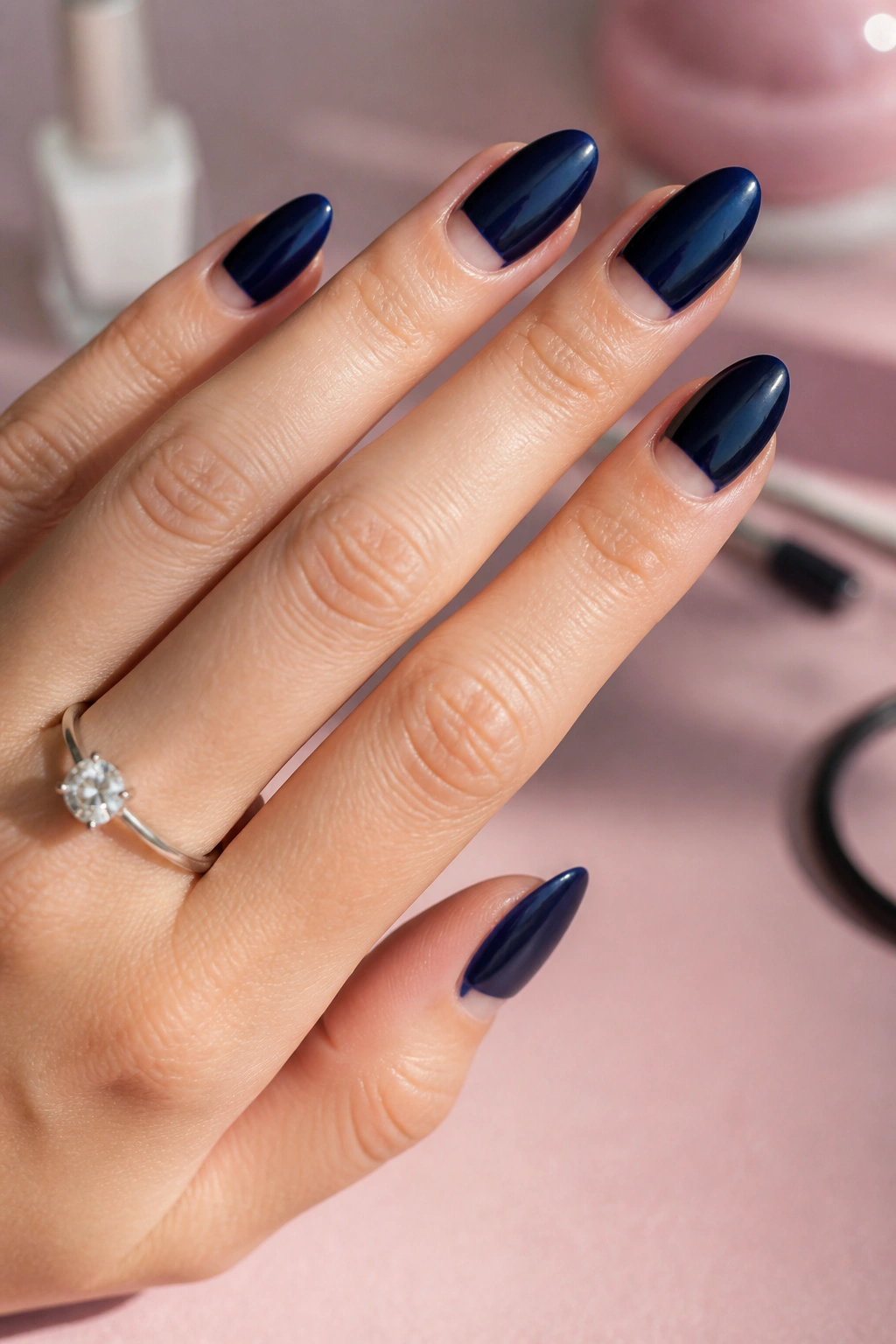
If you hate the look of a full grow-out line, negative space is your friend. A half-moon navy manicure leaves a bare crescent near the cuticle, which makes the design feel fresh even after the nails have grown a little.
Three Ways to Wear It
You can keep the navy at the tip, paint it in the middle like a floating panel, or frame the moon shape with a thin outline. The tip version feels the cleanest to me. The middle-panel version looks more graphic. The outlined version sits somewhere between the two and suits longer almonds well.
This design shines on almond nails because the curve near the base echoes the shape of the nail bed. The bare space makes the polish look lighter, and the dark blue feels less heavy than it would in a solid block. If your nails are naturally broad, this trick can make them look more delicate.
- Leave the moon unpainted and keep it clear or sheer nude.
- Use a thin liner brush for the border if you want definition.
- A glossy top coat keeps the negative space from looking dull.
- Avoid stacking too many extra details on top of the shape.
It’s a neat option when you want navy, but not too much navy.
11. Navy Nails With Pearl and Opal Accents
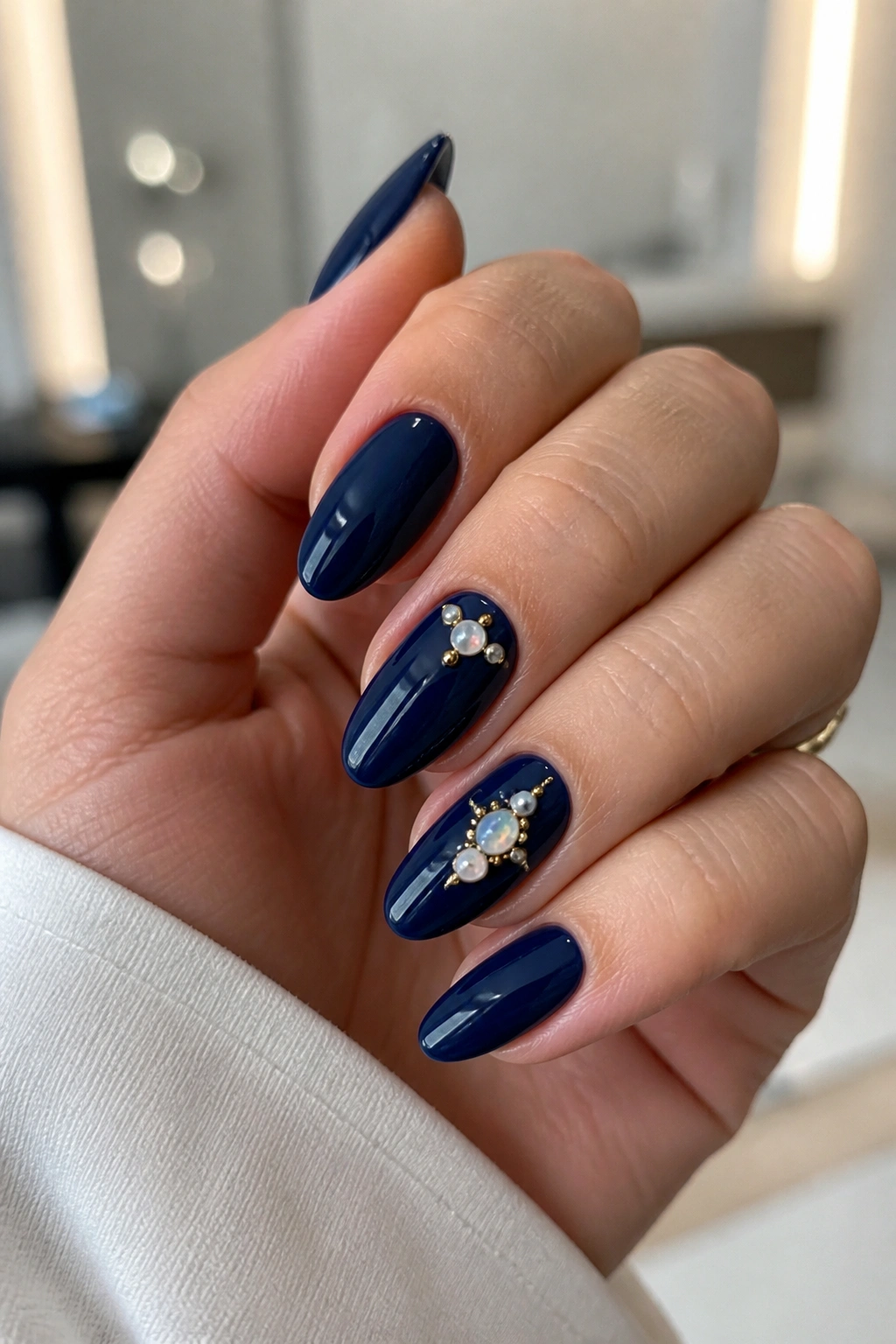
Pearls on navy read like jewelry, which is probably why this combination never really gets old. The dark blue background makes even small stones stand out, and on almond nails the placement can follow the curve without feeling stiff.
The key is moderation. One pearl on a couple of nails, or a tiny trail of opalescent studs, is enough. Too many and the manicure starts to feel heavy, which defeats the soft shape of the almond. I like the accents closest to the cuticle or along one diagonal line because they mimic the flow of the nail.
This is one of those designs that looks richer in person than in flat photos. The stone catches light in a tiny burst, then the navy absorbs it again. That contrast is the whole point.
Be careful with size. Tiny charms, flat-backed pearls, and small opals tend to wear better than chunky 3D pieces. Big stones snag on sweaters, hair, handbags — all the annoying stuff you don’t want thinking about all day.
12. Glitter Gradient Navy Tips
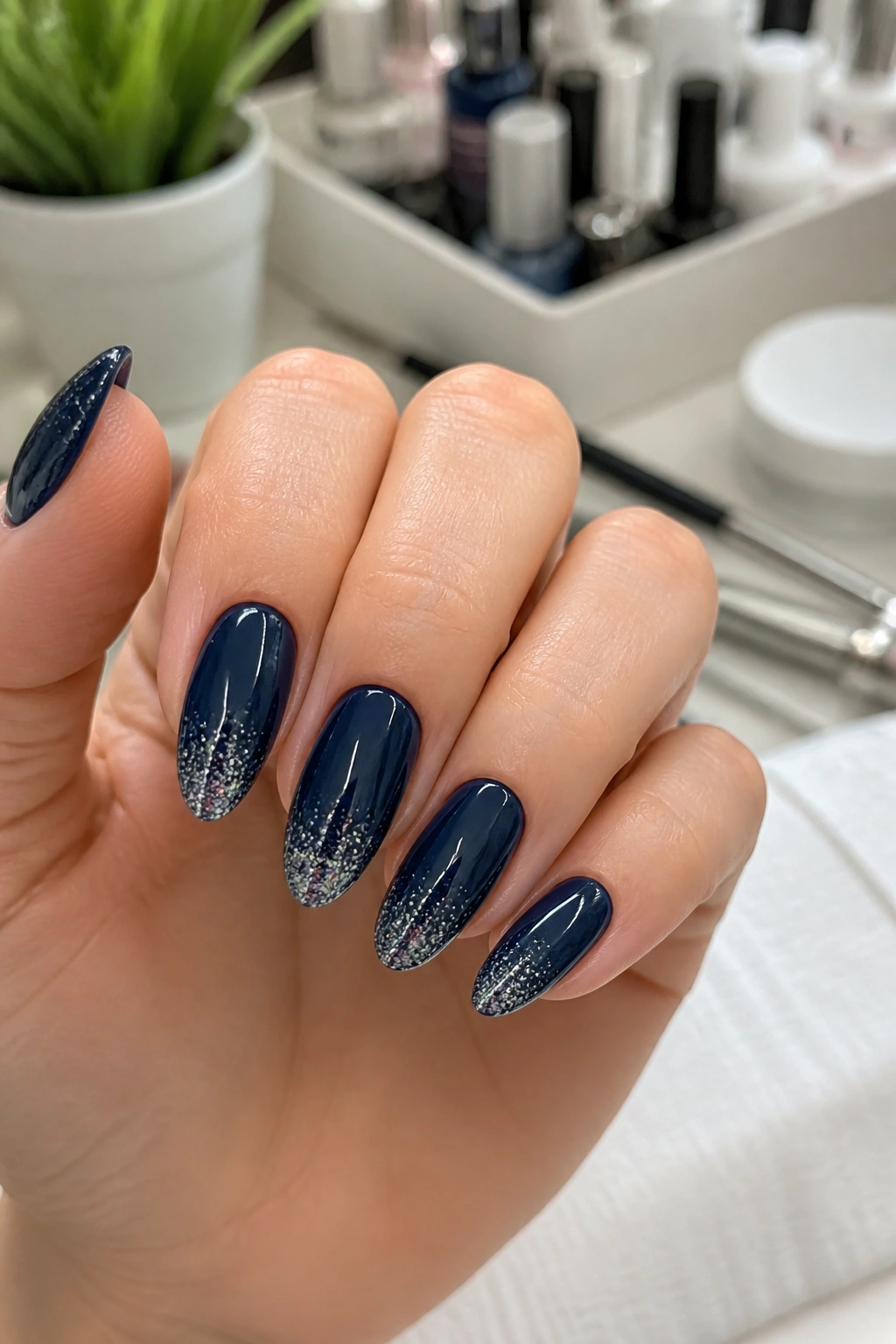
Glitter at the tip works because almond nails already narrow toward the edge. The shape gives the sparkle somewhere to concentrate, so you can get a lot of effect without covering the whole nail in shine.
Why the Gradient Looks Better Than Full Glitter
A gradient starts light and gets denser near the tip. That keeps the base dark and elegant while still giving you a bit of movement. Fine silver glitter, midnight-blue shimmer, or a mix of both usually works better than chunky pieces. Chunky glitter can look crowded fast on a narrow almond tip.
I’d start the shimmer about one-third of the way down the nail and build it up toward the free edge. That keeps the cuticle area clear and helps the nail look longer. If you want a softer version, use a very thin dusting instead of a dense fade.
- Choose fine glitter for a smoother finish.
- Keep the densest sparkle right at the free edge.
- Seal the tip twice if the glitter feels gritty.
- Pair it with a glossy top coat, not matte.
This design feels dressy without being fussy. That’s probably why people keep coming back to it.
13. Nautical Navy and White Stripe Nails
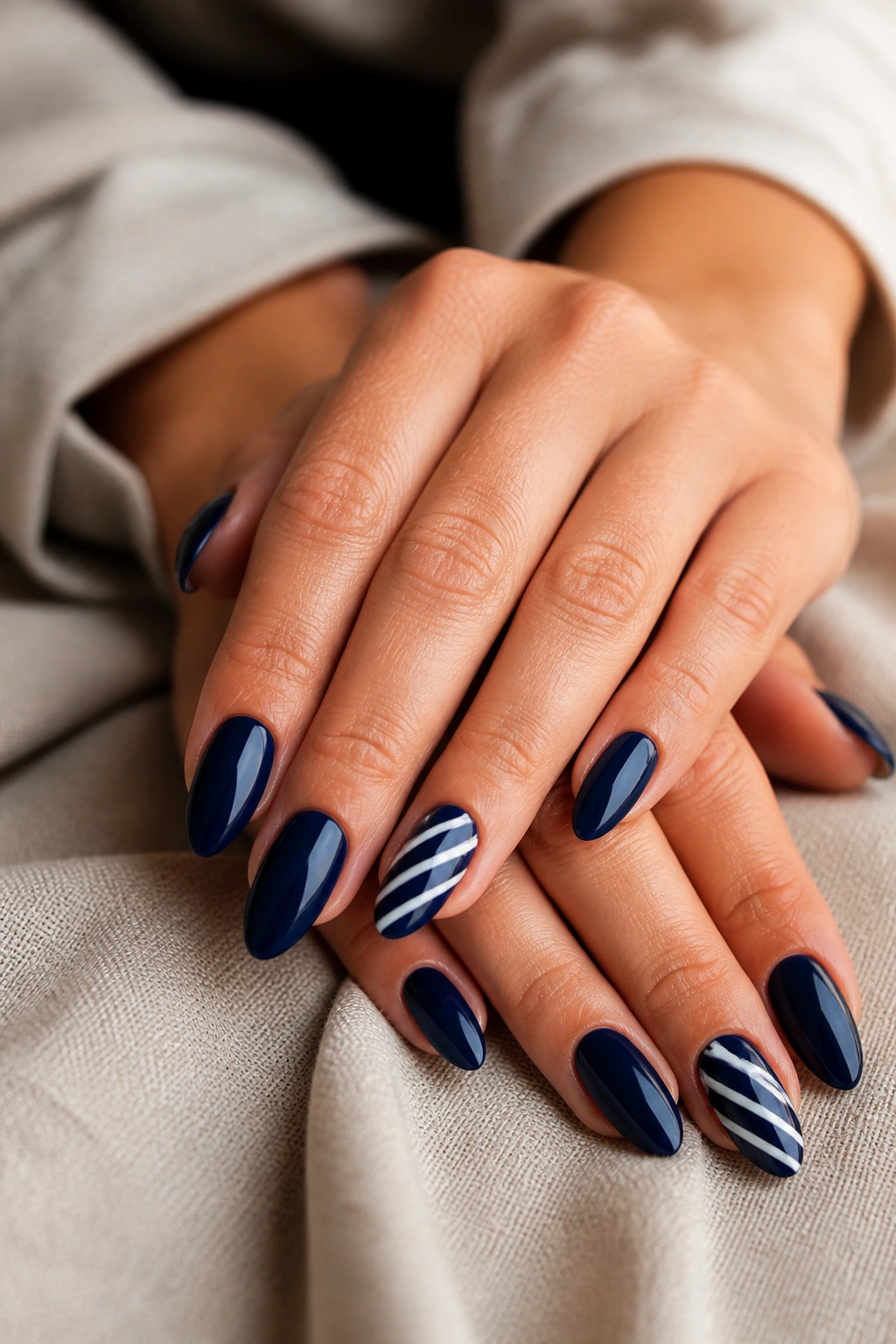
Nautical nails can go cheesy fast if you overdo the anchors and rope motifs. Keep it to navy, white, and clean striping, and the whole look stays crisp. On almond nails, thin stripes have enough curve to feel tailored rather than costume-y.
A simple diagonal stripe across one or two nails can be enough. So can a pair of parallel white lines near the tip, especially if the rest of the manicure stays solid navy. The almond shape helps because the stripes can follow the taper, which makes the hand look longer.
Where the White Should Go
Put the white where it creates a pause, not noise. A stripe near the center of the nail can break up the dark color, but a stripe too wide can make the nail look shorter. Two thin white lines, each about 1 mm, usually read better than one thick band.
I’d skip anchors unless you really want them. A clean stripe gives the same maritime nod without making the set feel themed. If you want a tiny extra detail, a single silver dot or micro-star on one accent nail works better than a full illustration.
This is one of those designs that looks especially good with a glossy finish and a sharp almond tip. Clean, no nonsense, done.
14. Blush Base Navy Floral Line Art
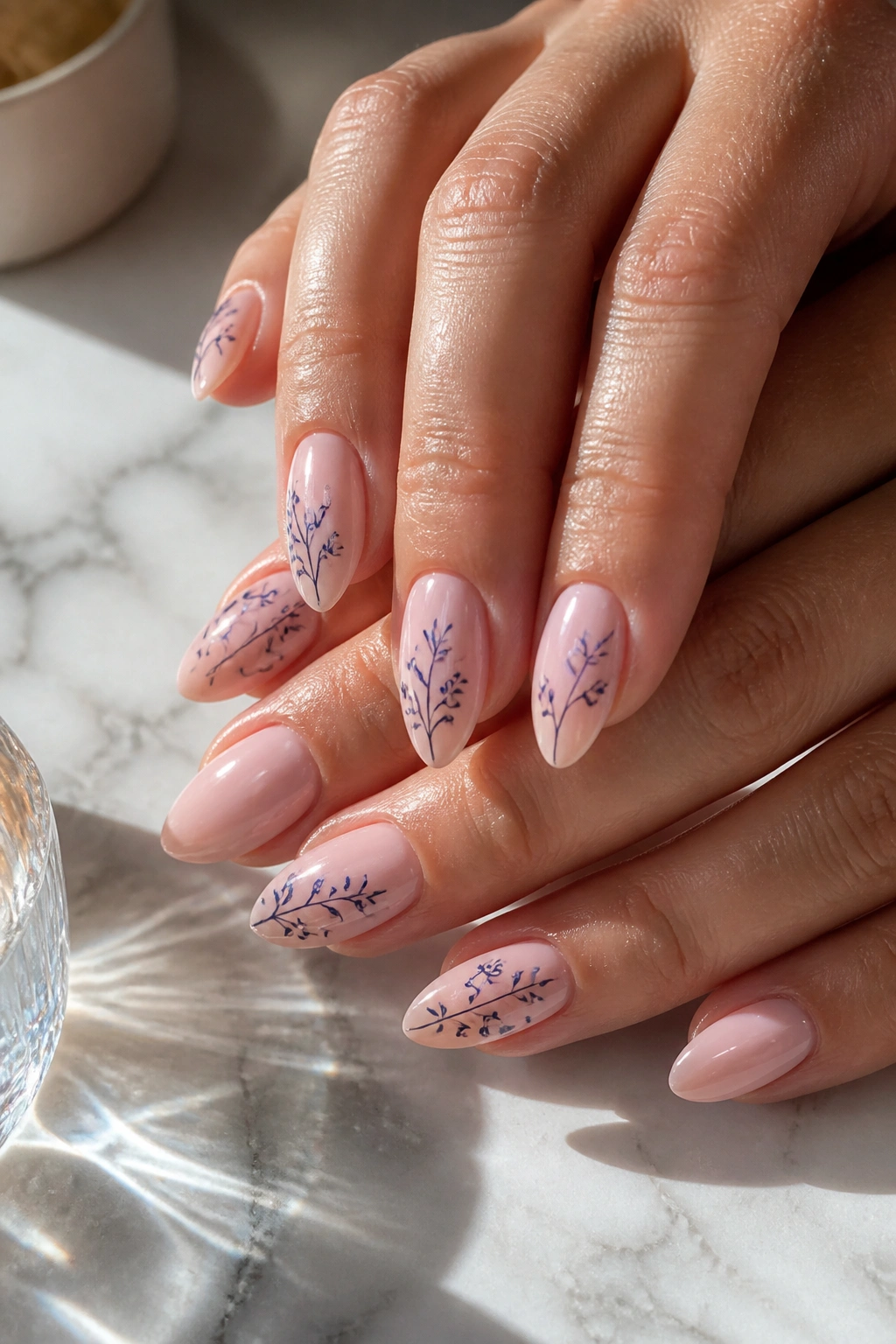
There’s something nice about putting delicate floral lines on top of a deep color story. A blush base with navy flowers keeps the manicure soft, but the dark line work gives it enough structure that it doesn’t disappear.
The best version uses tiny blossoms, thin stems, or little vine loops. Big flowers can overwhelm the almond shape. Small ones follow it. If the petals are drawn with a narrow brush and the stems are kept spare, the art feels like embroidery rather than stickers.
I like this look because it avoids the usual dark-nail trap. Navy can sometimes feel too heavy for people who like lighter manicures, and a blush base fixes that. The floral line work brings the navy back in without turning the nails into a full garden.
Keep the flowers away from the very tip. The almond taper already creates a strong ending point, and crowding that edge with petals can make the nail feel shorter. Let the design breathe a little. It pays off.
15. Navy Skittle Mani With Mixed Finishes
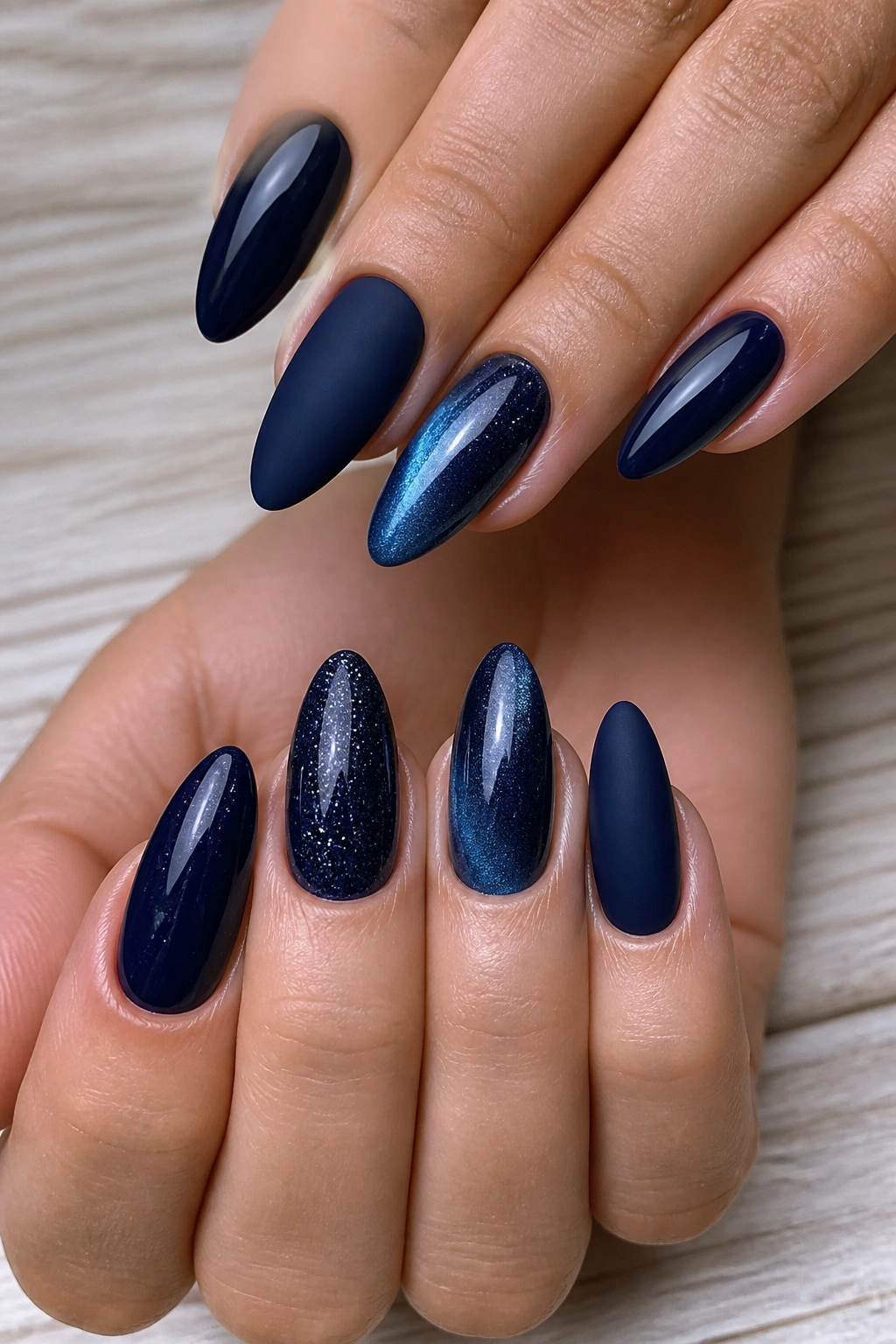
A skittle manicure means every nail is related, but not identical. On navy nails, that can be a lifesaver if you want variety without losing the color story. One nail can be glossy, one matte, one cat-eye, one sprinkled with fine shimmer, and one plain.
The trick is keeping the undertone consistent. All the shades should sit in the same navy family — no bright royal blue crashing into nearly-black ink. When the undertone stays steady, the mixed finishes feel intentional rather than random.
This is a good choice if you get bored fast. It gives you something new to look at every time you move your hands, which sounds small until you’re actually wearing the manicure for a week. I also like it because it lets you test finishes before committing to a full set of anything more dramatic.
- Keep the same base color across all nails.
- Use no more than three finishes if you want the set to stay calm.
- Put the boldest texture on one or two accent nails.
- Leave at least one nail plain and glossy for balance.
The result is lively, but not messy. That’s the sweet spot.
16. Navy Aura Nails With an Ink-Blue Center Glow
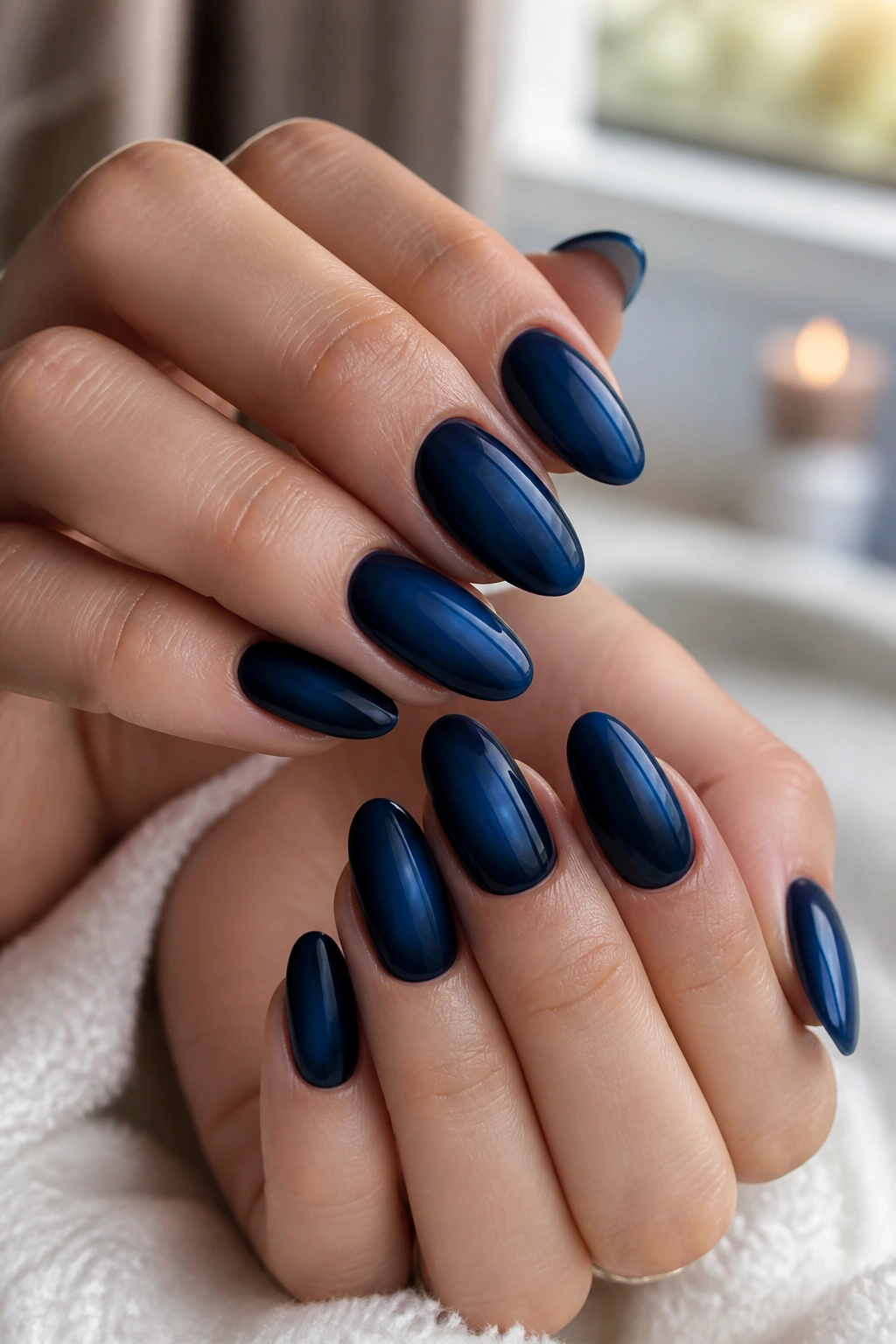
Aura nails look soft because the color blooms from the middle instead of sitting at the edges. On a navy base, that creates a kind of inky glow that feels moody without going flat. Almond nails are a good match here because the rounded center fades into the taper naturally.
The Soft-Center Trick
A lighter blue or smoky blue is usually airbrushed or sponged into the center, then deep navy frames it from around the edges. The goal is a glow, not a circle stamp. If the center is too round and too obvious, the nail starts looking cartoonish. Keep the blur wide and feathered.
This design works best when the background stays sheer enough to let the gradient show. A fully opaque navy base can swallow the aura effect. A thinner layer, followed by the glow in the middle, gives you more movement.
A good aura manicure should look slightly different from each angle. You want the center to brighten as the hand turns, then sink back into the darker edge. That shifting quality is what makes the design feel alive.
I’d choose this if you like nail art that’s modern but not loud. It has personality, just in a quieter register.
17. Navy Checkerboard Accent Nails
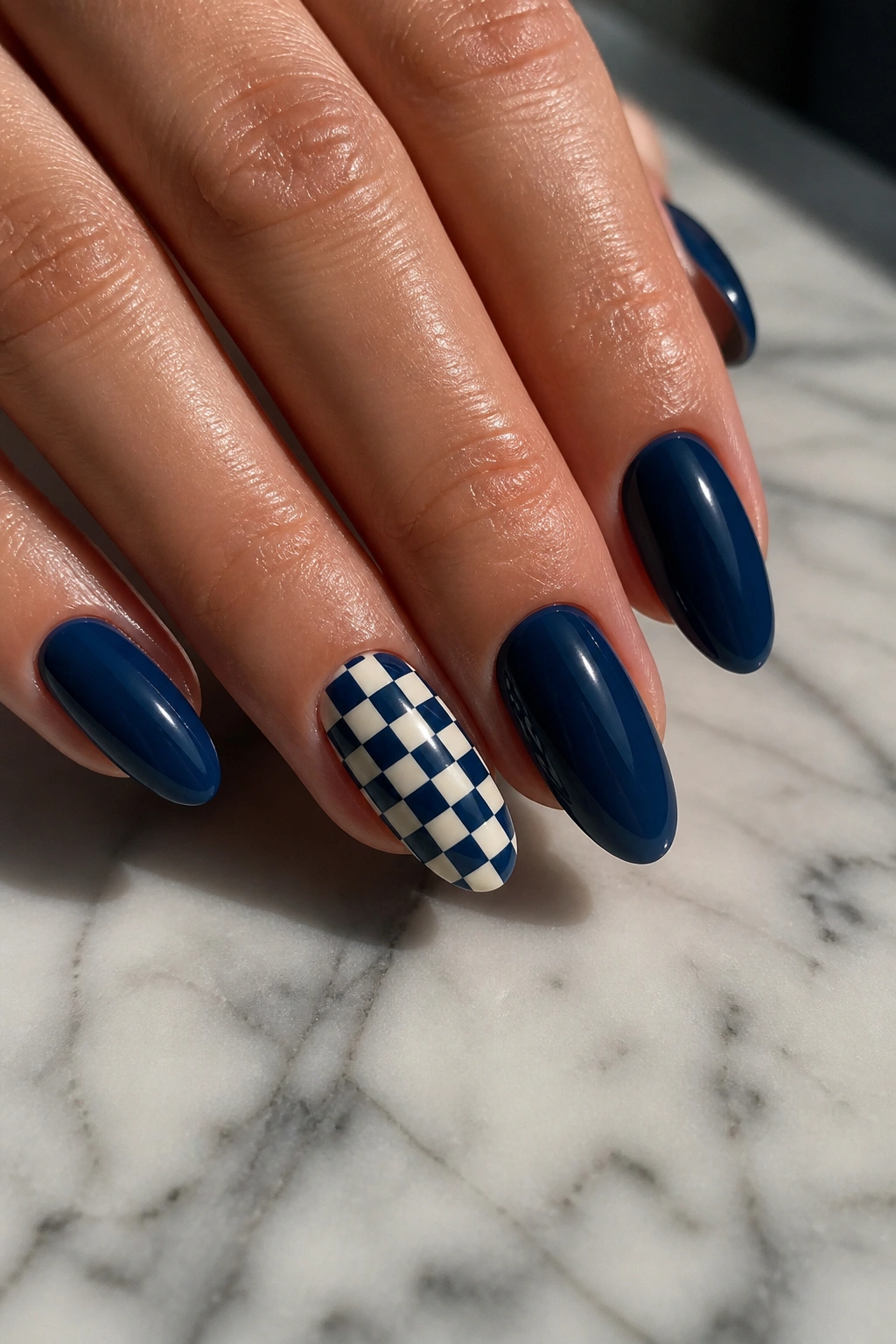
Checkerboard can feel playful or chaotic, depending on how much of it you use. On navy almond nails, a single accent nail with a cream-and-blue checker pattern is usually enough. The rest of the set can stay solid navy so the check doesn’t run away with the look.
The pattern reads best when the squares are small and even. Think 4 mm blocks instead of giant tiles. Large checks can make narrow almond nails look stubby, while smaller checks keep the shape long and crisp. A thin outline between the navy and cream can help, but only if your hand is steady enough to keep the lines clean.
I like checkerboard because it gives the manicure a graphic edge without needing glitter or stones. It’s a little retro, a little sporty, and surprisingly flattering when the colors stay deep and muted. Bright checkerboard can turn childish fast. Navy and cream keep it grounded.
If you’re nervous about committing to a whole accent nail, try just the tip. A checkerboard French edge is easier to wear, and the almond taper makes that mini pattern read clearly without dominating the whole hand.
18. Navy and Burgundy Mixed-Tone Nails
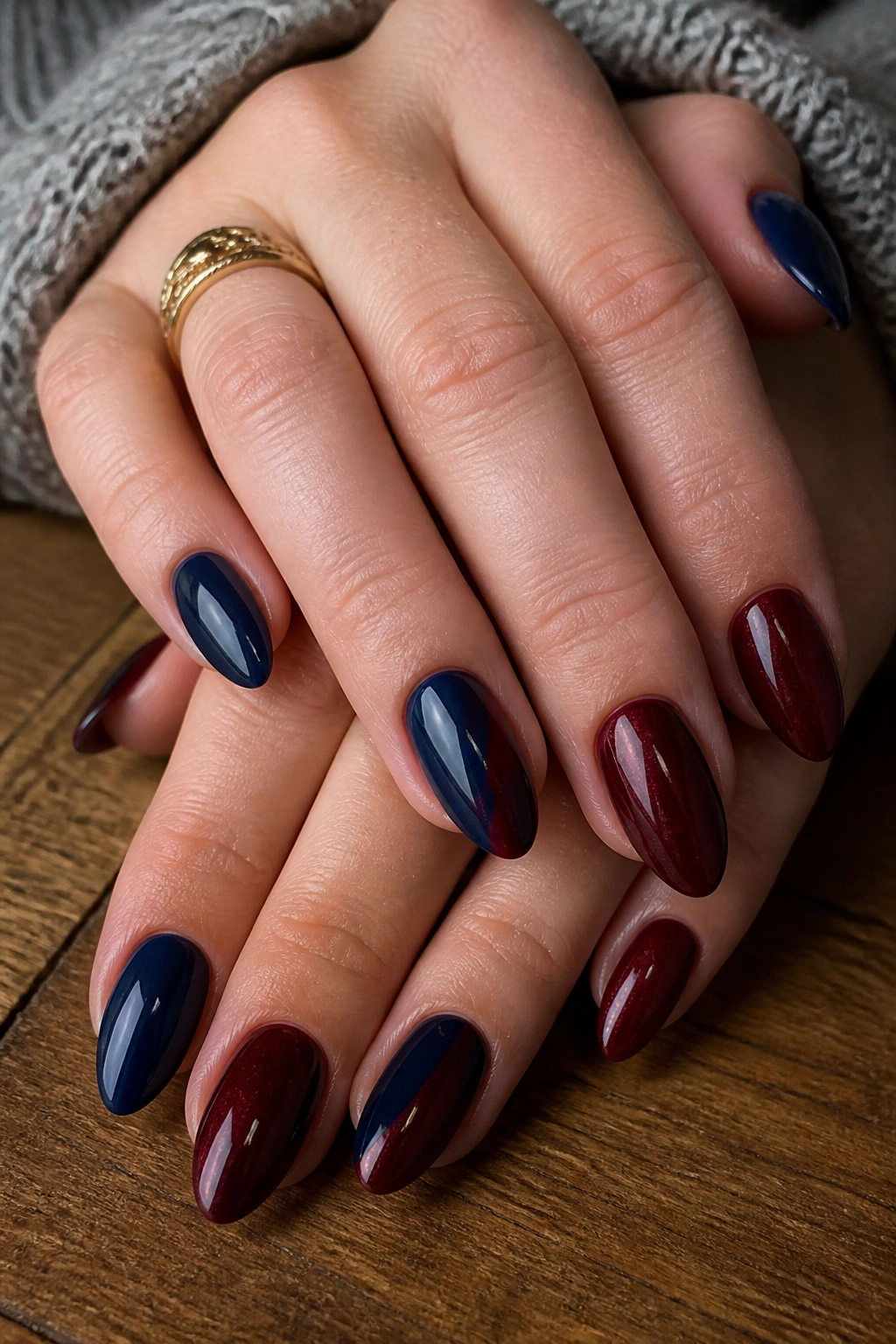
Navy and burgundy should not work as well as they do, but they do. Both shades are dark, both feel rich, and both look better on almond nails than on blunt square shapes. The contrast is subtle enough to feel tailored, not flashy.
This combo shines when the finishes match. Glossy navy with glossy burgundy feels sleek. Matte with matte feels softer and more fashion-forward. If one finish is shiny and the other flat, the difference can look accidental unless the design is carefully planned.
I usually like a split set: a few nails navy, a few burgundy, and maybe one nail with a diagonal divide between the two. That keeps the manicure from looking like two separate ideas fighting for space. You could also use burgundy as an accent on one ring finger and keep the rest navy if you want the safer route.
Who It Suits
- People who wear gold or mixed-metal jewelry.
- Anyone who likes dark nails but wants more depth than plain blue.
- Almond nails with medium length, since the shape gives both colors room to breathe.
This is one of my favorites for cooler months, though the colors themselves never really go out of season.
19. Navy Marble Nails With Silver Veins
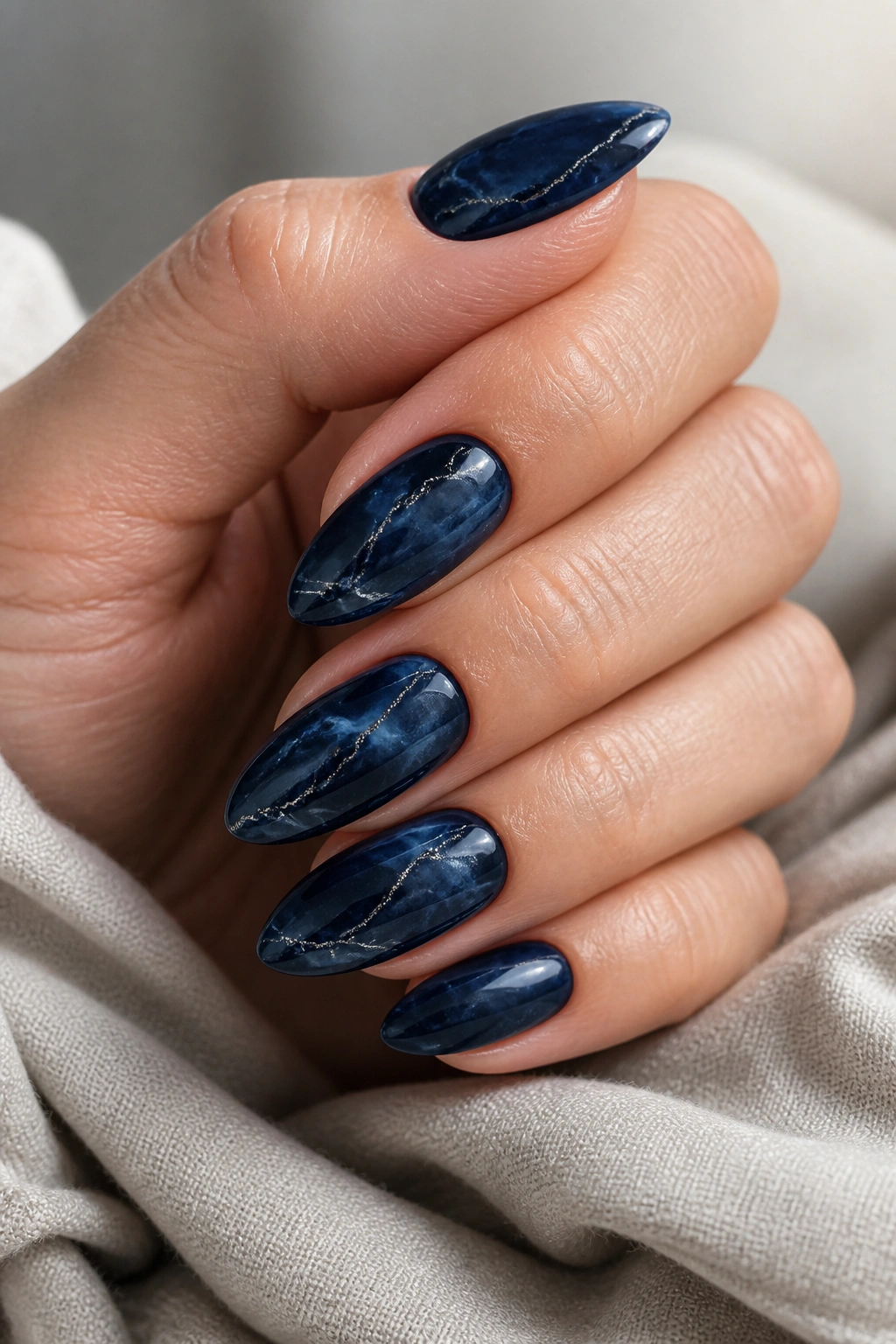
Marble nails can look messy if the veining gets overworked. Navy marble avoids that problem better than lighter colors do, because the dark base hides a little imperfection and the silver veins give the pattern something to hang on to. It’s one of the few designs where a bit of irregularity helps.
How to Stop the Marble From Turning Muddy
Use a mix of navy, white, and a touch of gray or black in wispy layers, then draw very thin silver veins through the design. The silver should be sparse, not flooded. If every line is metallic, the effect gets busy fast. You want the veins to look like they were dragged through stone, not painted on with a heavy hand.
This design suits almond nails because the long taper gives the marble room to travel. On a shorter nail, marble can bunch up and feel crowded. On a longer almond, the veining has space to stretch diagonally, which makes the nail look even more elegant.
I’d keep the marble to one or two accent nails unless you really love pattern. Too much marble can dull the impact of the navy base, and the base is the whole reason this design feels so rich.
20. Minimal Navy Almond Nails With Micro Dots and Fine Lines
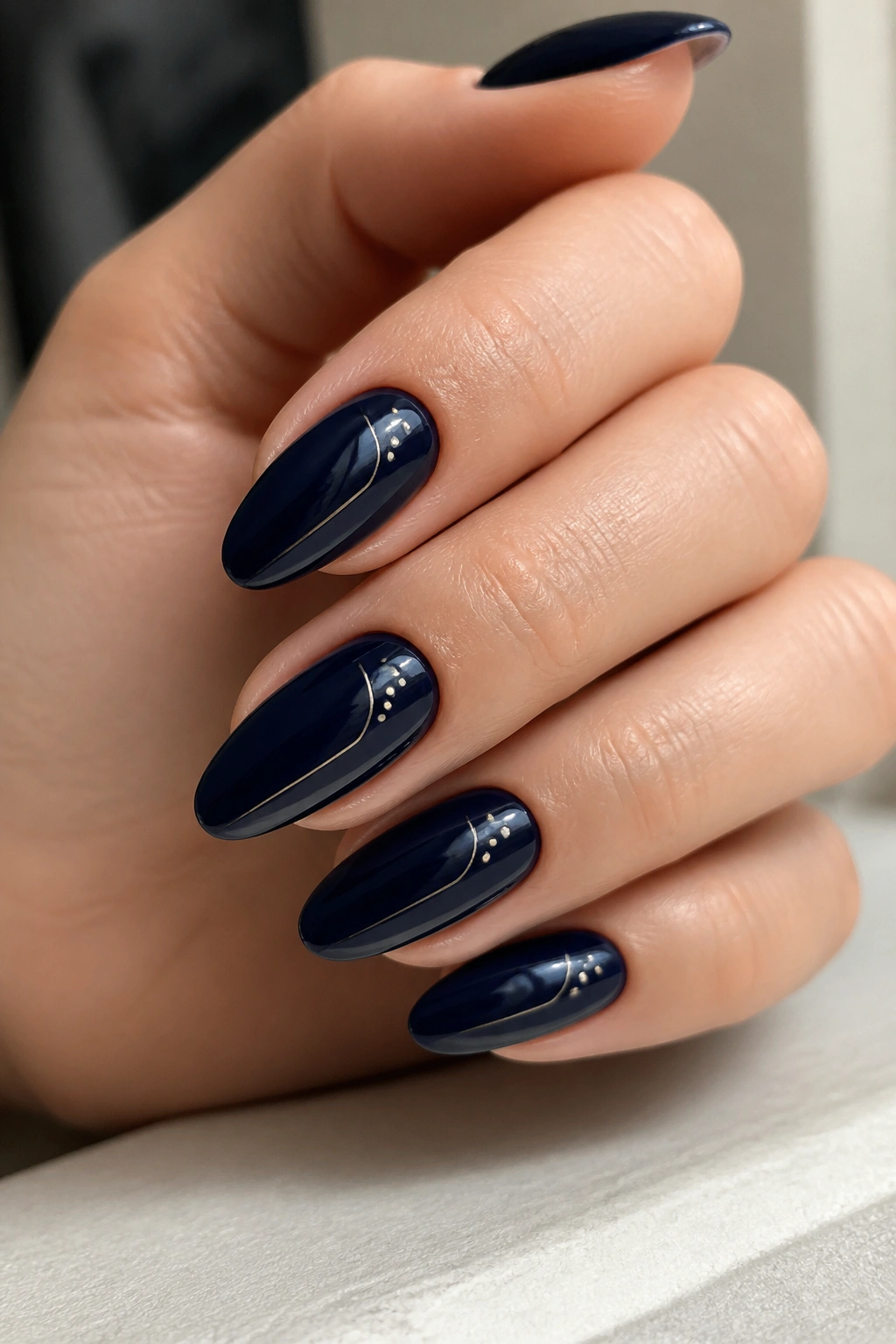
Sometimes the cleanest navy manicure is the one with the smallest details. A few micro dots, a thin side line, or a tiny crescent near the tip can be enough to make the whole set feel finished. On almond nails, these little marks follow the shape instead of competing with it.
The nice thing about micro art is that it doesn’t need to shout. A pinhead-sized dot near the cuticle, a hairline stripe running down one side, or a tiny row of three dots near the tip can create rhythm without clutter. The dark navy base carries most of the visual weight, so the detail can stay tiny.
I like this option for people who want art but not “nail art.” There’s a difference. One feels like a design choice. The other feels like a project. Minimal details let the almond shape stay the star, which is often the right call with a color this deep.
A glossy finish keeps the tiny marks crisp. If you go matte, the details soften and the whole manicure reads more muted, which can be lovely, but also easier to miss.
Final Thoughts
Navy works because it has range. On almond nails, that range gets even better: the shape softens the depth of the color, and the color sharpens the shape right back.
The simplest version is still a solid glossy navy with careful edges. The more playful versions — chrome crescents, swirls, aura fades, tiny floral lines — all work because they respect the same rule: keep the almond shape visible. When the design starts fighting the curve, it loses its charm.
If you’re deciding where to start, pick one finish first and one accent second. That keeps the manicure from feeling crowded, and it makes the whole thing easier to explain at the salon. A clean navy base with one smart detail usually looks better than a pile of ideas all at once.