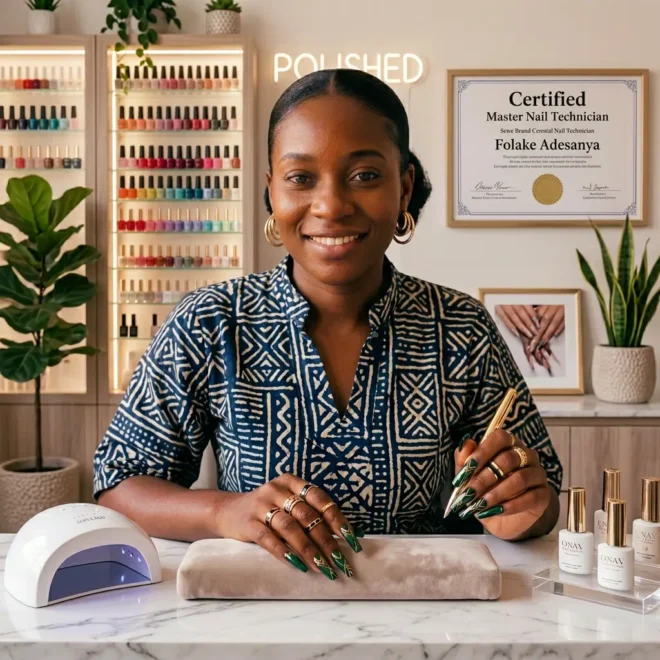


White almond nail ideas have a funny habit of looking more expensive than they should. A soft white almond shape can read bridal, crisp, minimalist, or a little dramatic, and the difference usually comes down to three things: opacity, finish, and how hard the white hits the eye.
The almond shape does a lot of the work for you. It pulls the eye into a long taper, so even a plain white manicure can feel sharp instead of flat. But white is unforgiving. Go too chalky and the nails look harsh. Go too sheer and they can start to look unfinished. The sweet spot is usually somewhere in the middle, where the color looks intentional and the shape still has room to breathe.
That’s why the best versions aren’t the loudest ones. They’re the ones that know exactly how much white to show, where to place shine, and when to stop adding extras. A tiny line of chrome can be enough. So can a milky wash, a thin French tip, or one careful accent nail.
1. Milky White Gloss Almond Nails
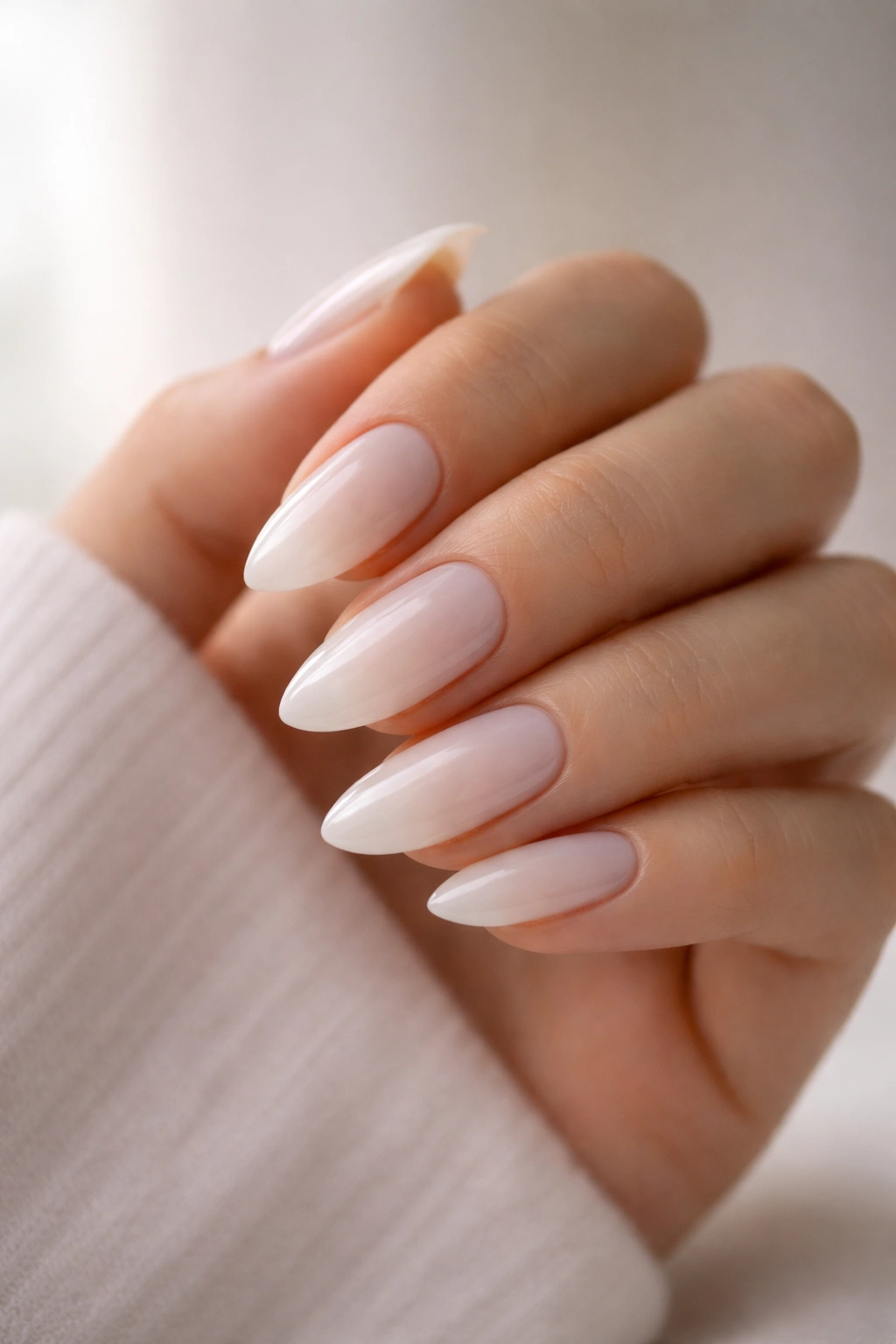
If you want the cleanest possible starting point, this is it. Milky white on an almond shape has that soft, polished feel that never tries too hard. It looks expensive because it doesn’t shout.
The key is translucency. Ask for a sheer white overlay, not a dense opaque block of color. A good milky set usually has two thin coats over a nude or builder-gel base, so the nail bed still shows through a little. That little bit of depth keeps the manicure from turning flat.
On almond nails, this finish works best at medium length. Too short, and the softness gets lost. Too long, and the style can start drifting into runway territory when you may have wanted something calmer.
- Best on medium almond lengths with a tapered free edge
- Ask for a soft-white gel, not stark paper white
- Keep the shine high with a glassy topcoat
- Use cuticle oil every day so the white stays fresh, not dusty
My rule: if the white looks bright enough to hide every trace of the nail underneath, it probably needs one more sheer layer, not a thicker coat.
2. Micro French Tips on a Sheer Nude Base
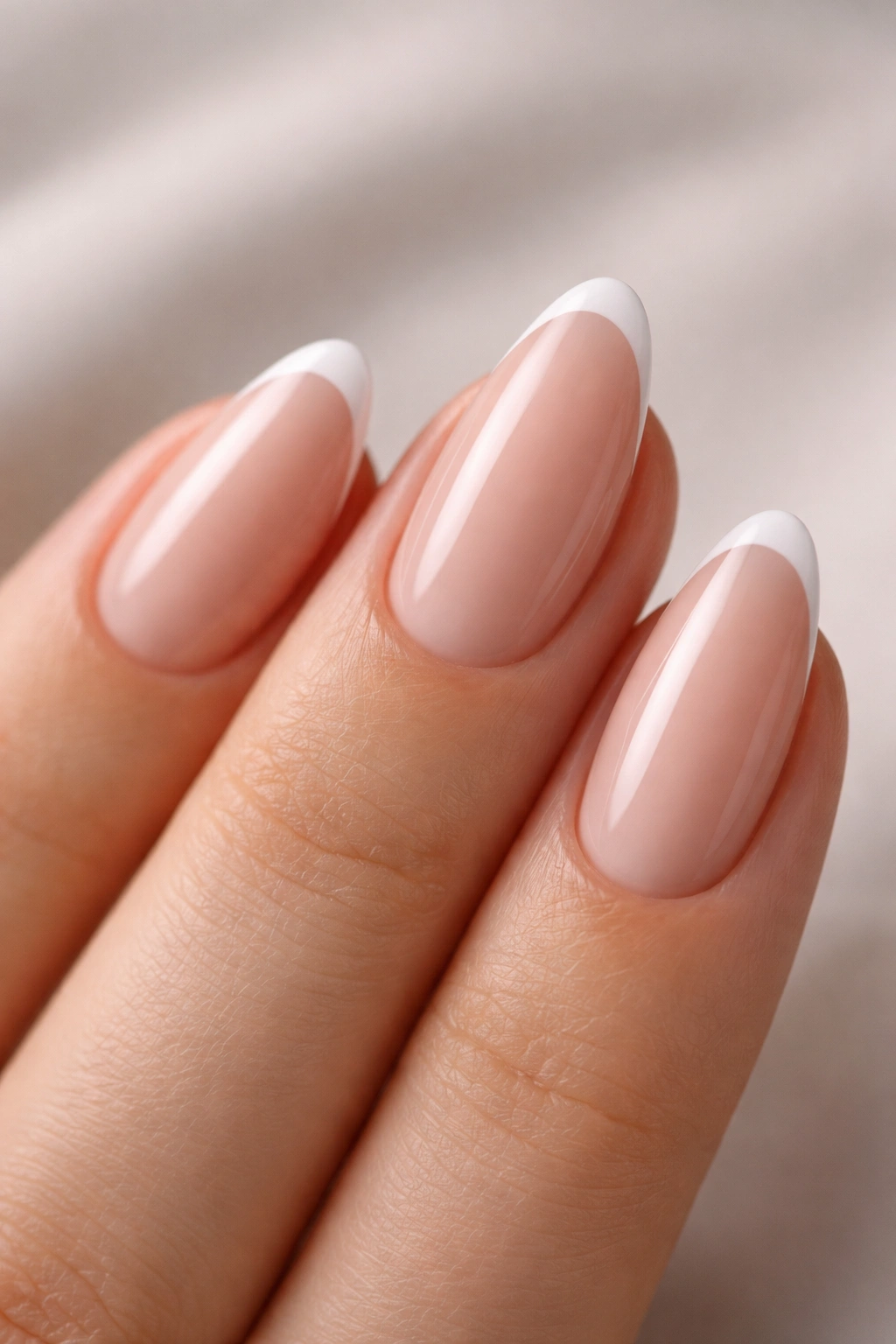
Why do micro French tips look cleaner than a full white nail? Because they give your eyes somewhere to rest. A thin white edge on a nude base is neat, restrained, and a little smug in the best way.
The line should be skinny. Think 1 to 2 millimeters, not a chunky crescent. On almond nails, the tip can follow the natural taper of the shape, which makes the whole manicure feel more tailored than a square French ever could. The base stays soft, the tip stays crisp, and nothing fights for attention.
How to wear it
This is the version I’d hand to someone who wants something office-safe but still nice enough for dinner. Keep the nude base close to your skin tone and avoid a beige that turns muddy under indoor light. If your nail bed is cool-toned, a pink-beige base usually reads cleaner than a yellow beige.
A micro French also gives you room to add a tiny twist later. A single pearl accent on one ring finger. A whisper-thin chrome line. Even nothing at all. It already has structure.
3. White Chrome Almond Nails
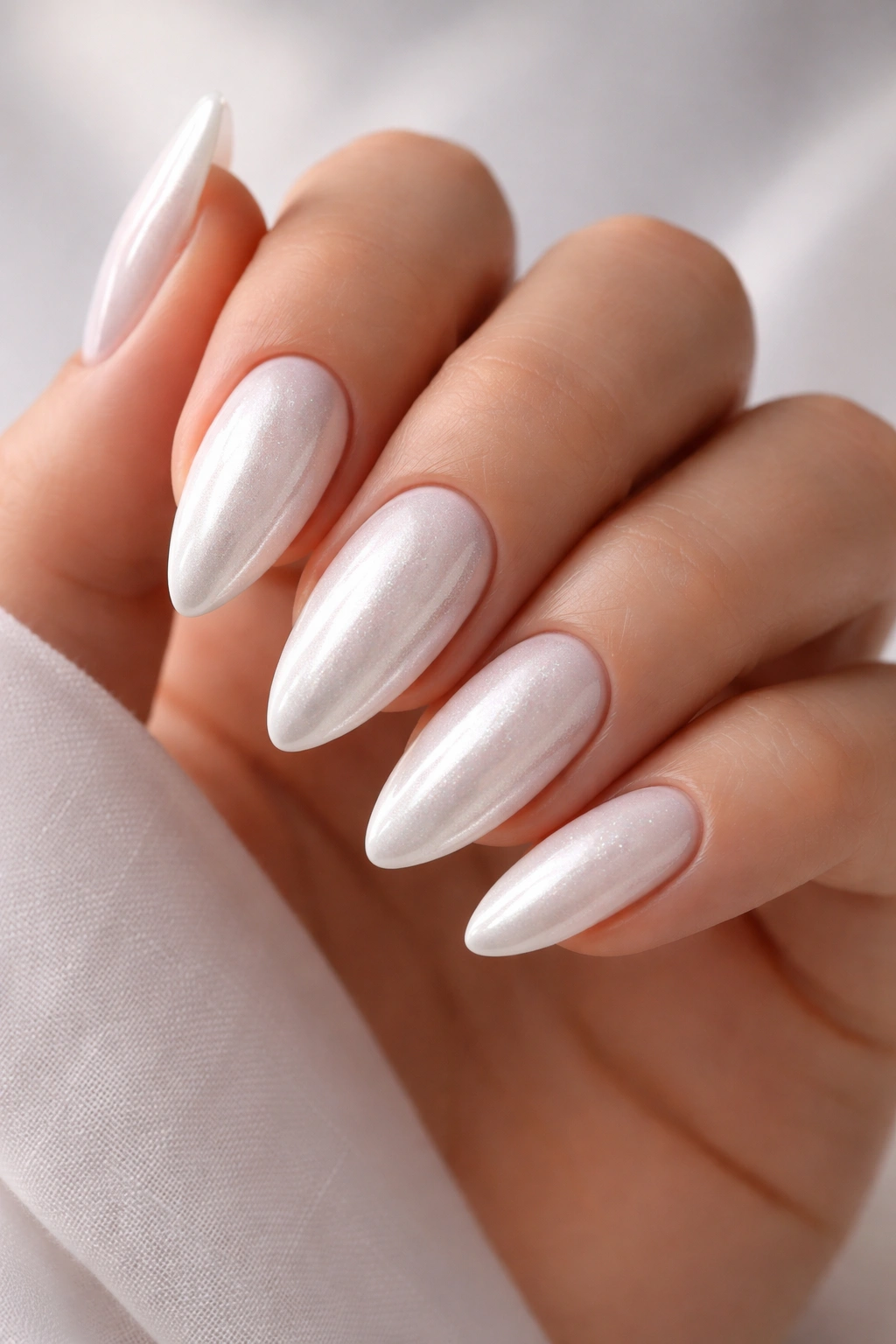
White chrome is for people who want their manicure to look polished without being plain. It catches the eye fast, but it does it with shine rather than color drama. That matters.
The best white chrome almond nails are built on a soft white base, then finished with a pearly chrome powder rather than a mirror-bright silver. The effect is cooler, smoother, and more refined. If the chrome gets too metallic, the whole look starts to feel harder than it should.
A salon set usually looks best when the chrome is kept even from cuticle to tip. Patchy chrome is brutal. It shows every uneven swipe, every thin spot, every rushed corner. Tell your tech you want the finish to stay smooth, not frosty in random places.
What makes it work
- Use pearl chrome, not heavy mirror chrome
- Keep the base white and slightly sheer
- Let the almond tip stay thin so the shine doesn’t look bulky
- Pair it with silver jewelry or plain gold, not both at once
Good to know: chrome looks strongest on nails that have a clean surface. If the base coat is bumpy, the finish will show it.
4. Soft White Ombré Fade
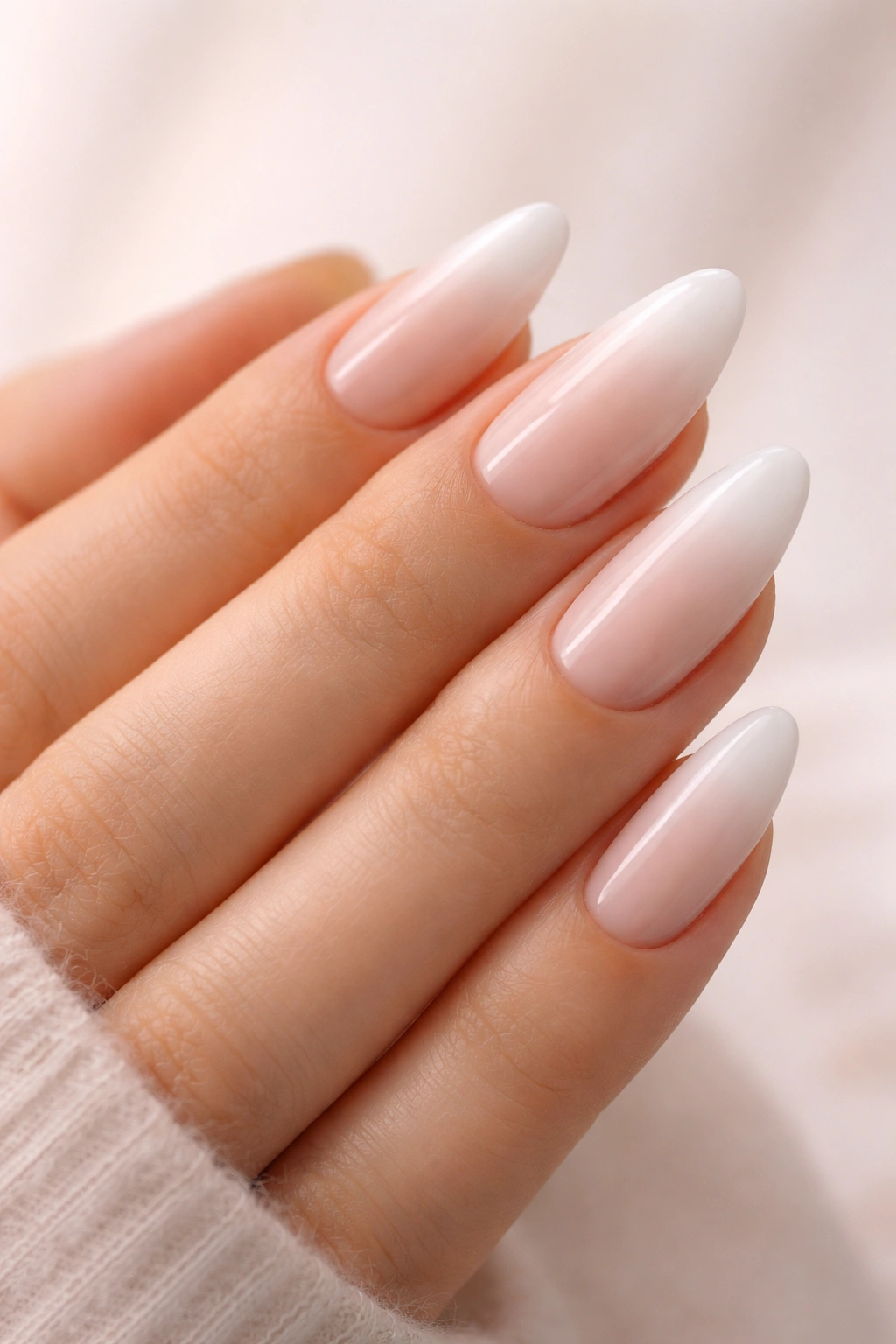
This is one of those styles that looks quiet from a distance and more interesting up close. The color fades from a transparent or nude base into soft white at the tip, and the gradient gives almond nails a little extra length.
The nicest ombré versions don’t have a harsh line anywhere. The fade should look misted on, like the white drifted upward instead of landing in a block. Airbrush gives the softest result, but a skilled sponge blend can work too if the layers stay thin.
There’s also a practical side here. Ombré white is forgiving on grow-out. That’s a big deal if you don’t want to be back at the salon every ten minutes. The soft transition hides the gap better than a solid white polish does.
And yes, this style can look a little dreamy. That’s the point. Keep the white soft, keep the nail shape lean, and it stays elegant instead of sugary.
5. Lace-Inspired White Detail
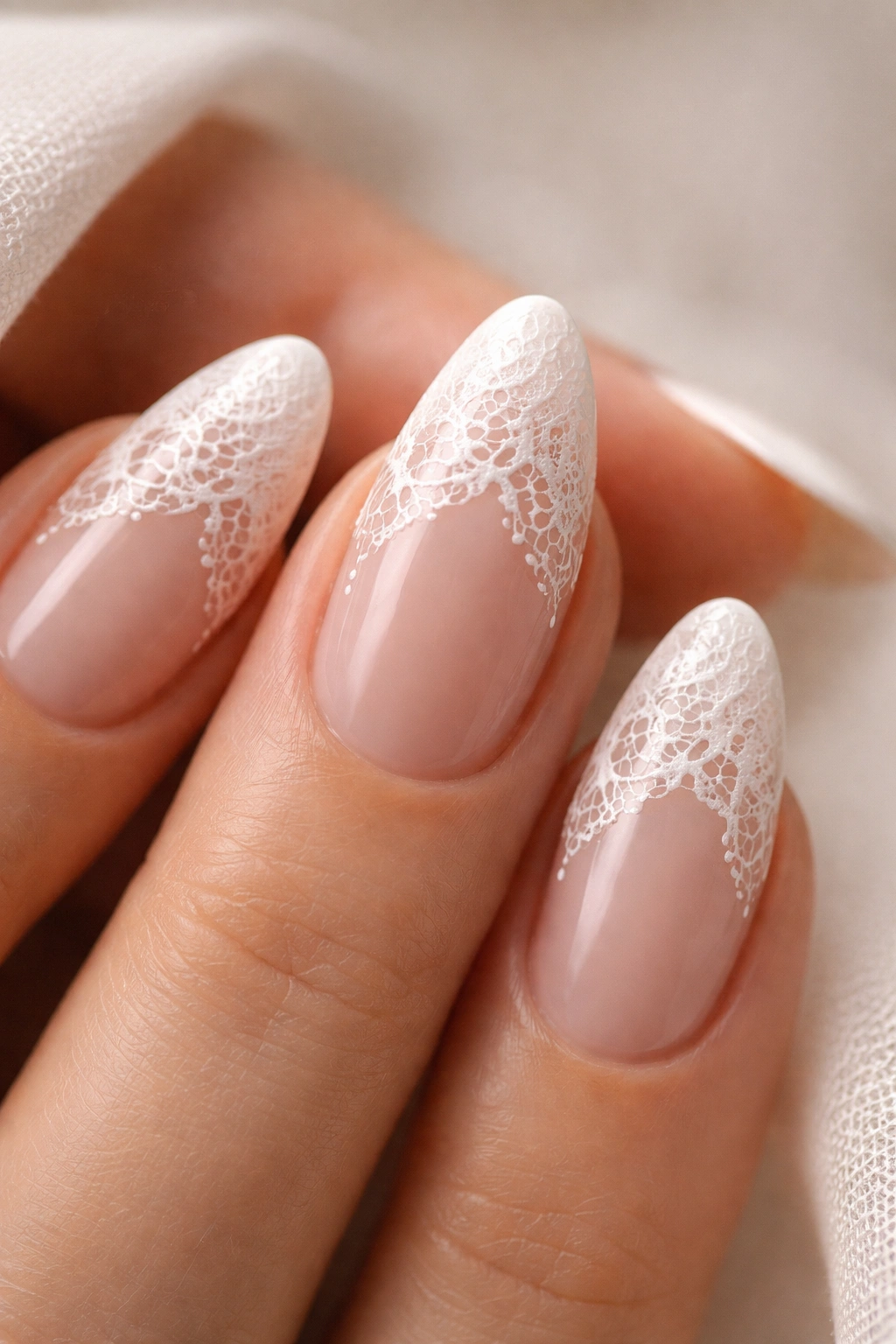
What separates lace nails from plain white nails is restraint. You are not drawing a wedding cake on each finger. You are tracing a little texture, usually in the top third of the nail or along one side, and letting the negative space do some of the work.
The best lace details are thin and airy. A fine brush, a steady hand, and a little patience matter more than a pile of decorations. A white lace pattern over a nude or pale blush base keeps the look soft. Over opaque white, the detail can disappear unless the design has a lot of contrast.
I like this style when it stays close to the cuticle or hovers near the tip. That makes it feel intentional instead of crowded. Put the busiest detail on one or two nails, and leave the rest plain. That little pause is what makes the manicure feel expensive.
You do not need a full lace overlay to get the effect. A tiny scallop edge is enough.
6. White Nails with Gold Foil
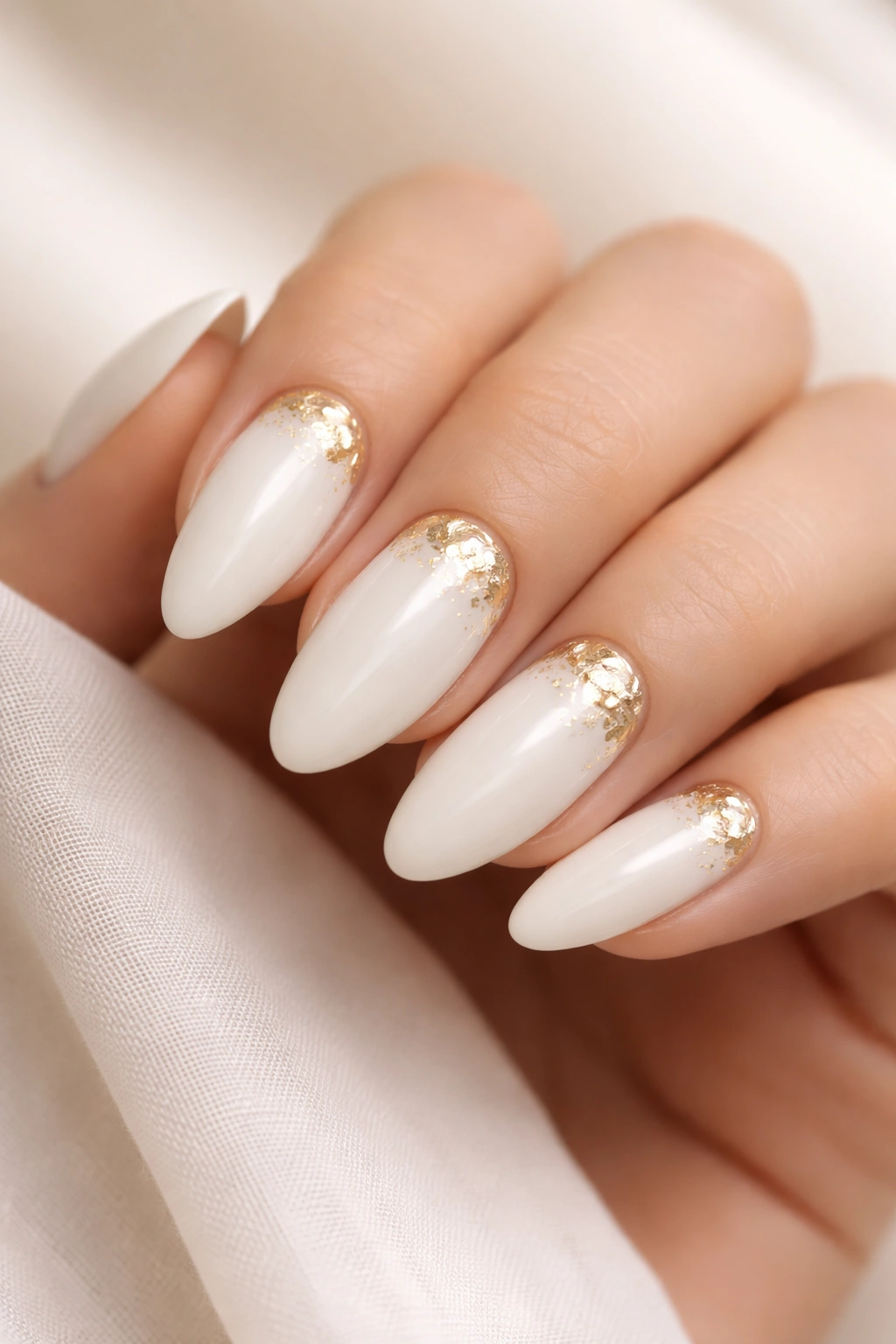
Gold foil on white almond nails works because the materials are doing different jobs. The white keeps things clean. The gold adds movement. Together, they feel dressed up without tipping into glitter overload.
The trick is to use the foil sparingly. A small cluster near the cuticle or a broken edge along one side of the nail is usually enough. If the foil starts covering more than about a third of the nail, it begins to compete with the white instead of framing it. That’s where the design loses its nerve.
This style looks best when the white base is solid and creamy. Thin, see-through white can make the foil look disconnected. A smooth opaque coat gives the metallic pieces something crisp to sit on.
It’s also a good choice if you wear warm-toned jewelry. Gold foil and yellow gold rings share the same visual temperature, so the whole hand feels coordinated without looking matched too hard.
7. Matte Porcelain Almond Nails
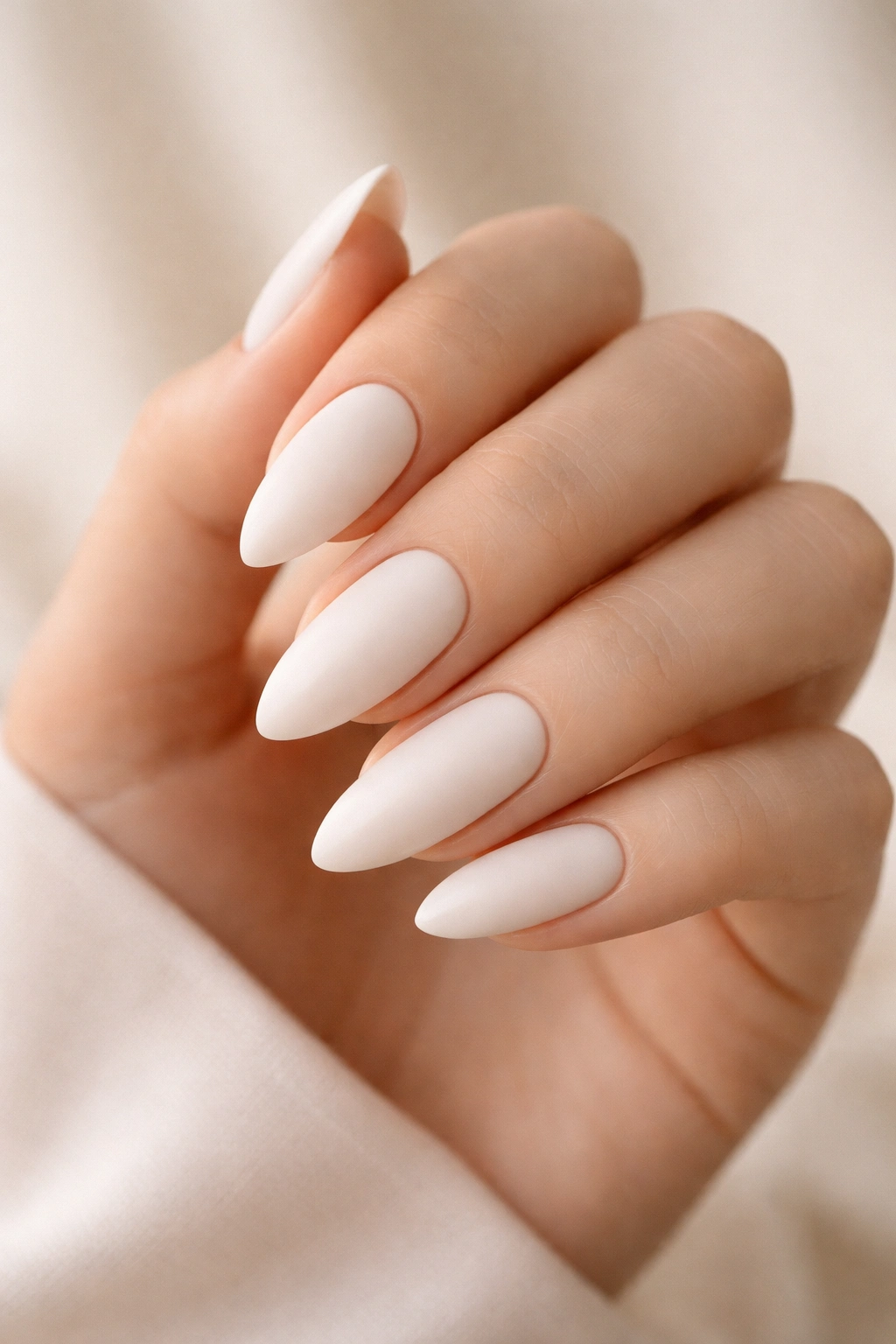
Can matte white look chic? Yes, but only if the shade is right. Stark white matte can go flat fast. Porcelain white, though, has enough softness to feel sculpted.
The texture is the point here. A matte topcoat removes the shine and leaves the nail looking almost like ceramic. On almond nails, that works because the shape already has a long, smooth curve. The result feels calm and deliberate.
How to keep it from looking chalky
Use a white that leans creamy rather than paper-bright. Then finish the edges carefully, because matte topcoat makes every uneven spot stand out. Oil around the cuticle helps too. Matte finishes dry out the eye a little, and a bit of shine on the skin next to the nail keeps the whole hand from looking dusty.
I like this style on shorter almond nails more than very long ones. The shorter shape keeps the matte finish grounded. Long matte white can drift into costume territory if the rest of the look isn’t very clean.
8. Pearl-Toned White Almond Nails
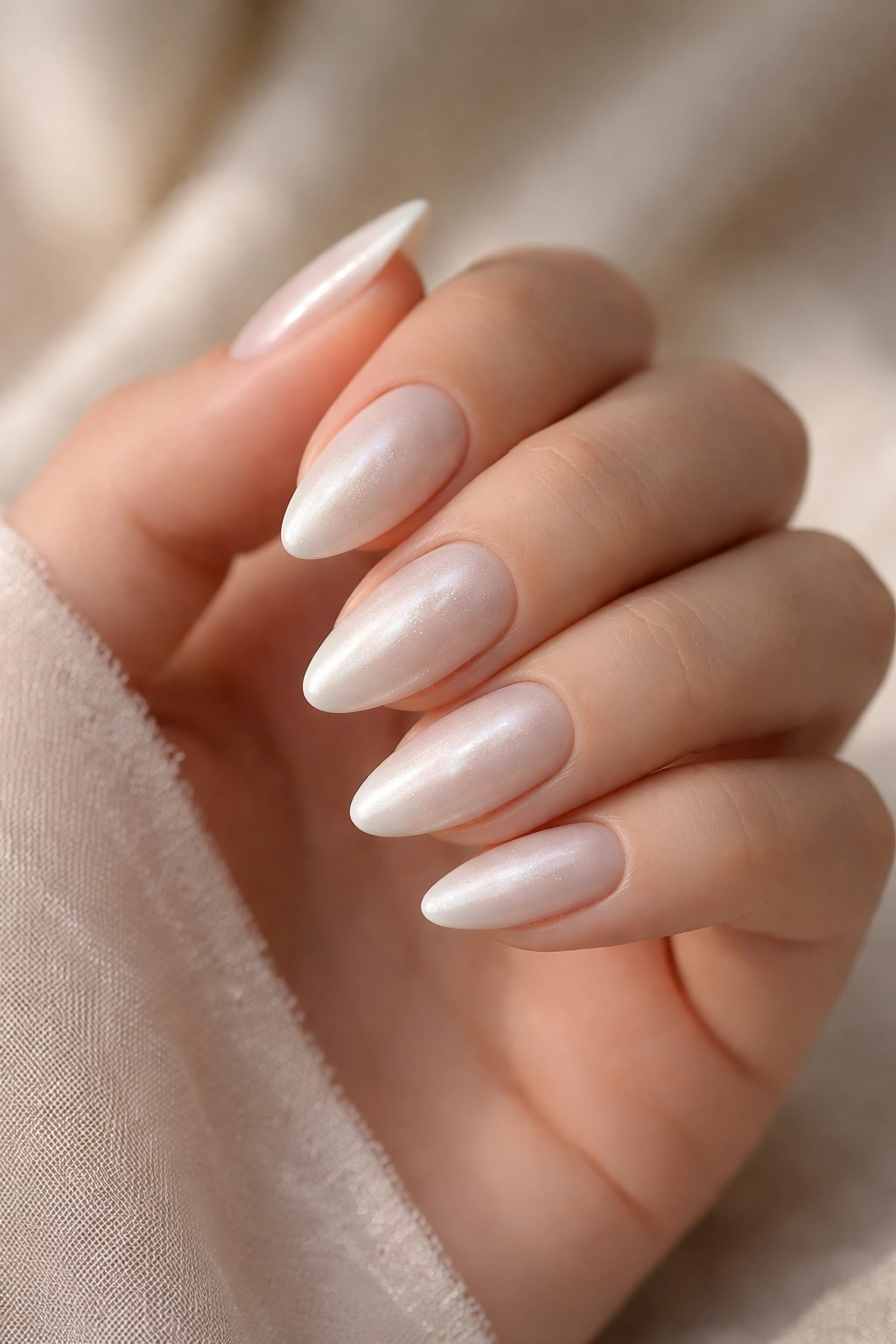
Pearl-toned white is what you reach for when plain white feels too harsh. It has a gentle shimmer, not glitter, and that shimmer gives the manicure some life when the light changes.
The finish should look like a shell, not like craft-store sparkle. Think fine sheen, a little depth, and a soft shift when you move your hand. On almond nails, pearl tones flatter the taper because the light slides along the curve instead of sitting in one flat patch.
This is the manicure I’d choose for someone who wants white nails but hates the idea of anything too stark. It works especially well on medium-length almonds with a rounded point. The softer the tip, the easier the pearl finish feels.
- Best with creamy whites rather than icy whites
- Looks good with both gold and silver jewelry
- Holds up nicely for formal events and daily wear
- Needs a smooth base coat, or the shimmer can emphasize flaws
A pearl finish is subtle, but not boring. There’s a difference.
9. White Swirl Tips
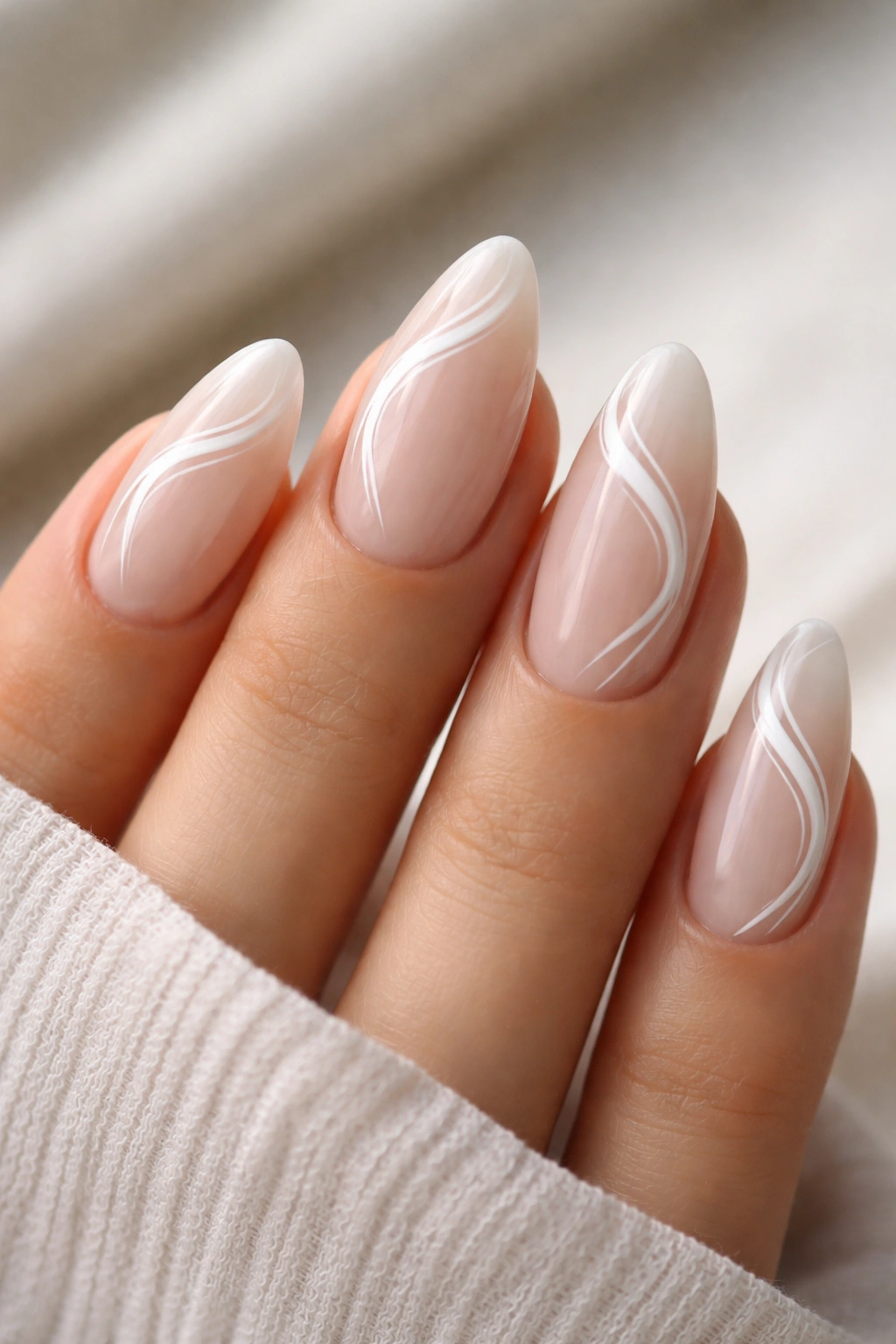
Swirls are where white almond nails get a little playful without losing their polish. The trick is to keep the line work thin and flowing, almost like a ribbon laid across the nail.
You can place the swirls over a clear, nude, or milky base. White-on-white swirls need more negative space to show up, so if you want the pattern to read from a few feet away, a sheer pink-beige base works better. One or two swirls per nail is usually enough. More than that and the design can start looking crowded.
What I like about swirl tips is the movement. They soften the rigidity of a full white manicure and make the nail look hand-drawn instead of stamped. That small difference matters. It feels less rigid, more lived-in.
Keep the swirls thin near the cuticle and slightly thicker toward the tip. That tiny shift gives the design a bit of rhythm.
10. Classic French with a Deep Smile Line
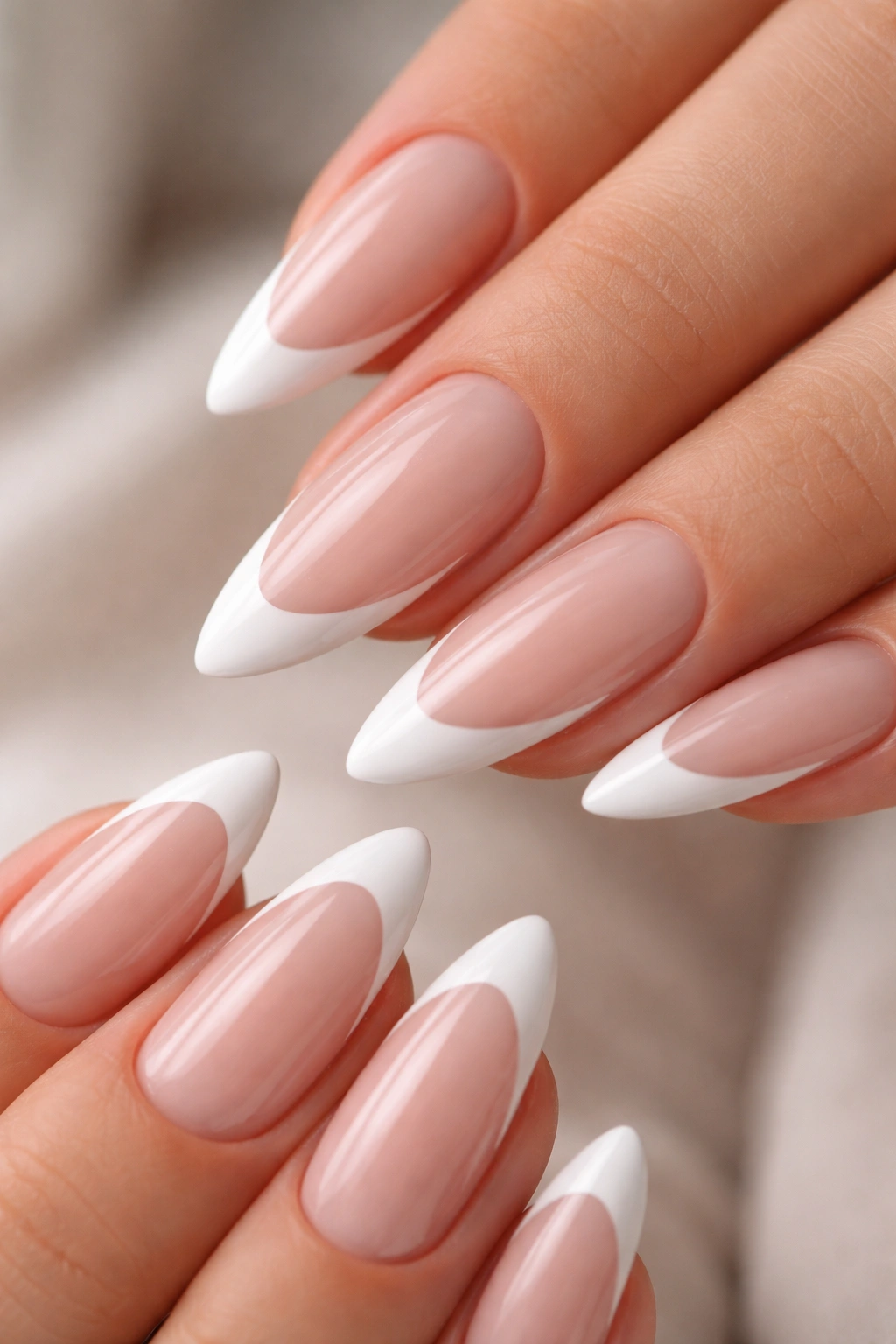
A deep smile line changes everything. Compared with a micro French, it makes the nail look longer and a little more dramatic, even when the color palette stays plain.
On almond nails, the deep curve follows the shape naturally, so the French tip looks more tailored than stiff. The white tip should still be crisp, but it can be wider here—maybe 4 to 6 millimeters depending on nail length. If the smile line sits too low, the nail can look short. Too high, and it starts to feel awkward. There’s a middle zone that just works.
This is one of those styles that looks especially good on hands with longer nail beds. The deeper arc gives a nice visual lift. It also pairs well with a glossy topcoat because the shine keeps the white from reading heavy.
I prefer this version when the base is sheer pink or beige. An opaque base can make the tip look disconnected. A soft base lets the white feel framed, which is the whole point.
11. White and Nude Negative Space
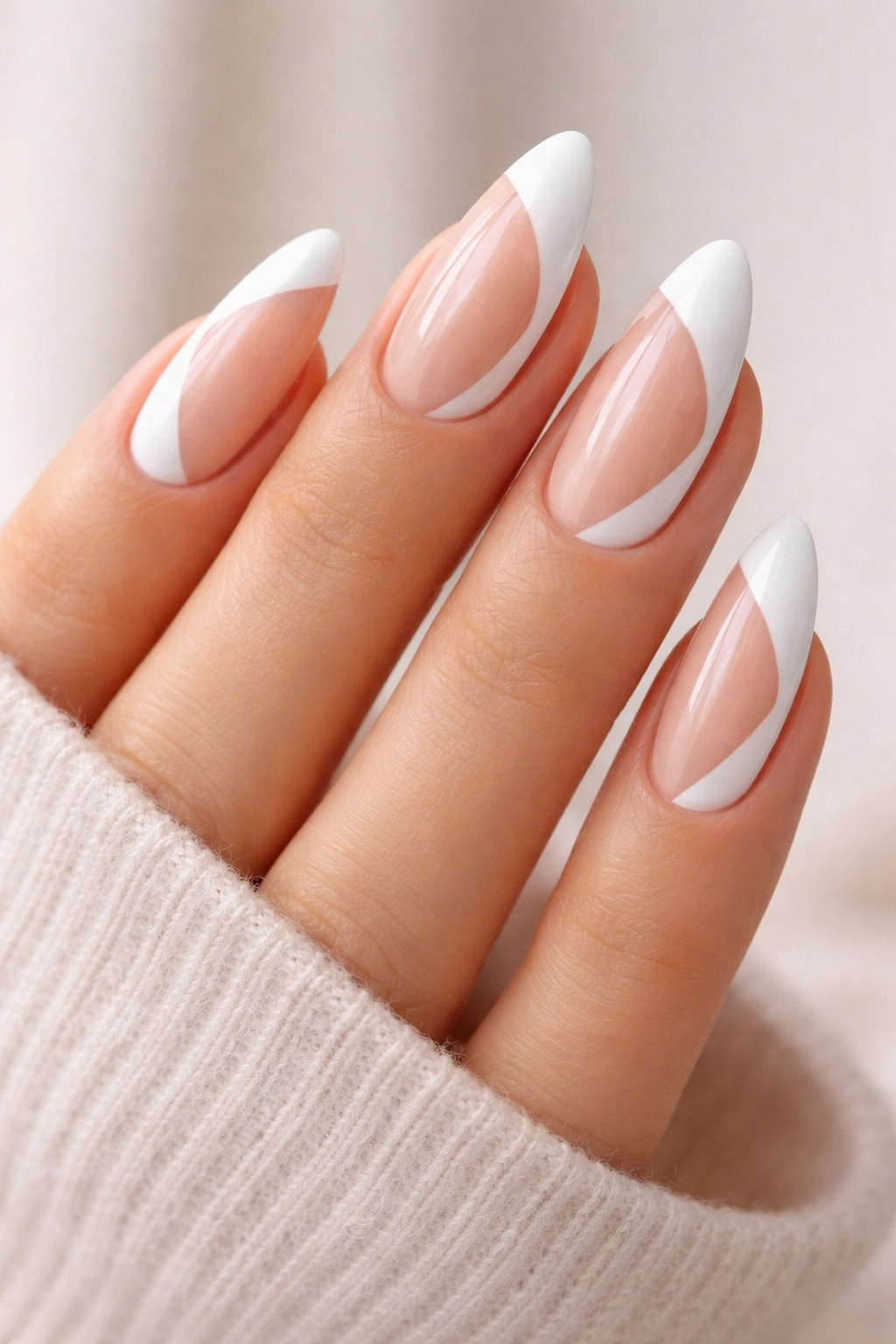
Negative space keeps white nails from feeling crowded. A few bare sections near the cuticle or along one side can make an almond shape look leaner, cleaner, and more current without leaning trendy in a way that ages fast.
This style works because your eye fills in the rest. A white crescent at the tip, a slim diagonal stripe, or a cutout near the sidewall creates shape without covering the whole nail. That little breathing room keeps the manicure from looking heavy.
The white should be crisp, but not thick. Negative-space designs depend on contrast, so the white has to be cleanly applied. Smudgy edges ruin the effect. If you’re doing this at home, use striping tape or a very fine brush and let each section dry before you move on.
I’d pick this design for short to medium almonds. On long nails, the spaces can look too fragmented unless the layout is really balanced.
12. White Marble Almond Nails
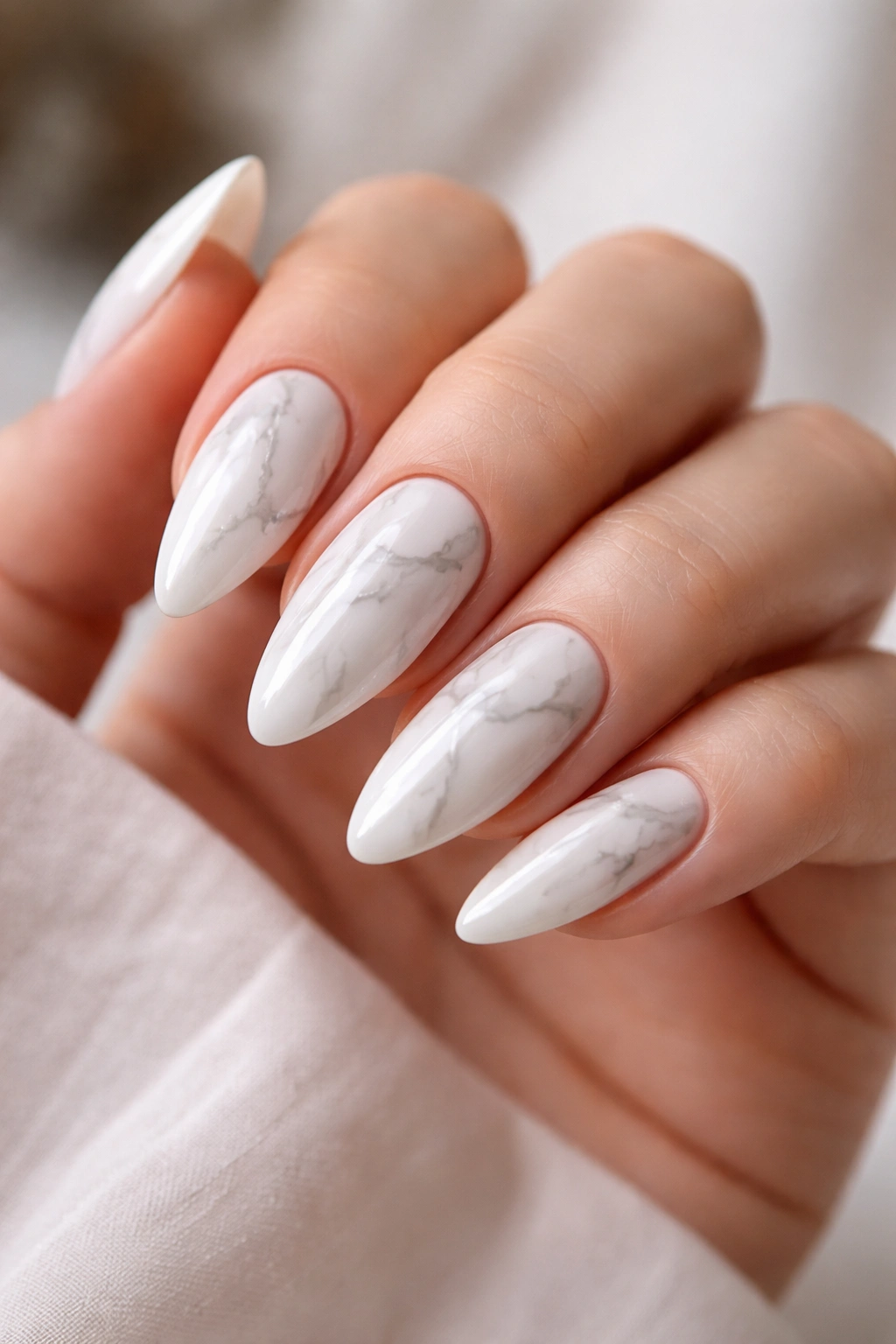
Why does marble look so good on white almond nails? Because the shape gives the veining room to stretch. On a square nail, marble can feel busy fast. On an almond shape, it has more flow.
What the veining should look like
The best white marble is soft, not loud. You want pale gray, a touch of ivory, maybe a few faint smoky lines. Heavy veining makes the nail look like tile. That’s not the mood. The base should stay mostly white or milky, with the marbling used like an accent, not a blanket.
I like marble best on one or two accent nails, with the rest kept solid. That keeps the design from getting too fussy. If all ten nails are marbled, the eye has nowhere to rest and the manicure starts fighting itself.
A glossy topcoat is non-negotiable here. It smooths the layers and gives the marble some depth. Without that shine, the design can flatten out and lose the little cloudy movement that makes it interesting.
13. Tiny Crystal Line Almond Nails
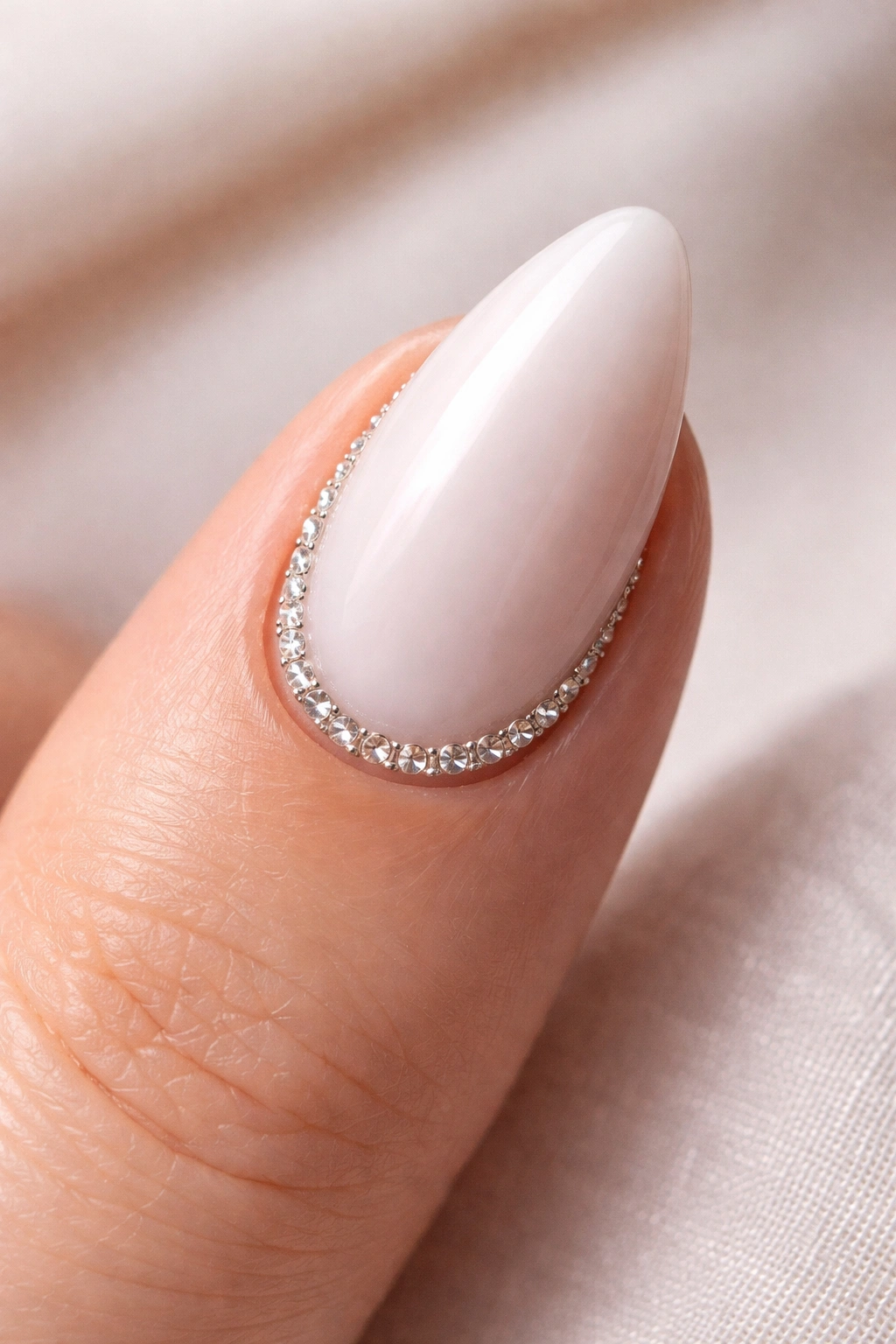
A narrow crystal line can do more for white almond nails than a whole tray of extras. One clean line of stones along the cuticle or down the center of the nail gives just enough sparkle to feel dressed up.
The scale matters. Use tiny crystals, not chunky gems. A stone size around 1.5 to 2 millimeters usually reads refined; bigger stones can drag the design into event-only territory. The white base should stay simple, because the crystals are already doing the talking.
- Place the line on one or two accent nails if you want it understated
- Keep the crystals evenly spaced so the eye doesn’t snag
- Use a clear gel or strong adhesive so they stay flat
- Stop before the tip if you want the shape to stay sleek
This is a good option when you want your manicure to pick up ring sparkle without competing with it. Too many stones, and the hand starts looking busy. One clean row, though, feels considered.
14. Sheer White Jelly Almond Nails
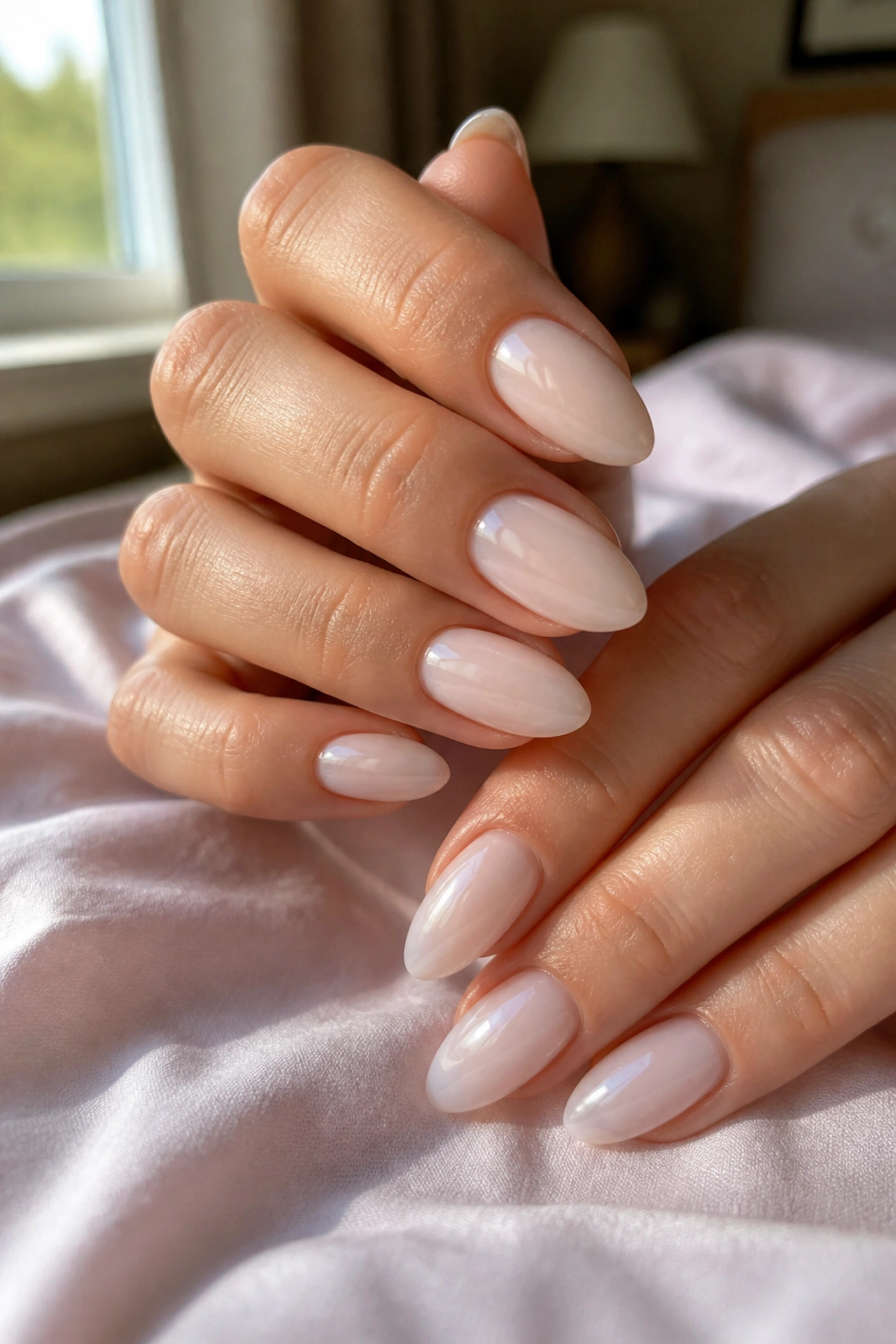
Sheer white jelly nails are for people who like the idea of white but don’t want the weight of opacity. The finish looks softer, almost cloudy, with a hint of translucence that keeps the nail from feeling heavy.
There’s something useful about that lightness. Jelly white is flattering on shorter almond nails because it doesn’t overwhelm the nail bed. It also grows out more softly than a solid cream white, which means fewer harsh lines if you wear the manicure for a couple of weeks.
The best versions use one to two thin coats. More than that and the transparency disappears. You want the nail to look like it has air in it. That’s the whole appeal. If the base underneath is a flattering nude, the final look feels smooth and a little glossy, like frosted glass.
This is the style I’d recommend to anyone who says white polish feels “too much” on them. It’s a good compromise. Quiet, but not dull.
15. White Tortoiseshell Accent Nails
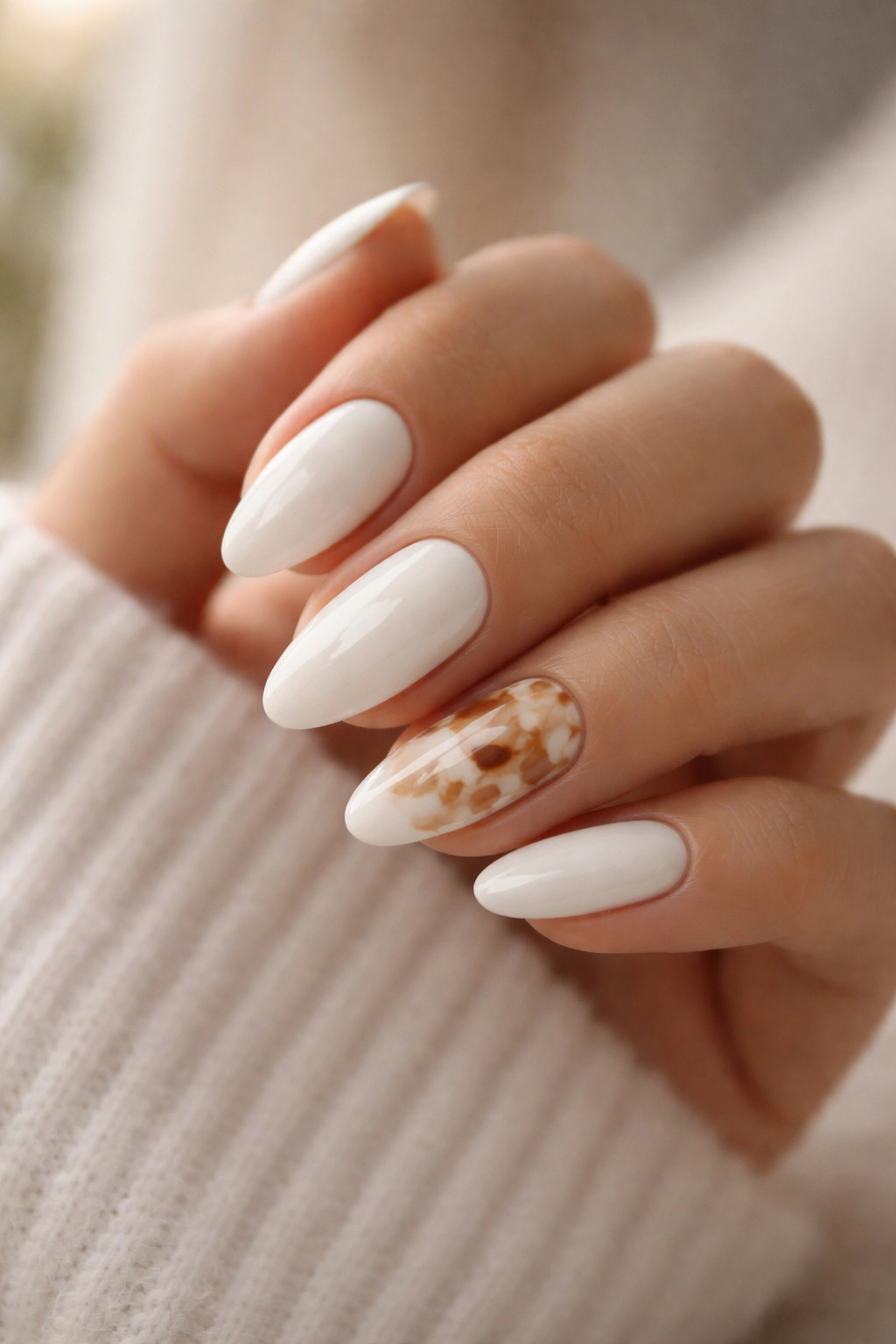
White tortoiseshell sounds odd until you see it in person. Then it makes sense. The warm amber-brown swirls against a white base give the manicure some depth, but the palette stays soft enough to read elegant instead of loud.
Use this design on one or two accent nails, not every finger. That keeps the effect refined. A full set of tortoiseshell can look rich, but it also pulls attention away from the white almond shape itself. One or two nails is the sweet spot.
Compared with classic brown tortoiseshell, the white version feels lighter. Less autumn, more polished neutral. It pairs especially well with creamy white nails on the other fingers, since the slight variation keeps the set from looking flat.
If you like warm-toned jewelry, this style is a quiet win. The amber streaks echo gold without matching it too hard, and that makes the whole hand feel more intentional.
16. White Almond Nails with 3D Bows
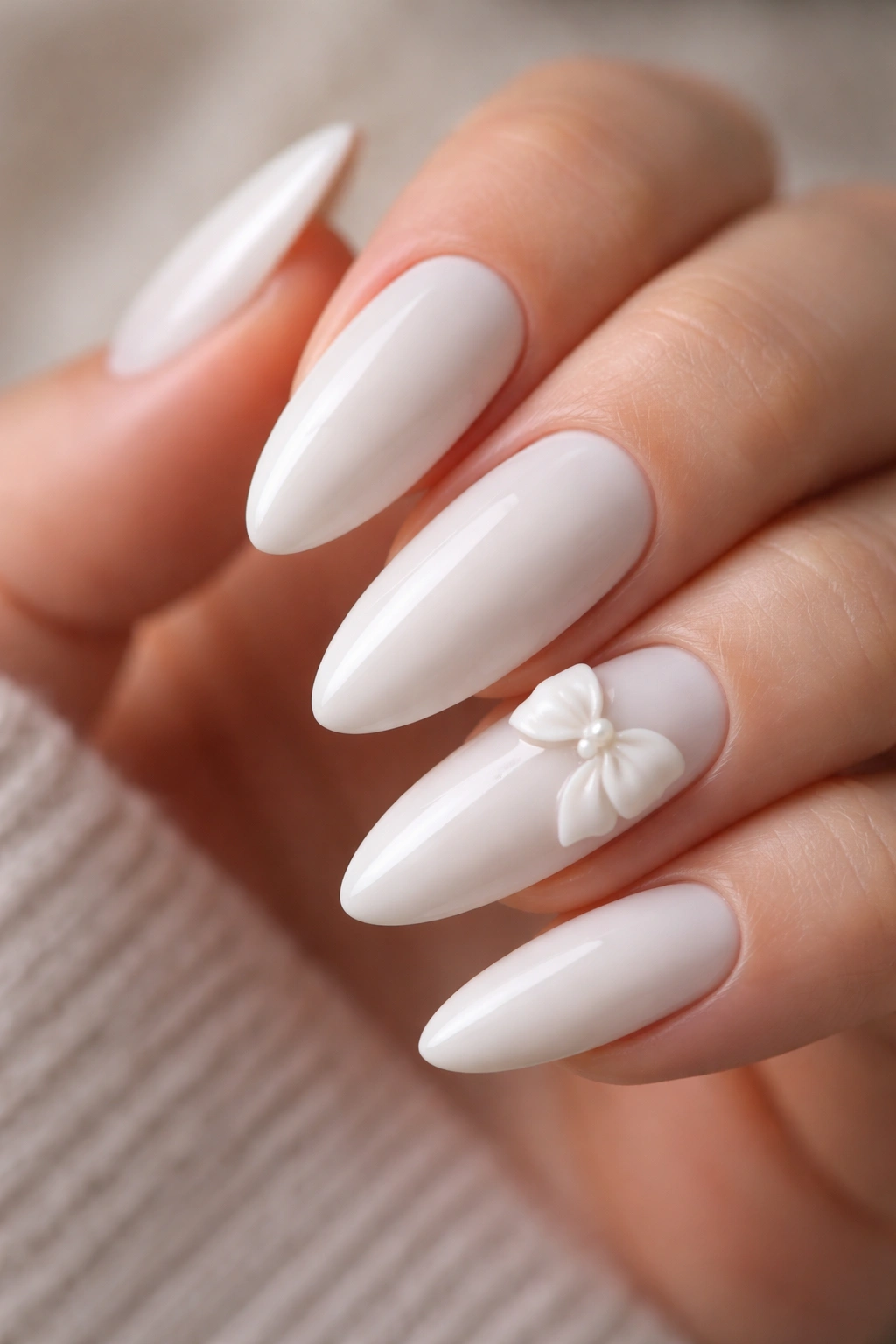
3D bows can go wrong fast. Too large, and the nails look costume-y. Too shiny, and they read toy-like. Kept small and simple, though, they can be charming in a grown-up way.
The best place for a bow is usually one accent nail, maybe two if the rest of the set stays very bare. A bow size around 4 to 6 millimeters is enough on most almond nails. Anything bigger starts to fight the shape. Flat sculpted gel bows tend to look cleaner than stiff plastic pieces, especially if you want the manicure to last.
This style works best when the rest of the nail is calm. A plain milky white base gives the bow room to stand out. Add a glossy topcoat around it, and leave the texture of the bow itself slightly raised so it catches the hand without becoming obnoxious.
I like this look for someone who wants a softer, more romantic version of white almond nails. Not sugary. Just a little sweet.
17. Frosted Glitter Tips
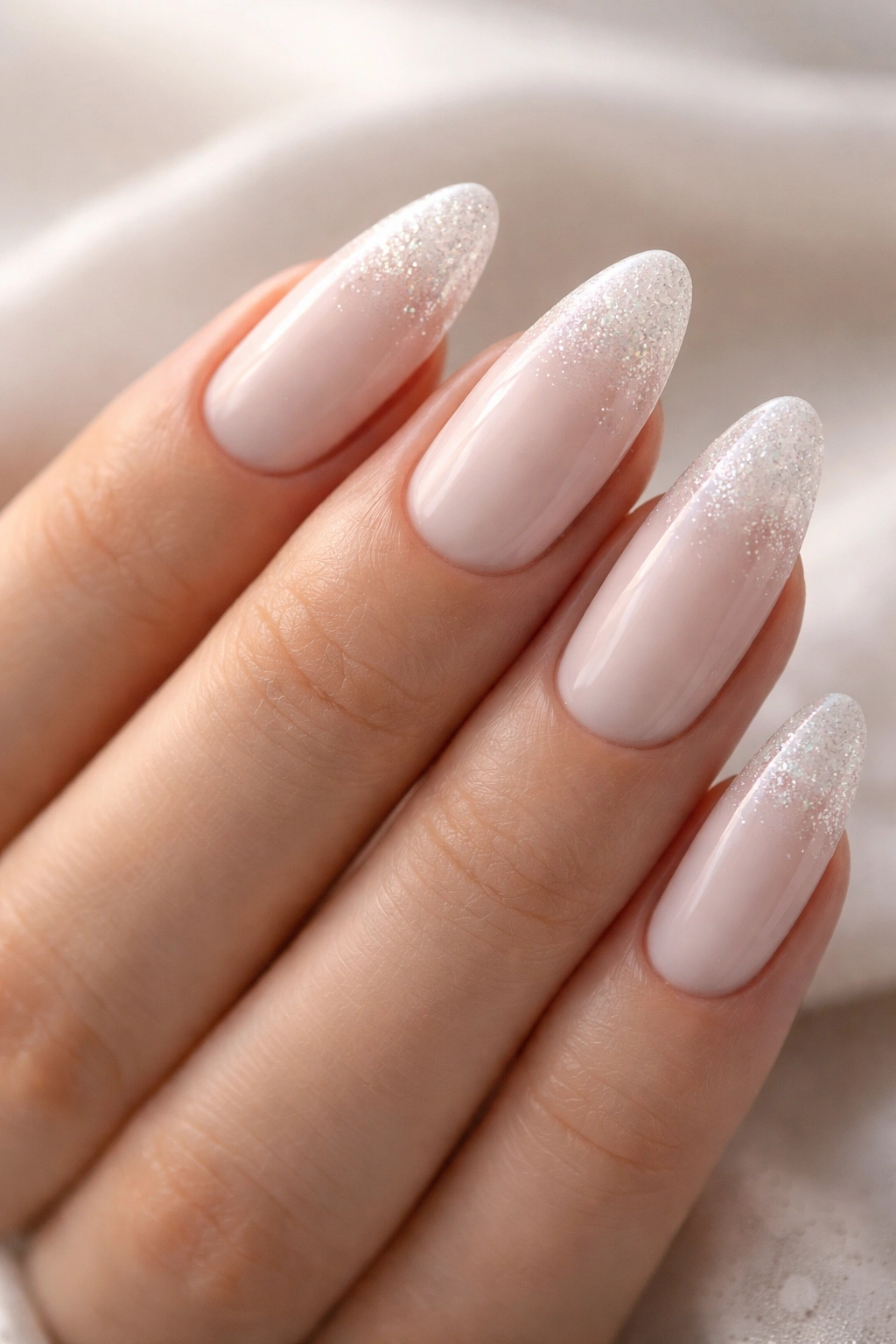
Frosted glitter is one of the few glitter looks that can stay elegant on white nails. The reason is simple: the sparkle stays at the tip, and the rest of the nail stays clean.
Where the sparkle should stop
Keep the glitter fine. Tiny particles, almost snow-like, work better than chunky shimmer. Spread it across the free edge or fade it in from the tip toward the middle, but stop before the glitter takes over half the nail. Past that point, the design loses its restraint.
A sheer white or milky base makes the frost effect stronger. The glitter needs something soft underneath it, or it starts to look disconnected. I also prefer this on longer almonds, where the tip has more space to carry the fade without crowding the nail bed.
This is a nice choice if you want a little shine for evening wear without going full metallic. The set still reads white first. The sparkle is just the extra note.
18. White Nails with Silver Chrome Edges
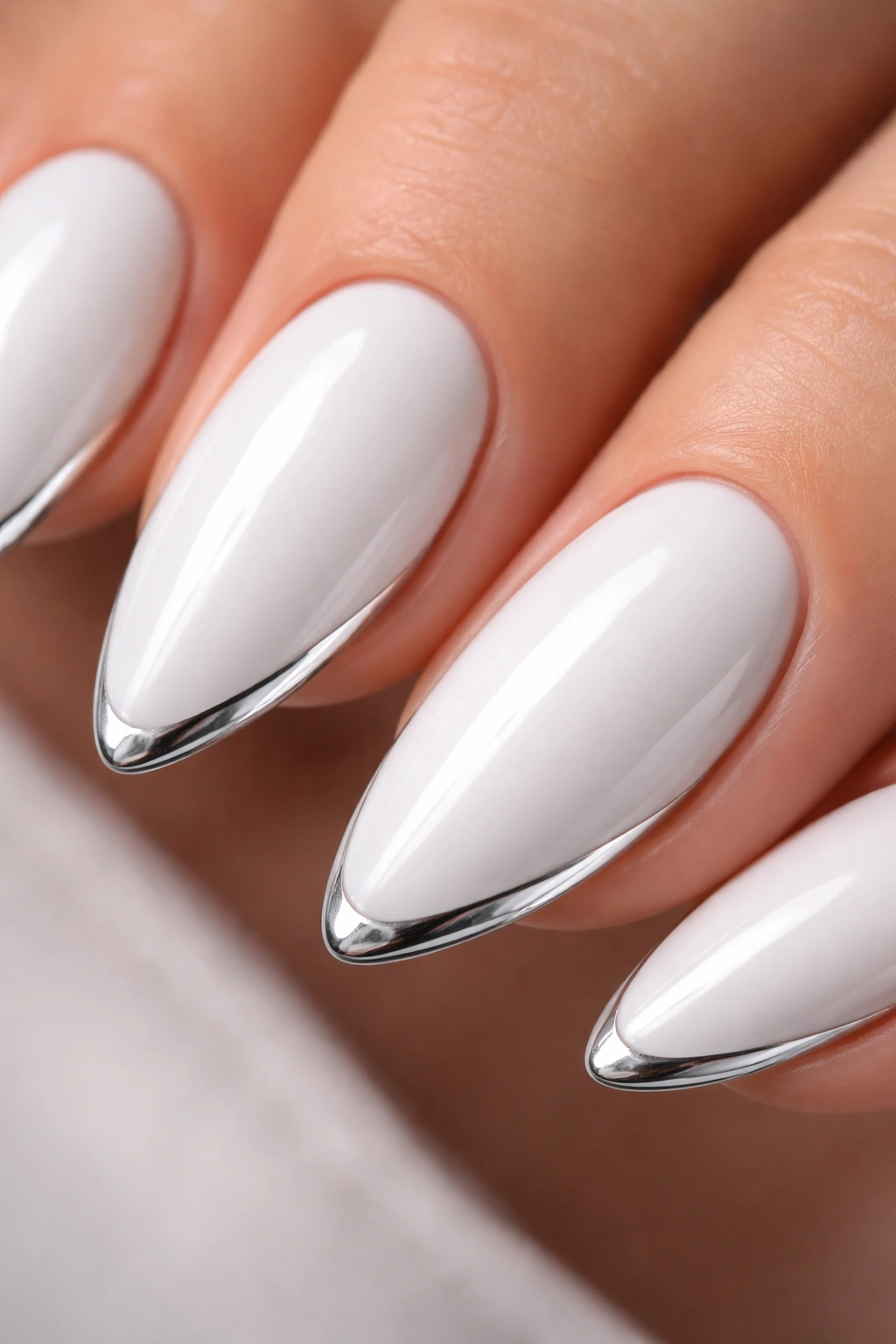
Why outline a white almond nail in silver? Because the edge is where the shape lives. A tiny chrome border makes the taper look sharper without needing extra art.
The line should be thin. Really thin. Something around 0.5 to 1 millimeter is enough for most nail lengths. If the silver border gets too thick, it starts reading costume again, and that ruins the quiet feel that makes this style work. The white base should stay smooth and opaque, while the edge gets that cool metallic trim.
This style is especially good if you like modern jewelry with clean lines. Silver hoops, slim rings, watch bands with a brushed finish—those kinds of details sit well next to this manicure. It has a little architectural feel without looking severe.
A high-gloss topcoat helps lock the border in place and keeps the white from turning flat. Skipping shine here is a mistake.
19. Abstract White Line Art
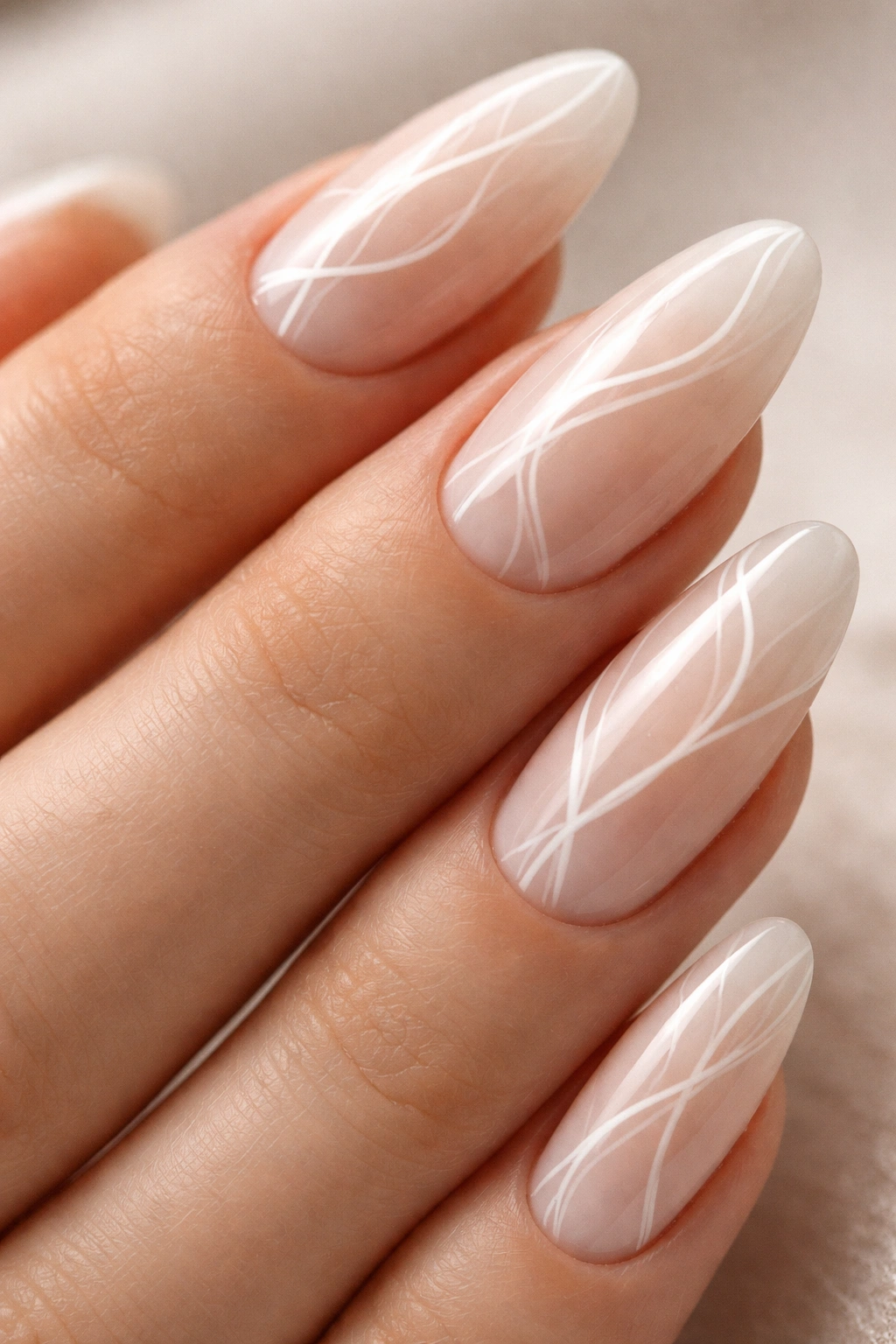
Abstract line art gives white almond nails a more personal feel. Instead of repeating the same pattern on every finger, you get a loose arrangement of curves, arcs, and small line breaks that look hand-drawn.
The base can be nude, milky, or soft pink. I’d avoid opaque white for the background here, because the line work needs contrast. Thin white lines on a clear or sheer base have more breathing room, and that keeps the design from turning busy. A few uneven arcs can be enough. You do not need a full pattern on every nail.
How to keep it from looking random
Pick one visual idea and repeat it in small ways. A curved line near the cuticle on two fingers. A soft diagonal on another. Maybe one nail with a little loop that echoes the almond tip. The repetition is what ties the set together.
This style suits people who like white nails but want something less expected than French tips. It’s still neat. Just less predictable.
20. Bridal-Style White Almond Nails
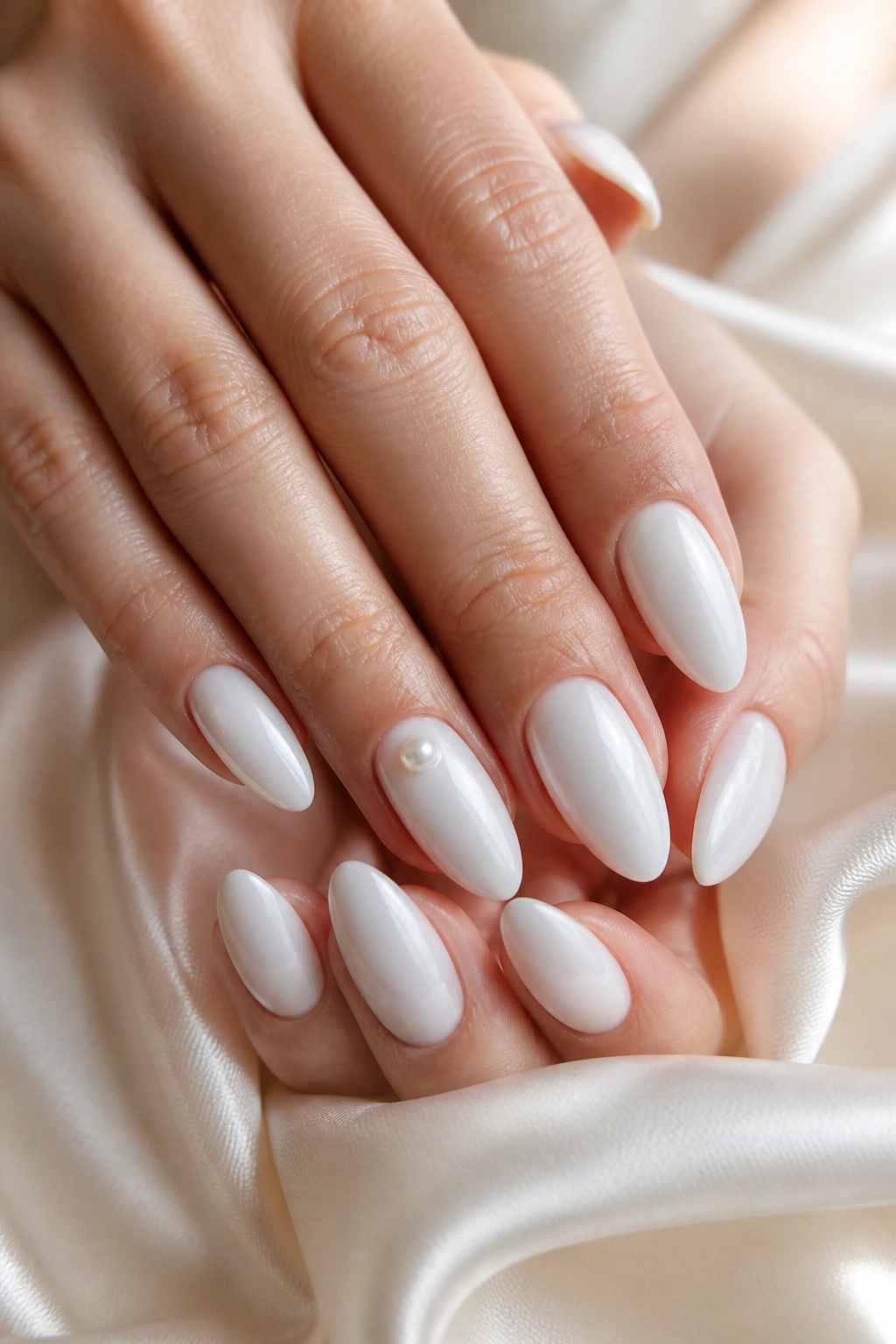
This is the version I’d choose if the goal is one set that behaves well with rings, sleeves, satin, and a whole lot of photos you don’t want to think about too hard. Bridal-style white almond nails work because they stay calm. They can include a milky base, a micro French edge, a faint pearl finish, or one tiny crystal line—but the set should never feel crowded.
The best bridal white is soft enough to flatter skin tone and bright enough to hold its shape next to a dress. That usually means no harsh blue-white polish and no thick opaque block unless the design has a very clean reason for it. A slightly creamy white nearly always looks kinder on the hand.
If I were building this set, I’d keep the thumb and index finger plain, use one accent nail for a pearl detail or crystal trail, and leave the rest smooth. That gives the manicure a little ceremony without turning it into a decoration contest. The almond shape already brings elegance. You do not need to pile on more.
And honestly, that’s the whole charm of white almond nails when they’re done well: they can be barely-there or dressed up, but they always look like someone made a decision on purpose.