


Sage green coffin nails solve a styling problem that a lot of manicure shades never quite manage to fix. They have color, but they do not shout. They look polished, a little moody, a little soft, and on a coffin shape they carry that clean, tapered finish that makes even a simple manicure look more thought-through.
I keep coming back to this color family because it sits in a sweet spot between nude and statement. Black can feel hard. Baby pink can disappear. Bright green asks for a certain mood and outfit. Sage green nails give you enough color to feel intentional, while the dusty gray-green base keeps them wearable with denim, gold rings, cream knits, tailoring, and almost any neutral in your closet.
The shape matters too. Coffin nails have more visual length than squoval or rounded tips, and that extra space changes how sage reads. A milky sage looks airier on a tapered tip. A dark eucalyptus shade looks richer. Even tiny details—one line of foil, a sheer marble vein, a micro-French edge—show up better because the nail has a flat edge and longer side walls. If you’ve ever picked a shade in the salon that looked flat once it hit your hands, you already know what I mean.
Not every sage manicure lands the same way, though. Undertone, finish, nail length, and accent placement can push the look toward clean minimalism, soft botanical, glossy editorial, or full-on art set. A few of these ideas are low-commitment and easy to wear for two weeks. A few are for the days when you want someone to grab your hand and ask where you got them done.
Why Sage Green and Coffin Nails Work So Well Together
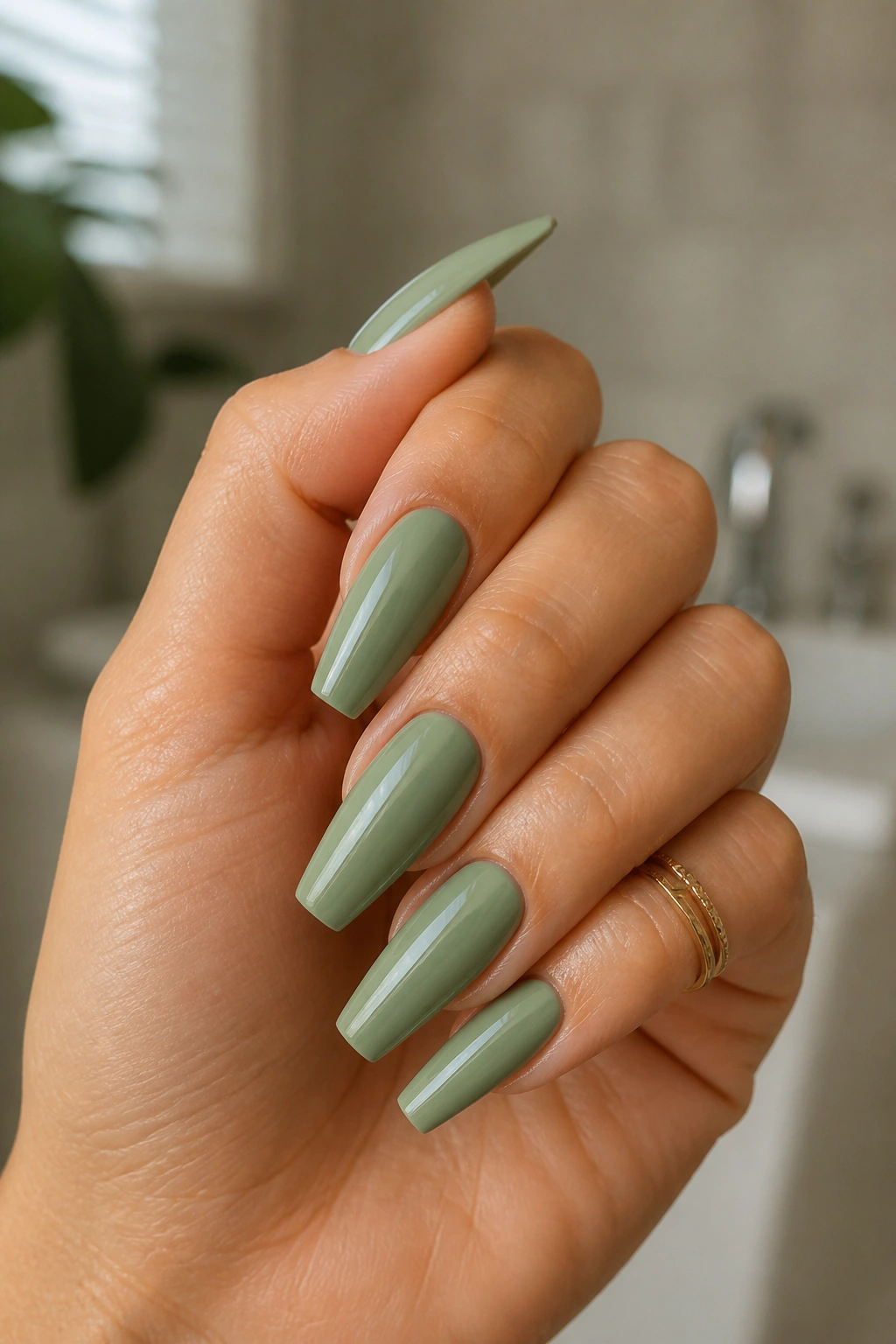
The color softens the shape. Coffin nails have a built-in edge because of their tapered sides and squared-off tip. On their own, they can feel sharp. Sage green takes that bite down a notch and adds a calmer, more balanced look than black, red, or neon ever will.
There’s also a texture trick happening. Muted greens tend to show surface detail better than pale beige but hide chips better than dark espresso or navy. On a coffin nail, where the flat tip can take a little more daily wear, that matters. A tiny edge chip on dusty sage is less obvious than the same chip on glossy black.
Another reason this pairing works: sage plays nicely with both cool and warm accents. Silver chrome, gold foil, ivory linework, tiny white florals, tortoiseshell, marble, and sheer nude bases all sit comfortably next to it. That gives you room to customize without changing the whole mood of the manicure.
And the shade has range. Some versions lean gray and misty. Others move closer to olive, pistachio, eucalyptus, or celadon. You can keep the shape long and dramatic while letting the color feel quiet, or go shorter and use chrome, marble, or negative space to make the set feel more designed.
Picking a Sage Green That Won’t Wash Out Your Hands
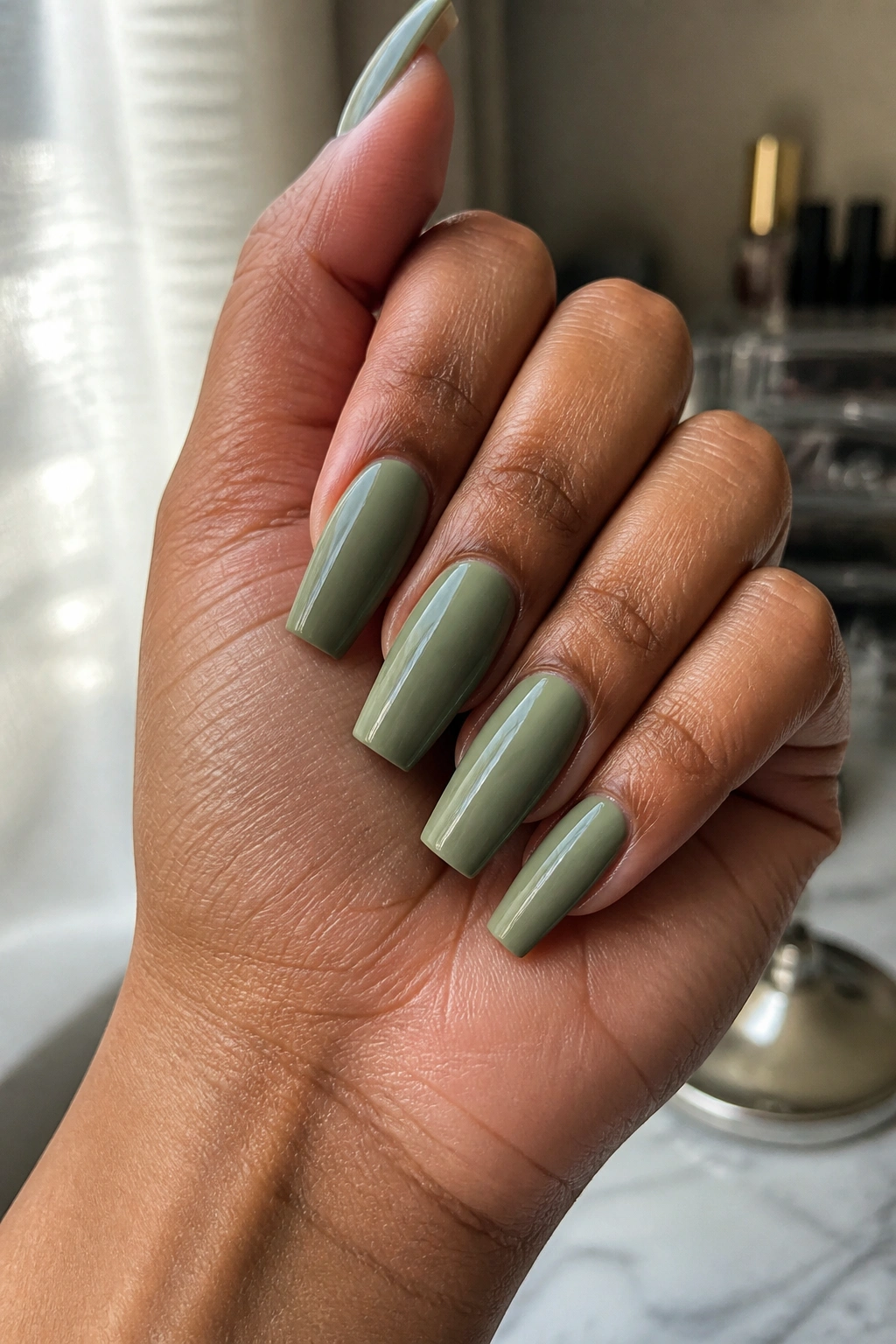
The wrong sage can make your skin look dull. That is the main risk with this color, and it’s worth fixing before the polish ever goes on.
If your skin has warm or golden undertones, choose a sage with a little olive or clay in it rather than a flat gray-green. Think eucalyptus, soft olive, or muted moss. Those shades echo warmth in the skin instead of fighting it.
If your skin leans cool, pink, or neutral, a dusty gray-sage or milky pastel sage usually looks cleaner. These shades tend to make the hands look brighter, especially with a glossy topcoat.
A quick salon test that saves regret
Hold the swatch next to the inside of your wrist, then against the back of your hand. If the shade makes your skin look ashy or yellow in either spot, move one step warmer or one step softer. Swatches on plastic sticks can be misleading—especially under salon lighting, which loves to flatten muted greens.
Undertones that usually work best
- Yellow-leaning sage works well on deeper golden or olive skin.
- Gray-sage looks sharp on fair to medium cool-toned skin.
- Milky sage suits almost everyone because the white mixed into the green softens the contrast.
- Deep forest-sage hybrids look richer on medium to deep skin tones and hold their shape well on longer acrylics.
A small shift in undertone can make the same design look expensive instead of muddy.
Choosing Nail Length, Apex, and Finish Before You Pick a Design
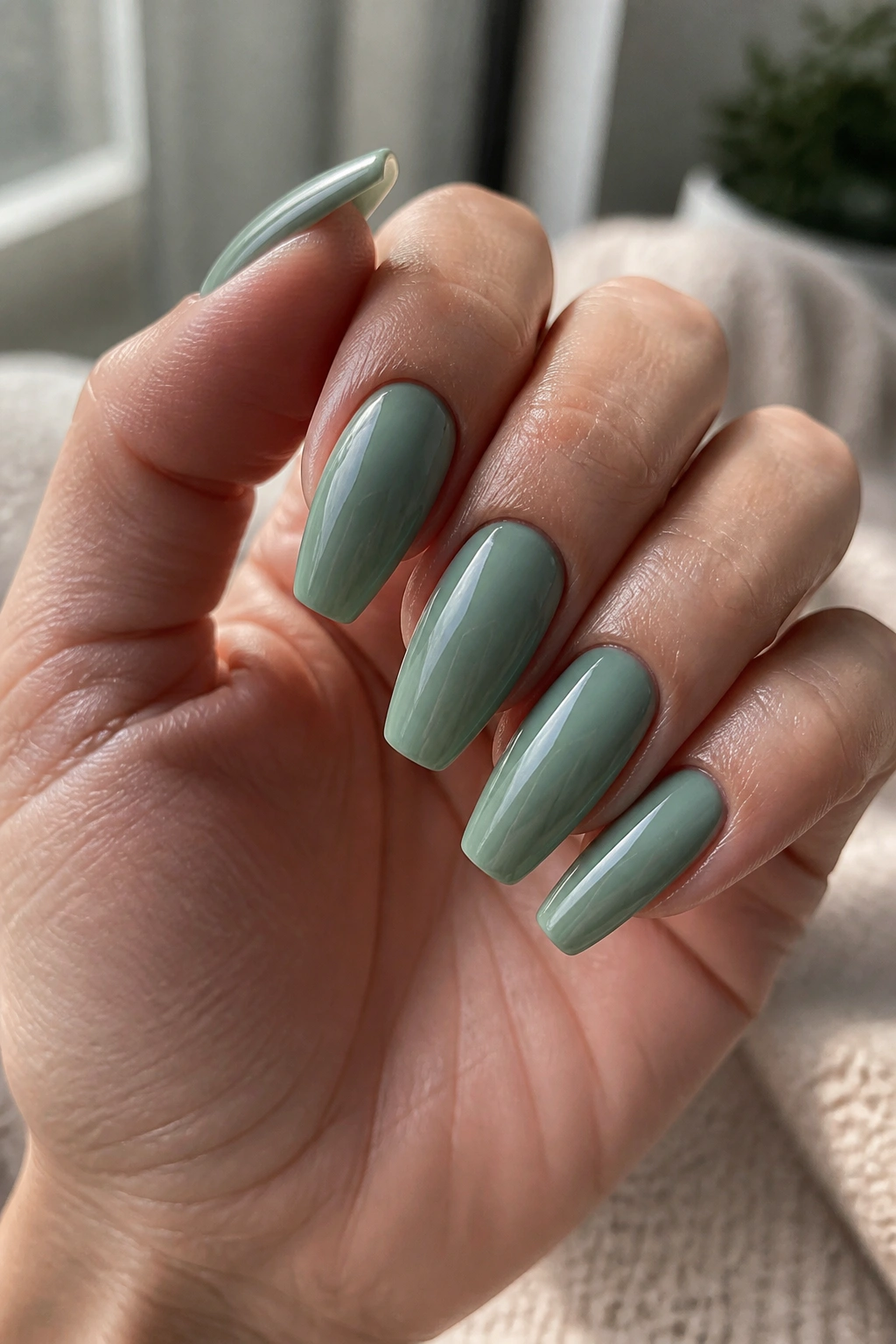
Length changes everything with coffin nails. A medium coffin—usually with about 6 to 10 millimeters of free edge past the fingertip—gives you enough space for art without making daily tasks annoying. Longer than that, and the set gets more dramatic fast.
The apex matters more than most people realize. If you’re doing acrylic or hard gel, ask for a balanced apex placed around the stress area, not a thick, bulky center. Coffin nails need structure because the side taper removes some width. Too flat, and the nail looks cheap. Too thick, and the whole set loses that sleek coffin line.
Finish is the mood switch.
- Glossy topcoat makes sage look cleaner, fresher, and a touch brighter.
- Matte topcoat pulls out the gray tones and gives the color a softer, velvety feel.
- Chrome or pearl finish can push sage into a cooler, more reflective look.
- Jelly or sheer finishes feel lighter and more modern than full-opacity cream shades.
If you already know you want gold jewelry, a warmer sage helps. If you wear more silver and black, cooler dusty sage often looks better. Tiny decision. Big difference.
1. Full-Coverage Glossy Sage Green Coffin Nails
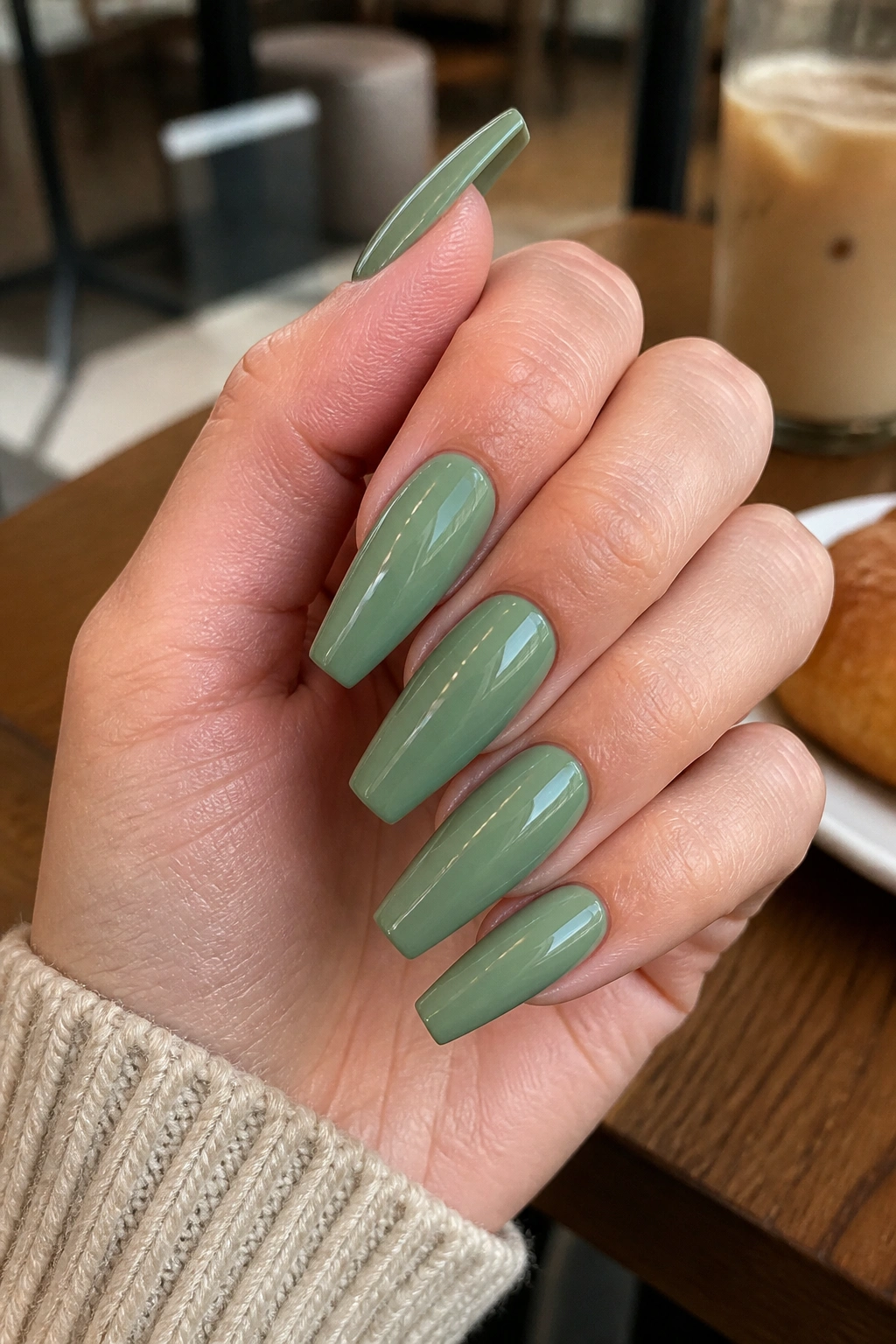
Start with the cleanest version first: a solid sage green manicure with a high-gloss topcoat. No accent nails. No stones. No line art trying to prove anything. On a coffin shape, this is enough.
The reason it works is simple. The shape gives structure, and the glossy sage gives depth without clutter. You get a manicure that looks deliberate from across the room and still holds up when you’re typing, holding a coffee cup, or scrolling in bad overhead light—the true test of any polish shade.
Why it works so well
A full-coverage cream color shows off the coffin silhouette better than a busy art set sometimes does. The tapered sides look cleaner. The straight tip reads sharper. And because sage has gray in it, the manicure does not feel sugary or loud the way pastel mint can.
Quick details to ask for
- Choose a two-coat cream formula rather than a streaky sheer polish.
- Ask for a glass-like topcoat if you want the color to read richer.
- Keep the length medium if you want a low-maintenance set that still looks polished.
- File the side walls straight before tapering—this keeps the coffin shape crisp.
Best pick if you want one color that still feels styled.
2. Milky Sage Green With a Soft, Cloudy Finish
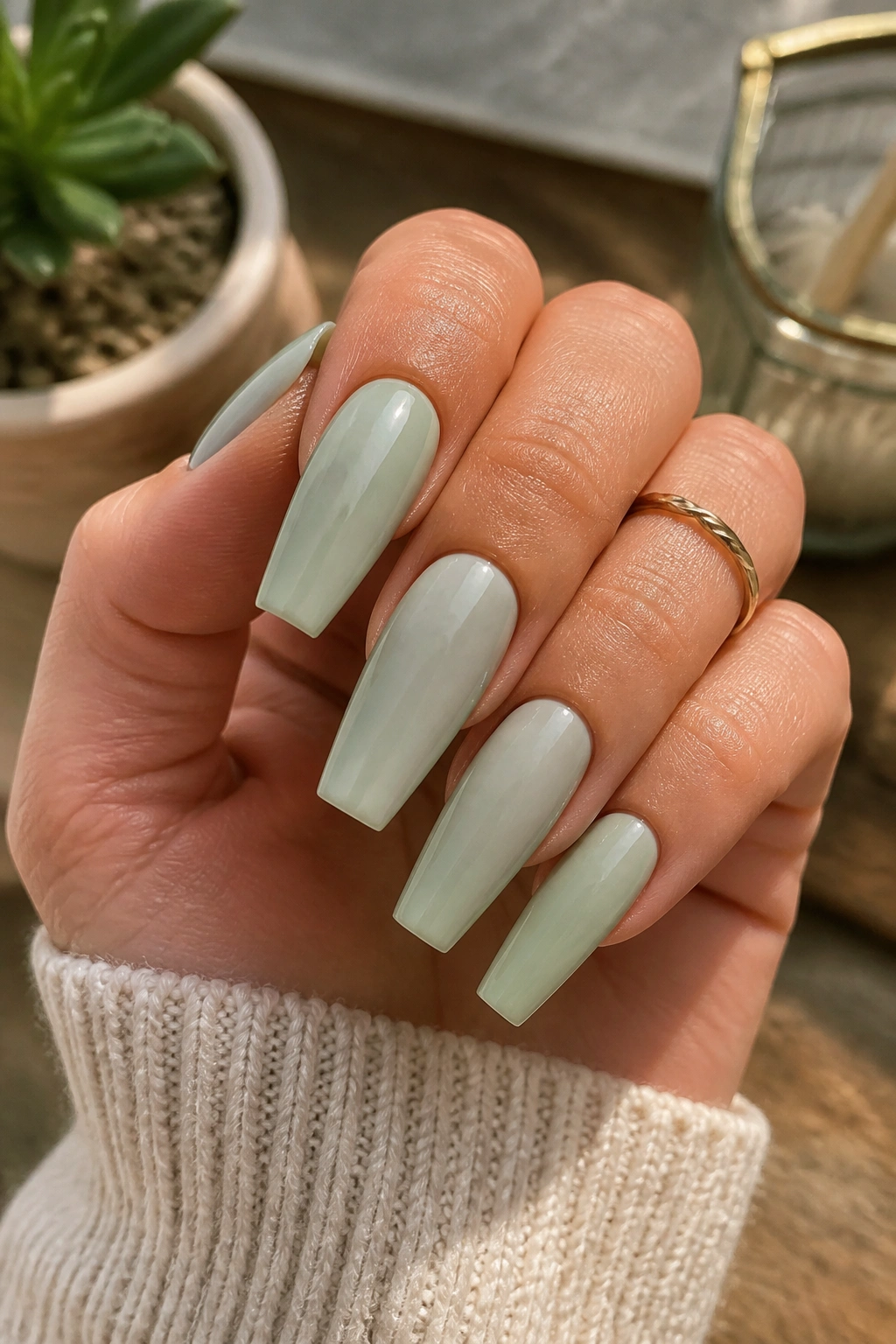
If solid sage feels a touch too direct, go milky. This is the version I recommend to people who like minimalist nails but want something more interesting than beige or pale pink. A milky sage has white mixed into the green, which gives it that blurred, almost creamy look—less opaque than a full cream, more polished than a sheer wash.
On coffin nails, that softness is useful. The shape already has a strong outline, so a cloudy color keeps the set from feeling harsh. It also makes regrowth less obvious. That matters if you like to stretch a manicure closer to the two-and-a-half-week mark instead of running back to the salon at the first sign of growth.
This shade is also forgiving under different lighting. Some greens turn murky indoors and too yellow in daylight. Milky sage tends to stay balanced. It reads fresh under natural light and still looks flattering in the dim, shadowy lighting where a lot of phone photos happen.
There is one catch. If the formula is too sheer, the free edge can peek through in a patchy way, especially on longer nails. Ask for two thin coats and one floated leveling coat if you’re using gel. You want cloudy, not streaked.
Gold rings look especially good with this one, and so do cream sweaters, soft gray tailoring, and anything linen-like. It has that clean, almost ceramic feel that makes hands look well kept without looking overdone.
3. Matte Sage Green With a Velvet Surface
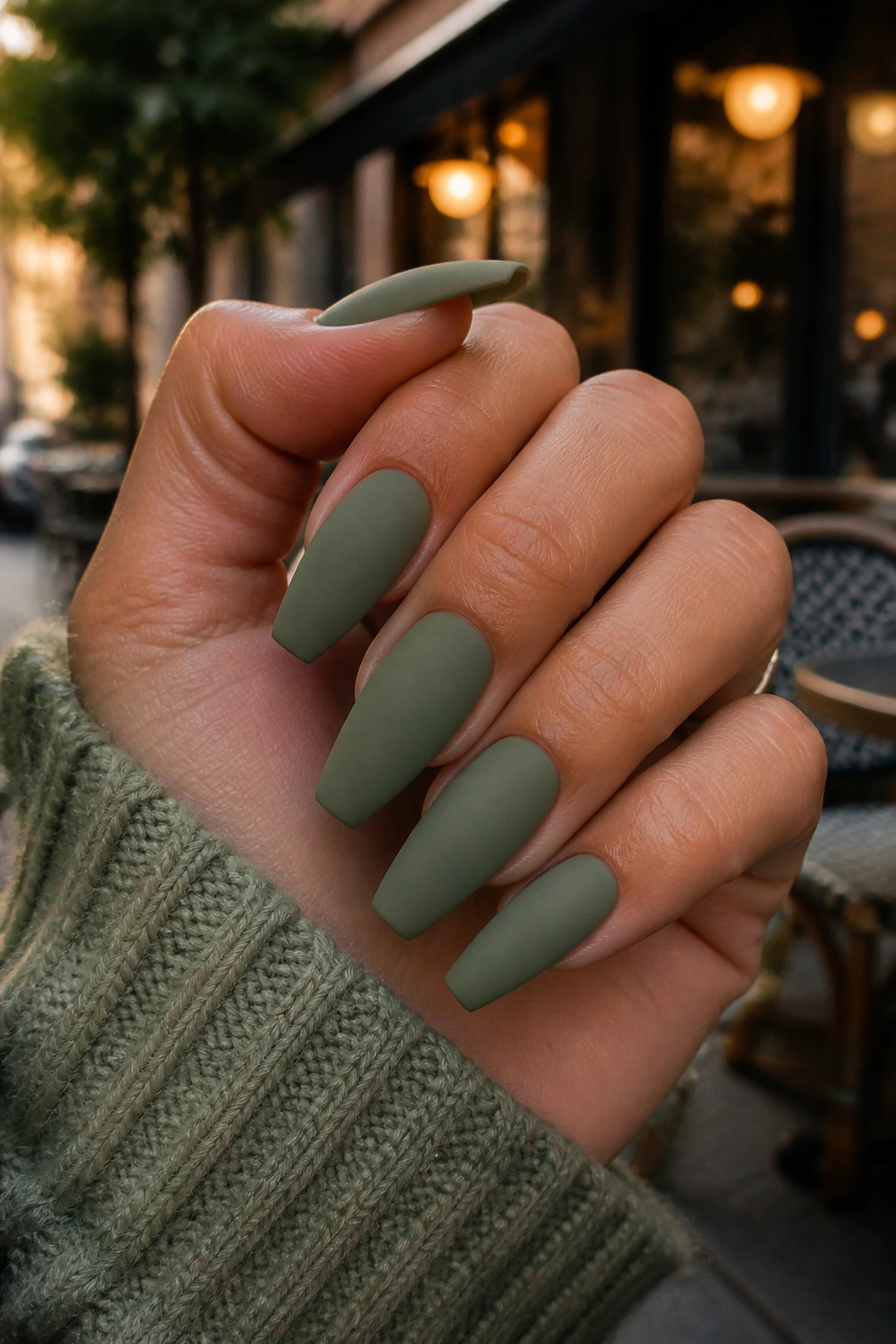
Matte sage looks better on coffin nails than on almost any other shape. There, I said it.
Round nails can make matte polish feel flat. Coffin nails give it architecture. The tapered sides and squared edge catch enough light and shadow to keep the finish interesting, even without shine. The result feels quieter, moodier, and a little more fashion-forward than a glossy set.
A true matte topcoat pulls out the gray in sage. A velvet matte—slightly smoother, less chalky—keeps the color richer and helps prevent that dry, dusty look some matte manicures get after a few days of hand cream and friction. If you go this route, ask your nail tech which matte topcoat they trust, because cheap formulas can scuff fast.
This design is strongest when the prep is clean. Any unevenness in the nail surface shows more under matte. So does cuticle dryness. If your sidewalls are rough or the apex is lumpy, matte will tell on you immediately.
Wear it when you want your nails to feel styled but not flashy. It pairs well with silver jewelry, black coats, chunky knits, and soft suede textures. And if you get bored halfway through your set, a glossy topcoat over the same color can change the whole mood in under ten minutes.
4. Sage Green French Tips on a Nude Coffin Base
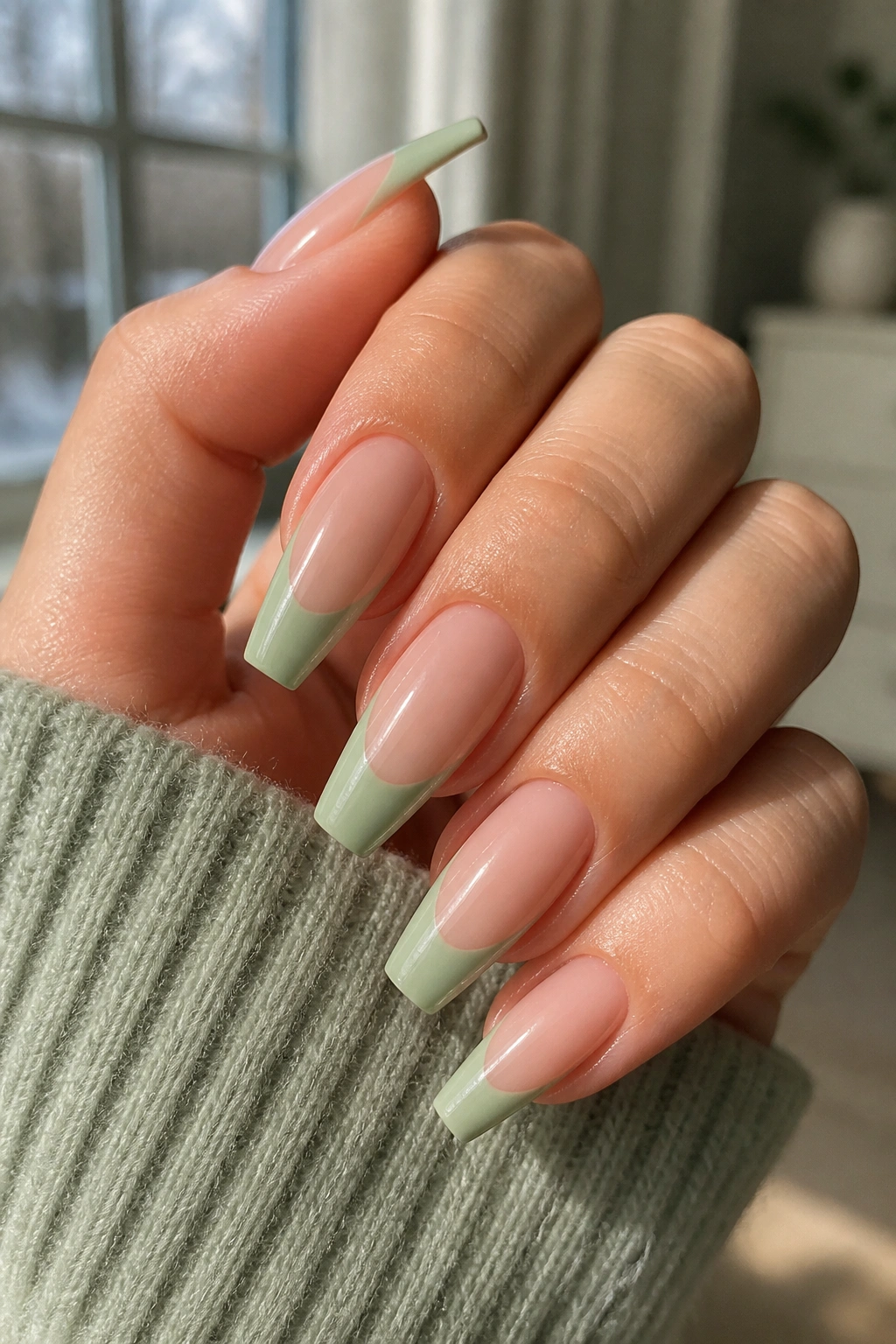
Why does this version stay popular? Because it gives you the color hit of sage green coffin nails without covering the whole nail, which means the shape looks lighter and the grow-out looks cleaner.
A nude or sheer pink base with sage French tips is one of the easiest ways to wear green if you are not ready for full-color nails. The coffin shape makes the tip line look crisp because the edge is straighter than it is on almond nails. That gives the whole manicure more graphic definition.
What to ask your nail tech for
Ask for a soft pink-beige base that matches your nail bed rather than a chalky nude. Then choose a French tip thickness based on length. On medium coffin nails, a tip around 2 to 3 millimeters deep usually looks balanced. If the tip is too thick, the nail starts to look shorter and heavier.
You can keep the smile line classic and curved, or make it flatter and more modern. I prefer a slightly flatter arc on coffin nails because it mirrors the squared edge without looking stiff.
A small detail that changes the whole set
Add a fine glossy topcoat even if the base is sheer. That little bit of shine makes the nude base look smoother and gives the green more contrast. Skip chunky gems here. The appeal is the clean line and open space.
This is the manicure I’d choose for someone who wants color at work but still needs it to feel tidy, not loud.
5. Double French Lines in Sage and Cream
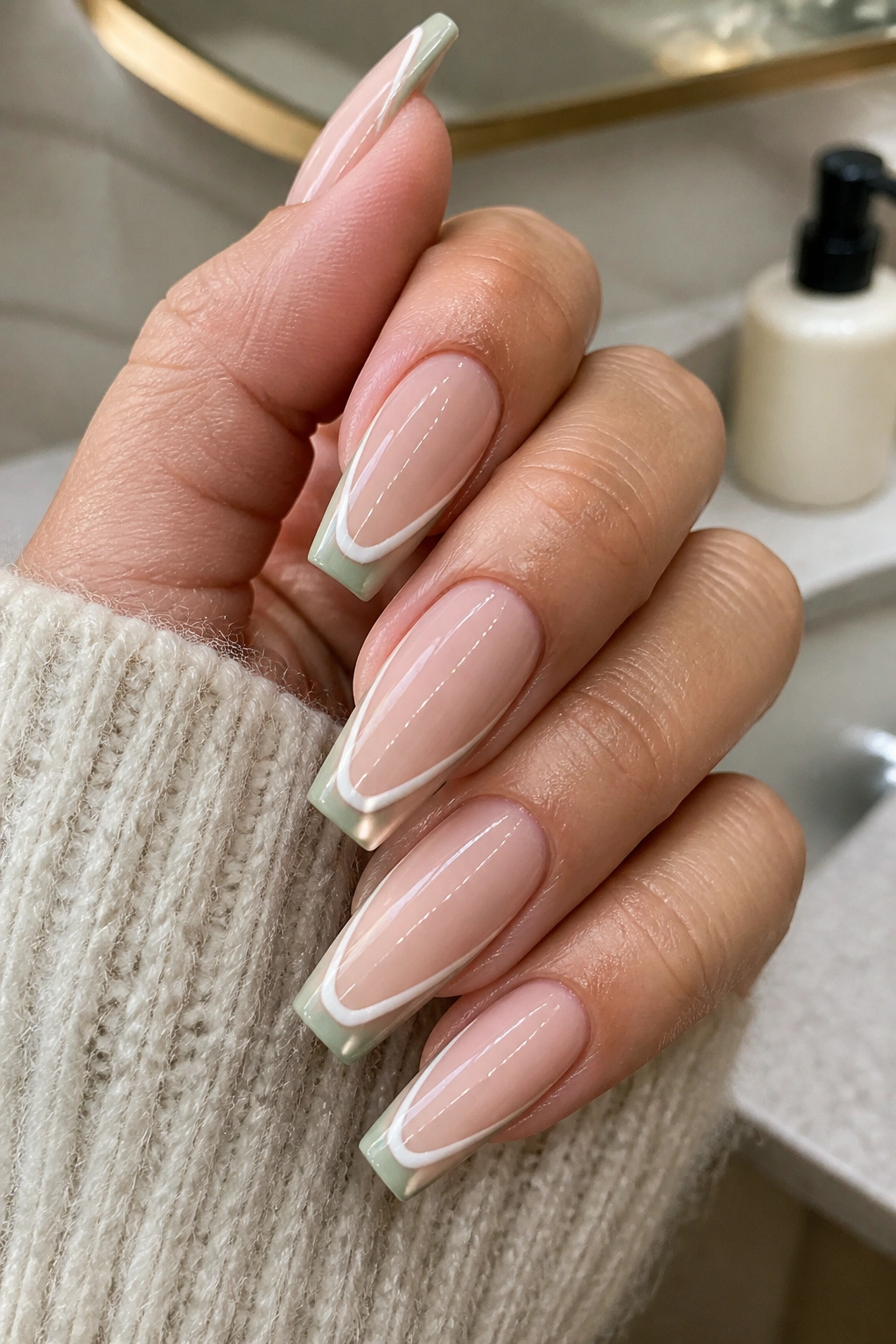
A single French tip is polished. A double French has more personality.
Picture a nude base, a slim sage tip line, and just above it a second whisper-thin cream or ivory line. On coffin nails, those parallel lines emphasize the flat edge in a way that feels sharp but not severe. It’s one of those designs that looks more custom the closer you get.
I like this style because it gives you contrast without crowding the nail. A lot of detailed art starts to fight with the coffin shape. Double French lines work with it instead. You still see the taper, the free edge, the length.
Keep the proportions tight
- Make the sage line the main line.
- Keep the cream line about 1 millimeter or less.
- Leave a sliver of nude between the two lines so they don’t blur together.
- Choose a sheer base with enough pink to keep the nails from looking flat.
The cream matters. Bright white can look too stark against muted sage. Ivory, off-white, or warm milk tones feel softer and richer.
This set also grows out well because the art sits at the tip, not the cuticle. That alone makes it easier to wear for a full two to three weeks without staring at your regrowth every time you check your phone.
6. Gold Foil Over a Soft Sage Base
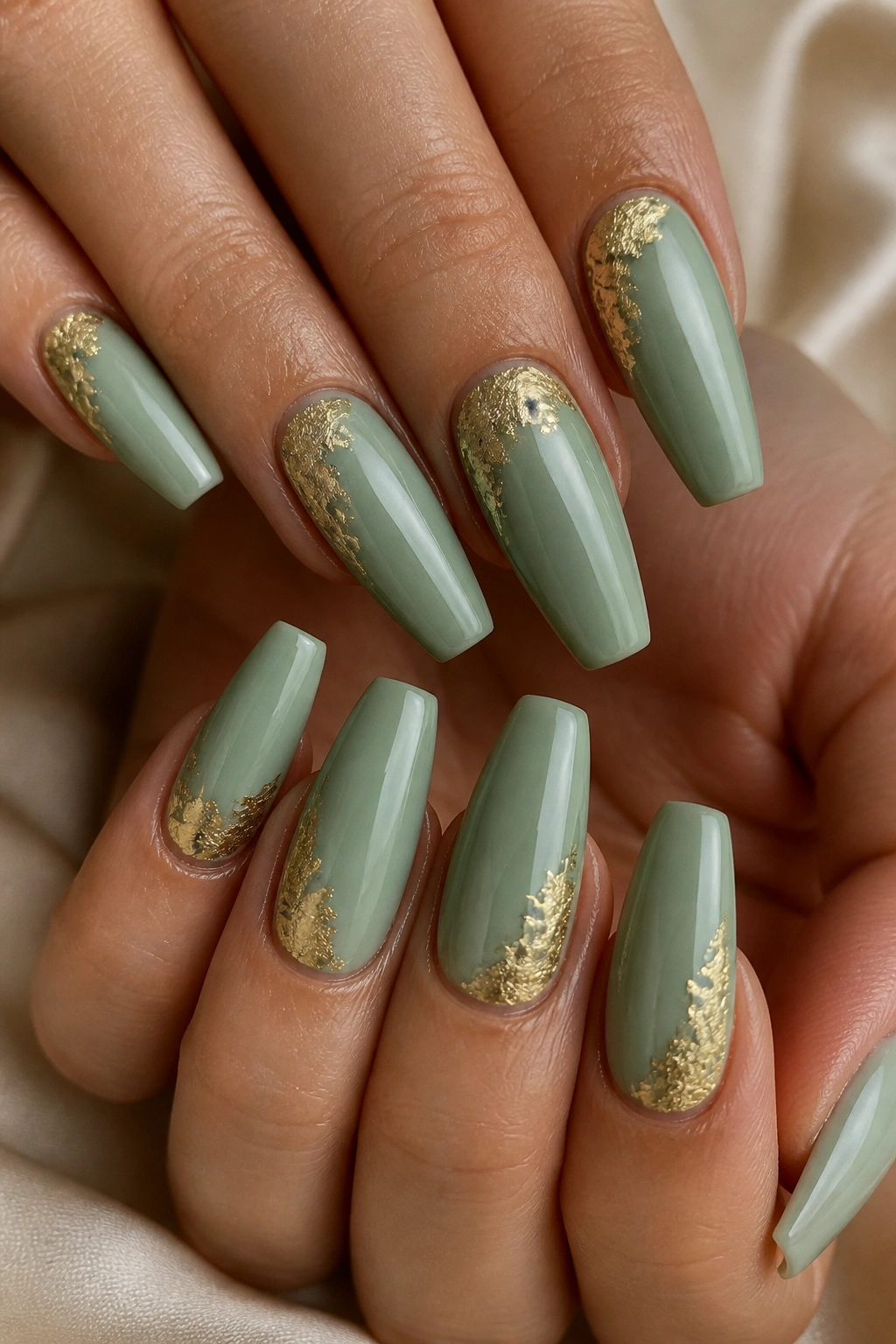
There are nail designs that look pretty on a swatch and messy on a hand. Gold foil on sage is not one of them—if the placement is controlled.
The trick is restraint. You want a soft sage base, glossy finish, and small pieces of irregular gold foil placed near the cuticle, along one sidewall, or scattered across one or two accent nails. Too much foil and the manicure starts to look busy. Too little and it feels accidental.
Why this combo works
Sage already has an earthy cast to it, so gold reads warm and natural against it rather than flashy. The foil catches light in little broken flashes, which gives muted green a lift. Coffin nails help because they give the foil room to sit flat without bunching at the edges.
Placement ideas worth asking for
- One foil-framed accent nail on each hand
- A cuticle crescent of tiny foil flakes
- Gold pressed into a marble or milky sage accent
- One diagonal foil line across the ring finger only
If you wear gold jewelry most days, this design ties in beautifully without matching in a rigid way. The look is especially good on medium to long acrylics with a smooth apex and a glossy, non-wrinkled topcoat. Foil will expose a lumpy surface fast.
Ask for encapsulation if you want the foil to stay glass-smooth. A foil piece sticking up at day five is enough to ruin the mood.
7. Swirled Sage Marble With White Veining
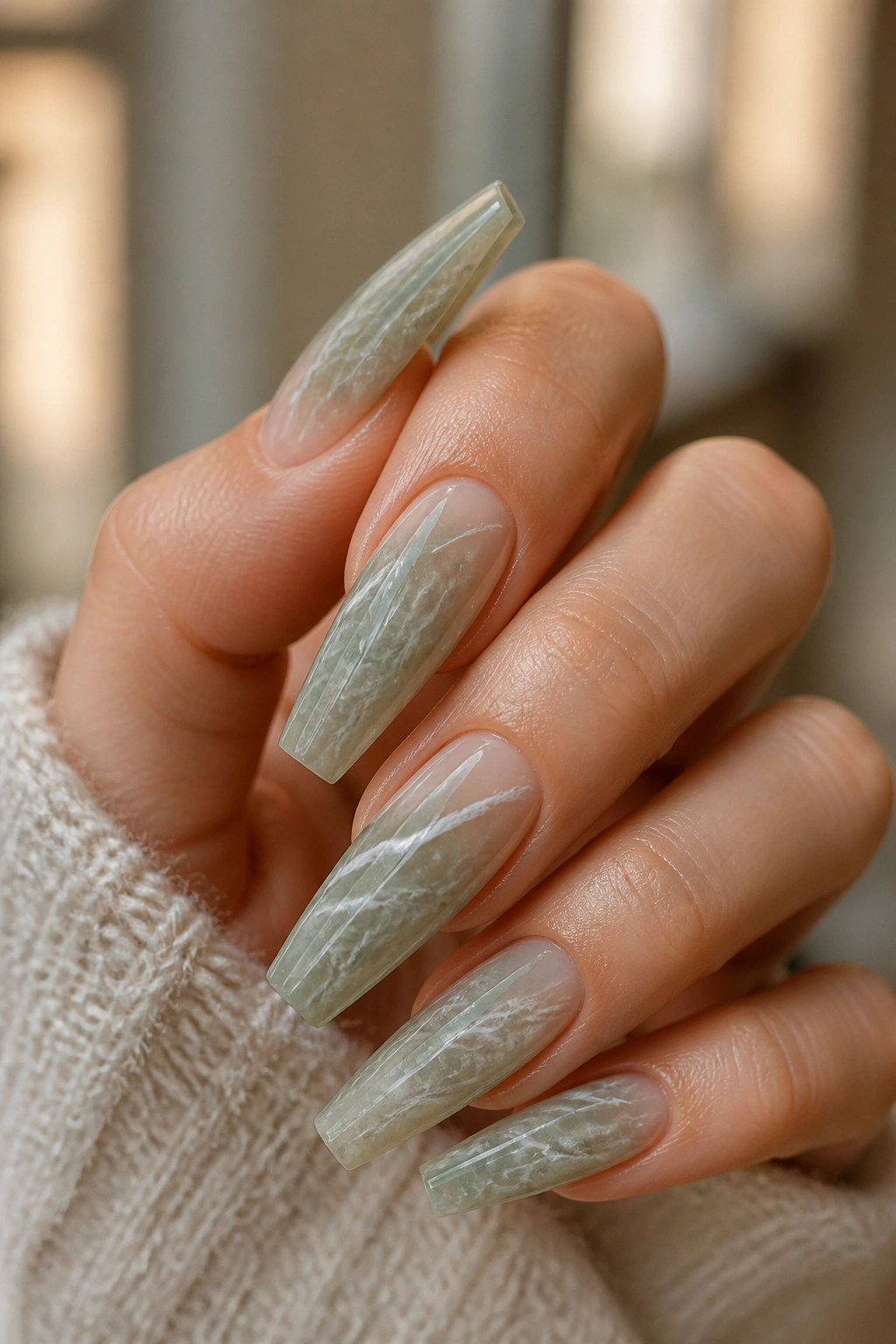
Marble can go wrong in a hurry. The bad versions look muddy, overmixed, and thick. The good versions have movement—soft ribbons of color, a little contrast, and enough negative space for the pattern to breathe.
On coffin nails, a sage marble with thin white veining and a touch of translucent nude looks elegant because the longer shape gives the swirl room to stretch. It feels less cramped than it does on short square nails. I’d use this either on every nail if you love nail art, or on two accent nails per hand with solid sage on the others.
The best marble sets are never too symmetrical. One nail might have a diagonal drift of green and white, another a softer cloud near the side. That unevenness is what makes it look hand-done in a good way, not mass-produced. You want the polish to blur at the edges a little, not form hard stripes.
Color balance matters. Keep the white fine and wispy. Add too much, and the set turns minty. Add a dark olive line, and it can get heavy fast. A milky base under the swirl helps keep the palette soft.
This is also one of the best ways to combine sage green coffin nails with bridal or event styling without falling into glitter territory. It has detail. It has movement. It still looks grown-up.
8. Olive-to-Sage Ombré Coffin Nails
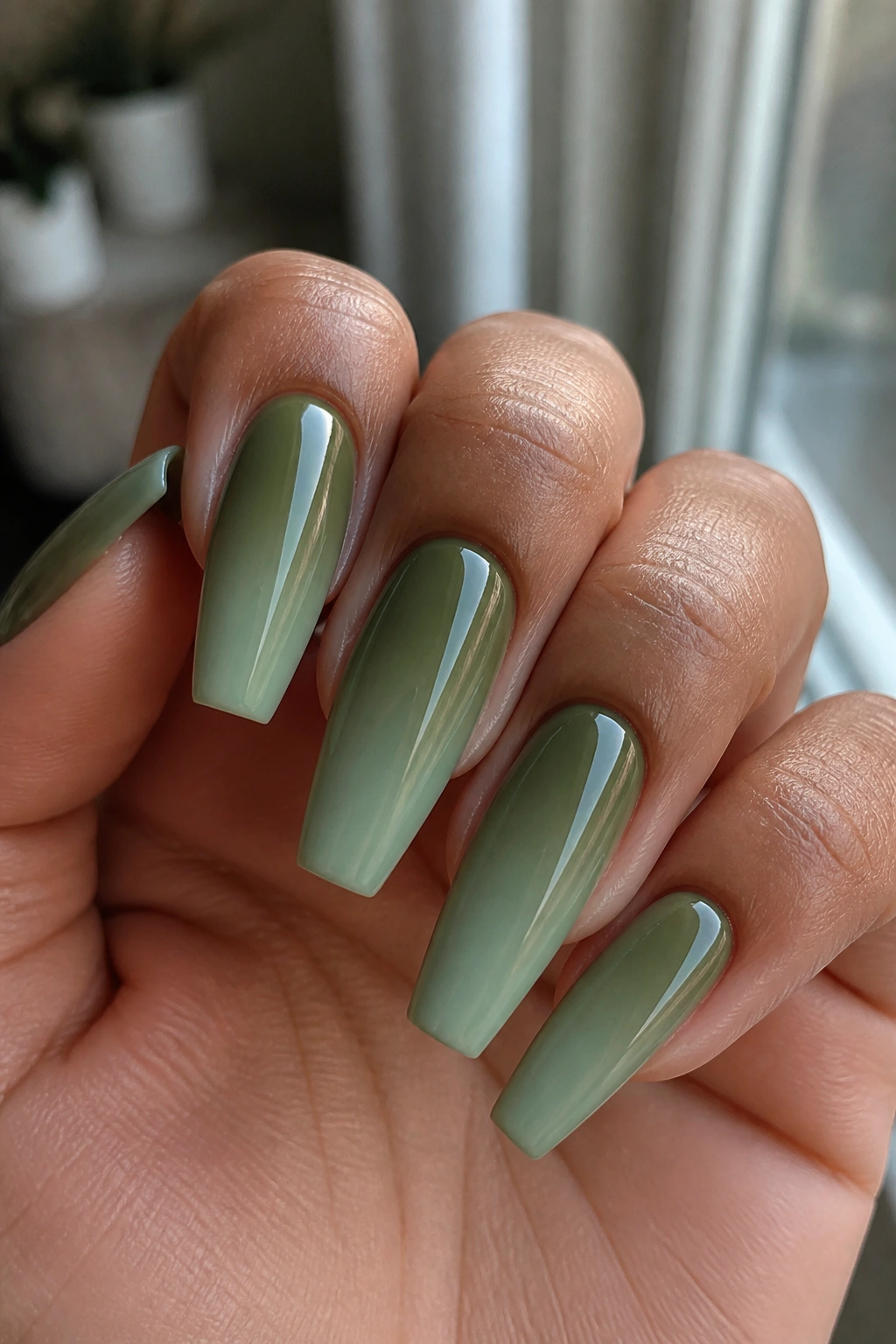
Unlike a standard single-color set, an ombré gives sage more depth and stops the manicure from reading flat under indoor light. The fade from a deeper olive at the cuticle into a softer sage or milky green at the tip adds dimension without needing line art, crystals, or decals.
That gradient suits coffin nails because the eye already follows the tapered shape outward. A vertical color fade strengthens that effect. Hands look longer. The nail shape looks more sculpted. The color story feels richer than one-note sage.
Who is this best for? Someone who likes muted colors but gets bored with flat cream finishes. It also works well on longer sets because the extra length gives the blend room to happen. On a short coffin, the fade can look abrupt unless your nail tech has a light hand.
Ask for an airbrushed blend or a sponge blend sealed under gel. A hard stripe down the center kills the look. You want a misted fade where one shade melts into the next.
The pairing I like most is deep olive near the base and a pale gray-sage toward the tip. Reverse ombré can work too, though it reads slightly heavier because darker tips pull attention outward. Wear this with matte if you want a softer finish, gloss if you want the color shift to stand out more.
9. Sage Green Chrome With a Soft Mirror Shine
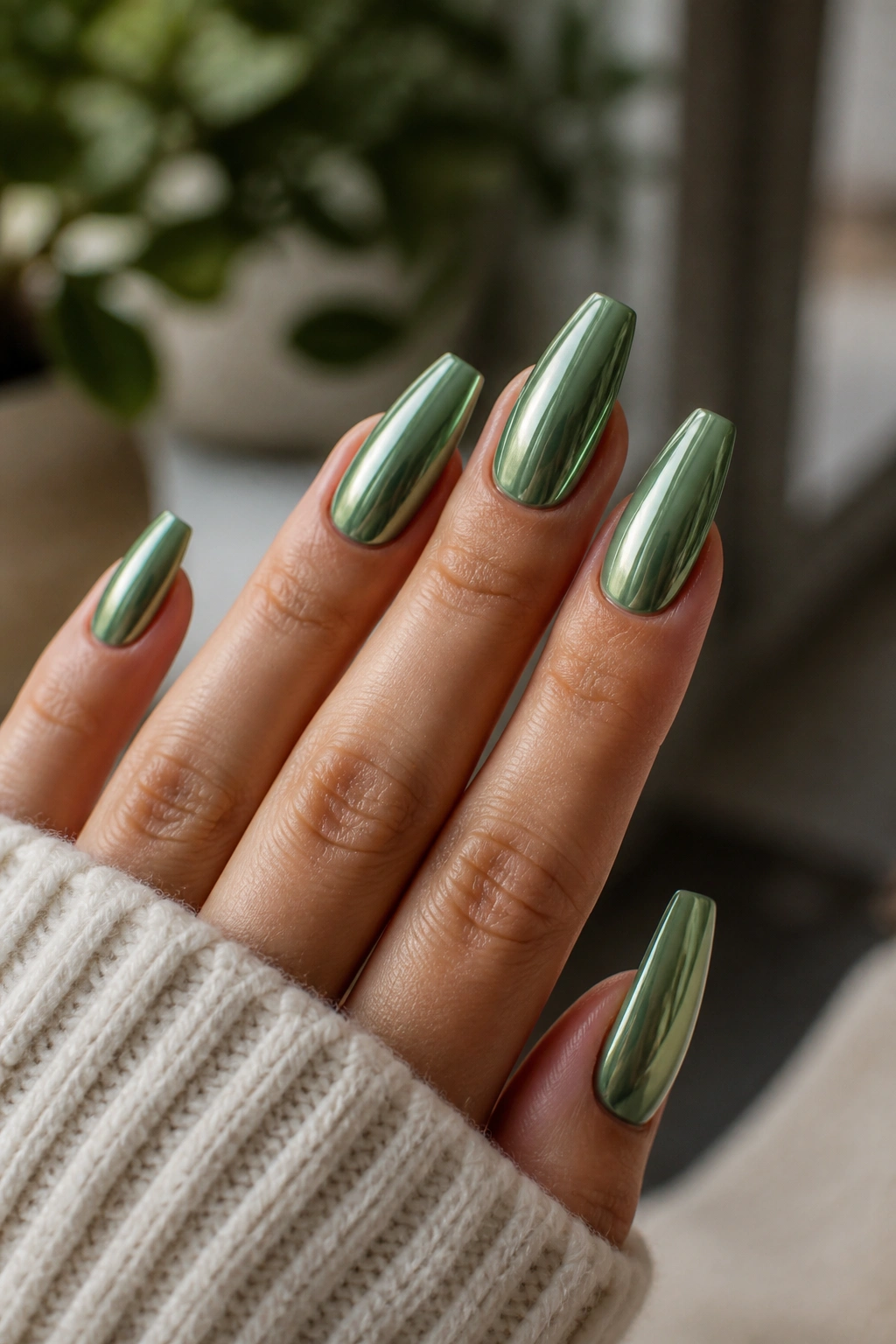
Chrome doesn’t have to mean silver robot nails. Over sage, it can look smooth, cool, and unexpectedly refined.
A sage chrome manicure usually starts with a green gel base, then gets rubbed with a pearl, silver-green, or soft aurora chrome powder. The result is not a blunt metallic. It’s more of a polished glow that shifts as you move your hands. On coffin nails, that reflective surface makes the flat tip and side taper look extra sharp.
The reason I like this look on muted green is that it keeps the color from feeling sleepy. Some sage shades can lean dusty in a way that borders on dull. Chrome adds life back in, especially in low light, where cream finishes can disappear.
There’s a line, though. If the chrome is too icy or too blue, the manicure stops feeling sage and starts drifting into seafoam silver. If that’s what you want, fine. If not, ask to test the powder over one sample nail first. Base color changes everything with chrome.
This style needs neat prep and a smooth base coat. Any ridge, dent, or flooding near the cuticle will show more under a reflective surface. When it’s done well, though, it looks sleek in that cool, expensive way that doesn’t need extra art piled on top.
10. Tiny White Daisy Accents on Sage Green Nails
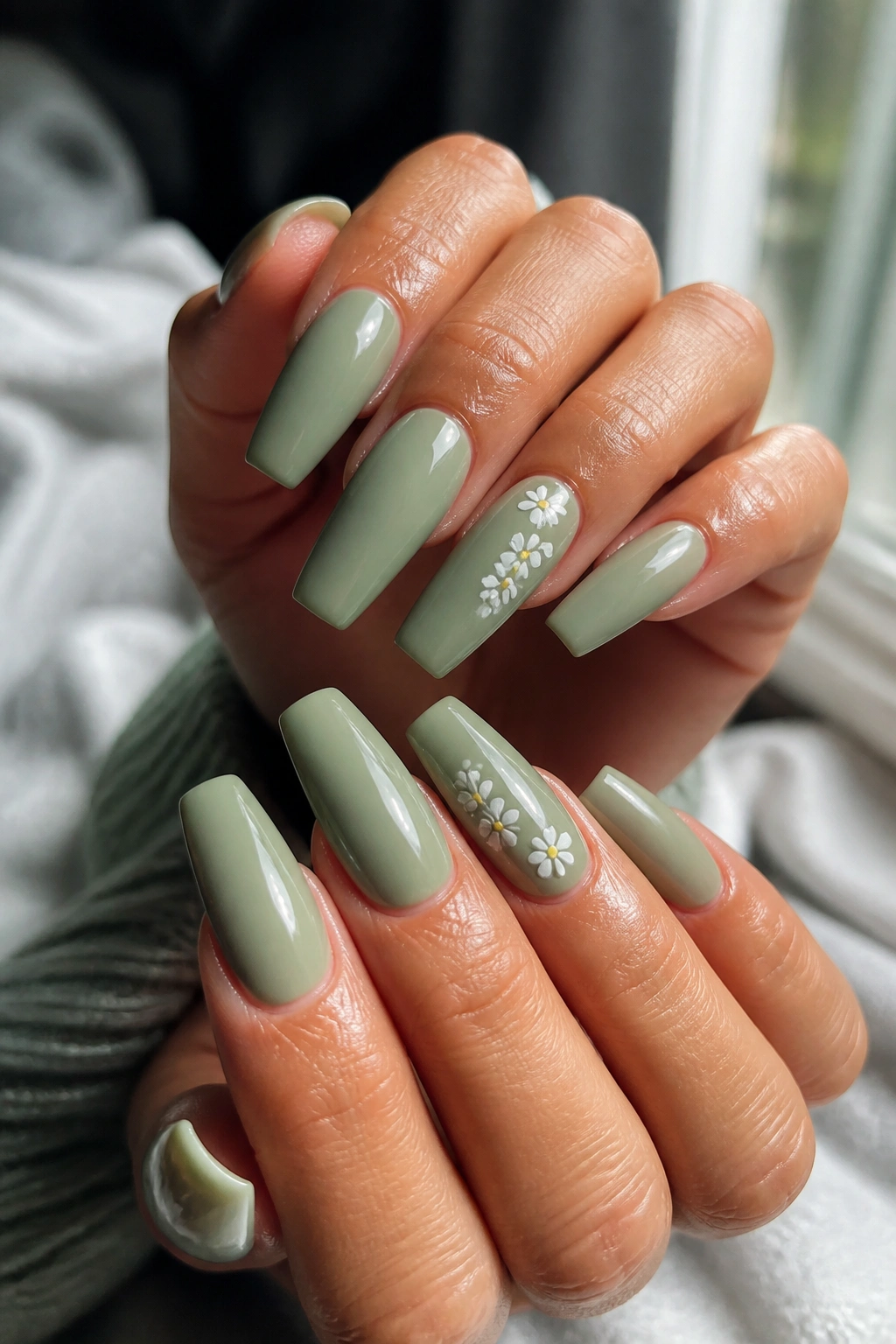
This one could have gone twee. On a coffin shape, if you keep the flowers small, it doesn’t.
A sage base with tiny white daisy accents works because the floral detail adds softness while the coffin shape keeps the set from getting sugary. I’d skip a daisy on every finger unless you love a playful set. One or two accent nails per hand is usually enough.
Where the flowers should go
- Near one corner of the nail, not dead center
- Clustered at the cuticle on one accent finger
- Scattered as two or three mini daisies, each with a muted yellow or nude center
- Paired with plain sage nails so the set has some visual rest
Bigger flowers can look costume-like. Keep them tiny—think 3 to 5 millimeters across—and let the negative space do part of the work. A milky sage base makes the whole thing softer. A deeper olive-sage gives the white petals more contrast.
This is one of those sets that looks great in spring-like outfits, sure, but it isn’t limited to that mood. It also pairs well with worn denim, plain tees, and lived-in gold jewelry. It has enough sweetness to feel fresh and enough structure to keep it from reading childish.
11. Checkerboard Accent Nails in Sage and Ivory
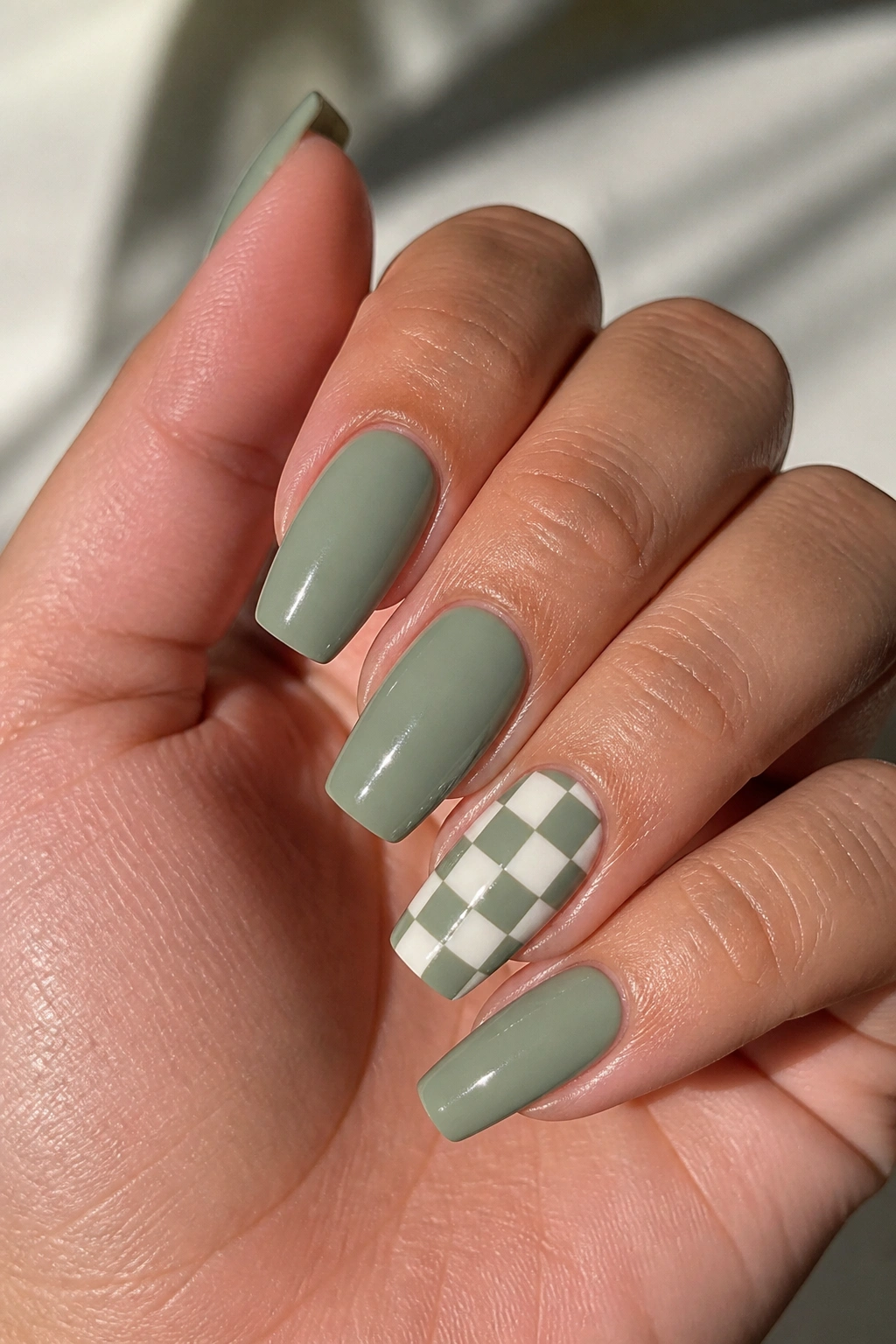
Would I do a checkerboard on all ten coffin nails? No. That’s too much visual noise for most people and, honestly, it can cheapen the set if the lines aren’t razor sharp.
Used as an accent, though, sage and ivory checkerboard looks playful in a smart way. One checker nail on each hand—usually ring finger or middle finger—next to solid sage nails gives you contrast and pattern without turning the manicure into a costume prop.
Why this version works
The muted palette is doing a lot of the heavy lifting. Black-and-white checkerboard is punchy and loud. Sage and ivory soften it. The coffin shape adds edge, so the pattern doesn’t need to.
Best execution notes
Ask for larger squares rather than tiny ones. On a medium coffin nail, two to three columns across the width usually look cleaner than trying to cram in miniature checks. Tiny squares can blur at the edges once the topcoat goes on.
A glossy finish keeps the pattern crisp. Matte can work, but only if the lines are immaculate. If they wobble even a little, gloss hides more. And I would keep the base nails solid—no glitter, no extra line art, no rhinestones competing for attention.
This set has a fun streak, no question. It also still feels wearable because the color palette stays muted and grounded.
12. Negative-Space Half Moons With Sage Arcs
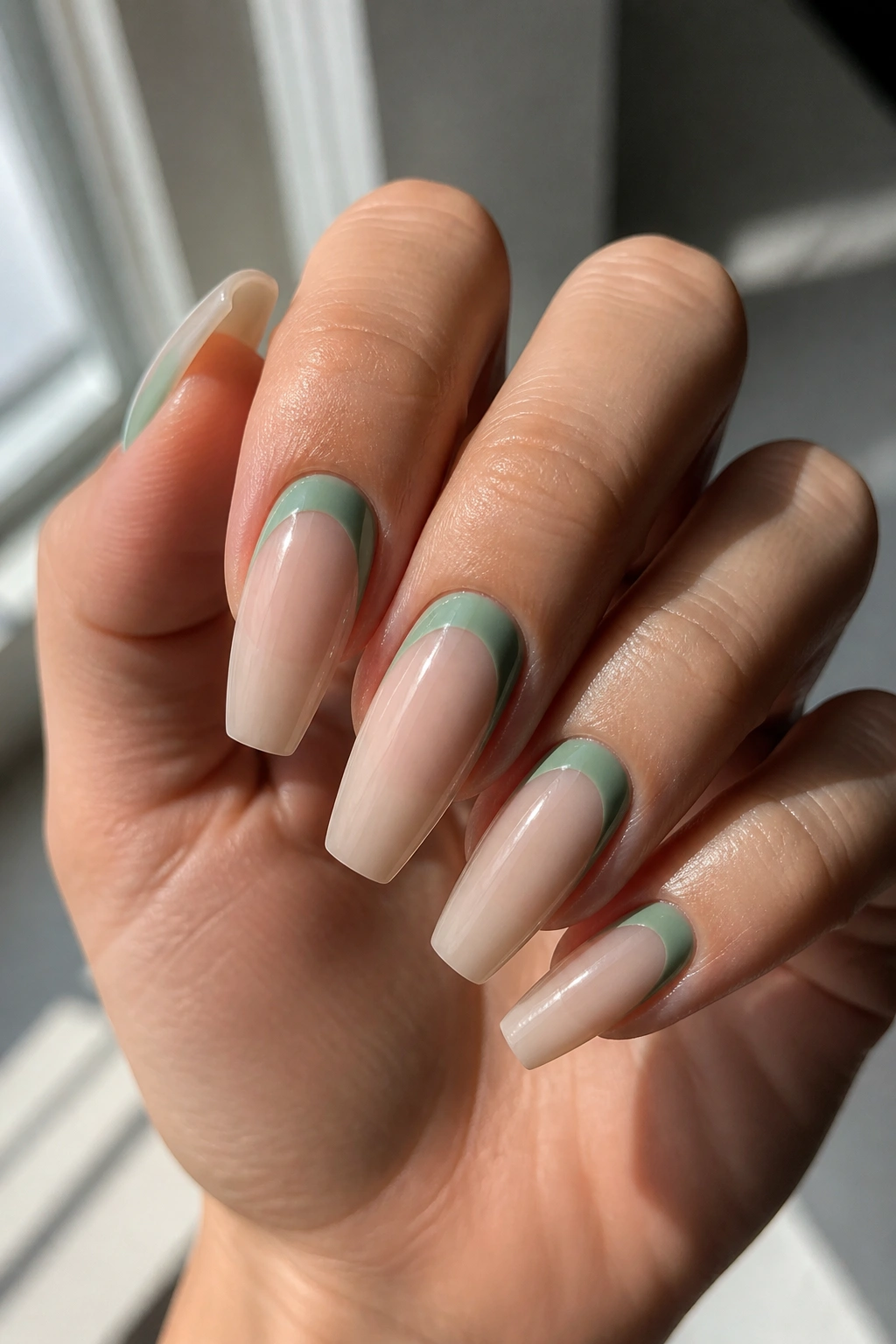
There’s something satisfying about a manicure that uses restraint instead of trying to fill every inch of nail. Negative-space half moons do that well.
The design is simple: leave the cuticle area bare or sheer nude, then paint a curved sage arc above it. On coffin nails, the contrast between the rounded half moon and the straight tip creates tension in a good way. The shape looks modern, a little graphic, and much lighter than a full-coverage set.
This style also solves a practical problem. Regrowth is less noticeable because the cuticle area is already part of the design. If you tend to stretch salon visits, this buys you time without your nails looking neglected by day twelve.
You can go thin and minimal or make the sage band thicker for more impact. I prefer a narrow crescent on medium-length nails and a deeper arc on longer extensions. A milky nude base underneath helps the bare space look polished rather than unfinished.
One warning: placement matters. If the half moon sits too high, the nail can look stubby. If it’s too low and wide, it crowds the cuticle. A balanced arc should echo the natural cuticle curve while leaving enough nude space to keep the design airy.
13. Sage Green and Tortoiseshell Mix-and-Match Coffin Nails
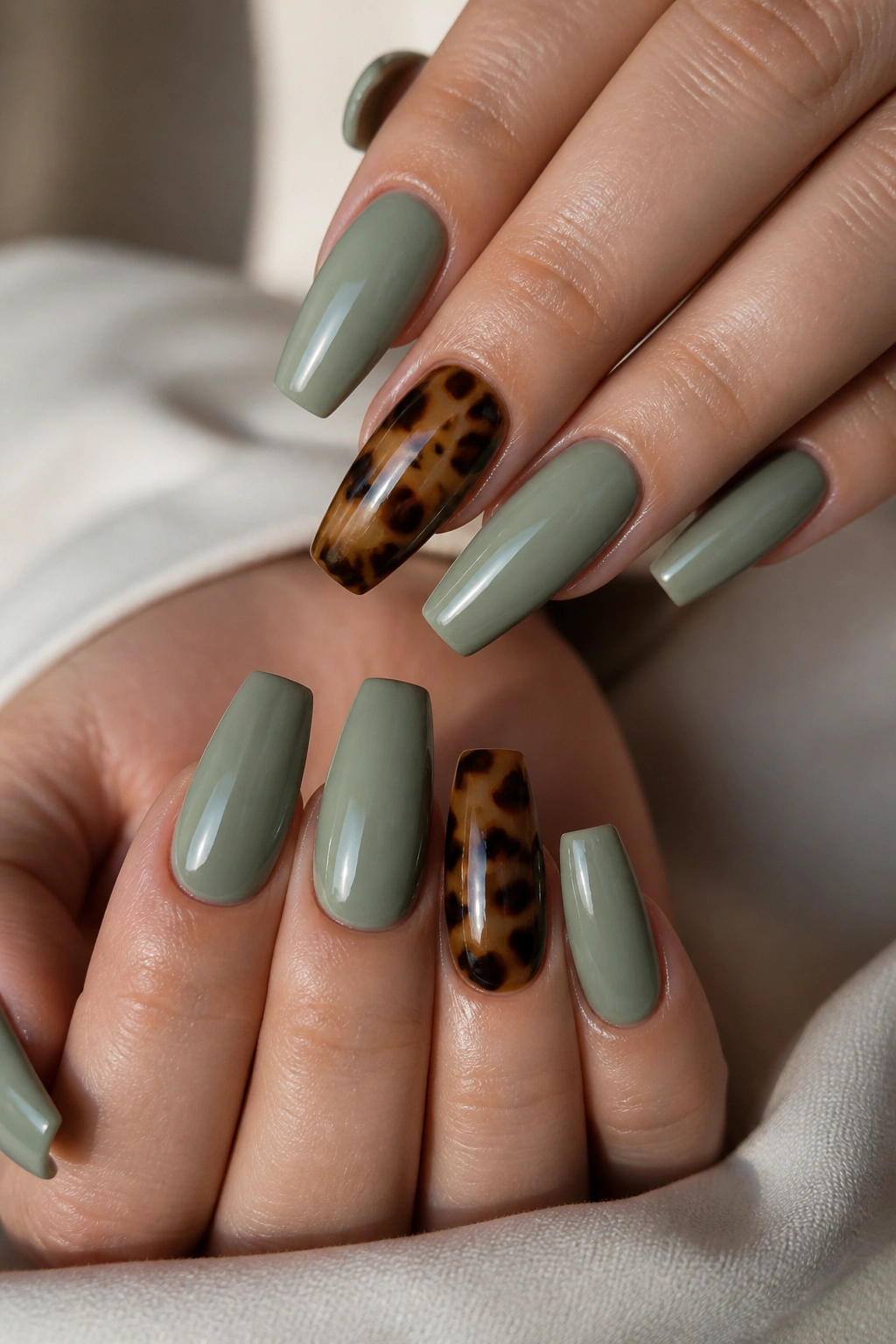
This set has more attitude than the softer ideas on this list, and that is exactly why I like it.
A mix-and-match manicure with solid sage nails, one tortoiseshell accent, and maybe one nude or foil detail can look rich and editorial without crossing into chaos. Tortoiseshell brings amber, brown, and black warmth. Sage cools it down. Together, they create contrast that feels styled rather than random.
The key is ratio. You do not want five tortoiseshell nails next to five green ones. That is too much pattern fighting with color. Use one or two tortoiseshell nails per hand, max. Let the rest of the set stay in soft sage, nude, or a sheer jelly tone that ties the palette together.
This pairing works best with a warmer sage—something olive-leaning rather than icy gray-green. That warmer base speaks to the honey and caramel tones inside the tortoiseshell pattern. Gold jewelry finishes the look nicely, especially if you add a tiny gold stripe or foil fragment on one accent nail.
It’s not the most low-key manicure here. But if plain sage feels too safe and floral art feels too sweet, this one hits a stronger note without losing polish.
14. Celadon-and-Sage Aura Nails
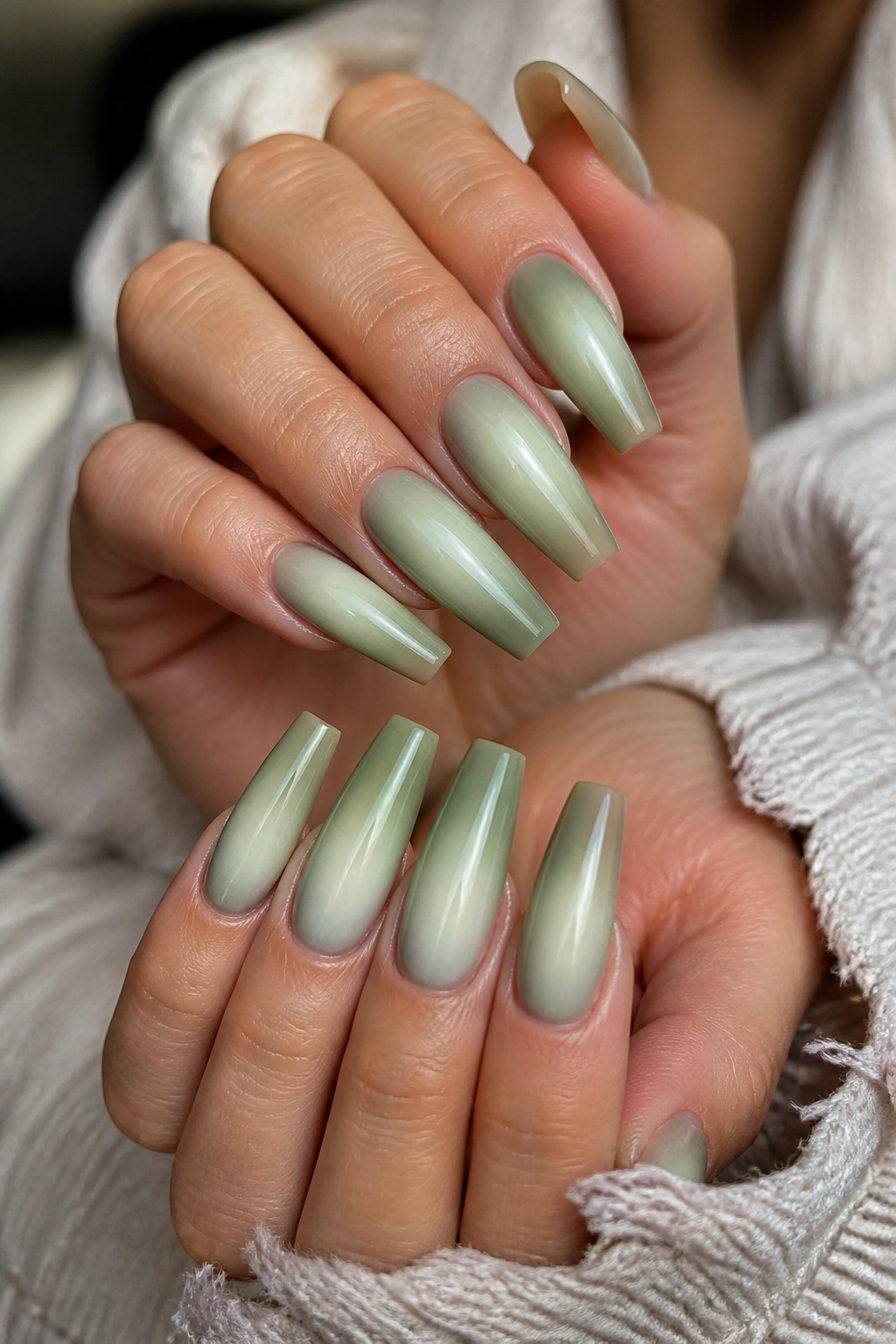
Aura nails can look cheap fast when the colors are harsh or the blend is too obvious. In a celadon-and-sage palette, they become softer, almost hazy.
A good aura nail starts with a base shade—usually pale sage or milky green—then a diffused bloom of deeper sage or celadon placed at the center. The edges should fade outward with no visible ring. On coffin nails, that airbrushed center creates a floating effect that makes the nail plate look larger and more dimensional.
What makes this feel modern
The color choice. Hot pink, neon orange, and high-contrast aura nails have their place, but muted green gives the style a calmer, more wearable edge. It feels less like festival nails and more like a thoughtful design choice.
Best ways to wear it
- Use aura on all ten nails if the blend is soft and the palette stays muted.
- Add a tiny chrome dot or micro star on one accent nail if you want more detail.
- Keep the center glow slightly off-center for a more hand-painted feel.
- Choose gloss, not matte, if you want the blurred center to look deeper.
This is one of the more artistic takes on sage green coffin nails, yet it still sits comfortably in a neutral-heavy wardrobe. It has mood. It has softness. It doesn’t need extra clutter layered on top.
15. Deep Sage Nails With Fine Black Line Details
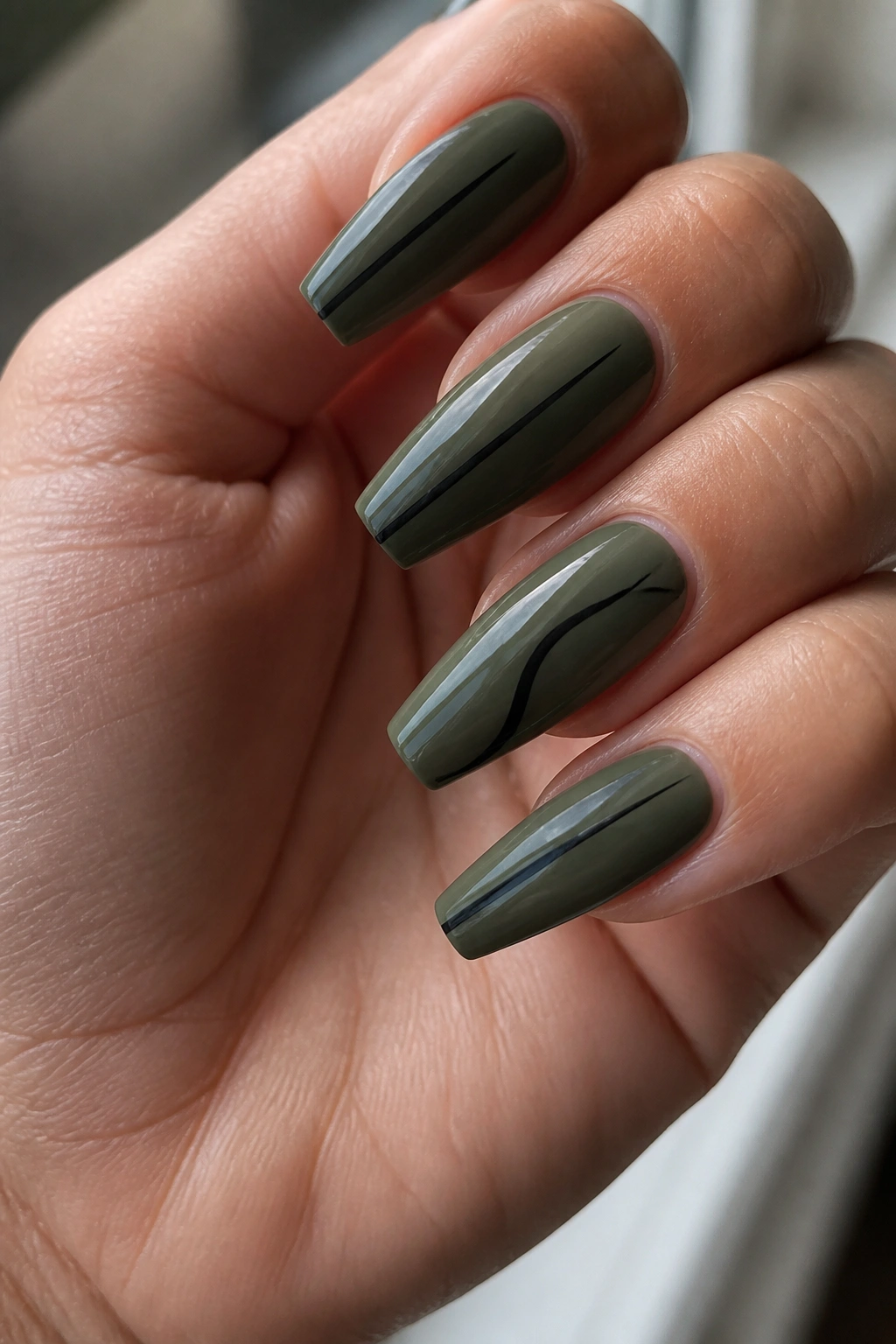
If you like your manicure a little sharper, this is the one. Take a deep sage or eucalyptus base and add thin black line details—micro swirls, a diagonal stripe, abstract curved lines, or a tiny corner frame on one or two accent nails.
The black changes the personality of sage immediately. It pulls the green away from spa-like softness and gives it more edge. On coffin nails, those line details look crisp because the shape already favors clean geometry. It’s graphic without needing heavy contrast on every nail.
I would keep the line work minimal. One curved line through the center of an accent nail. A black outline tracing one side. A thin double diagonal across the ring finger. Done. If the tech starts adding dots, stars, shimmer, and linework all at once, stop the set there. The power of this design is in the restraint.
Glossy topcoat works best because it sharpens the black and deepens the green. Matte can mute the contrast too much unless your base color is dark enough. Silver jewelry is a natural fit here, though black accessories and tailored clothing also play well with it.
This one feels cooler, cleaner, and a touch more urban than the floral or marble options. Same sage family. Very different energy.
What to Ask for at the Nail Salon
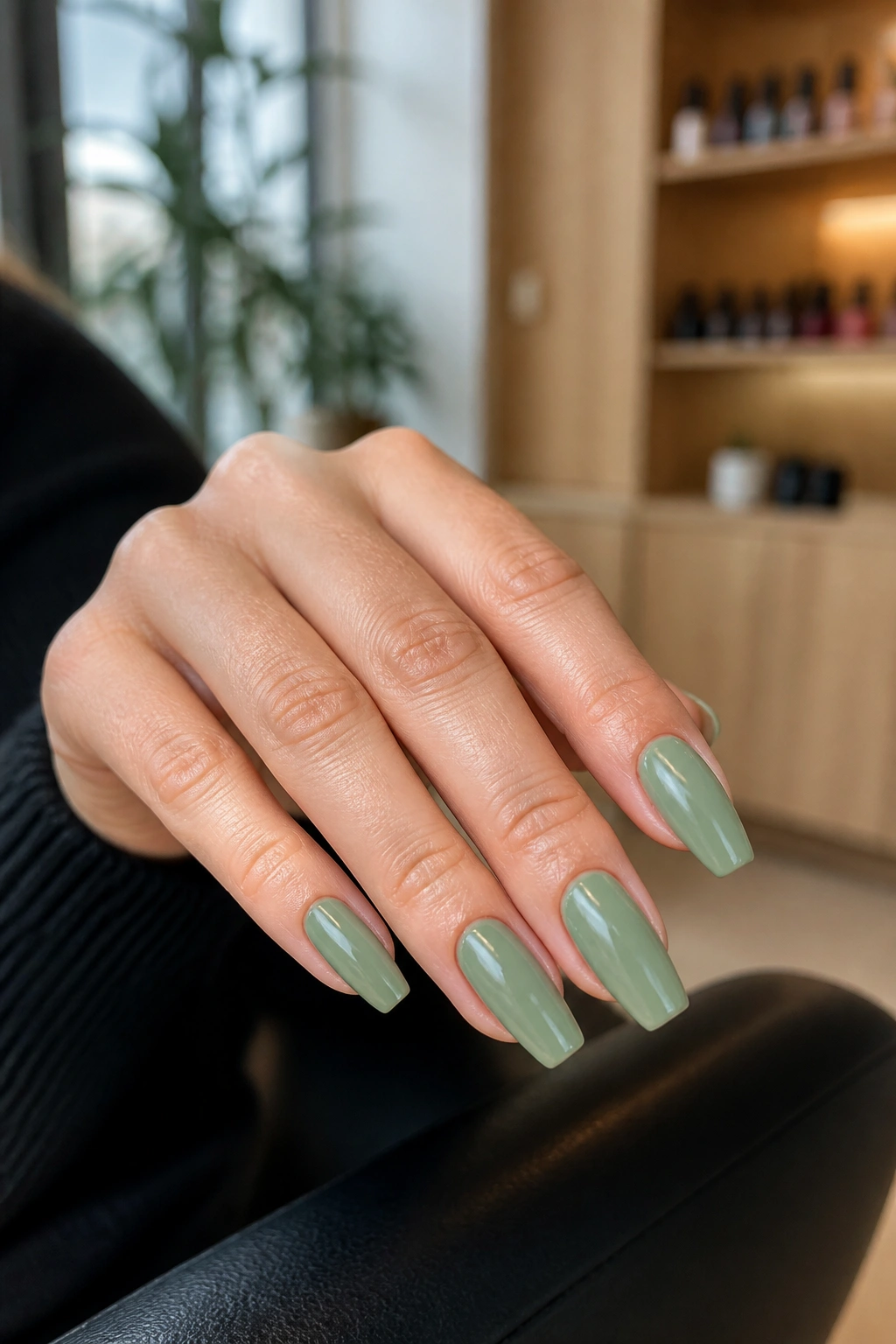
A good reference photo helps, but clear language helps more. Nail techs can recreate a design far more accurately when you describe the shape, finish, and color family instead of pointing to one tiny image and hoping for telepathy.
Use details like these:
- “I want a medium coffin shape, not ballerina-short and not extra long.”
- “Keep the sidewalls straight before tapering the tip.”
- “I want a dusty sage, more gray-green than mint.”
- “Make the apex smooth and balanced, not bulky.”
- “Use a glossy topcoat” or “I want a soft matte finish.”
- “Keep the art minimal—two accent nails per hand.”
If you’re getting acrylic or hard gel, ask about structure. Coffin nails need support through the stress area because the free edge is flatter and more exposed than on almond nails. If you’re using your hands hard all day—opening boxes, typing nonstop, lifting weights, chasing kids—say that. It affects the thickness your tech should build.
And bring a backup shade reference. Muted greens vary wildly from bottle to bottle. One salon’s “sage” can be another salon’s pastel mint or muddy olive.
How to Make Sage Green Coffin Nails Last Longer
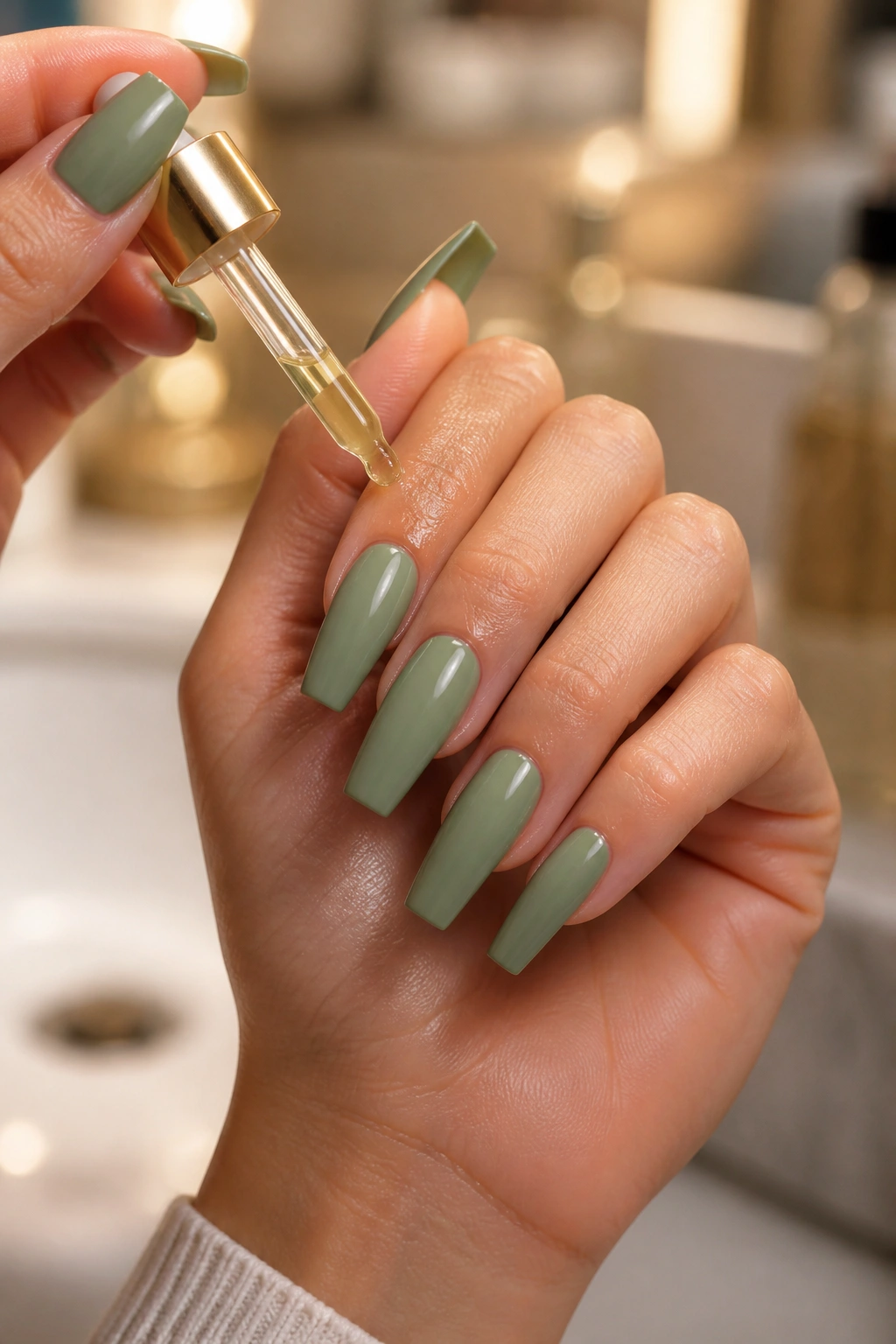
Chip resistance starts before color ever touches the nail. Dry cuticle work, a clean nail plate, and proper dehydration matter more than people want to admit. If your manicure lifts at the cuticle after six days, the issue is often prep, not polish color.
Daily habits matter too.
The habits that help most
- Wear gloves for dishwashing and long cleaning sessions.
- Use cuticle oil once or twice a day, especially if you have acrylic or hard gel.
- Do not use your nails as tools for cans, stickers, or packages.
- File tiny snags quickly with a fine-grit file instead of picking at them.
- Apply hand cream, then oil, before bed if your skin gets dry.
Matte topcoats may show wear faster than gloss. Chrome can scratch if the topcoat is thin. French designs hide tip wear a little better than dark solid shades. Every finish has trade-offs.
If one nail lifts, get it fixed early. Water slipping underneath a lifted enhancement can turn a small repair into a full redo, and nobody enjoys paying twice for the same manicure.
Best Outfits, Makeup, and Jewelry Pairings for Sage Green Nails

Sage green nails are flexible, but not in a boring, match-with-anything way. They work because they sit comfortably next to shades that already live in most wardrobes: cream, black, camel, charcoal, denim blue, soft white, chocolate brown, and faded olive.
Gold jewelry warms up sage, especially milky or olive-leaning tones. Silver makes cooler gray-sage look sharper. Pearl accents can look nice too—especially with French tips or soft aura nails—though I’d skip pearl charms on the nails themselves unless you’re ready for more maintenance.
Clothing textures matter more than people think. Sage looks especially good next to:
- ribbed knits
- brushed wool
- linen
- suede
- soft denim
- crisp cotton shirting
Makeup-wise, keep the tones grounded. Taupe eyes, brown liner, soft peach blush, muted rose lips, bronzy lids. Bright orange-red lipstick can clash with cooler sages, though a deeper brick or brown-red can look gorgeous next to warm olive versions.
And yes, sage works in colder months too. Against black coats and gray scarves, it reads moodier and more sophisticated than it does with summer whites and sandals. Same color. Different attitude.
Final Thoughts
The best sage green coffin nails are the ones that respect both parts of the idea: the softness of the color and the clean structure of the shape. When one overpowers the other, the set loses balance. Get the shade right, keep the coffin shape crisp, and even a simple design can look polished for two full weeks.
If you want the safest bet, go with glossy full coverage, a milky sage, or a nude base with sage French tips. If you want more personality, marble, chrome, tortoiseshell accents, and fine black line work all give the same color family a different mood without abandoning it.
Muted green has more range than it gets credit for. That’s the fun of it. One bottle can look soft, sharp, earthy, cool, minimal, or artful depending on what you do with the shape around it.